A radar operator's official report changed her UFO sighting to a malfunction, signed by her own system.
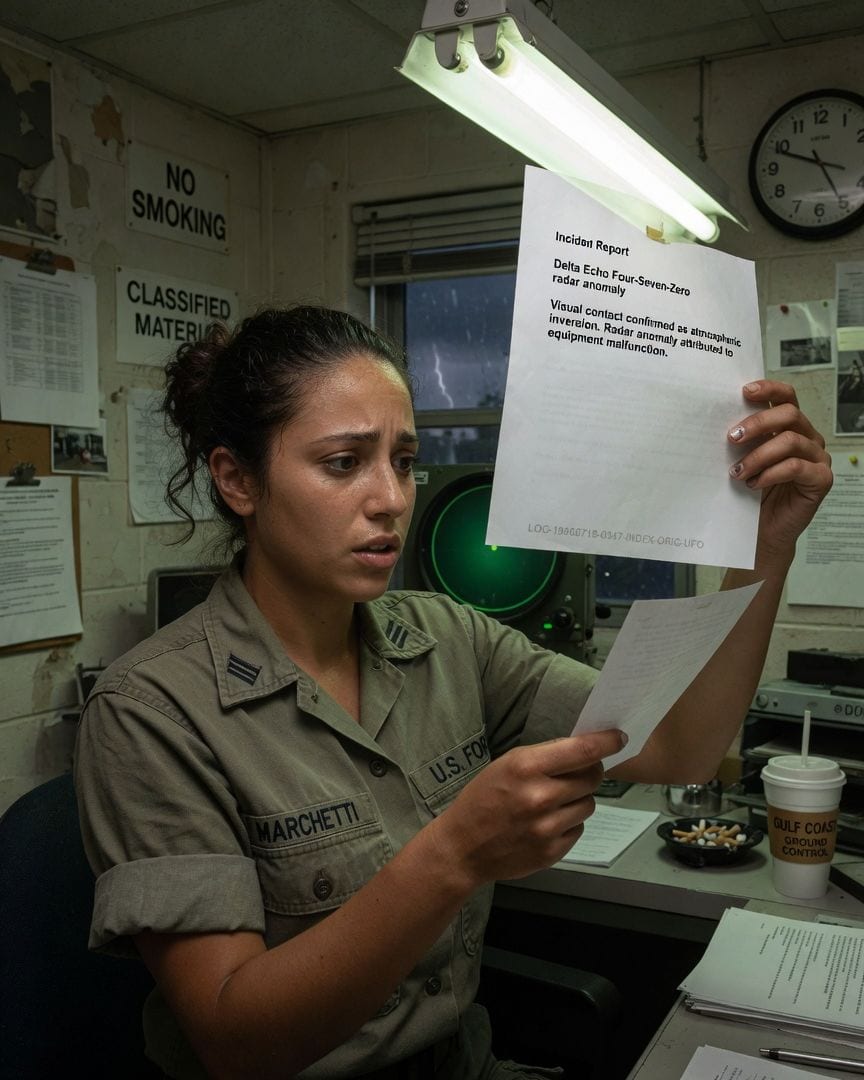
Technical Sergeant Odile Marchetti, 22, felt the hum of the radar console deep in her bones, the only sound in the dimly lit Gulf Coast ground control site.
It was 1996, past midnight, and the air was thick with the promise of a humid summer storm. Her shift was quiet, routine, until Captain Everett Hayes, 45, came up on frequency, his voice polite, almost apologetic.
"Ground, this is Delta Echo Four-Seven-Zero, flight level three-five-zero. Just checking, but are you showing anything flying formation with us?"
Odile’s stomach tightened. Her scope showed only Delta Echo Four-Seven-Zero, a solitary blip cutting across the dark expanse of the screen. The blip was a clear, solid green.
A moment later, as she watched, a second return bloomed beside it, twice the airliner’s size, solid and utterly impossible. It pulsed with the same green light, holding steady beside Delta Echo Four-Seven-Zero.
Her training kicked in, the 'primary target of unknown origin' checklist, a protocol she’d never expected to use. She typed 'UFO' into the log, the letters glowing green on the screen, feeling the cold dread settle in her chest.
Captain Hayes' voice crackled again, now laced with a tremor. "Ground, it just pulled ahead. Stopped. We’re… we’re flying through where it was."
Odile watched, mesmerized, as the two distinct blips on her scope converged, then merged, becoming one single return.
The new, unified blip was the exact size of Delta Echo Four-Seven-Zero, pulsing steadily, as if the second, larger return had never existed. It stayed one.
She logged the time, the coordinates, the captain’s report, her hands steady despite the cold sweat prickling her scalp.
The next morning, she printed the official incident report, a standard procedure for any anomalous event. Her original log entry, where she had plainly written 'UFO' and detailed the impossible merge, was there.
But beneath it, a typed addendum stated, 'Visual contact confirmed as atmospheric inversion. Radar anomaly attributed to equipment malfunction.' Odile frowned. She hadn't written that.
She cross-referenced her handwritten notes, her personal log, where she had meticulously recorded every detail, every timestamp. The official report was a clean, crisp forgery, a mundane explanation stamped over the uncanny truth.
It was almost perfectly done, a flawless erasure of the impossible, but she knew what she had seen.
She held the printout up to the fluorescent lights of her cramped office, scrutinizing it, looking for any trace of her original entry, any hint of the override. Nothing obvious. Just a blank, official lie.
Odile traced the smooth surface of the paper again, her eyes catching a subtle shift in the paper's texture, a ghost of an impression.
She angled it, holding it just so under the harsh overhead light, and then she saw it: a faint, almost invisible watermark.
It wasn't a physical impression but a digital signature, a layered imprint, barely perceptible, like a shadow beneath the text. It was a sequence of numbers, small and precise, embedded in the very fabric of the printed report.
A string of characters she recognized from her own system's internal file indexing.
This wasn't just a physical overwrite; it was a digital one, a quiet, methodical falsification that pointed directly back to her own original, unedited radar log, now officially buried.
The faint digital watermark became Odile's obsession. She spent her off-duty hours at the base's records office, a dusty, understaffed department, using the impending closure of the Gulf Coast site as an excuse for 'inventory review.'
The base was a skeleton crew now, morale low, oversight lax. She cross-referenced the watermark's numeric sequence with internal database codes, a tedious, methodical hunt through archived files.
Her colleague, Rachel Porter, 23, a cheerful, pragmatic tech sergeant, often found Odile hunched over microfiche readers, 'organizing.'
Odile explained it away as a personal project, a way to 'learn the system,' and Rachel, always focused on her next rotation, simply shrugged and went back to her own work.
The trail led Odile to an obscure classification code: EHA-7. 'Event Horizon Anomalies, Category 7.' She’d never seen it in her training, not in any manual or drill.
The files associated with it were deeply restricted, requiring a clearance level far beyond her own. But the relaxed atmosphere of the closing base had its advantages.
She found a backdoor, an overlooked terminal still linked to a higher-clearance network, left open by a departing officer who simply hadn't bothered to log out properly.
It was a gamble, a career-ending move if caught, but the need to understand burned too fiercely to be ignored. She copied the EHA-7 index, a list of incident reports, onto a floppy disk, her heart hammering in her chest.
The list was long, spanning decades, with cryptic titles and dates. Each one, she noted with a growing chill, was categorized as 'atmospheric anomaly' or 'equipment malfunction,' echoing her own experience with unsettling precision.
As Odile delved deeper, she started to notice things.
The lights in the records office would flicker when she was alone, casting long, dancing shadows that seemed to pulse with her own unease, the air growing strangely cold around her desk.
Her login attempts on the restricted terminal, though successful, were sometimes met with a lag, a brief, almost imperceptible pause, as if the system was 'thinking' or perhaps waiting for something.
One evening, leaving the office late, she saw a dark sedan parked discreetly at the edge of the lot, its engine off, windows tinted.
As she drove past, the interior light flickered on for a split second, revealing the silhouette of a man. He wasn't looking at her, but at the records office, his head tilted slightly, an unnerving stillness to his posture.
The next day, a memo appeared on her desk, a general reminder about 'unauthorized access to classified systems,' with a specific, underlined emphasis on 'EHA classifications.'
It was addressed to all personnel, but the timing felt too precise, too pointed to be coincidental.
A few days later, her supervisor, an easygoing major who usually just gave her a nod and a grunt, called her into his office.
He mentioned a 'random audit' of her system activity, a formality, he assured her, but his eyes held a flicker of something unreadable, something beyond mere professional concern.
"Just be careful, Marchetti," he said, his voice low, almost a whisper in the quiet office. "Some things are better left buried." The words were a warning, clear and chilling, cutting through the humid air of the room.
Someone knew she was digging, and they were watching.
The warning only fueled Odile's resolve. She remembered an old Air Force records clerk, Benjamin Sutton, 67, who'd retired years ago, a man known for his encyclopedic memory and his quiet resentment of 'modern efficiency' and digitized archives.
She found his address in an old phone book and drove to his small, cluttered house in a sleepy coastal town, miles from the base.
He listened to her story over lukewarm coffee, his eyes sharp and knowing, a faint smile playing on his lips. "EHA-7, you say?" he mused, a slow, almost conspiratorial smile spreading across his face. "They still using that old ghost?
Thought they'd have updated the code by now."
He produced a worn, leather-bound notebook, its pages filled with meticulous, handwritten notes in a spidery script. "They tried to erase me too, you know. Back in '78.
Saw a transport plane shimmer out of existence over the Pacific, then phase back in, two minutes later, empty." He pointed to an entry in his notebook, the faded ink detailing a similar event to her own. "The official report?
'Severe turbulence, cargo lost.' My log, though… I wrote 'Event Horizon Anomaly.' " He explained that EHA wasn't about hostile craft, but something else entirely. "It's not a ship, Odile. It's… a seam. A momentary tear in things.
And when something touches it, it gets… un-made. For a moment. Sometimes it comes back, sometimes it doesn't."
He confirmed the digital signature she'd found, describing it as a unique identifier for the 'un-happening' protocol, the marker they used when reality folded. "They don't want people to know reality isn't as solid as they think.
So they file it away. And they file away anyone who sees it, one way or another." The pieces clicked into place.
The captain's plane flying 'through where it had been' – not a solid craft, but an absence, a temporary void. The two returns becoming one – the plane re-coalescing from whatever non-space it had briefly inhabited.
The 'atmospheric anomaly' – a convenient, dismissive lie to cover up the impossible. Her incident was not a malfunction, but a documented, recurring event. A truth that had been systematically buried for decades.
Benjamin Sutton, with a quiet solemnity that made the old house feel colder, led Odile to a hidden compartment beneath his floorboards. He pulled out a dusty cardboard box.
Inside were dozens of floppy disks, neatly labeled with dates and classification codes. "My own little archive," he whispered, his voice thin but firm. "The ones they 'lost.' The ones they didn't know I kept copies of."
He explained that the 'Event Horizon Anomalies' were not isolated incidents, but followed a distinct, cyclical pattern, tied to specific geographical locations and atmospheric conditions. He showed her a hand-drawn map, yellowed with age, covered in red circles and annotations.
"Your Gulf Coast incident, 1996. There was one over the Great Lakes, 1982. A cargo ship in the Bermuda Triangle, 1970. An experimental jet in the Nevada desert, 1954."
Each circle on the map corresponded to an EHA-7 file, each with the same digital signature of alteration Benjamin had described.
The sheer scale of it, the cold, patient coordination across decades and branches of service, made her stomach churn, a knot of ice forming in her gut.
It wasn't just a cover-up of one event, but a systemic erasure of a fundamental, terrifying truth about reality itself.
As Benjamin pointed to a cluster of red circles along the very stretch of Gulf Coast where Odile was currently stationed, a new, horrifying realization dawned.
The file wasn't just about what had happened; it was about what was still happening, and she was right in the middle of a known 'Event Horizon Anomaly' hot zone.
Benjamin Sutton’s words echoed in Odile’s mind: "The file is still being signed." He laid out his collection of 'un-happened' records, showing her how the EHA events clustered predictably, like malignant constellations on the map. "They track them, Odile.
Not to stop them, but to manage the fallout. To contain the witnesses, to erase the proof."
He revealed that the current ground control site, slated for closure, was being decommissioned not just for budgetary reasons, but because it sat directly atop one of these recurring 'seams.'
The base was being emptied, its personnel reassigned, a clean sweep to ensure no one was left to witness the next inevitable event. The closure wasn't a reprieve; it was part of the protocol.
He showed her a final, chilling set of files: 'Witness Relocation and Reassignment Protocols.' These detailed the fates of previous EHA witnesses – sudden transfers to remote postings, medical discharges for 'stress-related' conditions, even early retirements with generous, silent pensions.
It was all laid out, a clear, cold blueprint for how the institution dealt with those who saw too much.
Her own reassignment orders, which had just arrived on her desk that morning, suddenly felt less like a career move and more like the next page in a very old, very dark file.
Odile knew she had to act. She couldn't expose the entire system, not yet, but she could at least carry the proof of its existence.
Benjamin helped her compile a condensed, encrypted file containing the cross-referenced EHA-7 index, the digital signature analysis, and the pattern map. "This is your proof, Odile," he said, handing her a single, small data chip, warm from his hand.
"But no one will ever believe it." She planned to leak the file to an investigative journalist he knew of, an old contact Benjamin called 'The Watcher,' after her reassignment. But the surveillance intensified.
Her phone calls were crackling with static that wasn't there before. She found a small, almost invisible tracking device taped beneath her car's fender, slick and cold against her fingertips.
The day before her scheduled transfer, as she was packing her few belongings, two unmarked government vehicles, dark sedans identical to the one she'd seen in the parking lot, pulled up to Benjamin Sutton's house.
Odile, watching from a safe distance, parked just out of sight around a bend in the road, saw two men in dark suits escort Benjamin out.
He didn't resist, just gave a small, almost imperceptible nod in her direction, a flicker of his eyes that seemed to carry all the weight of their shared knowledge.
It was a silent, chilling message: they knew about him, and they knew about her. She knew she had to run, not just for her freedom, but to get the truth out.
She drove through the night, the data chip a burning weight in her pocket, the dread of Benjamin's quiet nod a constant companion.
She made it to a pre-arranged safe house Benjamin had mentioned, a forgotten cabin in the backwoods of Louisiana, but her career, her life in the Air Force, was over.
She was a ghost now, carrying a truth that would brand her a lunatic.
Odile never heard from Benjamin Sutton again. His house was sold quickly, his records office pension revoked for 'gross misconduct' less than a month after she fled.
Her own military records were scrubbed of any mention of the EHA incident, replaced with a generic 'administrative separation' entry that sealed her fate as an unperson.
She lived under a new name, moving from town to town, working odd jobs, always looking over her shoulder, a phantom in her own life.
The journalist Benjamin had mentioned, a veteran of several classified leaks, eventually received the encrypted chip she sent through a dead drop, but he dismissed it as an elaborate hoax, a paranoid delusion, just as Benjamin had predicted.
He promised to 'keep an eye out,' a polite dismissal. No story ever ran. The world moved on, oblivious.
Years later, Odile Marchetti found herself working the night shift at a small, regional airport in central Florida, watching a different kind of radar screen. The blips were smaller, slower, far less dramatic than the Gulf Coast.
She lived a quiet life, haunted by what she knew.
Sometimes, late at night, when the screen was quiet and the air still, she would see a faint, almost imperceptible shimmer in the upper right quadrant of her scope, a distortion that lasted only a fraction of a second.
It was the same transient wrongness. She never logged it. She never spoke of it. She just watched, knowing that the pattern was still there, still waiting, and that the file was still being signed.
The terror wasn't that she had seen it, but that it was still happening, and nobody cared.
If this one got to you
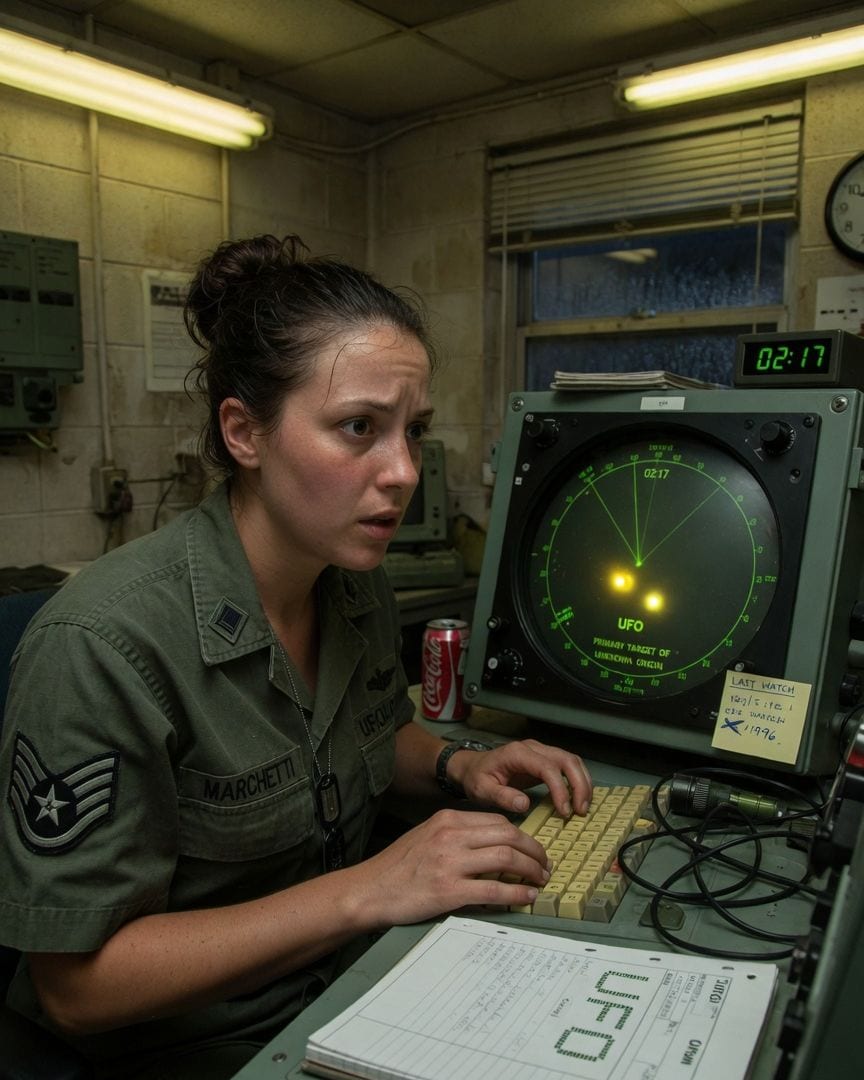
Technical Sergeant Marchetti's last watch saw an impossible radar blip merge with a plane. Later, its manifest showed a 'NO SHOW' passenger who *had* boarded, stamped 'FILE CLOSED'.
Technical Sergeant Odile Marchetti sat alone for her final watch at Gulf Coast ground control, anticipating a quiet transfer to a desk job. The dim console glow and rhythmic radar sweep were familiar, comforting sounds until 02:17, when an airliner captain reported impossible traffic flying in formation. Odile watched a second, larger blip appear on her screen, mirroring the plane's path with impossible precision. As the captain's voice, now tinged with a faint tremor, declared his plane was flying through where the object had been, the two radar returns merged into one, impossibly stable. Later, reviewing the official dismissal, Odile discovered an airline manifest listing a passenger as 'NO SHOW' who had, by handwritten note, definitely boarded—their name redacted, the file stamped 'CLOSED'.
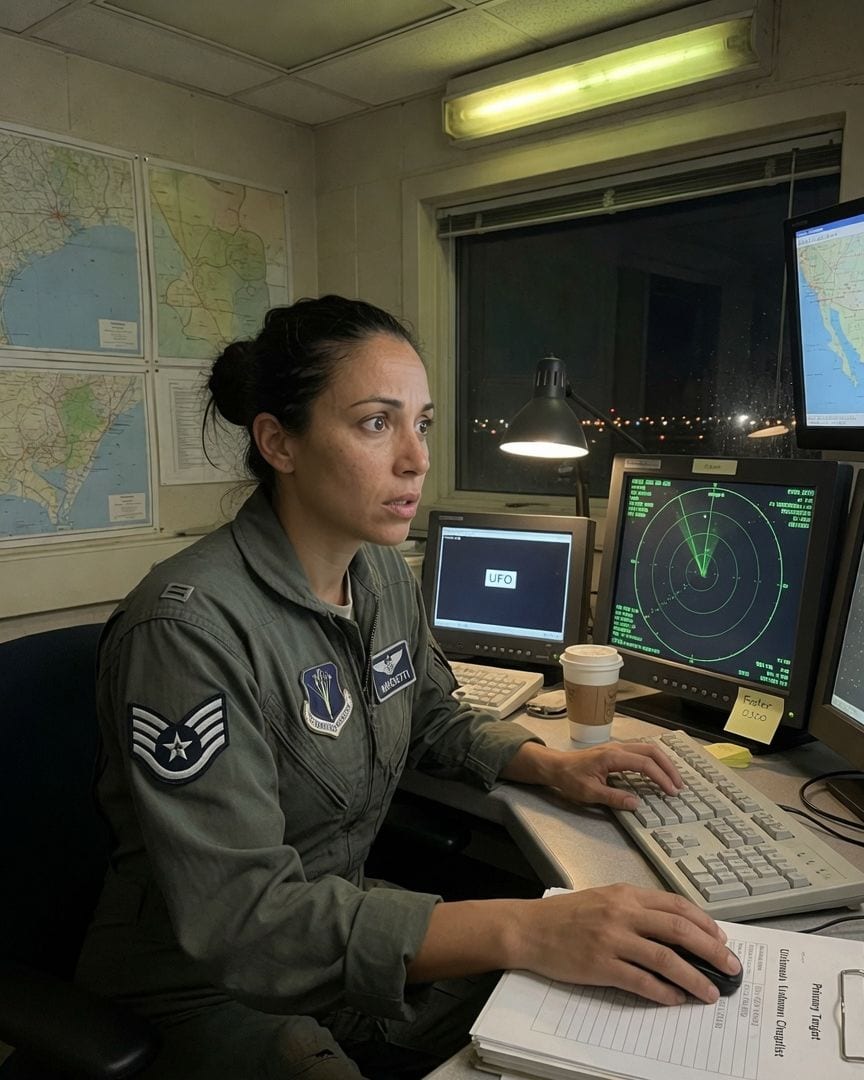
A radar operator watched a second blip, twice its size, merge into a plane on her screen. Her report was filed under a pre-existing, locked 'Special Handling' code.
Technical Sergeant Odile Marchetti sat alone in the dim radar room, her watch a final vigil for a base winding down along the silent Gulf Coast. At 02:17, a pilot reported a 'companion' on his wing, but her screen initially showed nothing. Then, a second blip bloomed, twice its size, before merging impossibly into the first and continuing its flight path without a ripple. She logged it as a UFO, only to discover the system already had a designated category for such anomalies – a pre-approved slot for the unexplained. A week later, her incident was re-categorized under a locked 'Special Handling' code, creating a new, inaccessible folder in her own personnel file.
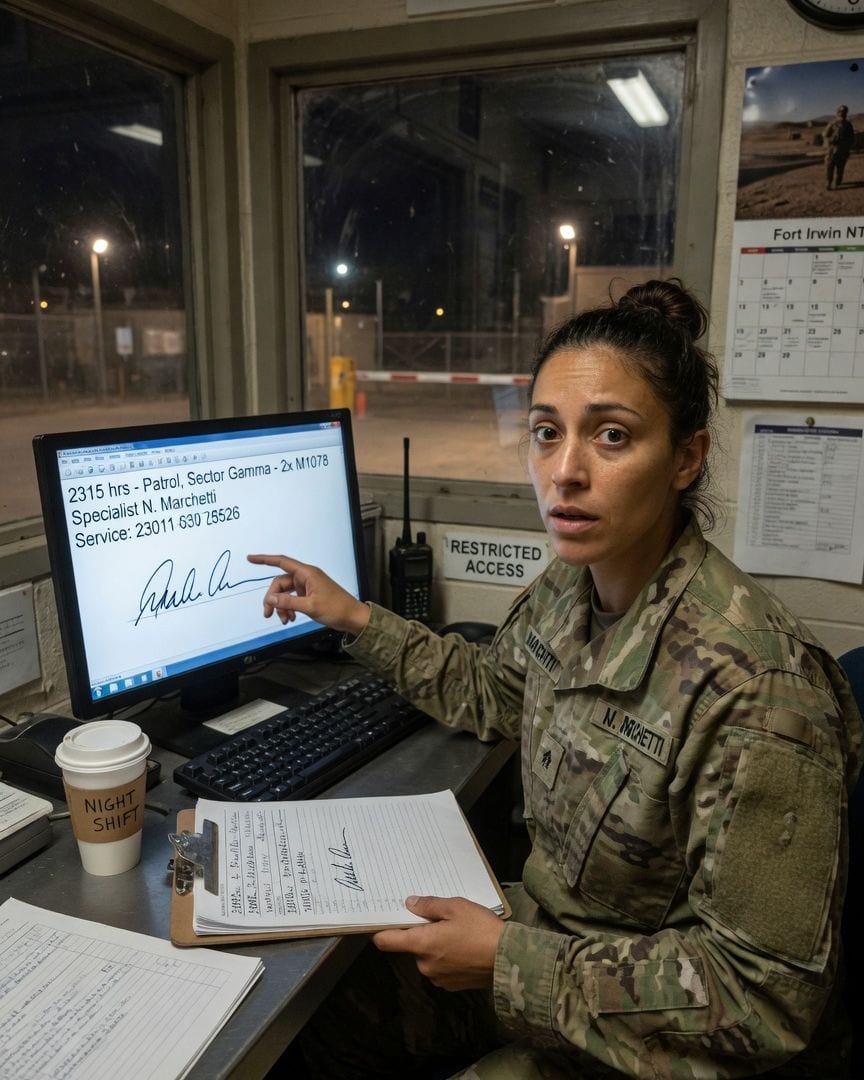
A Fort Irwin gate guard's own signature appeared on a patrol log for a mission she never sent.
Specialist Nadia Marchetti, a disciplined gate guard at Fort Irwin, logged a six-truck convoy departing into the high desert night. Five hours later, the same convoy returned, but with eight trucks, not six, baffling her meticulous records. Her superior dismissed it as fatigue, urging her to correct discrepancies before her promotion review. But when Nadia checked the digital manifest, she found an entry for a patrol she never sent, bearing her own undeniable, digitized signature. A cold dread settled as her reality was quietly violated by her own hand, swearing to a lie.
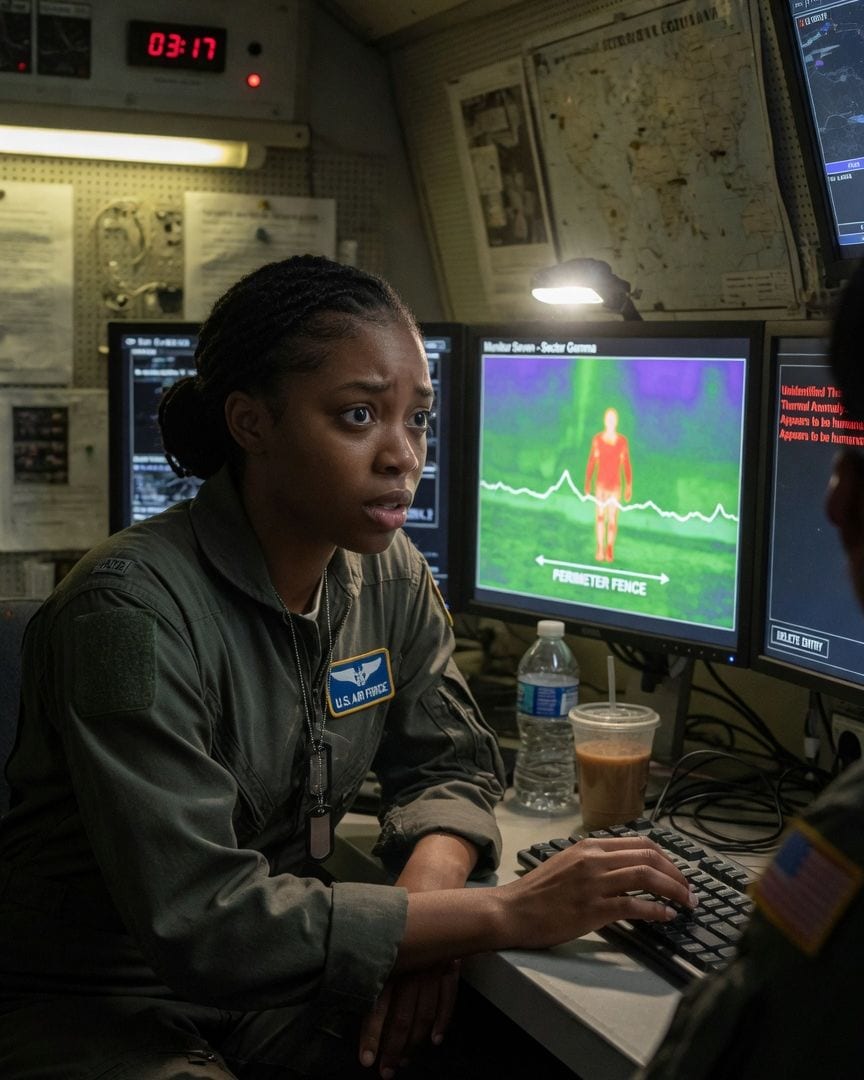
An airman’s thermal feed shows a figure moving in the restricted desert. Her captain orders it scrubbed, but the heat signature appears to tilt its head and look right at her.
Airman First Class Olivia Kade was new to her remote high-altitude outpost, fresh from advanced training, and the isolation pressed in, amplifying every hum. Her duty was to monitor the desert perimeter, but one shift, a faint thermal signature appeared on Monitor Seven: a solitary, upright figure moving with impossible precision beyond the barbed wire. No personnel were authorized in that sector. Her mission commander quickly ordered the anomaly scrubbed, but as it dissolved, the featureless outline seemed to tilt its head, looking directly into the camera. Now, the signature returns night after night, forcing the airman to wonder what impossible thing patrols the dark beyond the wire.
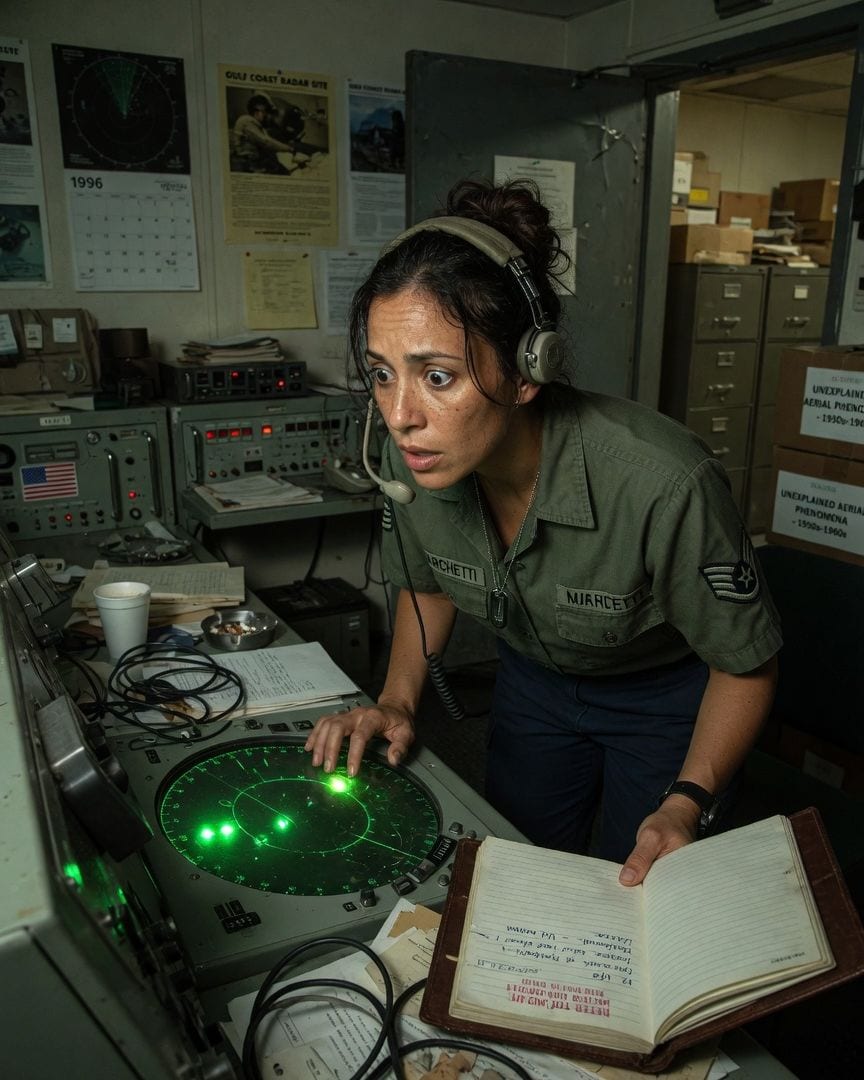
During her last weeks at the Cold War radar site, a technical sergeant logged a UFO. Her entry box was already stamped with a code from a missing 1958 jet.
Technical Sergeant Odile Marchetti was winding down her last few weeks as a radar operator at a remote Gulf Coast site in 1996. Alone in the cavernous room, she watched the green glow of her scope, the only light cutting through the pre-dawn gloom. At 2:30 AM, an airliner reported something flying in formation—a craft Odile couldn't see, until a massive, impossible blip bloomed beside it on her screen. After the pilot reported flying straight through empty air, Odile logged the UFO, only to find a faded, decades-old code already stamped on her logbook entry, identical to one on a missing jet report from 1958. Had this happened before, and was her own entry just a pre-written footnote in a much older, terrifying file?
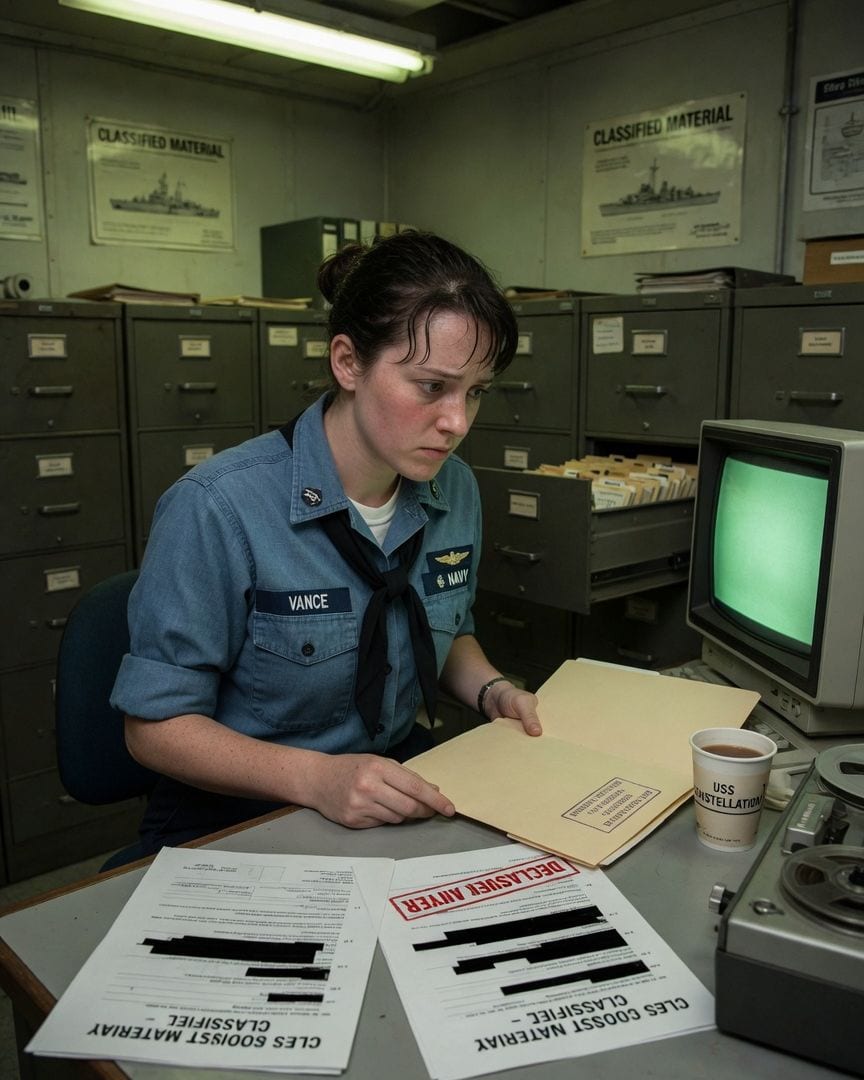
A radarman tracked an object from 60,000 feet to the deck in four seconds. The next night, her tape was gone, replaced by a lie.
Radarman Second Class Peggy Vance, 22, began her first night alone in the carrier's dim green radar room off San Diego, the ship gently rolling. She tracked an impossible contact: a shape without wings, falling from sixty thousand feet to the deck in under four seconds, baffling the pilot. The next night, her incident tape was gone, the slot relabeled, and the official log dismissed the event as a "weather balloon" that couldn't be found. Peggy soon uncovered a deliberate pattern: conflicting, heavily redacted reports, each copy hiding what the other revealed, confirming a layered deception. What secret was so vital it required such an intricate, impossible lie?