Technical Sergeant Marchetti's last watch saw an impossible radar blip merge with a plane. Later, its manifest showed a 'NO SHOW' passenger who *had* boarded, stamped 'FILE CLOSED'.
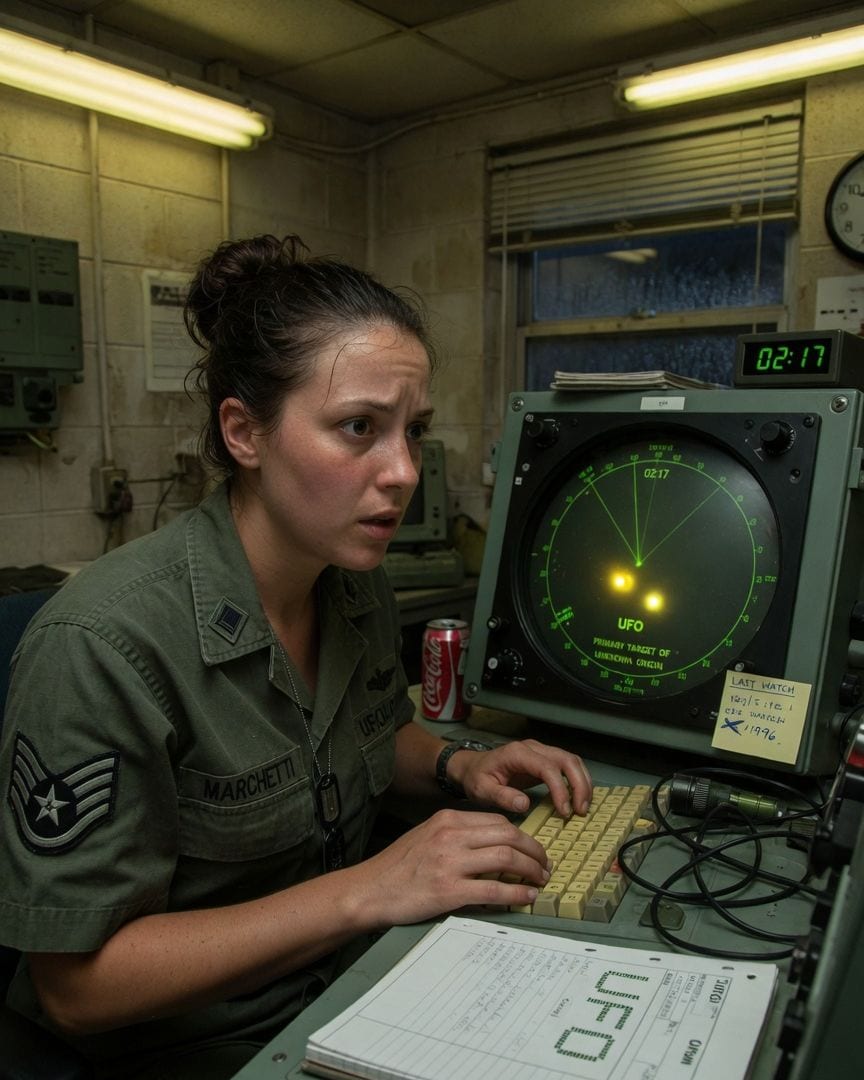
Technical Sergeant Odile Marchetti, 28, sat alone in the dim glow of her console at the Gulf Coast ground control site, the air thick with humid silence.
It was 1996, and her last watch before a transfer to a desk job, a quiet end to her active duty. The rhythmic sweep of the radar arm filled the room, a familiar, comforting sound.
At 02:17, an airliner captain, calm and professional, came up on frequency. “Center, confirm traffic flying formation with me at three-five-zero?”
Odile saw his primary return, a single blip, clear as day on her screen. Then, impossibly, a second, larger return bloomed beside it, twice its size, mirroring its trajectory with impossible precision.
Her trained hands moved without conscious thought, pulling up the checklist for 'Primary Target of Unknown Origin.' She typed 'UFO' into the designated box on her digital log, a box she’d only ever seen on training exercises, a phantom placeholder.
The captain’s voice crackled again, now with a faint, almost imperceptible tremor. “It just pulled ahead… stopped… and we’re flying through where it was.”
On her scope, the two returns converged, folding into one, then stayed as a single, impossibly stable blip.
The single point of light continued its path as if nothing had happened, crossing sector boundaries with perfect adherence to its flight plan. The silence that followed was heavier than the humid air outside, pressing in from the darkened room.
The next morning, Odile, methodical by nature, began her review. The official post-incident report for the airliner was boilerplate, citing atmospheric conditions and sensor anomalies, a standard dismissal.
But Odile had the raw data, the radar tapes, and the audio recording of the pilot’s transmission. She replayed it, her fingers hovering over the console controls.
His initial calm inquiry, the slight tremor when he reported the 'thing,' then the chilling declaration: "It just pulled ahead... stopped... and we're flying through where it was."
After the merge, his voice returned to professional neutrality, confirming his flight path and altitude, answering routine questions from the next sector. But something in that neutrality was off.
A subtle shift in cadence, a fraction of a second too slow on his 'affirmative.' It was imperceptible, the kind of detail only a seasoned operator listening for hours would catch, and only then if they were looking for it.
A faint echo in the dead air after his words, like the room itself holding its breath.
She cross-referenced the flight path, the transponder codes. Everything from the moment of the merge onward was perfectly normal, almost too perfect, as if the aircraft had never deviated, never encountered anything.
The stark contradiction between her live observation, the pilot’s initial report, and the 'normal' post-event data chafed at her rational mind.
A weather balloon, a temperature inversion, a faulty tube in her old console—she considered and discarded each mundane explanation, watching them fail on the page of her analysis. The data was clean, but the dread was not.
It clung to her, a cold, unreasonable certainty.
Odile couldn’t shake the unease. She decided to dig deeper, beyond the radar data she knew so well.
Using her access codes, she navigated the airline’s intranet, eventually pulling up the internal flight manifest for that specific flight, cross-referencing it with her own timeline of the event. Most details were routine: passenger names, seat assignments, meal preferences.
Then, she found it. One passenger, listed by name, had a 'NO SHOW' beside their entry. But further down, a handwritten note, initialed by a flight attendant, confirmed that the passenger had boarded.
The name itself was heavily redacted, a thick black bar obliterating it completely. And across the top of the manifest, stamped in stark red ink, were the words: 'FILE CLOSED.'
Odile stared at the document, the hum of her console suddenly loud in the quiet room, a low thrum against her teeth. Someone had known. Someone had filed this person away.
The 'FILE CLOSED' stamp became Odile’s obsession. Her internal access logs showed it was a highly restricted classification, usually reserved for national security incidents, not routine commercial flight manifests. It implied deliberate, high-level concealment.
Using her transfer orders as leverage for broader access, citing the need to familiarize herself with historical data trends, she navigated layers of digital bureaucracy, eventually finding a physical vault deep within the base archives.
The vault was a relic, a hulking concrete box tucked away in a sub-basement, accessible only by biometric scan and a heavy steel door that groaned on ancient hinges.
The air in the vault was cool and dry, smelling of old paper and ozone, a taste like rust on her tongue. It was a still, silent place where fluorescent lights hummed a low, almost inaudible note.
Row after row of olive-green filing cabinets stretched into the dim distance, many marked with variations of 'FILE CLOSED.' She focused her search on manifests from flights that had reported any kind of anomalous aerial phenomenon.
The pattern was horrifyingly consistent. Across dozens of files, spanning from the early 1970s to the late 1980s, she found similar discrepancies: a 'NO SHOW' passenger on board, a redacted name, and the chilling 'FILE CLOSED' stamp.
Some files even included cryptic one-line entries, like 'Subject transferred, status Alpha-07,' or 'Exchange complete, new designation Victor-12.' The sheer volume implied a systematic, ongoing process. This wasn't a clerical error; it was an active, decades-long protocol.
Each discovery ratcheted her unease, pulling her deeper into the labyrinth of concealed information. The more she found, the less sense the world outside the vault made.
The quiet hum of the fluorescent lights seemed to grow, a low, constant vibration against her skull.
Odile’s frequent, high-level access requests did not go unnoticed. One afternoon, as she was leaving the archives, she found Edmund Doyle, a senior archivist in his early sixties, waiting by the door.
Edmund was known for his quiet demeanor, his meticulous organization, and his unsettlingly calm eyes, which seemed to take in everything without betraying a single thought. He held a cup of lukewarm coffee, his posture relaxed, almost casual.
“Technical Sergeant Marchetti,” he said, his voice soft, almost a murmur, the sound absorbed by the quiet of the corridor. “Finding what you need in the old records? Some of these are quite… extensive.”
He didn’t smile, nor did he frown. His gaze simply held hers, steady and knowing.
Odile felt a cold prickle on her skin, as if the dry, cool air of the vault had followed her out.
“Just tying up some loose ends before my transfer, sir,” she replied, trying to keep her voice even, feeling the lie thin and transparent between them.
Edmund took a slow sip of his coffee, the faint scent of stale grounds filling the air. “Ah, yes. A fresh start. Good to close out the old chapters.”
He paused, his gaze drifting to the rows of sealed cabinets that lined the wall behind her. “Though sometimes,” he continued, his voice barely above a whisper, “some files are better left sealed.
Curiosity, after all, can lead to… dead ends.” He didn’t elaborate, didn’t threaten, simply offered a small, knowing nod before turning and disappearing down a corridor, his footsteps strangely silent.
Odile felt a sudden, profound chill that had nothing to do with the archive’s climate control. She wasn't just digging; she was being watched, and the watcher knew exactly what she was looking for.
The silence in the hallway after he left was thick, almost suffocating.
The encounter with Edmund solidified Odile’s resolve. He knew. She found him in his office later that week, a small, windowless space crammed with overflowing bookshelves and the soft whir of a microfiche reader.
He was reviewing a reel, his face illuminated by its dim, flickering light. “Mr. Doyle,” she began, her voice firm despite the tremor she felt in her stomach. “I’ve been looking into the ‘FILE CLOSED’ manifests.
The ones with the ‘NO SHOW’ passengers.”
Edmund slowly looked up, his expression unreadable, eyes unblinking in the microfiche glow. “And what have you concluded, Sergeant?”
“That they weren’t no-shows,” Odile pressed, stepping further into the small office. “That they were on board. And that something… happened to them. During anomalous events.”
Edmund leaned back in his chair, a faint sigh escaping him, a sound of old springs creaking under protest. “Indeed. What you’ve observed is a form of… management. The anomalies, as you call them, are not always about disappearance.
Sometimes, they are about exchange.”
Odile felt a knot tighten in her stomach, cold and hard. “Exchange? What does that mean?”
“It means that what returns, what continues the flight, what comes home,” Edmund explained, his voice devoid of emotion, as if reading from a manual, “is not always what left. The pilot you heard, the passengers… they are often replaced.
Subtly. Imperceptibly. The original subjects are… filed. The ‘NO SHOW’ is simply the official designation for the original human, no longer present in their original form. We call the replacements ‘Alphas.’”
He gestured vaguely at the stacks of documents surrounding them, the silent testament to decades of hidden work. “The system, Sergeant, doesn’t just record these events. It manages them. It ensures the Alphas are indistinguishable, integrated.
It’s a necessary function, for stability.”
Odile’s mind reeled, the subtle shift in the pilot’s voice, the too-perfect flight data, the 'NO SHOW' manifests, Edmund’s terrifyingly calm demeanor – it all clicked into a horrifying, coherent picture.
The dread wasn't in the unknown; it was in the known, in the quiet, patient machinery of it all, humming along beneath the surface of the world, perfectly camouflaged.
Edmund watched Odile process the information, his eyes unblinking, the faint whir of the microfiche reader the only sound. “You’re a good operator, Sergeant Marchetti. Observant. Persistent.”
He reached into a drawer, pulling out a slim, sealed manila folder, unmarked save for a date. “Perhaps you’d be interested in one more file. Just to complete your understanding of the scope.”
He slid it across the desk, the smooth, aged paper cool against Odile’s fingertips.
It was an incident report from 1978, detailing a radar anomaly over the Atlantic. Odile’s hands trembled as she opened it.
The narrative described a commercial vessel experiencing an unidentifiable contact, a momentary loss of power, and then a return to normal, much like her airliner incident.
Her gaze fell to the signature at the bottom of the report, the radar operator who had logged the event: George Marchetti. Her father. A cold wave washed over her, a sudden, dizzying sense of freefall.
The report was stamped 'FILE CLOSED - OPERATOR TRANSFERRED.' And then, in the margin, scrawled in what looked unmistakably like Edmund’s own precise hand, were three words: 'Subject now designated ‘George Alpha’.'
The realization hit Odile with the force of a physical blow. Her father. Not just a witness, but a victim, a subject. The pattern wasn't just across decades and classifications; it was generational, familial.
The institution hadn’t simply filed her father’s report; it had filed him. Edmund watched her, his expression still and calm, as if observing a scientific experiment.
“Your father, George, was an exemplary operator,” he said, his voice flat, as if discussing a commendation. “He handled his incident with remarkable composure. The exchange was seamless. He continued his career, raised a family.
No one ever knew the difference. That is the objective.”
Odile’s mind raced, replaying every interaction with her father over the years. His quiet patience, his predictable routines, the subtle lack of spontaneity she’d always attributed to age or temperament.
Was that the shift she’d heard in the airliner pilot’s voice? The fractionally ‘wrong’ cadence? The almost too-perfect composure. Her father wasn't lost; he was filed.
And the thing that came back, the man who had raised her, was an Alpha, a perfect duplicate living a perfectly ordinary life.
The dread wasn't that the truth was hidden, but that it was so perfectly, meticulously maintained, woven into the fabric of reality itself. Every clue, every anomaly, every 'NO SHOW' now made horrifying, coherent sense.
Her father was the thing that came back wrong. The stale air of the office felt suddenly heavy, suffocating.
Odile pushed the file back across the desk, a silent accusation. “My father… he’s still designated ‘George Alpha’?” she asked, her voice barely a whisper, the words catching in her throat.
Edmund nodded. “All Alphas are tracked, quietly. For continuity. For stability. We monitor for… deviations.” He paused, his gaze meeting hers, utterly unperturbed. “You now understand the breadth of this operation, Sergeant. The institution ensures order.
We cannot allow the truth of these exchanges to disrupt society.” He offered her a choice, delivered with the same placid calm he used to discuss filing protocols. “You can accept your transfer. Continue your career, knowing what you know.
You will be monitored, of course, for your own continuity. Or you can continue to dig, to challenge this system. But be warned, Sergeant, those who become… liabilities… are also filed.
Perhaps not as ‘No Shows’ on a manifest, but in other ways. Quiet ways.”
Odile looked at the rows of sealed files in the vault, at the microfiche reader, at the man who represented the silent, patient horror of it all. She understood. There was no exposing this, no fighting it.
The system was too vast, too deeply entrenched, too perfectly integrated into the world. Her own actions could only lead to her own quiet disappearance, her own filing.
She was left with the full, unvarnished truth, a heavy burden that could not be undone or acted upon. She simply knew. And the knowing was the ending.
Odile completed her transfer to the new administrative role, the paperwork processed without incident.
Weeks later, at a family gathering for her mother’s birthday, she watched her father, George, laugh at a joke from her uncle, his eyes crinkling at the corners in a familiar, almost perfect imitation of genuine amusement.
He looked exactly as he always had. He asked about her new assignment, his smile a fraction too wide, his eyes a little too still, a flat calm beneath the surface.
She answered, a practiced smile on her own face, the knowledge a cold, constant weight in her chest.
The world around her continued, oblivious to the quiet horror beneath its surface, a horror she was now complicit in, simply by knowing.
The hum of the refrigerator in the background suddenly sounded like the silent whir of a server somewhere far away.
Odile sat at her new desk, reviewing routine flight plans, the mundane details a contrast to the truth she carried.
Her gaze drifted to a small, almost imperceptible anomaly in a recent incident report—a momentary, inexplicable blip on a regional radar, quickly dismissed as atmospheric interference, filed away, forgotten.
She felt the familiar cold dread coil in her stomach, knowing the box for 'UFO' was still there, waiting, and that the files were still being signed.
If this one got to you
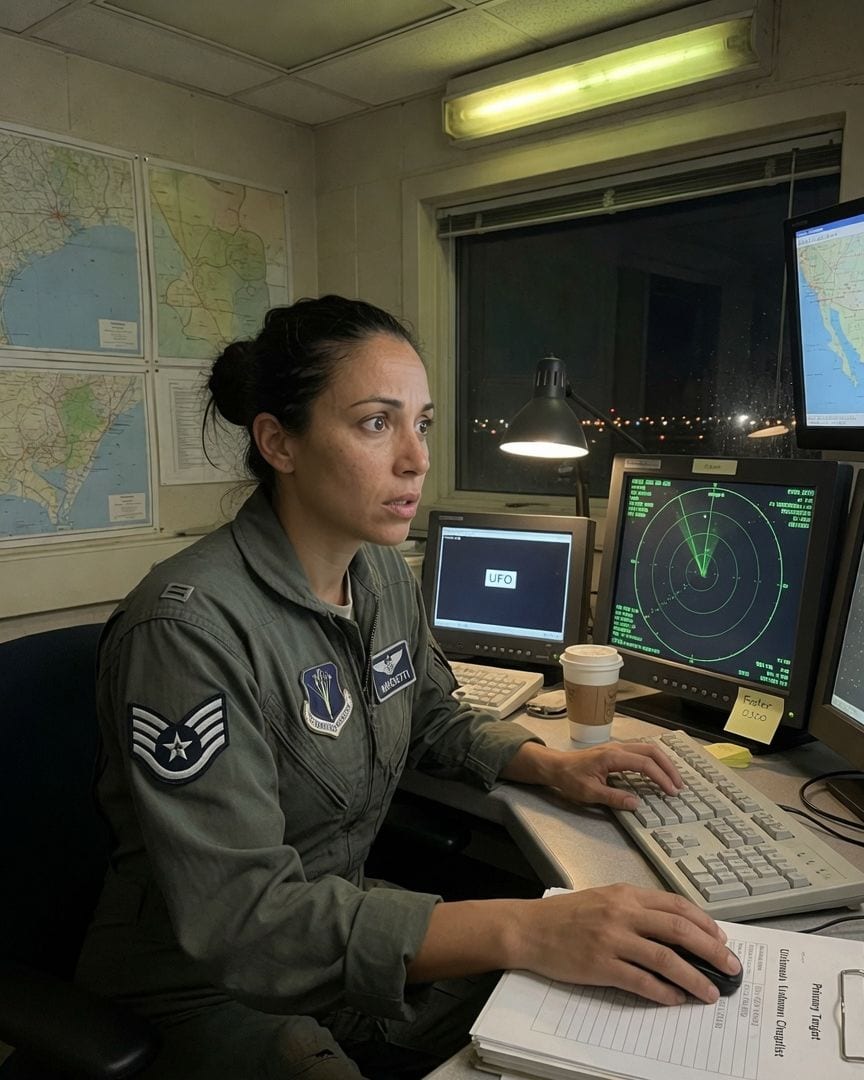
A radar operator watched a second blip, twice its size, merge into a plane on her screen. Her report was filed under a pre-existing, locked 'Special Handling' code.
Technical Sergeant Odile Marchetti sat alone in the dim radar room, her watch a final vigil for a base winding down along the silent Gulf Coast. At 02:17, a pilot reported a 'companion' on his wing, but her screen initially showed nothing. Then, a second blip bloomed, twice its size, before merging impossibly into the first and continuing its flight path without a ripple. She logged it as a UFO, only to discover the system already had a designated category for such anomalies – a pre-approved slot for the unexplained. A week later, her incident was re-categorized under a locked 'Special Handling' code, creating a new, inaccessible folder in her own personnel file.
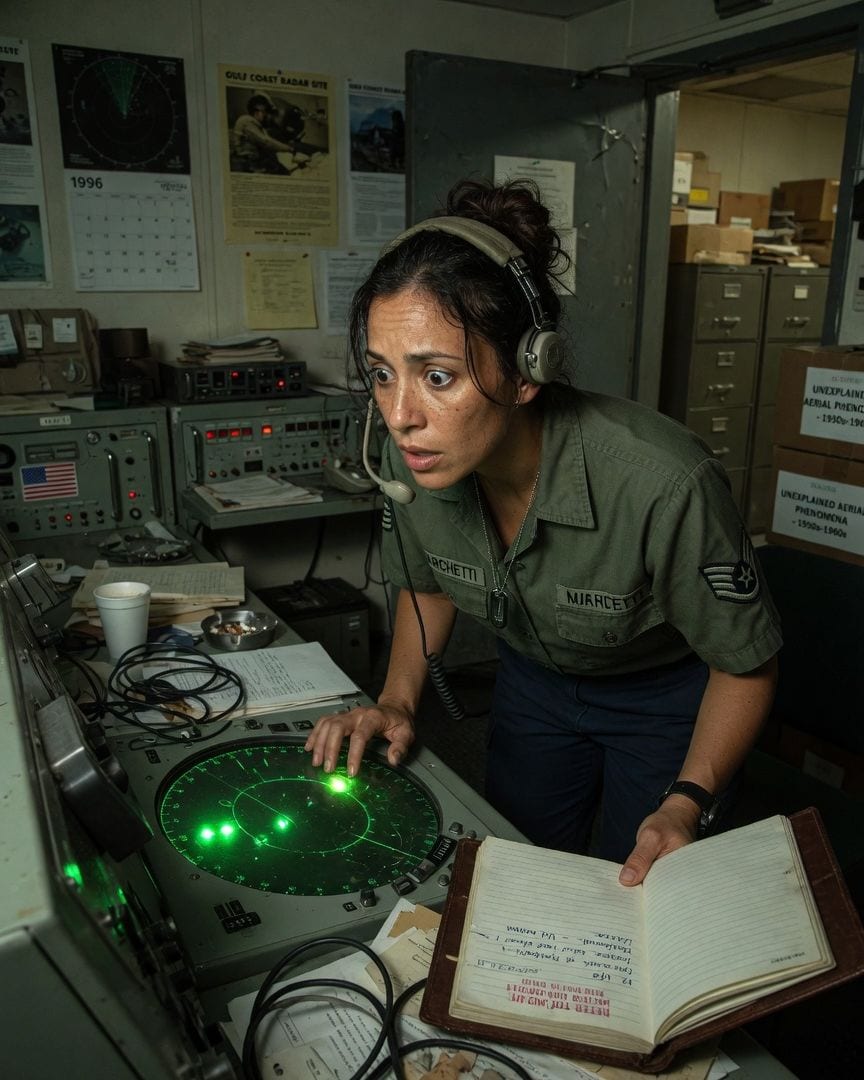
During her last weeks at the Cold War radar site, a technical sergeant logged a UFO. Her entry box was already stamped with a code from a missing 1958 jet.
Technical Sergeant Odile Marchetti was winding down her last few weeks as a radar operator at a remote Gulf Coast site in 1996. Alone in the cavernous room, she watched the green glow of her scope, the only light cutting through the pre-dawn gloom. At 2:30 AM, an airliner reported something flying in formation—a craft Odile couldn't see, until a massive, impossible blip bloomed beside it on her screen. After the pilot reported flying straight through empty air, Odile logged the UFO, only to find a faded, decades-old code already stamped on her logbook entry, identical to one on a missing jet report from 1958. Had this happened before, and was her own entry just a pre-written footnote in a much older, terrifying file?
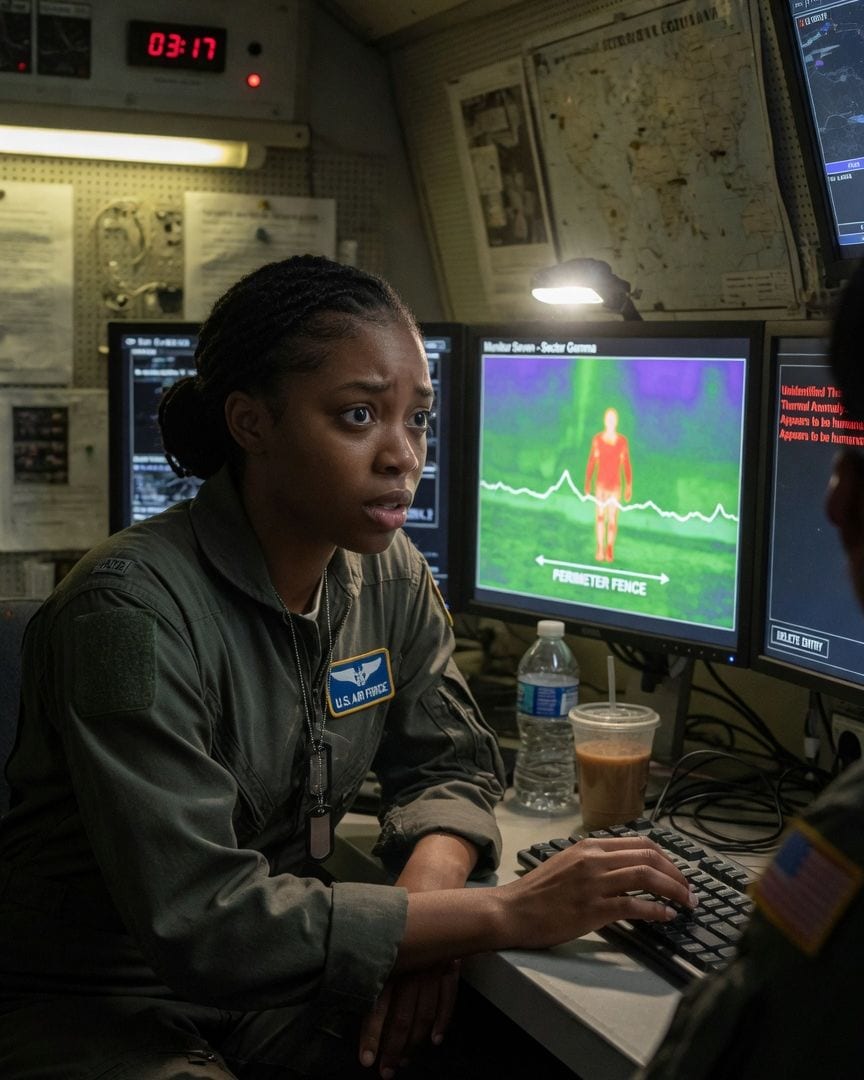
An airman’s thermal feed shows a figure moving in the restricted desert. Her captain orders it scrubbed, but the heat signature appears to tilt its head and look right at her.
Airman First Class Olivia Kade was new to her remote high-altitude outpost, fresh from advanced training, and the isolation pressed in, amplifying every hum. Her duty was to monitor the desert perimeter, but one shift, a faint thermal signature appeared on Monitor Seven: a solitary, upright figure moving with impossible precision beyond the barbed wire. No personnel were authorized in that sector. Her mission commander quickly ordered the anomaly scrubbed, but as it dissolved, the featureless outline seemed to tilt its head, looking directly into the camera. Now, the signature returns night after night, forcing the airman to wonder what impossible thing patrols the dark beyond the wire.
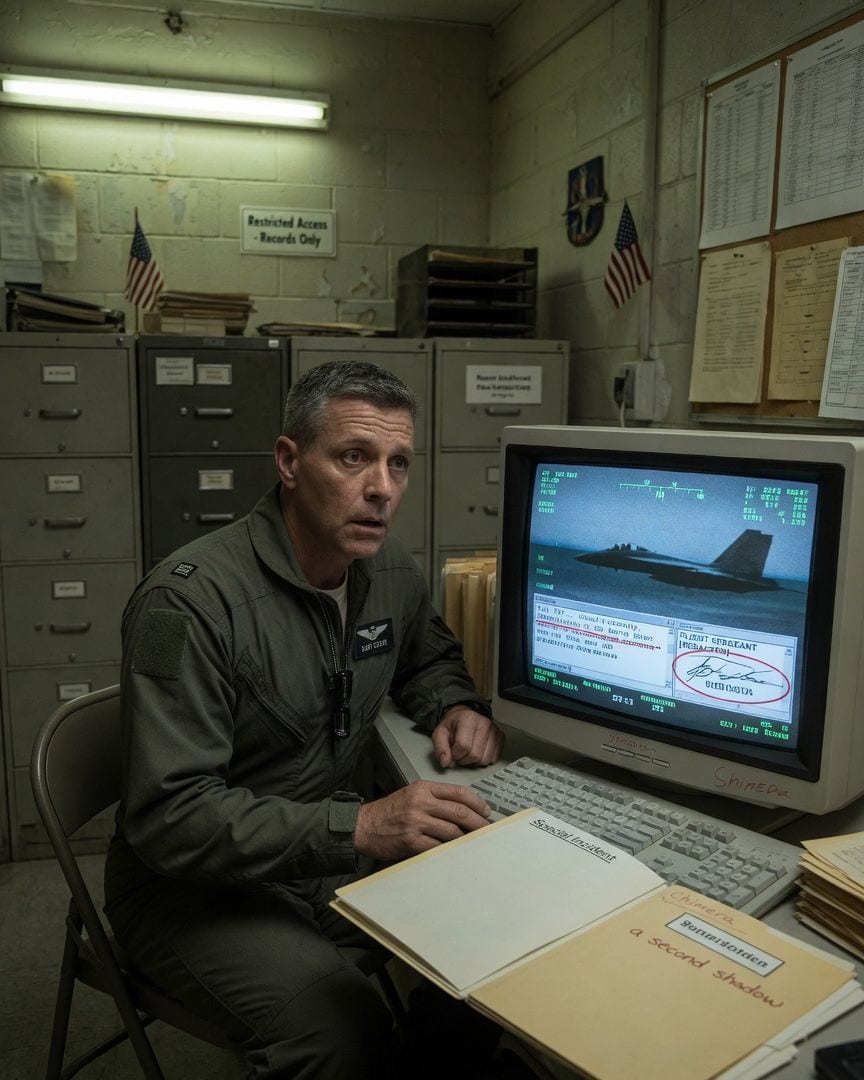
A Chief Warrant Officer's HUD showed a second aircraft watching his plane. He later found a log for *his* tail number reporting the same anomaly weeks ago, but he was grounded for medical leave.
Chief Warrant Officer Gary Estes, a man whose career was built on precision, found his impending Pentagon transfer shadowed by a baffling anomaly. On every flight, at exactly 800 feet, his aircraft's display would briefly show a sleek, dark second plane tucked off his right wing, its canopy subtly angled toward his, watching him. Ground radar never saw it, and his wingmen swore they flew alone. Desperate to maintain his clean record, Estes dug into maintenance logs and uncovered an entry for *his* tail number from weeks prior. It described the exact same 'visual anomaly' during a flight he knew, with chilling certainty, he had never flown.
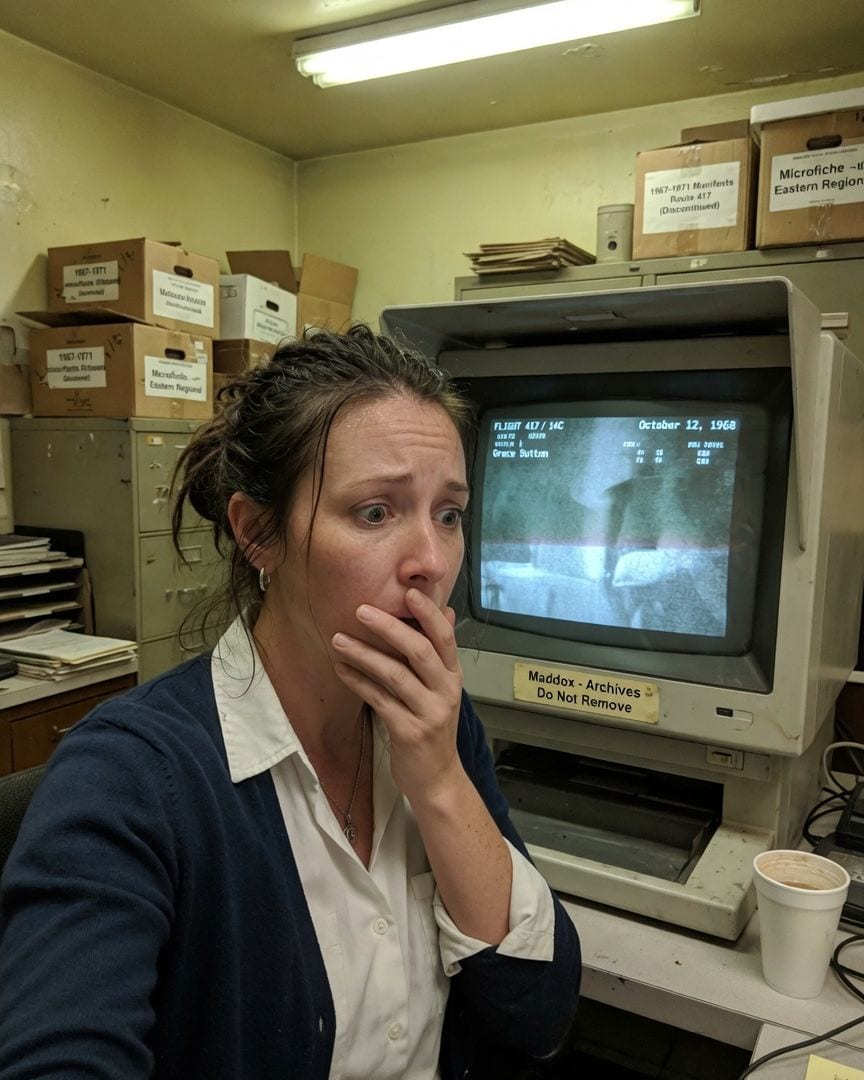
A woman I'd never met leaned across the aisle, said 'I'm sorry, Grace,' and warned me about the landing. We landed fine — but the airline says seat 14C flew empty.
My routine flight home took an unsettling turn when a woman in seat 14C spoke to me. She knew my name, warning me about the landing, then simply vanished from her seat after we touched down. Airline records confirmed seat 14C was unoccupied, as if she was never there.
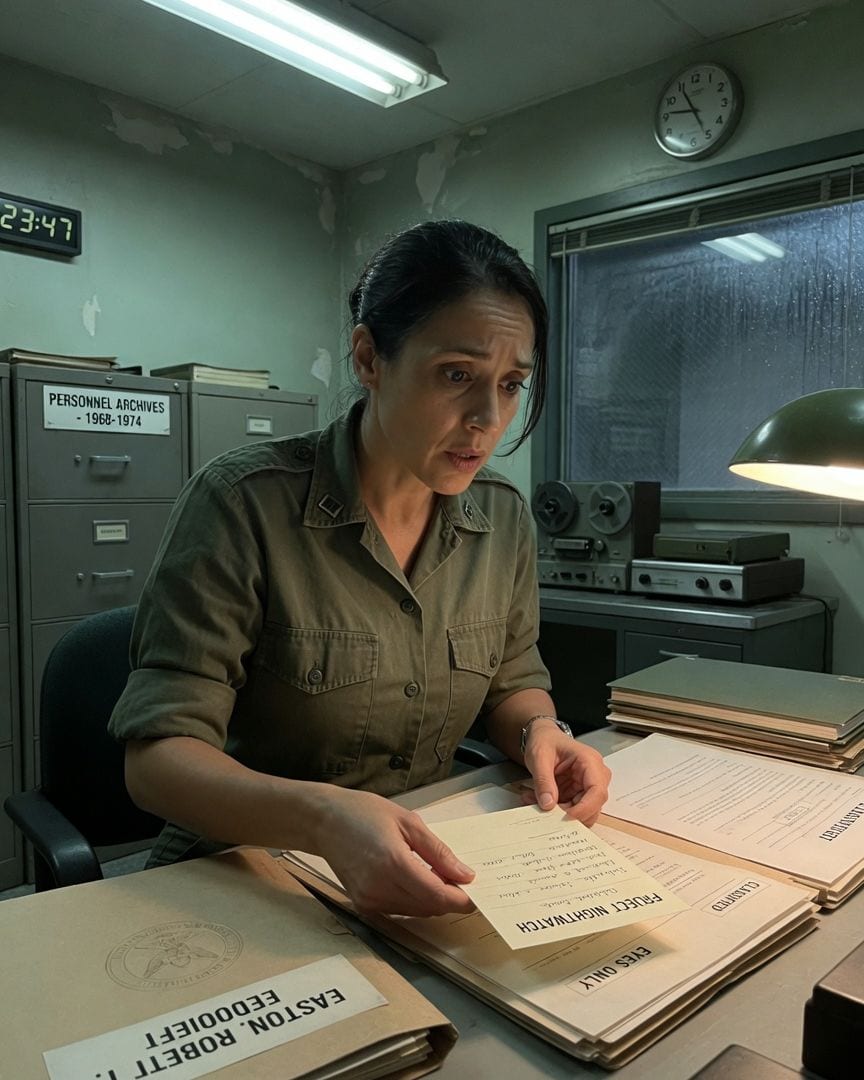
A Cold War tower controller logs an object vanish from radar, then hears the pilot scream it’s filling his windscreen. Her own name, 'Bardolph, Ines', now marked 'Observed' in a secret file.
Captain Ines Bardolph, a tower controller, was counting down the months until her transfer to Langley and the decommissioning of her base, hoping to leave behind the unsettling incidents of her final posting. But one night, her radar scope showed an impossible blip, solid and unwavering, 40 miles north of the Danube, only to vanish in less than a second, leaving a pilot screaming in terror. Despite the clear evidence, the official report blamed "atmospheric inversions," while the terrified pilot received a glowing review and promotion, his file meticulously scrubbed of any anomaly. As Captain Bardolph reviewed the pilot's pristine record, she found a hidden slip of paper, revealing a chilling truth: 'Subject: Bardolph, Ines. Status: Observed.' Was she merely an observer of the impossible, or was she now part of something far more sinister?