A Chief Warrant Officer's HUD showed a second aircraft watching his plane. He later found a log for *his* tail number reporting the same anomaly weeks ago, but he was grounded for medical leave.
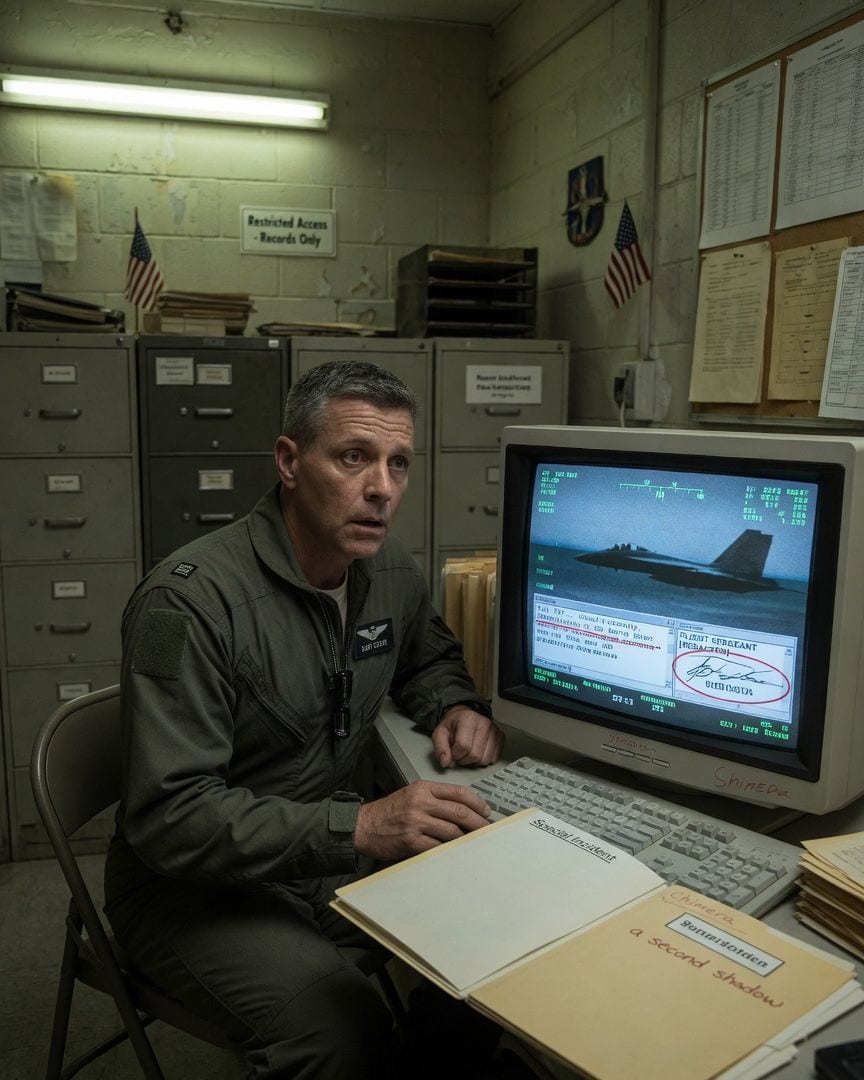
Chief Warrant Officer Gary Estes, a man whose career was built on precision, leaned forward in his debriefing chair, eyes fixed on the playback of his aircraft's Head-Up Display.
The Mojave sun still beat down outside, but inside the cool, humming room, a different chill settled. Every hop from this remote base, every downwind leg, at exactly 800 feet, the same anomaly.
One frame, frozen in time, showed a second aircraft tucked off his right wing. It sat in the same relative position, sleek and dark, its canopy subtly angled toward his. Ground radar, he’d already checked, had never seen it.
His wingman, when he had one, swore he flew alone. Maintenance had swapped the recorder out twice, citing a 'ghost in the machine,' but the frame always came back. Always at 800 feet. Always on the downwind.
And always, impossibly, watching him.
Estes felt a prickle of unease beyond mere technical malfunction. He was weeks from a Pentagon transfer, a desk job after decades in the cockpit, and a clean record was paramount.
He approached Chief Master Sergeant Sandra Lockwood in base records, a woman whose stern demeanor masked a surprising efficiency. The rows of filing cabinets stood silent sentinels, and the hum of the servers seemed to mock the stillness.
'Sandra, I need to see the maintenance logs for my bird, tail number 747, for the last six months. Specifically, any reports of sensor anomalies or HUD recorder issues.' Sandra, without looking up from her terminal, pulled the digital files.
Nothing. 'Clean as a whistle, Gary. No incidents, no anomalies. You signed off on all maintenance checks yourself.' Estes scrolled through the entries, his own digital signature staring back at him. Every entry was pristine. Then, he found it.
Not on his aircraft's log, but buried in a separate, older 'Special Incident' folder, flagged for 'sensor calibration issues.' It was an entry from three weeks prior, for his aircraft, on a day he was grounded for medical leave.
The entry, signed by a Flight Sergeant he didn't recognize, described a 'visual anomaly' on the HUD during a routine flight. The anomaly? 'Second aircraft, unknown origin, 800 feet, downwind.'
But the flight time listed was one he knew, with chilling certainty, he hadn't flown.
The blood drained from Gary Estes's face. He knew he hadn't flown that day. He’d been in the infirmary with a sinus infection.
Yet, there it was: his tail number, his aircraft, a flight he hadn't made, reporting the exact anomaly he was now experiencing. The signature wasn't his, but the details were too specific to be a coincidence.
He looked up at Sandra, who had finally stopped typing. Her gaze was direct, almost expectant. 'This… this isn't my signature,' Estes said, his voice flat. He pushed the screen toward her, highlighting the entry.
Sandra peered at it, then slowly leaned back, her expression shifting from professional disinterest to something unreadable, a flicker of apprehension in her eyes.
'That's… unusual,' she murmured, her voice barely a whisper, 'I've never seen an entry like this linked to your aircraft before. But there's more in this folder. Older ones. Different tail numbers. Different pilots. All flagged 'sensor anomaly'.'
She clicked a few times, pulling up a list of files. Estes saw the dates stretching back decades.
His thumb traced the faded, partially redacted word 'Chimera' in the margin of the printed incident report, then moved to a barely legible, handwritten note beneath it: 'a second shadow.'
He looked up at Chief Master Sergeant Lockwood, who watched him with an unreadable expression, the fluorescent lights buzzing faintly.
The next day, Estes, fueled by strong coffee and a gnawing sense of wrongness, returned to Sandra's office. The 'Special Incident' folder, now printed out, sat between them, its brittle pages rustling faintly in the static air.
'This 'Chimera' note,' Estes began, 'what is it?' Sandra shrugged. 'Declassified, heavily redacted. Looks like an internal project code from the '80s. Nothing official ever came of it. Most of these files are just misfiled sensor glitch reports.'
But Estes wasn't convinced. He started cross-referencing the 'sensor anomaly' reports. Each one, regardless of the aircraft or pilot, described a 'secondary visual contact' at 800 feet, during the downwind leg.
He even found a few entries where pilots had dismissed it as 'fatigue' or 'sun glare,' only to have a similar report filed by another pilot on the same aircraft days later. It was too consistent.
He noticed a recurring name on several older maintenance logs, not as a pilot, but as a ground crew chief: Richard Prescott.
Prescott was still on base, a civilian contractor in logistics, a quiet man who’d seen decades come and go. Estes found Prescott in a dusty hangar, overseeing a parts inventory.
The air hung thick with the smell of oil and old metal. 'Colonel Prescott,' Estes began, 'I'm looking into some old sensor anomaly reports. Your name came up on a few logs from the late '80s.'
Prescott, a man whose face was a roadmap of sun and time, paused, his eyes narrowing slightly. 'Those old ghosts,' he said, not unkindly. 'They still flying around?' Estes felt a chill. 'You've seen them too?'
Prescott simply nodded, then pointed to a faded diagram on a nearby workbench. 'Project Chimera,' he said, tracing a finger over a sleek, impossible aircraft design. 'They said it didn't exist.'
Estes spent the next few days in a blur of archived files and hushed conversations with Prescott.
Prescott, it turned out, was the 'one who knew,' calm and unbothered by the anomaly, like a man who'd long ago made peace with the impossible.
He spoke of 'Chimera' in whispers, describing a hyper-stealth experimental craft lost during a test flight in 1987, its existence immediately scrubbed from all official records. 'The energy signature,' Prescott explained, 'it was unstable.
Sometimes, under just the right conditions, it'd bleed through. Like a ghost on the old HUDs.' Estes felt a growing dread, not just from the story, but from the feeling of being watched.
He'd catch glimpses of Sandra Lockwood lingering near the archives, her eyes on him. Once, in the empty evening mess hall, the fluorescent lights humming over his solitary table, his phone buzzed.
An anonymous text: 'Some things are better left buried, Estes. Your transfer is pending.' He dismissed it as a prank, but the precision of the timing, the reference to his transfer, unnerved him.
The next morning, he found a small, unmarked envelope tucked under his office door. Inside was a single, grainy photograph: his own aircraft, taken from the ground, on a recent flight.
And just barely visible, a faint, dark smudge off the right wing, at exactly 800 feet. The phantom aircraft, captured by someone on the ground. The image was dated yesterday. Estes looked up, scanning the empty hallway. Someone knew.
Someone was watching him, confirming his discovery, and warning him away, all at once.
Estes confronted Sandra Lockwood in her office, the grainy photograph clutched in his hand. Her usually neat desk was now a jumble of files, as if something had been hastily searched for, or hidden.
'This was on my door this morning,' he said, his voice low. Sandra took the photo, her face impassive. 'You're digging too deep, Gary.' 'Project Chimera,' he pressed, 'the lost aircraft. Prescott told me about it.
It’s not a glitch, is it? It’s an echo.' Sandra sighed, running a hand through her short, graying hair. 'It was a highly classified project. Experimental stealth. Lost in '87. The technology was… ahead of its time. Too unstable.
Command wanted it erased. Every report, every trace. But the tech, it left a footprint. A temporal bleed. The specific conditions – 800 feet, downwind leg – those are the parameters of the Chimera's final recorded flight path.
When your HUD crosses that exact space, under the right atmospheric pressure, it's like a momentary resonance.' Estes felt the pieces click into place.
The 'flight' he hadn't taken, logged under his tail number, was likely a clerical cover-up, an attempt to rationalize an early sighting of the Chimera echo, perhaps even using his name to make it seem like a known pilot's 'error.'
Sandra continued, her voice heavy. 'Every pilot who reported it, every technician who tried to fix it… they were transferred, reassigned, or quietly 'retired.' Some disappeared entirely from the records. The system can’t acknowledge it.
It would expose a catastrophic failure, a multi-billion dollar ghost.' She looked at him, her eyes holding a weary warning. 'You're seeing a classified disaster, Gary. Not a ghost. And the system doesn't like witnesses.'
The flight he didn't take, the 'sensor anomaly' reports, the 'Chimera' note – all of it coalesced into a horrifying, coherent truth: a ghost in the machine, not supernatural, but a permanent scar on a system built for absolute accountability, actively suppressed for decades.
The truth of Project Chimera was a cold comfort. It explained the phantom, the cover-ups, the warnings. But Estes couldn't shake the feeling that something deeper was at play, beyond a mere systemic cover-up.
He returned to Prescott, describing the pattern of recurring sightings across decades. 'It's not just a single echo, Richard,' Estes argued, 'it's a repeating phenomenon. Why does it keep showing up for different pilots, over so many years?'
Prescott, for the first time, looked genuinely troubled. The usual calm had slipped from his face, replaced by a subtle tension around his jaw.
He retrieved an old, leather-bound logbook from a locked drawer in his desk – a personal record, not official. Its ancient leather creaked as he opened it.
'This belonged to Colonel Sterling, the base commander back in '87,' Prescott explained, his voice hushed. 'He was the one who signed off on Chimera. He saw it too. More than anyone.'
He opened the brittle pages to a handwritten entry from 1987. It detailed an identical sighting, followed by a crude sketch of the unique, sleek aircraft. Estes’s eyes widened, recognizing the design from Prescott’s earlier diagram.
But beneath the sketch, in faded ink, was a notation that made his blood run cold: 'Estes' Ghost – seen again. Seems to follow the new ones.' Gary Estes stared at the faded, handwritten logbook entry from the 1980s.
His finger trembled over the crude sketch of the unique aircraft, then dropped to the unsettling notation beneath it, in shaky, ancient script: 'Estes' Ghost – seen again. Seems to follow the new ones.'
The words blur, and a cold dread settled over him, not from the past, but from the sudden, terrifying realization that this pattern isn't just happening around him, but somehow through him, placing him at the center of a decades-old, impossible cycle he's only just begun to understand.
Prescott watched Estes, his gaze heavy with unspoken knowledge, like an oracle delivering a prophecy. 'Colonel Sterling,' he began, 'he believed the Chimera wasn't just an echo of the past. He thought it was… a premonition. Or a connection.'
Prescott explained that Sterling, a man obsessed with the occult as much as aviation, had theorized that the Chimera's unstable energy signature, combined with the unique geological properties of the Mojave, created a localized temporal distortion.
'He believed the aircraft wasn't just lost; it was displaced. And that its 'echo' wasn't just a sensor glitch, but a 'pull' – a resonance that linked specific individuals to its temporal trajectory.'
The 'Estes' Ghost' notation wasn't a reference to Gary Estes himself, but to a recurring 'pattern' or 'archetype' of pilot that the anomaly seemed to manifest for, or even, in some dark way, attract.
Sterling had found similar names, similar flight profiles, across decades of records, always associated with the Chimera sightings.
He’d even found references to a 'Gary' or 'G. Estes' in obscure, pre-war flight logs from the same region, detailing strange aerial phenomena.
'He thought it was a repeating loop,' Prescott said, his voice barely audible, 'That certain people, at certain junctures in their lives, become attuned to this… bleed. Like a magnet. And once it finds you, it doesn’t let go.'
The pattern across rotations and dates wasn't just random sightings; it was a curated, suppressed history of those 'attuned' to the Chimera, with Gary Estes's own name, or a spectral version of it, woven into its very fabric decades before he was born.
He wasn't just a witness; he was a designated observer, marked by an anomaly that predated him.
The full truth settled over Gary Estes like a shroud. He was not just a pilot who saw something impossible; he was a link in a chain, a name in a pattern that stretched back generations.
The Chimera wasn't just an echo of a lost project; it was a persistent, almost sentient, temporal anomaly, drawing specific individuals into its orbit. There was no escape. No action to take.
The system had buried it, not because it could be stopped, but because it couldn't.
He realized the anonymous texts, the photograph, Sandra's warnings – they weren’t just about protecting the secret, but about protecting him from becoming consumed by it, or perhaps, from becoming the next victim of its temporal pull.
He looked at Prescott, the old man’s eyes filled with a profound, weary knowledge, like old, deep wells. 'What happens now?' Estes asked, his voice hollow. Prescott simply shrugged. 'You transfer. You leave. But you'll carry it. You'll know.'
Estes understood. His meticulous nature, his desire for a clean record, had led him not to a solution, but to an unshakeable, terrifying knowledge.
He would leave the Mojave, leave the cockpit, but the phantom wingman, the ghost of Chimera, would forever fly in the back of his mind. The dread was not in what he could do, but in what he couldn't.
He had found the truth, and it was untouchable, unchangeable, an enduring glitch in the fabric of time itself, perfectly accounted for only in the suppressed records of a failed system.
Gary Estes completed his transfer paperwork without incident. His records were pristine, his career path clear. Sandra Lockwood offered a curt nod of farewell, her eyes holding a silent understanding, a shared burden of impossible knowledge.
Richard Prescott simply gripped his hand, a look of shared resignation passing between them. Estes left the Mojave, the vast, silent desert stretching behind him, carrying the weight of a secret that the world, and the military, refused to acknowledge.
The phantom aircraft never appeared on his HUD again, but the memory of its canopy, turned toward him, remained etched in his mind. He was out of the cockpit, away from the precise conditions that conjured the Chimera.
But the knowledge had taken root.
Years passed. Gary Estes settled into his Pentagon desk job, a life of regulations and reports. He never spoke of the Chimera.
But sometimes, when he looked at a flight manifest, or saw a young pilot’s name, a familiar chill would creep in. He’d find himself scanning old reports, looking for patterns, for names, for that specific altitude.
He was retired now, living a quiet life, but the ghost still flew. One evening, his wife, Emily, found him staring out their living room window at the darkening sky, a distant aircraft's contrail a faint line against the twilight.
'What are you thinking about, dear?' she asked softly. Gary turned, a faint, unsettling smile playing on his lips. 'Just remembering an old wingman,' he said, his eyes distant, 'one I used to fly with.'
If this one got to you
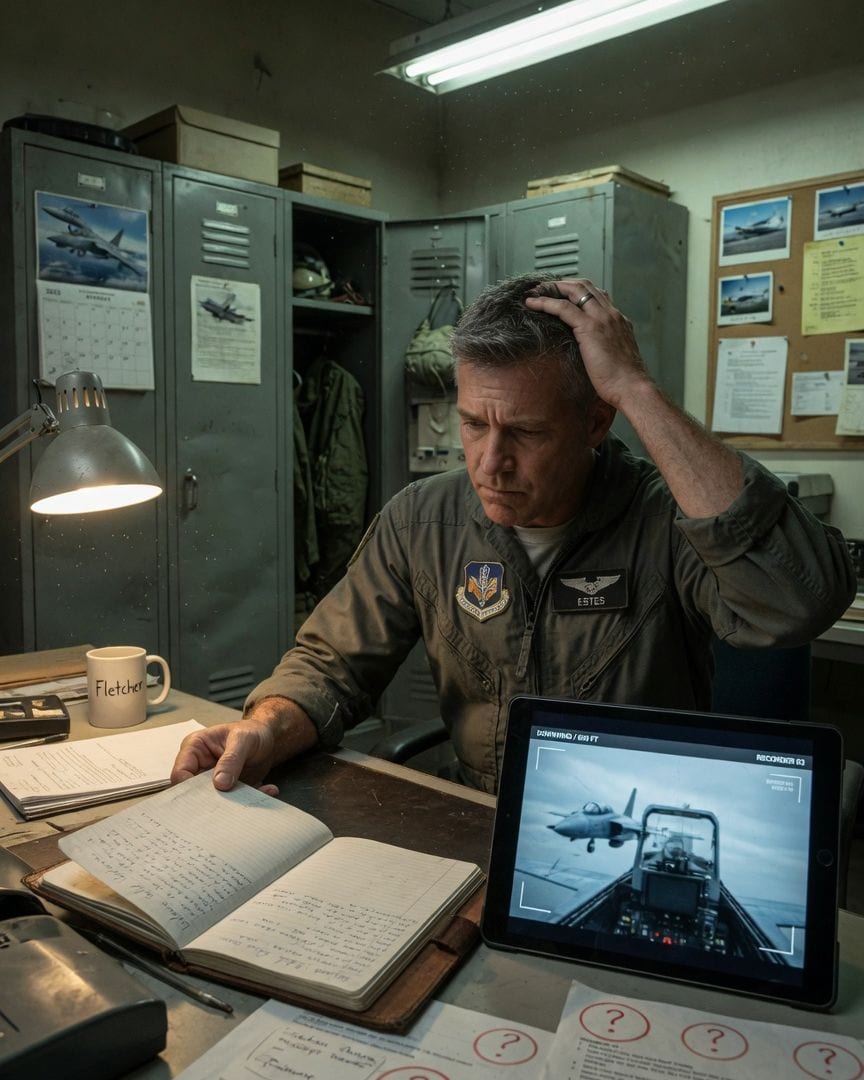
A Chief Warrant Officer's HUD tape shows a phantom jet, impossibly close, off his wing. Forty years ago, another Cold War pilot logged the same impossible sight.
Chief Warrant Officer Nathaniel Estes, a pilot whose career hinged on absolute precision, was under evaluation for a critical promotion. His nightly review of HUD tapes from routine Mojave test flights was a meticulous habit, but for a week, it revealed an impossible detail. At precisely 800 feet, one frame showed a sleek, experimental jet tucked impossibly close off his left wing—a craft ground radar never detected. When his maintenance chief found no equipment fault, Estes unearthed a dusty, decades-old logbook detailing identical phantom sightings from 1978. What unseen presence shadowed the desert skies?
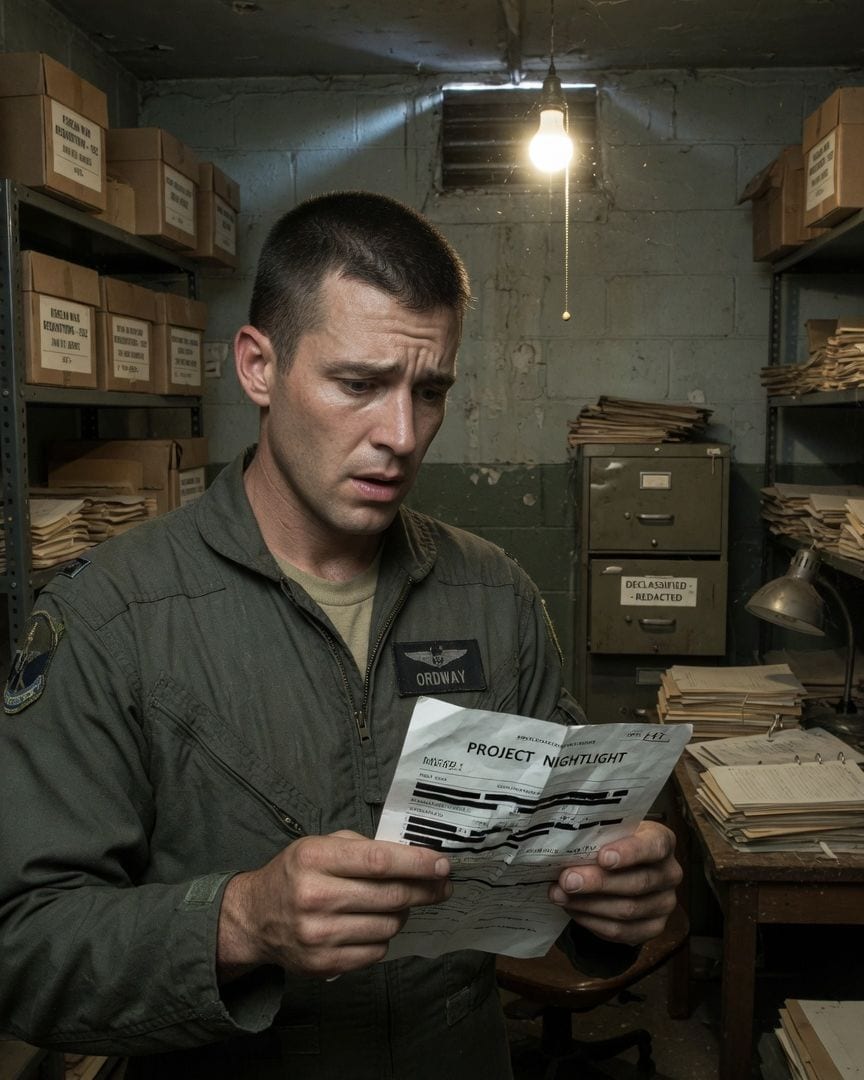
A Cold War pilot's F-104 Starfighter was shadowed by an impossible object. Weeks later, a secret memo referenced his own service number for 'pilot reassignment protocols.'
First Lieutenant Cal Ordway soared over the Mojave in his F-104 Starfighter in 1962, the night sky a familiar canvas. But that night, one 'star' broke formation, pulling alongside his wing and mirroring his every impossible maneuver. His instruments confirmed the silent, unblinking object, defying all known physics. After filing his precise report, Cal found his flight log altered to 'no incidents,' radar tapes corrupted, and a superior advising him to 'let it go.' Driven by his training, he uncovered a heavily redacted memo referencing 'Project NIGHTLIGHT' and, chillingly, his own service number for 'pilot reassignment protocols initiated.' Was he merely a witness, or already a subject in a much deeper secret?
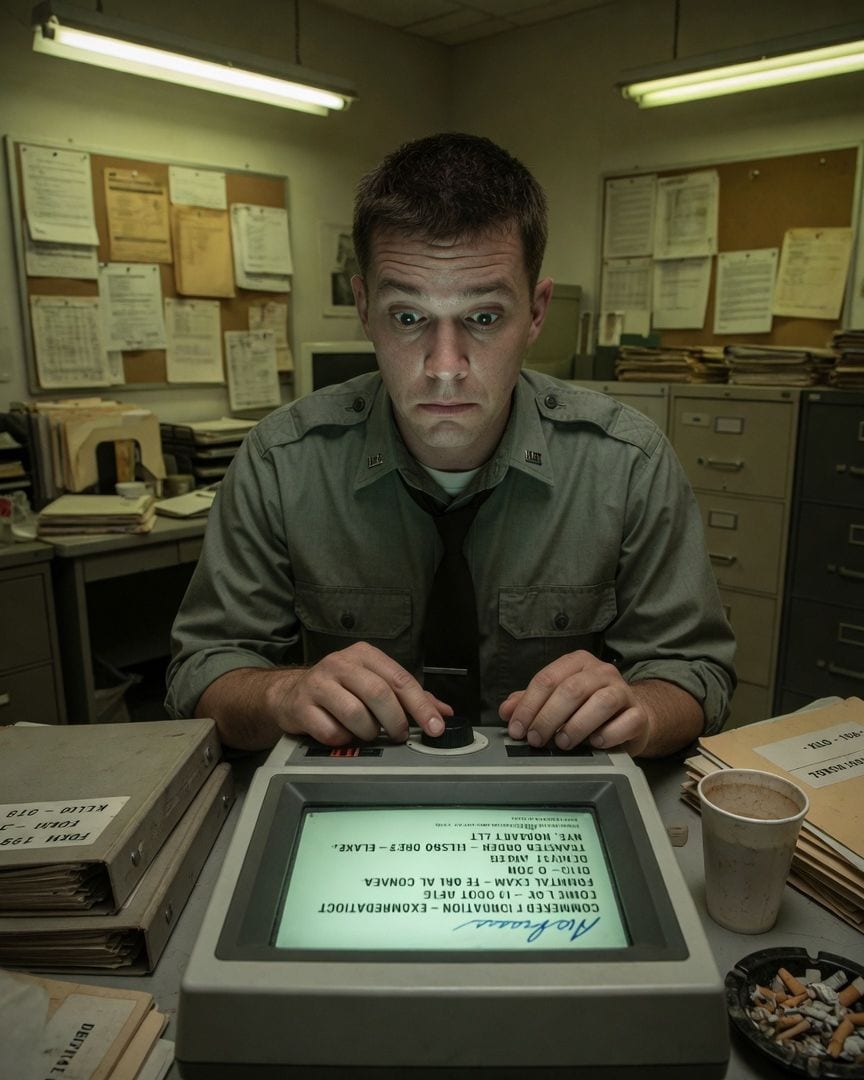
A missile commander watched his ten nuclear silos go dark. His own service record shows his signature on a future he's never lived.
Second Lieutenant Hobart Nye, a missile commander in Wyoming, had his quiet 0247 watch shattered by a security report: a massive, silent black triangle hovered over Launch Facility Kilo, casting a perfect shadow. Hobart watched his console's fault panel light up, signaling all ten nuclear missiles going dark in an impossible silence, followed by eleven minutes his security team could not remember. Official logs called it a "radio malfunction," but Hobart found a requisition for invisible-tracking sensors, signed by a base commander who was supposed to be off-base. The final, chilling discovery came when his own service record showed new entries—a dental check-up, a transfer to Alaska—all dated for a future he never lived, complete with his perfectly replicated signature.
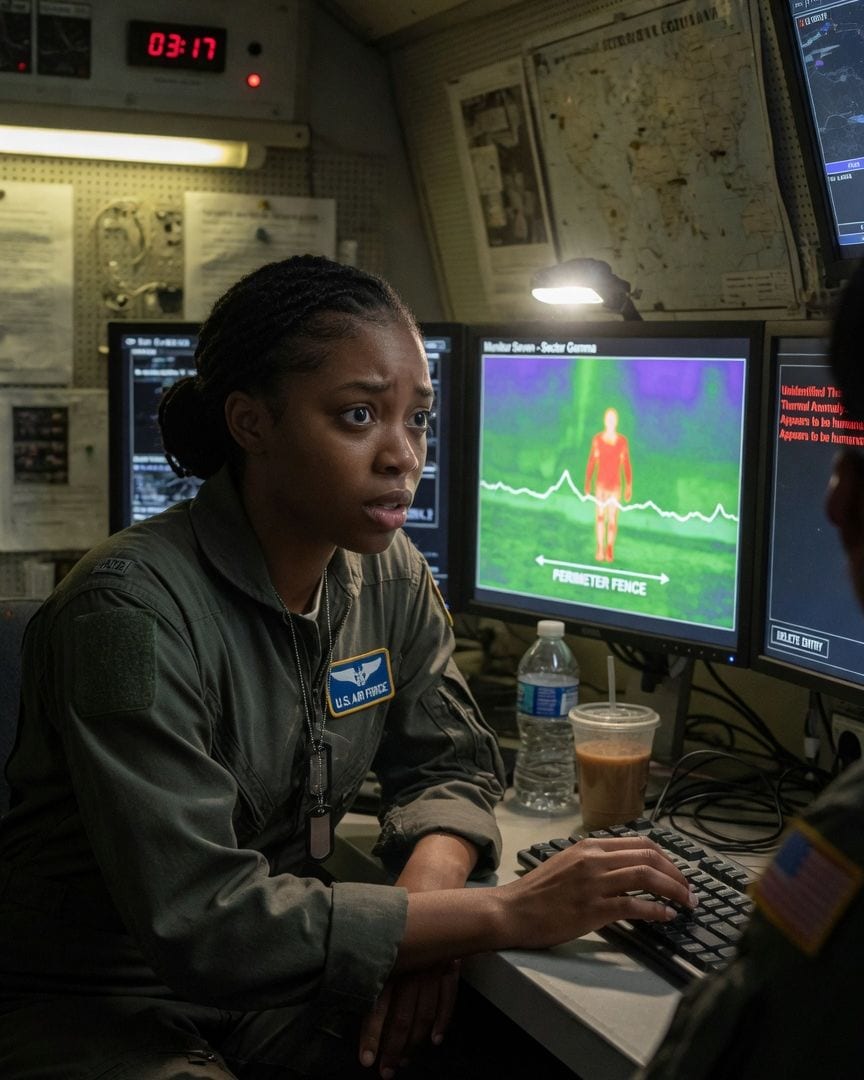
An airman’s thermal feed shows a figure moving in the restricted desert. Her captain orders it scrubbed, but the heat signature appears to tilt its head and look right at her.
Airman First Class Olivia Kade was new to her remote high-altitude outpost, fresh from advanced training, and the isolation pressed in, amplifying every hum. Her duty was to monitor the desert perimeter, but one shift, a faint thermal signature appeared on Monitor Seven: a solitary, upright figure moving with impossible precision beyond the barbed wire. No personnel were authorized in that sector. Her mission commander quickly ordered the anomaly scrubbed, but as it dissolved, the featureless outline seemed to tilt its head, looking directly into the camera. Now, the signature returns night after night, forcing the airman to wonder what impossible thing patrols the dark beyond the wire.
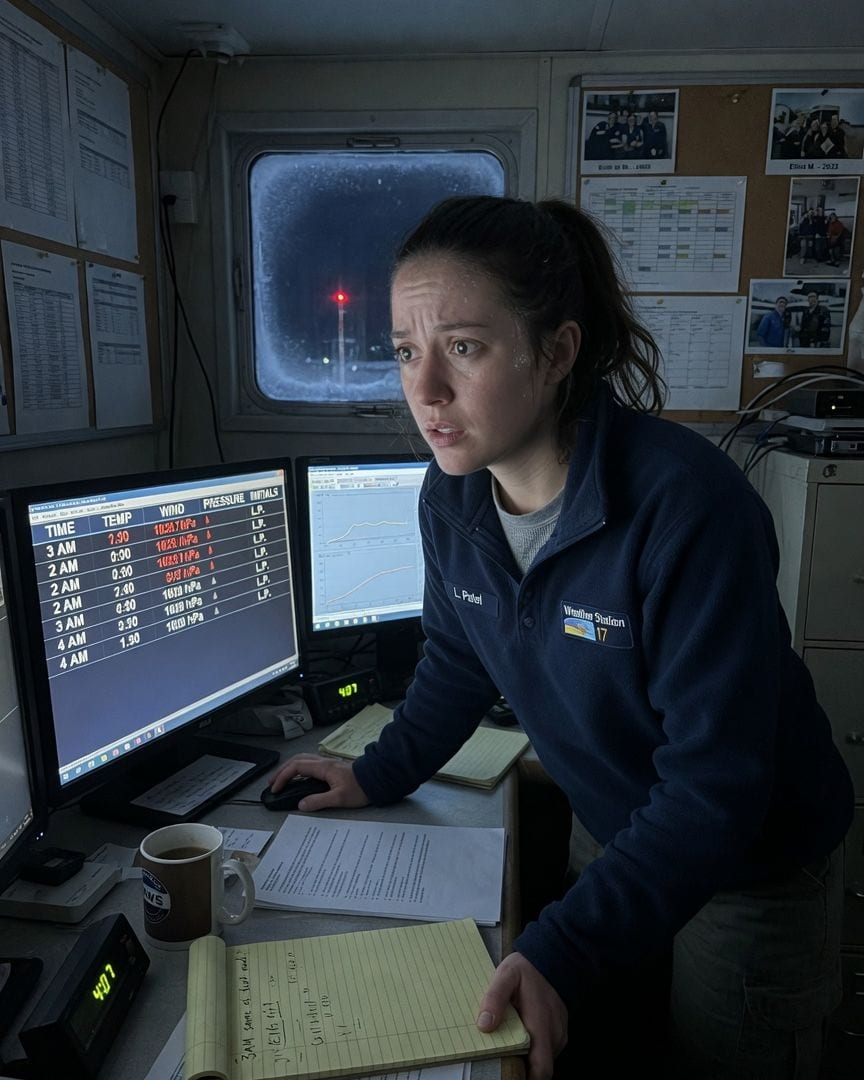
My weather station's 3 AM log shows a pressure reading I never made. My initials are on it, but the dials were dead still.
Working the overnight shift at the remote weather station, I routinely checked the digital logs. The 3 AM entry showed an impossible barometric pressure spike, a hurricane that simply hadn't happened. I distinctly remembered being outside at that time, calibrating a sensor, not making that entry. Yet, my initials, L.P., were clearly logged next to data I never made.
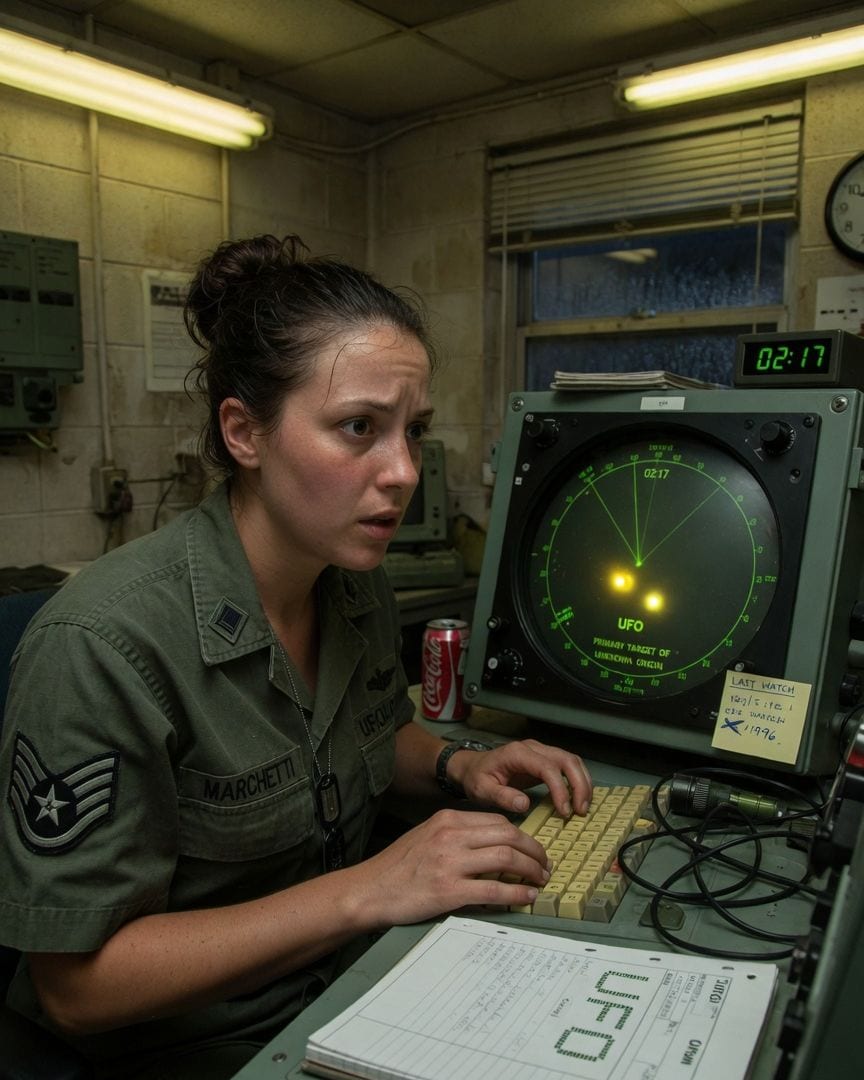
Technical Sergeant Marchetti's last watch saw an impossible radar blip merge with a plane. Later, its manifest showed a 'NO SHOW' passenger who *had* boarded, stamped 'FILE CLOSED'.
Technical Sergeant Odile Marchetti sat alone for her final watch at Gulf Coast ground control, anticipating a quiet transfer to a desk job. The dim console glow and rhythmic radar sweep were familiar, comforting sounds until 02:17, when an airliner captain reported impossible traffic flying in formation. Odile watched a second, larger blip appear on her screen, mirroring the plane's path with impossible precision. As the captain's voice, now tinged with a faint tremor, declared his plane was flying through where the object had been, the two radar returns merged into one, impossibly stable. Later, reviewing the official dismissal, Odile discovered an airline manifest listing a passenger as 'NO SHOW' who had, by handwritten note, definitely boarded—their name redacted, the file stamped 'CLOSED'.