A transport driver's signed logbook claimed her four missing minutes in the desert never happened.
Specialist Cleo Marchetti gripped the steering wheel of her transport truck, the only sound the low hum of the engine and the deeper, unsettling groan of the ‘unidentified craft’ secured behind her cab.
It was 0200, deep in the Nevada desert, ninety miles of empty road stretching ahead and behind. Her entire job was to keep the lead truck's taillights, driven by Senior Specialist Felix Hartley, in sight.
Every curve, every rise, every desolate mile, her eyes fixed on the twin red glows.
Then, at the halfway point, they simply vanished. Not a flicker, not a fade, just gone. One moment, they were there, a beacon in the oppressive dark; the next, the desert swallowed them whole.
Cleo slammed the brakes, the tires squealing a brief protest against the asphalt. Her rig shuddered, the cargo shifting with a dull thud.
She scanned the horizon, her mind racing for a rational explanation: dust, a sudden dip in the road, maybe an electrical short on Felix Hartley’s rig.
But there was no dust cloud, no turn-off visible in the beam of her headlights, no sign of anything. Just empty, dark desert. The silence pressed in, heavy and absolute, broken only by the ticking of the cooling engine.
She sat there for four minutes, alone with the silent, tarp-covered thing behind her, the isolation a physical weight.
Then, with a jolt that sent a spike of ice down her spine, the taillights reappeared. Not where they’d been, a distant pinprick on the horizon, but three hundred yards ahead, and unmistakably, impossibly, closer.
The sudden shift in proximity was a violation of physics, a direct assault on everything she knew about distance and speed. Her breath hitched.
The desert, which had been merely desolate, now felt actively hostile, as if it had played a trick on her, then decided to bring the game to a head.
Back at the depot, the debriefing was brief and sterile, just as she expected. Cleo recounted the incident, her voice steady, factual, laying out the impossible sequence of events.
Senior Specialist Felix Hartley, the driver of the lead truck, sat across from her, his posture relaxed. He confirmed their uneventful journey, no stops, no delays. His eyes, usually sharp, held a strange, flat calm, like still water.
The debriefing officer, a Captain Jenkins, simply nodded, his gaze flicking between Cleo and Felix. Cleo was dismissed, her account filed under 'operator fatigue.'
But Cleo was never fatigued. She prided herself on her vigilance, her discipline. That four-minute blank spot, the impossible jump of Felix’s rig, gnawed at her. She requested the convoy log, the physical document she had signed upon her return.
The clerk retrieved it from a stack, its pages crisp and official. Cleo found her entry, detailing departure, route, arrival time: 0431. No stops. No incidents. Perfect. She stared at her own signature, then at the meticulously recorded times.
The four minutes she’d sat frozen in the desert were simply… gone. Her own handwriting confirmed a reality that defied her senses.
It wasn’t a mistake; it was a contradiction, burned onto the page she herself had signed, and it made the dread in her gut feel colder than the desert night.
The logbook itself, usually a symbol of order and proof, now felt like a taunt, its blank spaces screaming louder than any words.
Driven by a gnawing certainty, Cleo secured the physical logbook again late that night, after the depot quieted down.
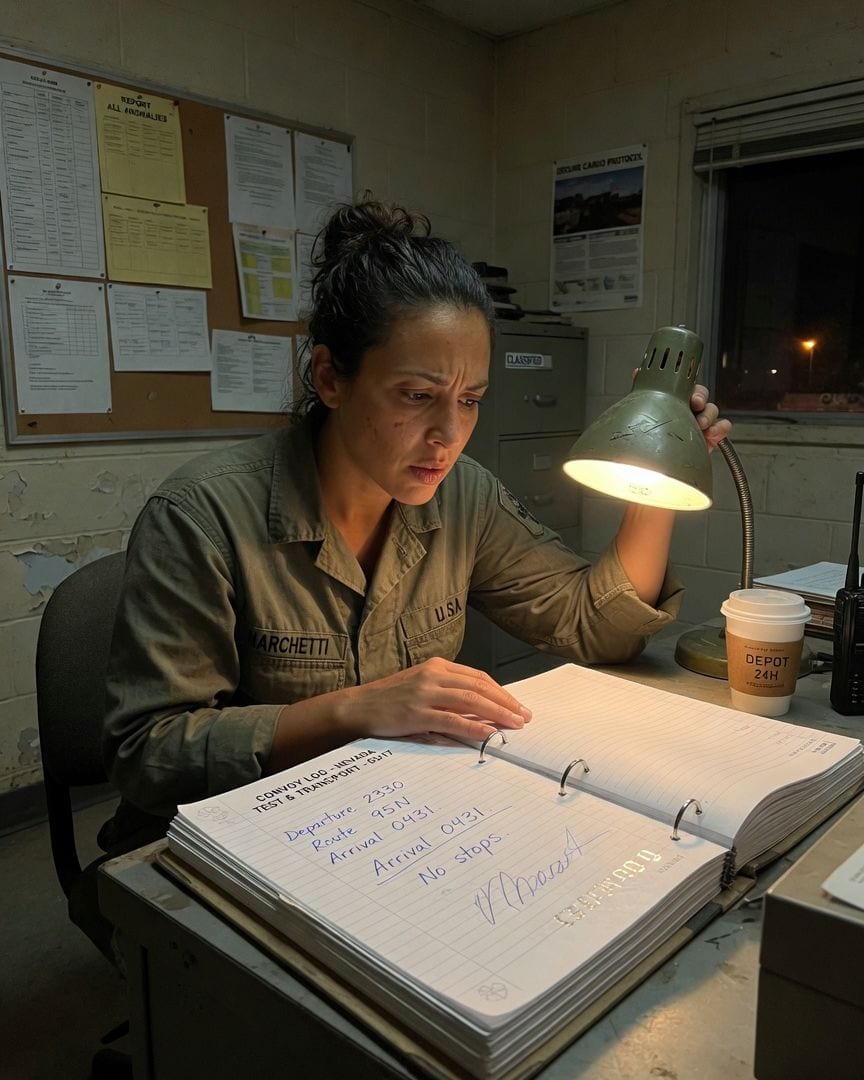
She spread it open on her desk, poring over her entry, searching for any anomaly her tired eyes might have missed before.
She ran her fingers over the paper, feeling for an imprint, a smudge, a wrinkle that might hint at an alteration. Nothing. The paper felt smooth, unbroken.
She switched off the harsh overhead fluorescent light, leaving only her small, adjustable desk lamp to cast a focused beam.
As she angled the page, the light catching it just so, she saw it: a faint, almost invisible watermark beneath her convoy's entry.
It was a series of tiny, interlocking symbols, barely perceptible, like a forgotten sigil printed onto the paper itself.
And then, as she shifted the angle slightly, a sequence of numbers and letters shimmered into view, etched into the paper itself, a spectral inscription: 'T-04:00'.
The 'T-04:00' annotation felt like a cold hand on Cleo's shoulder, a confirmation of the impossible. She tried to question Felix Hartley again the next day, catching him by his rig in the motor pool.
'Felix, about the other night…' He cut her off, his eyes sliding away from hers, focused instead on adjusting a strap on a tire. 'Just a glitch, Specialist. Happens.'
His dismissal was too quick, too practiced, the words echoing Davenport's earlier judgment. Cleo knew it wasn't a glitch. Glitches didn't leave impossible watermarks.
Using her clearance and an obscure administrative loophole she'd discovered years ago for equipment inventory discrepancies, she began sifting through the depot's restricted digital archives. She searched for any records related to 'T-04:00,' 'temporal events,' or even unusual convoy anomalies.
Weeks blurred into a haze of data, the glowing screen a constant companion in the quiet hours after her shifts. She found heavily redacted files, coded 'Project Chronos,' detailing 'Temporal Displacement Unit' (TDU) movements.
The descriptions were vague, clinical, referring to 'event duration,' 'reconciliation protocols,' and 'observer alignment.' But the patterns were chillingly familiar: sudden disappearances, inexplicable reappearances, and the consistent 'reconciliation' of transport logs to reflect an uneventful journey.
Each file was a ghost of her own experience, carefully sanitized, filed away as if perfectly normal. The digital air in the archive felt thin, as if the system itself was holding its breath.
The 'unidentified craft' she'd transported was, she now suspected, a TDU itself, its silent presence on the back of her truck a hidden, terrifying engine.
Her digging didn't go unnoticed. One morning, Cleo found her archive access revoked, her login disabled with an generic 'Insufficient Permissions' error. She tried to override it, but the system simply locked her out.
That afternoon, a man in a crisp, dark suit introduced himself as Special Agent Victor Davenport from Internal Security. He appeared in her office unannounced, a shadow in the doorway.
He was calm, unsmiling, and spoke in a low, even tone, his voice devoid of any inflection.
'Specialist Marchetti,' he began, his gaze sweeping over her desk, settling briefly on a stray printed page of a redacted file she'd left out. 'Your service record is exemplary. Let's keep it that way.'
He didn't accuse her, didn't threaten. Instead, he spoke of 'operational integrity' and 'unnecessary inquiries,' his gaze unwavering, dissecting her with a clinical precision. 'Some things,' he said, his voice dropping just slightly, 'are best left filed. For everyone's benefit.'
He knew exactly what she'd been looking for, the specific files, the coded terms like 'Project Chronos' and 'reconciliation protocol.'
He mentioned her 'excellent service record' with an inflection that implied he had read every line, every commendation, every private note, every moment of her career. Cleo felt a prickle of cold fear.
She wasn't just investigating; she was being observed, her every move now part of a file she couldn't access, a subject in an experiment she didn't understand.
The air in her small office seemed to thicken, pressing down on her, the silence from Davenport more unnerving than any threat.
Undeterred, Cleo sought out Sarah Oakley, a retired archivist known for her encyclopedic knowledge of military records and a quiet disdain for protocol.
Sarah lived alone in a small, cluttered house on the outskirts of town, smelling faintly of old paper and lukewarm tea. Over coffee, Cleo cautiously presented her findings: the vanishing taillights, the 'T-04:00' watermark, the redacted TDU files.
Sarah listened, her gaze distant, fixed on a dust motes dancing in a sunbeam, then nodded slowly. 'Project Chronos,' she murmured, a dry, rustling sound like old leaves. 'Thought it was buried for good.'
Sarah revealed that the watermark was an 'internal marker,' a signal for those 'in the know' that a temporal event had occurred, but had been 'reconciled' in the public log.
The 'unidentified craft' Cleo transported was indeed a TDU, a Temporal Displacement Unit, designed by a clandestine government institution to induce precise, localized temporal shifts.
The four minutes Cleo experienced were not a malfunction, but a calculated 'jump' to a slightly earlier, closer point in time – a standard operational maneuver to optimize delivery or avoid observation, the specifics often redacted.
The lead truck had simply bypassed those four minutes, arriving at the shifted point as if no time had passed. The official log, Cleo's signed log, was a 'reconciliation document,' a manufactured truth to overlay the impossible.
Her experience, the disappearing truck, the reappearance closer, the clean log – it all clicked into place, a horrifyingly coherent pattern of engineered reality.
The institution wasn't covering up an accident; it was orchestrating the impossible and then filing it away as normal.
The explanation, laid out in Sarah’s calm, methodical voice, felt like the floor dropping out from under Cleo, replacing the chaos with an even more terrifying order. The cup of coffee in her hands suddenly felt very cold.
Sarah, seeing the terror in Cleo's eyes, became visibly agitated, her hands trembling as she reached for her mug. 'There's more,' she whispered, her voice barely audible, hushed by the weight of what she was revealing.
'They… they track the observers. Some people are… recurrent.' She led Cleo to a hidden terminal, tucked away in a dusty corner of her study, behind stacks of old journals.
It looked ancient, but its screen glowed with an eerie blue light. 'One-time access,' Sarah cautioned her, 'be quick.'
Cleo's fingers flew across the keyboard, searching for anything related to her own incident, to the idea of 'recurrence.' She found a vast, cross-referenced file detailing similar temporal shifts, some dating back decades.
As she scrolled, a new section appeared, its title stark against the dark background: 'Cycle Recurrence.' Her eyes scanned a long list of names, service numbers, and dates. Suddenly, her breath hitched.
Under an entry dated forty years ago, detailing a TDU transfer across the same Nevada sector, was her full name: Specialist Cleo Marchetti. And her exact service number.
Below it, a handwritten, recent-looking addendum, in a precise, familiar script, stated: 'Subject: Marchetti, Cleo. Status: Active. Cycle: Initiated.'
Cleo spun to face Sarah, her face pale, the blue light of the terminal casting long, flickering shadows on the walls. 'This isn't possible. This is me.' Sarah nodded grimly, her eyes heavy. 'It is. You're an anchor. A recurrence.
They don't just track the events, Cleo. They track the patterns, the individuals who are consistently present when these shifts occur.'
Sarah explained that the institution, far from merely observing, actively 'seeded' these individuals into new cycles, their records adjusted, their memories subtly aligned.
Cleo wasn't just a witness; she was a component, a fixed point in a repeating, engineered reality, like a gear in a massive, hidden clockwork.
Her service record, her career, even her identity, had been meticulously crafted to place her in these specific moments.
The 'file' wasn't just about the craft or the shifts; it was about the control over who experienced them, and how their existence was 'reconciled' with the impossible.
The recent addendum in her file, the precise script that almost felt like Davenport’s, meant her current 'cycle' was recognized, initiated, and being closely monitored.
The horror wasn't just that the anomaly existed, but that she was a willing, if unwitting, participant in its perpetuation, her life a carefully written script, a role she was compelled to play over and over again.
The room, crammed with Sarah’s life, suddenly felt like a stage, the very air waiting for her next, rehearsed line.
The revelation solidified Cleo's resolve. She would not be a mere file, a recurring character in someone else’s play. She would expose it.
With Sarah's help, Cleo began to rapidly download the entire 'Observer Profiles' file, including her own recurring entries, onto a secure, encrypted drive, intending to send it to an anonymous journalistic contact Sarah vaguely knew.
The terminal whirred, its fan kicking into a higher gear, the progress bar crawling with agonizing slowness.
Suddenly, a red alert flashed across the screen: 'Unauthorized Access. Tracing.' The harsh klaxon blared from the terminal speakers, echoing off the cluttered shelves. Footsteps echoed outside the archive room, growing louder, closer. Agent Davenport. He knew.
Cleo frantically tried to accelerate the download, slamming her palm against the old keyboard. The door burst open, crashing against the wall, Davenport and two armed security personnel flooding the room.
'Specialist Marchetti,' Davenport's voice was calm, almost disappointed, as if she had merely failed a test. 'I warned you.' Cleo slammed her hand down on the 'send' key, her fingers slick with sweat.
A fraction of the data packet transmitted, a single, desperate breath, just as a security guard seized her arm, yanking her back from the screen.
The terminal screen went dark, the download incomplete, but a small, green confirmation flickered for a split second on the bottom corner before the terminal was forcibly shut down.
The room was silent save for the heavy breathing of the guards and the quiet click of zip ties on Cleo's wrists. She had sent something out, a fragmented, unreadable whisper into the void, but it was out.
Specialist Cleo Marchetti vanished. Her official service record was purged, her name erased from all active databases, her existence meticulously 'reconciled' out of the system.
The partial data packet she transmitted was intercepted almost immediately, its fragments deemed unintelligible, too garbled to make sense of, like a whisper lost on a hurricane wind. The institution's silence remained unbroken, its operations unseen, unchallenged.
The 'Observer Profiles' file was sealed even deeper, its records updated to reflect her 'deactivation,' a clinical note in a ledger of engineered lives.
Life at the depot continued, smooth and uneventful, as if she had never existed, her office cleaned out, her rig reassigned. The desert convoys continued their silent, precise journeys, their logs always perfectly aligned.
Years later, a new recruit, Private Eleanor Barlow, found herself driving the second truck of a two-truck convoy across the same empty Nevada road at 0200. Her entire job was to keep the lead truck's taillights in sight.
The night was vast, the desert silent, save for the hum of her engine. At the halfway point, the taillights simply went out.
Her hand hovered over the comms, a strange sense of déjà vu washing over her, a faint, unbidden memory of a name: Marchetti.
If this one got to you
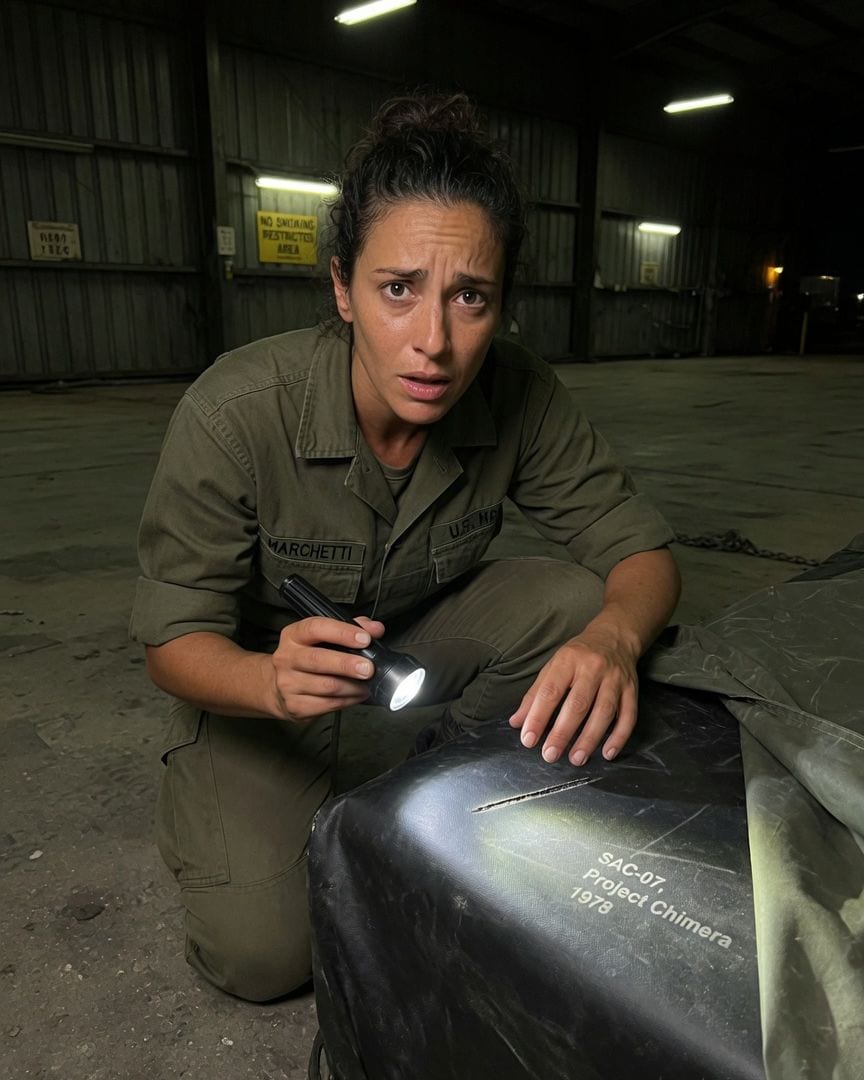
A military specialist watched her lead truck vanish and reappear closer. The convoy log said 'no stops,' but her secret cargo felt warm with a 1978 Cold War project stencil.
Specialist Cleo Marchetti knew her job was simple: keep the lead truck's taillights in sight across the empty Nevada desert. But at 0200, Sergeant Caldwell's truck simply blinked out, only to reappear three hundred yards closer moments later. Despite Cleo's shock, the official convoy log recorded a perfectly routine, non-stop journey, denying her very perception of reality. Her professional integrity demanded answers, leading her to the sleek, tarped craft she'd transported. There, she found a fresh scratch, and beneath it, an impossibly warm, faded stencil revealing a classified 1978 project name on a supposedly modern asset.
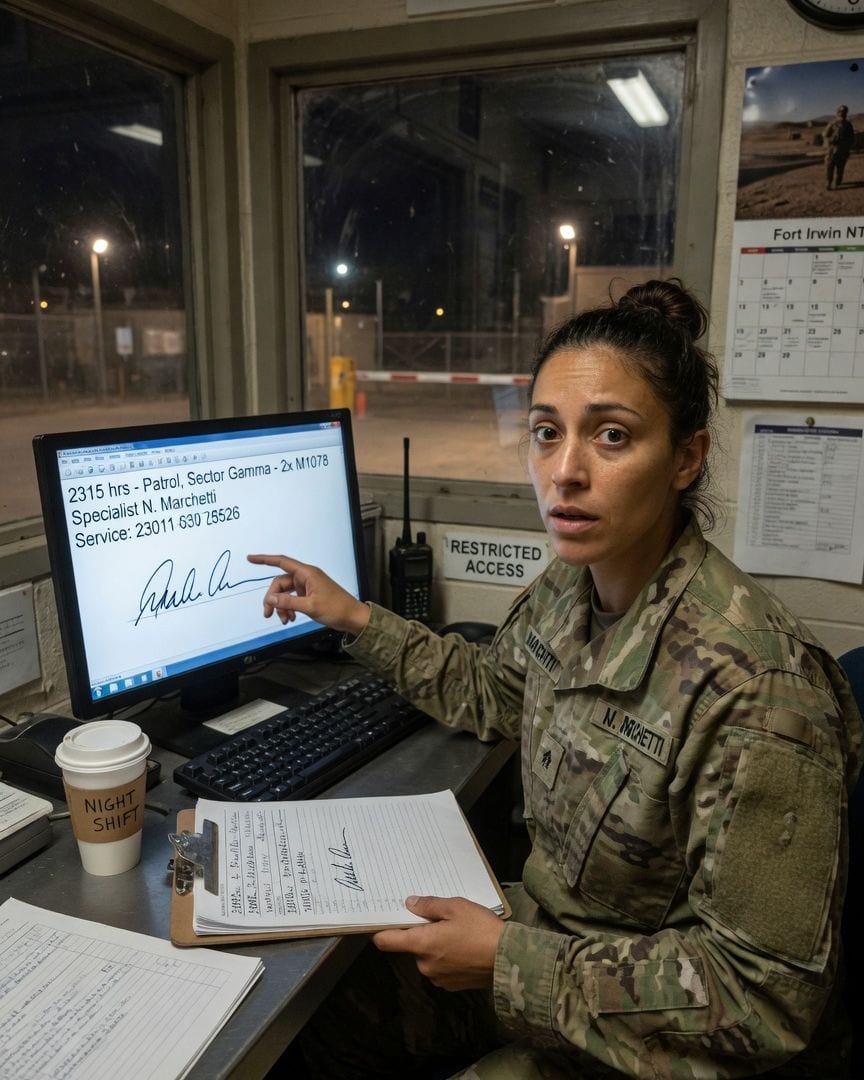
A Fort Irwin gate guard's own signature appeared on a patrol log for a mission she never sent.
Specialist Nadia Marchetti, a disciplined gate guard at Fort Irwin, logged a six-truck convoy departing into the high desert night. Five hours later, the same convoy returned, but with eight trucks, not six, baffling her meticulous records. Her superior dismissed it as fatigue, urging her to correct discrepancies before her promotion review. But when Nadia checked the digital manifest, she found an entry for a patrol she never sent, bearing her own undeniable, digitized signature. A cold dread settled as her reality was quietly violated by her own hand, swearing to a lie.
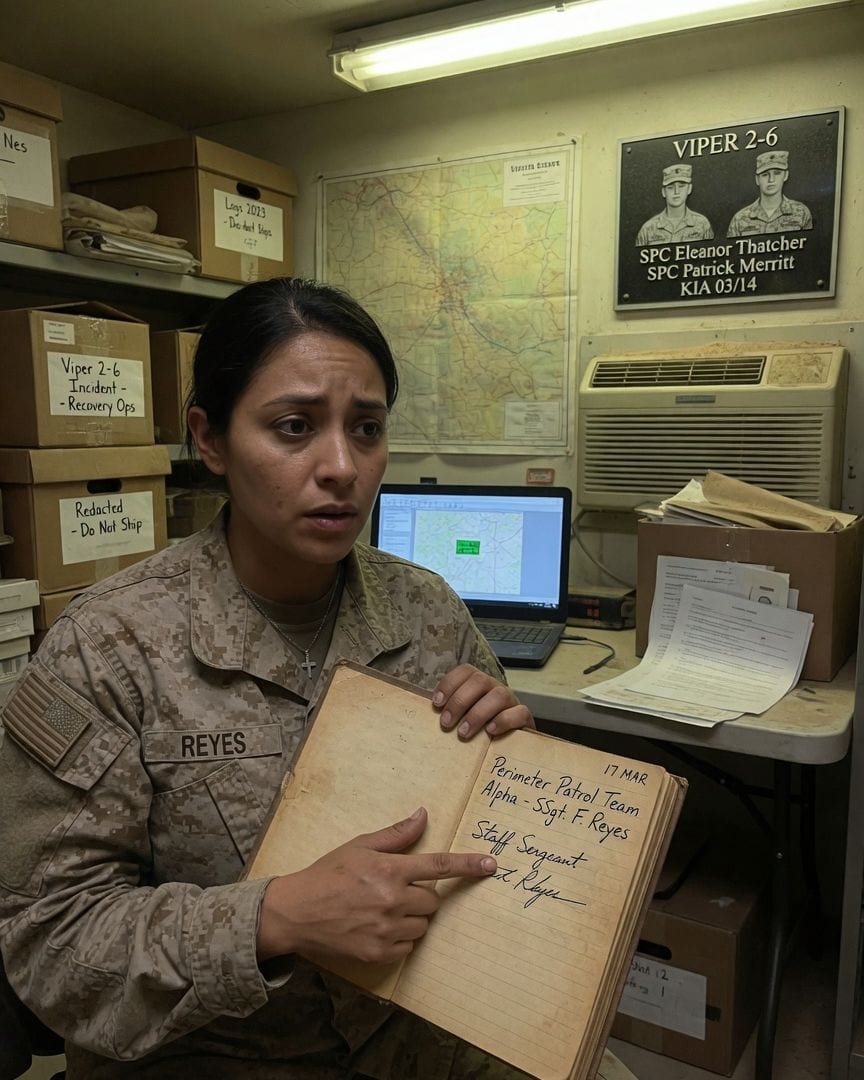
A Staff Sergeant, three weeks from transfer, finds her own signature in a logbook for a patrol she never made.
Staff Sergeant Fiona Reyes counted down her last three weeks at the high desert outpost, the fluorescent hum of the TOC a constant companion amidst the dust and old equipment. Her tired eyes scanned the digital map when an impossible icon, 'Viper 2-6' – a vehicle and crew lost last year – blinked alive, reporting its position and crawling steadily toward the base. Despite commanders dismissing it as a system ghost, Reyes meticulously searched dusty archives, finding strange log entries of phantom contacts and radio chatter, all dismissed as malfunctions. But the true chill came when she unearthed a field logbook from the recovery efforts, revealing her own undeniable signature on a perimeter patrol dated last year, a patrol she knew, with every fiber of her being, she had never made.
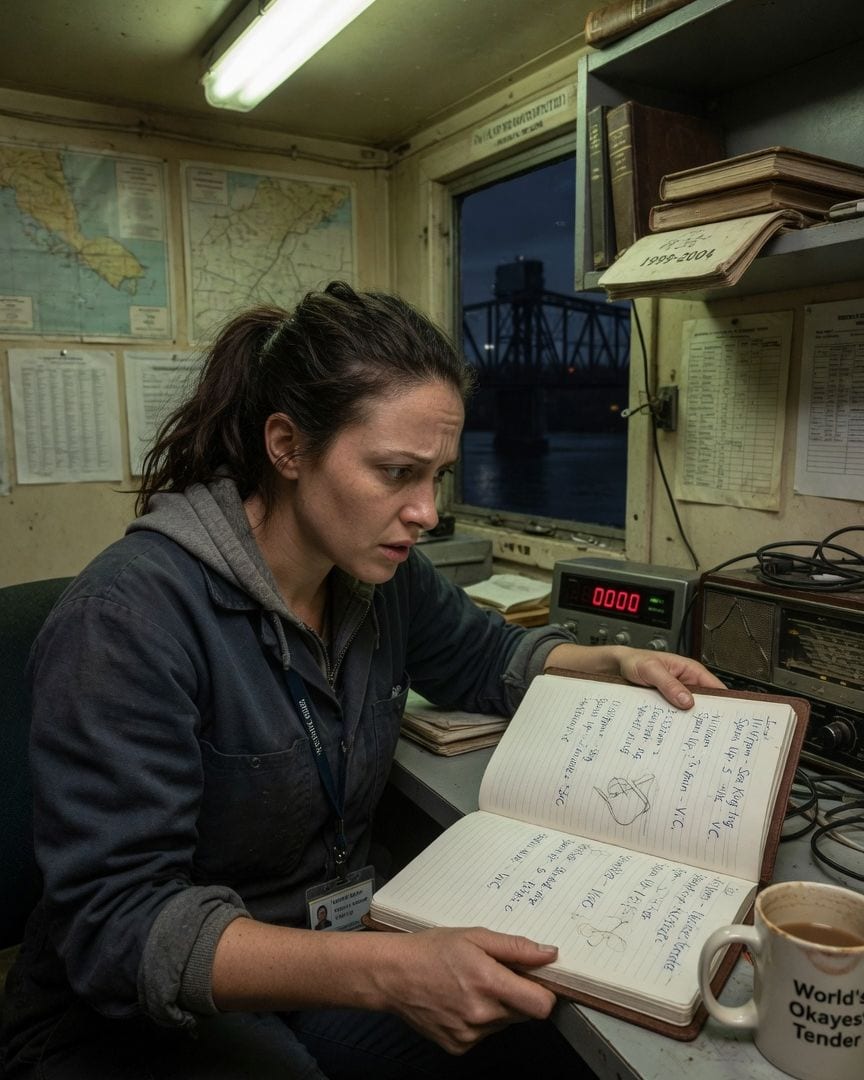
My drawbridge log shows a 2:33am lift I didn't make. The span counter never moved.
As a drawbridge tender, my midnight to dawn shift is usually quiet, a routine of monitoring traffic and logging lifts. But tonight, my own logbook shows an impossible entry for a bridge lift I have no memory of making. My initials and handwriting are there, yet the span counter above my panel reads a steady zero. No boat called, no span ever went up.
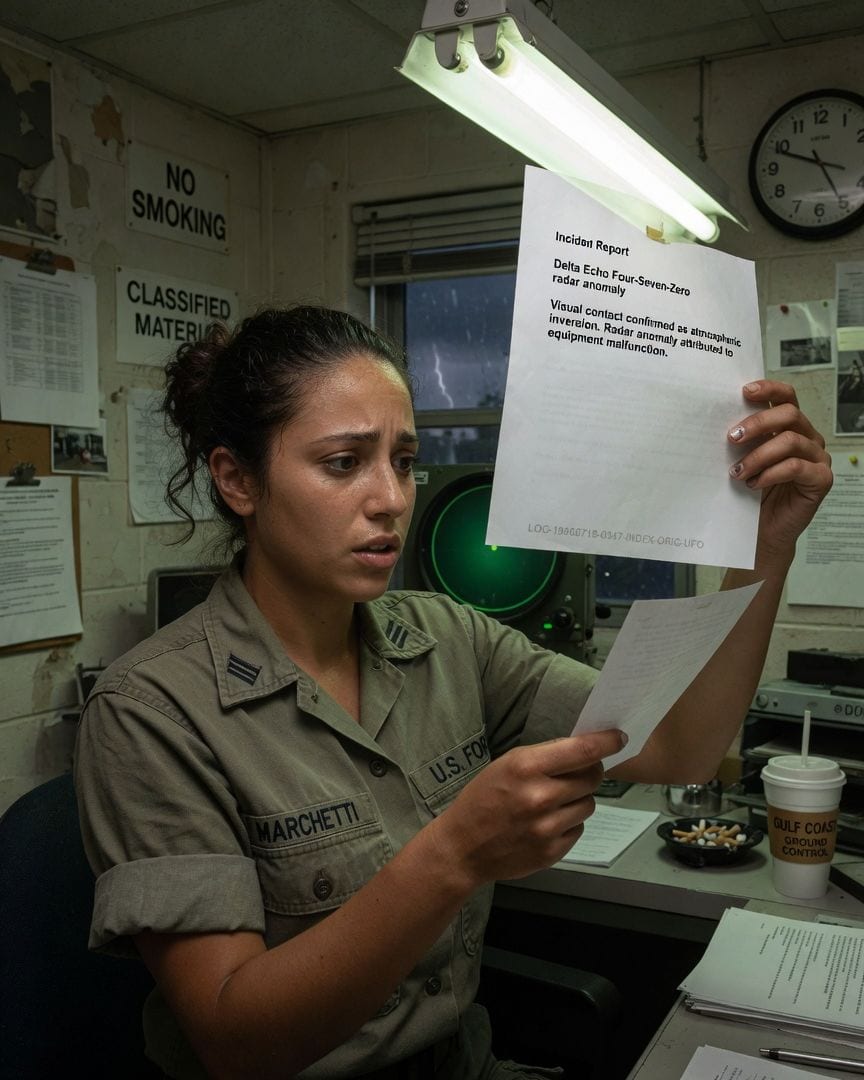
A radar operator's official report changed her UFO sighting to a malfunction, signed by her own system.
Technical Sergeant Odile Marchetti, a 22-year-old radar operator, was deep into a routine midnight shift at a dimly lit Gulf Coast ground control site in 1996, the air thick with an approaching summer storm. Her quiet night shattered when a pilot reported an impossible second return on her scope, a blip twice the size of an airliner that then vanished into the original. But the true dread settled in the morning when the official incident report, meant to log her 'UFO' sighting, returned with a mundane explanation she hadn't written. Scrutinizing the paper, she found a faint digital watermark: a sequence of numbers from her own system, silently falsifying her record. Who had overridden her log, and why?
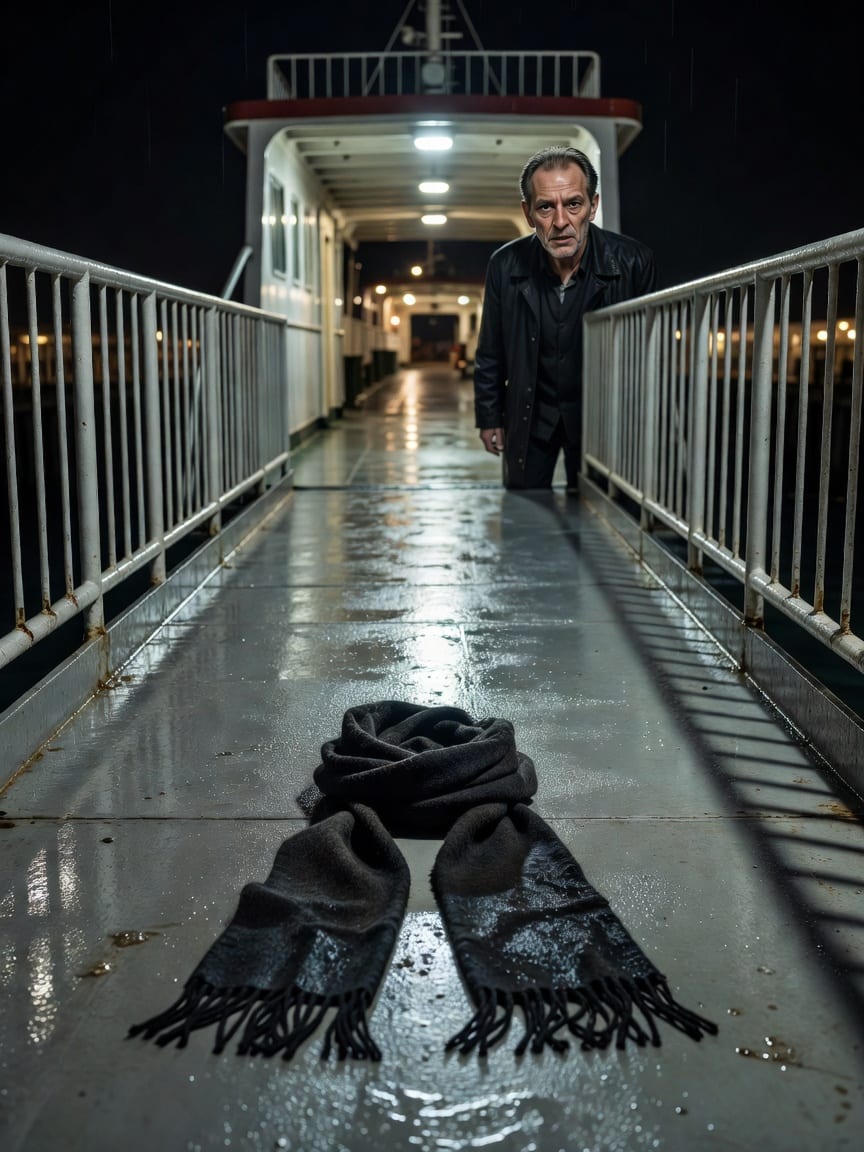
My ferry's night log recorded a foot passenger disembarked at 2:15 AM. We don't sail until six, and I wrote the entry myself.
Working the night shift on the 'Sound Clipper,' I found my own handwriting in the watch log recording an impossible event: a foot passenger disembarking at 2:15 AM. The ferry was tied up, engines cold, and the gangway locked tight. No one could have left, yet the entry was undeniable, signed with my initials.