A military specialist watched her lead truck vanish and reappear closer. The convoy log said 'no stops,' but her secret cargo felt warm with a 1978 Cold War project stencil.
Specialist Cleo Marchetti gripped the steering wheel, the hum of her truck a steady drone against the vast, empty canvas of the Nevada desert night. Her job, at 0200, was to keep the lead truck's taillights in sight.
Sergeant Caldwell, in the cab ahead, was just a pair of red pinpricks on the desolate road. Then, they simply blinked out.
Not a brake light, not a turn signal, but the entire glowing presence of a heavy military transport truck, gone. Cleo braked hard, the unidentified craft strapped behind her cab shifting with a low groan.
Four minutes passed in absolute silence, the only sound the faint hiss of her own idling engine, the desert air unnaturally still.
Then, the pinpricks reappeared, not ahead where they had vanished, but three hundred yards closer than they had been before. Cleo’s hands tightened on the wheel, her knuckles white against the black plastic. She radioed Caldwell.
His voice came back calm, matter-of-fact. 'Everything nominal, Marchetti. Keep pace.'
At 0431, both trucks arrived at the depot. Cleo, still numb, watched Caldwell swing his rig into its bay. She signed the convoy log, which stated, in clear, unblemished ink, 'No stops. ETA met.'
The log was right about the time. That was the part that truly frightened her.
The next morning, Cleo attempted to file an incident report. Her immediate superior, a tired-looking Lieutenant with shadows under his eyes, listened patiently, then dismissed it as 'desert mirage, night fatigue.' He pointed to the signed log: 'No discrepancies, Specialist.'
Cleo, methodical by nature, couldn't let it go. Her professional integrity, her grip on reality, depended on it.
She spent her lunch break at the depot, examining her own truck. She checked the odometer, the fuel consumption, the internal GPS logs – all perfectly aligned with a non-stop journey. No evidence of braking, no four-minute idle.
It was as if the event had never occurred for her vehicle. The records mirrored the official log, denying her own perception.
Next, she approached the 'unidentified craft' she'd transported. It was a sleek, dark form, tarped for discretion but still imposing.
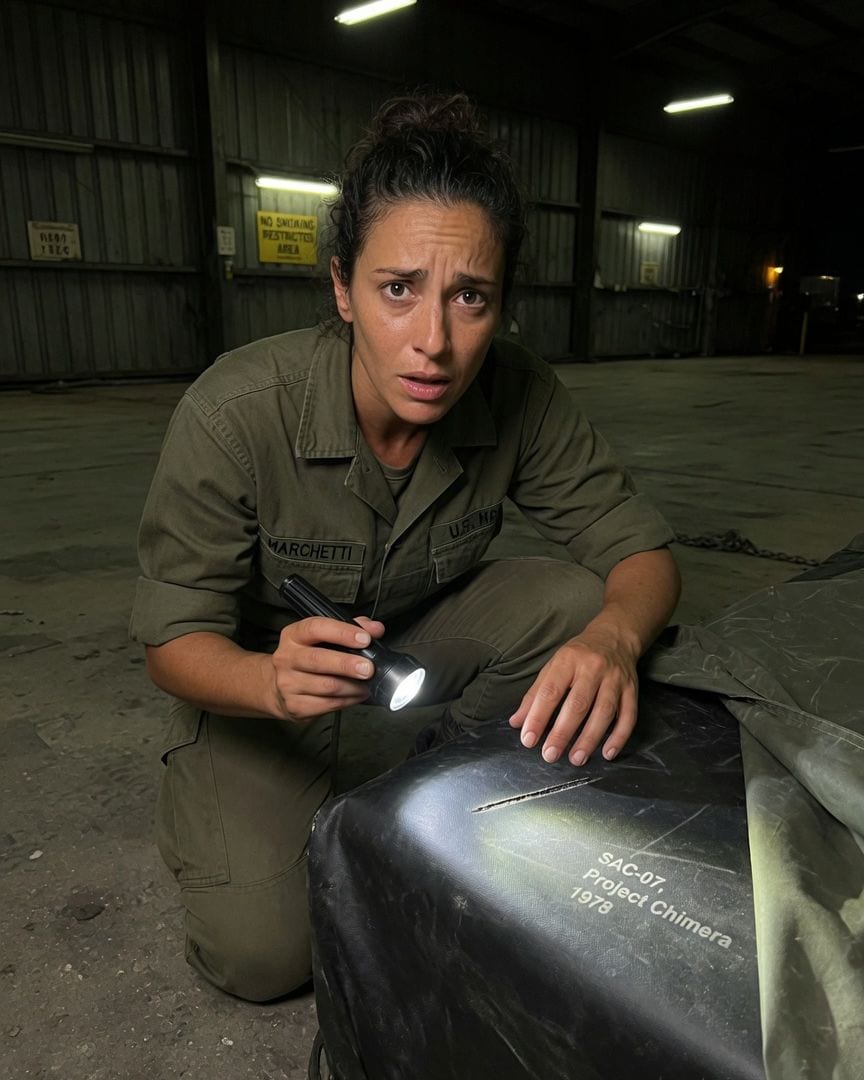
As she circled it, her flashlight beam sweeping across its surface, she noticed something impossible: a faint, almost invisible scratch near the base, barely a half-inch long.
It wasn't deep, but it was fresh, a pale line against the craft's matte surface. She knew for a fact it hadn't been there when she inspected the cargo before departure.
It was exactly the kind of mark that could occur if something had shifted during a sudden, unexpected stop, or if the craft had scraped something when it reappeared. But the log said no stop.
She touched the scratch, a cold dread settling in her stomach. This was physical proof of an event that officially didn't exist. The depot's vast, echoing space seemed to press in around her, the air suddenly thick with unasked questions.
Cleo knelt beside the craft, examining the scratch more closely. It was so faint, she almost missed it.
But then, beneath the fresh mark, barely visible to the naked eye, she saw something else: an even older, more faded abrasion, running perpendicular to the new one.
As she traced its faint outline, her fingers brushed against a small, almost imperceptible stencil. She squinted, wiping away a thin layer of dust. The letters, though faded, were clear enough: 'SAC-07, Project Chimera, 1978.' Her mind reeled.
SAC-07 was a Strategic Air Command designation, deactivated decades ago. Project Chimera was a classified program from the late Cold War, long since buried. Yet, the manifest for her current convoy clearly listed this craft as 'Asset-Gamma-3, Project Nightfall, 2024.'
The craft itself looked pristine, modern, undeniably 2024. But the 1978 stencil was undeniable, feeling impossibly warm beneath her touch.
The 'SAC-07, Project Chimera, 1978' stencil became Cleo's anchor in a sea of impossible facts. She couldn't report it directly without sounding insane, or worse, insubordinate. Instead, she began a subtle, off-the-books investigation.
During her downtime, she frequented the base library's restricted section, ostensibly researching 'historical convoy logistics.' The hushed quiet of the library felt like a fragile shield against the escalating wrongness.
She cross-referenced every mention of SAC-07, Project Chimera, and any associated 'asset transport' she could find. Most records were classified or heavily redacted, but enough fragments existed to paint a disturbing picture.
There were mentions of 'unexplained delays' and 'anomalous energy signatures' during long-haul transports in the late 70s and early 80s, often tied to 'specialized cargo.'
The descriptions were vague, but the operational parameters—desert routes, 0200 departures, 'unidentified assets'—mirrored her own experience with chilling accuracy. She found a single, grainy photograph of a similar craft from 1979, the same sleek, dark profile, but no visible markings.
The official explanation for these incidents was always 'equipment malfunction' or 'pilot error,' but the frequency and specific details, once isolated, coalesced into something far more deliberate.
The mundane explanations were failing, one by one, under the weight of accumulating, impossible coincidences. The air in the archive stacks seemed to thin with each new discovery, making it harder to breathe.
Cleo's quiet inquiries didn't go unnoticed. One afternoon, as she was reviewing a microfilm spool about 'Project Chimera logistical anomalies,' a figure appeared in the doorway of the deserted records office.
Captain Reynolds, an internal security officer known for his quiet intensity, leaned against the frame. His uniform, perfectly pressed, stood out against the dusty shelves.
'Specialist Marchetti,' he said, his voice flat, cutting through the whirring of the microfilm reader. 'Interesting choice of research. Most personnel stick to current operations.'
Cleo felt a cold knot in her stomach, the fluorescent lights humming overhead suddenly too bright. 'Just a historical interest, sir. Understanding past challenges informs present solutions.'
Reynolds simply nodded, his gaze lingering on the microfilm reader, then settling on her. 'Indeed. But sometimes, Specialist, past challenges are best left in the past. Especially when they involve assets that are… sensitive.'
He didn't raise his voice, didn't make a direct threat, but the implication was clear, heavy in the silence of the room. The stillness of his posture was unsettling.
Later that week, Cleo found her access to the restricted section revoked without explanation. A new, generic 'system error' message popped up whenever she tried to log in. The monitor gave a series of sharp, electronic chirps, like something trapped.
She also noticed her personal laptop, usually reliable, had undergone a 'routine security update' that wiped her recent search history. The hunt had stopped being abstract; it was now personal, and she was no longer just the hunter.
Undeterred, Cleo found an old, retired archivist, Edward Carver, who used to work on Project Chimera files. He had been a name she found on a list of obsolete personnel.
She met him off-base, at a quiet diner, carefully gauging his reactions over lukewarm coffee. She started by asking about 'unusual transport incidents' from his era, watching his frail hands tremble as he held his cup.
Edward, frail but sharp, initially dismissed them as 'rumors, nothing more.' Cleo pressed, describing the vanishing taillights, the reappearance, the 'no stops' log, and finally, the 1978 stencil on her craft. Edward’s eyes, which had been distant, sharpened.
He leaned forward, lowering his voice, his gaze flickering nervously around the almost empty diner. 'It's not rumors, Marchetti. It's protocol.'
He explained that 'Project Chimera' wasn't about the craft itself, but about its movement. The craft, he said, had a 'peculiarity.' It didn't just get transported; it sometimes chose its destination, or its timing.
'It's a temporal displacement, a jump,' Edward whispered, his voice barely audible above the clatter of a distant dish. 'The craft… it moves itself. Or it gets moved by something else, through time and space. The convoys?
We just pick it up where it lands, and take it to the next designated point. The logs? They're reconciled. Not falsified, mind you. Just… adjusted. To reflect the final outcome, not the messy middle.
The official record always shows a seamless journey. It has to.'
Cleo felt a chill colder than any desert night. The pieces clicked: the impossible log, the fresh scratch, the old stencil. It wasn't a cover-up of a single event; it was a system of managing a recurring, impossible phenomenon.
The dread wasn't in the lie, but in the truth of the system's perfect, patient coherence.
Edward, seeing her horrified comprehension, grew agitated, his hands now shaking noticeably. 'They've been doing this for decades, Marchetti. It's always 'Asset-Gamma-3.' Always the same Nevada corridor. Always the same… adjustments.' He pushed a brittle, yellowed file across the table.
The paper rustled dryly. 'This is from '83. 'Unexplained temporal displacement, Asset-Gamma-3 transport.' Look at the 'Personnel Noted' section.'
Cleo's hands trembled as she opened it. The report detailed a convoy incident almost identical to hers. Same time, same location, same 'no stops' log. Under 'Personnel Noted,' a line was heavily redacted in thick, black ink.
But the red ink was old, faded. And below it, faintly visible, was a handwritten entry, almost erased by a smudged thumbprint: '…iver: MARCHE…'. Cleo's breath hitched. Her heart hammered against her ribs.
She pulled out her own service ID, clipped to her belt. Her name, Cleo Marchetti, stared back at her from the laminated plastic.
Her convoy's specific cargo designation, 'Asset-Gamma-3,' was listed in an incident report from forty years ago, and a fragment of her own name was right there, as if her current transport was just another iteration of a long-standing, recurring event.
She wasn't an anomaly. She was a pattern.
The full, monstrous shape of the pattern snapped into place. Cleo wasn't just a witness; she was a participant in an ongoing, orchestrated dance. The 'unidentified craft,' Asset-Gamma-3, wasn't merely moved; it moved itself, initiating these temporal displacements at irregular intervals.
The convoys, the drivers, the logistics, the 'corrected' logs – they were all part of an elaborate, decades-long system designed not to control the craft, but to respond to its movements.
The military wasn't containing it; they were its handlers, its chauffeurs, picking it up wherever it landed after a 'jump' and delivering it to its next pre-determined destination.
The 1978 stencil, the 1983 incident report, her own experience in 2024 – all were perfectly coherent data points in the craft's own timeline.
Her name, half-erased in an old file, meant she wasn't just involved in this incident, but potentially in others, her personal timeline subtly folded into the craft's cyclical existence.
The institution wasn't hiding a secret; it was maintaining a continuous, impossible reality. The logs were never wrong; they were always, terrifyingly, right about the rewritten present.
Cleo tried to document everything. She started a personal journal, detailing the incident, Edward's testimony, the old files. She wrote on the thin, crinkling pages in the dead of night, the scratch of her pen the only sound.
She tried to transfer to a different unit, requesting a posting far from any 'specialized asset transport.' Her transfer requests were met with endless bureaucratic delays, her emails unreturned.
Each time she clicked 'send,' the screen seemed to glare back, mocking her efforts.
One evening, Captain Reynolds appeared at her barracks. The air in her small room felt heavy, charged. He didn't speak of the craft, or the logs.
He simply talked about 'loyalty,' about 'the importance of discretion for national security,' and about 'the career opportunities for those who understand the larger picture.' He spoke calmly, without a hint of menace, which only made his words more chilling.
He offered her a promotion, a transfer to a 'special projects logistics' unit – a unit, she realized with a cold certainty, that was likely dedicated to managing Asset-Gamma-3.
The choice was clear: accept her role in the system, or become an unperson. She felt the weight of the institution, a patient, silent force that had already absorbed her.
She saw herself, a ghost in the machine, signing logs that contradicted her own memory, her own experience. She realized that escape wasn't an option; the system wasn't a prison she could leave, but a reality she was already inside.
She could try to expose it, but who would believe her against a perfectly coherent, perfectly 'corrected' paper trail? Her own log, the one she signed, already said 'no stops.' She was already filed.
Cleo accepted the promotion. She now oversaw the 'special projects logistics' unit. She no longer questioned the logs, no longer sought discrepancies. Her gaze, however, became sharper, more distant.
She would watch the other drivers, fresh-faced and eager, as they departed with their 'unidentified assets,' knowing that their own logs would return perfectly, impossibly correct.
She became a ghost in the machine, moving through the depot, processing paperwork, her own file now thick with 'exemplary service' records.
No one asked why her eyes held a faint, knowing flicker, or why she often paused, hand on the door, before entering the records office, as if anticipating a shift in the building's very foundations.
Cleo sat at her new desk, reviewing the manifest for the next 'Asset-Gamma-3' transport. The departure time was 0200. The route, a familiar stretch of Nevada road.
She picked up her pen, her hand steady, and signed the pre-filled 'no stops' log, already prepared for its eventual, seamless return. She glanced at the clock: 0155. The world was quiet, operating perfectly on its impossible schedule.
Her own reality had been filed, sorted, and stamped, just like all the others. She was no longer frightened by the log. She understood it. It was simply how things were.
Captain Reynolds observed Specialist Marchetti from his office doorway. She was signing the pre-dispatch logs, her expression calm, almost serene. He noted the faint, almost imperceptible smile that played on her lips.
It was the same smile he’d seen on others who had been promoted to this unit. He closed her new file, marked 'Active, Classified.' The system had integrated her perfectly. The file was still being signed.
If this one got to you
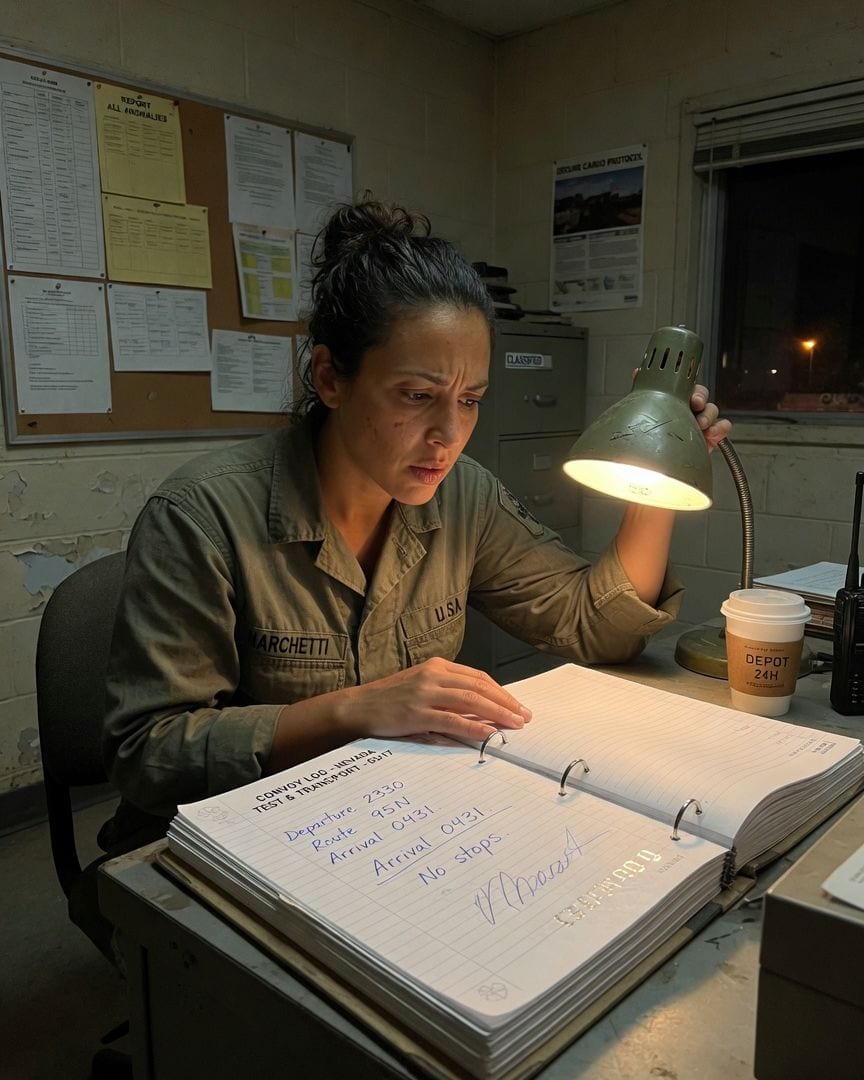
A transport driver's signed logbook claimed her four missing minutes in the desert never happened.
Specialist Cleo Marchetti followed the lead truck through the desolate Nevada desert, transporting an unidentified craft. Her only job was to keep the taillights of Senior Specialist Felix Hartley’s rig in sight. But at the halfway point, they simply vanished, leaving Cleo alone in the oppressive dark for four silent minutes. When the lights reappeared impossibly closer, Cleo knew something was terribly wrong. Yet, the official convoy log, bearing her own signature, recorded a perfect, uneventful journey with no stops. How could an entire four minutes disappear from the official record she herself confirmed?
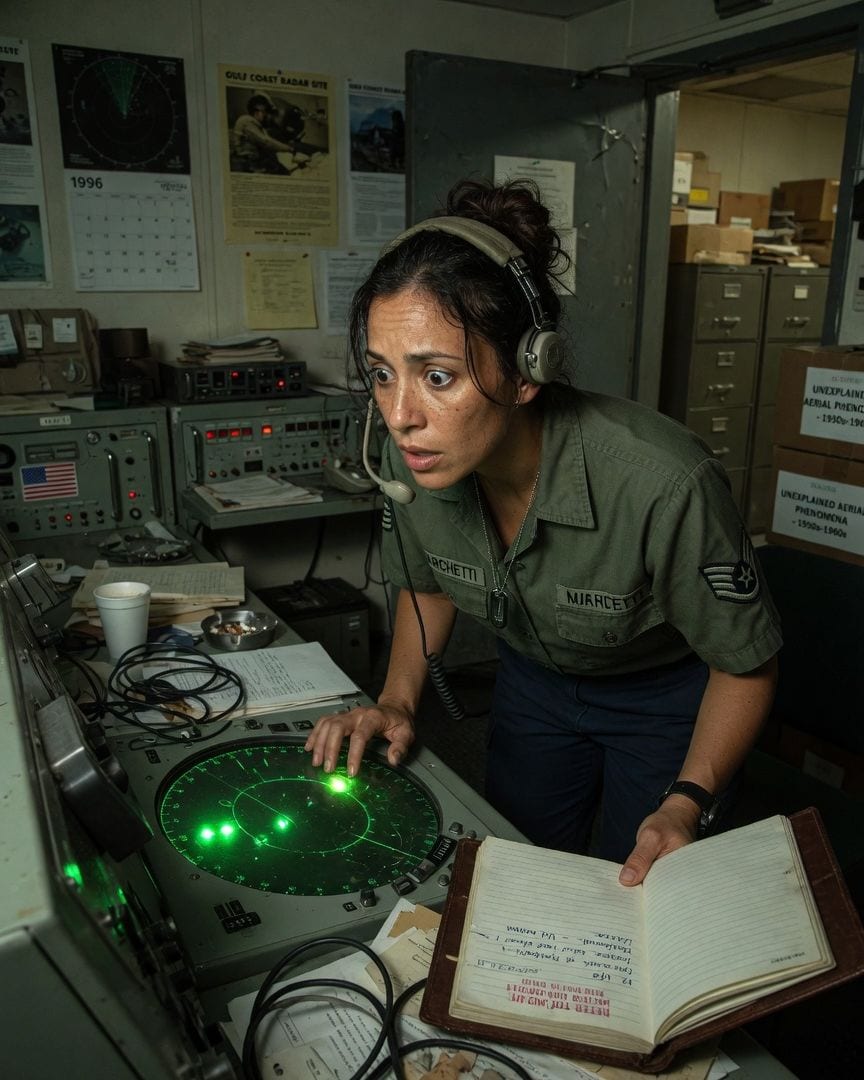
During her last weeks at the Cold War radar site, a technical sergeant logged a UFO. Her entry box was already stamped with a code from a missing 1958 jet.
Technical Sergeant Odile Marchetti was winding down her last few weeks as a radar operator at a remote Gulf Coast site in 1996. Alone in the cavernous room, she watched the green glow of her scope, the only light cutting through the pre-dawn gloom. At 2:30 AM, an airliner reported something flying in formation—a craft Odile couldn't see, until a massive, impossible blip bloomed beside it on her screen. After the pilot reported flying straight through empty air, Odile logged the UFO, only to find a faded, decades-old code already stamped on her logbook entry, identical to one on a missing jet report from 1958. Had this happened before, and was her own entry just a pre-written footnote in a much older, terrifying file?
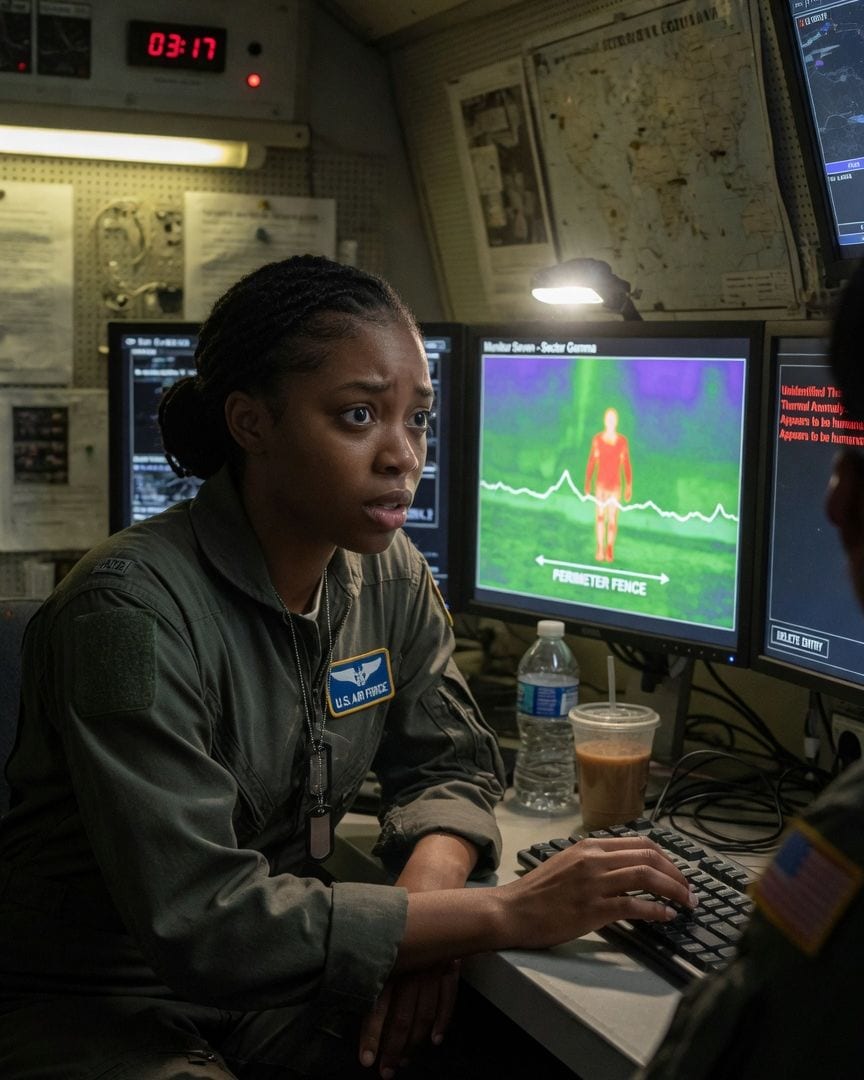
An airman’s thermal feed shows a figure moving in the restricted desert. Her captain orders it scrubbed, but the heat signature appears to tilt its head and look right at her.
Airman First Class Olivia Kade was new to her remote high-altitude outpost, fresh from advanced training, and the isolation pressed in, amplifying every hum. Her duty was to monitor the desert perimeter, but one shift, a faint thermal signature appeared on Monitor Seven: a solitary, upright figure moving with impossible precision beyond the barbed wire. No personnel were authorized in that sector. Her mission commander quickly ordered the anomaly scrubbed, but as it dissolved, the featureless outline seemed to tilt its head, looking directly into the camera. Now, the signature returns night after night, forcing the airman to wonder what impossible thing patrols the dark beyond the wire.
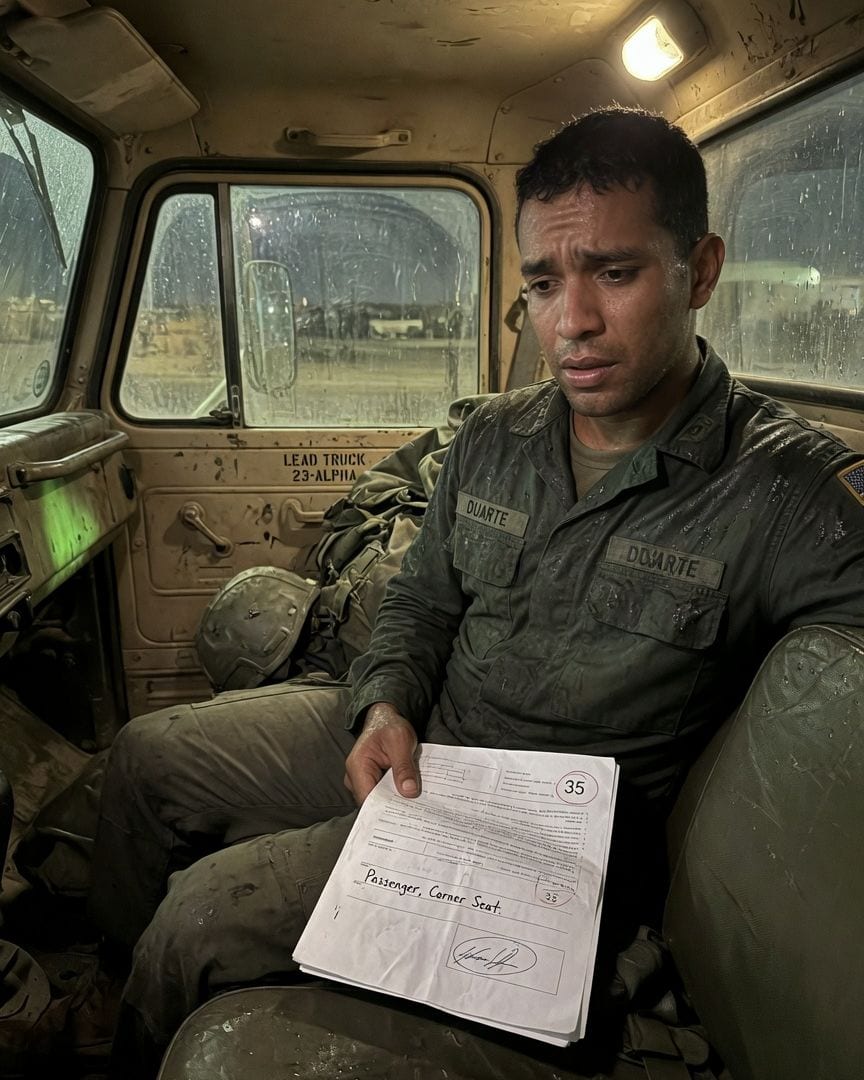
Specialist Duarte, two weeks from going home, found his empty truck seat warm and dented — then his service record showed a ghost deployment he never made.
Specialist Felix Duarte was just two weeks from going home, but a final convoy mission held an unsettling mystery. Soaked and running late, he squeezed into the lead truck's forbidden corner seat, a place every soldier knew to leave empty. Hours later, stepping out into the desert, he found the seat was strangely warm and distinctly dented, as if two unseen bodies had pressed in beside him. The official manifest then listed an extra soul for his truck, simply 'Passenger, Corner Seat,' signed by his own hand. What impossible presence had shared Specialist Duarte's ride, and what other records might it have altered?
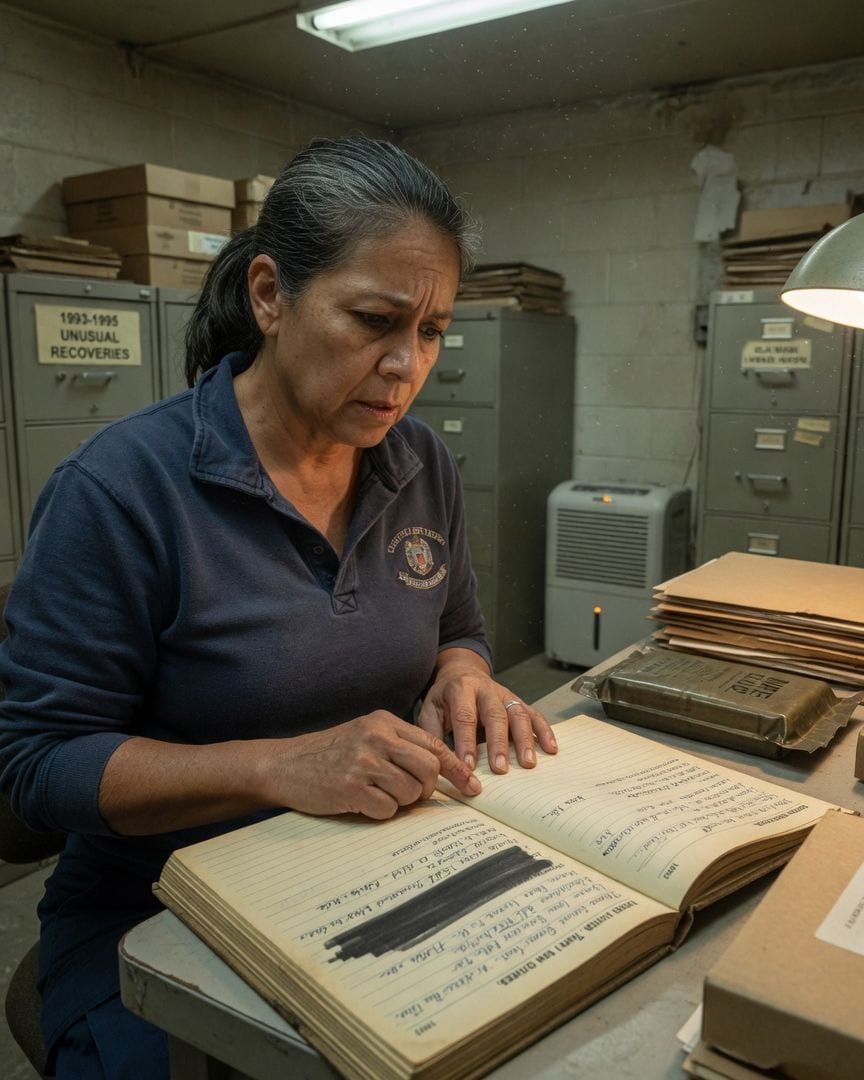
A retired Coast Guard pilot found her lost helicopter’s survival MREs, sealed for decades, stamped ‘EXP 203X.’
Ada Mireles, a retired Coast Guard pilot, faced a chilling discovery in the sterile evidence room. For decades, she had searched for Dune Two, the helicopter that vanished in '93, and now its mangled seat pan had been recovered from the Gulf. Among the debris, a sealed survival kit yielded MREs, their plastic casings cool and slick, but a pre-flight habit revealed an impossible expiration date: 'EXP 203X.' This future date defied all logic, sending her to dusty archives where a duplicate logbook entry for Dune Two recorded a kit issued in 1995, expiring in the 2030s, alongside a cryptic 'Project CHRONOS' note.
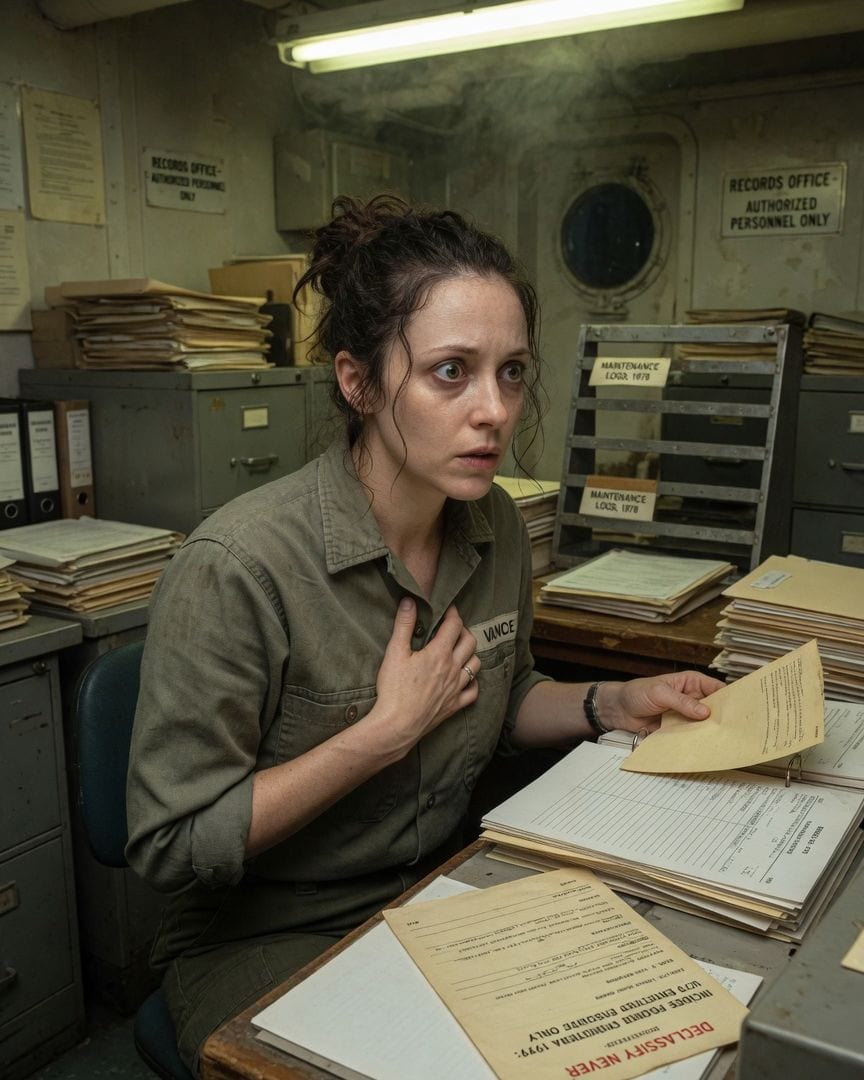
A Cold War carrier radar operator's first solo watch tracked a craft dropping 60,000 feet in four seconds. The next morning, her tape reel was gone.
A young radar operator, Peggy Vance, faced her first night alone in the USS Enterprise's Combat Information Center, the massive carrier steaming silently off San Diego. Her green-lit scope revealed an impossible contact: a craft dropping sixty thousand feet in under four seconds, then holding station just two hundred yards off the bow. Despite her detailed log, the tape reel vanished and official records showed no incident. The ship's history had been tampered with.