My bank app pinged a hardware store purchase three states away: shovel, rope, duct tape, 11:20pm. I was home in bed.
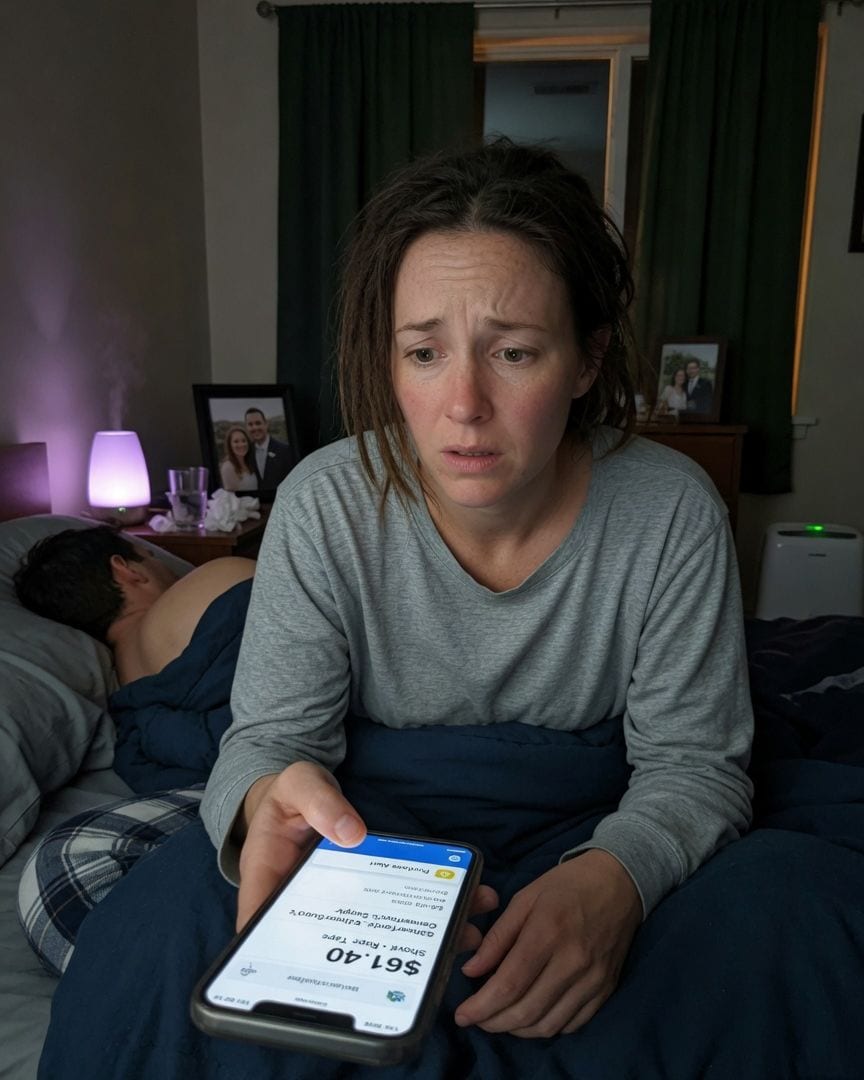
My bank app buzzed, a familiar, irritating thrum against the bedside table. I was already halfway to sleep, the low hum of the dehumidifier and Kevin’s even breathing a soothing rhythm. 11:20 PM.
Too late for anything important, I thought, probably just a spam notification. But then it buzzed again, insistent. My phone was already in my hand before I fully registered the action. My banking app, not social media.
A purchase alert. $61.40. Rutherford's General Supply. My brow furrowed. I didn’t recognize the name. The location beneath it pulled the last strands of sleep from my mind: Cedar Creek, VT. Three states away. My finger tapped the notification, pulling up the transaction details.
The items listed made a cold knot tighten in my stomach: Shovel. Rope. Duct Tape.
This was the third time this month.
The first was a week ago, Gardening Shears. Tarpaulin. Zip Ties. The second, four days later, Concrete Mix. Work Gloves. Face Mask. All late-night, all from this same obscure hardware store in Vermont, and all linked to my phone number through a ‘loyalty program’ I’d never heard of.
I’d called the bank after the second one, and they’d assured me it was a glitch, an error in their system, but the charges had cleared.
Kevin stirred beside me, a soft groan escaping his lips. "Everything okay?" he mumbled, his voice thick with sleep.
"Another one," I whispered, the words catching in my throat. I showed him the screen, the stark black text against the app’s white background.
He squinted at it, his eyes struggling to focus. "Still the glitch, Rach? You should just call them again in the morning. So annoying." He rolled over, pulling the duvet tighter around him.
But it wasn't a glitch. Not for me. A shovel, rope, and duct tape at 11:20 PM in a rural county I’d never visited was too specific for a mistake.
The familiar comfort of our bedroom, the scent of lavender from the diffuser, the heavy curtains blocking out the streetlights – it all felt suddenly paper-thin, a facade over something profoundly, impossibly wrong.
A metallic taste, like old coins, settled in my mouth. This wasn’t just a banking error. It was something else. Something colder.
The next morning, the "glitch" still gnawed at me. I called my bank again. The customer service representative, after a long hold, confirmed the transaction as legitimate. "It shows a loyalty program discount applied, Ms. Vance," she chirped.
"Everything appears in order."
"But I didn't make the purchase," I insisted, my voice tight. "And I've never been to Vermont."
She repeated that the transaction was legitimate and advised me to contact the merchant directly. Her voice had the glazed-over quality of someone who’d heard it all before, someone who wasn't truly listening.
So I called Rutherford's General Supply. A woman answered on the third ring, her voice calm, slightly gravelly, and entirely unbothered. "Rutherford's, Marianne speaking."
I explained, my story feeling increasingly surreal as I spoke it aloud. The late-night purchases, the loyalty program, the Vermont location. She listened patiently, making no interjections. "And your phone number, dear?" she asked when I finished.
I gave it to her. A moment of silence. "Yes," she said, her voice flat, "I see the loyalty number linked to that. And the recent purchases. Everything checks out here."
"But I didn't make those purchases," I reiterated, a growing, cold dread solidifying in my chest. "I need to know who did."
"We just process the transactions, dear. The system works automatically once the loyalty card is scanned." She sounded like a recorded message.
I needed to see it. Needed to touch the place, to see the face of the woman who processed these impossible transactions.
I told Kevin I was taking a day trip, needing to clear my head, omitting the true, terrifying purpose.
The three-state drive felt endless, the scenery blurring into anonymous rural landscapes, past fields and small towns that seemed to exist outside of time.
Finally, after hours of white-knuckled driving, my GPS led me down a winding road, past a single gas station, and then, there it was: a small, unassuming building with faded paint, its sign, equally faded, reading 'Rutherford's General Supply.'
It looked exactly as I imagined a general supply store in the middle of nowhere would – quiet, a bit ramshackle.
Inside, the air was thick with the comforting scents of sawdust, old metal, and something faintly earthy, like damp soil. Shelves were stacked high with tools, bolts, gardening supplies.
Marianne Rutherford, a woman in her sixties with kind but entirely unreadable eyes, emerged from behind a counter piled high with paint cans and gardening gloves. She wasn’t surprised to see me.
"You must be Rachel," she said, her voice the same calm, unbothered tone from the phone. It was unsettling.
I nodded, my throat suddenly dry. I pulled out my phone, showing her the most recent bank alert. "This is what I mean," I said, my voice barely above a whisper.
Marianne took the phone, her gaze flicking over the screen. She nodded slowly, then turned to her dusty computer terminal. With a few slow clicks, she pulled up the transaction, the screen a sickly yellow glow in the dim light.
Every detail was there, just as I’d seen it on my app.
Then, she looked up, her unreadable eyes meeting mine. Without a word, she reached under the counter and retrieved a laminated card. It was an application form. She casually slid it across the worn wooden surface.
'This is how we tie it to your number, dear,' Marianne said, her voice flat, entirely devoid of inflection. 'You filled this out last year, remember?'
I stared at the loyalty card application. My name, my address, my phone number. All printed neatly, somehow familiar, yet utterly foreign in this place. And at the bottom, a signature. It was mine. Unmistakably.
The looping 'R' and the precise slant of the 'V,' the way the 'e' trailed off – I’d practiced that signature since grade school, knew it as well as my own face.
The date on the form was eight months ago.
Eight months ago, I had been home, nursing a bad flu, barely able to lift my head, certainly not driving three states away to fill out a loyalty card application for a hardware store I had never seen, never even heard of, until today.
My hand, the one that wrote this, the one now trembling slightly on the counter, felt suddenly alien, disconnected from the undeniable proof on the paper before me.
I drove home in a haze, the image of my own signature, perfectly replicated on that loyalty card application, burned into my mind.
I showed Kevin the form, trying to explain Marianne’s unnerving calm, her claim that I’d filled it out myself. He looked at it, then at me, then back at the form, his face a mixture of confusion and concern.
"This has to be some kind of elaborate identity theft, Rach," he suggested, his voice trying to be reassuring but tinged with a tremor. "Or a sophisticated forgery. They can do anything with AI these days, right?
You should go to the police. Right now."
But I knew, with a certainty that chilled me to the bone, that without a clear perpetrator, without any physical theft, it would sound like madness.
A woman showing up with a copy of her own signature and a story about late-night shovel purchases in Vermont wouldn’t get taken seriously.
Instead, I sought out Mr. Davenport, a retired handwriting expert Kevin’s aunt had used for some estate documents. He was known for his meticulous, almost obsessive, work.
I provided him with the loyalty card application and a stack of old bills, letters, and even some signed checks – numerous samples of my actual handwriting from across the years. The waiting period was agonizing.
Every phone call made my heart leap, every email ping sent a jolt of anxiety through me.
After a tense few days, Mr. Davenport called. His voice was grave, serious. "Ms. Vance," he said, without preamble, "I've compared the samples. Extensively. Magnified them, traced every stroke. There's no doubt. It's yours. Not a forgery. Genuinely, unequivocally yours."
The phone felt heavy, hot against my ear. A cold dread, far deeper than any I'd felt before, settled in my bones, hardening them. The last sliver of rational explanation, of mundane theft, had just been extinguished.
I spent the next few days poring over my old calendars, confirming my whereabouts for the date on the loyalty card application. October 14th. I had been home, then. Flu-ridden, wrapped in blankets, binge-watching bad reality TV.
Definitely not in Cedar Creek, Vermont. The rational world was failing me, utterly. Every logical explanation I tried to construct crumbled under the weight of the impossible facts.
I then researched Rutherford's General Supply online, digging through local news archives, property records, anything I could find. But there was nothing unusual—just a quiet, family-owned business, seemingly unremarkable, existing in the forgotten folds of rural commerce for decades.
The internet, that vast ocean of information, offered no explanation, no flicker of wrongness to cling to.
I decided to go back to the store. This time, I was armed with the handwriting expert's confirmation and a desperate, primal need for answers. I didn't tell Kevin. I couldn't.
The long drive felt heavier this time, each mile a silent accusation against the ordinary world.
As I approached Rutherford's, I parked across the street, a slight drizzle beginning to tap on my windshield. I observed the unassuming storefront, the same faded sign, the same quiet air.
Marianne was inside, moving slowly, calmly serving a few customers, her movements practiced, almost ritualistic.
I felt a strange prickle on my neck, a sensation of being observed, a weight that wasn't there before, like a cold finger trailing down my spine. My eyes scanned the street, searching for nothing in particular, yet everything.
Then I spotted it: an old, dark sedan, parked a few spaces down from me, its windows tinted so black I couldn't see inside. A quick glance, and it appeared empty, inert.
But the feeling of being watched persisted, unsettling me, tightening the knot in my stomach. I took a deep, shaky breath, pushed open my car door, and walked into the store.
The bell above the door jingled faintly. Marianne looked up, her unreadable eyes meeting mine. There was no surprise, no recognition, just that same placid calm.
"Mr. Davenport confirmed it," I stated, my voice sharper, more accusatory than I intended. The words hung in the air, heavy and blunt.
Marianne's expression remained perfectly placid, but her eyes flickered, a brief, almost imperceptible shift. A small, knowing smile, thin as a razor's edge, touched her lips. "Remarkable, isn't it? The things people do."
Her voice was soft, conversational, as if we were discussing the weather.
I pressed her, my patience fracturing. "Who filled this out, Marianne? Who accepted it? Who's making these purchases? With my name, my number, my signature?"
She shrugged, a slow, deliberate movement. "We just process the forms, dear. Nothing more to it." Her gaze drifted over my shoulder, towards the front door.
I felt it again, that prickle on my neck. As I left the store, the dark sedan pulled away from the curb, its engine a low, guttural rumble, and disappeared down the road, swallowed by the gray afternoon.
It left me with a chilling certainty: my digging had been noticed.
I followed Marianne to a quiet corner of the store, away from the few lingering customers. The air in here was colder, smelling faintly of damp earth and something metallic. "Remarkable is an understatement, Marianne.
My signature, on a form I never touched, for a store I've never been to. And those bank alerts – shovels, rope, duct tape, at 11:20 PM. Who's buying those things? What is happening?"
Marianne sighed, a sound that seemed practiced, weary, but devoid of genuine concern. It was a sigh of resignation, not of empathy. "It's always the same, dear. Someone comes in, fills a form, takes a card. Late at night, mostly.
Like the purchases."
My heart pounded, a frantic drum against my ribs. "But who? Who are these people?"
Marianne looked at me, a faint, almost pitying smile playing on her lips. It wasn't unkind, but it was chilling in its detachment. "People who need them, I suppose. For their projects. Out in the woods, the quiet places.
We're just a supply hub." Her gaze drifted over the neatly stacked rolls of wire and a display of hunting knives.
I realized Marianne wasn't clueless; she was entirely complicit. Not malicious, not an antagonist in the conventional sense. She was 'the one who knew,' a quiet, unbothered facilitator, a cog in a larger machine that simply… existed.
"What kind of projects?" I pushed, my voice barely a whisper, the cold of the store seeping into my bones.
Marianne shrugged again, her eyes distant, as if looking through me to something far away. "Things that need to be... started. Or finished. Things that leave no trace."
The words hung in the stale air, heavy with unspoken implication. My mind raced, connecting the dots. The shovel, the rope, the duct tape. The gardening shears, the tarpaulin, the zip ties. The concrete mix.
These weren't random purchases by some anonymous customer. They were tools. Tools for creating something, or for disposing of something. The purchases weren't mistakes; they were functional, part of a process.
A chill ran down my spine as I connected the mundane items to the chilling phrase 'things that leave no trace.'
This store, this calm woman, these impossible records – they were all part of something far more organized and sinister than simple identity theft.
As Marianne turned to restock a shelf of spray paint, her back to me, my gaze fell upon a dusty, leather-bound ledger half-hidden beneath the counter, nestled between a stack of invoices and an old cash register.
Its leather was cracked with age, its pages thick with the ghosts of forgotten transactions.
"What's that?" I asked, pointing, my voice surprisingly steady.
Marianne hesitated for a fraction of a second too long, her placid expression faltering, a flicker of something unreadable in her eyes. "Old records. Nothing important."
But her hesitation was all the encouragement I needed. Emboldened by Marianne's quiet admissions and the cold certainty that I was onto something far bigger, I insisted. "Let me see it."
To my surprise, Marianne didn't fight me. With a resigned sigh, she slid the heavy book across the counter. The worn leather felt cool beneath my fingertips. My fingers, trembling slightly, opened the ledger.
It was a meticulously kept log of loyalty card applications and late-night purchases, each entry dated and signed. I flipped through pages, scanning names, dates, and item descriptions.
My own name appeared multiple times, across different dates, each entry accompanied by my perfectly replicated signature. The looping 'R', the precise slant of the 'V'.
Then I saw another name, one that made my breath catch in my throat, a sudden, desperate gasp for air that wouldn't come. Kevin Russo. My husband. And then, a neighbor from down the street, Adam Lambert.
Then Sylvia Underwood, a colleague from my office. All with similar late-night purchases in distant, rural counties, all with their own unmistakable signatures, as familiar to me as my own.
A chill that has nothing to do with the draft from the door crawls up my spine, a horrifying certainty that the pattern isn't just her; it's everyone she knows.
I slammed the ledger shut, the thud echoing in the unnaturally quiet store. The air felt heavy, suffocating. "My husband? My neighbor? What is this, Marianne?"
Marianne, leaning against the counter, her face now completely devoid of expression, finally spoke. Her voice was utterly flat, devoid of emotion, a monotone hum against the ringing in my ears. "It's a system, Rachel. Been running for decades.
People come and go. Others... need to exist, or disappear. We facilitate the paper trail. The records. The purchases." She gestured vaguely around the store, to the shelves of tools, the bins of screws, the paint samples.
"This place, the items, the loyalty cards, the signatures – it all builds a credible, untraceable existence. A life, a ghost. Just like yours, Rachel. You're just one of the latest templates."
I understood with a sickening, gut-wrenching clarity. The shovels, rope, duct tape – they weren't for some hobbyist building a shed. They were tools for creating physical sites for these ghost identities, or for burying traces of their inception.
The signatures, so perfectly hers, and Kevin's, and Adam's, and Sylvia's – it wasn't a crude forgery.
It was biometric data, perhaps, or an advanced deep-fake AI that could replicate handwriting from existing samples, pulled from the endless digital detritus of their lives.
It wasn't about her identity being stolen in the traditional sense; it was about her identity being borrowed, replicated, and used to provide a credible, untraceable existence for someone or something else.
Her life was a blueprint, a template, being used to construct other lives, other deaths, in the shadows. The sheer scale, the quiet efficiency, the cold indifference of it all, was the true horror.
My mind raced, a frantic hamster on a wheel, searching for an escape, a way to fight back, to unravel this monstrous system. "I'll go to the police. I'll expose this. I'll tell everyone."
Marianne shook her head slowly, a faint, almost imperceptible smile touching her lips. "Who would you tell, Rachel? That your bank account is buying supplies for someone else's ghost life? That your signature is being used to create new people?
They'd call you delusional. This system is too deep, too quiet. It's been running since before you were born. Since before your parents were born, probably. We're just a small part of it. A necessary cog."
I realized the horrifying truth: the full truth was understood, but it could not be undone or acted on. There was no one to fight, no institution to expose.
It was a vast, decentralized operation, woven into the fabric of anonymous rural commerce, too subtle, too pervasive to be touched.
I considered running, changing my identity, disappearing myself, becoming a ghost in truth, but then the names in the ledger flashed before my eyes: Kevin Russo, Adam Lambert, Sylvia Underwood. They were already in it. I was already in it.
The system had already claimed pieces of their lives, their identities, and mine. The knowing was the ending. The futility of resistance settled over me like a suffocating blanket, heavy and cold.
I reached for my phone, my thumb hovering over Kevin's contact. What would I even say?
How do you explain to your husband that his identity, and yours, is a template for the unseen, and that there's nothing you can do about it? The phone felt heavy, a useless weight in my trembling hand.
The silence of the store, broken only by the hum of an old fluorescent light above us, deepened the dread.
I looked at Marianne, who simply watched me, calm and unbothered, 'the one who knew,' a quiet sentinel of an inescapable truth.
I drove home in a daze, the miles ticking by unnoticed. The world looked the same, but it wasn't.
The sky was still blue, the trees still green, but beneath it all, an invisible current flowed, carrying pieces of our lives away.
Every bank notification, every form I signed, every mundane detail of my existence now carried a chilling implication.
I watched Kevin as he slept that night, his face soft and innocent in the pale moonlight, wondering if he knew, if he’d ever noticed a strange charge, a misplaced paper, a flicker of wrongness in his own life.
I never brought it up. The silence was heavy, a shared secret I carried alone, for what words could possibly convey such a burden?
The hardware store continued its business, an unassuming hub in a quiet county, its ledger silently growing, expanding the reach of the unseen system, one signature at a time.
I continued my life, a ghost within my own existence. I checked my bank app constantly, the notifications now a silent, terrifying tally of my replicated life, each ping a reminder that somewhere, another version of me was being constructed.
I saw Kevin sign a credit card slip at the grocery store one evening, his hand moving with familiar ease, and a cold certainty settled over me.
I knew, with absolute dread, that somewhere, another Kevin Russo was signing forms, making purchases, existing in the shadows, his identity now a template for the unknown.
I understood that I was not alone, but merely one thread in a vast, invisible tapestry. The dread was not in what I had lost, but in what had been taken and silently multiplied.
I lived with the knowledge that my life was not entirely her own, and never would be again, endlessly copied, endlessly used. The signature was hers, but the life it built was not.
If this one got to you
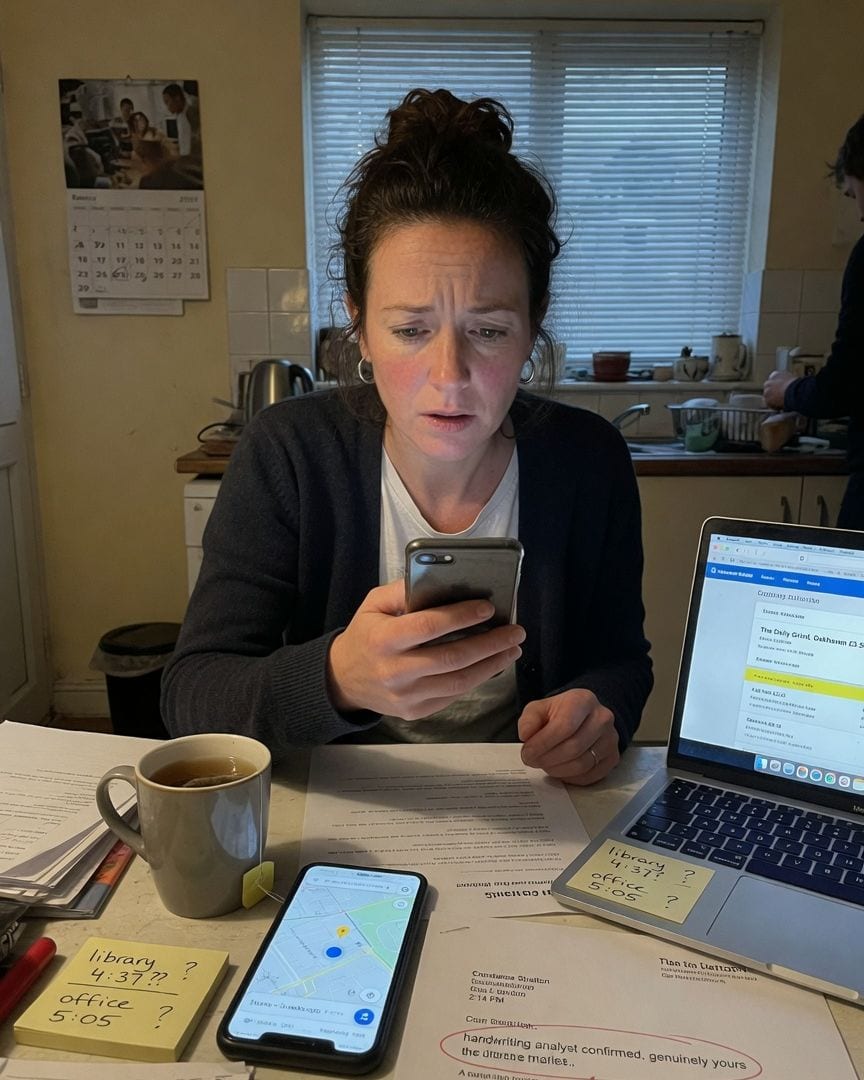
My signature covers a twelve-thousand-pound loan agreement. It's witnessed three hundred miles away, the day my phone confirms I was home.
My afternoon takes a chilling turn when the bank calls about a £12,000 loan, signed with my own handwriting in a town 300 miles away. My phone proves I was at my kitchen table at the time, yet a handwriting analyst confirms the signature is genuinely mine. The impossible truth deepens when a keycard log places me 100 miles away, just minutes before I entered my office.
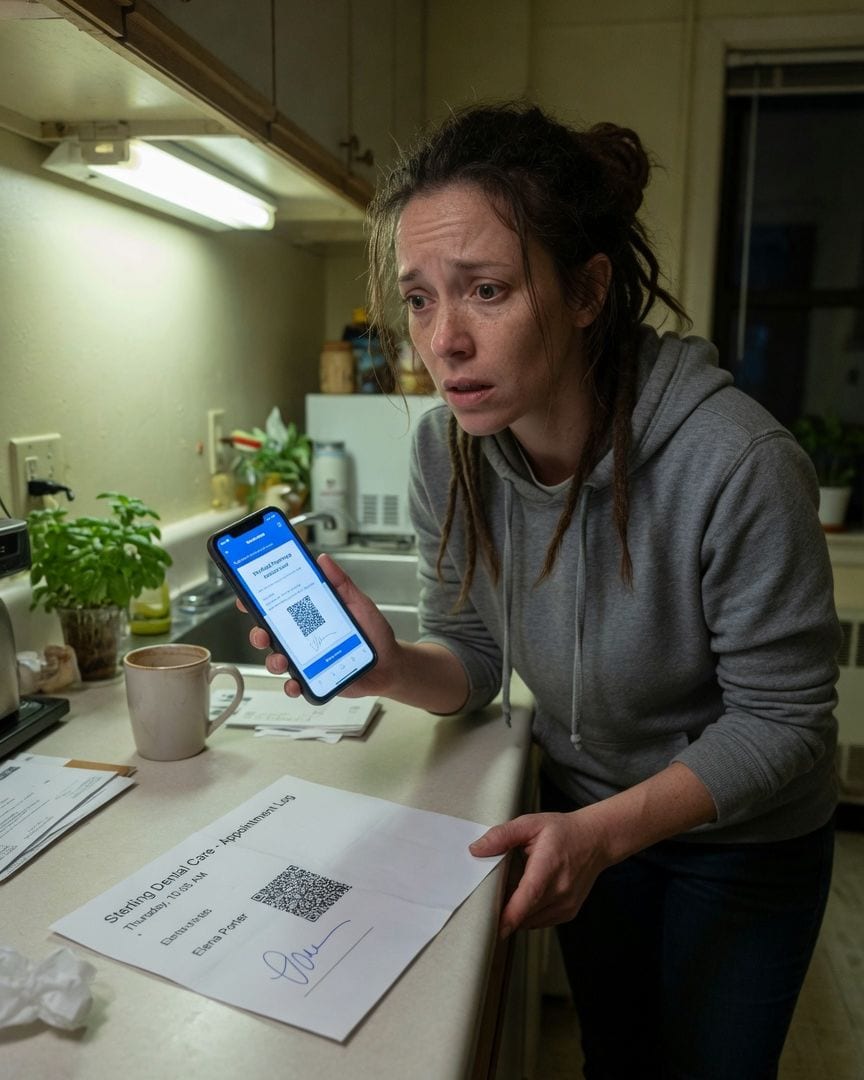
My dentist's system says I was there last Thursday. I wasn't. But the check-in tablet shows my signature, and the hygienist described my chipped tooth exactly right.
I received a call confirming a dental appointment I never made, for a day I was home. Yet, Sterling Dental had my perfect digital signature and described a chipped incisor I’d never told them about. The physical proof insisted I was there, but I wasn’t.
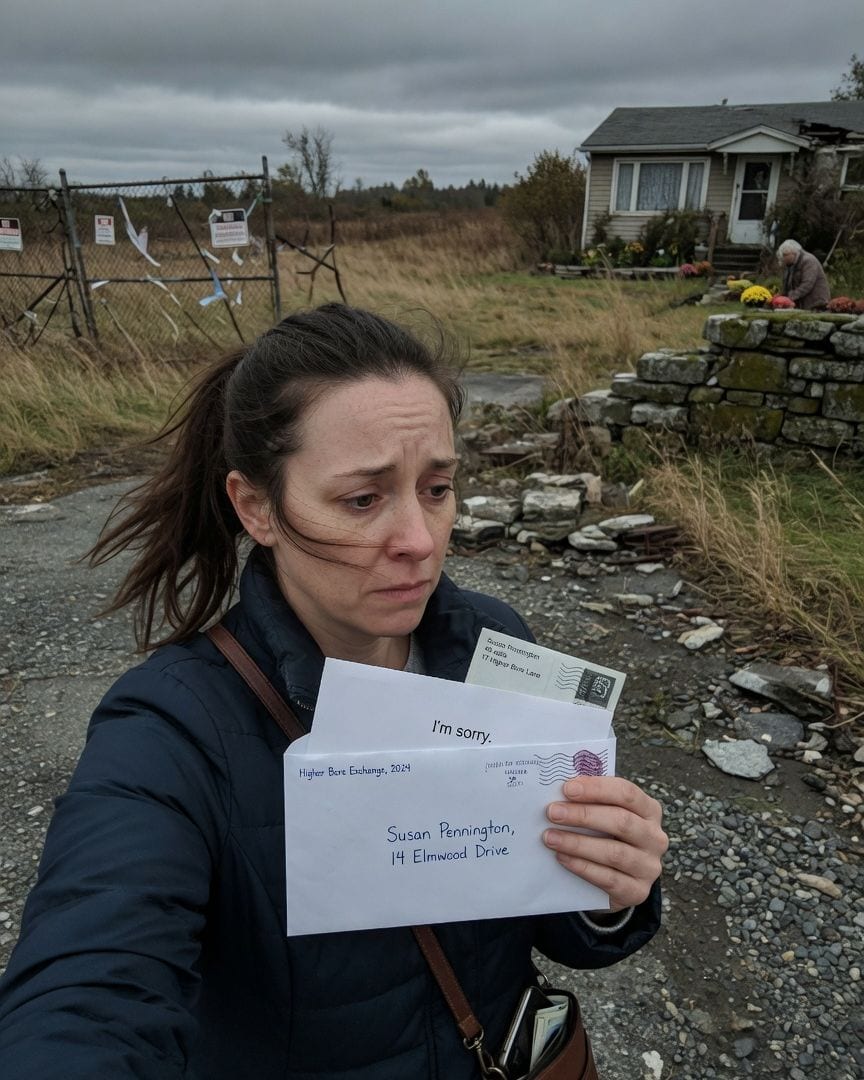
My phone bill listed forty calls made at 3:14 AM to a house demolished in 1990. The paper bill came from a flattened building. My name is on it.
I stared at my phone bill, my morning coffee forgotten. It detailed forty calls, each at 3:14 AM, to an address I knew was a vacant lot where a house had stood decades ago. But the real dread began when I saw the bill's return address: a telephone exchange flattened years before.
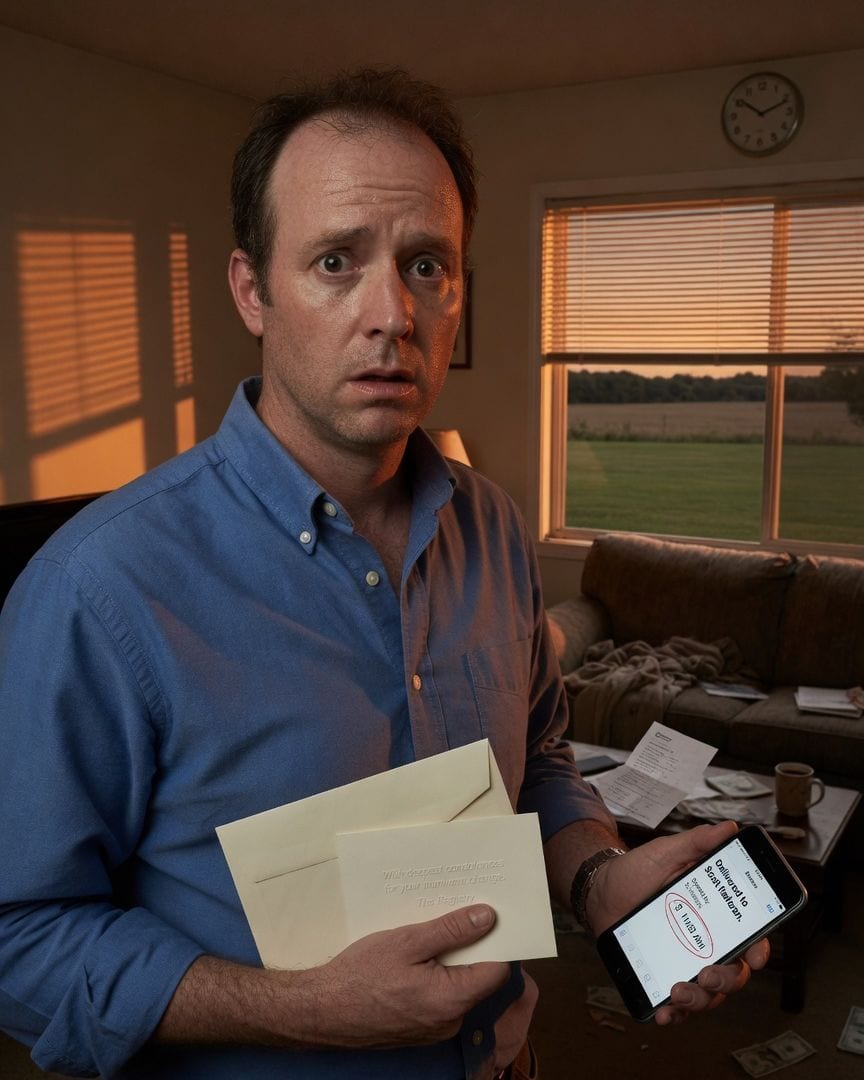
My delivery driver apologized for nothing. The app showed my signature, a completed drop, timestamped eleven minutes before he even arrived.
The delivery driver pulled away, leaving me on my porch with no parcel, yet my phone buzzed 'delivery complete.' The app showed *my* unmistakable signature, but the timestamp logged the delivery eleven minutes *before* the van had even pulled onto my road. A cold, digital lie.
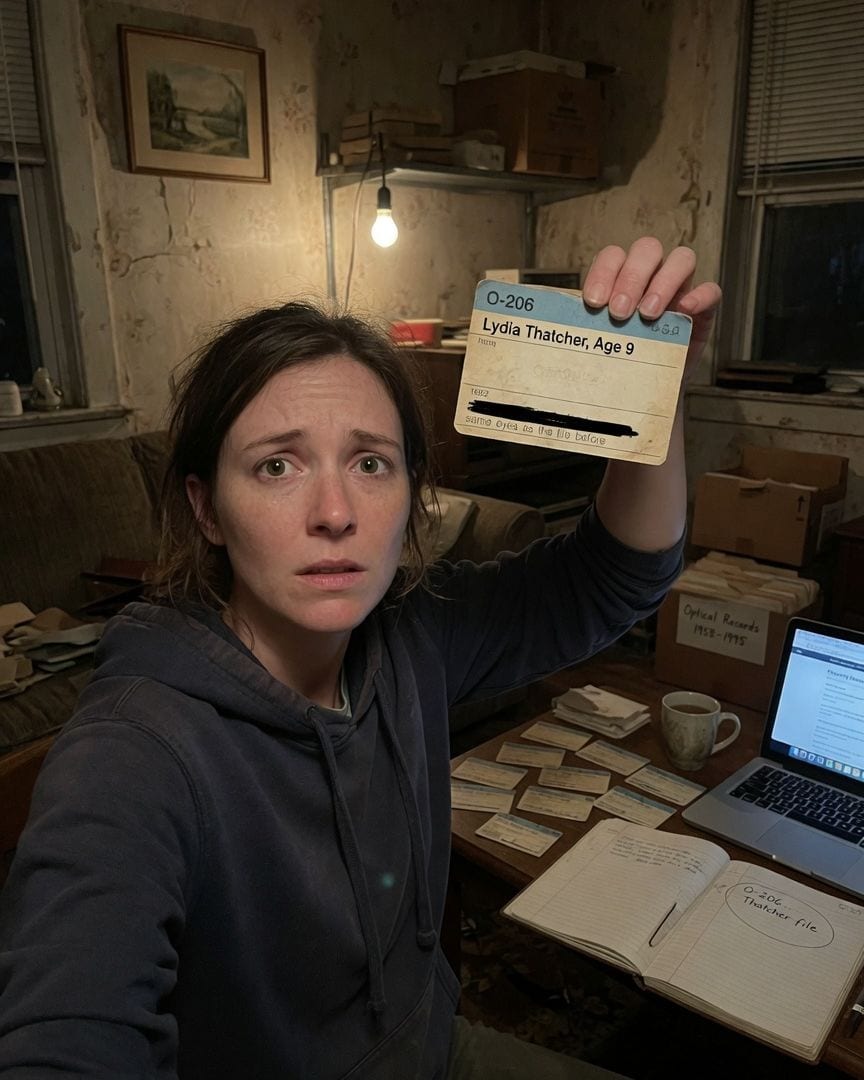
My own optical card is dated 1962, with my name on it. I wasn't born until 1993.
Sifting through old patient files from my former optical practice, I found my own O-206 card. It had my name, Lydia Thatcher, and my current home address printed on it. But the card was dated 1962, decades before I was even born, and a redacted note mentioned 'same eyes.'
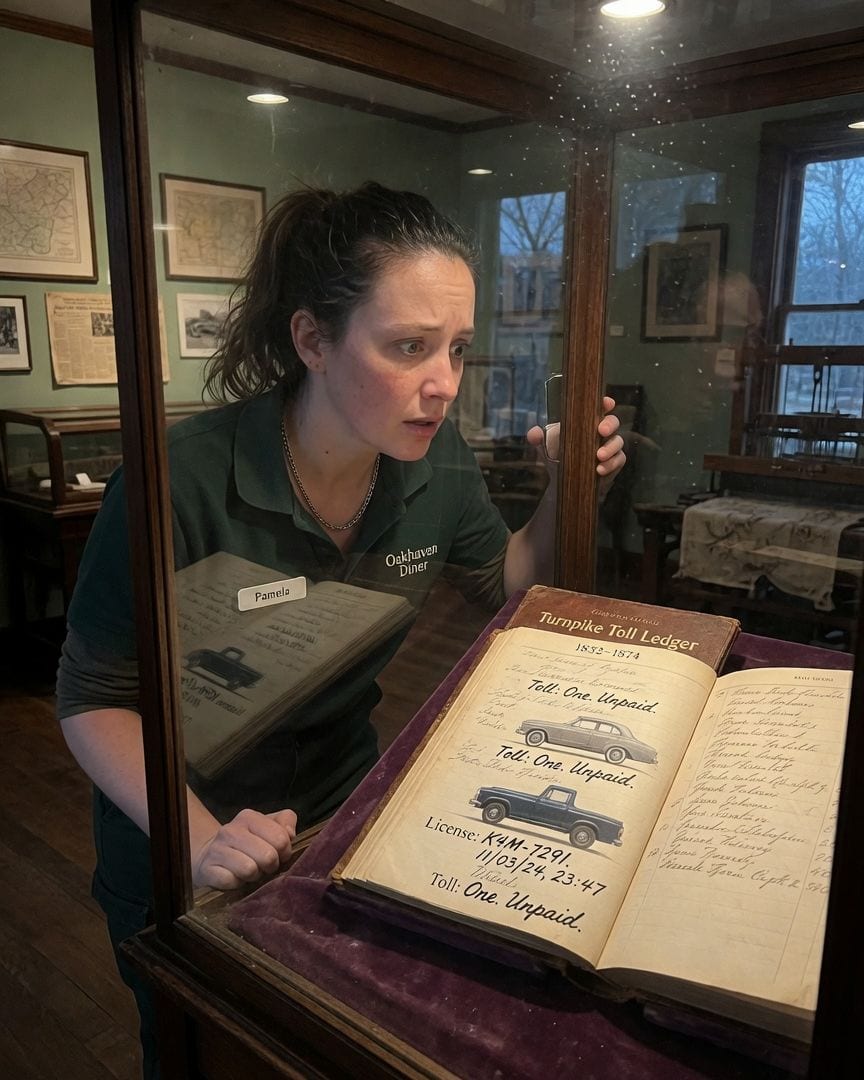
My car stalled at the old turnpike milestone, after dark. The toll ledger, closed in 1874, then listed my car, my stall time, and a toll of one, unpaid.
I had just moved to Oakhaven when my old sedan died on a dark, winding road by an infamous turnpike milestone. The next day, I found my car's exact registration and stall time written in fresh ink in a 150-year-old, locked museum ledger, marked 'Toll: One. Unpaid.' The curator dismissed it as a prank, but her white knuckles and strained voice hinted at something far more unsettling.