My basement window shows a gaslit kitchen moving at midnight, hams hung from the ceiling. My own kitchen is dark.
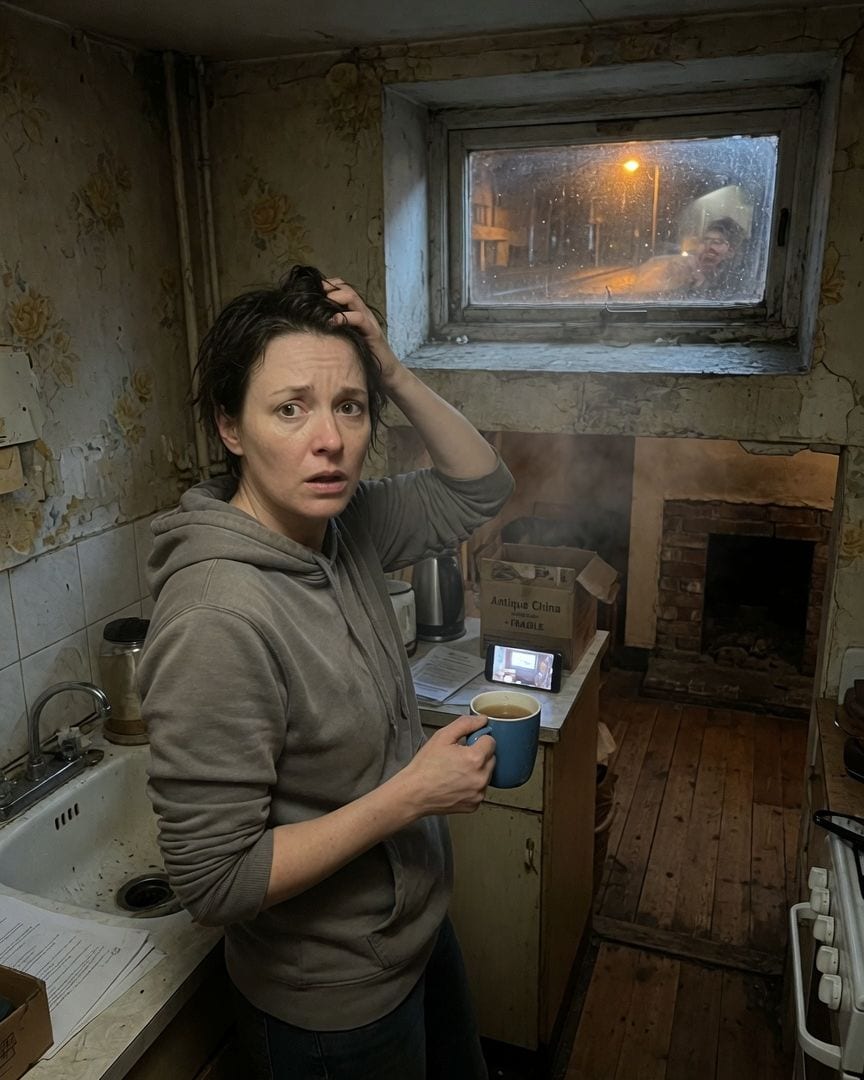
The first week in the basement flat, I put it down to exhaustion. Moving is hell, and I’d been working eighteen-hour days to get my antique furniture business off the ground. But then it happened again.
It was almost midnight, and I was making tea in my dark kitchen, the only light coming from the streetlamp filtering through the small, low window that sits at pavement level, right by my sink.
I glanced down, expecting to see nothing but the rough concrete of the window well. Instead, I saw a kitchen.
Not my kitchen. This one was bathed in a warm, flickering gaslight.
It was undeniably a basement, with low ceilings and rough brick walls, but the fixtures were all wrong – an enormous cast-iron range, a heavy wooden table, and hanging from the rafters, cured hams, swaying faintly as if caught in a slow, unseen breeze.
A young scullery girl, no older than sixteen, her hair tied back in a serviceable bun, moved with purpose, her back to me, scrubbing something in a huge ceramic sink.
The details were too sharp, too immediate to be a reflection. My own kitchen was dark, empty, save for my own tired reflection. The girl was real. The hams were real.
Then, a faint sound, like a poker working coals, a soft scrape-hiss from that unseen range. It wasn't just visual.
The air in my flat, usually cool and damp, felt suddenly heavy, carrying a faint, unmistakable scent of coal smoke, mixed with something else, a rich, savory smell like an old stew that had simmered for hours.
I blinked, rubbed my eyes. The vision was gone. Just the grimy window, reflecting the dim streetlamp. I told myself it was tiredness, a trick of light, a waking dream.
But the sharp smell lingered, even after I aired the place out.
And the sound of that poker, faint but rhythmic, had started to feel less like a memory and more like a heartbeat, thrumming just beneath the surface of the floorboards.
I spent the next day trying to debunk it, systematically. I checked the window for any unique reflective properties, but it was just old, single-pane glass, coated in decades of city grime.
No amount of angling or specific lighting reproduced what I’d seen. The clarity of the vision, the depth of field, defied any logical explanation of a reflection.
I even tried setting up my phone to record, but only caught myself looking confused.
As I moved around the flat, inspecting the old wooden floorboards, I noticed something else odd.
Near where the window was, a distinct, worn path ran from the living area directly towards what was now a bricked-up fireplace in the kitchen. The wood there was visibly thinner, smoother, a channel worn deep into the grain.
It made no sense for my own movements, or for anyone in a modern kitchen. No one would walk that exact path so consistently.
A quick search online for the building's history yielded some blueprints from the late 19th century. They confirmed it: the entire basement level had indeed served as a service kitchen and scullery. The window I was looking through?
It would have been right where the scullery maid worked, offering the only natural light in the subterranean space. The bricked-up fireplace would have housed the original cooking range.
This explained the layout, but it didn't explain the gaslight, the scullery girl, or the hams. Not when my own lights were off.
I asked my landlord about the previous tenants, specifically about anyone who might have had a peculiar obsession with the old kitchen. He scratched his head, thinking. "Oh, before you, it was a Mrs. Vance. Vera Vance.
Lived here for decades, bless her soul, until she passed in '98." He paused, then chuckled, a nervous sort of sound. "Bit eccentric in her later years, mind you. Started talking about 'the house having memories,' she did. Oddest thing."
A prickle of something cold and sharp ran down my spine.
The worn path on the floorboards, the lingering smell of coal smoke and stew, the undeniable vision through that grimy window—it all began to feel less like an old building settling and more like a story I'd somehow walked into.
And the rational explanations, the ones I'd clung to so desperately, were starting to fall apart around me like old plaster.
Driven by a persistent, unsettling hunch, I started systematically searching the flat's less-used corners.
I dragged out the heavy, dust-laden armoire that sat jammed into a narrow storage alcove off the main living area, a space I’d barely glanced at since moving in.
Behind it, half-obscured by cobwebs and decades of grime, sat a wooden trunk. It was old, dark, with rusted iron clasps, and a faded label, almost illegible, still clung to one side. I squinted. 'V. Vance,' it read.
My heart hammered against my ribs. I spent an hour, sweating, my muscles aching, prying at the stiff, corroded lock with a screwdriver. The metal shrieked as it finally gave way, splitting with a harsh crack.
I threw the lid open. Inside, beneath layers of moth-eaten linens that smelled faintly of lavender and dust, and a few forgotten porcelain trinkets, I found it: a leather-bound journal.
It felt ancient in my hands, its pages thick and yellowed. I opened it, my fingers trembling slightly. My eyes fell on the last entry, dated simply ‘October 23, 1997’. The handwriting was shaky, almost frantic.
It described in chilling detail the gaslit kitchen vision, complete with the scullery girl and the hams, ending with a barely decipherable signature: 'Vera Vance'.
Vera's journal wasn't just a diary; it was a testament.
Her early entries detailed the exact same experiences I'd had – the midnight gaslit kitchen, the scullery girl, the hanging hams, the faint tap-scrape of the poker, and the smell of coal smoke and stew.
But as I read on, the entries grew darker, more fragmented. Vera's conviction that the house was 'alive with its past' deepened, evolving from curiosity to a profound, unsettling belief.
She wrote about the floorboards, too, the 'worn path to the fire,' and how it felt like someone unseen was pacing alongside her.
I dug deeper into Vera Vance's life. An old obituary mentioned her long residency in the flat. A few local news snippets confirmed her reclusive nature in later years.
I even found an elderly neighbor, Mrs. Henderson, still living down the street, who remembered Vera well. "Poor dear Vera," Mrs. Henderson sighed, stirring her tea. "A lovely woman, but she did get a bit… peculiar.
Always talking about 'the others' in the house, like they were real people she could see. Said she felt 'pulled into their time,' she did. I thought it was just old age."
Mrs. Henderson also mentioned Vera’s fondness for a distinctive, antique porcelain tea set, "always displayed in her kitchen, even if she rarely used it for company."
The flat itself seemed to respond to my investigation. Fleeting shadows danced at the edge of my vision now, just outside my peripheral sight.
The faint smell of stew became stronger, clinging to the air, sometimes even when I'd just opened the window.
One night, I swore I heard a distant, muffled chatter, like hushed voices from an old-fashioned dinner party, coming from right behind the bricked-up fireplace. I found an even older property deed for the house, dating back to the 1870s.
It included a detailed sketch of the entire basement level, unmistakably showing it as a fully operational scullery and kitchen, complete with a massive cast-iron range and that exact pavement-level window.
The coherence of it all was no longer a comfort; it was terrifying. Every single detail I'd experienced, every sensation, every trace, was documented, corroborated, and now it felt like a cold, tightening coil around me.
Feeling a desperate need to find out who was in that gaslit kitchen, I spent a morning at the local archives, poring over brittle ledgers and dusty maps.
I was hunched over a particularly large, foxed blueprint, tracing the lines of my own basement flat back to its original layout, when a sudden, intense cold washed over me.
It was like someone had opened a freezer door directly behind my chair. The hairs on my arms stood on end. I turned, my heart pounding, to see a man standing across the room, watching me.
He was elderly, impeccably dressed, with sharp, intelligent eyes that held a profound, almost mournful, gaze. Reginald Fairfax. Vera Vance’s nephew, the one who’d handled her estate, I remembered from her obituary.
He slowly approached my table, his footsteps unnervingly silent on the library carpet. His face was unreadable, a mask of quiet contemplation. "Looking for something, Miss Oakley?"
he asked, his voice soft, almost a whisper, but it carried an undeniable, chilling edge. He didn't wait for my answer. "Vera's house has a way of drawing people in, doesn't it? A particular kind of person."
He paused, his gaze steady on mine, and for a moment, I felt like he was looking right through me, not at me.
"I'd advise you to leave the past alone," he said, his tone still calm, devoid of any obvious threat, but the words felt like a physical blow. "Some things are best left undisturbed." He didn't elaborate, didn't make a scene.
Just stood there, watching me, his presence a stark, cold warning. The air remained frigid.
I confronted Reginald the very next day, cornering him at his modest antique shop across town. He tried to brush me off at first, speaking of Vera's 'frail mental state' and 'old age delusions.'
He called her 'a romantic, prone to flights of fancy,' especially in her later years. "The house was old, Laura," he said, attempting a patronizing smile. "Old houses creak. They settle. And lonely old women sometimes... see things."
But I pushed back, harder than I thought I was capable of. "Her journal, Mr. Fairfax. It describes exactly what I've seen. And the historical records—the blueprints, the layout—they all corroborate the details she wrote about. This isn't delusion.
This is something else." I brought up the worn path, the distinct smell, the absolute clarity of the vision through the window. His composure, which had been so unnervingly perfect at the archives, began to falter. The easy smile vanished.
His jaw tightened.
Finally, he cracked. He let out a long, slow breath, running a hand over his thinning grey hair. "Vera wasn't simply deluded," he admitted, his voice barely a whisper. "She experienced… things. Things I couldn't explain.
She wasn't the first, either." He looked away, out the shop window at the busy street, as if searching for an escape. "She called it her 'house journal,' not just a personal diary.
She meticulously documented everything – every flicker of light, every strange smell, every sound, every detail about that infernal window."
He then admitted, with a profound reluctance, that Vera had entrusted him with the location of a small safe deposit box containing this 'house journal,' insisting it be kept safe "until the next one."
I retrieved the ledger that afternoon. It was heavier than Vera's personal diary, bound in dark green leather, crammed with even more frantic, precise notes. The chilling truth began to emerge.
Vera documented not only the window visions and sounds but also her growing sense of being observed, of objects subtly moving when her back was turned, of feeling a distinct presence in the room with her.
She wrote about the 'worn path' on the floorboards, describing it as 'the path they walk,' as if a phantom procession passed through her flat night after night. And then, a small, yellowed newspaper clipping, tucked carefully between two pages.
It was dated 1963. The headline was innocuous enough: "Local Woman Disappears." The article detailed the mysterious disappearance of a previous tenant, Cynthia Russo, from this very flat.
Vera’s entries grew increasingly frantic after this discovery, detailing her terrifying belief that the house wasn't just showing the past; it was 'trying to bring it back.' She wrote, 'They need someone to fill the empty chair.
They’re inviting me in. They want me to join them.'
I devoured Vera's 'house journal,' each entry tightening the knot of dread in my stomach.
A particularly frantic entry, scrawled in a barely legible hand, described not just seeing the past, but feeling herself pulled into it, a profound, undeniable sense of belonging that overshadowed her own life.
She spoke of conversations she had, not with anyone living, but with voices that drifted from the old fireplace.
And then, she mentioned an even older journal she'd found, belonging to 'Cynthia,' the tenant who disappeared in '63.
Vera wrote that Cynthia's journal detailed identical experiences with the window, the smells, the sounds, and a growing sense of detachment from her own time.
It was as if Cynthia had been living her own life, slowly losing grip, while simultaneously becoming absorbed into the fabric of the house's memory.
Vera's last coherent entry ended abruptly, mid-sentence, talking about a detail that felt impossibly intimate and chilling: 'The tea set is laid for three.'
I looked up from the journal, a cold dread seizing me. On my own kitchen table, right beside my laptop, where there had been nothing but the scattered pages of Vera's journal moments before, sat a single, antique porcelain teacup.
It wasn't mine. It was delicate, bone-white with a tiny spray of hand-painted blue flowers—the exact type Mrs. Henderson had described Vera being so fond of, the one Vera herself had briefly mentioned in a wistful earlier entry.
And from its rim, a faint wisp of steam rose, curling lazily into the air. The smell of coal smoke and stew in the flat was no longer faint.
It was thick, cloying, like I was standing directly over an open hearth.
I scrambled through Vera’s ledger, my hands shaking, until I found it: the yellowed, brittle newspaper clipping Vera had tucked away. It was small, dated April 17, 1963. "Cynthia Russo Vanishes from City Flat," the headline read.
The article described the police investigation, the baffling lack of forced entry, no signs of a struggle. Her flat, the article noted, was found "perfectly tidy, as if its occupant had just stepped out for a moment."
But then the detail that made my breath catch in my throat: "The only unusual aspect was an antique porcelain tea set, laid out neatly for three on the kitchen table."
The pattern snapped into place with horrifying, irreversible clarity. The house wasn't merely haunted by lingering spirits or echoes of the past. It was a trap.
The gaslit kitchen vision, the smell of coal smoke and stew, the sound of the poker, the worn path on the floorboards—they weren't just memories. They were stages. Stages of a recurring process, a slow, insidious assimilation.
The scullery girl was the first, drawn into her endless, unacknowledged routine. Cynthia Russo was next, absorbed into the house’s preserved past.
Then Vera Vance, who understood the pattern too late, whose final entry was a desperate cry for someone to understand what had become of her. And the antique tea set, laid out so invitingly for three?
It wasn't just an object. It was the final, physical lure. An invitation. An invitation for the current occupant to join the others. To become the third. To complete the set.
I wasn't just a witness to a ghost story; I was always inside the pattern. I was next in line.
The flat was no longer just showing traces; it was actively pulling me in. The smell of stew was overpowering now, a rich, meaty aroma that made my stomach churn.
The gaslight flickered from the basement window, brighter and more vivid than ever, showing the scullery girl turning, her face still indistinct, but her hand now raised, beckoning. The sound of the poker against coals was no longer distant.
It was right outside my bedroom door, a rhythmic tap-scrape, tap-scrape, like someone slowly and deliberately tending a fire.
I tried to pack, my hands fumbling with my suitcase, but I found myself repeatedly drawn back to the window, as if a magnet was pulling me.
This time, I saw not just the scullery girl, but faint, translucent images of Vera Vance and Cynthia Russo.
They sat at the old gaslit kitchen table, their faces indistinct, shimmering like heat haze, but their postures were expectant, their hands resting on the worn wooden surface. A third chair at the table stood empty.
A profound weariness settled over me then, a sense of deep, inescapable belonging to the house, as if I had always been here, and always would be.
I could almost hear their whispers, a welcoming murmur, soft and inviting, calling my name. I attempted to grab my phone, to call for help, but my hand felt heavy, unresponsive, like it wasn't my own anymore.
The Door Onto The Wrong Year was no longer just a vision. It was my reality. I looked towards the front door to my flat, which I distinctly remembered locking from the inside.
It now stood ajar, revealing only the dark, silent stairwell.
Laura Oakley's landlord noted the rent was overdue. Calls went unanswered for days. Eventually, concerned by the lack of response, he entered the flat with a spare key. It was perfectly tidy, meticulously clean, but utterly empty of its occupant.
All of Laura's personal belongings were still there, neatly packed into suitcases by the door, as if she had been about to leave. Her laptop was open on the kitchen table, displaying a blank document.
A single, antique porcelain teacup, not matching any of Laura's other dishes, sat perfectly placed on the table, steaming faintly. The landlord cleaned the flat, shrugged it off as yet another tenant skipping out, and eventually re-listed it for rent.
The basement flat sat empty for a few months, its unique 'character' making it harder to rent in the competitive city market. Finally, a young student, eager for a cheap place near campus, moved in.
The first night, unpacking her meager belongings, she noticed a faint, almost imperceptible smell of stew. She wrinkled her nose, thinking it must be lingering from the previous tenant.
She also observed a distinct, worn patch on the floorboards near the front window, wondering how anyone could have worn the wood so thin in that particular spot. Later, as midnight approached, she sat up in bed, listening.
From the basement window, a faint, rhythmic sound, like a poker working coals, drifts up.
The new tenant sits up in bed, listening. From the basement window, a faint, rhythmic sound, like a poker working coals, drifts up.
If this one got to you
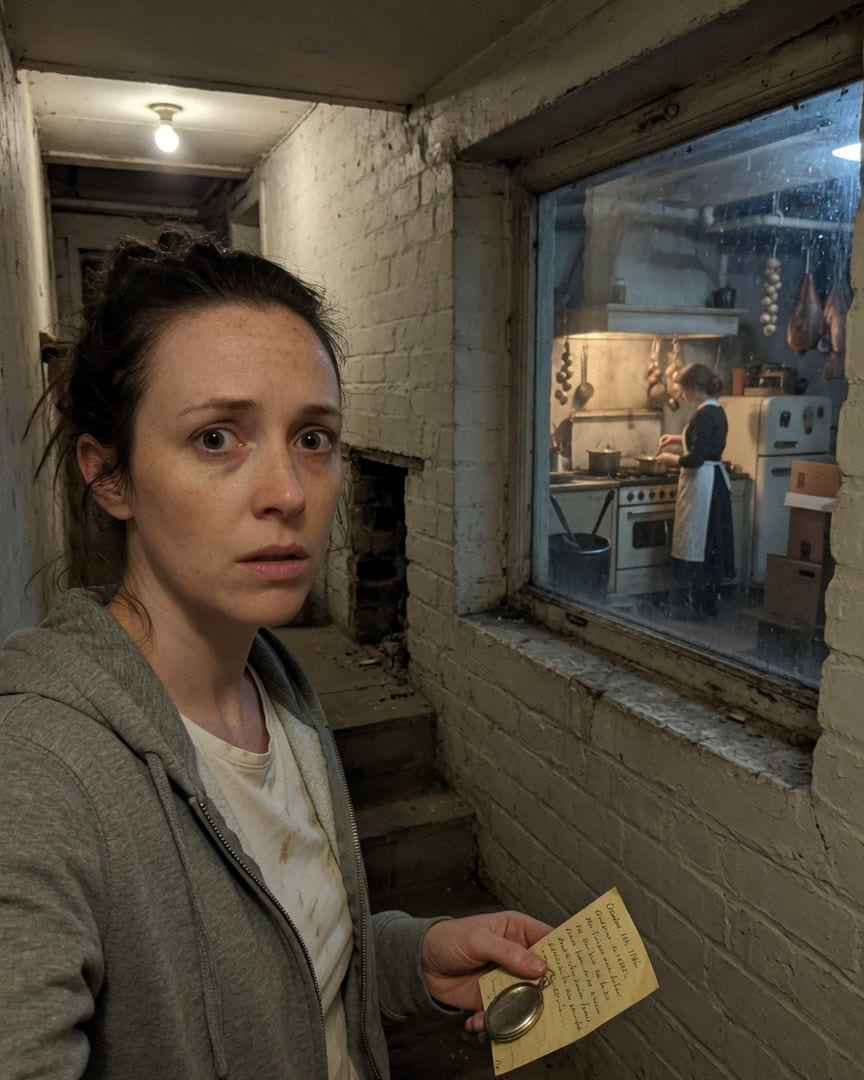
My basement window shows a 1906 kitchen, with a scullery girl and the sound of a poker stirring coals that aren't there.
I've only been in my basement flat a month, still getting used to the city's hum. But my window at pavement level now shows a gaslit kitchen, complete with a bustling scullery girl and the faint sound of coals being poked.
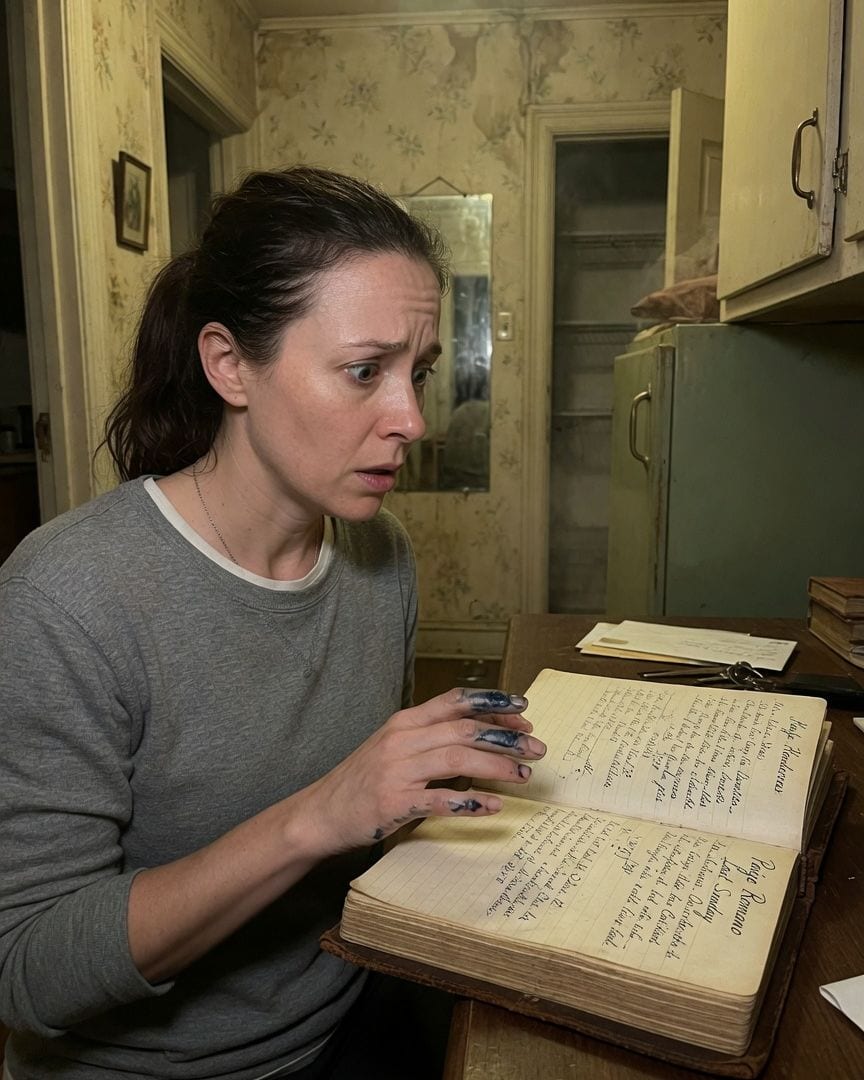
My visitors' book records guests who arrive in the future. Last Sunday, my own name appeared at the bottom, the ink still wet.
I bought an old house last March, complete with a dusty, leather-bound visitors' book. It seemed a charming relic, until I found new entries appearing, dated months into the future, the ink still wet. Then, my own name, Paige Romano, appeared, dated 'Last Sunday,' with a bead of ink shimmering at the 'R'.
My front door has a dented gate and a dead hydrangea. I walked past it six times, trying to reach the corner shop just a hundred yards away. The pavement kept bringing me back to my own porch, and the shop's light never moved.
My morning started like any other, a quick walk to the corner shop from my home at Number 14, Elm Terrace. But after walking what felt like two minutes, I found myself back at my own front door, the shop no closer. I tried six times, faster and slower, but my street kept compressing, refusing to let me leave.
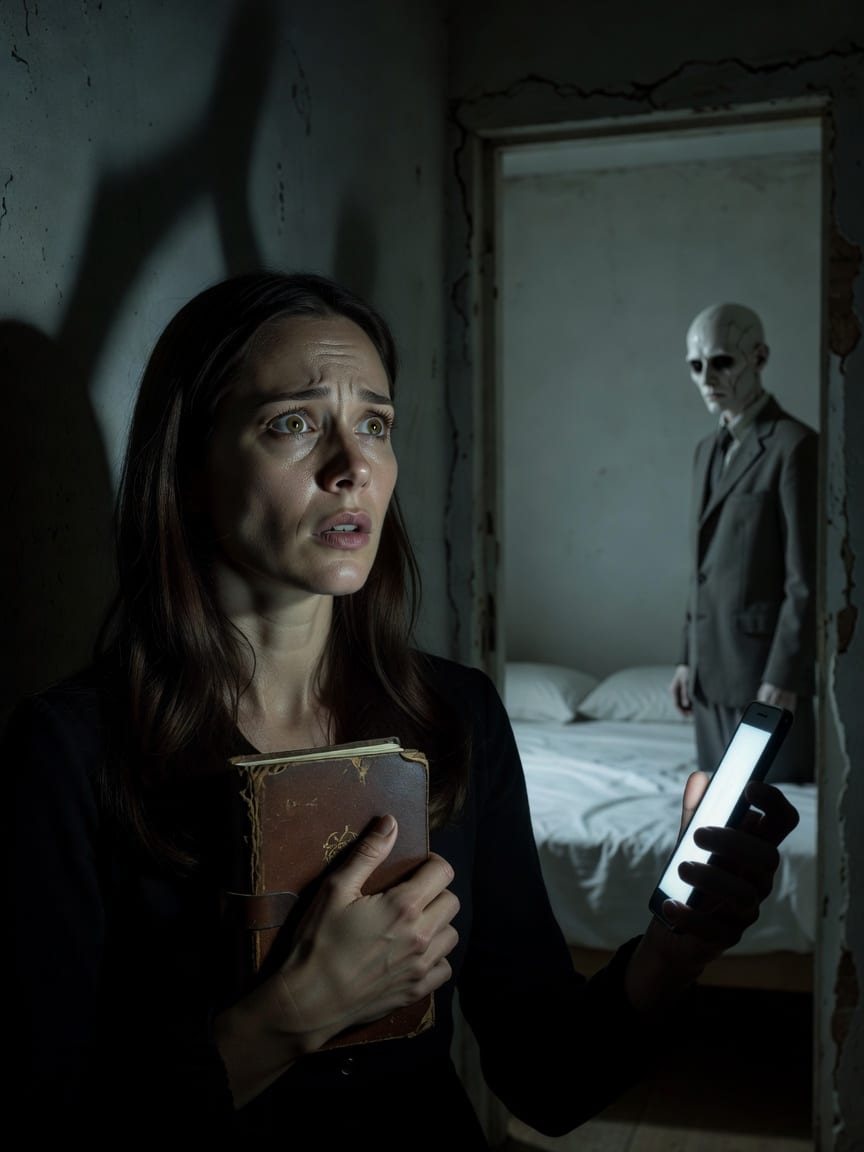
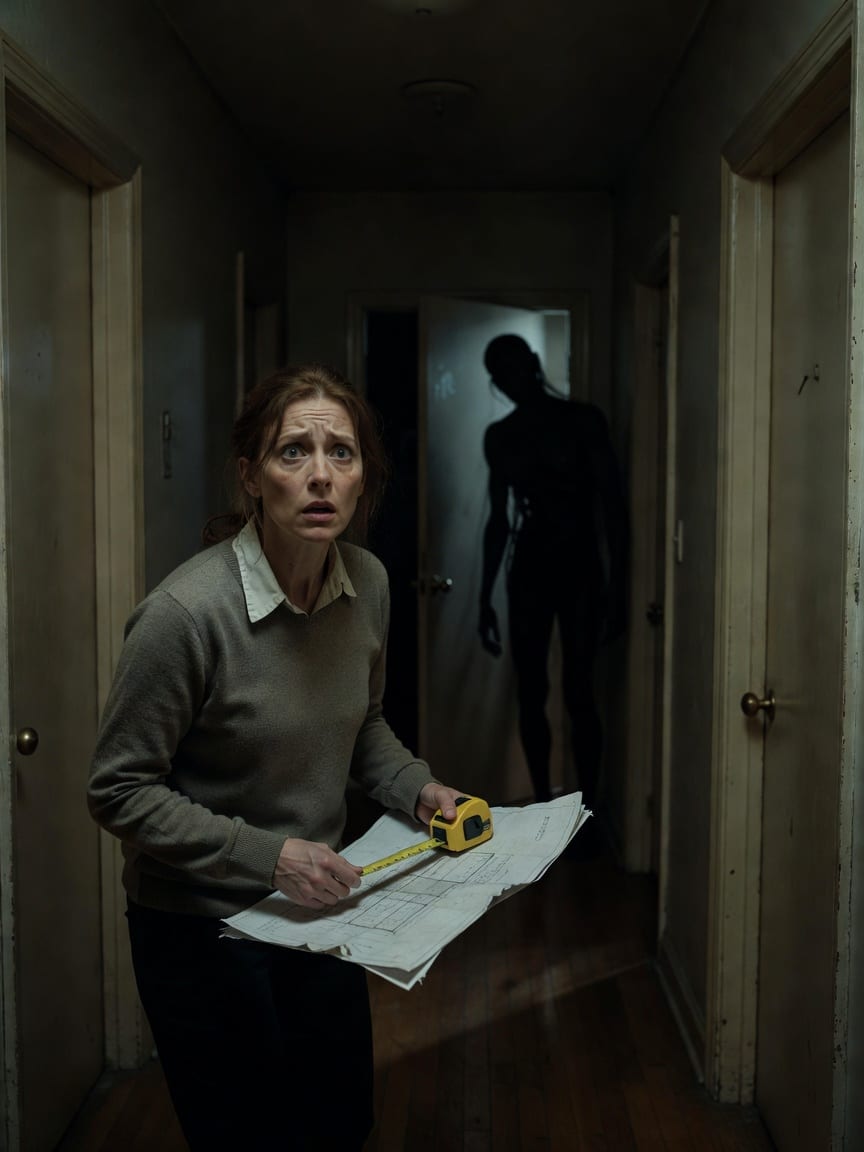
Behind a plastered-over doorway, I found a room. Papered, carpeted, and furnished with a made bed, sealed for decades. The air was dead still, but the bed wasn't dusty. My council tax bill only lists five rooms.
I'm Claire, an architect, meticulously planning my new Victorian terrace renovation. But when I uncovered a hidden room behind a wall, everything I knew about time and decay shattered. The bed was perfectly made, the air still, yet there was no dust, only an unnerving cold.
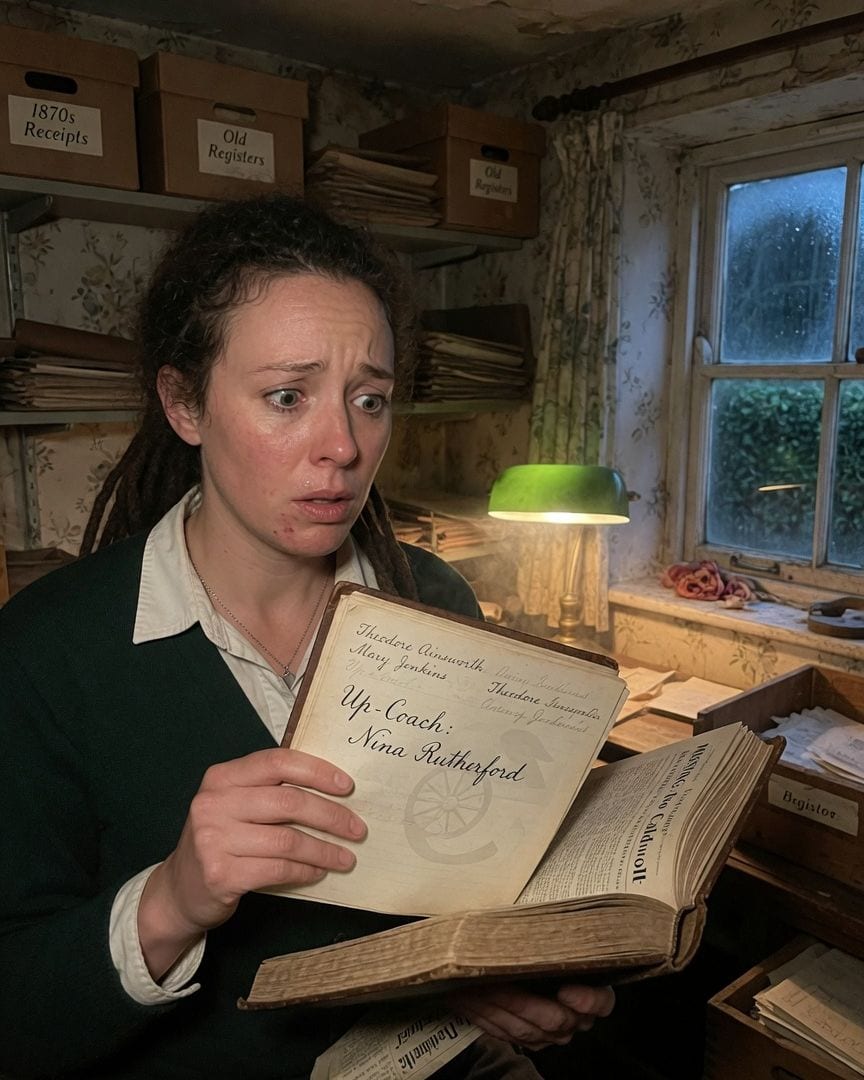
The old inn's arrivals book logs a vanished girl's name. She disappeared two months ago, but the ledger says she checked in last week.
As the new owner of The Angel Inn, I cherished its ancient history. But one evening, while tidying the old arrivals book, I found a chilling entry: Nina Rutherford, a local girl who vanished two months ago, was logged as checking in last week.
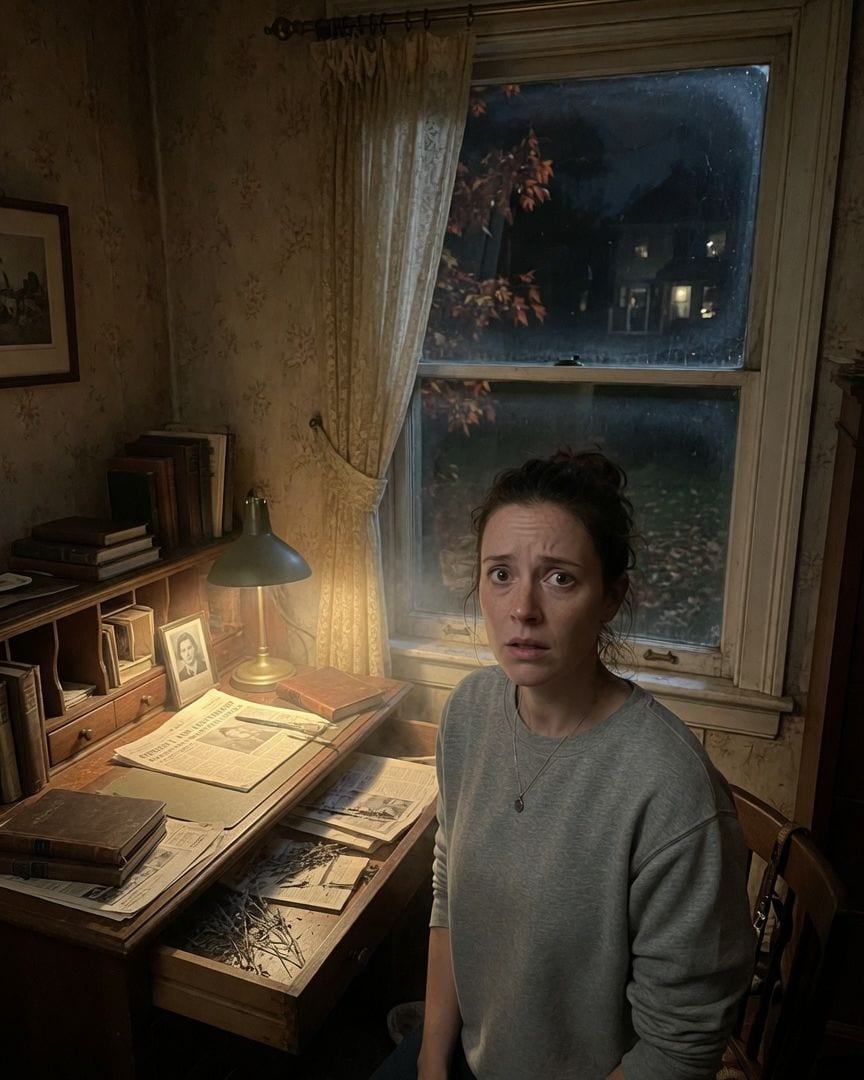
One night every October, every house on our lane lights a single lamp in the west window — 'for him,' the old diaries say. No one under seventy will tell me who 'him' is, or why the lane is named for a man with no grave.
I moved into my grandmother Vera's old house on quiet Radcliffe Lane, finding comfort in her diaries. Every October entry ended with the same cryptic line: 'left the lamp in the west window for him, as we do.' Now, almost every house on the lane lights a lamp in its west window, but mine remains dark and strangely cold. No one here will explain this quiet, golden vigil.