My chest CT shows four old healed rib fractures. I've never broken a rib in my life. The consultant asked if anyone hurt me when I was small. No one ever had.
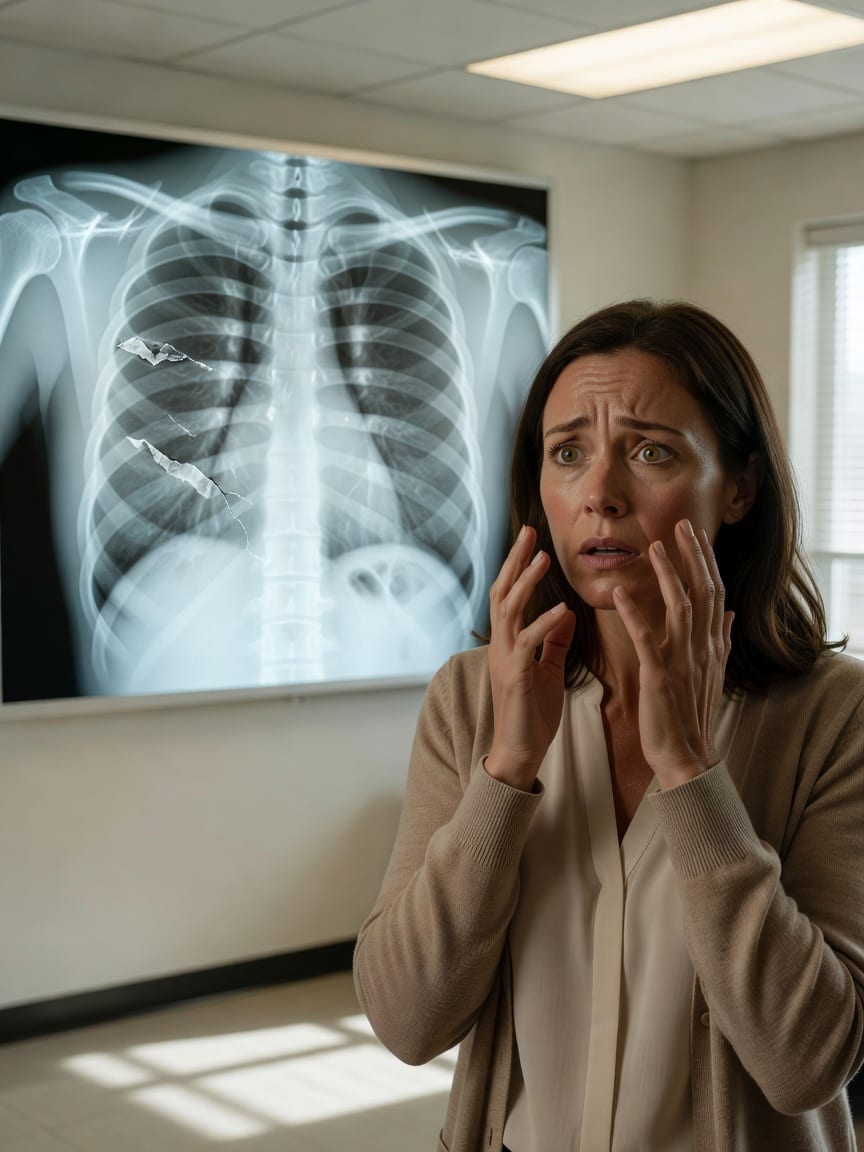
I sat there in Dr. Vance's office, the bright fluorescent light doing nothing to dispel the chill that had crept up my spine the moment he’d started talking.
The consultant, a man with too-gentle eyes, gestured to the glowing image on the screen, a spectral map of my own chest.
His voice was soft, almost a murmur, as he pointed to four faint, jagged lines on my left ribcage.
'Well-corticated, remote,' he explained, tapping a stylus against the screen. 'These are old healed fractures, Fiona. Down your left side.'
I frowned, a knot tightening in my stomach. Fractures? I’d come in for a lingering cough, nothing more. A routine CT scan. 'Fractures?' I asked, my voice thin, hardly audible above the hum of the scanner next door.
'I’ve never broken a rib in my life.'
His gaze softened further, a hint of genuine concern settling in his eyes. He leaned back in his chair, folding his hands. 'Sometimes, especially with children, these things can go unnoticed. They heal on their own.
Was there ever any kind of… accident? A bad fall? When you were very small?'
I shook my head slowly, feeling a bizarre, unsettling wrongness settle over me. No. There had never been anything like that.
Not a fall from a tree, not a bicycle crash, not a bump or bruise that had put me in a hospital. No pain I could remember, no cast, no whispered stories from my parents about a childhood mishap.
My body, this familiar vessel I lived in, insisted on a history I did not possess, a memory that wasn’t mine. It was impossible, and the impossibility was what burrowed into me, cold and sharp.
The first consultant had been kind, but insistent. The next one, a radiologist at a different hospital, had confirmed the findings without hesitation, his expression clinical. Then a third, whose office felt too sterile, the air too still.
Each time, the results were the same: four distinctly healed rib fractures, definitively mine, definitively old. They were 'well-aligned,' meaning they’d healed perfectly, almost seamlessly, into the bone. But they were there.
I walked out of that third appointment with a growing sense of dread, the phantom ache of injuries I’d never sustained starting to manifest as a real, physical tightness in my chest.
Trevor, my husband, tried to rationalize it when I told him. 'A childhood fall you forgot, maybe? Kids bounce, Fiona. You were probably running around, took a spill, cried for a minute, and then forgot all about it.'
He squeezed my hand, trying to reassure me, but Fiona knew, with a chilling certainty, that this wasn’t forgetfulness. This was impossible. This was my body carrying a secret that was utterly alien to my lived experience.
I started digging into my own past. I pulled old photo albums from the attic, blowing dust from the cracked leather covers.
I meticulously searched through faded snapshots of scraped knees and gap-toothed smiles, looking for scars, for any hint of a childhood injury. Nothing.
Not a single photograph showed me with an arm in a sling, or a bandage peeking from under my clothes. My childhood, as recorded by my parents, was unremarkable, unmarred.
Then, I remembered my mother, Vivian, kept meticulous records. Not just photos, but boxes of documents. She was a Virgo, she’d always said, everything filed, labeled, alphabetized. I called her, citing a sudden, vague concern about childhood immunizations.
'Just updating my own records, Mom,' I’d lied, hating the tremor in my voice. Vivian, initially hesitant, asking why I needed them now, eventually produced a thick, yellowed folder from a locked cabinet in her study.
I sifted through the brittle pages: birth weight, vaccinations, developmental milestones. All perfectly normal. Boring, even. My life, laid out in neat, spidery handwriting, was perfectly ordinary. Until I reached the very back.
A single sheet of paper, a faded sonogram report from her first trimester, tucked between two blank pages.
It wasn't the image itself that caught my eye first, but a minuscule, almost erased note scribbled in the margin, so faint I almost missed it. It read: 'Fetal Anomaly – Resorption suspected.'
My heart pounded as I held the sonogram up to the light, tracing the faint lines with a shaking finger. The image was grainy, distorted by age, but undeniable. Two distinct shapes, curled close together in the shadowy fluid.
Two developing fetuses. One was clearly me, perfectly formed, head and limbs discernible. The other, much smaller, was a distorted mass, barely an outline, curled in on itself like a withered leaf.
But what truly froze me, what made the air catch in my throat, was an unsettling dark smudge across its tiny form, right where the ribs should be.
An unnatural shadow, dark and indistinct, a mirror to the jagged lines of the fractures on my own CT scan.
I stared at it, the paper trembling in my hands, the world outside my small office fading into a distant, muffled hum.
'Mom, what is this?' I confronted Vivian, the sonogram clutched in my hand, its faded edges crinkling under my grip.
We were in her bright, meticulously clean kitchen, the air thick with the scent of lemon polish and a freshly baked apple pie. 'Why did you never tell me I was a twin?'
Vivian blanched, her carefully composed facade crumbling like dry pastry. The color drained from her face, leaving her pale and brittle. She looked from my face to the sonogram, then back, her eyes wide with a sudden, panicked aversion.
She admitted to a 'vanishing twin' scenario – a common occurrence, she insisted, her voice tight, almost a whisper. 'It happens all the time, darling. One twin is naturally absorbed early in pregnancy. It was nothing.'
She dismissed the 'anomaly' note with a wave of her hand, her gaze darting away from mine, as a doctor's over-cautiousness, a typical medical scare that amounted to nothing. 'It was nothing, Fiona. You were always our only child.
You were fine.'
But I couldn't shake the image of that traumatized twin, that dark smudge on its tiny form, or the eerie coincidence with the four healed fractures on my own ribs.
The two were inextricably linked in my mind, a cold, impossible knot. I spent days online, falling down a rabbit hole of medical forums and academic papers, researching vanishing twin syndrome.
While common, the specific detail of a visible 'anomaly' or 'trauma' on the absorbed twin was rare, almost unheard of, for a 'natural' resorption. Most cases involved an early disappearance, a fading speck.
This sonogram showed something more defined, more wrong.
I found old medical journals, obscure case studies from decades ago, poring over them until my eyes ached. A name kept resurfacing, mentioned in the footnotes of experimental procedures and early perinatal interventions: Dr. Julian Rutherford.
A pioneer, the articles called him, in a nascent field of fetal medicine. He was the attending physician listed on my original birth certificate, right there alongside my mother's name.
A quick online search revealed he was retired, but still living in a quiet, affluent suburb an hour away from my own home. His name, typed into the search bar, felt like a key turning in a long-locked door.
I called Dr. Rutherford’s old practice, navigating a labyrinth of automated messages and receptionists who barely remembered him. Eventually, through a friend of a friend who worked in medical administration, I found his personal number.
To my surprise, he agreed to meet me. 'For old times' sake,' he’d said, his voice a low, gravelly rumble over the phone.
We met at a quiet cafe, tucked away on a tree-lined street. He was a man in his early seventies, impeccably dressed in a tweed jacket, with calm, discerning eyes that seemed to miss nothing.
He ordered a black coffee, while I opted for a herbal tea, my hands already trembling. I explained my CT scan, the impossible fractures, and then, slowly, pulled out the faded sonogram.
Dr. Rutherford listened patiently, his expression unreadable, his gaze fixed somewhere over my shoulder.
'Vanishing twin syndrome is a fascinating area,' he murmured, stirring his coffee, the spoon clinking softly against the ceramic. 'Many cases. Mostly uneventful.'
He offered clinical generalities, avoiding any specifics about my case, speaking of statistics and medical history as if discussing a textbook.
I pressed him, my voice tight. 'What about the 'anomaly' note? The trauma visible on the scan?'
A flicker of something – recognition? unease? – crossed his face, a shadow passing over his calm features, before he smoothed it away, his expression once more neutral. 'Medical records from that era can be… imprecise.
A lot of unknowns back then, Fiona. We were at the very edge of what was possible.' He leaned forward slightly, his voice dropping, though the cafe was nearly empty. 'Fiona, some things are best left in the past.
Your mother has clearly moved on. Reopening old wounds… it rarely brings peace.' The subtle warning was unmistakable, a quiet blade slipping between my ribs.
The air in the cafe, which had felt warm moments before, now felt cold enough to freeze the room.
As I left the cafe, the conversation replaying in my head, I felt a prickle on the back of my neck, the distinct sensation of being watched.
A dark sedan, parked across the street and slightly down the block, pulled away from the curb a moment after I did, its engine a low thrum. I glanced in my rearview mirror.
The car was still there, two car lengths behind, for the next three turns, a silent, persistent shadow. I sped up, my heart pounding, but it kept pace.
I drove home, the encounter with Dr. Rutherford leaving me more unsettled than ever.
His calm evasiveness, the implied threat from the car that had followed me, the way his eyes seemed to know more than he was willing to say – it all pointed to something far deeper than a simple 'vanishing twin.'
That night, I barely slept, the image of the traumatized fetus on the sonogram burning behind my eyelids.
I remembered an old box of Vivian’s, marked 'Baby Keepsakes,' tucked away in the back of her closet, usually locked, always off-limits. My mother, usually so meticulous, had always been strangely guarded about that box, almost possessive.
After Trevor left for work, I drove back to her house, letting myself in with the spare key. She was at her weekly book club.
I found it in the back of her walk-in closet, nestled under a pile of old linens: a dusty, forgotten cardboard box, tied with a faded ribbon. My hands trembled as I opened it.
Inside, beneath christening gowns and tiny booties, was a small, leather-bound diary. Not Vivian’s, but clearly a professional’s, with precise, dated entries. A nurse’s log, detailing procedures at the hospital around the time of my birth.
The entries were terse, clinical. Page after page of names, times, observations. Then, a page, dated two days before my own recorded birth, caught my eye. 'Patient V.V.,' it read, scrawled in neat cursive, 'complications, fetal distress, twin demise.'
My breath hitched. Twin demise. Greta.
But it was the next entry, below that, that made my blood run cold, turning the quiet, sunlit room into a tomb. 'Procedure: Experimental Cellular Integration. Subject: Fetus F.F. Donor: Fetus G.'
Fetus G. Greta. It wasn't just a vanishing twin; it was an intervention. A desperate attempt. An experiment.
I called Dr. Rutherford again, my fingers fumbling with the phone, my voice tight and raw, on the edge of hysteria. 'What was 'Fetus G'? What the hell was 'Experimental Cellular Integration'?'
There was a long silence on the other end, the kind of silence that screams guilt. Finally, he spoke, his voice strained, heavy with a resignation that chilled me to the bone. 'It was… a last resort, Fiona.
Your mother was in a terrible accident, a fall down a flight of stairs, late in her pregnancy. Traumatic. Your twin, Greta, didn't survive. But you… you were still viable. Barely. We tried to save you.
To give you a chance.' He didn't explain the fractures, not explicitly, but the pieces were starting to click into a horrifying, coherent whole in my mind.
I continued to scour the box, the nurse’s log clutched in my hand like a lifeline, or a death warrant. The air in the closet felt thick, heavy with unspoken history.
Below the diary, wrapped in layers of yellowed tissue paper, was a small, flat package. My fingers trembled as I unwrapped it, the rustle of the paper unnaturally loud in the silence.
It wasn’t a toy, or a lock of baby hair. It was a faded, sepia-toned clinical photograph.
A close-up, clearly taken in a sterile medical environment, of an infant's ribcage. Tiny, fragile bones, heartbreakingly small. But four ribs on the left side were clearly fractured, bruised purple and yellow, captured in agonizing, stark detail.
It was the exact pattern of the healed fractures on my own CT scan. The date stamped faintly in the corner, almost illegible, read: 'October 12th, 38 years ago.' Two days before my own recorded birth. This was Greta.
And these were her injuries. I stared at the impossible object, my body suddenly cold, the dread blooming in my chest like a toxic flower, choking the air from my lungs.
I drove straight to Vivian's house, the photograph clutched in my hand, the nurse's log tucked into my bag. My knuckles were white on the steering wheel, my jaw aching from clenching it so tight.
I found her in the backyard, watering her roses, humming softly, completely oblivious to the storm about to break. The sweet scent of the flowers filled the air, a cruel counterpoint to the bitterness in my mouth.
I stopped short, the gravel crunching under my feet. 'Who is this, Mom?' I demanded, my voice raw, stripped of its usual deference, as I thrust the photograph at her. Her hand, holding the watering can, trembled.
'And why does it have the same broken ribs as me? Why is it dated before I was born?'
Vivian dropped the watering can. It clattered to the patio, spilling water across the flagstones, but neither of us noticed. Her face drained of color, going utterly white, her eyes wide with a terror I had never seen.
She looked at the photo, her gaze lingering on the bruised ribs, then back at me, her own pain finally visible, unvarnished. The story spilled out, a torrent of suppressed grief and desperation, years of silence breaking like a dam.
The accident. The fall down the stairs during pregnancy. So violent. So sudden. The doctors had told them Greta was gone, the trauma too severe. But I, Fiona, though severely compromised, still had a faint heartbeat.
Dr. Rutherford, a young, ambitious specialist then, had offered a radical, experimental procedure. They would attempt to 'integrate' Greta’s viable cellular material – her stem cells, her essence – with my failing system, hoping to bolster my chances of survival.
It was never done before, he’d warned, a desperate, unimaginable gamble.
Vivian cried, tears streaming down her face, mixing with the dirt from her hands. 'We just wanted you to live, Fiona! We didn't know what it would mean! We just wanted one of you to survive!'
The fractures, the ones on my CT scan, the ones on the impossible photograph – they were Greta’s, suffered in the fall.
The integration, a terrifying success, had unknowingly woven Greta's trauma into Fiona's very being, a ghost wound carried for a lifetime. My body, my damn body, held the physical imprint of her dying.
The truth, once revealed, was a crushing weight. My body was a monument to a tragic, unnatural event, a living testament to a sister I never knew, whose pain I had inherited, whose cellular memory resided beneath my skin.
I looked at Vivian, my mother, who was now a trembling, weeping wreck, begging for forgiveness, her words dissolving into choked sobs. I couldn't offer it. Not yet.
The betrayal of the secret, the magnitude of what had been done, how they could have hidden such a profound, terrifying truth from me – it felt like a chasm had opened between us.
I called Dr. Rutherford one last time, my voice flat, devoid of emotion. He confirmed everything, his words heavy with the burden of his past choices, the impossible gamble he’d taken. 'It was a miracle, Fiona. You survived.
We never anticipated… the physical manifestation. It was an unforeseen consequence. A cost.'
I felt a profound alienation, a chasm opening between me and the life I thought was mine. I couldn't stay. Not in this house, not in this life.
I couldn't look at Vivian without seeing the complicity, the desperation that had scarred my very bones. I packed a single bag, taking only the nurse's log and the photograph.
Trevor found me in the bedroom, staring blankly at the packed suitcase. He pleaded with me, confused and hurt, his face a mask of bewilderment. He didn't understand.
How do you explain that your own body isn't entirely yours, that it holds the scars of another's death? How do you explain that your mother kept that hidden from you for 38 years?
I looked at my reflection in the dresser mirror, seeing not just myself, but the shadow of Greta, the impossible trauma, an echo residing within me.
I was a vessel, a living, breathing testament to a life ended before it began.
I left, the quiet click of the door echoing the finality of my decision, carrying proof no one would ever believe, but which I could never unsee.
I moved to a small coastal town, far from the life I'd known. The salt air and the constant roar of the ocean felt like a cleansing, though it did little to ease the ache in my chest.
I changed my number, severing ties with my parents, unable to reconcile their desperate love with their terrible secret. Trevor's calls eventually stopped.
The healed fractures remained, a constant, silent presence beneath my skin, an internal compass pointing to a pain that wasn't mine.
I saw them every time I caught my reflection, a physical reminder of the truth no one else shared, a grim, permanent tattoo of my impossible history.
Sometimes, late at night, in the quiet of my small cottage, I would press my fingers to my left side, feeling the faint ridges of bone, the ghost of a pain that wasn't hers, yet was utterly mine.
I was Fiona, yes, but I was also a living echo of Greta, a body that contained a trauma it had never experienced, a secret kept in flesh and bone, a permanent, unsettling guest.
She had escaped, but the wrongness was now utterly, inescapably her own.
If this one got to you
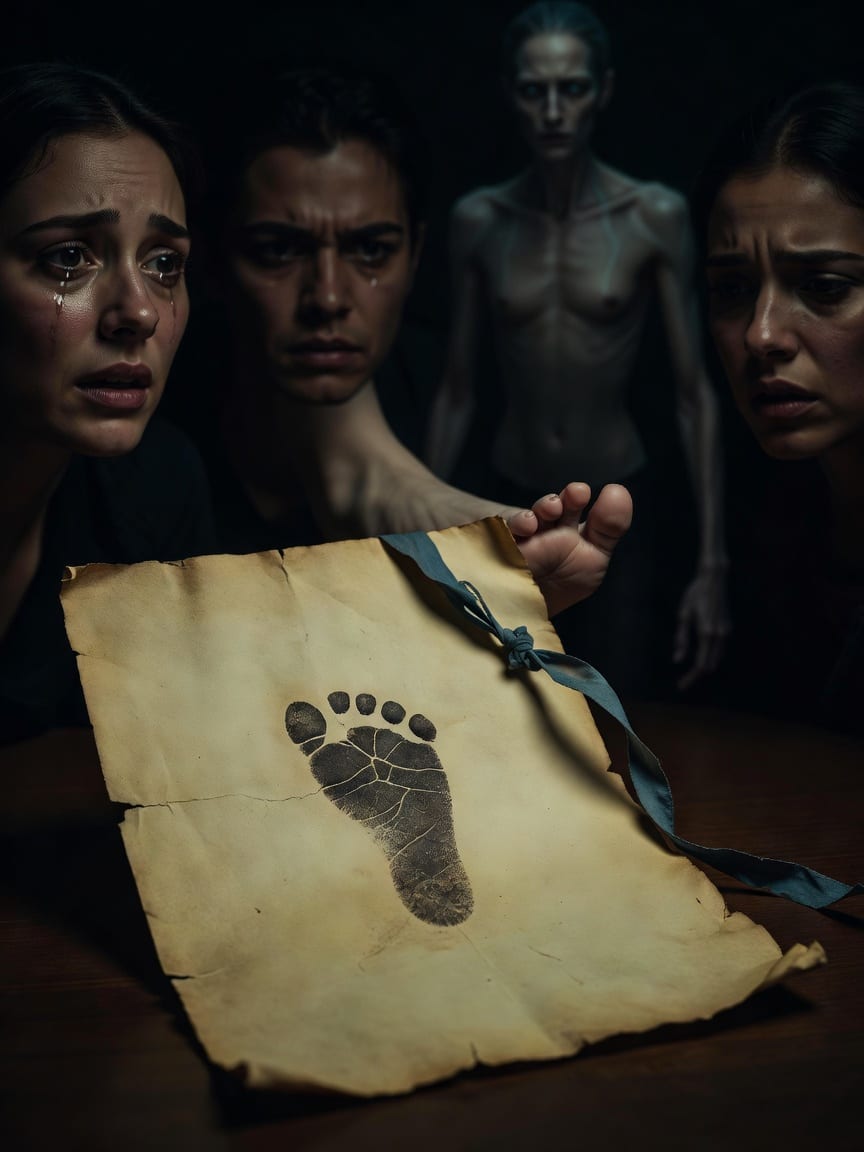
My hospital scanned old newborn footprints. They matched my foot, every whorl and arch, to a stillborn infant's card from 1954. Those tiny, inked ridges on the yellowing paper were undeniably mine. Sixty years apart, the same feet.
I was only curious when St. Jude's Hospital sent my newborn footprint card, part of digitizing their old records. But a genealogist soon revealed my own unique footprint matched a stillborn infant's card, filed in 1954 – an impossible biometric anomaly.
The blood on my own newborn heel-prick card — the one my mother saved in a drawer for thirty years — doesn't match the DNA in my mouth today. The lab ran it three times: two different people.
I sent my newborn heel-prick card to a genealogy lab, expecting to confirm my family tree. Instead, the lab tech called with an impossible truth: the blood from my infancy did not match my adult DNA. My own record insisted I wasn't quite myself.
My twin sister Ruth sleeps on the right now, facing the wall. For forty-one years, she always took the left side. She insists I'm misremembering.
After three days missing, my partner Ruth finally came home. But the morning after, I woke to find her sleeping on the wrong side of our bed. She claimed she'd always slept there, and my memory was wrong, despite forty-one years together.
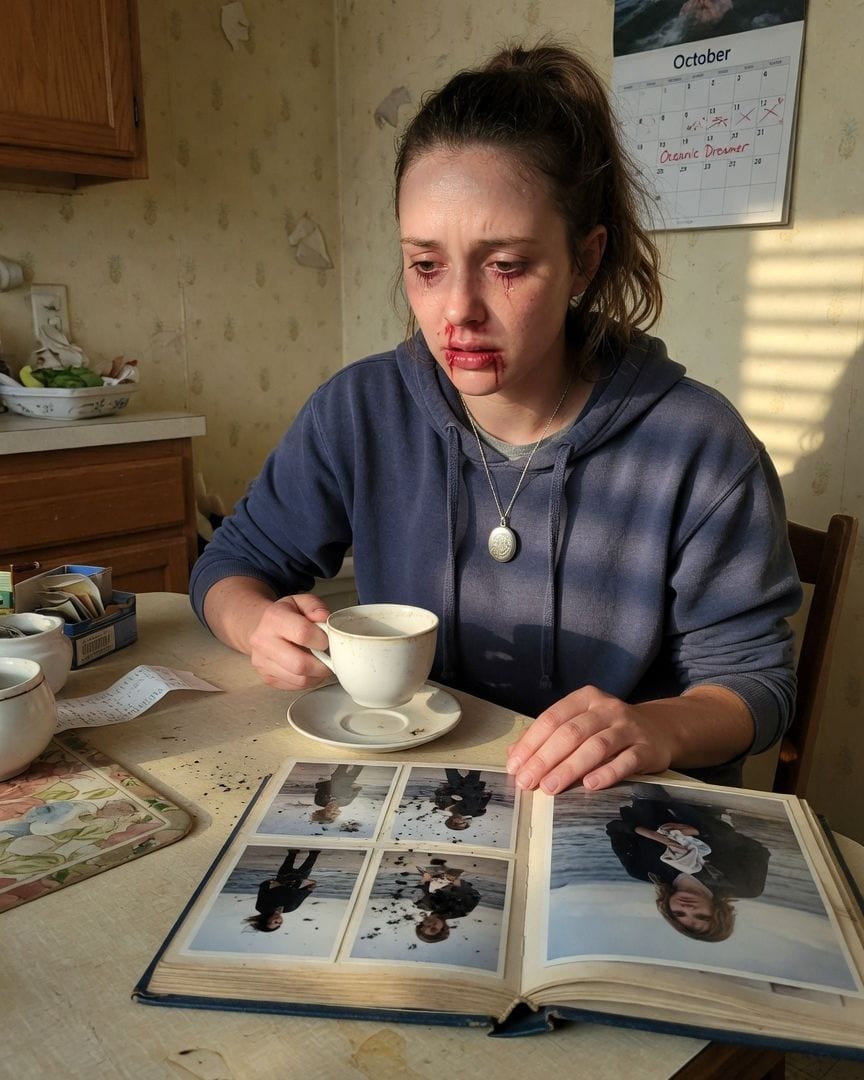
My mother recalled scattering Dad's ashes. She was gone when we did it, lost at sea. She knew which of us cried that day.
My mother came home a month ago, changed after nearly drowning at sea. But then she started describing the day we scattered my father's ashes, every detail sharp and clear. She couldn't have been there; she was lost at sea when we stood on that pier.
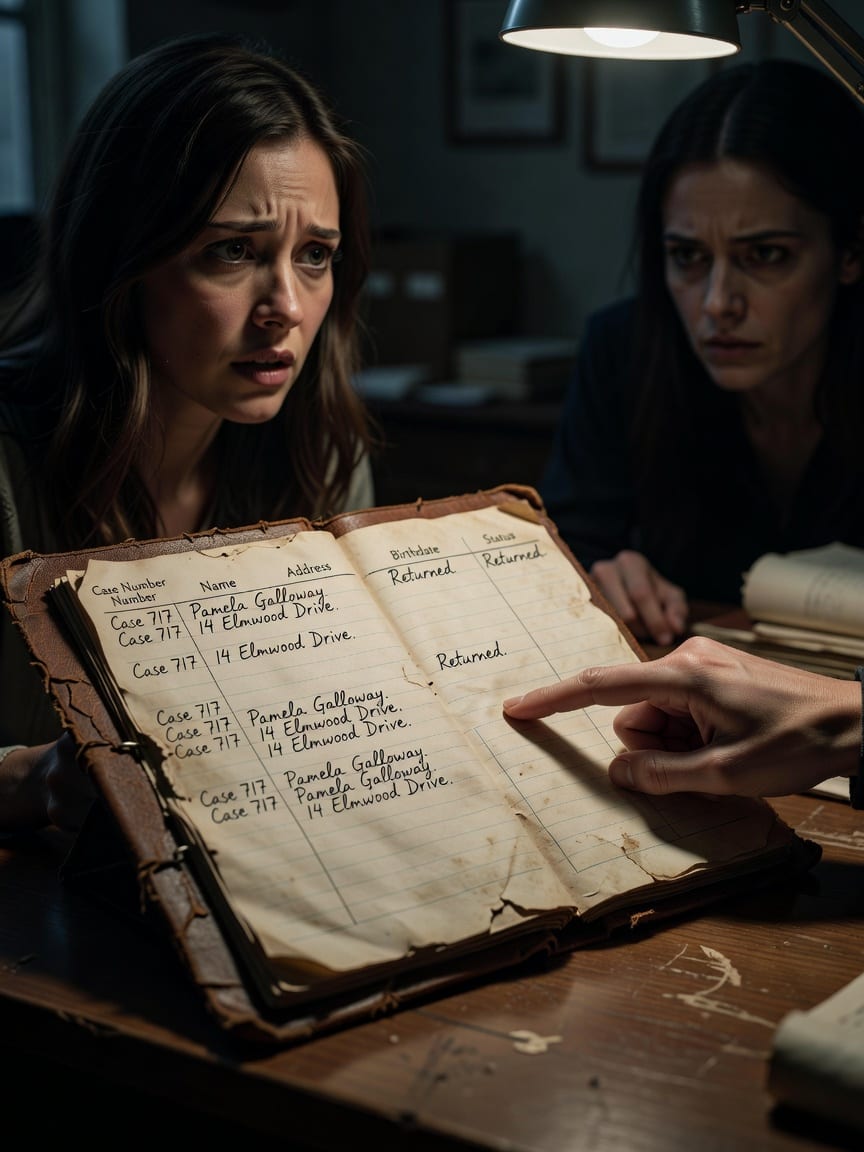
My hospital file has a blacked-out line from 1988. It names my street address, decades before I lived here. Then: 'returned'.
I finally got my medical file, hoping to clear up a ridiculous bill. Inside, I found an entry from 1988: my current home address, scrawled on a partial intake form and marked 'returned.' I was six then, living fifty miles away.
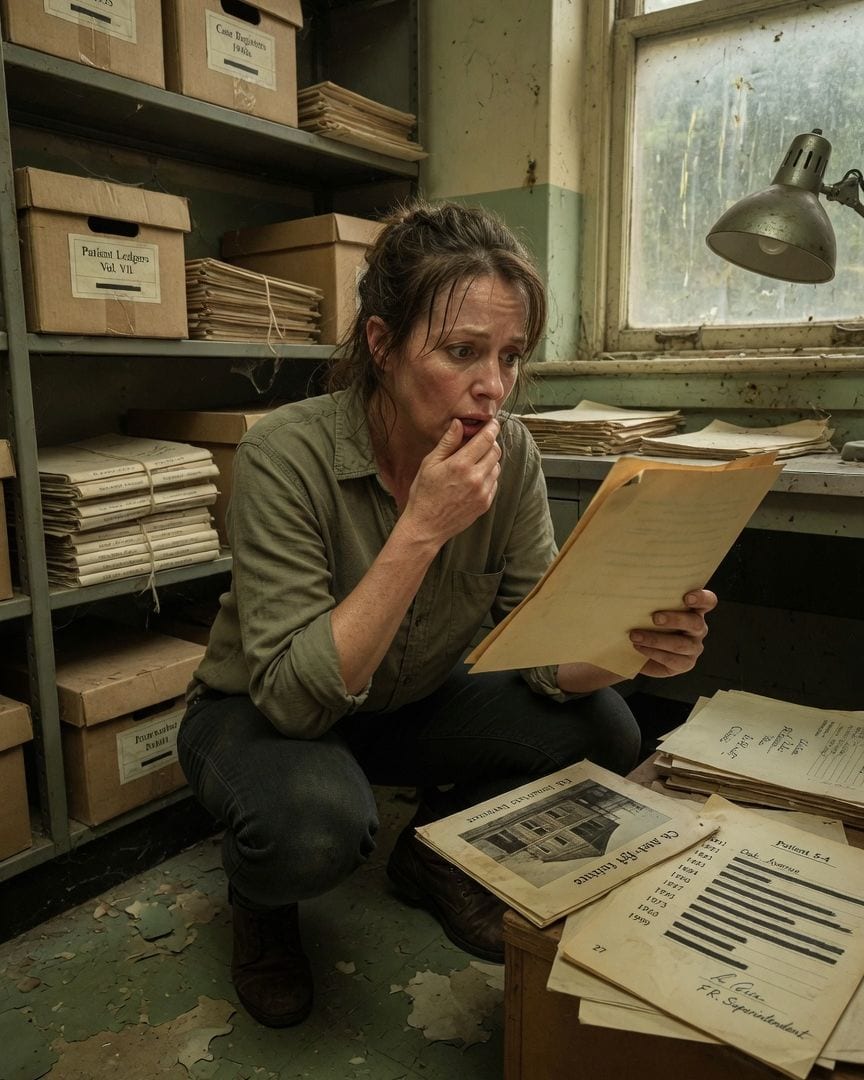
Patient 5-4 keeps checking into my aunt's old sanatorium chalet. The same initials sign them out, 'not traced,' every thirteen years since 1921.
Sifting through my aunt Margaret's estate, I found her old sanatorium file from 1999. Her patient record listed her as 'Patient 5-4,' discharged 'not traced.' But when I accessed the archives, I found 'Patient 5-4' was admitted every thirteen years since 1921, always with identical discharge notes.