Chief Petty Officer Marlo Tench had hours left when her sonar read a live plant inside the Cold War target ship's sealed hull. Then the official film showed a human face staring out from a porthole, just before the atomic blast.
Chief Petty Officer Marlo Tench descended into the perpetual twilight of the Ferrell Atoll, ninety feet below the salvage barge. Her nine-hour window was already shrinking, the pressure on.
The USS Bellwether, a designated target ship from the 1954 atomic shot, sat upright on the coral, a ghost of the Cold War. The official record, etched into her memory, stated 'unmanned target.'
But as her powerful dive lights swept across the hull, Marlo saw no blast damage, no scorch marks. The ship’s paint, she noted with a growing unease, was bright, impossibly vibrant after seventy years.
Every single hatch, she confirmed, was dogged from the inside. Then her sonar picked up a faint, internal hum.
She checked her instruments: the Bellwether’s own systems were reading a live plant, a pulse of energy from within the sealed hull, as if the ship were still operating, still alive.
Marlo, fighting the growing dread, swam toward the bridge. If the ship was truly dead, the 'live plant' reading was a sensor malfunction, a deep-sea anomaly. But the pristine condition of the hull, the dogged hatches—they argued against simple malfunction.
She found a heavy, brass-bound logbook secured in a waterproof container inside the bridge. With gloved hands, she carefully opened it. The last entry was dated August 10, 1954, two days after the atomic shot.
It detailed routine engine checks, a clear sky, and a full crew manifest, each name meticulously signed off. Not a single mention of an atomic blast, nor a single empty bunk.
The names were legible: Ensign Scott Underwood, Quartermaster Fiona Mitchell, Chief Machinist Oscar Kowalski. Marlo’s breath hitched. Oscar Kowalski. The name reverberated, a faint echo from her family history, a name associated with a different, later disappearance.
The mundane explanation of a misfiled logbook, or a crew that somehow survived and then resealed the ship, crumbled under the weight of the impossible date and the familiar name.
This wasn't just a wrongness; it was a deliberate lie, preserved in brass and ink.
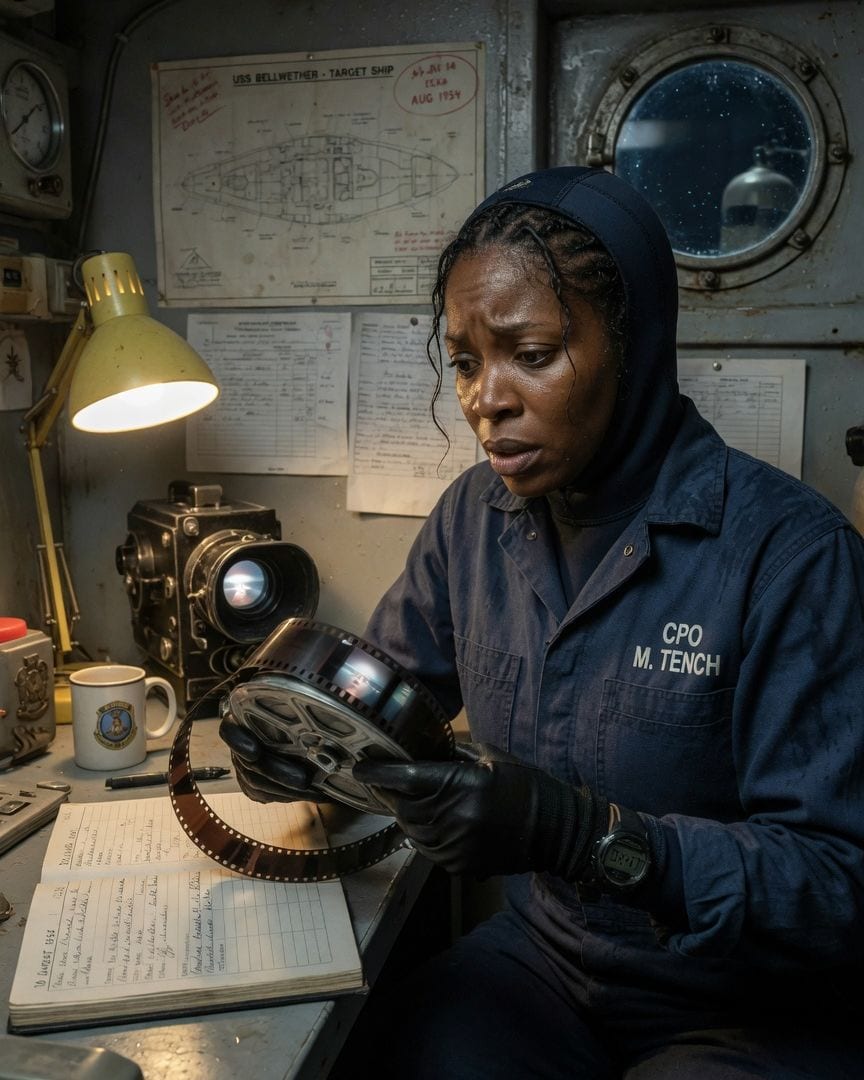
Marlo continued her survey, driven by a cold, methodical determination. She found a sealed, heavy-gauge film canister, labeled '1954 A-Shot, Target Ship Bellwether - Unmanned,' tucked into a storage locker near the bridge.
It was the official gun camera footage, the definitive record of the shot. Back on the salvage vessel, the clock still ticking on her nine-hour window, Marlo Tench held the canister.
Her junior officer, Scott Underwood, 26, watched over her shoulder as she carefully began to spool the film by hand, inspecting each frame.
The initial frames showed the vast expanse of the Pacific, the distant mushroom cloud, the target ship bobbing placidly in the foreground.
Then, as she slowly turned the reel to inspect it, a single frame flickered past her thumb: a blurred, indistinct human face, pressed flat against a porthole, staring out, directly at the lens, from within the ship, just before the white flash of the atomic blast.
The image of the face haunted Marlo Tench. It was undeniable, a human presence where none should have been. Her nine-hour window had closed, but her mission had changed.
Back at the Naval records center in Norfolk, far from the sun-drenched Atoll, Marlo used every ounce of her clearance and reputation. She requested the full operational logs, crew manifests, and all photographic records for the USS Bellwether from 1954.
What she received was a stack of seemingly identical files: one declassified, bearing the 'unmanned target' stamp, and another, heavily redacted, classified 'TOP SECRET - PROJECT NIGHTLIGHT.'
The sheer volume of blacked-out text in the classified file was a red flag. Through persistent requests, citing 'historical accuracy for salvage operations,' she managed to get specific sections unredacted.
She found a partial crew list in the classified file, matching names from the Bellwether's logbook, including Fiona Mitchell and Oscar Kowalski. But these names were accompanied by cryptic notes: 'transferred out, pre-shot' or 'missing in action, prior to deployment.'
The official story was that these men weren't on the ship, but the classified record contradicted itself, showing their presence, then their convenient, unexplained absence just before the detonation.
It was a bureaucratic sleight of hand, a paper trail designed to obscure, not inform. The unease solidified into a certainty: someone had gone to great lengths to hide the truth about the Bellwether.
Marlo’s persistent inquiries did not go unnoticed. One afternoon, while reviewing microfiches in a dusty back room of the archive, a man in a crisp, dark uniform appeared silently beside her.
Commander Malcolm Thatcher, a Naval Intelligence officer in his late fifties, introduced himself with a calm, unblinking gaze. He didn't raise his voice, but his presence was a palpable weight.
“Chief Tench,” he began, his tone even, “your interest in the Bellwether is commendable. However, certain historical anomalies are best left in their designated classifications.” He leaned closer, his voice dropping to a near whisper.
“Project Nightlight files, in particular, are not for casual review. National security, you understand.” Marlo felt a cold prickle on her skin. He knew exactly what she was looking for, what she had found.
It wasn't a warning; it was an acknowledgment. “My salvage report requires full historical context, Commander,” Marlo replied, her voice steady despite the tremor in her hands. Thatcher merely smiled, a thin, humorless line. “Indeed.
But sometimes, Chief, the context is… broader than one might initially perceive. I suggest you complete your report with the provided declassified materials. It would be… prudent.”
He walked away as silently as he had arrived, leaving Marlo with the chilling certainty that her digging had been observed, and that she was now a part of the very file she was trying to unearth.
Thatcher’s veiled threat only hardened Marlo’s resolve. She knew she was being watched, but the truth of the Bellwether was too close. She doubled down, using a secure, off-network channel to a former mentor, Captain Curtis Romano, retired.
She spoke in hypotheticals, describing a ship, an atomic test, a contradictory logbook, and a face on film. Romano, cautious but intrigued, gave her a single, cryptic piece of advice: “Look for the 'containment protocols.'
They’ll always be separate, but they’ll cross-reference the primary project.” Back in the archives, Marlo focused on the most heavily redacted sections of the 'Project Nightlight' files. Hours later, in a sub-section marked 'Anomaly Management Procedures,' she found it.
A memo, dated 1955, from a Dr. Eileen Blackwood, titled 'Containment Procedures for Anomalous Personnel Retention – Target Ship Bellwether.' It detailed not the destruction of the ship, but the 'stabilization of bio-signatures within the vessel.'
The memo referred to the crew not as 'personnel' or 'casualties,' but as 'occupants.' It outlined methods for monitoring 'internal energy flux' and 'structural integrity maintained by occupant bio-feedback.' The pieces clicked into place with sickening precision.
The 'live plant' instrument readings Marlo had detected underwater weren't a malfunction; they were measuring the crew. The dogged hatches weren't to keep people out; they were to keep the 'occupants' in.
The logbook wasn't lying; it was a record of their existence, preserved in a state beyond life and death. The Bellwether wasn't a target; it was a trap.
The atomic blast hadn't destroyed the crew; it had transformed them, integrated them into the ship, and Project Nightlight had been established to manage this horrific, ongoing reality.
The faces on the film, the names in the log, they were all still there, filed away, generating the very energy that kept the ship intact.
The realization of the Bellwether's true nature was a cold weight in Marlo’s gut. She had uncovered a scientific horror, a living tomb. But the phrase 'Anomalous Personnel Retention' gnawed at her. It implied recurrence, a pattern.
Pushing past the nausea, Marlo searched the Project Nightlight files for other instances of this protocol. The system was designed to hide, but the cross-references, once understood, were undeniable.
She found similar memos, with the same chilling language – 'occupants,' 'personnel retention,' 'bio-signatures' – but attached to entirely different incidents, spanning different branches of the military and different decades. A missing submarine in the Atlantic, 1968.
A downed reconnaissance aircraft over the Pacific, 1977. Each file described a vessel or facility found intact, sealed, with 'live' internal readings, its crew officially 'lost' or 'transferred.'
The pattern across decades and classifications was horrifyingly clear: the Bellwether was not an isolated incident. It was a template. And then she saw it.
Another file, cross-referenced from a 1985 Arctic research station incident, listed 'Personnel Transferred - Oscar Kowalski.' Marlo stared, horrified, at the classified Project Nightlight memo. The name was clear, listed under 'Personnel Retention Anomaly - Arctic Station, 1985.' Oscar Kowalski.
Her grandfather. The same man officially listed as 'lost in a training accident' that year. The file, she realized, has always known her family.
Marlo, fueled by a terrifying mix of grief and rage for her grandfather, knew she couldn't simply walk away. She arranged a meeting with Commander Thatcher, not as an investigator, but as someone who knew.
They met in a sterile, windowless conference room. Marlo laid out her findings, the logbook, the film, the cross-referenced Project Nightlight files, her grandfather’s name. Thatcher listened, impassive. When she finished, he finally spoke, his voice devoid of emotion.
“Chief Tench, you have indeed demonstrated a remarkable aptitude for… pattern recognition.” He paused. “Project Nightlight began not as a test of weaponry, but of human resilience under extreme conditions.
The 1954 shot, and subsequent 'incidents,' revealed a… unique form of biological stasis. The 'occupants,' as we refer to them, maintain a symbiotic relationship with their vessels. They are neither alive nor dead in the conventional sense. They are… retained.
Their bio-signatures generate a subtle, stable energy field, keeping the vessel pristine, its systems operational. The secrecy, Chief, is not to hide a weapon. It’s to prevent global panic.
Imagine the implications: a form of eternal containment, a living prison, powering itself. We don’t understand how it happens, only that it does. And that it can be provoked.
Your grandfather, Oscar Kowalski, was part of an Arctic experiment to replicate the conditions. It was… successful. He, and his team, are now part of that station. Preserved. Filed.”
The full truth detonated: the secrecy machine didn't just cover up; it harvested. It had been collecting these 'retained' individuals for decades, filing them away, using them. And Marlo, by digging, had made herself known to the file.
Thatcher leaned forward, his calm demeanor chilling. “Now, Chief Tench, you understand the scope. You are a highly intelligent, highly capable individual. Your family history, as you’ve discovered, makes you uniquely… attuned. We have two options for you.
You can join Project Nightlight. Your expertise in salvage, your understanding of these… anomalies, would be invaluable. You would be given a new identity, a new life, a purpose.
You would become a part of the machine, helping us manage these… assets.” Marlo felt a wave of nausea. To join them, to become a party to this endless, quiet horror, to monitor her own grandfather’s living tomb.
“And the other option?” she asked, her voice barely a whisper. “The other option,” Thatcher said, his gaze unwavering, “is that you disappear. Completely. Your career erased, your records expunged, your identity dissolved. You become a ghost.
We would ensure your silence, not through force, but through… bureaucratic efficiency. You would cease to exist in any official capacity. You would be un-filed. But you would also be… un-protected.”
The choice was stark: become a part of the horror, or live a shadow life, forever hunted by the knowledge. Marlo made her decision. She would not join them. She would not become a signatory to this atrocity.
She would burn her life, vanish, and carry the horrific truth alone. She stood up, her jaw set. “I’m leaving the Navy, Commander.” Thatcher simply nodded. “As you wish, Chief. We will ensure your administrative discharge is… expedient.”
He offered no handshake, no farewell. Marlo Tench walked out of that room, leaving her entire life behind, knowing that she was now a target, not for containment, but for quiet, methodical erasure.
Marlo Tench vanished. Her personal effects, packed and shipped by a civilian contractor, arrived at a non-existent post office box in a small, forgotten town in the American interior. Her last paycheck was never cashed.
Her name was quietly scrubbed from active Naval rosters, officially marked 'administratively discharged.' No one on her salvage team questioned it; Chief Tench was known for her intensity, her sudden, decisive actions.
Scott Underwood, her junior officer, simply assumed she had taken an early, quiet retirement, perhaps to escape the pressures of the sea. The USS Bellwether remained undisturbed at Ferrell Atoll, its 'live plant' readings fading from active monitoring systems.
The vast, patient machinery of Project Nightlight continued its silent work, filing away the anomalous, keeping the world safe from truths it could not comprehend.
Marlo lived under a new name, in a small cabin far from any ocean, working a solitary job. The knowledge of Project Nightlight, of her grandfather, of the 'occupants' in their living ships, was a constant, cold presence.
She scanned every face, every shadow, knowing they could find her at any moment. One morning, an unmarked envelope appeared in her mailbox. No return address, no postmark.
Inside was a single sheet of paper: a copy of a declassified memo, dated 1992, concerning 'Project Nightlight.' It was a routine review of 'personnel retention protocols,' detailing budget allocations and operational adjustments.
At the bottom, in a hand-written note, was a single name, underlined in red ink. 'Tench, M.' The file was still being signed.
If this one got to you
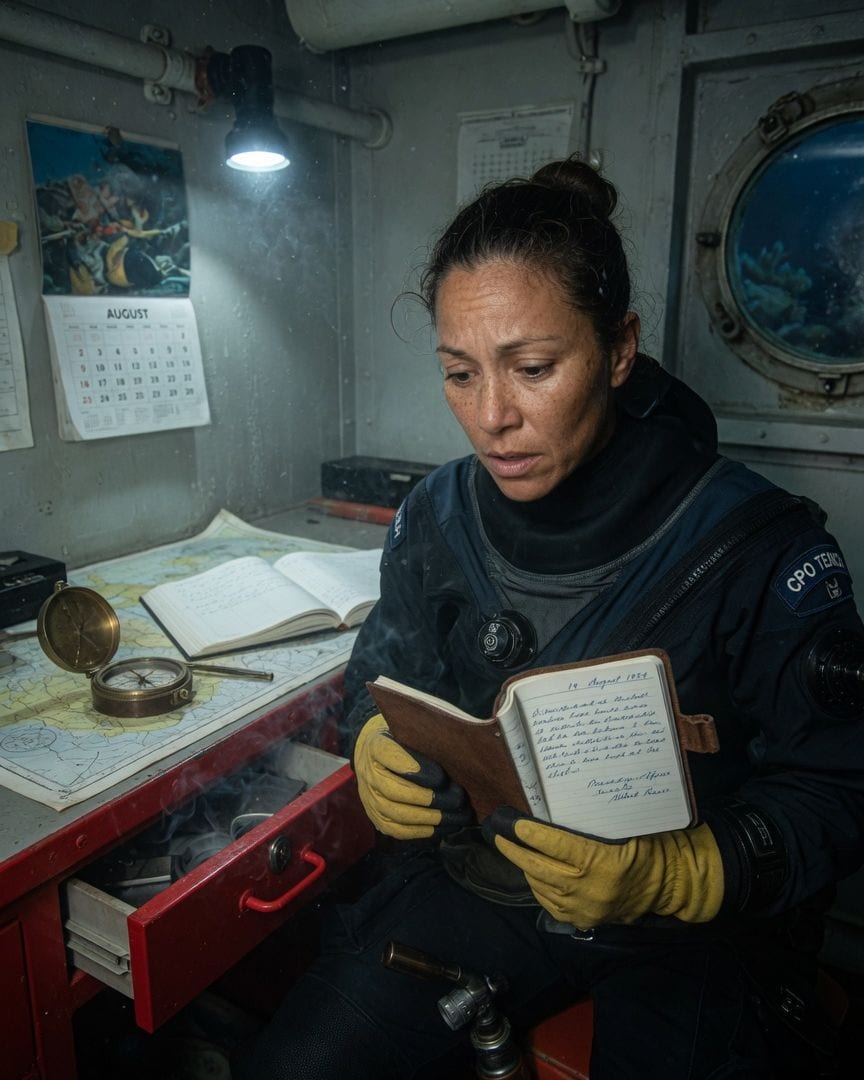
A deep-sea diver found a Cold War target ship's logbook dated months after it was vaporized in 1954.
Chief Petty Officer Marlo Tench, a methodical deep-sea diver, stared in disbelief at the ROV feed. Her team watched with her as the USS Triton, a target ship from the 1954 Castle Bravo nuclear test, appeared pristine and upright ninety feet below. It was supposed to have been vaporized, yet its hull number was unmistakable, its paint unburned, and its internal systems inexplicably active. Descending into the eerie silence, Marlo found a logbook dated five months after the ship’s destruction, and a journal entry naming a crewman officially listed as 'unmanned target.' What impossible force kept the Triton a living ghost decades after its fiery end?
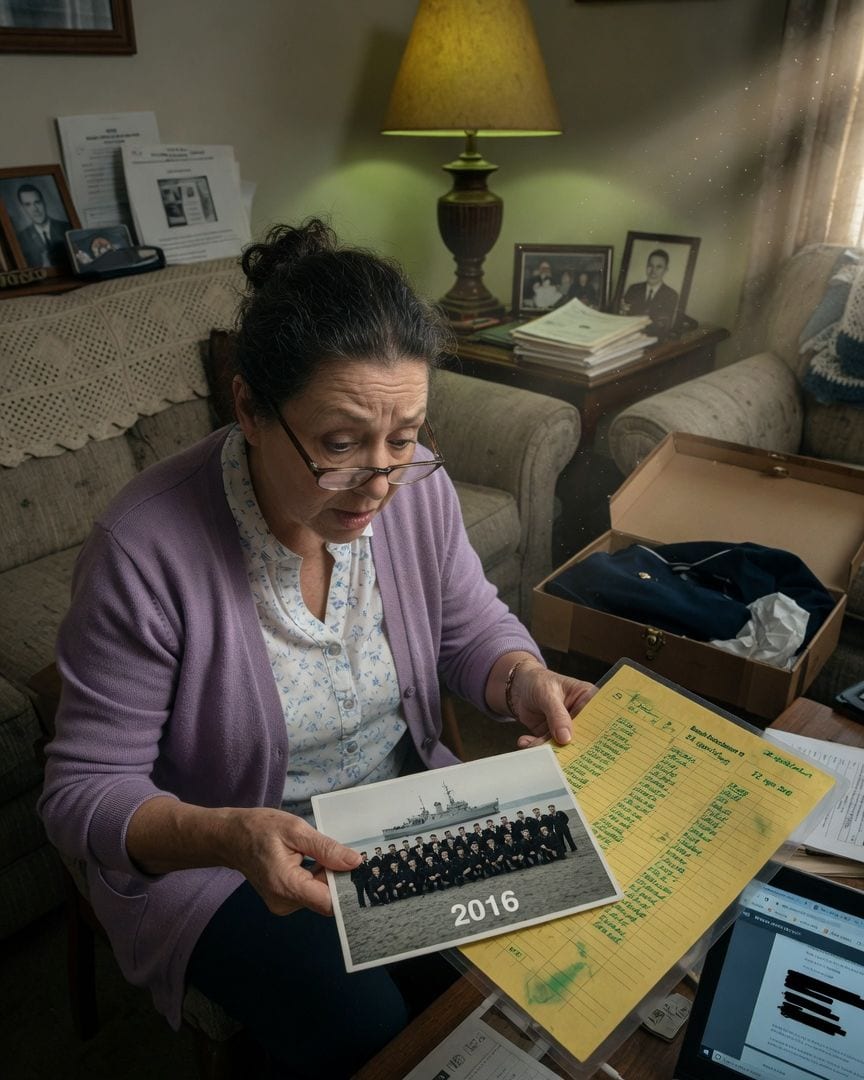
Marisol Frayne unlatched her husband's old footlocker. A photo inside showed his ship, pristine in 2016, three years after the Navy declared it lost.
Marisol Frayne, 62, finally unlatched her husband’s old footlocker in 2024, eleven years after the Navy declared his ship, the Kaskillan, lost at sea. Dust motes danced in the afternoon light as she lifted the lid, releasing the scent of old canvas and cedar. Inside, beneath his perfectly folded dress blues, she found a photograph of David and his crew standing before a pristine Kaskillan. Her breath caught: the photo was dated 2016, three years after the official reports claimed the ship vanished with all hands. Marisol's methodical search then revealed official logs showing a K-class vessel designation active in 2016, leaving a chilling void where her husband's fate should have been.
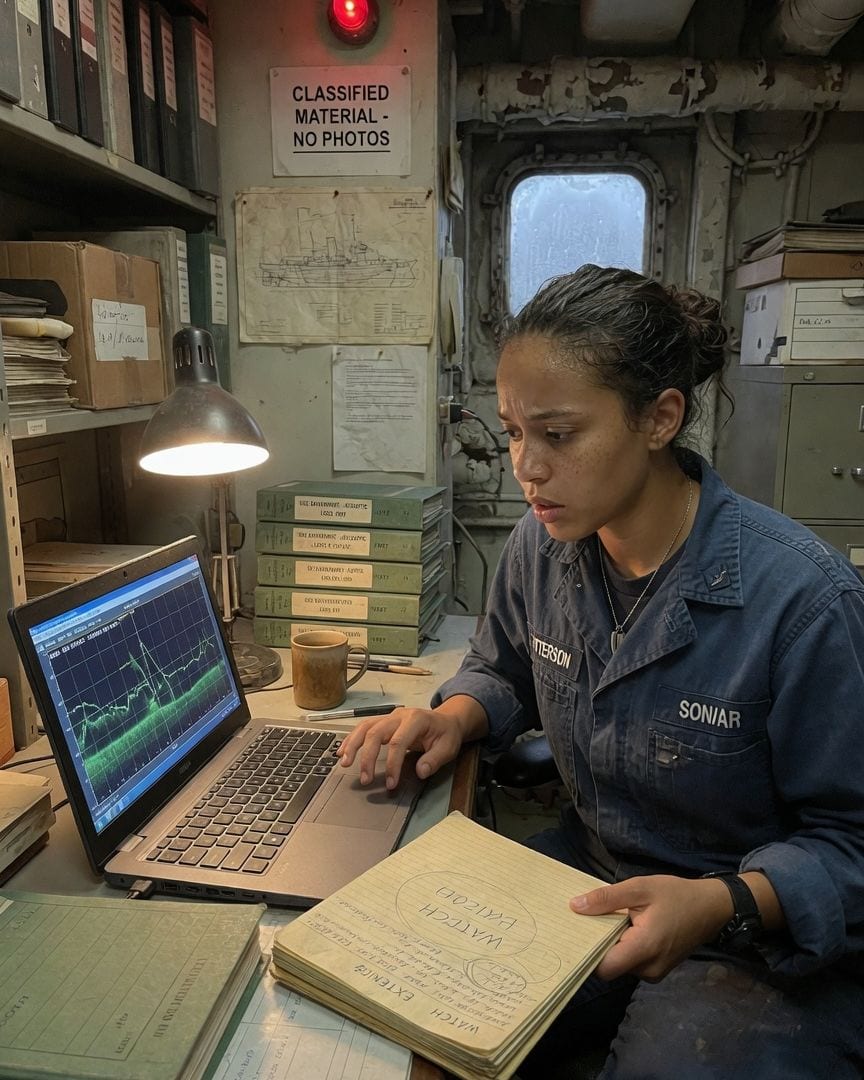
On the USS Calloway's final patrol, a sonar technician found an old log with two chilling words: 'WATCH EXTENDED.'
Sonar Technician Brooke Patterson had only two days left on the USS Calloway's last patrol, a finality that hung heavy in the humid sonar room. Through the impenetrable fog, her radar showed only empty water, but then an impossible biologic contact pinged, mimicking a vessel with eerie precision for three silent hours. It vanished at 0400, just as an identical trace had done weeks before. Searching old archives, Brooke found the precise pattern in a decades-old log from a scrapped destroyer. Scrawled next to it, in faded ink, were two words: "WATCH EXTENDED." What did those words truly mean?
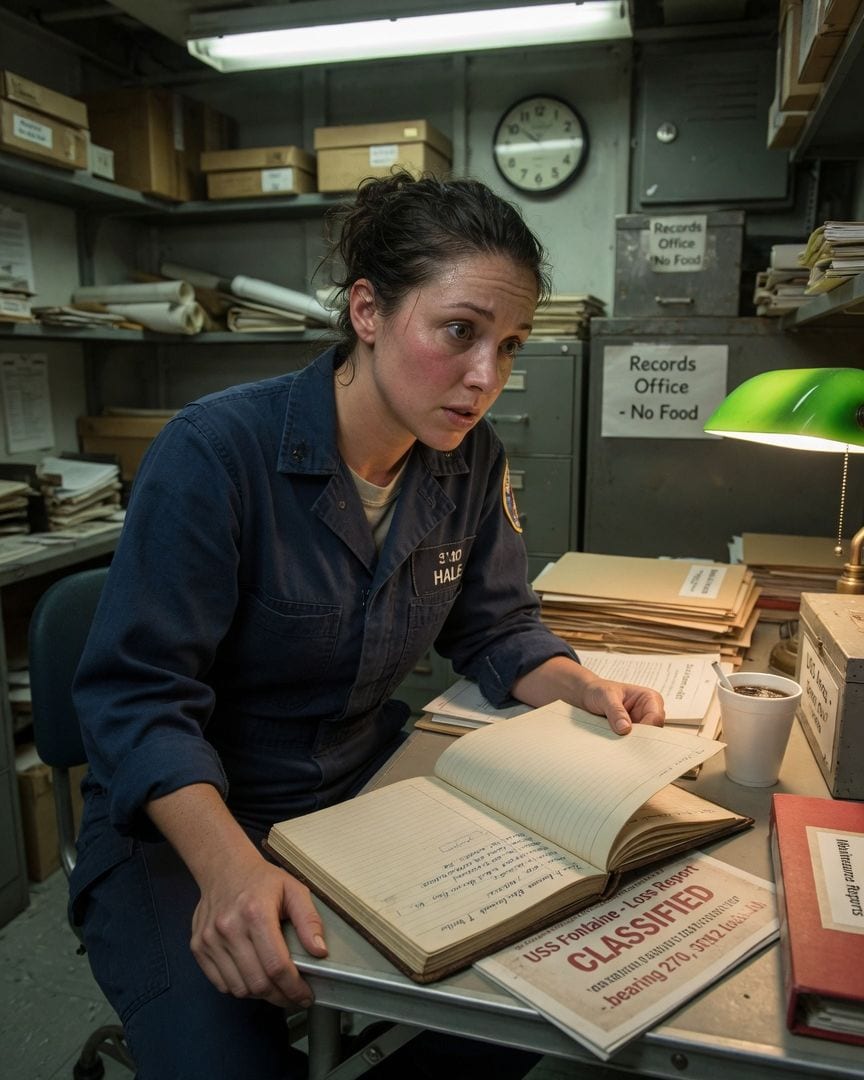
Petty Officer Hale needs a spotless record for her transfer. But the USS Ares sonar logs show an identical, impossible contact, logged to the minute, years apart, and tied to a classified loss report.
Petty Officer Sarah Hale needed a spotless record for her coveted shore duty transfer, a posting she'd worked five years to secure. Alone in the USS Ares sonar shack, three days out from San Diego, her midwatch was broken by an impossible contact: a close, slow echo holding perfect pace, invisible to radar, then vanishing. Her heart hammered, not from fear, but from the data's impossibility. When she found an identical entry in her own log from just one week prior, the cold dread tightened its grip. But the true chill settled when she unearthed decades of similar records, signed by other sonar officers, all showing the same impossible contact at 0212, off the port beam, for nineteen minutes, on the same ship, stretching back years—a persistent echo tied to a classified loss report.
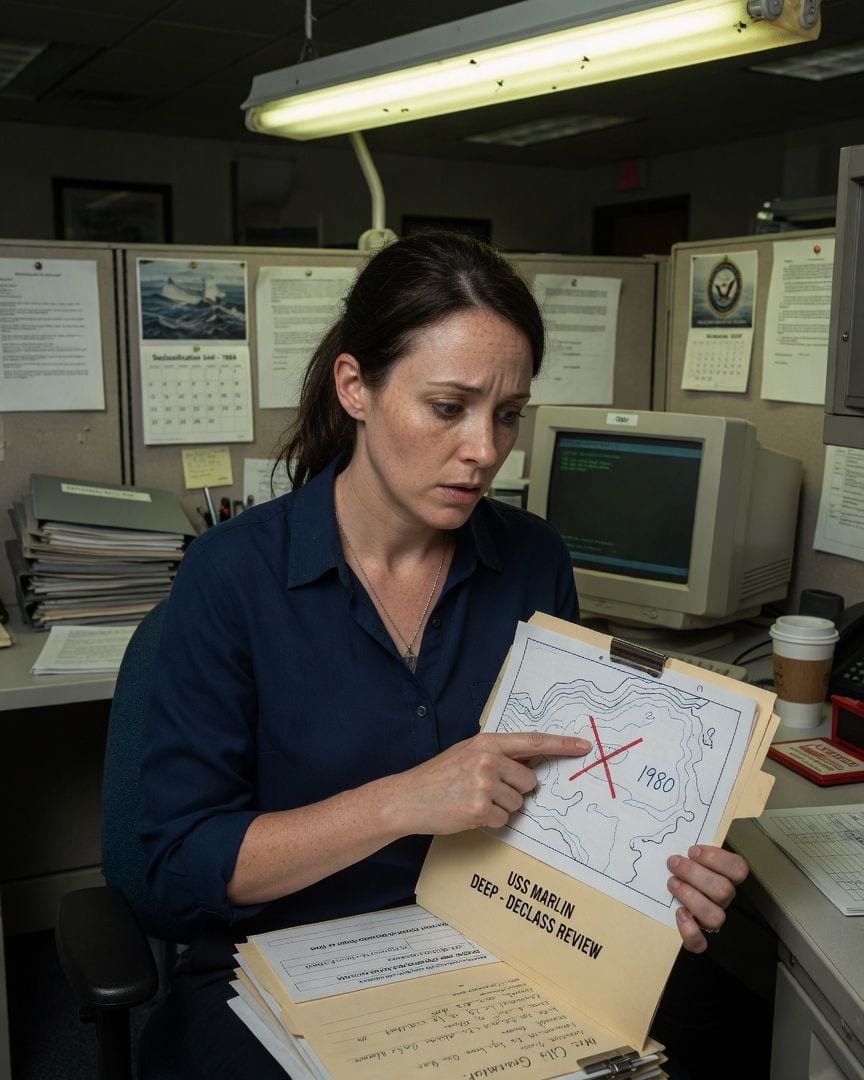
A declassification reviewer finds a dead Cold War submarine officer's report, filled out three years after his official loss.
Declassification reviewer Cass Berrigan understood the quiet anguish of widows, sifting through files like the USS Marlin Deep's. The submarine was lost in 1978, leaving behind Lily Granger's desperate letters, asking where her husband Arthur Thatcher's body was. But deep within the file, Cass found a chart of the wreck site, dated 1980—two years after the loss—in Thatcher's unmistakable hand. The dread solidified when she later uncovered an official report, also in his hand, dated 1981, stating 'Station Maintained. Status: Green.' How could a man officially dead for three years still be filing reports?
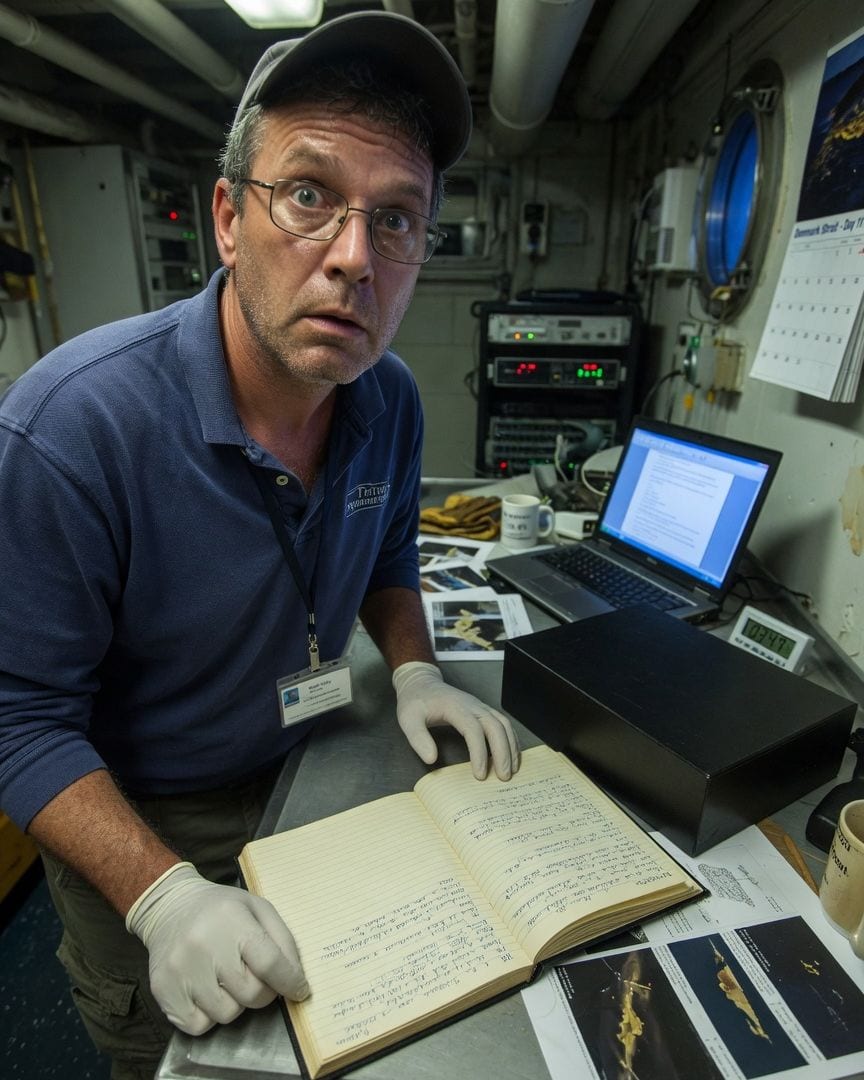
A hydrographer found a lost Cold War submarine from 1968. Inside, its logbook carried entries dated '12.03.2012'.
Hydrographer Wells Duffy had spent eleven days in the *Triton*'s control room, guiding the deep-sea submersible through the crushing dark of the Denmark Strait, chasing a phantom sonar signature. When the USS *Gale Prescott*, lost with all hands in 1968, finally resolved on his monitors, triumph turned to unease as he saw its escape hatch stood simply ajar. The hatch rim and ladder rungs were eerily clean and worn bright, used repeatedly long after the ocean claimed the vessel, prompting Captain Crane to authorize an unauthorized dive. Inside the frigid wreck, Wells discovered a non-Navy container, strangely warm, holding a logbook whose precise entries continued across the decades, ending in the impossible date of '12.03.2012'.