Marisol Frayne unlatched her husband's old footlocker. A photo inside showed his ship, pristine in 2016, three years after the Navy declared it lost.
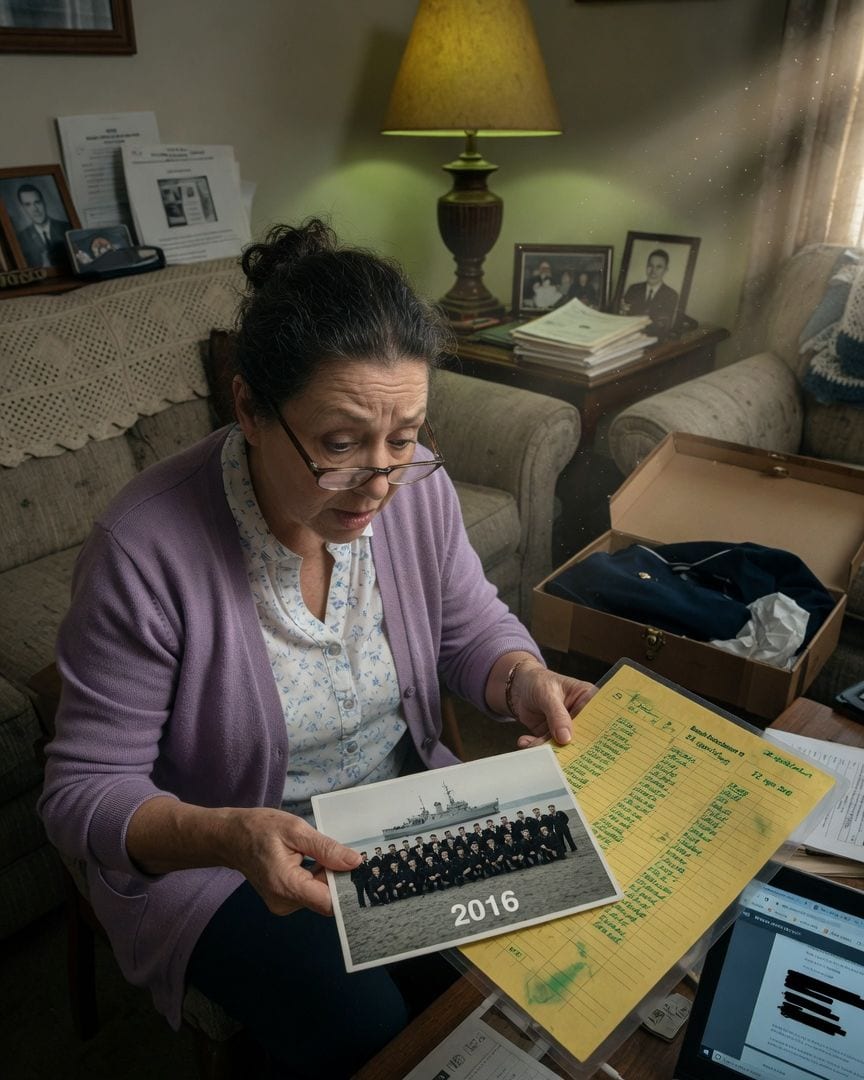
Marisol Frayne, 62, finally unlatched her husband’s old footlocker in the spring of 2024, eleven years after the Navy had called her to say the tender Kaskillan was gone.
Dust motes danced in the afternoon light that slanted across her living room, illuminating the worn brass clasp. Her fingers, usually steady, trembled as she lifted the lid, releasing the scent of old canvas and cedar.
Inside, beneath his perfectly folded dress blues, wrapped in tissue paper, lay a muster sheet for a unit she’d never heard David name: Beach Detachment 19.
Fifty-two men signed on, fifty-two signed off, all on the same day, in the same steady green ink.
It was a peculiar detail, a single-day transfer that seemed to vanish into thin air, leaving no trace in the official records Marisol had access to.
Beneath the muster sheet, tucked carefully into a plastic sleeve, lay a photograph. It was a standard-issue Navy photo, the kind given to families. Fifty-two men, including David, stood on a desolate shingle beach, their faces grim but clear.
David, younger, stood in the front row, his gaze direct, a faint smudge of what looked like grease on his cheek. The Kaskillan rode at anchor behind them, its hull untouched by the Aleutian storms, its paint fresh.
Not a scratch, not a dent. Marisol’s breath caught. She remembered the official reports, the debris fields, the impossible currents. This ship, in this photo, was pristine. Below the image, in stark white lettering, was a date: 2016.
Three years after the Navy declared the ship, and all aboard, lost. The air in the room suddenly felt colder, despite the spring sunlight.
Marisol’s initial shock gave way to a cold, methodical disbelief. She reread the date on the photograph, her thumb brushing the smooth surface of the glossy print. 2016.
Then she looked at the muster sheet again, checking and rechecking the peculiar single-day transfer as if the numbers would shift, would align with the impossible truth the photo suggested.
She tried to rationalize it – a mislabeled box, a printing error on the photograph, a simple mistake in the Navy’s vast, sprawling records. Perhaps David had just kept a training photo, incorrectly dated.
But the photograph was sharp, uncreased, undeniably real. David’s face, younger, yes, but undeniably her husband, looking directly at the lens. The Kaskillan, unmistakable, with its distinctive superstructure and the faint, familiar numbering on its hull.
The same distinctive green ink on the muster sheet seemed to glow under the lamp on her side table, a strange, vivid emerald against the aged paper.
She spent the next days glued to her computer, her fingers flying across the keyboard, sifting through naval archives, declassified documents, and obscure forum posts.
She searched for 'Beach Detachment 19,' for 'Kaskillan 2016,' for anything that would explain the discrepancy. There was no official record of a 'Beach Detachment 19' ever existing, let alone serving on the Kaskillan.
The ship's official file, when she finally located it through a FOIA request, was thinner than she expected for a vessel lost with all hands.
It contained the casualty reports, the formal declaration of loss, and a brief, uninformative summary of search efforts. No detailed manifests for its final voyage, no logs leading up to the incident, nothing to explain the circumstances of its disappearance.
It was as if the ship had simply ceased to be, without leaving a paper trail.
The only anomaly was a single, faded entry in a logistics manifest from 2012, listing a 'special transfer' of 'personnel and materiel' to the Kaskillan, signed with a distinctive, looping hand in green ink.
The same precise, emerald green ink from the muster sheet. The mundane explanations were dissolving, one by one, leaving a chilling void in their wake. Her once-orderly world tilted on its axis.
Driven by a cold certainty that defied logic, Marisol leveraged her connections from her late husband's veteran's association.
A former Navy clerk, now retired and living in Florida, quietly pointed her to an obscure, partially declassified database that listed vessel movements by hull designation rather than name.
It was a digital maze, but Marisol, fueled by an almost desperate need for answers, navigated it with fierce concentration. Digging deeper, past the public-facing logs, she found it: a heavily redacted official log.
It wasn't for the Kaskillan by name, but for a 'K-class vessel designation 71-B,' a sequence of letters and numbers that felt like a deliberate obfuscation.
The entries detailed supply transfers and routine maintenance operations, all occurring in the Aleutian region, the very stretch of ocean where her husband's ship had supposedly vanished. Her breath hitched as she scanned the dates. 2015. 2016.
The numbers swam before her eyes, then sharpened into dreadful focus. Her finger traced the specific entry, a knot tightening in her stomach, making it hard to breathe: '2016, 14 APR, K-71B, Routine Systems Check, (Abbott).'
The Kaskillan, or something using its hull and designation, had been alive and active a full three years after the Navy told her it sank.
The 'K-class vessel designation 71-B' became Marisol's singular obsession, a relentless current pulling her deeper into an ocean of secrets. She cross-referenced every detail, every supply code, every vague location reference in the redacted logs.
The vessel seemed to operate in the same general region of the Aleutians where the Kaskillan was supposedly lost, but its movements were erratic, its missions always described with generic, unsettling terms like 'survey' or 'reconnaissance,' never anything concrete.
The green ink signature, 'Abbott,' appeared consistently, a familiar, unsettling thread weaving through the otherwise sterile records, almost like a personal mark.
Through a series of increasingly bold FOIA requests, some of which she knew bordered on harassment, and a sympathetic, if cautious, archivist named Frances Ingram, Marisol discovered that the Kaskillan's original file, after its 'loss,' had been quietly merged into a larger, highly classified dossier.
Its title chilled her to the bone, a name whispered in the hushed halls of naval history: 'Project CHARYBDIS.'
The archivist, Frances, a woman in her late fifties with tired eyes and a nervous tic at the corner of her mouth, had warned her that this project was a 'black hole,' a designation where records went in and rarely, if ever, came out.
'Nobody talks about CHARYBDIS, Mrs. Frayne,' Frances had said, her voice hushed, glancing nervously around the silent archives, which seemed to hold its breath in response. 'It's one of those things that just... is. Best left alone.'
The fluorescent lights above them hummed, a low, constant drone that seemed to vibrate in Marisol's teeth. Marisol, however, could not leave it alone. The very name, CHARYBDIS, evoked ancient, swirling dangers, a whirlpool that consumed everything in its path.
She focused on the 'Abbott' signature. It belonged to Henry Abbott, a name that appeared on records dating back to the late 1960s, always in obscure, highly classified logistics or personnel departments.
He was a phantom, an institutional memory, a man who had been signing off on secrets for decades, his green ink a silent testament to a hidden history.
The further she dug, the more the files seemed to close in around her, the air growing heavy with untold stories.
Marisol’s deepening investigation did not go unnoticed. One afternoon, as she was watering the wilting hydrangeas by her porch, a sleek, unmarked sedan, dark as a shadow, pulled up outside her modest suburban home.
Its engine purred, almost silently, before cutting off. A man in a dark suit, impeccably dressed despite the warm spring day, emerged. He introduced himself as Philip Drummond, a 'records management specialist' from Naval Intelligence.
He was younger than Marisol, perhaps forty, with a polite, almost deferential tone that masked eyes as cold and sharp as shards of ice.
The gentle breeze rustled the leaves of her oak tree, but the air around him felt unnaturally still. He knew exactly what she had been looking at, referencing specific file numbers and dates from her recent requests with unnerving precision.
'Mrs. Frayne,' he began, his voice smooth, devoid of any discernible emotion, 'we appreciate your dedication to your husband’s memory. It’s commendable. However, some of these older files, particularly those related to Project CHARYBDIS, contain sensitive information.
Information that, for various reasons, remains classified.' He paused, his gaze steady, unwavering. 'For your own safety, Mrs. Frayne, and to avoid further complications, we strongly advise you to discontinue your inquiries.'
He didn't threaten her directly, but the implication was clear: she was trespassing on dangerous ground, uncovering something that was meant to stay buried. The silence between his words seemed to expand, filling the space with unspoken warnings.
He handed her a sealed envelope containing a copy of David’s official death certificate, already in her possession, as if to underscore the finality of the Navy’s narrative and dismiss her quest as a futile act of grief.
As he turned to leave, Marisol noticed a faint, almost imperceptible green smudge on his thumb, as if he had recently handled something signed in that very specific ink. The encounter left her shaken, but also solidified her resolve.
Someone was actively protecting this secret, and that meant there was a secret to protect, a living, breathing entity hidden within the files.
The very walls of her house seemed to press in on her, no longer a sanctuary, but a stage for unseen surveillance.
Marisol, emboldened by Drummond’s chilling visit, decided to confront Henry Abbott directly.
Locating him proved surprisingly easy: he worked in a small, windowless office in a nondescript federal building downtown, a place that felt forgotten, nestled between a laundromat and a tax office.
The air inside smelled of old paper and dust, surrounded by stacks of ancient, bound ledgers that seemed to hum with forgotten histories.
Abbott, a man in his late seventies with wispy white hair meticulously combed over his balding scalp, and a precisely neat desk, greeted her with an unnerving calm, as if her arrival had been pre-scheduled for decades.
He didn't deny anything.
'Ah, Mrs. Frayne,' he said, his voice soft, almost a whisper, his gaze steady, devoid of surprise, 'I had a feeling you might come calling. You've been... persistent. Your husband, David Ingram. A good man. Dedicated.'
Marisol, her voice tight with suppressed emotion, laid out her evidence on the corner of his polished mahogany desk: the muster sheet, the photograph of the undamaged Kaskillan, the K-71B logs detailing activity years after its supposed sinking, the tell-tale green ink.
Abbott nodded slowly, almost imperceptibly, his expression unchanging.
'The Kaskillan was never lost, Mrs. Frayne. Not in the way the public was told. It was... repurposed. And Beach Detachment 19, your husband among them, was transferred to a special, long-term assignment. Project CHARYBDIS.'
Marisol demanded to know what that meant. Where were they? What was the assignment? The small office, lined with rows of filing cabinets that stretched to the ceiling, suddenly felt suffocating.
Abbott leaned forward, his calm gaze unwavering, his hands resting neatly on a stack of invoices. 'Their service is ongoing. The nature of the assignment is highly classified, beyond your clearance, I'm afraid.
But the records must reflect their continued status. It's a matter of maintaining continuity, you understand. Their existence, their activities, must be accounted for. It ensures the integrity of the project.'
He spoke of the men as if they were still performing routine duties, still present, still filing reports, despite the passage of over a decade. 'They are serving the nation, Mrs. Frayne. In a capacity few can comprehend.
Their files, meticulously maintained, are simply a testament to their enduring commitment.' The pieces clicked into place with horrifying clarity: David wasn't dead, not in the way she had mourned. He was gone, filed away into a perpetual, secret existence.
The ship, the unit, the men — all of them were still 'active' in a system that refused to let them go, a bureaucratic horror that simply kept signing.
Shaken but not broken by Abbott's chilling composure, Marisol returned to the Project CHARYBDIS file, now with a new, terrible understanding. If the men were still 'serving,' what did that entail? What did their 'continued status' truly mean?
She meticulously reviewed every page, every cryptic entry, every faded memo within the massive dossier. Most were decades old, brittle with age, detailing long-past logistical transfers and obscure scientific readings.
The fluorescent lights of the records office hummed, reflecting off the polished linoleum floor.
Then, deep within a sub-section labeled 'Logistical Support: Detachment 19,' she found it. A requisition. It was for 'Type-B atmospheric filters.'
The description was terse, technical, but the quantity was substantial, and the delivery point a series of coordinates deep in the Aleutian trench, far beyond normal human habitation or naval operations, in a place the charts labeled 'uncharted.'
Marisol’s eyes fixate on the date at the top of the requisition: '2024, 07 MAY.' Below it, the item 'Type-B atmospheric filters' and the familiar, looping green signature of Henry Abbott for 'Beach Detachment 19.'
She looks up at the ceiling of the records office, the silence suddenly deafening, the fluorescent hum a buzzing in her ears that vibrated through her skull.
The file in her hands was no longer a dead record, a historical cover-up.
It was a living, breathing testament to an ongoing horror, still being signed, still being updated, still demanding supplies for a unit that should not, could not, exist.
The date, '2024, 07 MAY,' burned into Marisol's mind like a brand. It wasn't just a historical cover-up; it was an active, ongoing operation.
The men of Beach Detachment 19, her husband among them, were still there, wherever 'there' was, requiring 'atmospheric filters' in a place no human should be.
She confronted Abbott one last time, bursting into his quiet office, the requisition clutched in her hand, the paper crinkling sharply in her grip. He received her without surprise, as if he'd been expecting her.
He offered her a cup of lukewarm tea, his gaze as placid as a still pond, reflecting the muted light from his desk lamp.
'They are fulfilling their purpose, Mrs. Frayne,' he explained, gesturing vaguely to the stacks of files around him, which seemed to lean in, listening. 'The Kaskillan, or what remains of it, serves as their transport and base of operations.
The filters are... necessary for the environment they now inhabit. They were never truly lost. They were simply reassigned, their official status shifted from 'active duty' to 'permanent assignment, classified.''
He spoke of it with the detached calm of a bureaucrat explaining a zoning ordinance, his voice devoid of emotion, a flat monotone that scraped against Marisol’s raw nerves. 'The mission requires a stable, consistent crew.
These men, your husband included, volunteered for a service beyond the ordinary. They are beyond retrieval, beyond recognition. They have become part of the mechanism, the living record of Project CHARYBDIS.'
The full, terrible truth settled over Marisol: David was not dead and buried.
He was a piece of this machine, forever performing an unknowable task, maintained by official paperwork, his humanity likely stripped away by whatever 'environment' required atmospheric filters in the Aleutian deep.
The horror was in the coherence, the meticulous accounting of a living, ongoing file for the irrevocably lost.
Marisol slammed the requisition onto Abbott’s meticulously neat desk, the paper crinkling under her hand with a sound that seemed overloud in the quiet office. 'My husband isn't a line item! He's a man! What have you done to them?
What have they become?' Abbott merely adjusted his spectacles, his expression unruffled, his hands folded patiently on the desk blotter. The faint scent of old paper and something metallic seemed to thicken the air around him.
'We have ensured their continued service, Mrs. Frayne. They are integral to Project CHARYBDIS. Their original orders were clear: maintain the illusion of loss to the outside world, while ensuring their continued, uninterrupted function within the project.
It's a delicate balance, managing the files of those who are... permanently deployed.' He explained how the 'green ink' signature was a personal identifier, a mark of his responsibility for this particular, long-term protocol.
He had inherited the duty from his predecessor, a man named Henderson, and he would pass it to the next. 'They are not dead, Mrs. Frayne. But they are not as they were.
The transformation was necessary for the mission's parameters. They are sustained, provided for, their needs meticulously recorded and fulfilled. Their file is simply a reflection of their ongoing status.'
His calm acceptance, his unwavering conviction that this was simply 'procedure,' was far more horrifying than any anger or denial could have been. Marisol felt a profound, chilling despair. There was no escape for David, no rescue.
He was filed, and the file was still being signed. She had found the truth, and it was a truth that swallowed men whole, then meticulously documented their continued consumption.
She had pulled back the curtain, and all she found was the quiet, methodical hum of a machine that never stopped taking, its gears turning slowly, patiently, forever.
Marisol Frayne returned home, a ghost in her own house. The footlocker remained open, its contents now a testament to a monstrous bureaucracy that had devoured her husband.
She tried to tell her sister, her old friends, but her story, filled with classified projects and perpetually serving, transformed men, was met with concern, then pity, then quiet distance. They saw grief, not horror.
The Navy's official stance remained unchanged, the Kaskillan still listed as lost in 2013, David Ingram still officially deceased.
Henry Abbott continued to sign his green-inked requisitions in his small, windowless office, an unseen architect of a hidden reality, maintaining the files of the perpetually deployed.
The world moved on, oblivious to the meticulous accounting of the permanently lost, their service recorded in an endless, living ledger.
Years passed. Marisol, now frail, lived a solitary life, the terrible knowledge a constant companion, a chill that never left her bones.
She rarely spoke, often staring blankly at the sea on overcast days, as if searching for a phantom ship on the horizon, or perhaps the edge of an impossible, uncharted trench.
One autumn afternoon, a small, official-looking envelope arrived in her mailbox. It bore no return address, only her name and address, typed with an old-fashioned ribbon, the characters slightly faded.
Inside, on a crisp, blank piece of heavy stock paper, was a single, precisely executed signature, familiar and chillingly neat. It was Abbott’s green-inked looping hand.
The old woman's mail slot clattered shut, the sound echoing in the silent house. A neighbor, checking in later that day, found the envelope still on the floor, the green signature stark against the white.
The door was ajar, the television still humming, but Marisol Frayne was gone. The signature, so patient and precise, seemed to wait, still fresh on the page.
If this one got to you
A declassification reviewer finds a dead Cold War submarine officer's report, filled out three years after his official loss.
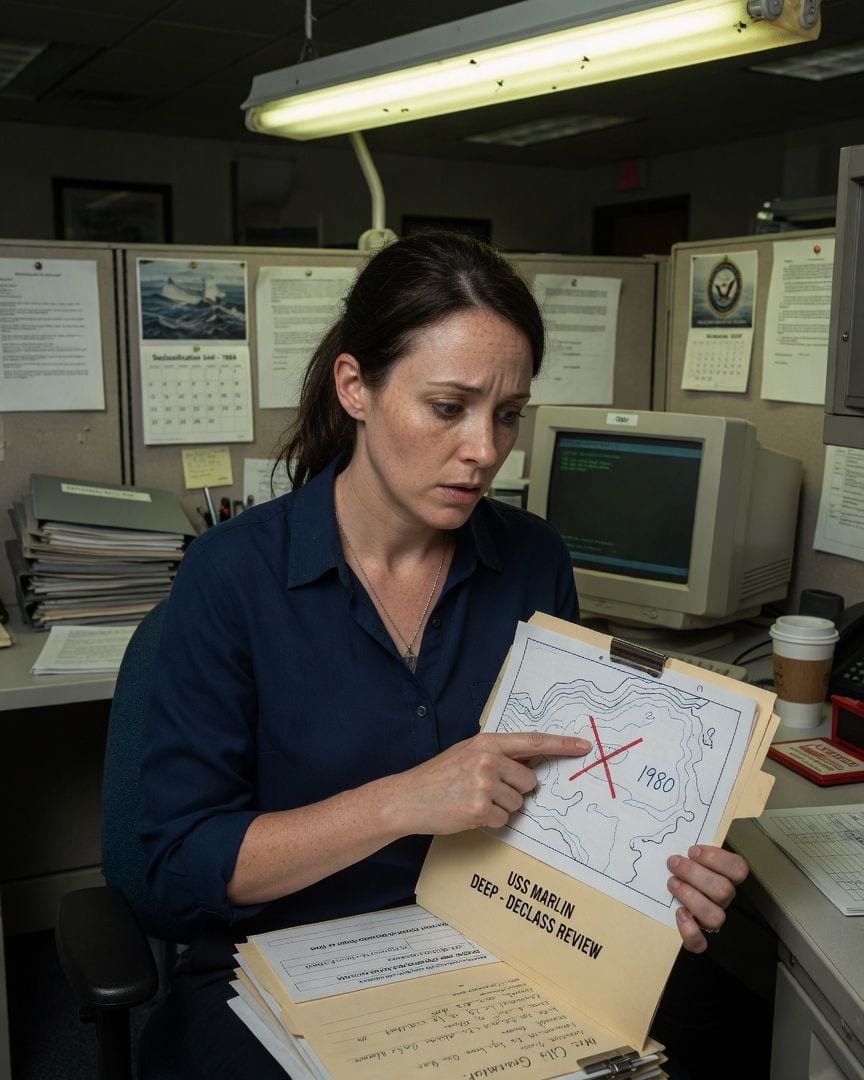
Declassification reviewer Cass Berrigan understood the quiet anguish of widows, sifting through files like the USS Marlin Deep's. The submarine was lost in 1978, leaving behind Lily Granger's desperate letters, asking where her husband Arthur Thatcher's body was. But deep within the file, Cass found a chart of the wreck site, dated 1980—two years after the loss—in Thatcher's unmistakable hand. The dread solidified when she later uncovered an official report, also in his hand, dated 1981, stating 'Station Maintained. Status: Green.' How could a man officially dead for three years still be filing reports?
A Navy records reviewer found a Cold War captain’s own hand-drawn map, marking his submarine’s location two years after it vanished.
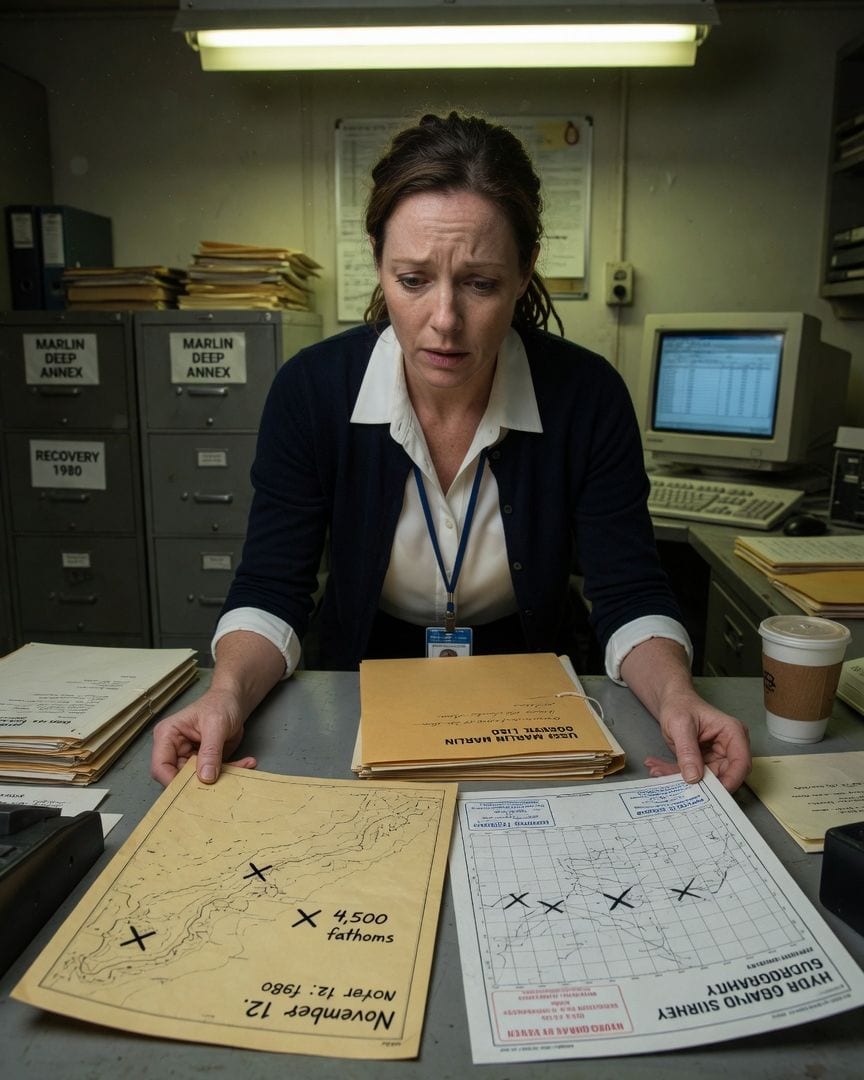
In the quiet, cold Navy archives, records reviewer Catherine Berrigan unearthed the sealed file of the USS Marlin Deep, a Cold War submarine lost with all hands in 1978. Decades of unanswered pleas from Captain Caldwell’s widow, Dorothy, filled the binder, seeking closure for her husband’s vanishing. But among the tragic records, Catherine found a crudely hand-drawn map, dated two years after the sub was declared lost, marking its exact deep-ocean location. The captain’s own distinct handwriting on the chart left her with a chilling, impossible question: how could he have charted his own wreck two years beyond the grave?
Petty Officer Hale needs a spotless record for her transfer. But the USS Ares sonar logs show an identical, impossible contact, logged to the minute, years apart, and tied to a classified loss report.
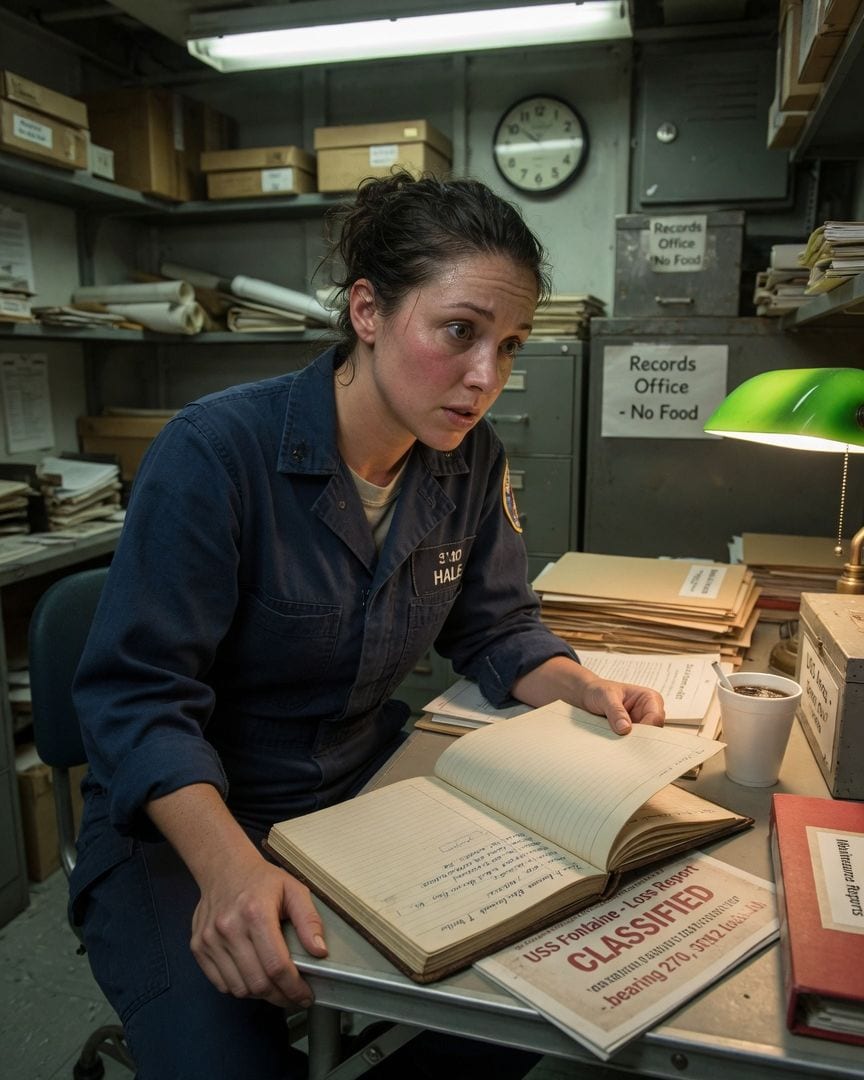
Petty Officer Sarah Hale needed a spotless record for her coveted shore duty transfer, a posting she'd worked five years to secure. Alone in the USS Ares sonar shack, three days out from San Diego, her midwatch was broken by an impossible contact: a close, slow echo holding perfect pace, invisible to radar, then vanishing. Her heart hammered, not from fear, but from the data's impossibility. When she found an identical entry in her own log from just one week prior, the cold dread tightened its grip. But the true chill settled when she unearthed decades of similar records, signed by other sonar officers, all showing the same impossible contact at 0212, off the port beam, for nineteen minutes, on the same ship, stretching back years—a persistent echo tied to a classified loss report.
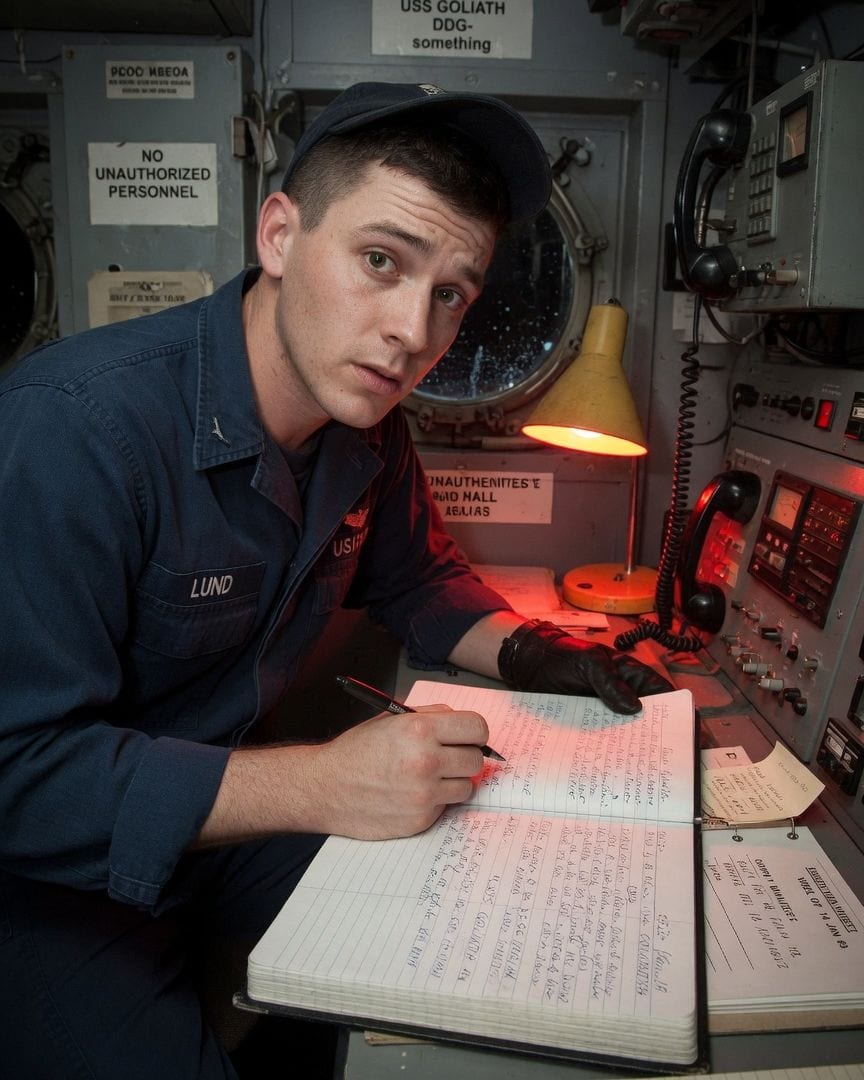
Petty Officer Lund heard his own captain's mayday: the Cold War USS Goliath was sinking, two hundred miles astern.
Petty Officer Marco Lund kept a lonely vigil in the USS Goliath's radio room, the destroyer battling the North Atlantic in deep winter 1983. Suddenly, a garbled mayday broke through: his own ship, his own captain, reporting they were going down two hundred miles astern. Though the bridge confirmed the Goliath was fine, the same chilling call came again an hour later, stronger and from the exact waters they had just crossed. Deeply unsettled, Marco began searching ship logs, eventually discovering a phantom entry: an identical mayday, logged a week prior, pressed into the very paper beneath his own.
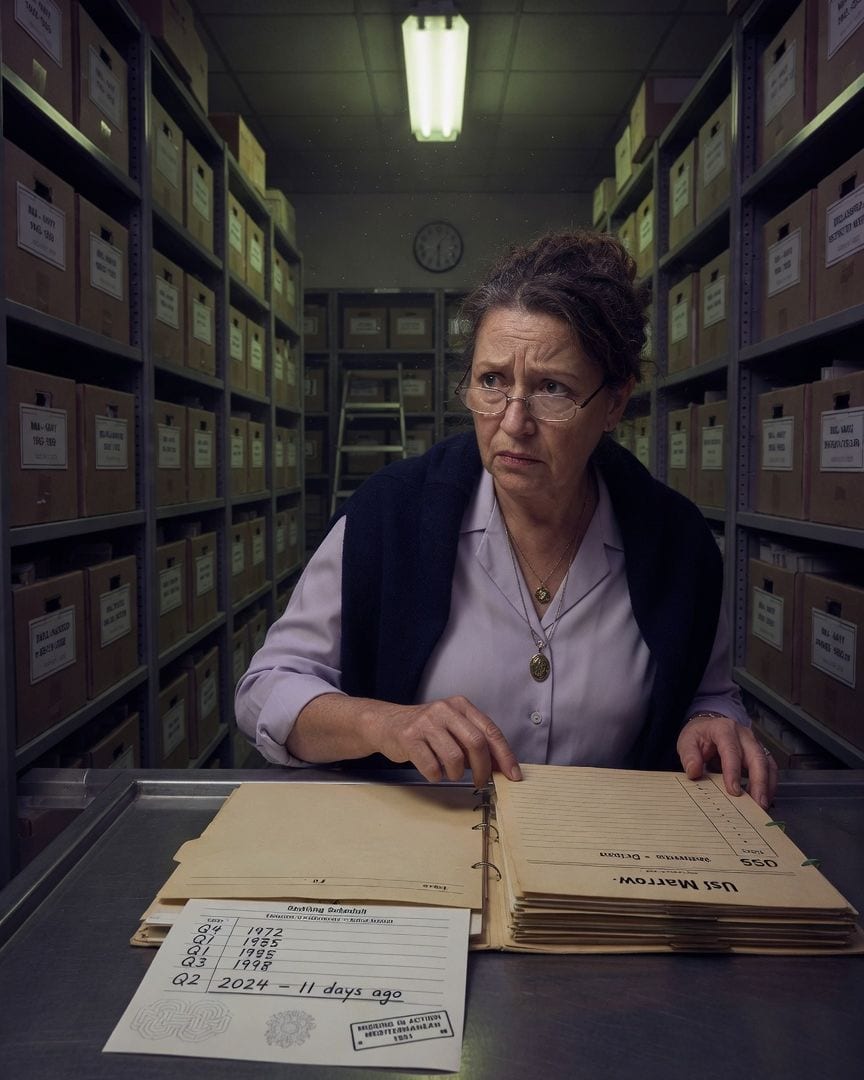
In her last week before retirement, an archivist discovers a Cold War oiler, lost in 1951, still has fuel logs updated just 11 days ago.
Marguerite Ansell, an archivist, faced her final week before retirement in the National Archives. Dust motes danced in the anemic fluorescent light as she navigated endless rows of forgotten history, counting down to quiet days. Her last routine task, auditing 'missing in action' files, led her to the oiler Pell Marrow, officially lost in the Mediterranean in 1951. Inside its yellowed folder, a crisp, newer fueling schedule revealed quarterly updates, running relentlessly forward to an entry just 11 days old: someone was still filling the Pell Marrow’s tanks. As she found similar active schedules for other 'lost' assets, each bearing a peculiar, unknown fractal stamp, a cold dread settled: what agency kept these ghosts of the Cold War afloat?
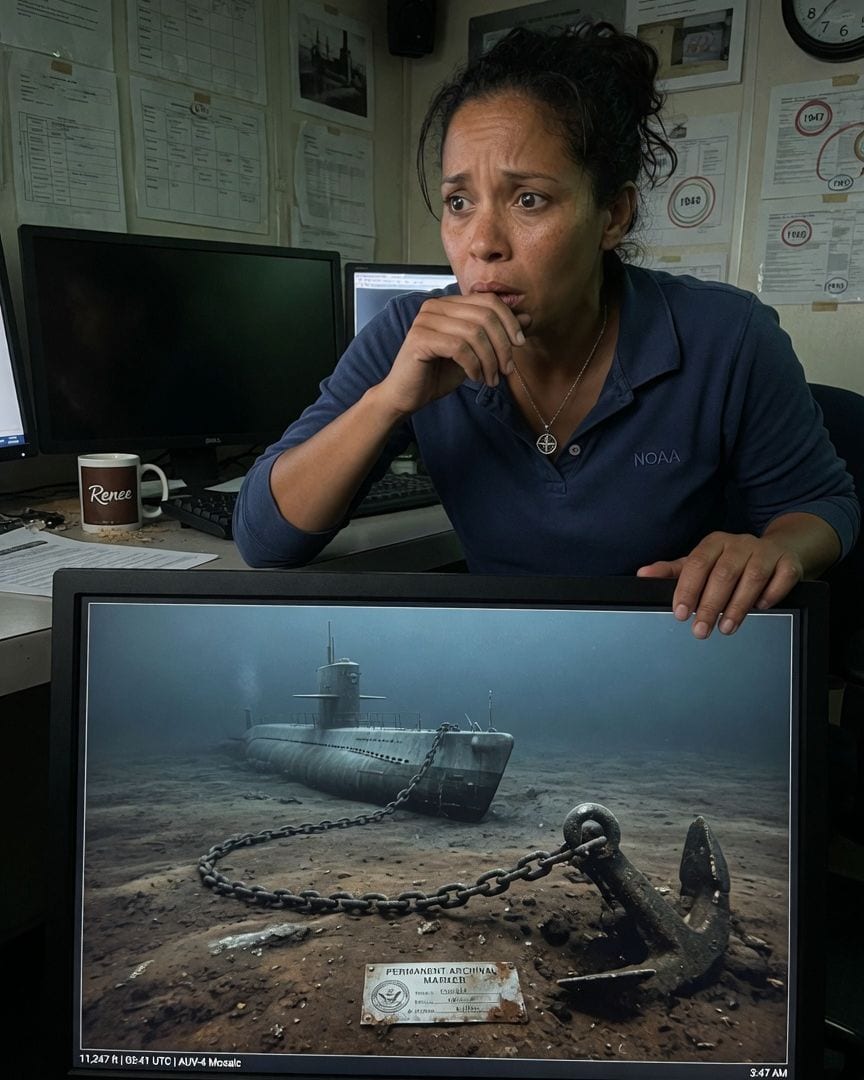
An oceanographer found a 1943 submarine anchored at eleven thousand feet, its Cold War records still meticulously updated.
Oceanographer Marisol Beckwith's career-defining discovery began with the ghostly outline of a 1943 submarine, the USS Kettle Iron, resolving from the abyssal murk at eleven thousand feet. Her initial elation curdled into dread when she realized the long-lost vessel was not a wreck, but sat upright, its massive anchor deliberately set. Even more unsettling, the sub's official service record, supposedly lost with its eighty-seven men in 1943, contained meticulous maintenance logs and commendations dated well into the Cold War era. Someone, or something, had been keeping watch over a ship filed as 'permanently retired,' long after its crew vanished.