Chief Salas finds a new bunker seal signed by men d*ad or discharged decades ago.
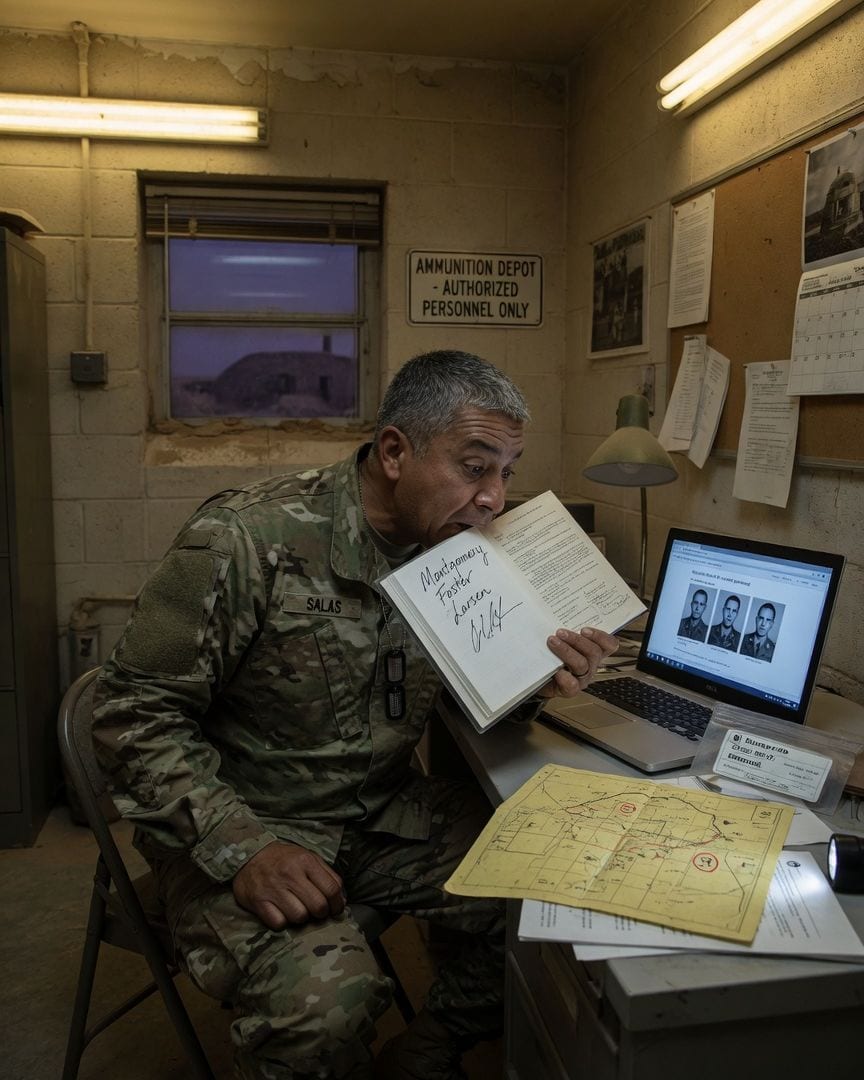
Chief Warrant Officer Curtis Salas squinted at the faded bunker map, its grid lines crisscrossing the high desert terrain. The map, yellowed and creased, showed thirty-nine earth-covered igloos, each a concrete dome designed to store munitions.
He had just finished the physical count, a final inventory before the depot’s closure. But his tally was forty. He walked the perimeter again, the desert wind whipping sand against his face.
There, half-hidden by a stand of creosote bushes, was Bunker 40. It wasn’t on the map.
It had a heavy-duty lock, a bright new security seal, and a magazine data card taped inside a weather-proof sleeve. The card listed lot numbers for a munition type the Army retired before Salas even enlisted.
He checked the seal number against the duty book he carried. It matched an entry made just that week, signed by three names: Montgomery, Foster, Larsen. None of them were on the depot’s current roster.
Salas ran a hand over the cold steel of the bunker door, the silence of the desert amplifying the impossible count. The arid air, usually still, felt almost watchful.
Salas returned to the temporary office, the digital roster glowing on his laptop. He typed in Montgomery, Foster, Larsen. 'No match found for current personnel at this facility.' He tried the broader Army database, a long shot.
The system whirred, then populated results. The names were real. Greg Montgomery, Everett Foster, Michael Larsen. Each had a service record. But the dates were wrong. Montgomery and Larsen were listed as K*lled in Action, Vietnam, 1968 and 1971 respectively.
Foster, honorably discharged in 1978.
Salas leaned back, his chair groaning softly in the otherwise silent room. Clerical error? A bad joke? He dismissed the idea. The seal was new, the duty book entry fresh, the ink still dark.
Someone had physically signed those names this week. He pulled out the printouts, comparing the digital records to the handwritten entries. The signatures, though not perfectly identical, bore a striking resemblance to the digitized samples of the historical personnel files.
The 'retired' munition listed on Bunker 40’s data card, he found, had been a specialized, highly volatile ordnance, discreetly phased out after a classified incident in the late 90s. Its presence here, now, made no sense.
He felt a prickle of unease. This wasn't a simple mistake. This was a system-wide anomaly, a ghost in the machine, demanding explanation. The air in the small office seemed to thicken, pressing in on him.
He decided to consult Dorothy Sullivan, the depot's long-serving civilian archivist, whose institutional memory stretched back decades.
Dorothy Sullivan, a woman whose gray hair seemed spun from the desert dust, regarded Salas with calm, knowing eyes.
She listened patiently as he laid out the discrepancies: Bunker 40, the impossible count, the retired munition, the duty book, the d*ad men’s fresh signatures.
When he finished, she simply nodded, her gaze fixed on the printouts from the central personnel database that Salas held. The paper trembled slightly in his hand. “You looked up their records, then,” she said, her voice flat.
“And you found nothing.” Salas corrected her. “I found they were d*ad or discharged. Decades ago.” Dorothy picked up the duty book, flipping to the page with the recent entries. Her finger traced the signatures: Montgomery, Foster, Larsen.
A faint, almost imperceptible smile touched her lips. “Oh, they’re still here,” she murmured, her eyes meeting his, devoid of surprise or concern. “They’ve always been here.”
He looked from the faded printouts to the stark, fresh signatures in the depot's current logbook, the ink still seeming wet on the page.
Dorothy's words hung in the air, a cold, dry statement of fact. Salas felt a shiver despite the desert heat. “What do you mean, 'always been here'?” he pressed, his voice tight.
Dorothy merely shrugged, placing the duty book back on the desk. “Some things just are, Chief. Not everything fits into a neat little file.”
She turned, her shadow stretching long and thin in the archive’s dim light, and walked back towards her own desk, leaving Salas with the echo of her unsettling calm.
Unconvinced, Salas spent the next two days digging deeper. He found no official record of Bunker 40 ever being decommissioned or re-activated. It simply wasn't on any recent map or manifest.
He cross-referenced the munition lot numbers from Bunker 40’s data card with historical inventory logs. They appeared only once, tied to a classified 'special projects' allocation in 1997, then vanished from all records.
The system was a labyrinth of dead ends, each path leading to another sealed door. He tried to find any other personnel assigned to these 'special projects' and hit a wall of redacted files and 'no record found' entries.
The system was designed to forget. Its digital walls seemed to hum with a silent, deliberate refusal.
He then turned his attention to the signatures. He requested high-resolution scans of the historical signatures of Montgomery, Foster, and Larsen from their service records.
Comparing them side-by-side with the fresh entries in the Bunker 40 duty book, he noted subtle but distinct differences.
The fresh signatures were not exact forgeries; they were similar, almost like someone had practiced them, or like a hand had grown old and shaky. This wasn't identity theft. This was something else.
He started looking for other anomalies at the depot, any other impossible counts or strange entries. He found nothing, but the sense of being watched, of scrutinizing a perfectly normal facade, began to set in.
The quiet archives, once a sanctuary of information, now felt like a stage, with him as the unwitting performer.
As Salas delved deeper, the quiet hum of the depot began to feel less like routine and more like surveillance.
He found himself glancing over his shoulder, convinced he saw movement at the edge of his peripheral vision, only to find nothing there.
The old fluorescent lights in his temporary office flickered with an unnerving irregularity, casting dancing shadows that seemed to mock his solitude.
One evening, after working late in the archives, he returned to his temporary quarters to find his laptop screen open to the personnel database, specifically on the search results for Greg Montgomery. He was certain he had closed it.
A faint, metallic scent, like ozone or old electronics, lingered in the air, barely noticeable but persistent, like a whispered warning. The curtains in his small window, which he had drawn, were slightly parted.
The next day, Dorothy Sullivan approached him as he reviewed old maintenance schedules in the main office, far from her usual archive domain. Her eyes, usually placid, held a sharper glint, like polished stone.
“You’re asking too many questions, Chief,” she said, her voice soft but firm, cutting through the low murmur of the depot’s cooling system. “Some things are better left alone. Curiosity can be… unhealthy.” Salas felt a chill. “Unhealthy how?”
he challenged, trying to keep his voice steady, his gaze locked on hers. Dorothy merely smiled, a tight, humorless curve of her lips that never quite reached her eyes. “The Army has a way of making things… disappear.
Not just documents. People.” She walked away, her steps deliberate and unhurried, leaving Salas with the distinct impression that he had just been warned, and that his investigation had been noticed by more than just the archivist.
He started locking his office door, double-checking his quarters, and carrying his sidearm even within the confines of the depot. The feeling of being hunted sharpened with every passing hour, a silent, mounting pressure.
Salas cornered Dorothy again, this time in the desolate main warehouse, away from prying ears. Dust motes danced in the slivers of sunlight piercing the corrugated steel roof.
“What did you mean, ‘the Army has a way of making people disappear’?” he demanded, his voice low, ricocheting slightly in the cavernous space. Dorothy sighed, leaning against a stack of empty crates, seemingly unfazed by his intensity.
“It’s not a secret, not really. Just… unacknowledged. Some personnel, for various reasons, become… assets. Too valuable to lose, too compromised to keep in the public eye. They get reassigned. To places like Bunker 40.”
Salas stared, the implication heavy. “You mean, they’re not d*ad? They’re living in those bunkers?” Dorothy shook her head slowly, her eyes sweeping over the quiet, still warehouse. “Not exactly ‘living,’ not in the way you mean. They’re maintained.
Kept in… operational readiness. Bunker 40 is a hub for that. A transition point.” Salas’s mind raced, connecting the dots. “The retired munition… it’s not ordnance, is it? It’s a code for something else. For them.”
Dorothy gave a small, approving nod. “Very good, Chief. It’s a designation for a specific kind of… material. And personnel. They cycle through. They maintain the sites. They sign the logs, to keep the illusion of activity.
It’s a very old program.”
Salas remembered the slightly off signatures, the aged quality he had noticed. “The signatures… they’re not perfect copies. They’re like an older version of the person.” Dorothy’s gaze grew distant, fixed on a far, grimy windowpane.
“Time takes its toll, even on the maintained. The system is designed to keep them functional, not youthful. It’s about accountability that cannot be, Chief. Their names are on the books, but not the right books.
They exist, but not officially. They are the Army’s ghosts, ensuring certain things stay buried.” The pieces clicked into place with a sickening thud.
The impossible count, the fresh signatures of d*ad men, the retired munition code—all of it was a carefully constructed facade for a deeply hidden, ongoing operation.
The dread that had been a prickle now settled deep in his gut, cold and solid. This wasn't an error; it was a deliberate, living system, vast and silent, humming just beneath the surface of official reality.
Salas, now armed with Dorothy’s chilling admissions, used his access to the classified archives to search for any mention of 'special personnel reassignment protocols' or the 'retired' munition code.
The archive room seemed to hold its breath as he worked, the faint scent of old paper and dust filling his lungs. He unearthed a faded memo from 1985, its typeface barely legible, detailing 'low-visibility asset transfers' to 'decommissioned sites.'
The language was oblique, but unmistakable.
His heart hammered as he cross-referenced the munition code with other inactive depots across the high desert region, finding a disturbing pattern: similar impossible personnel counts, logs signed by ghosts, and recurring mentions of the code.
This wasn't an isolated incident at Bunker 40; it was a systemic operation, spanning decades and facilities, a secret architecture beneath the visible Army.
Then, as he scrolled through a digitized file from a depot closed in '98, his breath hitched. At the bottom, a handwritten notation, almost missed, faded but clear. It was an internal transfer order, dated five years in the future.
It read: 'Transfer Order – CWO Curtis Salas – Inactive Status, Site 40 – Effective: 05/XX/2029.'
He stared at his own name, five years in the future, assigned to the very bunker that shouldn't exist, the bunker where the ghosts signed their names.
The system wasn't just managing ghosts; it was creating them, and it had him in its sights.
Salas confronted Dorothy, thrusting the transfer order at her across the scuffed desk in her archive office. “My name. Five years from now. What is this?”
Dorothy took the paper, her eyes scanning the familiar script without a flicker of surprise. She didn’t deny it, didn’t flinch. Her calmness was a lead weight in the air, pressing down on Salas. “It’s your assignment, Chief.
Your new posting, if you will.”
She folded the paper neatly, her movements precise. “The program identifies personnel who fit a certain profile. Disciplined. Resourceful. And… with a certain lack of deep personal ties that might complicate things.” Salas scoffed, a dry, bitter sound.
“You’re saying I’m being selected to become a ghost? To sign logs for d*ad men?” Dorothy nodded slowly, her gaze unwavering. “You’ll maintain the sites. Keep the records. Ensure the system’s integrity. Just like Montgomery, Foster, and Larsen.
They were all exceptional soldiers, Chief. Too valuable to simply disappear. This way, they serve. Indefinitely.”
Salas remembered the slightly off signatures, the aged quality he had noticed. “What happens to them? To us?” Dorothy’s expression remained serene, almost detached. “You are cared for. Maintained. The facilities are self-sustaining.
You operate outside the official grid, but you still have a purpose. A vital one. Someone has to keep the ghosts accounted for, after all.” The horrifying coherence of it settled over Salas, cold and final.
Every impossible detail, every discrepancy, every ghost signature—it all fit a system designed to preserve and utilize personnel beyond their official expiration dates, making them truly 'unaccountable' except to the program itself.
He was looking at his future, laid out by a calm, unbothered archivist who had been a quiet guardian of this terrible truth for decades. The room, once a repository of forgotten history, now felt like a mausoleum.
Salas stood before Dorothy, the desert sun streaming through the dusty warehouse windows, illuminating the terrible calm in her eyes. The air hung heavy, thick with the scent of old metal and the dry, ancient dust of the facility.
“I won’t do it,” he said, his voice firm despite the tremor he felt starting in his hands. “I won’t become one of your ghosts.”
Dorothy merely smiled, a faint, sad expression, as if she were contemplating a distant, inevitable horizon. “It’s not a choice, Chief. Not anymore. Once the system identifies you, once you start asking the right questions, you become part of it.
Your transfer order has been on file for years. It’s a contingency.” She gestured vaguely around the vast, echoing warehouse. “This depot, this closure… it’s all part of the process. Clearing the board for new assignments. New… assets.”
Salas knew he couldn't fight the entire system. He had seen its reach, its meticulous, decades-long planning etched in the faded memos and ghost signatures. He had seen his own name, already slotted into its future.
He looked at the quiet archivist, the guardian of this hidden world, and realized she wasn't a villain, but another component, another cog in the unaccountable machine. He wouldn't escape. He couldn't.
The dread wasn't in a monster, but in the cold, rational logic of a military bureaucracy that had simply expanded its definition of 'service' beyond life and d*ath, beyond all official records.
He felt a profound sense of resignation, of the inevitable. The system was too vast, too deeply embedded. He was already accounted for, just not in the way he understood.
Dorothy stepped closer, her hand reaching out, not to threaten, but to offer. In her palm lay a small, tarnished brass key, identical to the one for Bunker 40, glinting dully in the light.
“Welcome to the program, Chief Salas,” she said, her voice a soft whisper in the echoing space. He looked at the key, then at her, his fate sealed not by force, but by the quiet, inescapable coherence of it all.
The depot closure proceeded without a hitch. All official personnel were transferred out. Bunker 40 remained, its location still absent from the updated maps, its purpose unknown to anyone outside a select few.
Chief Warrant Officer Curtis Salas was officially listed as 'transferred to classified duties, location undisclosed,' a bureaucratic shrug that raised no eyebrows.
His personal effects were packed and shipped to a forwarding address that no one ever checked, a box of personal history vanishing into the ether.
The duty book, with its impossible signatures, was filed away, a minor anomaly in a sea of paperwork, waiting for the next inventory cycle, the next curious officer.
Years later, a newly assigned junior officer, conducting a routine inspection of an old, remote desert facility, found a single, earth-covered igloo not marked on her map.
Its heavy steel door bore a new security seal, and a magazine data card listed a munition retired decades ago. Inside, a duty book lay open, freshly signed by three names: Montgomery, Foster, Larsen.
And beneath them, a new entry, dated that very week, in a familiar, disciplined hand: C. Salas. The officer frowned, pulling out her own roster. No Salas. No Montgomery. No Foster. No Larsen.
She tapped the name 'C. Salas' with her pen, a faint, metallic scent in the air, like ozone or old electronics. She felt a prickle of unease, a sense of something profoundly, meticulously wrong.
She looked up, scanning the empty desert horizon, the wind now a low, mournful whistle. The quiet hum of the facility seemed to hold a secret. She closed the duty book, its weight unexpectedly heavy in her hands.
She knew, with a certainty that chilled her, that the count would never reconcile.
If this one got to you
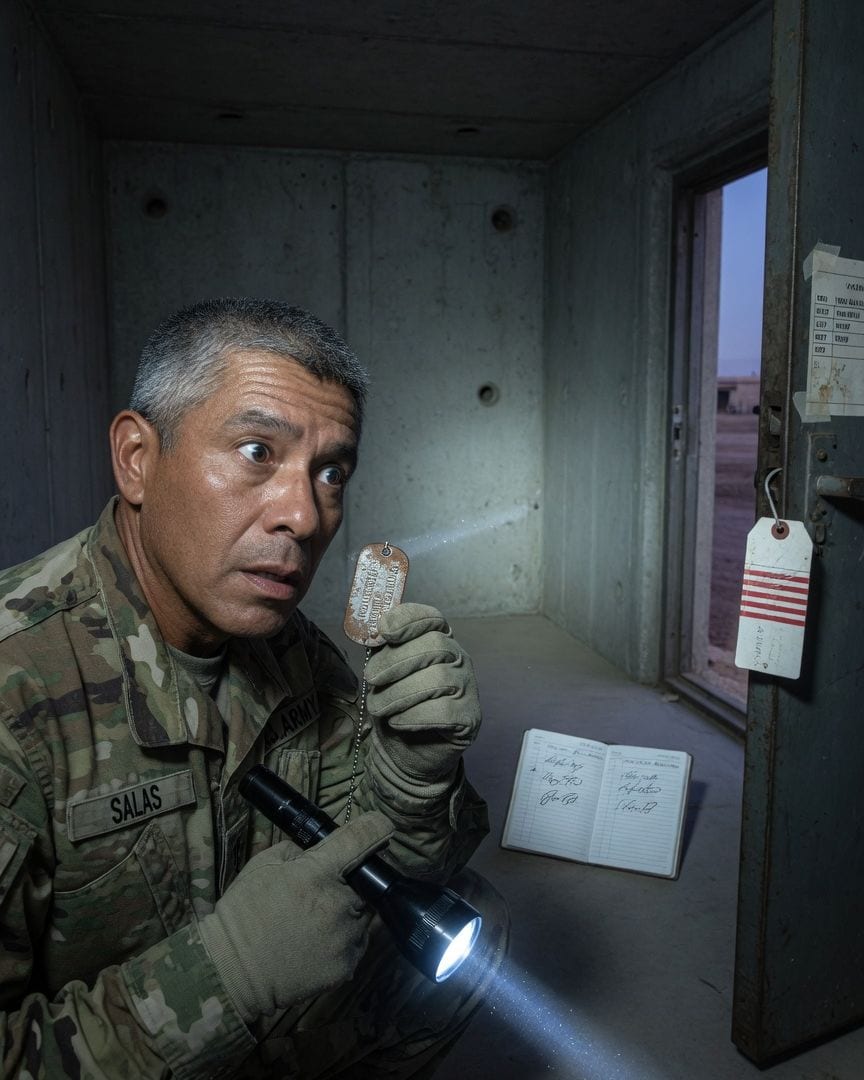
An inventory officer found a bunker's log of soldiers, then found one of their dog tags marked 'KIA, 1970'.
Chief Warrant Officer Gideon Salas meticulously oversaw the Hawthorne Ammunition Depot's inventory, racing against its final closure in two weeks. The high desert winds whipped dust across the familiar igloos as he worked, each bunker accounted for, until he reached the eastern perimeter. There, an extra igloo, Bunker 40, stood with a current lock and seal, though it wasn't on any map. A duty log propped open nearby listed inspections signed by men the Army swore didn't exist. His gut, honed by decades of service, churned with unease; inside the empty bunker, his flashlight found a corroded dog tag bearing one of those names, marked 'KIA, 1970'.
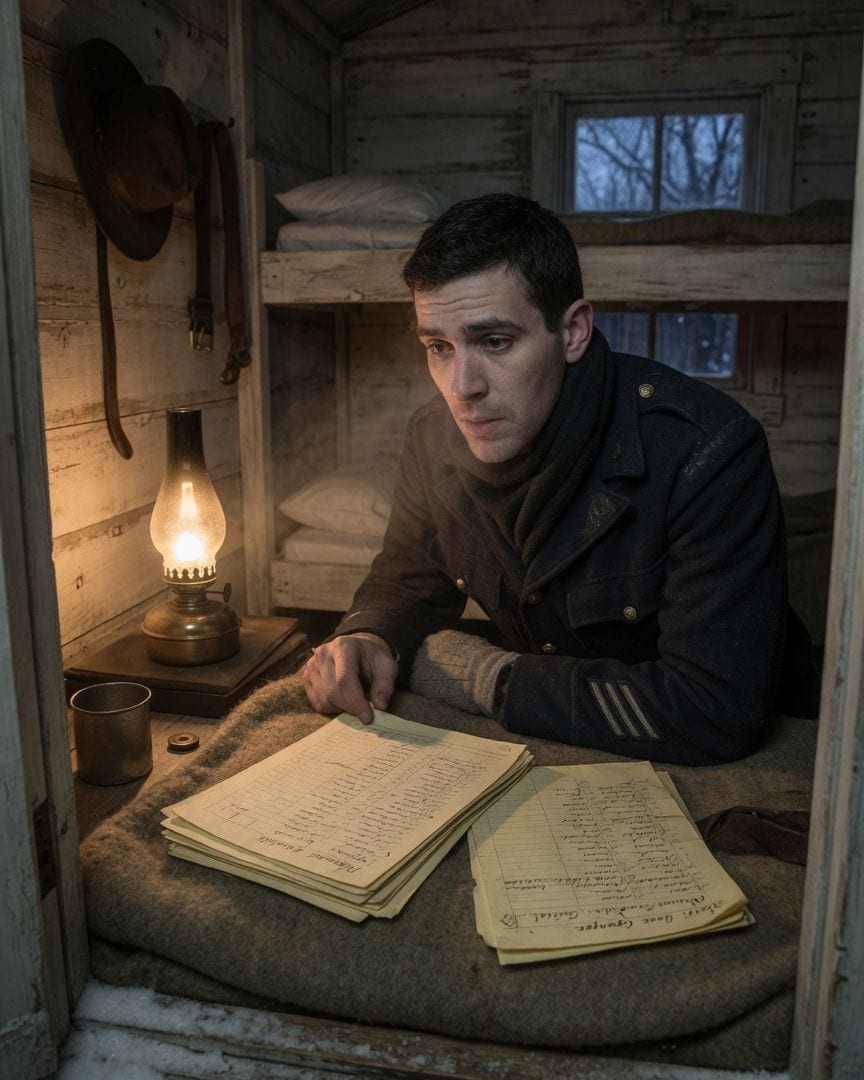
On his last watch, Corporal Carter found boot prints ending inside a sealed magazine, and a blood-red handprint from a soldier decades out of time.
Corporal Franklin Carter shivered, not from the biting November wind, but from the chill of his last pay muster at Fort Taggart before its winter abandonment. His final duty was to count every man, tallying thirty-seven, precisely the company strength. But his breath hitched when he saw the completed roll: it ran thirty-eight names long. An impossible extra slot, filled by a voice that answered 'Here, Corporal,' for a soldier whose name, Pvt. Isaac Granger, vanished from all official records, only to reappear in a forgotten supply log from 1863. Was Fort Taggart abandoning its dead, or something far older?
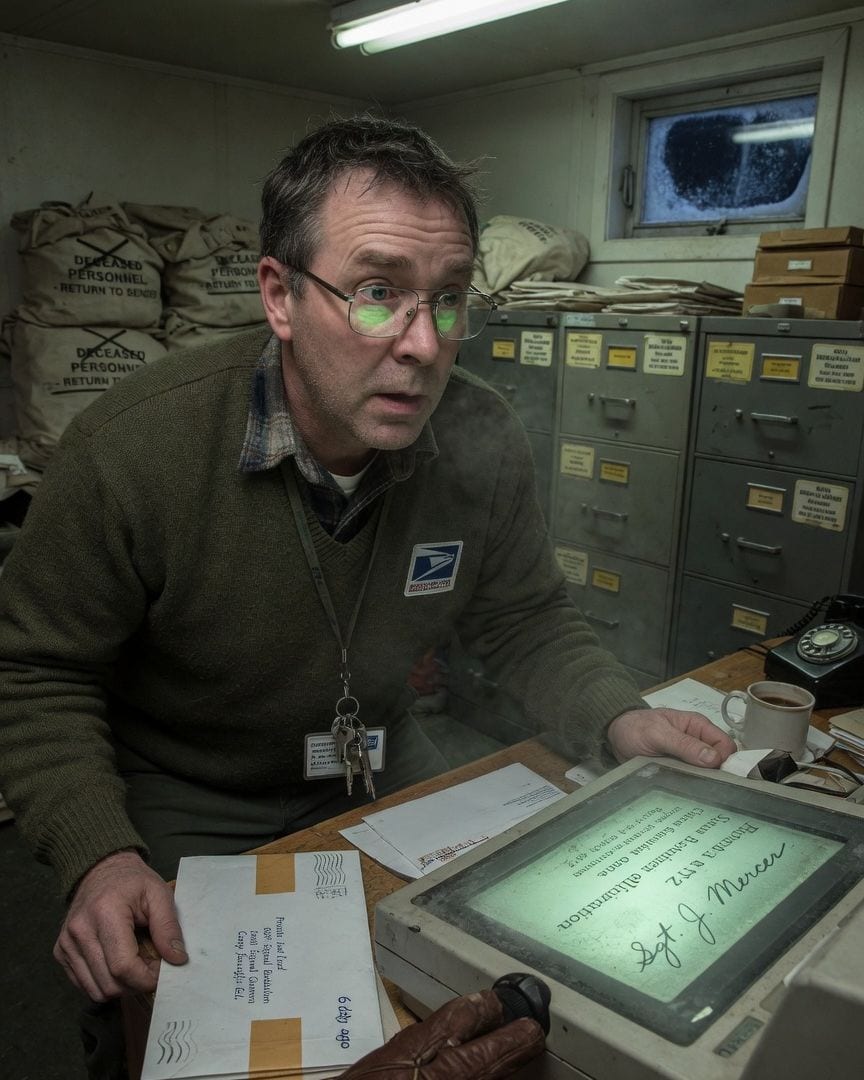
A postmaster at a Cold War Alaskan outpost still received mail for soldiers declared dead in 1969. Then he found their base was active three years later.
Postmaster Rowan Ashcroft had spent two decades watching the weekly mail plane land at Camp Bidwell Annex, a lonely outpost in the bitter Alaskan wind. His methodical mind, accustomed to order, was jolted when the latest mail sack contained forty-three letters for men officially declared dead in 1969. Each envelope, postmarked within days, was addressed to a soldier who wasn't coming back, and Rowan found one already opened and neatly resealed. Driven by duty, he began to sift through declassified Army archives, only to uncover a chilling maintenance log entry for the camp's equipment, dated three years after the base was officially shuttered. What was still happening at Camp Bidwell?
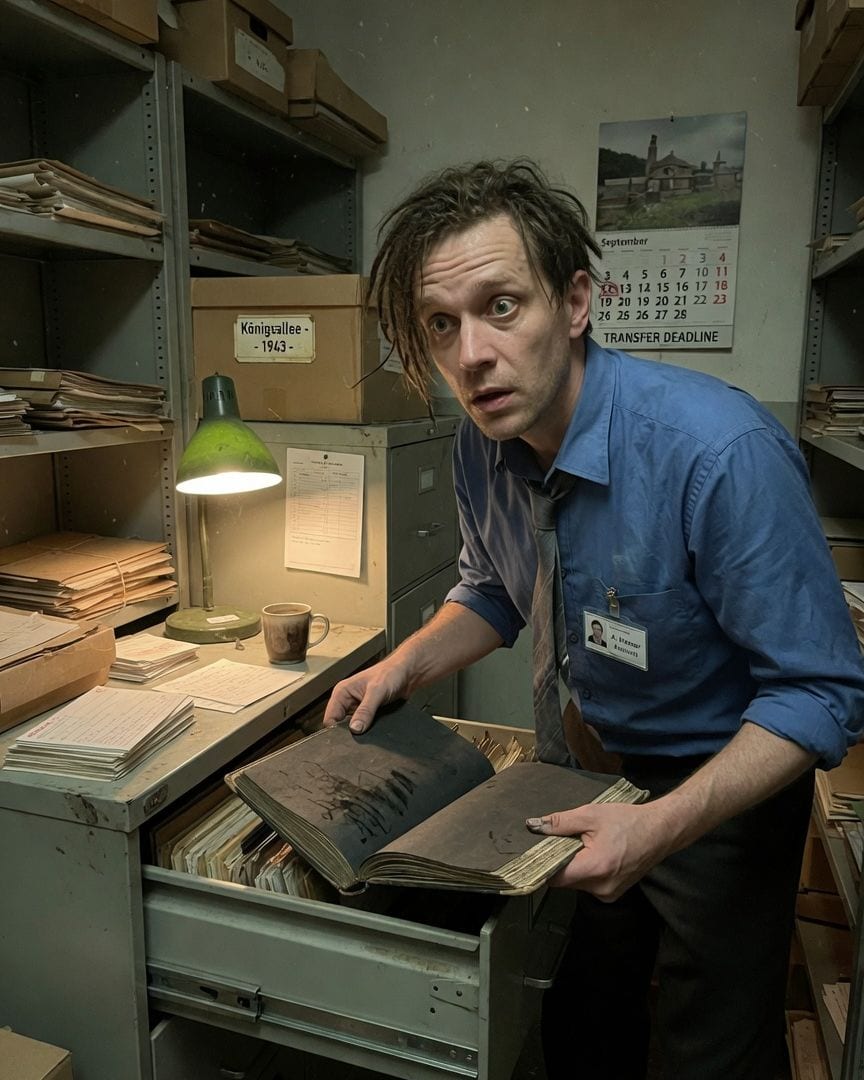
A Berlin archive researcher races a deadline. A hidden log for a Cold War barracks on a vacant lot has ink still wet from last month.
Ansel Vidmar, a methodical researcher, felt the pressure of a looming deadline. The municipal transfer of the old Berlin archive was days away, and he still had countless documents to categorize amidst towering stacks of forgotten history. His focus narrowed to an unindexed metal cabinet, revealing records for a garrison company at Königsallee – an address that had been a vacant lot since the war. A punishment log inside listed an entry from 1983, a date far too recent for a non-existent building. When Ansel visited the site, he found only overgrown grass, save for a single, eerily clean concrete doorstep emerging from the earth. His unease solidified into dread when he later uncovered a hidden Quartermaster's Log, meticulously detailing supplies for the same barracks, with entries extending to "last month," the final page's ink still faintly wet. What unseen operations were still being maintained?
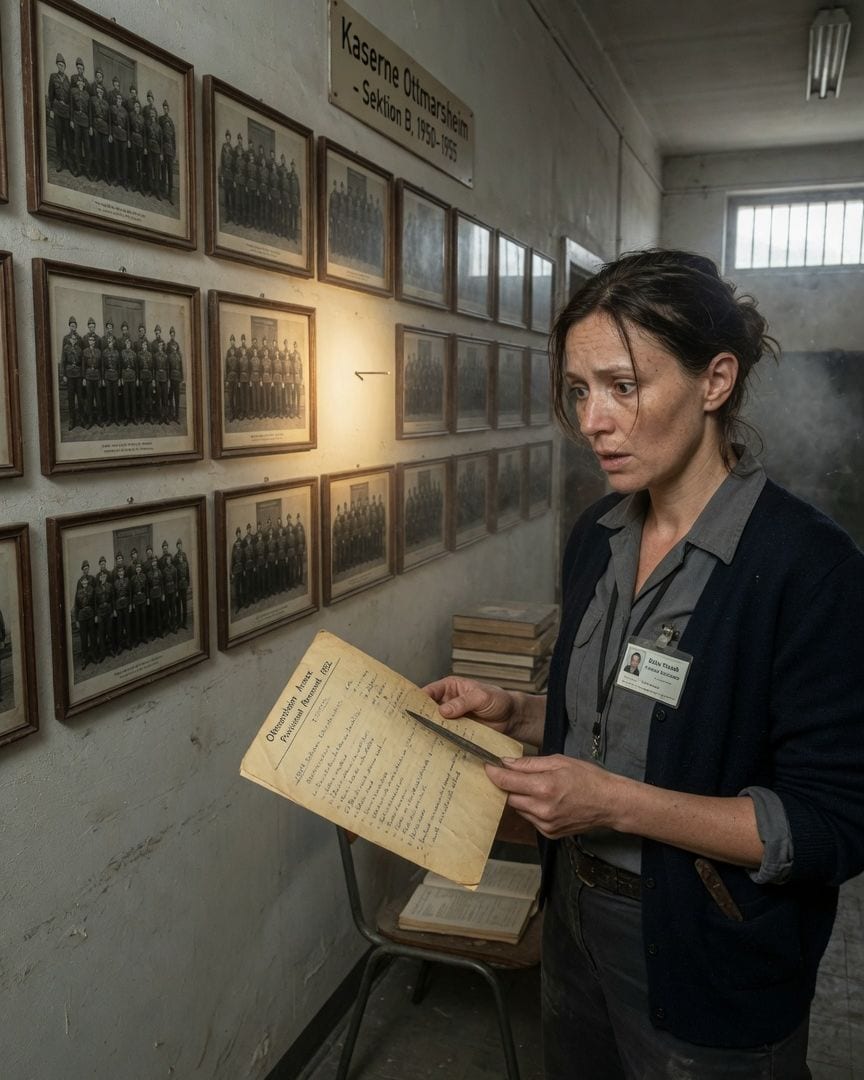
At a Cold War kaserne days from demolition, inventory clerk Delia Straub found a missing photo frame for a unit that never existed. Every soldier on the wall stared directly at its empty space.
Inventory clerk Delia Straub had eleven days to log every item at Kaserne Ottmarsheim before demolition crews arrived, turning history into rubble. Amid the dusty halls, she found a stark anomaly: a missing photo frame for the 604th Ordnance Detachment, a unit never officially stationed at the base. What made the empty space chilling was that every soldier in the surrounding photographs was looking not at the camera, but directly into that void. Delia's search for answers unearthed an unofficial manifest listing the 604th, with names of men officially declared killed in action years before. Who were these phantom soldiers, and why did their impossible record persist?
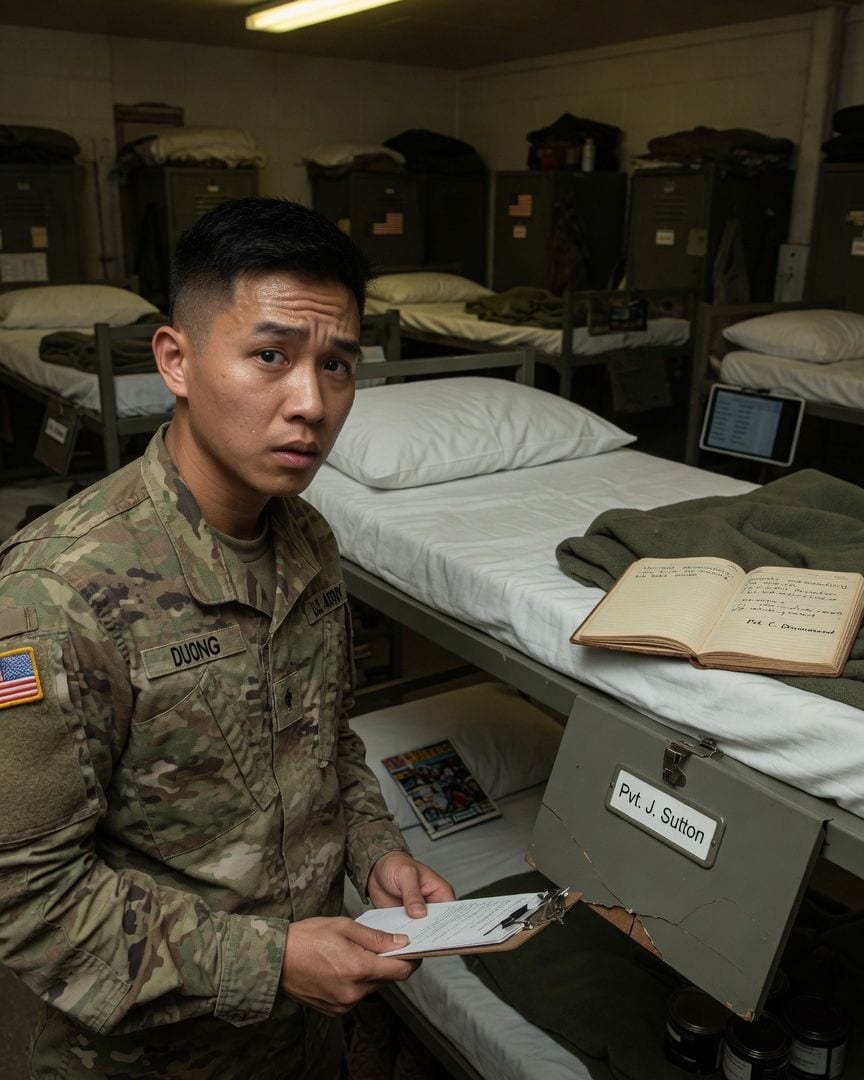
Specialist Duong’s final check unearths a logbook from decades past: an entry for '9 men present, 10 bunks made'.
Specialist Quentin Duong meticulously conducted his platoon's final barracks accountability check before graduation, the air thick with stale boot polish. He confirmed nine men against the roster, but the tenth bunk in the bay stood apart, always perfectly made and tagged 'Pvt. J. Sutton,' a name not on any current manifest. Despite dismissals from his battle buddy and sergeant, Duong couldn't shake the quiet unease. He returned to the immaculate bunk, uncovering a false bottom in its footlocker holding a decades-old logbook. Inside, a chilling entry from a previous cycle detailed '9 men present, 10 bunks made,' signed with a hand eerily similar to his own.