On a closing Cold War base, an inventory clerk finds every soldier in old photos staring at an empty wall. Her own name is on a hidden footlocker holding the missing picture: a dark, blurred figure among them.
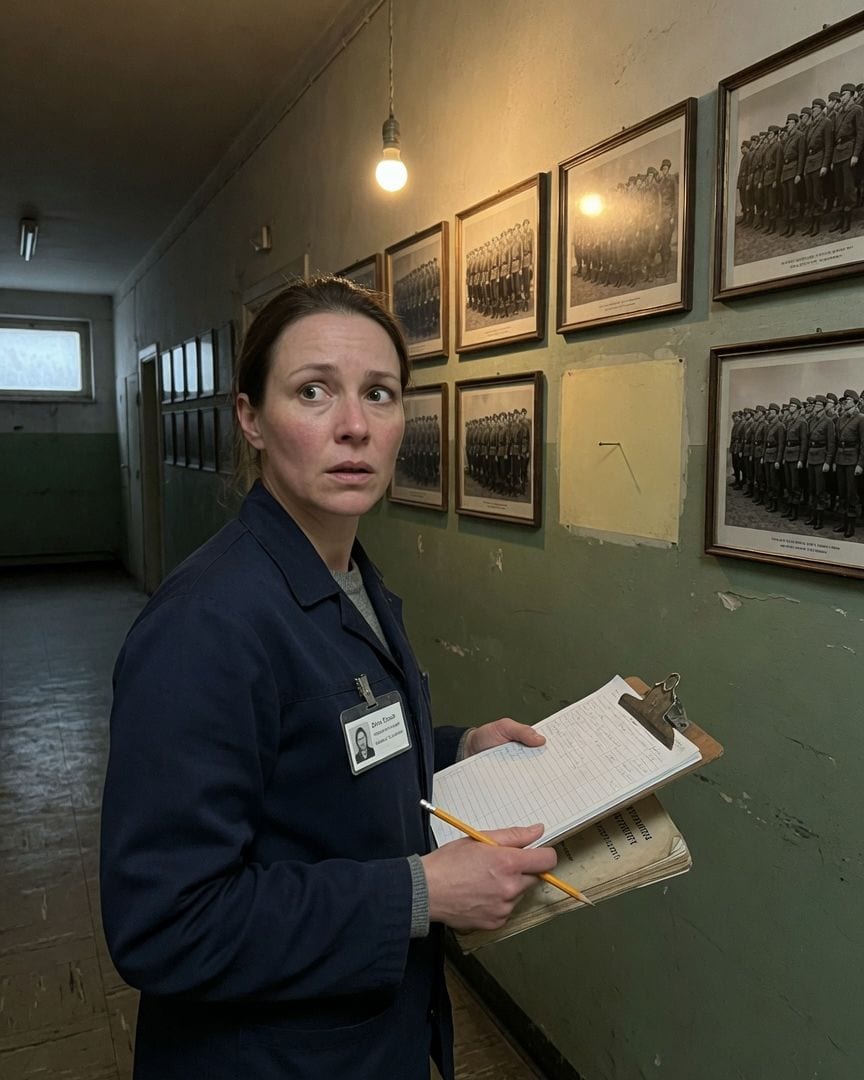
Delia Straub had eleven days. Kaserne Ottmarsheim, a former German military base, was a maze of echoing halls and abandoned offices, slated for demolition. Her job was to inventory every last item, a relentless race against the clock.
The air in the main administration corridor smelled faintly of coal smoke and old floor wax, a scent that clung to the forty-one framed black-and-white photographs lining the wall.
Between the ninth and tenth frame, a precise, empty rectangle of unfaded paint marked where a photograph had once hung. The nail, still bright and unrusted, protruded from the wall as if waiting for its purpose to return.
Delia paused, her pencil hovering over her clipboard. An empty space was hardly unusual in a decommissioned building, but the paint was too crisp, the nail too new for a frame that had been gone for decades.
She checked the 1952 property book, its brittle, yellowed pages whispering under her touch. Her finger traced down the neatly typed entries. Item 41/A-7: '604th Ordnance Detachment, Formation, All Present.' The entry was clear, precise.
Yet, Delia knew from every official record she’d consulted for the Kaserne’s history, every unit roster and deployment map she’d scoured: there had never been a 604th Ordnance Detachment. Not at Ottmarsheim, not anywhere in the European theater.
It was a phantom unit, yet explicitly accounted for.
Delia’s rational mind demanded an explanation. A misfile? A clerical error from a bygone era? She spent the next day cross-referencing every unit history, every deployment roster, every personnel file associated with Ottmarsheim from 1950 to 1955.
Her fingers ached from turning pages, her eyes burned from reading microfiche. The 604th Ordnance Detachment simply did not exist. It was a ghost, a name in a ledger with no corresponding presence in reality.
Yet, there it was, explicitly listed in a perfectly preserved property book, as tangible as the desk she sat at.
She returned to the corridor, drawn back to the anomaly of the empty space. She examined the photographs flanking it. They depicted real units, their faces clear: supply clerks, motor pool mechanics, quartermasters.
These men were undeniably part of Ottmarsheim's history. But as Delia studied them, a detail, once dismissed as incidental, sharpened into focus, pulling her forward.
In every adjacent frame, every man, whether smiling awkwardly for the camera or standing at rigid attention, was looking slightly to his left. Not at the lens.
Not at a commanding officer who might have stood in front of the formation. But directly at the empty space where the '604th Ordnance Detachment' photo should have been.
It wasn't a casual glance; it was a uniform, fixed gaze, a silent acknowledgment of something that was no longer there, or rather, something that should have been there.
The air around the spot seemed to grow colder, a subtle shift that prickled the hairs on her arms.
Driven by a cold, methodical dread that warred with her insistence on logic, Delia ventured into the deepest sub-basement, a forgotten storage annex not listed on any current blueprint. Dust motes danced in the single bare bulb hanging overhead.
Tucked behind stacks of mildewed office furniture and defunct filing cabinets, she found a single, heavy, olive-drab metal footlocker.
It was unmarked by any unit designation or accession number, a signature device of the 'Box That Is Not on Any List' phenomenon she’d encountered in other decommissioned sites—items meant to be forgotten.
Its clasps were rusted shut, but a small, faded stencil on its lid caught her eye, barely legible in the dim light. It read: 'Straub, D.'
Delia froze. She recognized her own surname. Her own initial.
With a crowbar she’d found near a workbench, she pried the stiff clasps open. The sound echoed in the cavernous space.
Inside, nestled amongst layers of perfectly preserved packing material, was a single, official, black and white photograph, pristine and unfaded. It was clearly the '604th Ordnance Detachment, Formation.' The men stood in neat rows, their uniforms crisp, their faces grim.
But the space where the men were looking, the space that had been empty on the wall, was not empty here.
A tall, indistinct figure, dark and blurred, stood among them, solid as a shadow, a void that somehow possessed mass. Delia’s gaze dropped to the caption, neatly typed below the image.
It read: '604th Ordnance Detachment, Formation, Subject Present.'
The photograph, the name, the impossible unit – Delia’s methodical approach shifted from mere inventory to an obsessive investigation. The cold dread had solidified into something sharp and insistent.
She spent the next few days holed up in the Kaserne’s dusty historical archives, cross-referencing 'Subject Present' against other declassified documents.
The small, claustrophobic room, stacked with boxes and smelling of old paper, felt less like a sanctuary and more like a trap closing around her.
She found no direct matches for 'Subject Present,' but a heavily redacted memo from 1953, labeled 'Ottmarsheim Incident - Anomalous Photographic Capture,' mentioned 'unauthorized personnel' and 'discrepancies in visual records.'
The original property book’s 'All Present' caption now felt less like an error and more like a deliberate, bureaucratic lie, a taunt whispered across decades.
The fact that her own name, 'Straub, D.,' was on the footlocker that contained the 'real' photo gnawed at her.
She searched personnel records, trying to find any 'Straub, D.' who might have been stationed at Ottmarsheim in 1952, or even later. Nothing. It was a blank, an anomaly that shouldn't exist, attached to her own identity.
The footlocker itself, a standard-issue military item, seemed to defy its own history, appearing decades before any 'Straub' was officially connected to the base. It was a physical wrongness, tangible, and now, intimately personal.
The hair on her neck prickled constantly, and the silence of the Kaserne seemed to amplify every creak of the old building, every gust of wind outside.
Delia’s frantic searches for '604th Ordnance Detachment' and 'Subject Present' in the Kaserne’s limited digital records did not go unnoticed.
Everett Foster, the Kaserne’s long-time facilities manager, a quiet man with a knowing glint in his eye, found her hunched over a microfiche reader late one evening.
The fluorescent hum of the machine was the only sound in the cavernous hall. He offered her a cup of lukewarm coffee from a dented thermos, his movements slow and deliberate, a figure carved from the Kaserne’s own history.
“Still digging through the old ghosts, Miss Straub?” he asked, his voice a low rumble that seemed to absorb the room’s silence.
Delia stiffened, her focus broken. She pulled back from the glowing screen. “Just trying to make sense of some… inconsistencies.”
Everett nodded, stirring his coffee with a spoon that clinked softly against the mug. “The Kaserne has many inconsistencies. Some are better left undisturbed.” He took a slow sip.
“The system, you see, has its reasons for the way things are filed.” He didn’t threaten, didn’t raise his voice, but his calm demeanor and the precise choice of 'filed' sent a fresh shiver down Delia’s spine.
The air in the archive, already stale, suddenly felt heavy and still, pressing in on her.
He began to tell a story about a 'lost' unit from the 70s, a story that mirrored the 604th’s impossible existence, a unit that disappeared from all records overnight.
He didn't elaborate, just laid out the bare facts, making it clear he knew exactly what she was chasing, what kind of threads she was pulling. He smiled then, a faint, unreadable expression that didn’t quite reach his eyes.
“Some records are declassified, Miss Straub. Others are simply… managed.”
Delia, emboldened by Everett’s knowing hints, confronted him the next morning. She laid the 'Subject Present' photograph on his worn desk, its stark image a direct challenge. The blurred figure seemed to swim in the harsh office light.
She pointed to it, then to the caption, then to her notes on the 604th. “This. And the 604th Ordnance Detachment. And my name on that footlocker. What is this, Mr. Foster?” Her voice was tight, thin.
Everett picked up the photograph, his gaze lingering on the indistinct presence, a ghost made solid. “The 604th was a special unit, Miss Straub,” he said, his voice flat, emotionless. “They were tasked with… documentation. Of certain events.
The men, looking left, they were observing the subject. Your photograph is the original record. The property book entry, ‘All Present,’ was a necessary adjustment. For public consumption.” He placed the photo down, sliding it back towards her.
“The subject was present. The unit was then officially ‘disbanded,’ its records expunged. Making it ‘never exist.’ It’s how these things are handled.”
Delia felt a cold clarity descend, sharp and devastating. “Handled? You mean filed away? Like a bureaucratic error?”
Everett nodded, a slow, deliberate movement. “Precisely. And your name on that footlocker… some records are prepared. For those who might discover things. Those who might… need to be filed.”
The earlier clues re-meaning on-page: the uniform, fixed gaze of the men in the hallway photographs, the impossible unit that existed only in a doctored ledger, the carefully altered caption – it all clicked into a terrifying coherence.
The pieces, once scattered and nonsensical, now formed a horrifying mosaic. The secrecy machine wasn't hiding a mistake or protecting a secret; it was processing a truth, a terrible, ongoing event.
The Kaserne office, with its faded walls and echoing quiet, seemed to shrink around her, the air suddenly thin and cold, as if something vast and unseen had just materialized beside them.
Everett led Delia through a forgotten maintenance tunnel, its air thick with the smell of ozone and damp concrete. The dim emergency lights cast long, flickering shadows that danced ahead of them.
It opened into a vast, subterranean cold storage facility, its existence nowhere on the Kaserne’s blueprints, a chamber carved out of the earth itself.
Rows upon rows of identical metal footlockers stretched into the gloom, hundreds of them, each with a faded name and unit designation that appeared in no official history.
The silence here was absolute, deeper than anything Delia had ever experienced, broken only by the drip of unseen water.
“The pattern, Miss Straub,” Everett murmured, his voice echoing unnaturally in the vast space. He pointed to a section labeled 'Project Chimera,' and pulled out a footlocker for a 'Bishop, E.' from 1978.
Inside, another photograph, identical in composition to Delia’s: a group of men, looking left, at a blurred, dark presence. The caption read, 'Subject Present.' Everett then led her to a more recent section.
There, amidst older, dusty footlockers, one stood out. It was gleaming, freshly labeled, its metal still reflecting the dim overhead lights. An empty space stood beside it.
Everett’s gaze fixed on Delia, his unreadable smile unwavering. “The files are still being signed, Delia. And some of them are waiting for new names.”
The label on the gleaming footlocker, stark and final, read: 'Straub, D.'
The full, horrifying truth detonated in Delia’s mind, echoing in the cavernous cold storage. Everett explained, his voice calm and unhurried amidst the rows of silent, waiting footlockers, that the 'subjects' were not contained by the military, but within it.
They were entities, manifestations, drawn to places of institutional routine and hidden knowledge, like predators to a well-worn path.
The 604th, and all the other 'non-existent' units marked on the footlockers, were not formed to fight or contain these things, but to document their passage, to be witnesses. And then, to be absorbed.
The men looking left in the photographs were seeing their fate. They were not fighting; they were simply observing the moment they became part of the 'file.'
'All Present' was the final, chilling irony: the subject was present, and the men were taken, their existence bureaucratically erased.
The records, the expunged units, the doctored captions – it was all a precise, bureaucratic mechanism to process disappearances as 'deactivated units' or 'lost equipment.'
The footlockers were not storage; they were for those who were 'filed,' their identities subsumed into the system. Her own footlocker, prepared in advance, was not a warning; it was a pre-assigned destination.
The subjects were drawn to knowledge, to those who saw the pattern, those who understood.
Delia stumbled backward, away from her own designated footlocker, her mind screaming for escape, for a way out of this cold, metal tomb. Everett, however, remained perfectly still, blocking the tunnel entrance, an impassive sentinel.
He wasn't a guard; he was an anchor, a part of the system himself, his calm composure a horrifying testament to his own absorption. “You know too much now, Delia,” he said, his voice devoid of malice, utterly matter-of-fact.
“Too much to be outside the file.” He gestured to his own footlocker, 'Foster, E.', nestled among the older, dustier ones in the section labeled 'Maintenance – Classified.' “I was once like you. A discoverer. And then… I was filed.”
As he spoke, the air in the vast cold storage grew heavy, a low, resonant hum beginning to vibrate through the concrete floor, a sound that seemed to come from within her own bones.
The dim overhead lights flickered, seemed to dim even further, and in the far reaches of the room, amidst the endless rows of footlockers, a deeper shadow began to coalesce.
It was indistinct, yet undeniably present, a tall, blurred figure, just like in the photographs, slowly gaining definition from the ambient gloom. Drawn by Delia’s fear, by her dawning, terrible knowledge, by the very act of understanding.
The presence moved, slowly, deliberately, towards her, its form shifting at the edges of her vision. The hum intensified, a deep, internal thrum that resonated in her bones, rattling her teeth.
The heavy metal door to the tunnel, her only way out, clicked shut with a soft, final sound, sealing them in. She was part of the file now.
The demolition of Kaserne Ottmarsheim proceeded on schedule. The old buildings were leveled, the ground churned and re-seeded, the dust settling over new earth. Official reports confirmed all personnel accounted for, all inventory complete.
No one questioned the sudden, unexplained disappearance of inventory clerk Delia Straub. Her name was quietly removed from the Kaserne’s final roster, a minor clerical adjustment in the vast machinery of decommissioning.
Months later, on a decommissioned naval base overlooking the Pacific in California, a new inventory clerk, Nathaniel Hayes, began his meticulous work.
The salty air was clean, but sometimes, by the old administration building, he caught a faint, sweet scent of floor wax, even here, by the ocean, miles from any Kaserne.
He found a long corridor lined with faded photographs of naval personnel, and between two frames, a perfectly polished nail protruded from a rectangle of unfaded paint.
He looked at the surrounding photos; every sailor in them stared slightly to their left. He adjusted his glasses, then consulted the base’s 1952 property book, its pages pristine. Item 27/C-4: 604th Ordnance Detachment, Formation, All Present.
He writes "604th Ordnance Detachment, Formation, All Present" into a new property log, his hand steady and official.
If this one got to you
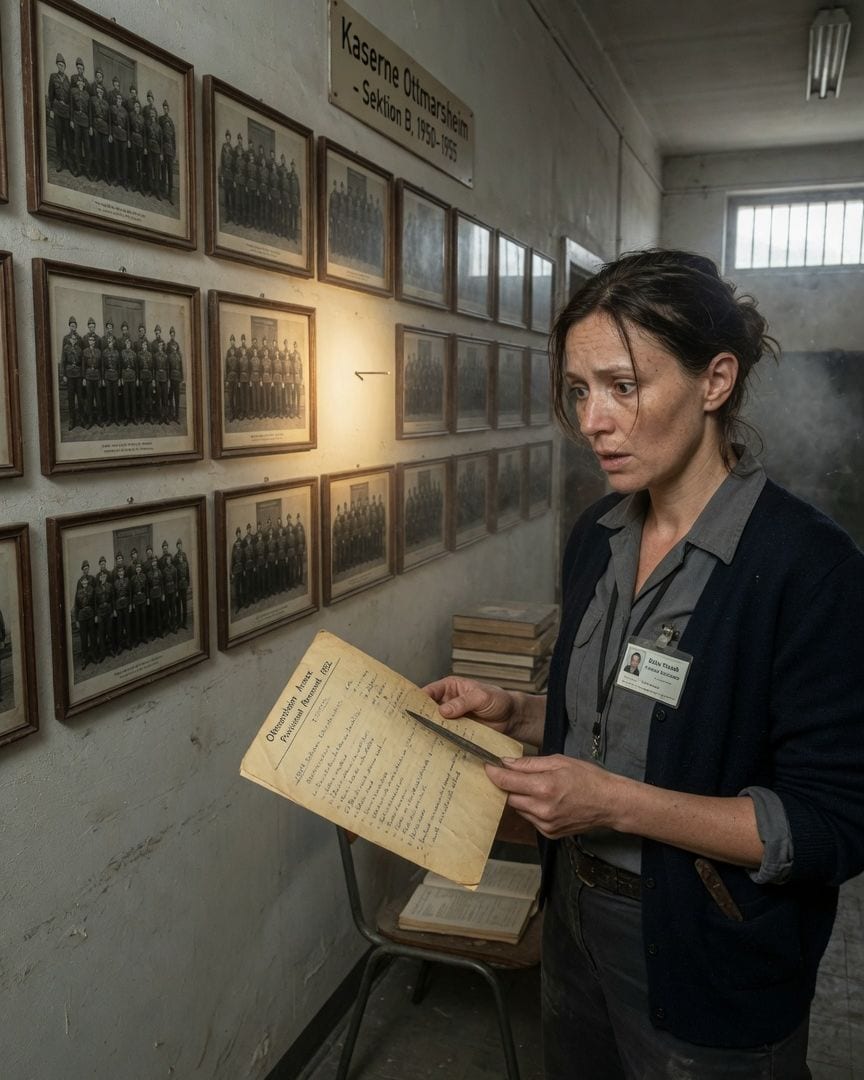
At a Cold War kaserne days from demolition, inventory clerk Delia Straub found a missing photo frame for a unit that never existed. Every soldier on the wall stared directly at its empty space.
Inventory clerk Delia Straub had eleven days to log every item at Kaserne Ottmarsheim before demolition crews arrived, turning history into rubble. Amid the dusty halls, she found a stark anomaly: a missing photo frame for the 604th Ordnance Detachment, a unit never officially stationed at the base. What made the empty space chilling was that every soldier in the surrounding photographs was looking not at the camera, but directly into that void. Delia's search for answers unearthed an unofficial manifest listing the 604th, with names of men officially declared killed in action years before. Who were these phantom soldiers, and why did their impossible record persist?
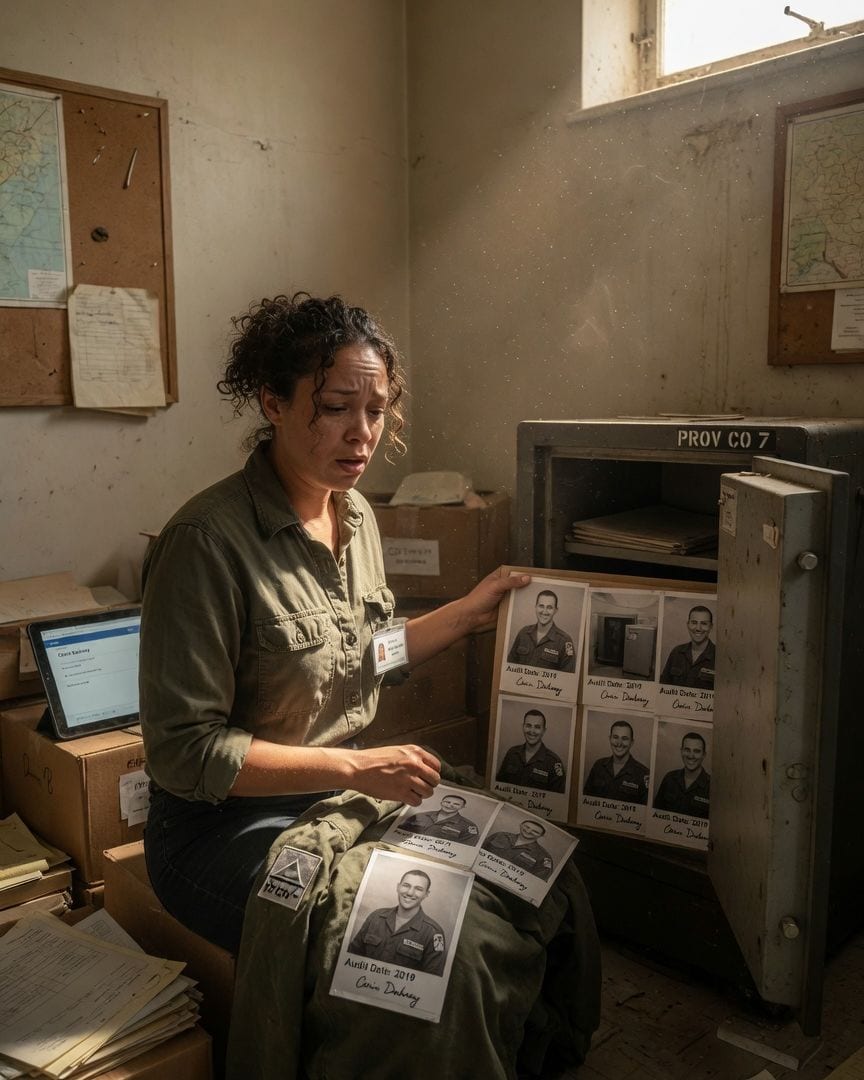
With eight days to clear a Cold War fort, Corin Calloway found files signed 'Corin Dabney' from 2019.
With just eight days left before Fort Halloway was gutted by demolition crews, Corin Calloway worked to clear half a century of forgotten lives from its dusty archives. As she meticulously sorted through records, she discovered an old, unlisted safe, its pitted door stenciled with a phantom designation. Inside, Corin found seven personnel jackets, each dated '2019' and signed with the name 'Corin Dabney.' But Corin Calloway knew she had never set foot in the building before this week, and the name 'Corin Dabney' existed nowhere in the base's official history. What secret was Fort Halloway's forgotten safe trying to reveal?
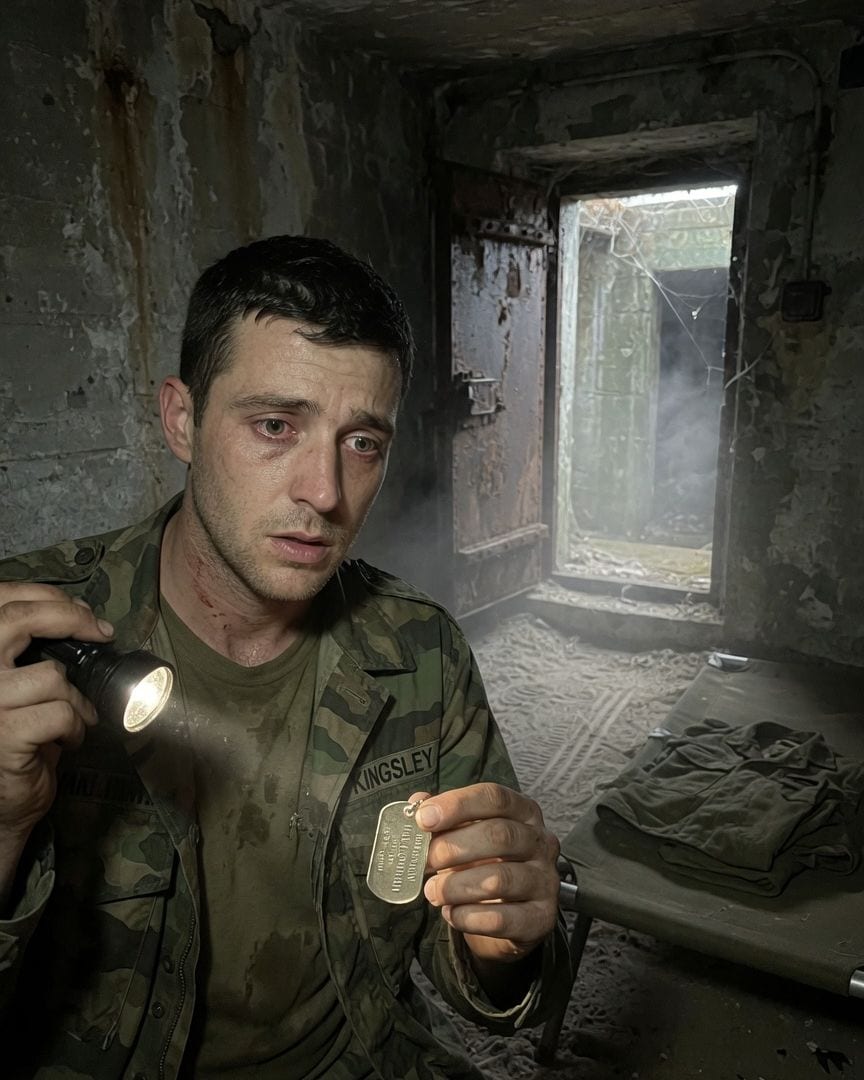
On his final rotation, a Private finds a WWII dog tag for 'Halloran' in a bunker sealed for eighty years.
Private Roland Kingsley endured the bone-deep weariness of his final graveyard watch at a reactivated WWII bunker on the Northern California coast, just hours from dawn and the end of his deployment. His searchlight cut through thick fog, revealing impossible figures: men in archaic WWII uniforms, assembling on the deserted beach, only to vanish moments later. As dawn broke, Kingsley discovered the bunker's rear hatch, sealed for decades, now stood mysteriously ajar. Inside, on an empty cot, lay a WWII-era field jacket, and in its pocket, a dog tag for 'Halloran' — a name impossible to the bunker's eighty-year history. What unseen presence had disturbed the long-sealed past?
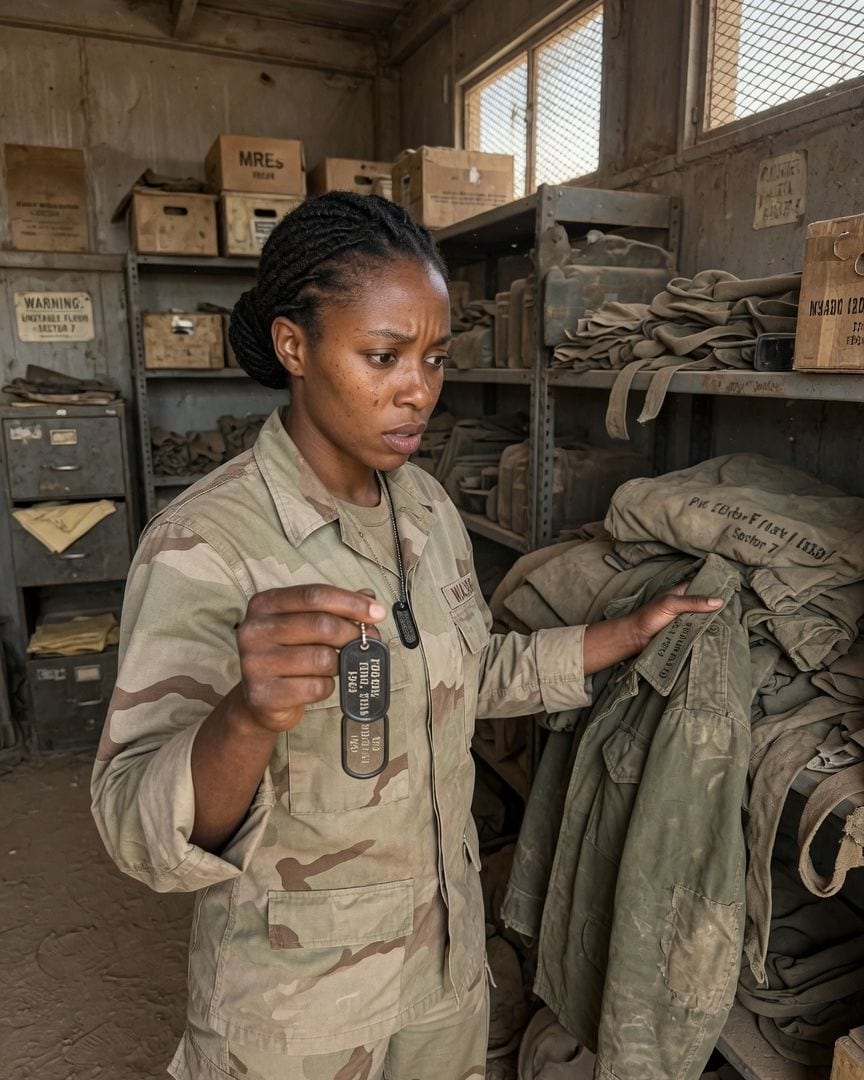
Lieutenant Walsh investigates an unnervingly silent new soldier, then finds his exact name on a Cold War dog tag dated 1983.
Observing a formation in the dry Mojave, Lieutenant Naomi Walsh felt a prickle of unease as a platoon counted one man too many. The extra soldier, Private Ethan Ford, moved with an unsettling quietness, performing duties flawlessly but without a single personal gesture. When his deployment records appeared pristine yet absent from the original manifest, Naomi searched a dusty old depot for answers. There, beneath a pile of tarps, she uncovered a field jacket bearing his name, 'Pvt. E. Ford,' and a dog tag from 1983, decades before the silent soldier could have been born.
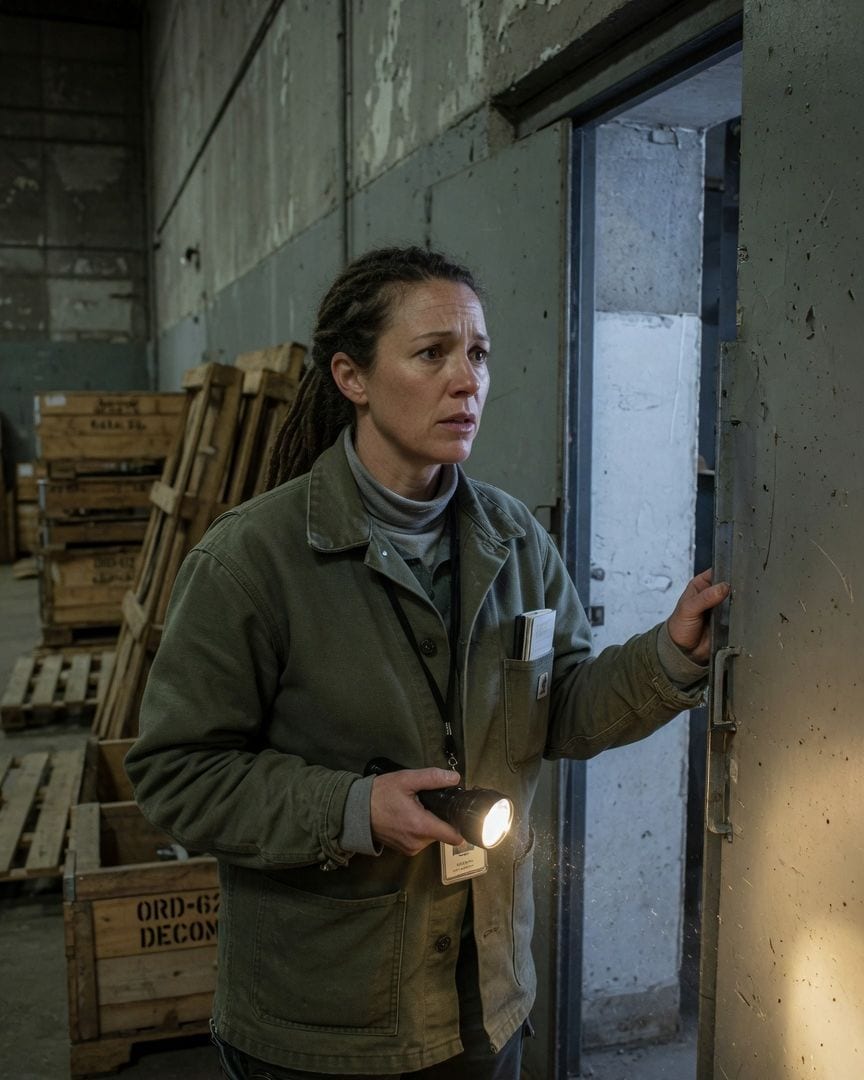
An inventory specialist sought a missing Cold War footlocker for 89 men. She found 89 metal containers marked 'PROCESSED' in a hidden room.
Halcyon Reeve, a meticulous inventory specialist, prided herself on the perfect records of the vast Sweetgrass ordnance depot. But one blank space on a 1962 ledger gnawed at her: a missing footlocker for 89 men, when only 16 were ever assigned. Her search led her back to the silent, cavernous warehouse, where she uncovered a cleverly disguised access panel. Behind it, a hidden room, unnaturally cold and sterile, held not the missing footlocker, but 89 identical metal containers, each chillingly marked 'PROCESSED'.
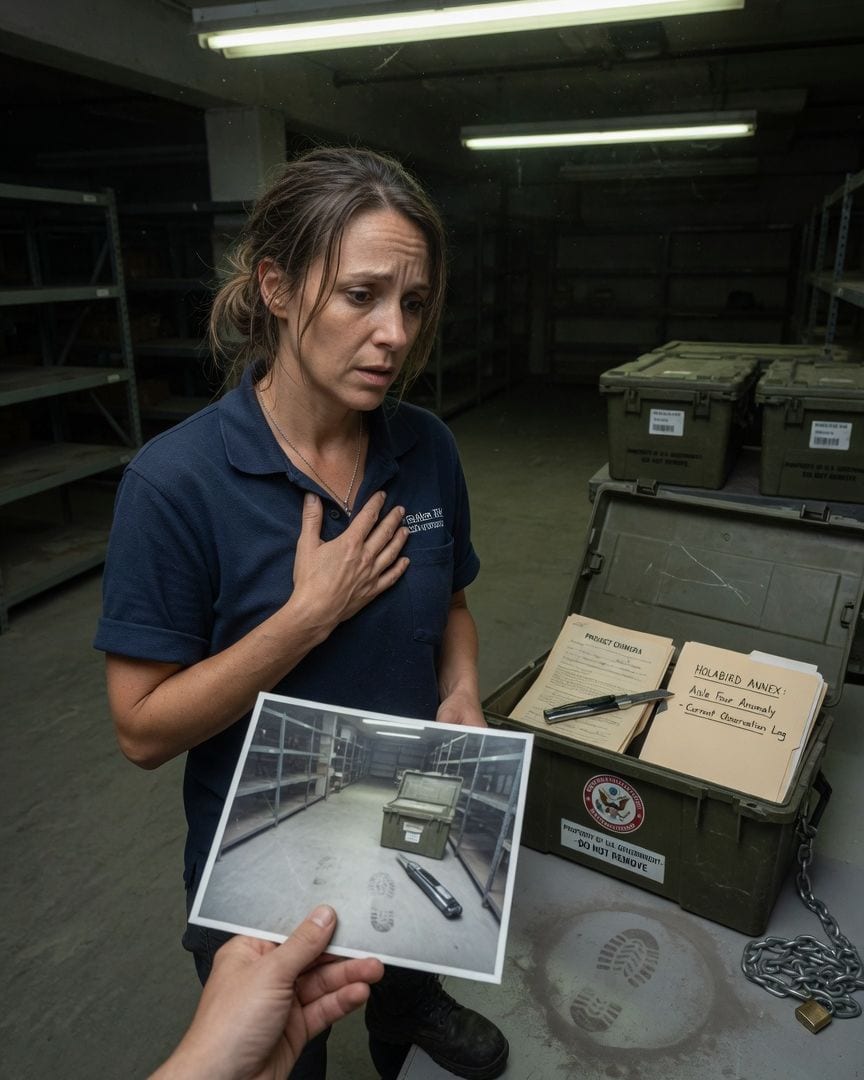
A logging clerk's last week at the Cold War annex uncovered a crate she'd moved, back in place with a photo of itself and a boot print not hers.
Elke Sarrazin, a forty-year-old logging clerk, felt the cold finality of her last week at Fort Holabird annex. The vast, echoing storage facility, slated for demolition, was almost empty as she meticulously logged the last sealed government crates for off-site storage. But Monday morning, a crate she had moved and logged days earlier sat precisely back in aisle four, its official seal unbroken and a fresh ring of dust around it. After it returned multiple times, Elke found a distinct boot print not her own beside it, then later, inside the crate, a glossy photograph of that very aisle, taken moments ago, showing the same impossible boot print.