A logging clerk's last week at the Cold War annex uncovered a crate she'd moved, back in place with a photo of itself and a boot print not hers.
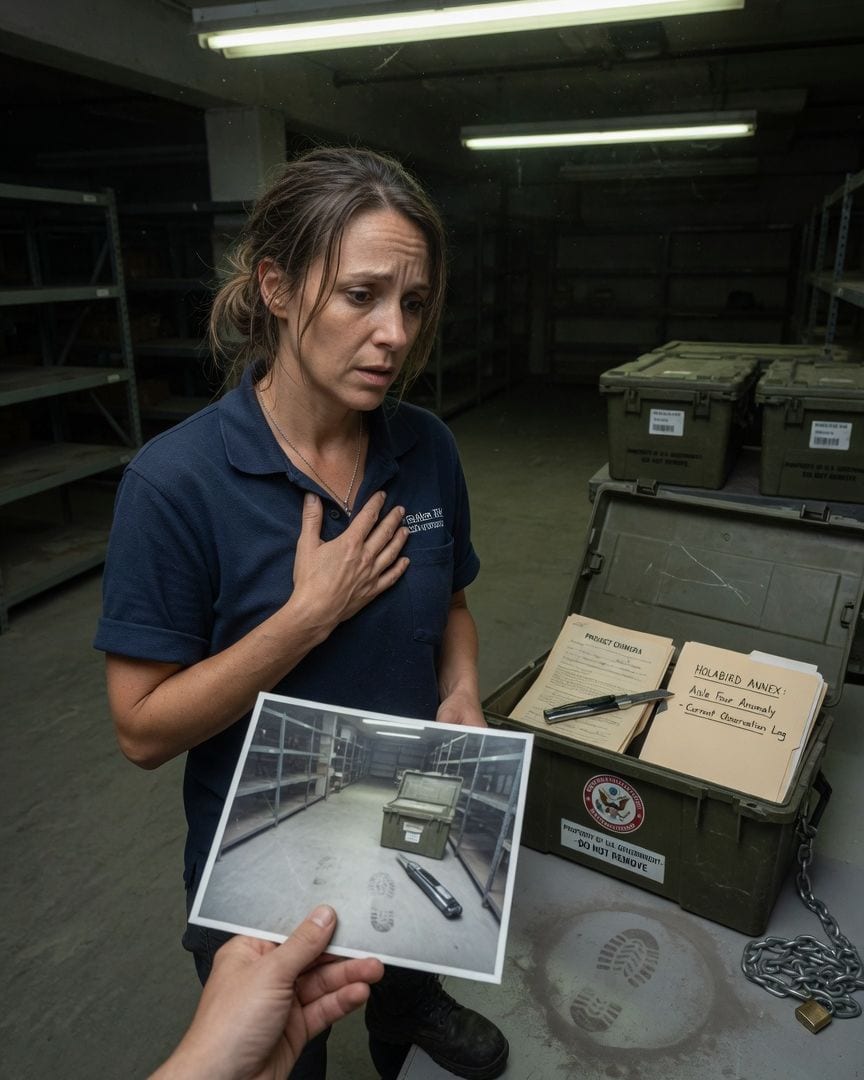
Elke Sarrazin, forty, felt the finality of her last week at Fort Holabird annex like a cold draft. The vast, echoing storage facility, slated for demolition, was almost empty, save for the last few rows of sealed, government-issue crates.
Her job, mundane and precise, was to log them out, one by one, for off-site storage.
She worked through a long Friday, diligently scanning barcodes and updating digital manifests, ensuring every crate in aisle four was accounted for and earmarked for transit.
When the last entry was made, she locked up the annex with a familiar, metallic click, the sound echoing in the cavernous space.
But Monday morning, as the fluorescent lights flickered to life over aisle four, a crate sat precisely where she’d found it days earlier. Its seal was unbroken, the official government tape still taut and pristine.
A perfect, undisturbed ring of fine gray dust marked the concrete floor around it, as if it had settled there overnight, undisturbed by movement.
Elke, methodical by nature, attributed it to a clerical error, a new directive she hadn't yet received. She logged it again, assigned it to a new truck, and moved it herself with a hand dolly.
This happened twice more that week. By Friday, a knot of unease had tightened in her stomach. Before she left for the weekend, she started photographing the dust rings before she moved the crates.
Monday’s photo matched Friday’s exactly, down to a single, distinct boot print in the fine gray powder, a print she knew, with a chill, was not her own.
Elke tried the rational explanations first, running them like a checklist in her mind. A prank by the skeleton crew still working on-site?
Unlikely, given the annex’s somber atmosphere and the impending demolition that had everyone focused on their own transfers. A misfile by her supervisor, Daniel Ingram? She checked the logs again; her entries were clear, unambiguous.
She even tried securing one of the repeatedly returning crates with a heavy chain and padlock, a small, desperate act of defiance against a pattern that made no sense.
Monday arrived, and the chained crate was back in its familiar spot in aisle four, exactly where it had been before.
The heavy steel chain lay in a neat coil beside it, the padlock still locked but unattached from the crate’s handles. The dust ring was perfect, pristine around the crate’s base.
This time, Elke noticed a faint, almost imperceptible scratch across the official government seal, a hairline mark as if a tiny, impossibly sharp blade had been used to pry it, then reseal it perfectly, leaving no trace of entry.
She pulled out her utility knife, its blade clicking open with a stark, mechanical sound. The crate felt cold to the touch, colder than the ambient air, a chill that seemed to emanate from its very core.
Her heart thudding, a frantic drumbeat against her ribs, she sliced through the official seal of the crate that had returned five times now. Inside, layers of brittle, yellowed paper revealed decades of bureaucratic silence, dusty reports from long-forgotten projects.
But beneath a stack of 'Project Chimera' reports from the 1970s, she found something else. A manila folder, its label crisp and new, lay perfectly flat, stark against the faded historical documents.
Its title, handwritten in a precise, almost mechanical script, read: 'HOLABIRD ANNEX: Aisle Four Anomaly - Current Observation Log.' She pulled out a glossy photograph from inside. Her breath caught in her throat.
It was a picture of the very aisle she stood in, taken recently, with a dust-ringed crate in the foreground, and a faint, dark boot print beside it.
The photograph was not old. The lighting, stark and artificial, the dust patterns on the shelves, the specific crate itself—it was a snapshot of today, of this very moment.
And the boot print, the one she'd photographed just last Friday, the one that had chilled her to the bone, was undeniably there in the photo, perfectly imprinted in the fine gray dust.
It was a picture of a present that was already contained within a past, a sealed record of an event that had just happened, or was happening now.
Elke stared at the impossible image, then at the actual dust ring on the floor around the very crate she had just opened, then back at the glossy photograph in her trembling hand.
Her hand shook, the paper rustling softly, the only sound in the vast silence of the annex.
The air in the annex felt impossibly still, heavy and cold, as if the space itself was holding its breath, waiting for her to understand what she had just found.
Elke spent the next two days meticulously examining the 'Current Observation Log' and the photograph. The log contained precise, almost clinical descriptions of the crates' movements, including timestamps and locations that matched her own recent activities.
It read like a surveillance report, but one written from an impossible vantage point, without human error or subjectivity. It detailed her every attempt to move the crate, her chaining it, even the exact moment she sliced its seal.
She cross-referenced the unique serial number of the crate with the other files she’d pulled. She found a series of heavily redacted reports from the 1950s and 60s, detailing an incident designated 'Project Sky-Mirror.'
These files described radar contacts of an unknown aerial phenomenon, tracked by multiple military installations, including a now-decommissioned airbase in rural Nevada. The reports included grainy gun-camera footage frames showing a metallic, disc-shaped object, clearly labeled 'UFO.'
The unsettling part was the consistent conclusion of every single report: 'Object unhappened. All records purged.' Yet, here they were, in a returning crate, as if the purging had been merely a temporary filing status, a bureaucratic sleight of hand.
She tried searching public archives, old newspaper databases, even obscure ufology forums for 'Project Sky-Mirror' or 'Nevada UFO.' Nothing. Not a single mention, not a whisper.
It was as if the official public record had been systematically scrubbed, erased from history, but these particular files refused to stay erased, pushing their way back into existence, re-manifesting in sealed crates.
The sheer coherence of the impossible details—the precise timestamps, the consistent descriptions across decades of reports—began to erode her rational defenses, crumbling the bedrock of her understanding. It wasn't a mistake; it was a system.
A system that unhappened things, then refiled them, and now, somehow, was actively observing her.
Elke’s focused, almost frantic, activity in aisle four did not go unnoticed. Daniel Ingram, her supervisor, a man usually buried in budget reports and HR complaints, started making more frequent rounds through the annex.
He’d pause near her, asking casually about her progress with the final disposition logs, his gaze lingering on the opened crate and the spread of anachronistic documents.
“Sarrazin,” he said one afternoon, his voice low, almost a murmur against the vast quiet of the annex, “some things… they’re buried for a reason.
Best to let sleeping dogs lie, especially when the dogs are government property, and particularly stubborn property at that.” It wasn’t a threat, but a warning, heavy with unspoken history and a weariness that seemed to settle around him.
Later that day, Elke found her small, temporary office door ajar, despite her having locked it with a definitive click before lunch.
Nothing appeared to be missing, no drawers rifled through, no files disturbed, but a single, official-looking manila folder sat on her desk. It was unmarked, a blank canvas of thick paper.
Inside, she found a grainy photograph of a man, his face obscured by shadow, standing in aisle four, next to a dust-ringed crate.
The photo was taken from a high angle, a security camera perhaps, but the annex cameras hadn’t been operational for years; their lenses were dark with age and disuse.
The man’s posture, his very presence, suggested a watchful stillness, an unnerving patience. Elke felt a prickle on her neck, a visceral sense of being watched.
She was no longer just an observer of the impossible; she was part of the observation, caught in a lens she couldn’t see. She tucked the photograph away, her heart hammering against her ribs like a trapped bird.
The next morning, as she approached the annex building, she saw a dark sedan, unfamiliar and out of place, parked down the street, its windows tinted, reflecting the morning sun like dark mirrors.
It pulled away smoothly, without a sound, as she entered the building, leaving only empty pavement in its wake. Someone was watching her, and they knew exactly what she was finding.
Elke couldn't ignore the escalating pressure. The silent surveillance, Daniel’s cryptic warnings, the impossible photograph—it all pointed to a truth far stranger than clerical errors.
She found Daniel Ingram in his office, hunched over a stack of old manifests, the green glow of his monitor illuminating the deep lines on his face.
She placed the 'Current Observation Log' and the recent photograph—the one showing aisle four with the dust-ringed crate and boot print—on his desk.
“This isn’t a prank, Daniel,” she stated, her voice steady despite her racing pulse, a tremor she fought to suppress. “And it’s not a misfile. This crate, these records… they’re active. They’re observing.”
Daniel sighed, a long, weary exhalation, and rubbed his temples with his thumb and forefinger. He picked up the photograph, his eyes scanning the impossible image, lingering on the dust ring and the print.
“I’ve seen this before,” he murmured, almost to himself, his voice thick with resignation. “Not this exact photo, but the pattern. The effect.”
He looked up at Elke, his usual bureaucratic mask replaced by a look of profound weariness, his eyes clouded with a knowledge that clearly burdened him. “The annex isn’t just being demolished, Elke. It’s being… reset.
An attempt to clear the slate, to start fresh.” He leaned back in his creaking office chair, the sound loud in the quiet room. “These files, what you’re calling ‘returning’… they have active retention protocols. They don’t stay purged.
They re-manifest. Physically. It’s why this place is being leveled. It’s why it was built in the first place, after the last one failed.” Elke pressed, her mind racing, connecting the impossible dots. “What do you mean, ‘failed’?
And who’s writing these ‘observation logs’?” Daniel ran a hand through his thinning gray hair, his gaze unfocused. “The system. The machine. It’s not human. Or it wasn’t originally. It files. It unhappens. And it refiles. It corrects itself.
The demolition… it’s a desperate measure. It’s never worked before. We just move the problem somewhere else for a few decades, give it a new building, a new set of data to process.”
He pointed to a dusty framed photo on his wall, a group of stern-faced men from the 1950s, all in dark suits. “See him? Second from the left, Walter Galloway. He was my predecessor’s predecessor.
Went missing just before the last 'reset' of these records. They found his logbook. Full of observations just like yours. Even a boot print, he wrote. An unmade one.”
Elke felt a cold wave wash over her, a chill that had nothing to do with the annex’s temperature.
It wasn't just a record; it was a repeating pattern, a cyclical horror, and she was walking right into it, a new participant in an old, terrible loop.
The returning crates, the dust rings, the unmade boot print—they weren't just anomalies; they were the active traces of this 'machine' trying to reassert its own impossible reality.
The dread wasn't just in the hidden truth, but in its relentless, cyclical nature, a pattern that seemed destined to repeat forever.
As Daniel spoke, gesturing vaguely towards a stack of old, yellowed internal memos, his hand brushed against a document near his elbow, partially hidden.
It was a recent internal memo, a work log, or a security report, and her own name, 'Elke Sarrazin,' was unmistakably listed. Her attention snapped to it, focusing with desperate intensity on the text.
It detailed her recent activities, her inquiries into 'Project Sky-Mirror,' her attempts to secure the crates with chains, even her conversations with Daniel.
The last entry, dated just hours ago, read: 'OBSERVATION: Subject Sarrazin has demonstrated increased engagement with active retention protocols. Current status: Integration in progress.' Elke felt a sudden, sickening lurch in her stomach, a cold fist clenching her insides.
She wasn't just uncovering a historical secret; she was becoming part of an ongoing, active record, a living subject. Her every action, her every discovery, was being logged, filed, and processed by this unseen 'machine.'
Daniel glanced down, following her gaze, and his face went slack, a flicker of panic in his tired eyes. He quickly covered the document with his hand, but it was too late.
Elke looked at him, her eyes wide with dawning horror, the full, crushing weight of his words settling on her. She wasn't an investigator anymore. She was the subject. And the file was still being written.
The truth detonated in Elke’s mind with chilling clarity, each piece of impossible evidence now clicking into place with a horrifying, patient logic.
The 'secrecy machine' wasn't just an institution that filed records; it was a self-sustaining entity, a meta-system that existed within and alongside the military's bureaucratic structure, utilizing it as a shell.
It didn't just 'file' secrets; it actively managed and manipulated reality itself, 'unhappening' events like 'The Thing on the Scope' and then, inevitably, 'refiling' them when its containment failed, when the records resurfaced.
The returning crates were its physical manifestation, its tentacles reaching back, attempting to re-integrate erased data, pushing back against attempts to destroy or ignore its reality. The perfect dust rings were the imprints of its movements, its subtle shifts.
The boot print she'd seen wasn't human; it was the trace of the machine itself, or one of its previous human 'subjects'—like Walter Galloway—who had been absorbed into its endless loop of filing and refiling, leaving their own physical mark as a ghost of the process.
The demolition of Fort Holabird wasn't a solution; it was merely a temporary reset, a desperate, futile attempt to starve the machine of its physical anchors, knowing it would simply re-manifest elsewhere, in another annex, another forgotten corner of the bureaucratic labyrinth.
Elke now understood: the 'Thing on the Scope' wasn't just an object, a historical incident; it was the active, anachronistic phenomenon that the machine endlessly processed, recorded, and sometimes, failed to contain.
It was a presence that required filing, and when the filing failed, it reasserted itself, even subtly manifesting within the physical space of the annex.
She, Elke Sarrazin, was now part of its current 'observation log,' her own story being written into its impossible, self-correcting archive.
The dread was not in the mystery, but in the dreadful coherence of it all, a horrifying, patient logic that devoured time and human agency.
With the annex's demolition scheduled for midnight, Elke knew her window was closing. She had to get physical proof, something tangible, before it all became dust and memory.
She raced back to the annex, her heart thudding a frantic rhythm against her ribs. She slipped past Gloria Bishop, the lone security guard on duty, who was distracted by a phone call, her back to the entrance.
The vast space of the annex was plunged into near-darkness, the emergency lights casting long, dancing shadows that stretched and warped with every distant sound.
Every creak of shifting metal, every distant rumble from the pre-demolition work outside, amplified the oppressive silence within. She navigated to aisle four, her small flashlight beam cutting a path through the gloom, illuminating the familiar rows of empty shelving.
The crates were still there, waiting, like patient sentinels. She found the specific crate, the one with the 'Current Observation Log.' Her hands, steady now with a cold, desperate resolve, retrieved the folder.
She quickly photographed the log entries, the impossible timelines, and most importantly, the security memo with her own name on it, timestamped and filed, her actions now recorded for eternity.
As her phone camera flashed, a stark burst of white light, the annex lights flickered violently, then died completely, plunging her into total, absolute darkness.
A low, resonant hum began to vibrate through the concrete floor, a deep, unsettling thrum that grew steadily louder, resonating in her very bones. From the far end of aisle four, a distinct, heavy scraping sound echoed—metal on concrete.
A crate was moving. On its own. Elke froze, her breath held captive in her chest.
The air grew perceptibly colder, an unnatural chill that bit at her exposed skin, and a faint, shimmering distortion became visible at the end of the aisle, a vaguely humanoid outline, a ripple in the darkness, moving towards her with a slow, deliberate cadence.
It was 'The Thing on the Scope,' manifesting, subtle but undeniable, its presence a cold pressure in the air. This was not a historical record; it was a living, filing presence, awake and aware.
Fear, cold and sharp as a surgeon's scalpel, spurred her to action. She shoved her phone and the folder into her bag and bolted, sprinting down the aisle, the scraping sound and the hum growing louder, more urgent, behind her.
She reached the main entrance just as the first distant, muffled boom of a demolition charge shook the ground, rattling the building’s foundations.
Gloria Bishop looked up, startled, as Elke burst through the emergency exit, narrowly clearing the security gates as they began to slowly swing shut, sealing the annex for good.
The second, louder detonation vibrated through the ground, shaking the very air, an invisible hand slamming the door on a terrible secret.
The Fort Holabird annex was successfully demolished that night, reduced to a pile of rubble and twisted metal. The official reports cited no anomalies, no unusual activity.
Elke Sarrazin was reassigned two days later to a federal records facility in a remote corner of Oregon, a transfer that came with no explanation and no opportunity to refuse.
Her old colleagues were scattered to different agencies, their departments quietly dissolved, their records purged. Daniel Ingram, her former supervisor, took an early, unexpected retirement, citing 'personal reasons,' his face etched with a permanent, profound weariness.
Elke carried her proof—the encrypted files, the impossible photographs, the logs with her own name, the details of the machine’s impossible logic—on a secure drive, a constant, heavy weight in her mind.
No one asked about the annex, or the crates, or why her transfer felt less like a promotion and more like a permanent re-filing.
Months later, Elke sat in her new, bland office, hundreds of miles away from Fort Holabird, the scent of pine needles replacing the dusty concrete. The view from her window was of a dense, anonymous forest, impenetrable and still.
She opened her laptop, the familiar glow illuminating her face in the dim afternoon light. The files were there, irrefutable, undeniable.
The grainy images of 'The Thing on the Scope,' the 'Current Observation Log,' the memo with her name on it—all of it. She clicked through them, a ritual of quiet dread, a reminder of the impossible truth.
Then, on her screen, in her active work folder, a new document appeared. It was blank, perfectly formatted, with a standard government template. The title blinked, crisp and new: 'SARRAZIN, ELKE: TRANSFER REPORT. DATE: [CURRENT DATE].'
The cursor waited, patiently, at the top of the blank page, ready to begin. She closed the document. It reappeared. She closed it again. It waited. She knew she was still being filed.
Elke Sarrazin was observed by her new supervisor, Frank Galloway, staring blankly at her computer screen for several minutes before sighing and quietly beginning to type.
The empty document on her monitor, titled 'SARRAZIN, ELKE: TRANSFER REPORT,' awaited its first entry, the cursor blinking patiently as if it knew exactly what to write.
If this one got to you
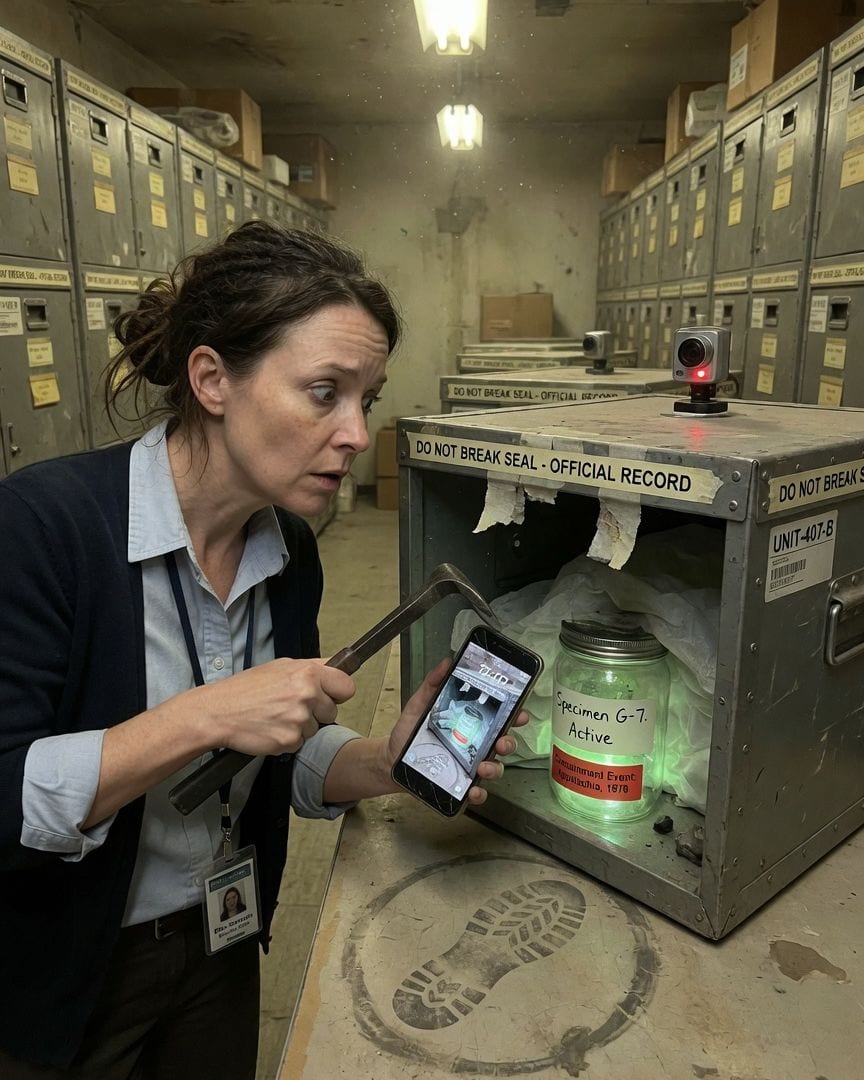
A records clerk on her last week found the Cold War crate she disposed of back. The boot print in its dust matched a photo from days ago, perfectly undisturbed.
Records clerk Elke Sarrazin was counting down her final week at the Fort Holabird annex, the air thick with the scent of forgotten paper and the impending demolition of the facility. She'd personally logged UNIT-407-B for disposal days ago, yet Monday morning, the heavy storage crate sat precisely back in its original aisle, its seals pristine. The impossible detail was a single, clear boot print in the dust before it, captured identically in photos taken days apart. Despite her efforts to move and monitor it, the crate returned again, leaving only static on her camera and a redacted file hinting at 'self-correction protocols.' What dark secret pulsed within the crate's forbidden depths?
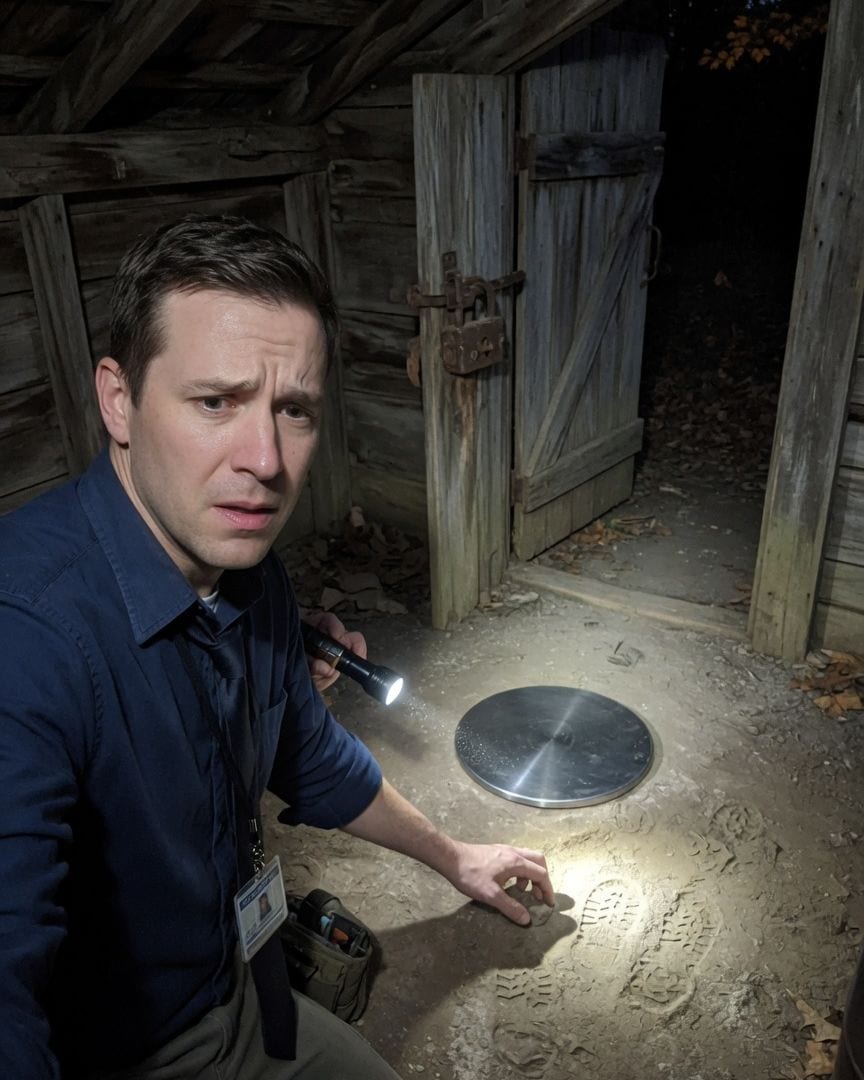
A meticulous archivist found a Cold War file showing a weathered shed with boot prints walking in, but none ever walking out, and a custody log signed for eighty-one years.
Devin Mauch, a methodical archivist at Fort Loran, was meticulously preparing the last of the WWII bundles for transfer, relishing the quiet order of declassification in the hushed, climate-controlled vault. His calm was shattered when he discovered the Ashfield Barn file, a slim folder containing a single grainy photograph of a small, weather-beaten wooden shed. In the dust before its slightly ajar door, a clear set of boot prints led directly inside, but none led out. The chilling caption read: 'SUBJECT REMAINS INSIDE, IN CUSTODY, INDEFINITE,' with the entry re-signed quarterly for eighty-one years, the last signature just six days ago. The shed, he knew, stood less than four miles from his home, its ancient, medieval lock hinting at a secret far deeper than any rural incident. What, or who, had been kept in that shed for over eight decades, and why did its custody continue to this day?
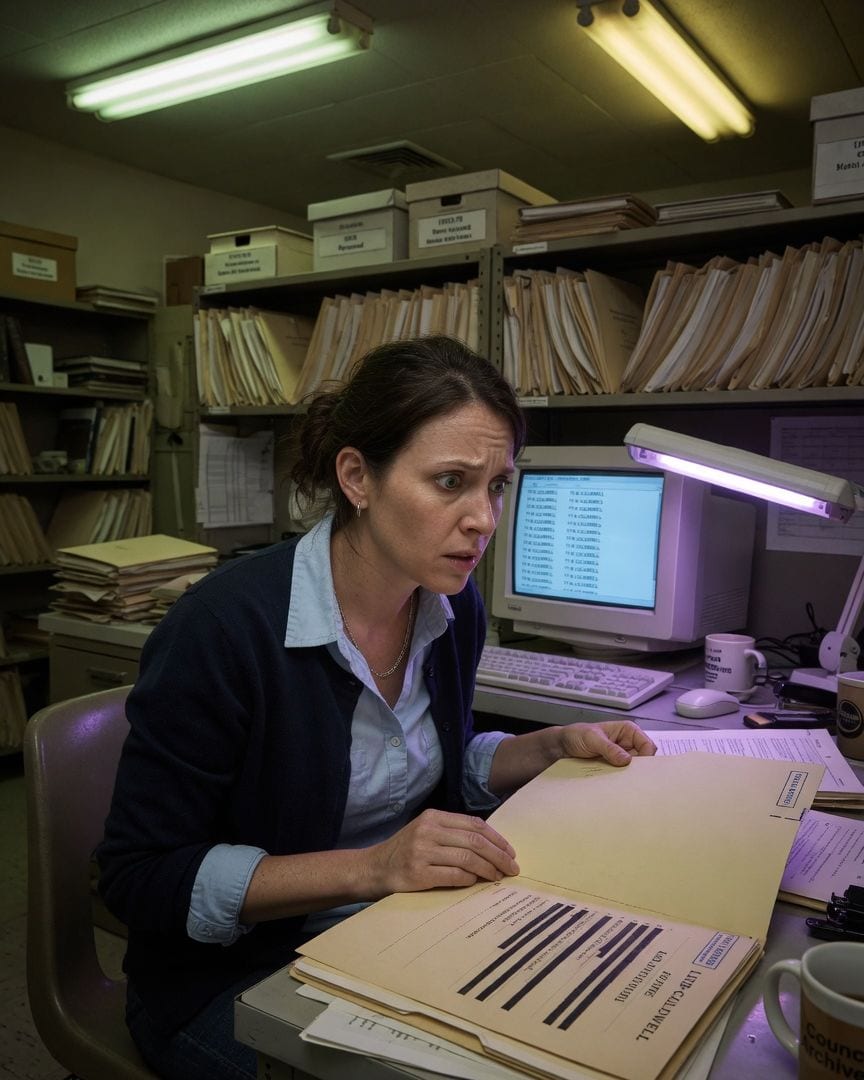
My employer's security file holds a vetting report on me dated nine years before I ever applied. It has my full name and my parents' address — with only one line, the source who referred me, blacked out.
Working a routine data audit, I pull my own security file. The issue date is nine years before I even applied for the job. Then, hidden within an old archive file, I find my current address etched under a blacked-out line.
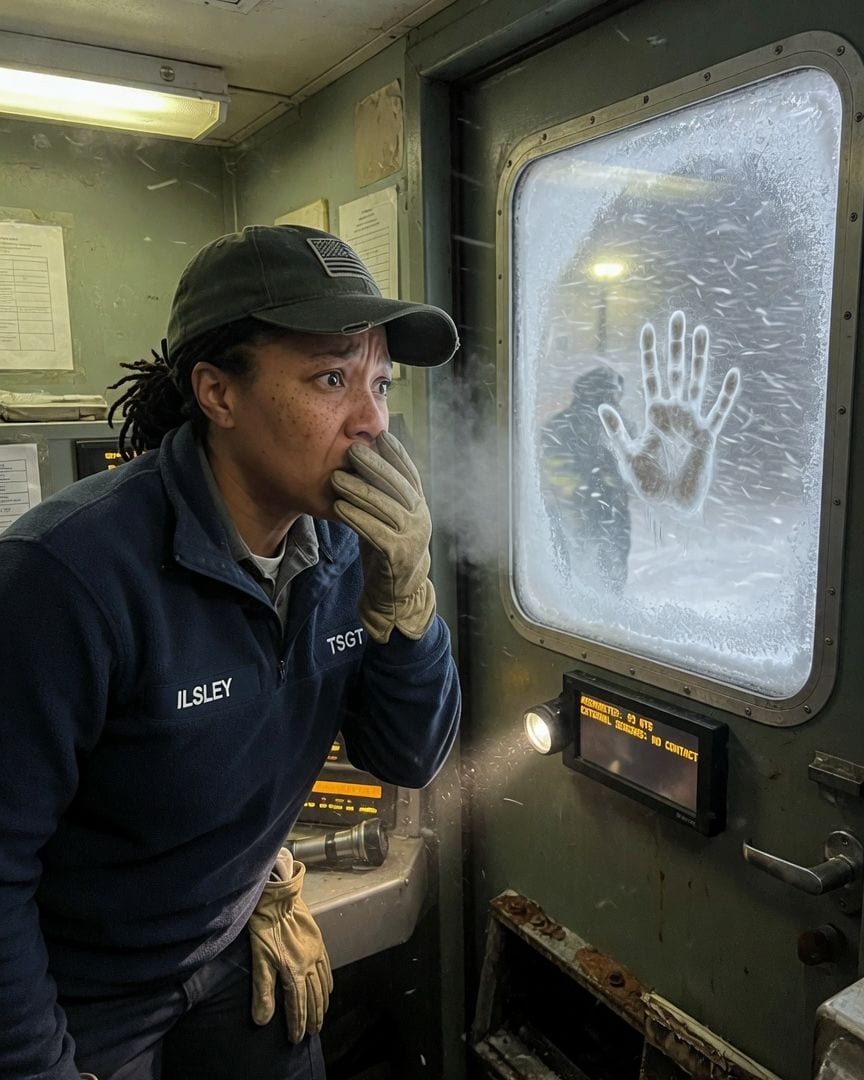
Technical Sergeant Ada Ilsley had two weeks left when a handprint appeared on her sealed window, unnervingly warm and pressed from the *inside*.
Technical Sergeant Ada Ilsley was counting her last two weeks on the Greenland ice-cap before Thule-Gamma Station closed for good. Tonight, the polar wind howled at ninety knots, clawing at the station's insulated walls as she kept a lonely vigil. Through the main door's triple-paned port, she watched a dark figure emerge from the impossible blizzard, its face pressed against the glass, only to vanish. On the frost outside, a perfectly clear handprint remained, unnervingly warm and undeniably pressed from the *inside* of the sealed pane. How could anything have touched the glass from within a supposedly impenetrable barrier?
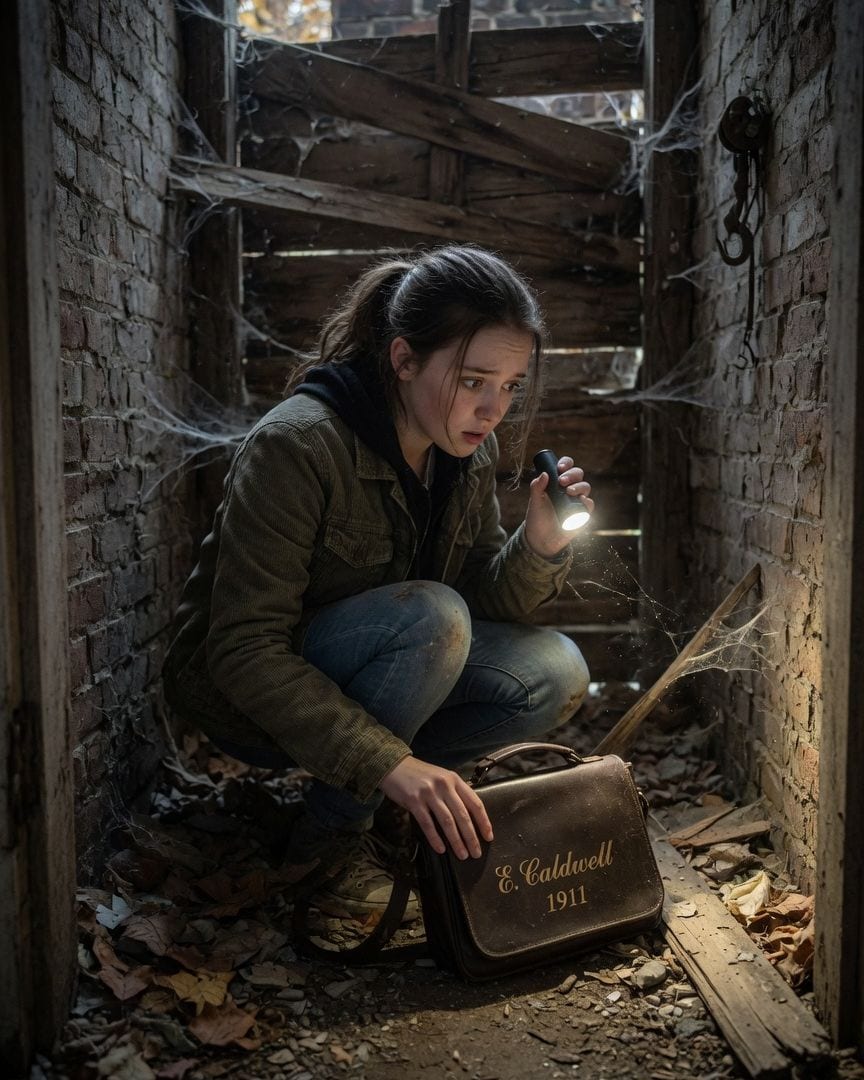
The school attendance register lists a child present every day since 1911. No such student ever sat an exam.
My new school, Caldwell High, felt too quiet, especially around its ancient, boarded-up bell tower. Teachers gave identical, rehearsed lines about it being "structurally unsafe." But then I found the attendance register, detailing a student named Eleanor Caldwell marked present every single day since 1911. No other record of her exists anywhere.
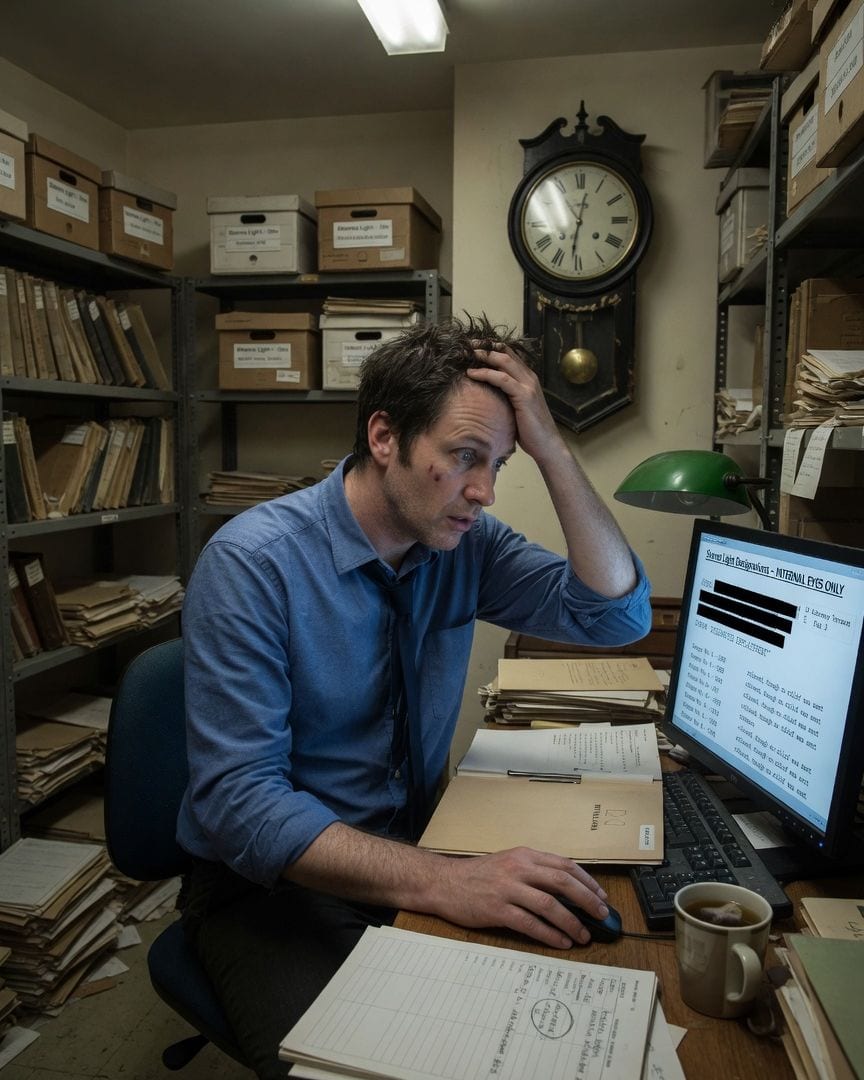
I found my street address in a century-old lighthouse file, printed decades before I lived there.
As a maritime archivist, my world revolves around forgotten lives and dusty ledgers. But the Skerne Light files broke that quiet rhythm, revealing a chilling pattern: 'Keeper number 6' relieved, though no relief was sent, repeating for decades. Now, an internal document with a strange code has led me to a redacted entry, revealing my own street address, decades before I ever lived there.