An inventory specialist sought a missing Cold War footlocker for 89 men. She found 89 metal containers marked 'PROCESSED' in a hidden room.
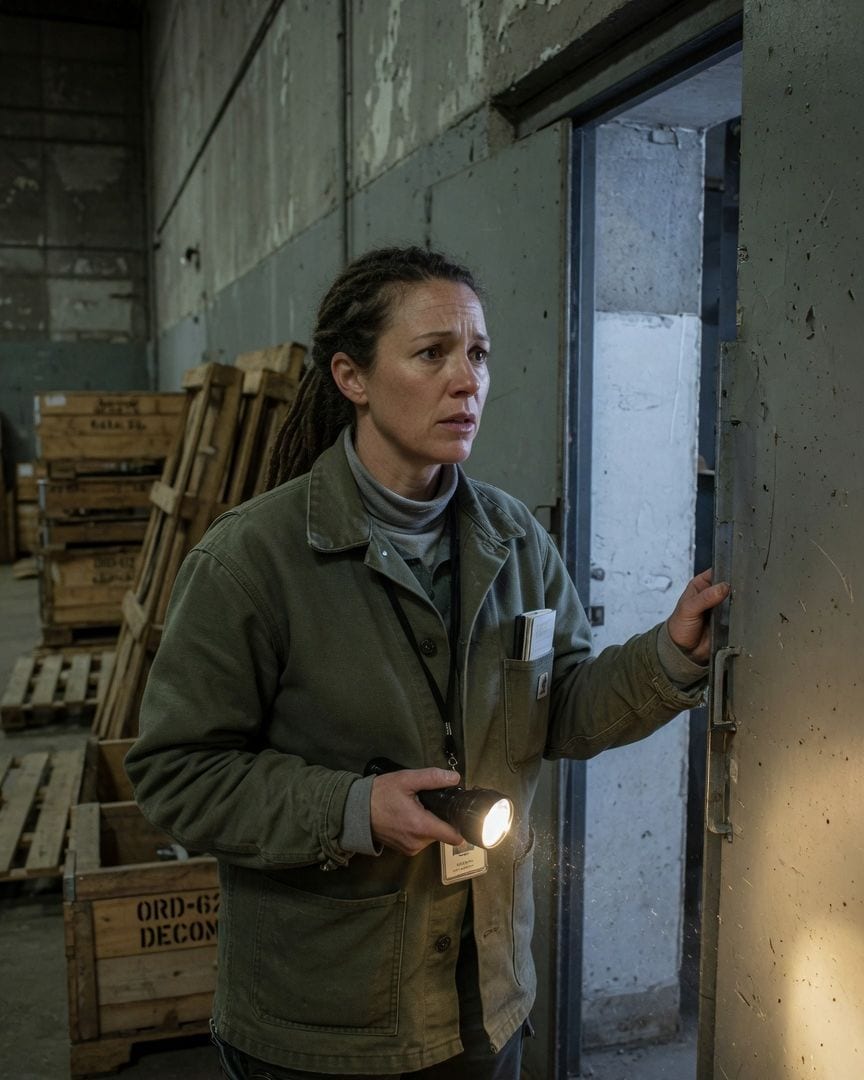
Halcyon Reeve, forty and meticulous, moved through the cavernous interior of the 55th Ordnance Depot warehouse in Sweetgrass, Montana.
The vast space, recently emptied for its 2004 auction, still smelled faintly of dust and old metal, a scent she found both melancholic and invigorating. Beside her, Greg Mitchell, the depot’s new owner, grunted his satisfaction.
Greg, a man of practicalities, saw only square footage and future profit. Halcyon, however, held the brittle pages of the 1962 property book like a sacred text, her fingers tracing the faded ink.
Each pallet, every crate, every stenciled code on the rough wooden boxes mirrored the inventory perfectly. This rare alignment of record and reality was usually a quiet triumph for her professional integrity.
Yet, a stubborn blank space on page 17 kept drawing her gaze, a small, cold void in the otherwise flawless ledger.
It listed one item she couldn't find, an entry that seemed to mock the meticulous order: 'Footlocker, contents recorded as PERSONAL EFFECTS, 89 MEN, 89 SETS.'
She had already checked every shadow, peered into every corner of the main warehouse, even double-checked the adjacent storage bays. Nothing. Sixteen men had been officially assigned to the depot in 1962.
The last of them had died in 1990, his final, rambling words to a nurse insisting there had been eighty-nine.
The math simply did not add up, and the complete absence of the footlocker felt like a cold, empty cavity in the heart of the otherwise perfect record.
She tried to rationalize it as a clerical error, a misprint, but the physical reality of its absence was undeniable. The discrepancy gnawed at her, a professional itch she couldn’t ignore.
Halcyon returned to the warehouse alone the next day, her flashlight a solitary beam cutting through the vast, still space. The silence pressed in on her, heavy and absolute.
The gnawing discrepancy had grown into a persistent thrum beneath her skin, a challenge to her professional integrity. She systematically re-checked the area where the missing footlocker should have been, near a set of decommissioned loading bays.
She ran her hands over the cold concrete walls, searching for any anomaly.
One section felt subtly different. The concrete here was smoother, newer, the institutional gray paint a shade lighter, almost imperceptibly so, than the faded original around it.
It was too uniform, too perfect, as if someone had gone to great lengths to make it blend seamlessly. She pulled out her measuring tape, a habit born of years spent verifying blueprints against extant structures.
The dimensions of the warehouse, according to the 1962 blueprints she’d painstakingly sourced from the county archive, did not quite match the physical space.
There was a void, a section about twenty feet wide and thirty deep, that should have been there but wasn’t.
Her fingers, calloused from years of handling old documents and artifacts, traced a faint seam where the newer concrete met the older. It wasn't a repair; it was a cover-up, a deliberate artifice.
Following the nearly invisible line, she discovered a cleverly disguised access panel, flush with the wall, hidden behind a stack of empty, discarded crates. It was almost invisible to the casual glance, but to Halcyon’s practiced eye, it stood out.
With a crowbar borrowed from Greg’s toolkit, she wedged it into the seam and pried. The groan of old metal against concrete echoed in the silence.
The air that spilled out was colder, sterile, carrying a metallic tang she couldn’t quite place, something chemical and sharp, not the usual dust and rust of the depot.
Beyond the panel, a narrow, unlit corridor stretched into absolute blackness, a space completely absent from any official record, from any blueprint. The silence of the warehouse seemed to deepen, drawing her in.
Halcyon Reeve hesitated for only a moment, the metallic tang of the hidden room clinging to the air around her.
Then, her professional curiosity overriding her nascent apprehension, she stepped into the hidden corridor, her flashlight beam cutting through the oppressive darkness. The cold embraced her, an unnerving chill that seemed to seep into her bones.
The corridor opened, not into another storage bay, but into a smaller, square room, impeccably clean, devoid of dust or the grime that coated the main warehouse.
It was unnaturally cold, the air still and heavy, as if nothing had disturbed it for decades. Her light swept across the room, and she stopped, her breath catching in her throat.
There was no footlocker. Instead, arrayed in precise, military-grade rows, were eighty-nine identical, heavy-duty storage containers, each made of dull green metal.
They were stacked three high, reaching almost to the ceiling, a silent, imposing block in the center of the room. On the side of each, stenciled in crisp, black letters, was a unique serial number.
And beneath each number, a single, chilling word: 'PROCESSED.'
The single word 'PROCESSED' echoed in Halcyon Reeve’s mind as she retreated from the hidden room, the sterile cold clinging to her clothes even after she sealed the access panel behind her.
Her methodical nature, the very core of her professional identity, demanded answers. Back in her office, away from the depot’s oppressive silence, she plunged into military archives, chasing any mention of the 55th Ordnance Depot beyond its official function.
She pulled up fragmented personnel records, heavily redacted, mentioning 'unaccounted for' units and 'classified incidents' in the general Sweetgrass area during the early 1960s. The phrase 'localized training exercise' appeared frequently, always followed by 'unspecified anomalies.'
One recurring phrase, always buried in a footnote or a cross-reference, caught her eye: 'Project Sky-Mirror.' It was always linked to unusual atmospheric phenomena or radar anomalies.
She cross-referenced the dates of these incidents with the timeline she’d constructed around the '89 men.' The numbers aligned too perfectly, a pattern emerging from the digital static.
She uncovered an old, grainy declassified report, almost an aside, describing a 'Thing on the Scope' – an impossible contact held by radar, confirmed by a second station, and captured briefly on gun camera, then officially 'unhappened.'
The report detailed an interceptor vectored onto something that did not obey air, before the entire incident was sealed. It read like a bad science fiction novel, yet the language was cold, precise military jargon.
She found a faded newspaper clipping from 1962, yellowed and brittle, reporting a localized 'training exercise' that closed off a vast section of the Montana wilderness for weeks, with multiple civilian reports of 'strange lights' dismissed by official channels as swamp gas.
The official story was a flimsy veil, stretched thin over something far more substantial, a flimsy sheet that Halcyon now felt she could see through.
The dread wasn't in what she was finding, but in the sheer scale of what had been hidden, and how easily it had been filed away, the impossible made mundane.
Halcyon Reeve’s inquiries, once innocuous, began to draw subtle attention. An archive request she submitted for 'Project Sky-Mirror,' after being pending for days, was suddenly marked 'unavailable due to ongoing review.'
Her office computer, usually a reliable workhorse, began to glitch. A folder containing her meticulously organized research notes deleted itself, then restored itself an hour later, but with key documents corrupted, the text a jumble of untranslatable characters.
She tried to dismiss it as a system error, an old machine finally giving up, but the timing felt too precise, too deliberate.
One evening, as she left her office, the streetlights humming above the empty parking lot, a nondescript dark sedan was parked across the street, its engine idling softly.
The driver, a man in a dark suit, made no overt move, but his gaze was fixed on her, unwavering, even as she got into her car.
He didn’t follow her, but the image of his still face, watching, etched itself into her memory. The next morning, a plain brown envelope, unmarked by post, was taped to her office door.
Inside, there was only a single, photocopied page from an internal military memo. It was heavily redacted, block after block of black ink obscuring most of the text.
But one sentence was perfectly clear, starkly visible, and underlined in red ink: 'Proximity to classified materials may result in reassignment or reclassification of personnel.'
The message was chillingly precise, a quiet threat without a single aggressive word. It didn't tell her to stop; it told her she was already on a list, already noted.
A cold knot formed in her stomach, a distinct sense of being watched, of her every move now being part of some unseen audit, her very existence being documented.
Driven by the chilling warning, Halcyon Reeve located Everett Brooks, eighty-five, listed as a junior officer at the 55th in 1962. His address led her to a quiet, manicured retirement community, far removed from the dusty depot.
His apartment was neat, filled with the scent of old paper and Earl Grey tea. His mind, she quickly discovered, was sharp despite his age, his gaze clear and unsettlingly calm.
She held out a blurred photo of the 'PROCESSED' containers, carefully printed from her phone.
His eyes, though old, flickered with a recognition that was neither surprise nor alarm, but a deep, weary understanding. He took a sip of his tea.
'The depot wasn't just for ordnance, Miss Reeve,' he stated, his voice calm, steady, and devoid of tremor. 'It was for… data management. And inventory control.'
Halcyon pressed him, her voice barely a whisper. 'The 89 men? The footlocker of personal effects?'
Brooks nodded slowly, his gaze drifting to the window. 'The 'personal effects' were the men, yes. Or what was left to file. They were part of a unit, a response team, assigned to an incident. A… visitor, you might say.
Something from 'Sky-Mirror.'' He paused, the silence in the room stretching, heavy and expectant. Then he continued, his voice maintaining its flat, almost academic tone.
'When you track something that doesn't obey air, that moves like thought, you learn to file its effects. The depot was one of several facilities, established for processing the evidence, the… remnants. And the people who interacted with it.'
He described the 'Thing on the Scope' not as a single, isolated event, but a recurring phenomenon, something that 'came and went,' leaving ripples in its wake.
The 89 men, he explained, were part of a larger unit that encountered it directly, made physical contact in some way. 'They were never truly lost,' Brooks said, his voice devoid of emotion, like a scientist discussing specimens.
'They were simply… filed. As personal effects. The system is quite thorough.' Halcyon felt a wave of nausea, a sudden dizzying rush as the floor seemed to tilt beneath her.
The missing footlocker, the 89 containers, the disparity in numbers, the dying man’s insistent words – it all snapped into a horrifying, coherent picture.
The dread wasn't in the mystery any longer, but in the cold, bureaucratic logic of it all, the chilling efficiency with which human lives had been reduced to inventory.
Halcyon Reeve sat opposite Everett Brooks, reeling from his calm revelations. The nausea had receded, replaced by a cold, hard knot in her chest. He gestured to a stack of old, leather-bound journals on his coffee table.
'I kept my own records,' he said, his voice almost apologetic, 'unofficial, of course. For my peace of mind. To keep the truth… filed, in a different way.'
He reached for a thin, yellowed file, bound with string, marked simply 'Sky-Mirror Personnel Addendum.' 'There were others, beyond the 89. Observers. Auditors. Those who got too close to the filing cabinet, as it were.'
He handed her the file. Her fingers trembled as she took it. It was a list of names, some redacted with thick black marker, some with cryptic alphanumeric codes that held no meaning for her.
She scanned it, looking for familiar dates, for anything that might link directly to the 'Thing on the Scope' or the 89 men. Her eyes snagged on a name, half-obscured by a fold in the brittle paper, but unmistakable.
She smoothed the page with a shaking hand, her breath catching in her throat. The entry was recent, disturbingly so, and beside a coded designation that seemed to hum with dark, unspoken meaning, was her own name: HALCYON REEVE.
A date, just weeks from now, was printed beside it. A date that hadn't happened yet.
Halcyon Reeve confronted Everett Brooks, the classified addendum trembling in her hands. The quiet room, once a sanctuary, now felt like a cage. 'My name,' she whispered, the words catching in her throat. 'It's here. With a future date.'
Brooks looked at her, his eyes still unnervingly calm, utterly devoid of surprise or remorse. He merely nodded. 'You opened the file, Miss Reeve. You followed the thread. You became part of the record.'
He explained that the 'secrecy machine' wasn't just about hiding information; it was about managing anomalies. 'The Thing on the Scope,' he clarified, 'it leaves traces. And those traces… they draw attention. Some people, like the 89, are directly 'processed.'
Others, like yourself, become part of the 'metadata,' the associated personnel. Your investigation, your persistence, it simply completed the necessary data points for your own classification.' He gestured around his quiet room, encompassing his journals, his tea, his solitary existence.
'I'm 'filed' too. As a retired observer. My information is contained. Your name appearing is just the system cataloging a new entry. It's not malicious, Miss Reeve. It's just… efficient.'
Halcyon felt a cold dread spread through her, colder than the hidden room, more profound than any fear she had ever known.
The missing footlocker, the 89 men, the 'PROCESSED' containers, the precise, chilling logic of Brooks's words – it all made a terrifying, perfect sense.
The horror was in the coherence, the realization that she had not uncovered a secret, but had walked willingly into a meticulously maintained system that now included her, had cataloged her, had assigned her a future date.
Halcyon Reeve, attempting to understand the full scope of her predicament, to grasp the implications of a name and a date on a secret ledger, arranged a meeting with Philip Marsh, a name Everett Brooks had subtly provided.
Marsh, a man of about forty-five, met her in a sterile, windowless conference room in an unmarked government building, a space so neutral it felt hostile. He was calm, meticulously dressed, and his demeanor was utterly unbothered.
He didn't deny anything, didn't threaten. He simply explained, his voice even and soft.
'Ms. Reeve,' he began, his hands resting flat on the polished conference table, 'your classification is complete. Your access to certain historical documents will be curtailed. Your professional focus will be subtly redirected.'
He paused, meeting her eyes with a placid, unreadable gaze. 'You are now a managed asset. You will continue your work, but within parameters. Your curiosity, while admirable, has served its purpose in updating the record. The system is self-correcting.'
Halcyon tried to argue, to demand answers, to assert her autonomy. 'This is insane! You can't just… categorize people! Assign them dates!' Marsh merely smiled, a faint, polite curve of his lips that didn't reach his eyes.
'The classification is already complete, Ms. Reeve. Your function is now to integrate. There is no escape from the file. It is, after all, a perfect record.'
The calm, quiet certainty in his voice was the worst part, more terrifying than any overt threat. It was the sound of an immutable, indifferent mechanism.
She tried to leave, to walk out, to physically reject the conversation. She rose from her chair, her legs trembling, and strode to the door.
She grasped the handle, but it felt impossibly heavy, unyielding, as if the very frame had shifted and sealed itself around her. Marsh didn't stop her.
He simply watched, his expression unchanging, as she struggled with the handle, pushing and pulling fruitlessly. The file, she realized, had already closed around her.
In the weeks that followed, Halcyon Reeve found herself subtly, irrevocably altered. Her requests for certain historical documents, particularly those predating the 1970s, were routinely met with 'administrative delays' or 'unforeseen processing issues.'
Email alerts for new declassified records, once a constant stream filling her inbox, dwindled to nothing. Her phone would occasionally ring with a silent call, ending just as she answered, leaving only a dead line.
Colleagues at the state historic office noted her quietness, her slightly distant gaze, attributing it to stress from a particularly demanding project.
She continued her work, appearing outwardly normal, but the meticulous joy she once found in uncovering history was replaced by a hollow, almost rote adherence to procedure.
The world around her seemed to operate normally, oblivious to the invisible threads that now bound her, pulled taut by unseen hands.
Halcyon Reeve sat at her desk, reviewing a mundane property deed for an old farmstead, the kind of paperwork she once would have found tedious.
The sun streamed through the window, illuminating dust motes dancing in the air, a thousand tiny, insignificant specks. She felt no urgency, no drive to dig deeper into the world's hidden corners.
The knowledge she carried was a heavy, cold stone in her gut, but it was also, strangely, a form of peace, a quiet acceptance.
She understood now that the world was not meant to know certain truths, and some records were not meant to be fully opened.
Her phone buzzed. It was Greg Mitchell, the auction buyer, calling about a new discrepancy in the Sweetgrass depot's inventory, a minor issue with a missing utility closet.
'It's just a minor clerical error, Greg,' she heard herself say, her voice calm, devoid of any hint of her past fervor, utterly professional. 'Nothing to worry about. I'll handle it.'
She ended the call, a faint, almost imperceptible smile touching her lips as she looked at the ordinary deed before her. The file, it seemed, was still being signed.
If this one got to you
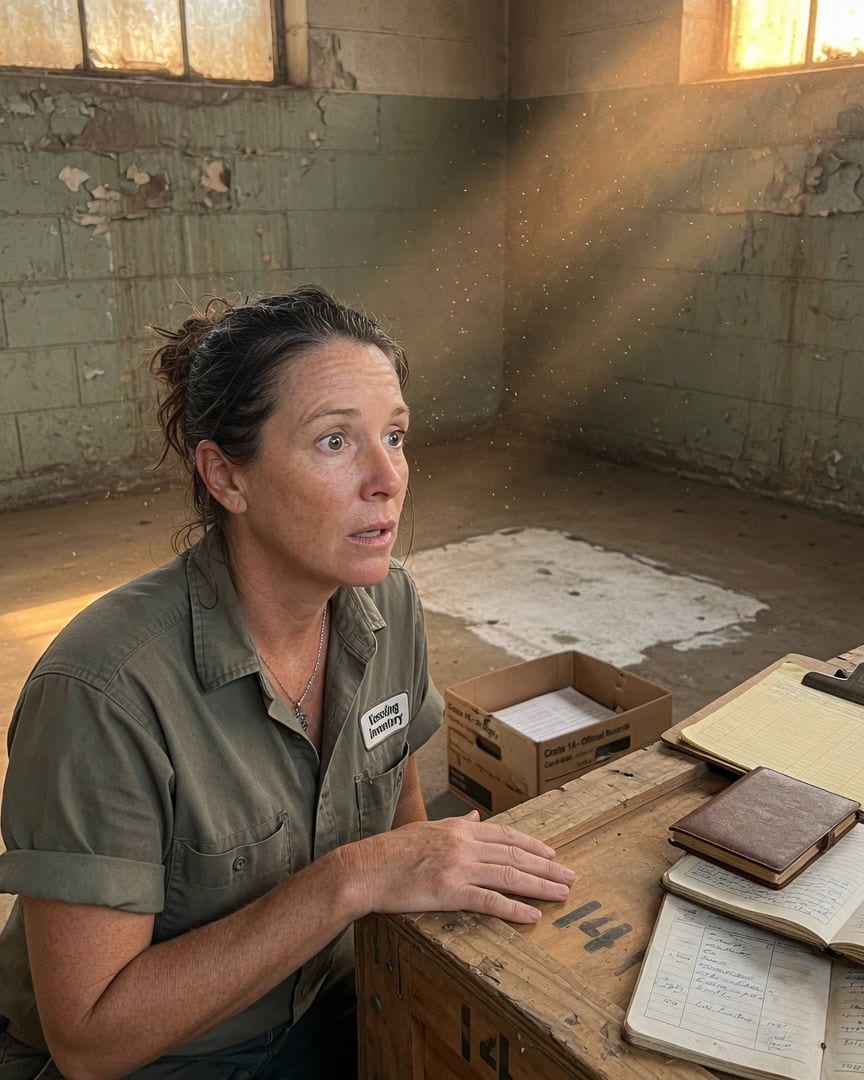
A Cold War base's hidden ledger showed a dead man's signature, dated five years after his death.
With demolition crews just a day away, inventory specialist Deborah Kessling raced through the vast, dusty Carolina warehouse, tasked with logging its final forgotten equipment. In a cold, far corner, she discovered Crate 14, an unremarkable box that inexplicably radiated an absolute, bone-deep chill, having spalled the concrete beneath it for decades. Her research uncovered an official logbook detailing quarterly signatures for sixty years, unbroken by base closures or disasters, but a hidden ledger revealed an entry from 1980 signed by Lars Thornton, a logistics officer confirmed dead since 1975. As Deborah read the dead man's words describing 'a faint, rhythmic pulse,' a subtle thrum began to vibrate through the floor beneath her feet. What was Crate 14 protecting?
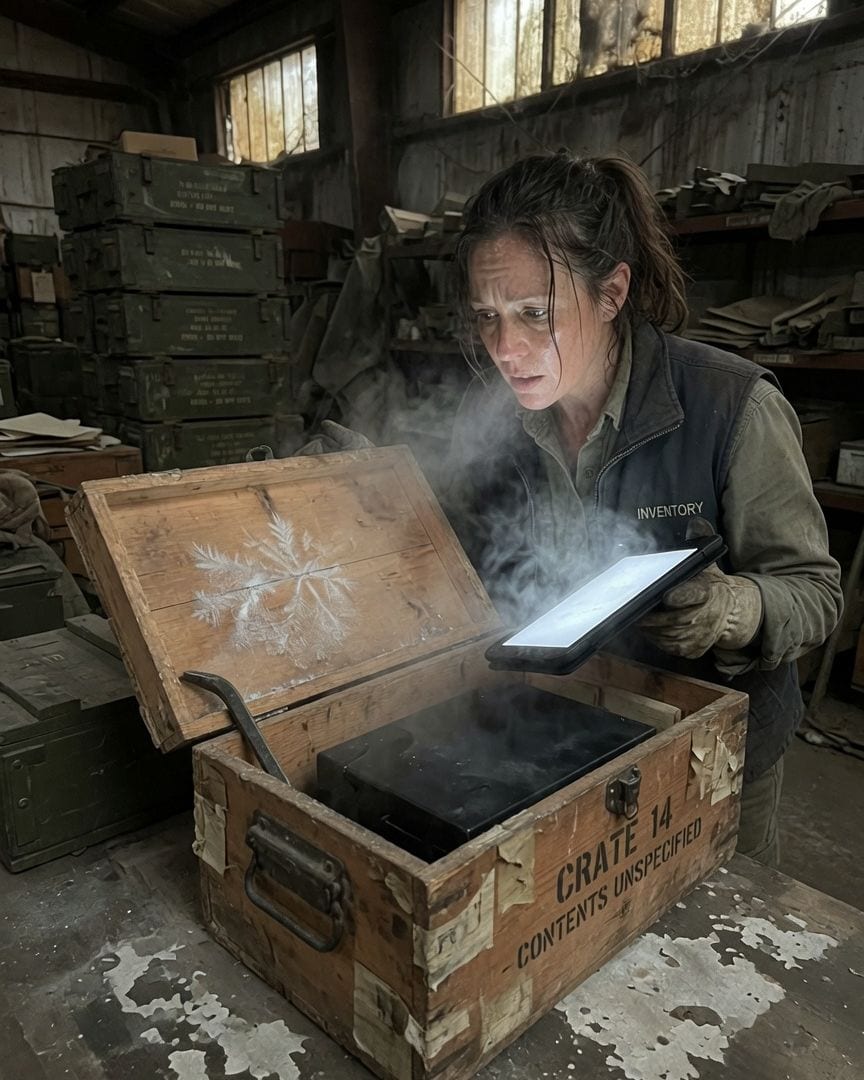
An inventory clerk found one crate in a condemned Cold War warehouse. It emanated a bone-deep cold, signed for every ninety days for sixty years.
Inventory clerk Deborah Kessling faced a race against time, cataloging the final items in a condemned military warehouse before its demolition on the twelfth. Amidst forgotten equipment, she discovered Crate 14, radiating an unnatural, bone-deep cold that had scarred the concrete beneath it for decades. Its sparse file hinted at a 'flying disc' entry from 1948, later struck through, and an unbroken chain of signatures every ninety days for sixty years. When Deborah finally forced open the ancient lid, a metallic, obsidian object pulsed with a low hum, its cold intensifying, coating the inner lid with frost. What ancient secret had the military meticulously guarded for so long?
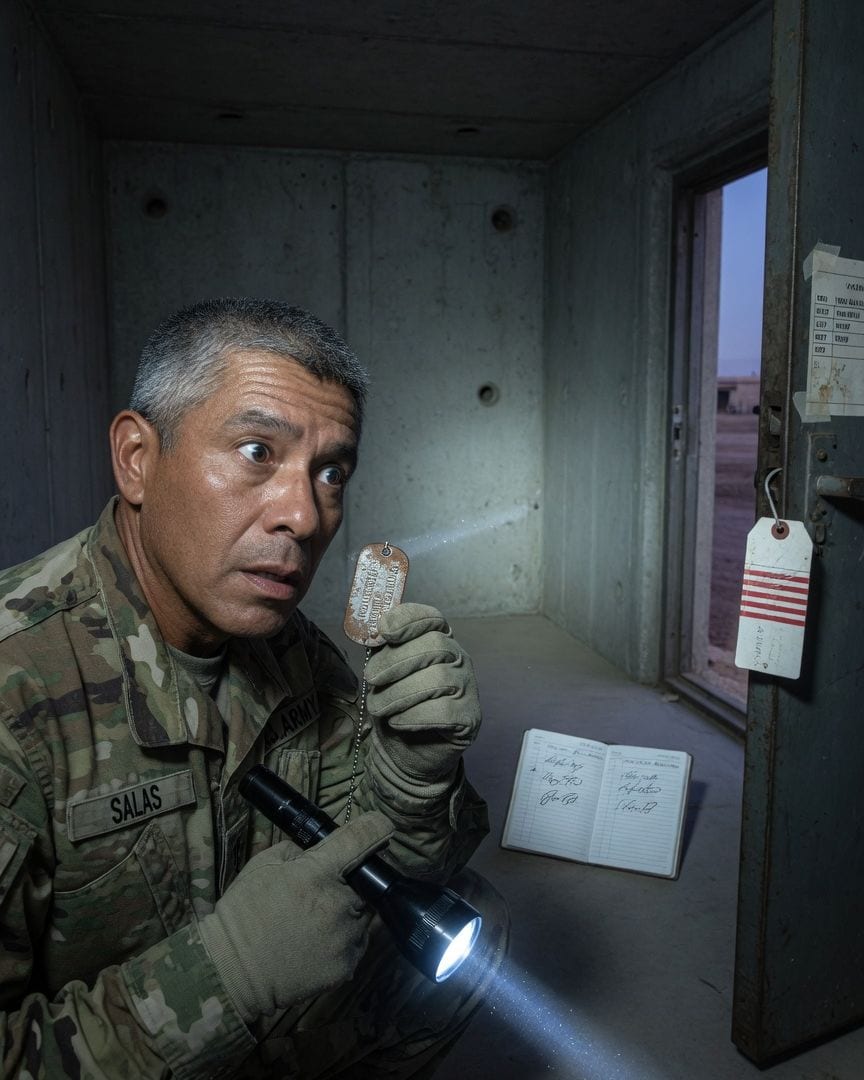
An inventory officer found a bunker's log of soldiers, then found one of their dog tags marked 'KIA, 1970'.
Chief Warrant Officer Gideon Salas meticulously oversaw the Hawthorne Ammunition Depot's inventory, racing against its final closure in two weeks. The high desert winds whipped dust across the familiar igloos as he worked, each bunker accounted for, until he reached the eastern perimeter. There, an extra igloo, Bunker 40, stood with a current lock and seal, though it wasn't on any map. A duty log propped open nearby listed inspections signed by men the Army swore didn't exist. His gut, honed by decades of service, churned with unease; inside the empty bunker, his flashlight found a corroded dog tag bearing one of those names, marked 'KIA, 1970'.
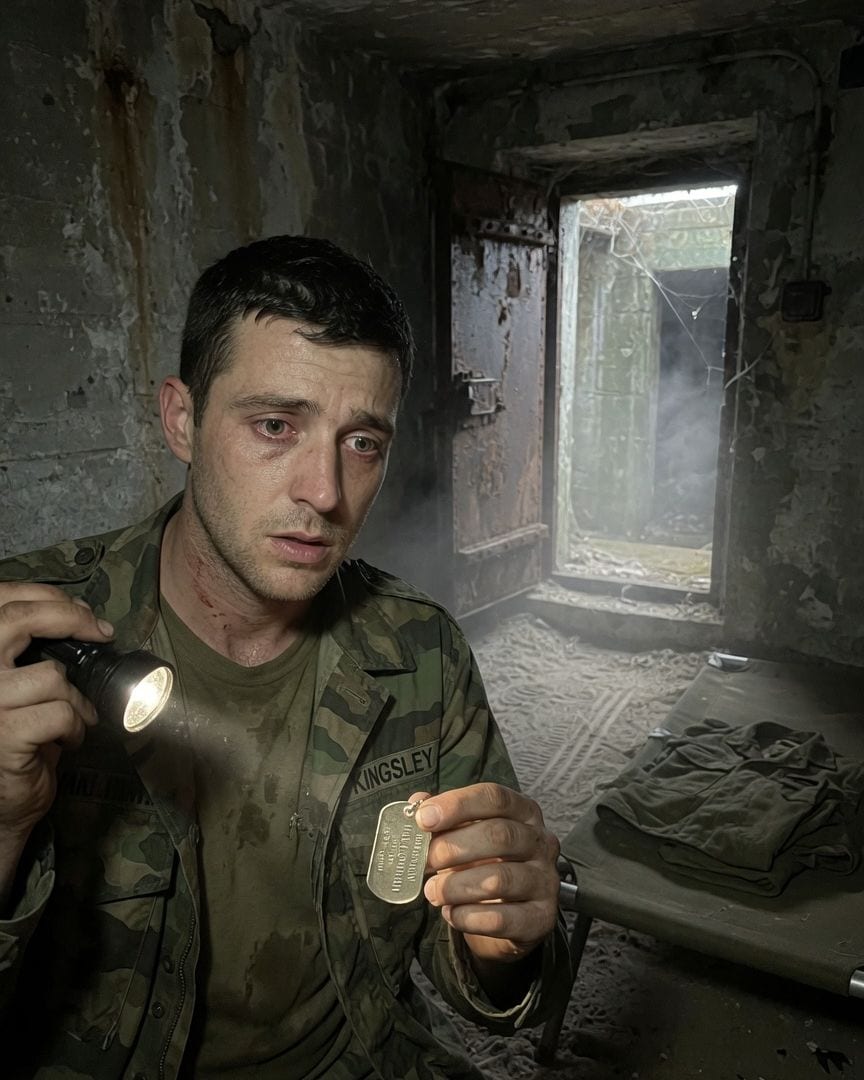
On his final rotation, a Private finds a WWII dog tag for 'Halloran' in a bunker sealed for eighty years.
Private Roland Kingsley endured the bone-deep weariness of his final graveyard watch at a reactivated WWII bunker on the Northern California coast, just hours from dawn and the end of his deployment. His searchlight cut through thick fog, revealing impossible figures: men in archaic WWII uniforms, assembling on the deserted beach, only to vanish moments later. As dawn broke, Kingsley discovered the bunker's rear hatch, sealed for decades, now stood mysteriously ajar. Inside, on an empty cot, lay a WWII-era field jacket, and in its pocket, a dog tag for 'Halloran' — a name impossible to the bunker's eighty-year history. What unseen presence had disturbed the long-sealed past?
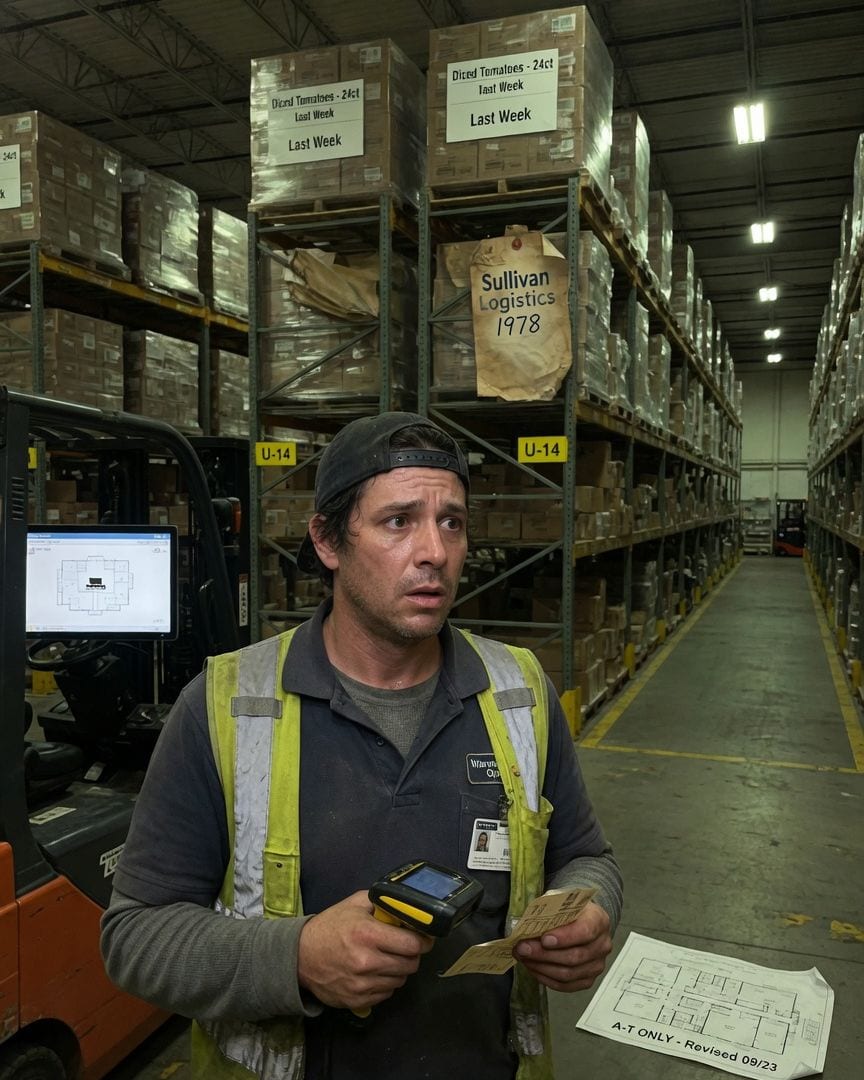
My warehouse floor has an extra aisle past the end wall. Aisle U, full of pallets for orders no one ever placed. My forklift’s GPS says I’m off the map.
On my usual night shift route, driving the forklift through the familiar warehouse aisles, I rounded a corner and found something new. Aisle U. It shouldn't exist; the building's official blueprints only go up to Aisle T. But there it was, stretching out into the dim lights, a solid, tangible section of building that wasn't on any map.
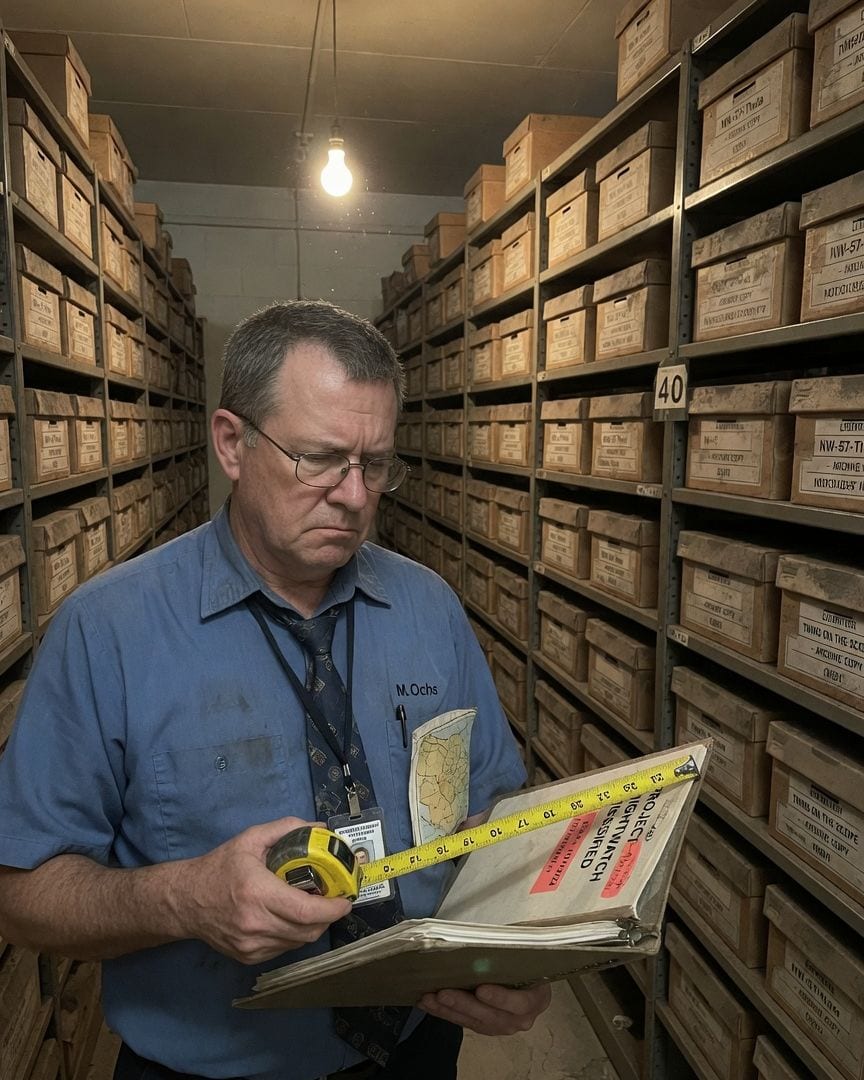
A Cold War records clerk on his final patrol found Aisle 40 stretched 61 feet longer, lined with unknown boxes. Inside one: 'PROJECT NIGHTWATCH - CLASSIFIED' with a fresh timestamp.
Marlin Ochs, a creature of habit after nineteen years at the St. Louis federal records depot, faced his final patrol through Aisle 40 before its scheduled pulping. His routine walk, usually 92 precise strides, suddenly stretched to an impossible 119, making the aisle 61 feet longer than its blueprint. The extra section felt colder, lined with dust-laden boxes bearing alien classification codes and no manifest. Inside one, he found a metal-bound file: 'PROJECT NIGHTWATCH - CLASSIFIED,' dated 1957, but with a timestamp just hours old.