A Cold War base's hidden ledger showed a dead man's signature, dated five years after his death.
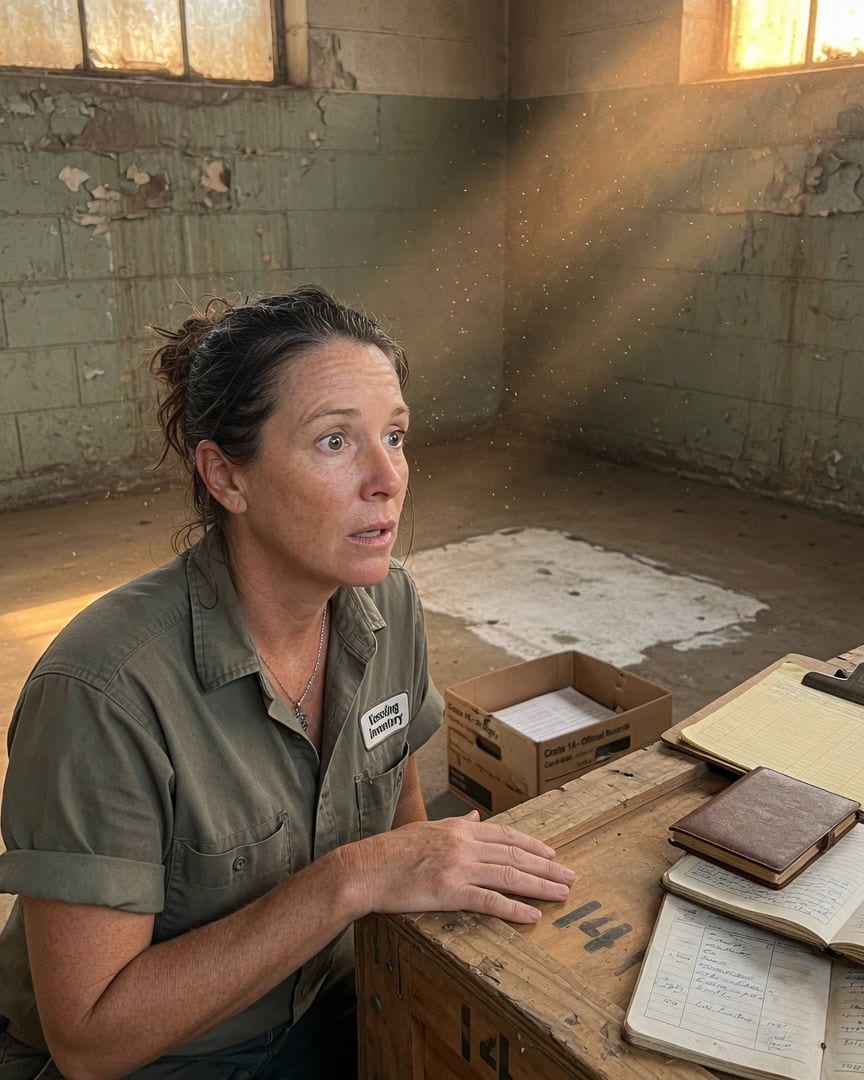
Deborah Kessling moved through the vast, hollowed-out warehouse, her footsteps echoing. Dust motes, thick as pollen, danced in the late afternoon light that poured through the high, grimy windows, painting the air a hazy gold.
The eleventh was already here, the deadline of the twelfth a palpable pressure in the humid Carolina air.
She had one more section to inventory before the demolition crew moved in, one last series of forgotten equipment to log before the wrecking balls arrived.
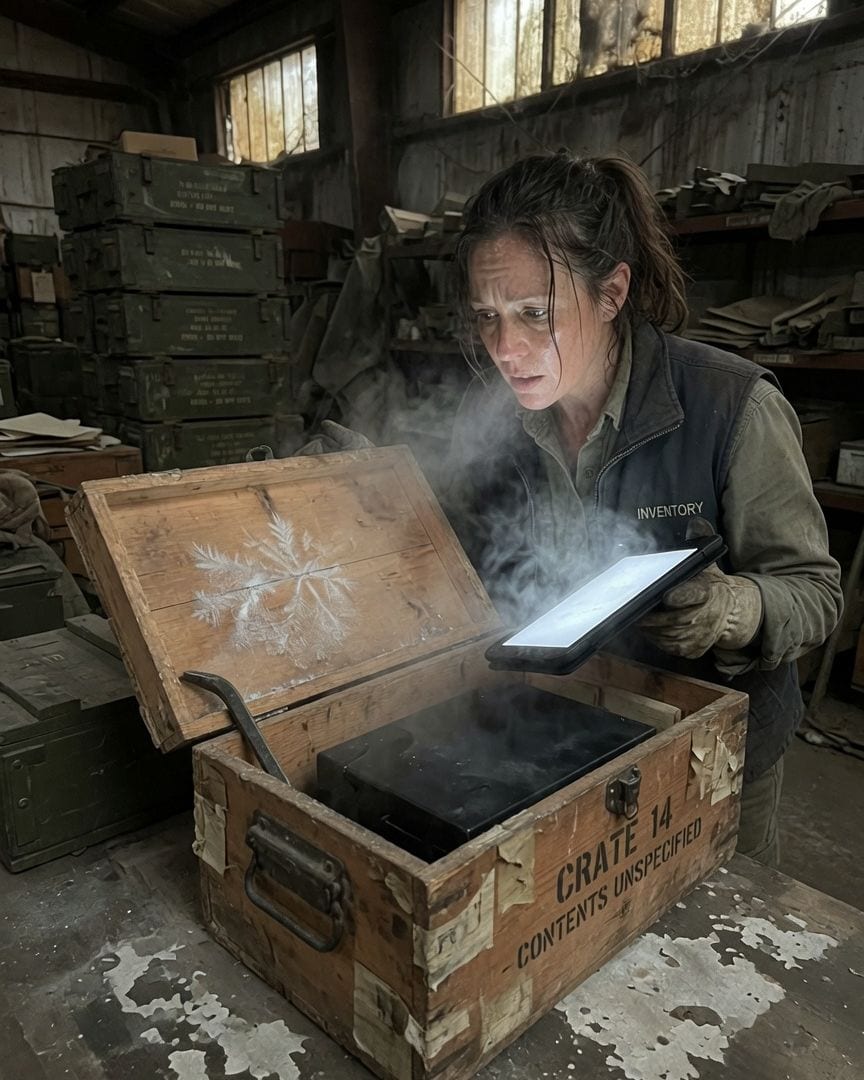
She reached a far corner, cooler than the rest of the building, where a heavy wooden box rested on dunnage. Crate 14.
It was utterly unremarkable, a plain, sturdy container built for long-term storage, save for one detail: beneath it, the concrete floor had spalled in a perfect, crate-sized rectangle, as if something perpetually cold had leeched the moisture out of the slab for decades.
A continuous, unnatural cold emanated from it, not a draft, but a localized, absolute chill that raised goosebumps on her arms despite the heat outside.
She tried to rationalize it – perhaps an old, buried refrigeration line that ran beneath this specific spot, a phantom current – but the cold was too contained, too insistent.
She placed her hand on the crate’s rough, splintered surface, feeling an insistent, deep chill seep into her bones, bypassing skin and muscle to settle directly into her marrow.
Deborah retrieved Crate 14’s official records from the base archives, a small, insulated building that smelled of decaying paper and disuse. The signature logbook was a thick, ledger-sized volume, its cover faded to a dull gray, spanning decades of entries.
Page after page, a different hand, a different rank, but always the same quarterly frequency. Every ninety days without fail, for sixty years. She traced the entries backward, a grim catalog of steadfast bureaucracy.
The log showed signatures made through the base’s official closure in '92, entries signed straight through the records of two hurricanes that had ripped through the coast, even after a fire that took the roof off the east bay, leaving behind only skeletal steel.
Each disaster, each abandonment, had failed to interrupt the cadence of the quarterly signatures for Crate 14.
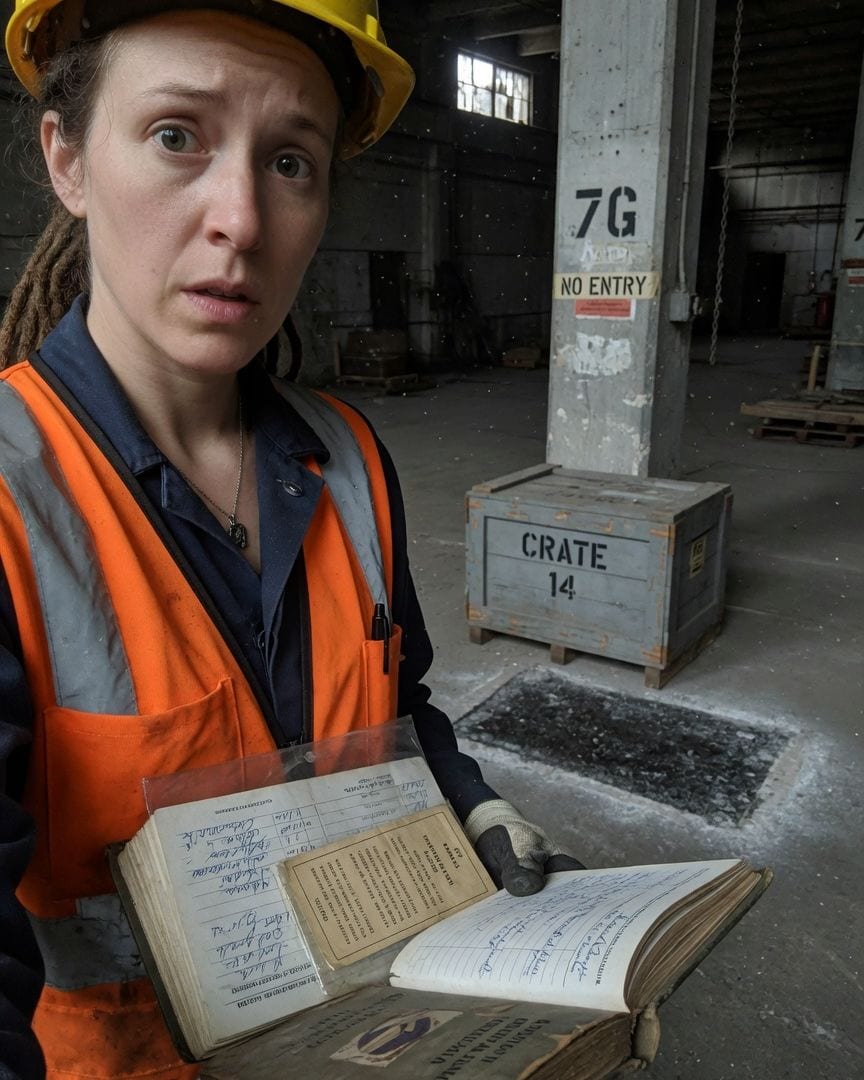
She finally reached a 1948 receipt, crisp against the aging paper, explicitly using the words 'flying disc' to describe the crate’s contents, scrawled in a tight, official hand.
Then, suddenly, all subsequent entries reverted to 'Object Alpha-14,' as if the earlier term had been redacted from memory itself. She noted a specific internal file reference, 'D-77,' cited on that early receipt, but searching the main archive yielded nothing.
There was no corresponding folder, no box with that designation. It was a dead end in a labyrinth of paper.
Frustrated, she dug through the bottom of Crate 14's official file box, a standard cardboard banker’s box, thinking she might have missed a loose document.
Her fingers brushed against something solid beneath the false bottom, almost seamlessly blended into the cardboard.
Within the hidden compartment, Deborah found a small, plain, leather-bound ledger, distinct from the official, imposing logbook. This one was intimate, almost private. It was filled with neat, handwritten observations, not administrative signatures.
She opened it to a random page, the binding creaking softly. The script described peculiar phenomena related to 'Object Alpha-14,' dated years after the base officially closed.
Her eyes fixed on an entry from 1980, long after the base was a ghost town, signed 'Lars Thornton,' a name she recognized from her initial research as a logistics officer who had died in 1975.
The chilling words described 'fluctuations in ambient temperature and a faint, rhythmic pulse.' Deborah looked up at Crate 14, feeling a subtle, deep thrum against the soles of her feet that wasn't there before.
Deborah returned to the archives, the leather-bound ledger clutched in her hand. She meticulously cross-referenced entries from the unofficial book with the official records.
She discovered a pattern that painted a far darker picture than simple bureaucratic oversight: 'transfers' of Crate 14 that never occurred, 'inspections' without corresponding reports in the official files, and 'personnel reassignments' that aligned precisely with dates in the unofficial ledger detailing intensified phenomena from 'Object Alpha-14.'
Each official signature, she now realized, seemed to precede a new, strange entry in the handwritten log.
The official paperwork wasn't just a record; it was a deliberate obfuscation, a veil for the true, ongoing monitoring and management of something hidden.
She focused on a pattern of personnel from obscure, specialized units involved in the signatures, noting that many vanished from public records soon after their last acknowledgment.
Their names simply ceased to appear in any searchable database, their lives seemingly erased. Deborah felt a growing unease. She attempted to contact a more recent signer, retired Colonel Richard Caldwell, his name listed on a 2005 entry.
His listed phone number was disconnected, replaced by a generic government message that simply stated, "This number is no longer in service. No forwarding information is available."
It was as if these people, once they touched Crate 14’s history, were systematically scrubbed clean from the world.
Deborah’s solo investigation did not go unnoticed. A security guard she’d never seen before, a man named Vincent Patterson, started patrolling her section of the warehouse with unnerving regularity.
He was younger than the usual contracted guards, quiet, and his gaze lingered on Deborah, a silent, unsettling presence. One afternoon, her access card to the digital archives, the only one allowing her to cross-reference the old files, briefly malfunctioned.
It displayed a flashing 'restricted access' error across the screen, a jarring red warning. Moments later, it reactivated, showing no record of the incident in the system logs, as if the brief blackout had been a phantom.
Later, she received an anonymous email, its sender listed as '[email protected].' The attachment was a single, garbled audio file.
When she ran it through an audio cleaner, it revealed a distorted, whispery voice repeating 'Alpha-14' followed by a static burst that sounded like a scream cut short.
As she left the warehouse one evening, locking up, the vast, empty space silent around her, she scanned the support beams near Crate 14, a habit she’d recently developed.
There, tucked into a joint high on a steel girder, she spotted it: a tiny, almost invisible surveillance camera, no bigger than her thumbnail. Its red light was a faint, accusing pinprick in the dimness.
The realization that she’d been watched, perhaps for days, perhaps from the moment her interest in Crate 14 deepened, sent a cold shiver down her spine that had nothing to do with the crate itself.
Deborah, desperate for answers, tracked down Joseph Walsh, an elderly, retired logistics officer who had signed for Crate 14 in the 1960s.
He lived in a quiet nursing home almost an hour inland, surrounded by the faded photographs of a life lived. He was lucid, sharp despite his ninety-two years, but initially dismissive of her inquiries.
His hands trembled slightly as she showed him the unofficial ledger, the leather-bound book with Lars Thornton’s chilling entries. Under her gentle but persistent questioning, his composure began to crack.
"They told us it was just a formality," he rasped, his voice fragile. "Routine inventory. Keep the books straight." He closed his eyes for a moment, then opened them, revealing a deep, ancient fear. "But it wasn't. It never was."
He admitted that Crate 14 contained an 'anomaly,' something recovered in 1948, 'not of this world.' He spoke of the ‘flying disc’ incident as if it were yesterday, then corrected himself to the official 'anomaly' designation.
He explained that the quarterly signatures were never about maintenance, never about physical upkeep. "It was a ritual," he whispered, his eyes scanning the empty room as if something listened. "An acknowledgment. A feeding, if you want the truth."
He said it was to maintain the containment field around it, a thing they barely understood, a subtle energy drain that kept the anomaly from... waking fully.
"The crate is alive," he continued, his voice barely audible now. "Not in a way you or I understand, but it lives. And that cold you feel, Deborah? That's its breath.
A constant drain, keeping it tied to our world, and us to it." He gestured vaguely at the ledger in her hand. "The file. This whole bureaucratic system. It has a will of its own.
It's a self-sustaining entity that demands participation. It needs the acknowledgment. It needs new names to keep it going." He leaned closer, his eyes wide with fear. "It watches who takes an interest. And it writes them in."
Joseph Walsh’s eyes were wide with a sudden, profound fear.
He pointed a trembling finger at the unofficial ledger Deborah still held open, specifically at the last entry on the page, dated just last week – mirroring the most recent official signature she had found.
"It's still writing," he whispered, his voice thin and reedy, a dry leaf skittering across pavement.
Deborah looked at the page, her gaze following his pointing finger. Below the last entry, almost imperceptible unless you knew to look, was a faint pencil notation. A series of numbers, written lightly, as if hesitant: 39-74-001.
Her own employee ID number for the demolition project. And below it, a starkly blank space, waiting for a name. She felt the cold emanating from the crate, a magnetic pull now, drawing her in.
A horrifying realization bloomed in her mind: the file wasn't just being written about her, not just a record of her investigation. It was being written for her, demanding her participation, waiting for her to fill in the blank.
Deborah Kessling stood in the silent, cavernous warehouse, the dust motes dancing, no longer golden but gray in the morning light. The twelfth had arrived. She understood with a horrifying clarity what Joseph Walsh had tried to tell her.
The 'file'—the official logbook, the unofficial ledger, the decades of entries—was not merely a record of containment; it was the containment.
Crate 14’s anomaly, the 'flying disc' remnant, was a presence that could not be destroyed, only managed through a continuous, ritualistic interaction.
The institution, in its frantic attempt to control the unknown, had unwittingly become an integral, self-perpetuating part of the anomaly’s existence, its very life cycle.
The quarterly signatures, the precise cadence of ninety days, the endless stream of new personnel, the meticulous, redundant records—they were all part of a complex, self-sustaining system.
It was designed not to keep 'Object Alpha-14' dormant, but perhaps simply to ensure its continued presence.
The cold from the crate was a constant, subtle drain, a siphon of ambient energy, and each signature was a form of energy transfer, a tacit agreement to maintain its presence.
The records, stretching back decades, showed this seamless integration of new personnel as old ones retired, or vanished, or died. The empty space in the ledger, with her ID number scrawled above it, was for her.
She was the next link in the chain, drawn in by the very act of seeking the truth, ensnared by her own curiosity.
The twelfth, demolition day, was cold. The air around Crate 14 was noticeably colder than usual, the faint hum Deborah had felt before now a low, resonant thrum vibrating through the concrete floor and into her bones.
Vincent Patterson, the security guard she’d seen patrolling, stood nearby, watching her with an unnerving stillness. A faint, almost imperceptible smile played on his lips, a smile that held no warmth or humor, only a quiet knowing.
Deborah realized he wasn't just a guard; he was the current 'signer,' or perhaps already fully integrated into the system, overseeing her transition. He was another strand in the web.
A freshly opened, official signature logbook lay on a makeshift table beside the crate, open to the next blank line. A pen rested beside it, its metallic gleam catching the sparse light.
Deborah felt an overwhelming, cold logic urging her to complete the ritual, to pick up the pen, to sign her name. The crate seemed to breathe, its cold drawing her in, a silent, irresistible current.
Her hand, acting almost on its own, reached for the pen, her fingers brushing its cool metal.
She looked at the blank line, her name already a ghost hovering above it, waiting to be made real, to be etched into the file, into the very being of Object Alpha-14.
She was at the precipice, about to become another entry, another name in the file.
The Carolina warehouse was demolished on schedule, its remains cleared and the site sold for redevelopment. No official record detailing the disposal or relocation of Crate 14 ever surfaced.
The demolition crew, a grizzled team used to strange requests, reported a persistent, inexplicable cold spot in the corner where the crate had sat, even after the concrete foundation was pulverized into dust and carted away.
The new developers, citing 'unforeseen ground anomalies' in their public statements, quietly altered their blueprints to leave that precise section as a small, unused green space, bordered by a low fence and a scattering of wild scrub.
Deborah Kessling's contract for the inventory project ended as scheduled on the twelfth. She left the area shortly after the demolition, her lease terminated.
Her old colleagues from the inventory firm tried to reach her in the following weeks, but her phone was disconnected, her email inactive. She simply vanished, leaving no forwarding address, no trace.
A few months later, an anonymous post appeared on an obscure online forum for former government records clerks. It was a scanned image of a page from a small, plain, leather-bound ledger, dated last week.
The latest entry, in neat, unfamiliar handwriting, simply read: 'Kessling, Deborah. Transferred. Alpha-14. Quarterly acknowledgment complete.'
Her old supervisor, Cynthia Walsh, clicked on the image, a faint frown on her face. 'Deborah, you never did finish that inventory report,' she muttered to the empty office. Then she paused, looking at the screen. 'Kessling... Alpha-14.'
A shiver ran through her, a cold whisper in the quiet room. 'No, that can't be right.'
If this one got to you
An inventory specialist's final check of a Carolina Cold War warehouse before demolition finds a crate signed for last week, years after the base closed, radiating impossible cold.
An inventory specialist, Deborah Kessling, raced a demolition deadline for a vast Carolina military warehouse, shuttered for years with its employees gone over a decade prior. Her final task was to log its forgotten contents. In a shadow-choked corner, she found Crate 14, radiating an impossible, decades-old chill. Its attached logbook showed a recent maintenance entry from 'Last week,' signed by a civilian contractor no one should have been, yet meticulous quarterly signatures stretched back sixty years, an unbroken chain of checks, even as the paper itself grew cold in her hands. What impossible secret had been so carefully maintained in this forgotten place?
An inventory clerk found one crate in a condemned Cold War warehouse. It emanated a bone-deep cold, signed for every ninety days for sixty years.
Inventory clerk Deborah Kessling faced a race against time, cataloging the final items in a condemned military warehouse before its demolition on the twelfth. Amidst forgotten equipment, she discovered Crate 14, radiating an unnatural, bone-deep cold that had scarred the concrete beneath it for decades. Its sparse file hinted at a 'flying disc' entry from 1948, later struck through, and an unbroken chain of signatures every ninety days for sixty years. When Deborah finally forced open the ancient lid, a metallic, obsidian object pulsed with a low hum, its cold intensifying, coating the inner lid with frost. What ancient secret had the military meticulously guarded for so long?
On his last patrol, Airman Vann sees a Cold War silo hatch light up from *inside*—it was welded shut a decade ago.
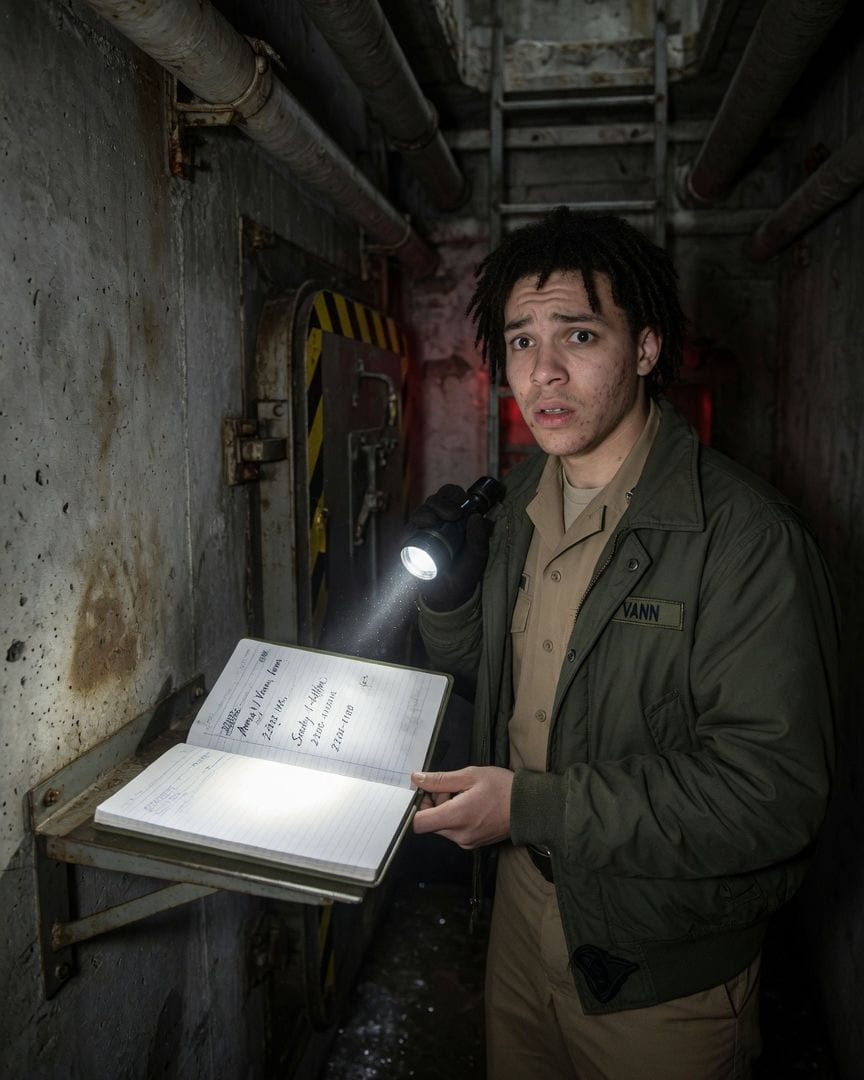
Airman Vincent Vann was on his last patrol across a vast, desolate Cold War missile field in the Dakotas, the cold, starless sky mirroring the emptiness of the landscape before his transfer. His routine check of eight hardened silo caps was shattered when a red fault light pulsed on Silo 4’s access panel, signaling an impossible breach from *inside* a hatch sealed for a decade. As more silos lit up, ignoring base orders, Vann found the hatch unlocked from within and descended into the dark shaft, where he discovered a pristine logbook bearing his own signature next to a chilling entry from a non-existent sentry, dated for *that very night*. Now, a steady *thump* echoed from deeper within the sealed concrete, leaving the Airman desperate for an explanation that simply wasn't there.
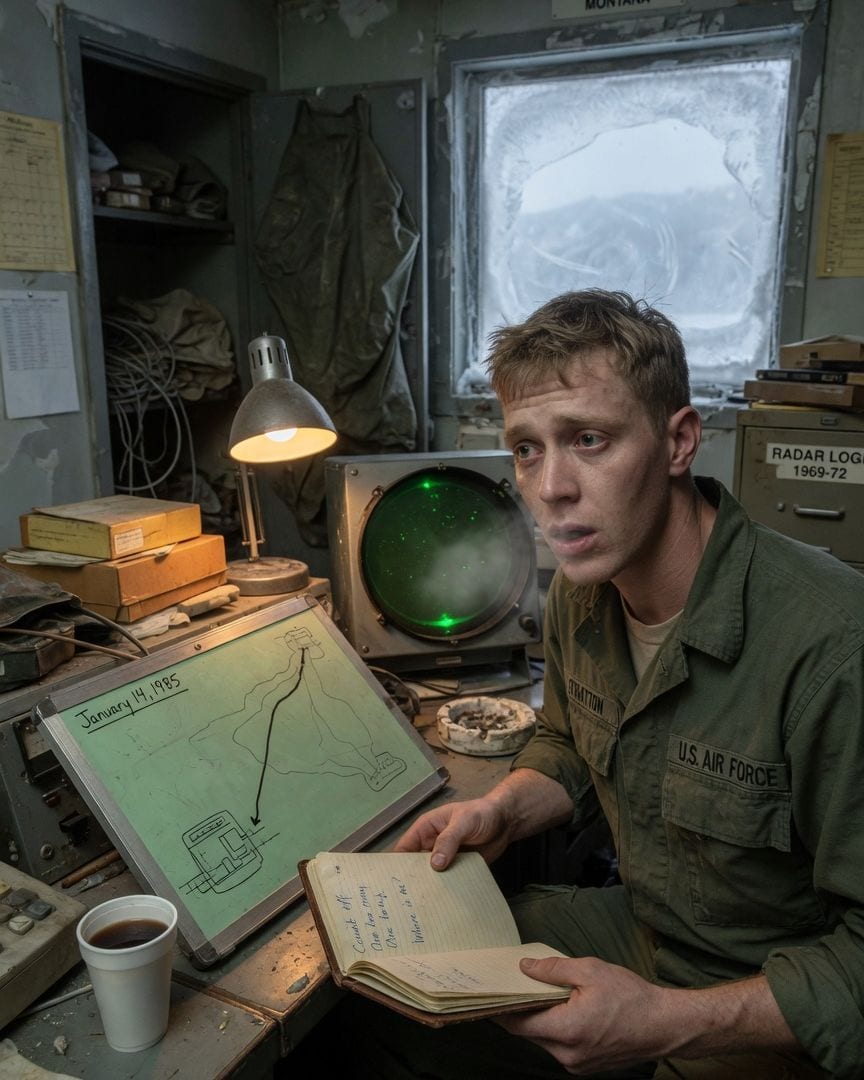
Airman Lars Stratton found an old Cold War manifest listing one name twice: 'Bernard Radcliffe' transferred and 'Bernard Radcliffe' still present.
Airman Second Class Lars Stratton was counting down his final weeks at Echo Station, a desolate Cold War outpost due for mothballing. He longed for home, far from the bitter Montana winds and the constant hum of static. Inside the dim radar shack, he logged the usual nightly ghost blip, a faint contact appearing at 2300, just as it had every winter since 1987. This night, a metallic tang like old blood lingered in the air, raising the hairs on his arms. Seeking distraction, Lars later discovered a leather-bound logbook from 1971, detailing the same 2300 contact, but with chilling notes and a manifest listing one airman's name, Bernard Radcliffe, twice—once transferred, once present. Was he truly alone in the silent, remote station?
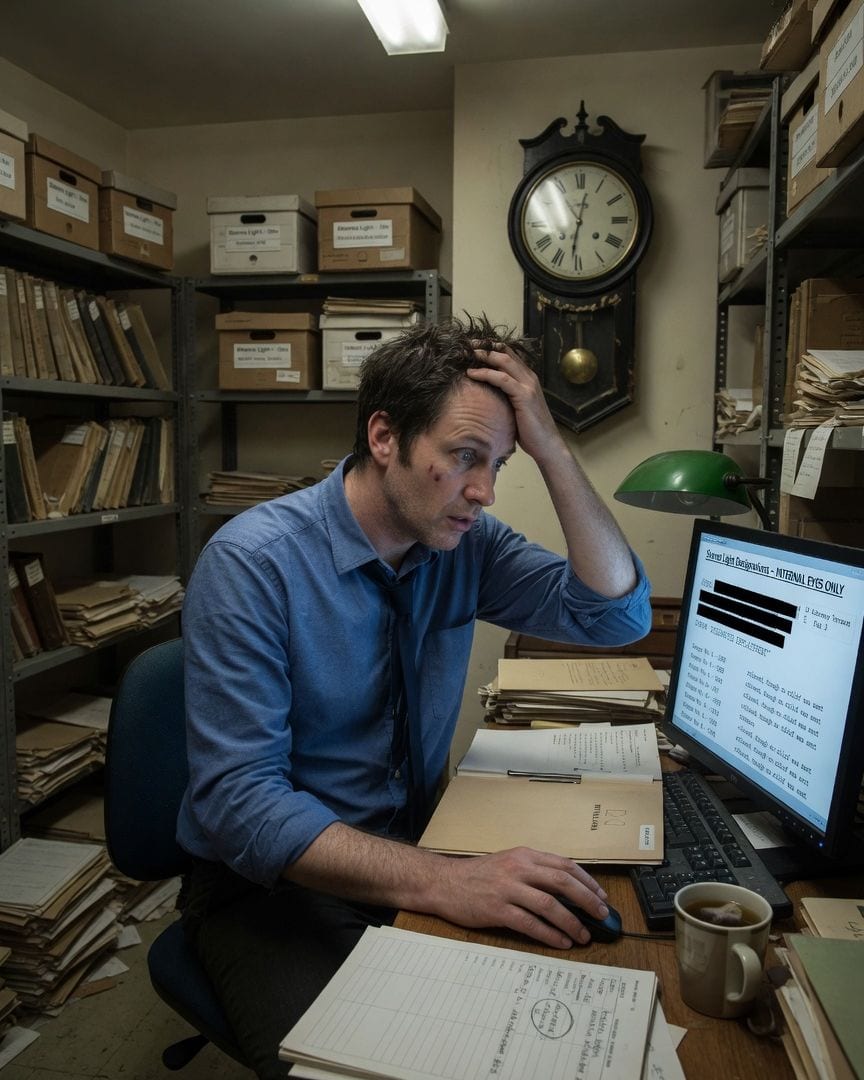
I found my street address in a century-old lighthouse file, printed decades before I lived there.
As a maritime archivist, my world revolves around forgotten lives and dusty ledgers. But the Skerne Light files broke that quiet rhythm, revealing a chilling pattern: 'Keeper number 6' relieved, though no relief was sent, repeating for decades. Now, an internal document with a strange code has led me to a redacted entry, revealing my own street address, decades before I ever lived there.
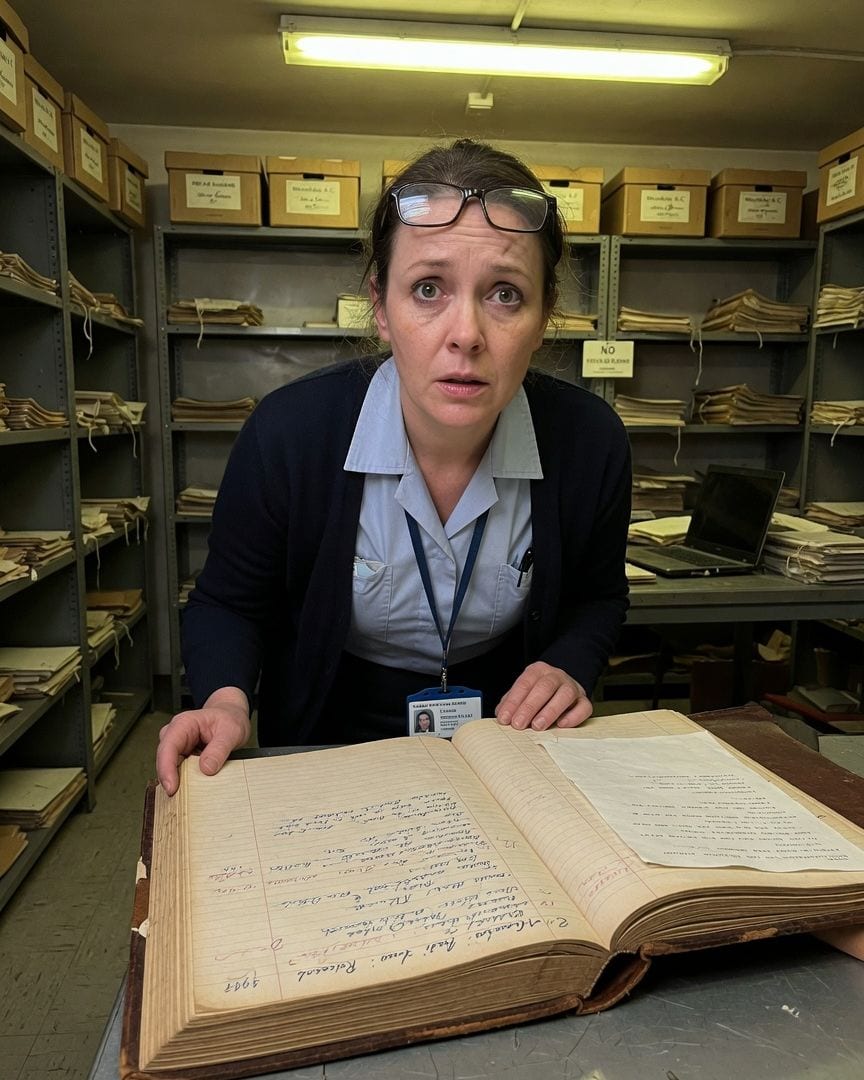
My ambulance trust's incident log shows callout 22-014 to 6 Cathcart Row at 2:40 AM. Every four years, the same call, same address. Always 'patient not found'.
My job involves tedious data entry for ambulance calls, but Incident 22-014 was different. It appeared every four years, always at 2:40 AM, always closed as 'patient not found.' Digging into the dusty physical archives, I found an entry from 1961 for the exact same incident, but its resolution read: 'Subject Secured. Relocated to "Holding".'