A Cold War archivist's last project reveals an ice cap airfield – the recon flight was lost the day before.
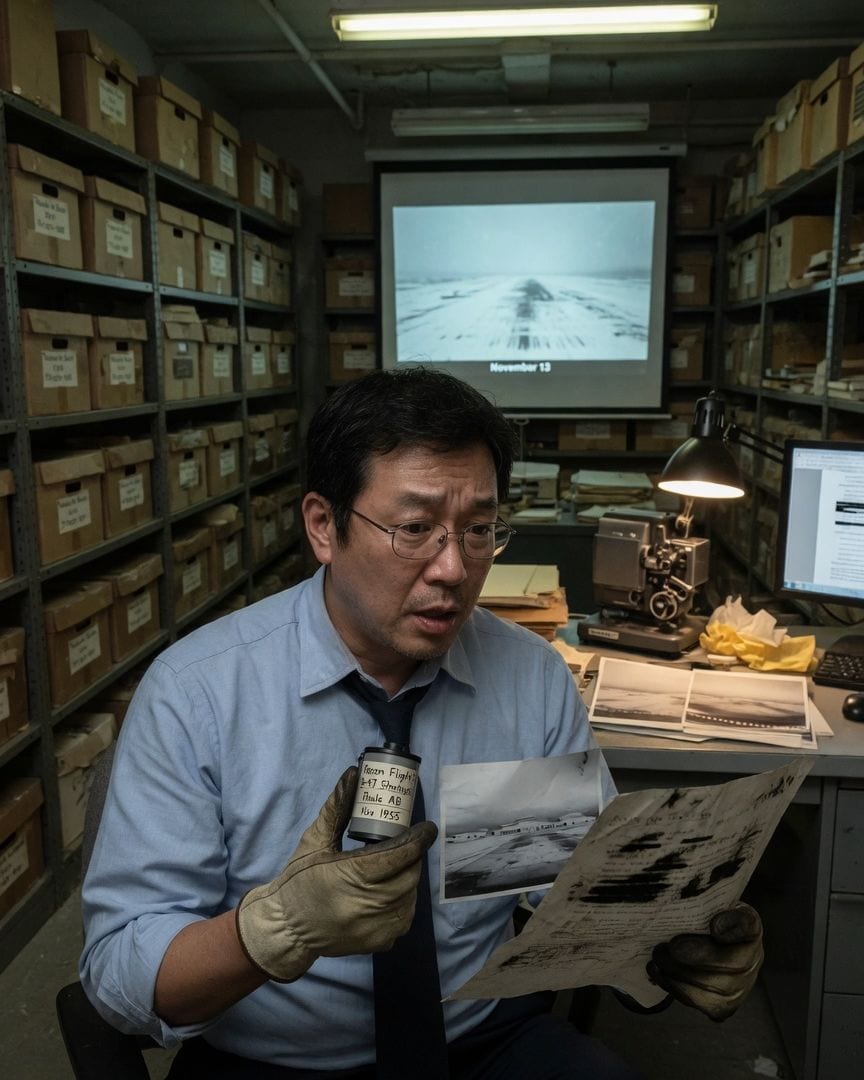
Ken Sudo, in his early forties, moved with a practiced, almost ritualistic slowness through the National Archives Annex basement. Dust motes danced in the sparse overhead lights, illuminating endless rows of forgotten history.
This Thule cleanup project, a final, exhaustive audit of Cold War-era documents, was his last major assignment before a long-awaited transfer to a quieter, less demanding department.
He navigated the labyrinthine stacks, his gloved hands meticulously sorting through the crumbling cardboard boxes, each one heavy with the weight of time.
He paused before a section marked 'Thule Air Base - 1950-1960,' a particularly dense cluster of files. There, nestled awkwardly between two properly labeled boxes, sat a smaller, unlabeled carton.
It felt out of place, a silent anomaly in the orderly chaos. He pulled it free, its plain gray exterior unmarked by even a date. Inside, cushioned by yellowed tissue paper, he found an old 16mm film canister.
Its label, handwritten in faded ink, read: 'Recon Flight 734, B-47 Stratojet, Thule AB, Nov 1955.'
A flicker of mild interest, nothing more, stirred in him. Ken carried the canister to the single, ancient film projector kept for legacy media, its metal frame cold beneath his touch.
He threaded the reel, the sprockets catching with a series of sharp, mechanical clicks that echoed in the cavernous, quiet space. The projector lamp hummed to life, casting a stark white rectangle onto the pull-down screen.
Frame after frame flickered past: a monotonous expanse of stark, featureless ice cap, an endless white desert. Ken watched, a dull ache starting in his neck. Then, abruptly, in the last forty frames, an impossible detail materialized.
A full-fledged airfield, undeniably there, carved into the ice. A long, dark runway, hangars squatting low against the horizon, a windsock standing stiffly in the unseen arctic gale.
It was stark, visible, and utterly out of place on an ice cap that, as far as any official record stated, had never held anything but snow.
The film’s own internal frame counter, momentarily captured and magnified by the lens, advanced: November 13, 1955.
A cold dread settled in Ken’s gut, solidifying into a terrible certainty. The aircraft on the canister label, Recon Flight 734, had been officially declared lost the day before.
Ken carefully removed the reel, his fingers tracing the faded stencil on the canister: Recon Flight 734. He carried it upstairs to his workstation, the hum of the modern servers a contrast to the basement’s mechanical ghosts.
He pulled up the official digital file for Flight 734. It was a standard 'lost at sea' report: no wreckage, no distress signal, no survivors. Declared lost on November 12, 1955. Just as he remembered.
He double-checked the film’s internal counter, projecting a single frame onto his office wall with a small digital viewer. November 13. The dates simply did not align. Not by a minute, but by a full, impossible day.
He downloaded the flight manifest, the names familiar from the canister’s supplementary notes: Captain Dean Hughes, Pilot Roland Holloway, Navigator Paul Holloway. All declared lost.
Ken searched for any mention of the date discrepancy. He found nothing in the official report. Delving deeper, he eventually located a heavily redacted internal memo, attached to Paul Holloway’s service record.
It was classified, but the unredacted portions mentioned 'reassignment for specialized duties' and 'continued service,' dated after November 12. His transfer.
The memo’s control number was a dead end, pointing to a defunct office that no longer appeared in any active directory.
But it was the blacked-out lines that were the most unnerving. They didn't obscure a small detail or a single word; they formed an almost perfect rectangle, as if censoring an entire, coherent paragraph, a complete thought.
What was so important, so specific, that it needed to be erased, yet left a perfect, telling shape where it had once been? The absence itself felt like a presence.
Ken cross-referenced Paul Holloway’s service record against other personnel files from the period. The heavily redacted memo was an anomaly, its language unusual, its dates contradictory.
He expanded his search, delving into the physical archives, bypassing the digital system for raw paper, hoping to find any duplicate copies, any overlooked versions.
In a forgotten 'misc' box, shoved deep in a corner of the Annex’s lesser-used storage, he found it: a second, carbon-copy of Holloway’s file, brittle with age, accidentally misfiled. The redactions were different here.
Where the first copy was a solid black rectangle, this one had gaps, imperfect smudges of ink, revealing glimpses of what lay beneath. It explicitly stated Holloway was 're-assigned, Project ICEWORM, effective 13 Nov 1955.'
Ken’s breath hitched, a cold knot tightening in his chest. Project ICEWORM. The name itself was like a whisper of frost in the quiet archives.
He looked from the chilling, impossible project name back to the printouts of the film frames on his desk, the grainy image of the stark airfield against the endless ice. The date on the film. The date of Holloway’s 'reassignment.'
The terrifyingly coherent logic of it all clicked into place, cold and sharp.
Ken immediately attempted to search for 'Project ICEWORM' in the digital archives. The system hummed, accessed its vast databases, and then returned the inevitable, sterile message: 'No results found.'
He tried variations, cross-referencing keywords from the Thule incident, the specific grid coordinates he’d managed to extrapolate from the film’s flight path, anything that might connect. Still nothing.
The official systems were a blank, unyielding wall, like staring at a freshly painted surface where a door used to be.
He switched tactics, returning to the physical archives, his hands now guided by a different, more desperate instinct.
He poured over old, uncatalogued ledgers, microfiche reels that hadn't seen light in decades, and forgotten card catalogs, the kind of deep-dive work few archivists bothered with anymore.
Hours blurred into days, the rhythmic rustle of paper and the faint click of ancient machinery becoming the soundtrack to his growing obsession.
Finally, in a dusty, leather-bound handwritten inventory from a long-defunct special projects office, he found it. A faint, almost erased pencil entry, visible only under the harsh beam of his penlight: 'ICEWORM: Classified Operational Site, Grid Ref. [redacted], Status: Active.'
The single word 'Active' sent a fresh shiver down his spine. It wasn’t a historical footnote; it was still a living thing.
He attempted to trace the control number for the misfiled Holloway record, following a labyrinthine path through obsolete departmental codes and unlisted offices.
Each step led to a dead end, a phantom office that had dissolved into bureaucratic ether, or a record that simply ceased to exist, replaced by a circular reference.
The official system wasn’t just withholding information; it felt actively designed to obscure it, to make it disappear as if it had never been.
Growing increasingly isolated in his pursuit, Ken remembered Rachel Fletcher, a retired declassification specialist known for her encyclopedic institutional memory and a whispered reputation for having 'seen things' during her tenure.
He found her contact information in an old personnel directory and called her, his voice tight with suppressed urgency. Rachel, in her late seventies, answered with a weary but sharp tone.
She initially dismissed his query, warning him about 'rabbit holes' and the futility of chasing ghosts. But when Ken mentioned 'ICEWORM,' her voice hardened, a noticeable shift in her demeanor. The line went silent for a beat too long.
'Some things,' she told him, her voice low, almost a hush against the static, 'are better left filed, Ken. For your own good.' The click of the receiver was abrupt, final.
After his tense call with Rachel, Ken noticed a subtle, insidious shift in his work environment. His access to specific, high-level archival databases, previously unrestricted, became sporadic.
Frequently, his queries would return 'permission denied' errors, or files he had viewed just days ago were now flagged 'under review' or 'temporarily unavailable.' It wasn't a complete shutdown, but a deliberate, almost surgical, restriction, a tightening net.
It felt less like a glitch and more like a warning.
One morning, he found a small, generic-looking USB drive plugged into the back of his workstation. It wasn't his. It was a standard government-issue device, devoid of any identifying marks, just like hundreds of others.
He quickly ran a forensic scan; it was clean, but its internal logs revealed it had been active during the precise hours he was researching ICEWORM, its memory filled with temporary files from his search queries.
It wasn't just observing; it had rooted itself in his machine. It was monitoring him.
A new security guard, Brandon Holloway—a man in his early thirties with an unnervingly calm demeanor and a name that prickled Ken’s skin—started doing his rounds specifically in Ken’s basement section.
Brandon was polite, almost solicitous, but his questions about Ken’s current project – the 'Thule cleanup,' the 'historical significance' – were too pointed, his gaze too lingering, often falling on the pile of printouts Ken now instinctively covered with an old newspaper.
A prickle of unease grew into genuine paranoia. The Annex, once his refuge, now felt like a cage.
The following day, an anonymous email landed in his inbox. The sender was '[email protected],' untraceable, a ghost in the machine. The subject line was blank. The body contained only five words: 'The file is still being written.
Don’t become an entry.' The message was chillingly clear, a direct threat that confirmed his suspicions: someone knew, and they were watching him very closely.
The server room, usually a comforting hum, now seemed to thrum with a silent, watchful presence.
Unable to shake the feeling of being watched, Ken drove directly to Rachel Fletcher's modest suburban home after work.
He found her in her living room, a space filled with the scent of aged paper and regret, surrounded by precarious stacks of old papers and books.
He laid out his evidence on her coffee table: printouts of the impossible airfield, the conflicting Holloway service records, the 'ICEWORM' entry from the old ledger, the anonymous email now open on his tablet.
Rachel studied each piece, her face etched with a mix of fear and resignation. 'They’re still at it,' she whispered, her voice barely audible, frayed like the edges of an old photograph.
Ken pressed her. 'What is ICEWORM, Rachel? What happened to Flight 734? And to Paul Holloway?'
She hesitated, her gaze distant, fixed on a faded photograph on her mantelpiece, a picture of a younger woman with an unreadable expression. 'ICEWORM wasn't a project on the ice, Ken. It was a facility for things that vanished.
A 'holding pattern,' they called it. For classified assets. Planes, ships, personnel.' She explained that in her early days, whispers circulated among the most senior archivists, stories of 'black files' and 'ghost units' that never appeared in official logs.
'They weren't lost, Ken. They were filed.'
She spoke of hushed rumors: some who went to ICEWORM were never seen again, others returned subtly changed, quiet, distant, like hollowed-out versions of themselves, their eyes holding a particular, unsettling blankness.
'The records were designed to make it look like they were lost, or reassigned to phantom projects. It was an institution that knew, recorded, and sealed. The airfield… that was real. A collection point. A waypoint to somewhere else.'
She confirmed that Paul Holloway wasn't a clerical error; he was one of the first 'recruits,' his plane redirected, not crashed. The 'reassignment for specialized duties' was their euphemism, a polite bureaucratic lie to cover a chilling truth.
Ken looked at the airfield photo, then at Holloway's name on the manifest, his young, confident face staring back from the grainy black and white. It all snapped into horrifying focus: the plane wasn't lost, it was taken.
The film wasn't a mistake; it was a silent, accidental record of the delivery. The air in the room seemed to grow cold, heavy with unspoken histories.
Rachel rose with a sigh, the sound weary, as if carrying decades of secrets. She moved to an antique wooden chest in the corner of her living room, its dark wood gleaming faintly in the dim light.
She pulled out an old, heavy binder, its cover a faded, generic blue. 'My own little ICEWORM file,' she said, her voice heavy, her eyes sad and knowing.
It was thick with photocopies, cryptic notes, and handwritten entries, a testament to decades of quiet defiance, a history compiled in the shadows.
'I kept track,' she explained, her trembling fingers tracing the worn edges of the binder. 'The ones who vanished. The ones who returned… different. And the ones who asked too many questions.'
She opened the binder, its pages brittle with age, and pointed to a list titled 'Personnel of Interest – Unofficial Monitoring.'
It was a chronological compilation of individuals who had either gotten too close to the truth or were considered 'candidates' for 'reassignment' into the system.
Ken leaned closer, his heart pounding a frantic rhythm against his ribs. He saw names and dates, some from decades ago, some more recent, stretching across the faded pages.
He read through them, looking for familiar patterns, for any clue to the institution’s current methods, a way to predict its next move.
Then, midway down the list, his eyes fixed on a name, stark and undeniable, written in the same neat hand as the others.
His own.
'SUDO, KENNETH. Archivist. Opened Thule Box 734. Status: Pending Reassignment.'
Beneath it, a date: 'Effective: [next week’s date].' The blood drained from Ken’s face, leaving him cold, a sudden, profound chill spreading through his limbs. His 'transfer' wasn't a promotion, or even a lateral move. It was a designation.
His own name now an entry in the very file he was trying to expose. The file wasn't just about the past. It was still being written. And he was the next entry.
Ken and Rachel stared at his name on the list, the implication chilling them to the bone. His 'transfer' wasn't to a new department, or even a quieter one; it was to ICEWORM itself.
Rachel’s voice was grim, a low murmur of warning. 'They don't just file events, Ken. They file people. Especially people who uncover too much. It's how they keep the story straight.'
She explained that the institution behind ICEWORM wasn't a single agency or a rogue unit. It was a deep-state mechanism, a 'secrecy machine' embedded across various government branches, operating beyond oversight, its tendrils reaching into every corner of officialdom.
Its purpose was to maintain a carefully curated reality, where certain disappearances were explained away, and inconvenient truths were buried under layers of bureaucracy and redaction, a constant, ongoing act of historical revision.
The airfield on the film wasn't just a collection point; it was a processing center, a liminal space where lives were erased and rewritten.
Paul Holloway, the navigator, wasn't merely 'filed.' Rachel pointed to an additional, deeply disturbing note in her binder, cross-referenced with Holloway’s entry: 'Subject Holloway, Paul. Re-education protocol initiated. Deployment as internal asset, Project WATCHER, effective 1956.'
He wasn't just taken; he was broken down and rebuilt, repurposed to serve the very system that erased his original life. The inconsistencies in his files, the conflicting dates, the shifting redactions – they weren't errors.
They were deliberate manipulations, designed to make him disappear and then reappear as a ghost in the machine, a silent guardian of its secrets.
Ken remembered Brandon Holloway, the new security guard, and his unsettlingly calm demeanor, the polite but pointed questions, the lingering gaze. A cold, hard certainty settled over him. Brandon, perhaps, was not just a guard.
He was a product of the machine, a modern-day 'Holloway,' a silent, perfectly adapted sentinel.
The horror was not just that it had happened decades ago, but that it continued, evolving its methods, always filing, always repurposing, an endless, quiet consumption of inconvenient truths and people. The Annex itself felt like a vast, silent maw.
Ken refused to become another entry. He and Rachel devised a desperate, whispered plan over strong coffee. He would return to the Annex, feigning calm, pretending to accept his 'reassignment' for the following week with professional grace.
He told Rachel to wait for a signal, a specific notification that would trigger her part of the plan.
Inside the Annex, Ken moved with a practiced slowness, packing a few personal items from his desk, his heart hammering against his ribs, a drumbeat of panic held in check.
Then, with an outward show of routine, he accessed the main server room, using his administrator credentials. Instead of packing, he worked quickly, his fingers flying across the keyboard.
He uploaded Rachel’s entire unofficial ICEWORM binder – decades of meticulous, dangerous work – along with his digital copies of the film, the contradictory Holloway records, and the internal memos, to a secure, public-facing dead-drop site, designed for whistleblowers, a tiny beacon in the darkness.
The progress bar on his screen crawled agonizingly slowly, each percentage point a torment. The hum of the servers seemed to intensify, to take on an accusatory tone. He heard footsteps approaching, too measured, too deliberate for a casual stroll.
The door to the server room slid open with a soft, ominous hiss. Brandon Holloway stood there, flanked by another security agent, their faces devoid of expression, like statues carved from granite.
'Time for your transfer, Mr. Sudo,' Brandon said, his voice flat, emotionless, his hand already reaching for Ken’s arm, a pre-programmed movement. The progress bar for the upload was at 98%.
Ken slammed the 'Enter' key, confirming the final transfer, just as Brandon's fingers closed around his bicep, a grip of surprising strength. The screen flashed 'UPLOAD COMPLETE' in stark green text, a single, defiant victory.
Ken looked up at Brandon, a flicker of grim satisfaction in his eyes, even as he felt the cold, unyielding grip. He had exposed it. He had gotten the truth out, even if it cost him everything.
Ken Sudo vanished. Official records stated he completed his transfer to a 'highly classified internal oversight department,' with no forwarding contact.
His workstation was cleared, his office reassigned to a new junior archivist within a week, the faint scent of disinfectant erasing any trace of his presence.
A few days later, a small, independent online news outlet, specializing in investigative journalism, published a cryptic story about a 'deep-state archiving facility' and 'discrepant military records,' linking to a trove of declassified documents.
The story gained a brief, intense burst of attention before being quickly dismissed as a conspiracy theory by mainstream media, effectively buried under a wave of counter-narratives and official denials.
Rachel Fletcher, from her quiet suburban home, watched the news reports with a grim, knowing nod. She knew the truth, and now, for a brief window, others did too.
The dead-drop site was eventually taken down, its contents scrubbed from the internet, but not before a few hundred people had downloaded the files.
The digital dead-drop was eventually taken down, its contents scrubbed from the internet with chilling efficiency. But not before a few hundred people had downloaded the files, a tiny crack, a fleeting fracture in the vast secrecy machine.
Weeks later, Brandon Holloway, now promoted to Senior Security Liaison for 'Special Projects,' reviewed a newly generated 'personnel of interest' list on his secure terminal.
He scrolled through the names, his expression neutral, his posture perfectly still, a man unburdened by conscience. He paused at a new entry, dated for next month. It read: 'FLETCHER, RACHEL. Retired Archivist. Contacted Sudo, K. Status: Pending Reassignment.'
He closed the file, the screen going dark, reflecting his own unreadable face.
The file is still being signed.
If this one got to you
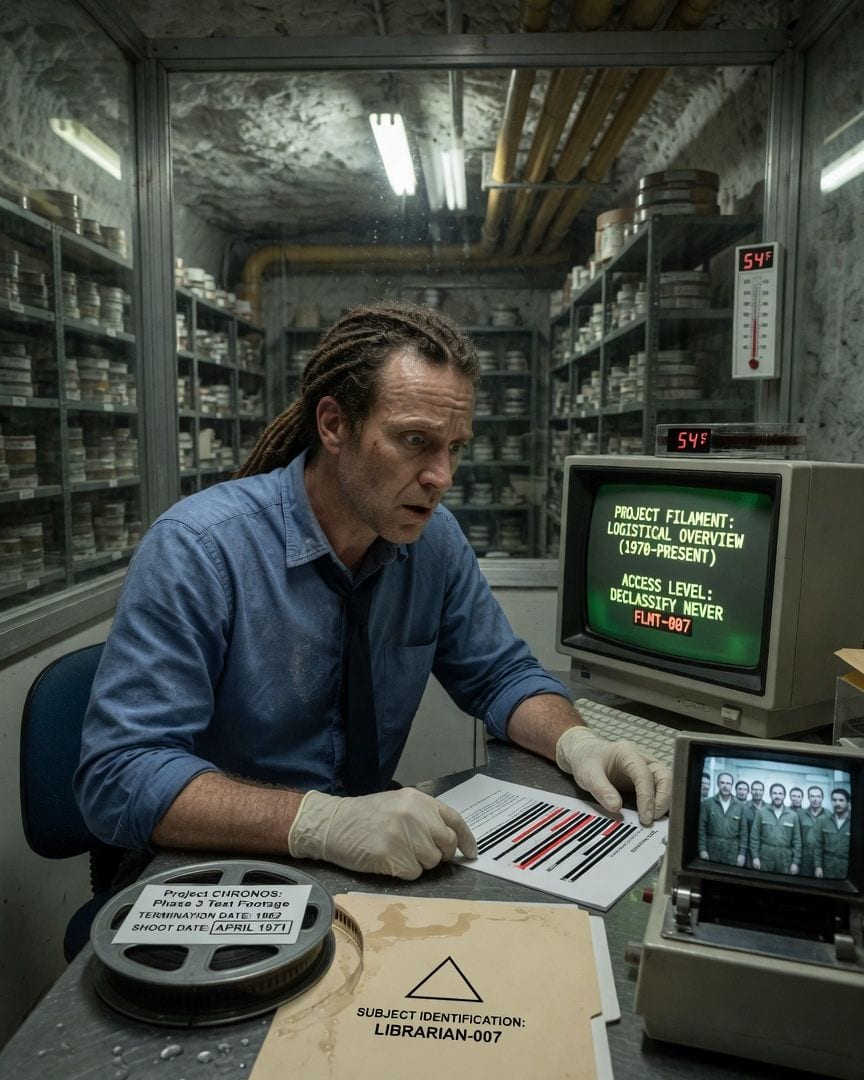
A records archivist found a Cold War film reel weeping cold condensation, shot nine years after its project officially terminated.
Hosea Pike, an archivist in a vast Kansas salt mine vault, meticulously maintained records in a perfectly dry, controlled environment. His brow furrowed when his gloved hand closed around a film reel weeping cold condensation, its metal chilled like well water. The label stated 'Project CHRONOS: Phase 3 Test Footage,' terminated in 1962, yet stamped beneath was an impossible shoot date: April 1971. What could explain a film shot nine years after its project's official end?
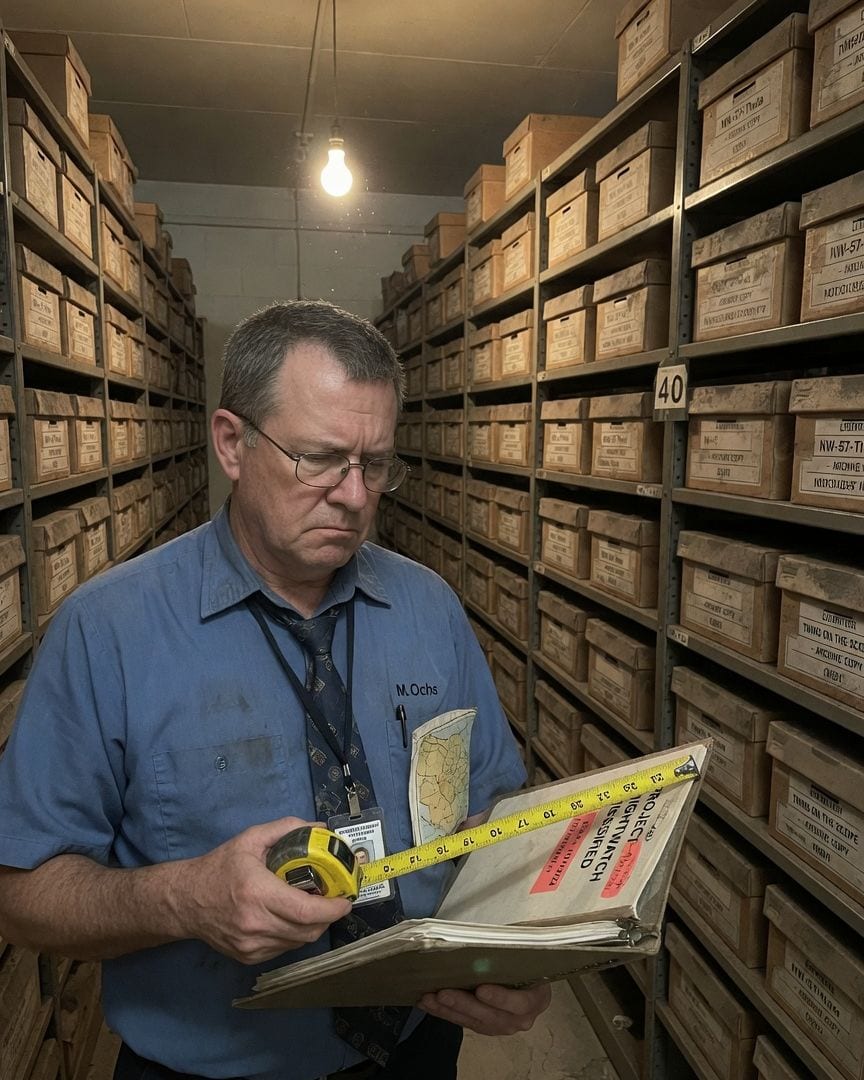
A Cold War records clerk on his final patrol found Aisle 40 stretched 61 feet longer, lined with unknown boxes. Inside one: 'PROJECT NIGHTWATCH - CLASSIFIED' with a fresh timestamp.
Marlin Ochs, a creature of habit after nineteen years at the St. Louis federal records depot, faced his final patrol through Aisle 40 before its scheduled pulping. His routine walk, usually 92 precise strides, suddenly stretched to an impossible 119, making the aisle 61 feet longer than its blueprint. The extra section felt colder, lined with dust-laden boxes bearing alien classification codes and no manifest. Inside one, he found a metal-bound file: 'PROJECT NIGHTWATCH - CLASSIFIED,' dated 1957, but with a timestamp just hours old.
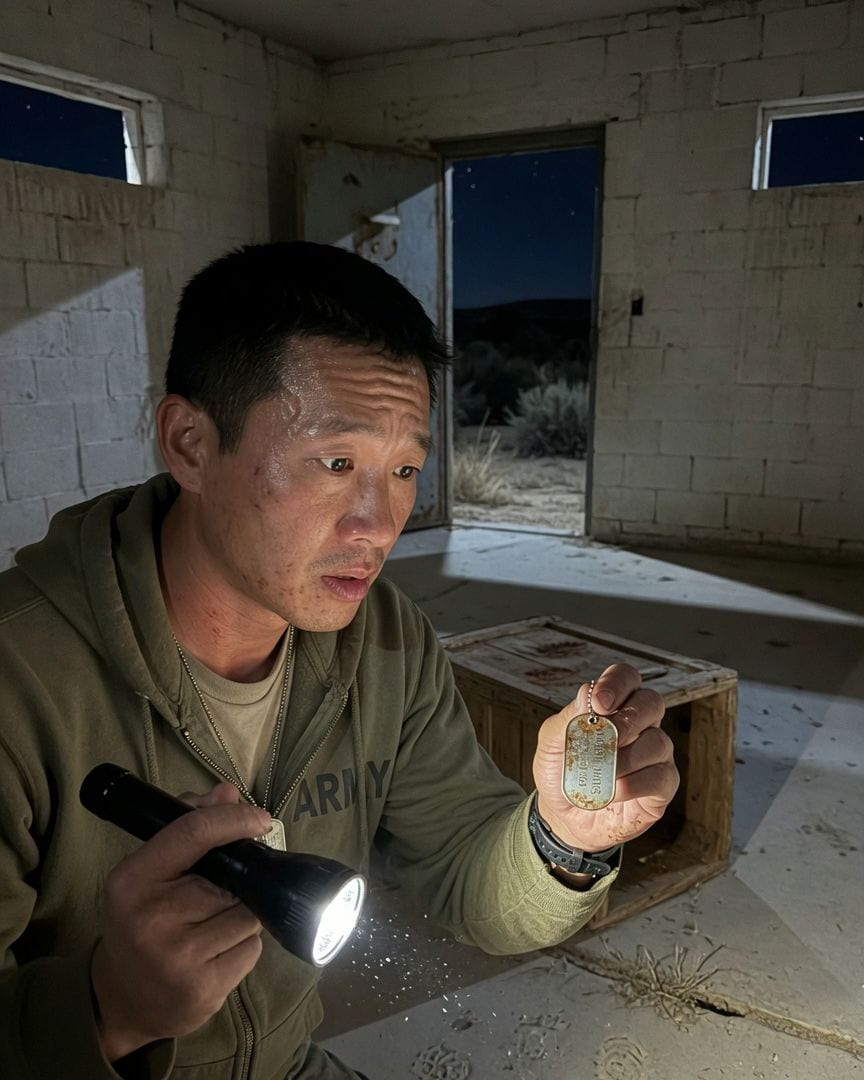
Staff Sergeant Rhee’s squad found a Cold War building not on their map. Range Control confirmed no structure. Minutes later, it vanished, leaving a foundation decades old.
Staff Sergeant Adam Rhee halted his squad at the Yakima Training Center, staring at a cinderblock building that simply wasn't on his map. Range Control confirmed there was no structure at his coordinates, leaving him to wonder what impossible thing stood before them. Moments later, after the range-safety truck arrived, the building vanished, leaving only a rectangular patch of earth with a foundation of decades-old weeds. That night, driven by an unsettling certainty, Rhee returned to find the building reappeared, its door ajar, holding a single, rusted dog tag from 1983. How could a place appear and disappear, leaving behind evidence from forty years ago?
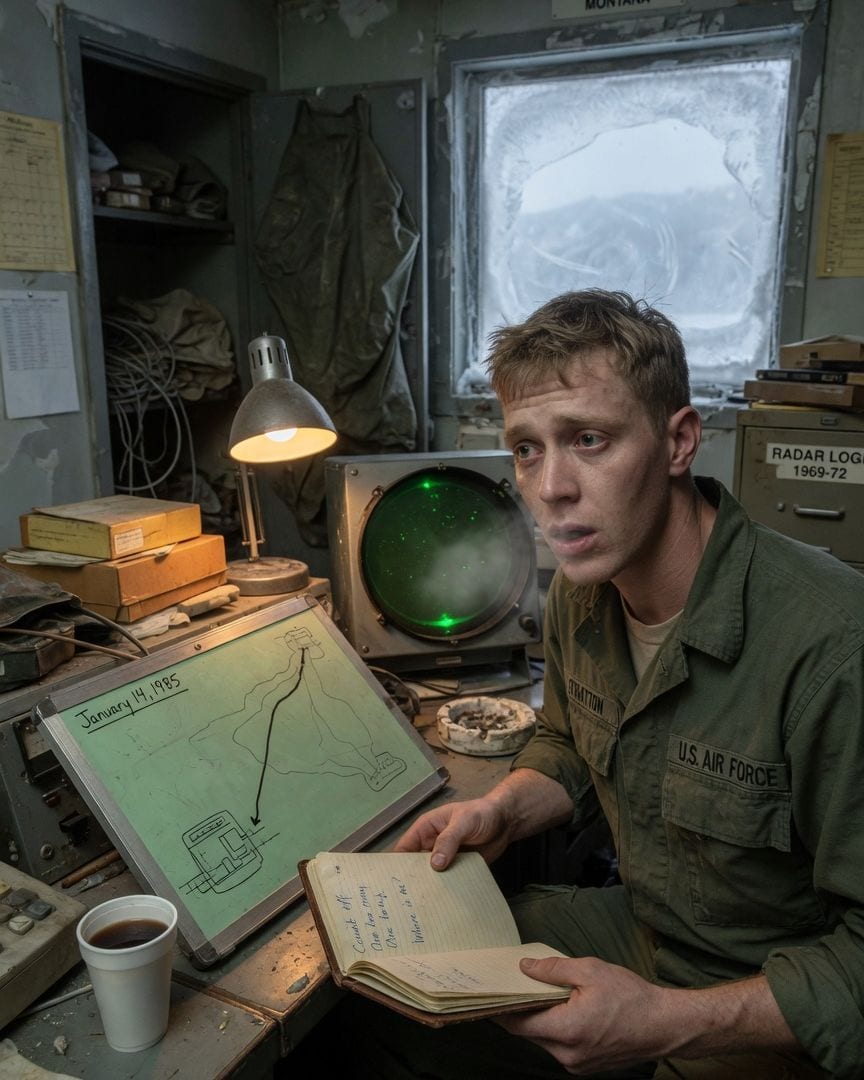
Airman Lars Stratton found an old Cold War manifest listing one name twice: 'Bernard Radcliffe' transferred and 'Bernard Radcliffe' still present.
Airman Second Class Lars Stratton was counting down his final weeks at Echo Station, a desolate Cold War outpost due for mothballing. He longed for home, far from the bitter Montana winds and the constant hum of static. Inside the dim radar shack, he logged the usual nightly ghost blip, a faint contact appearing at 2300, just as it had every winter since 1987. This night, a metallic tang like old blood lingered in the air, raising the hairs on his arms. Seeking distraction, Lars later discovered a leather-bound logbook from 1971, detailing the same 2300 contact, but with chilling notes and a manifest listing one airman's name, Bernard Radcliffe, twice—once transferred, once present. Was he truly alone in the silent, remote station?
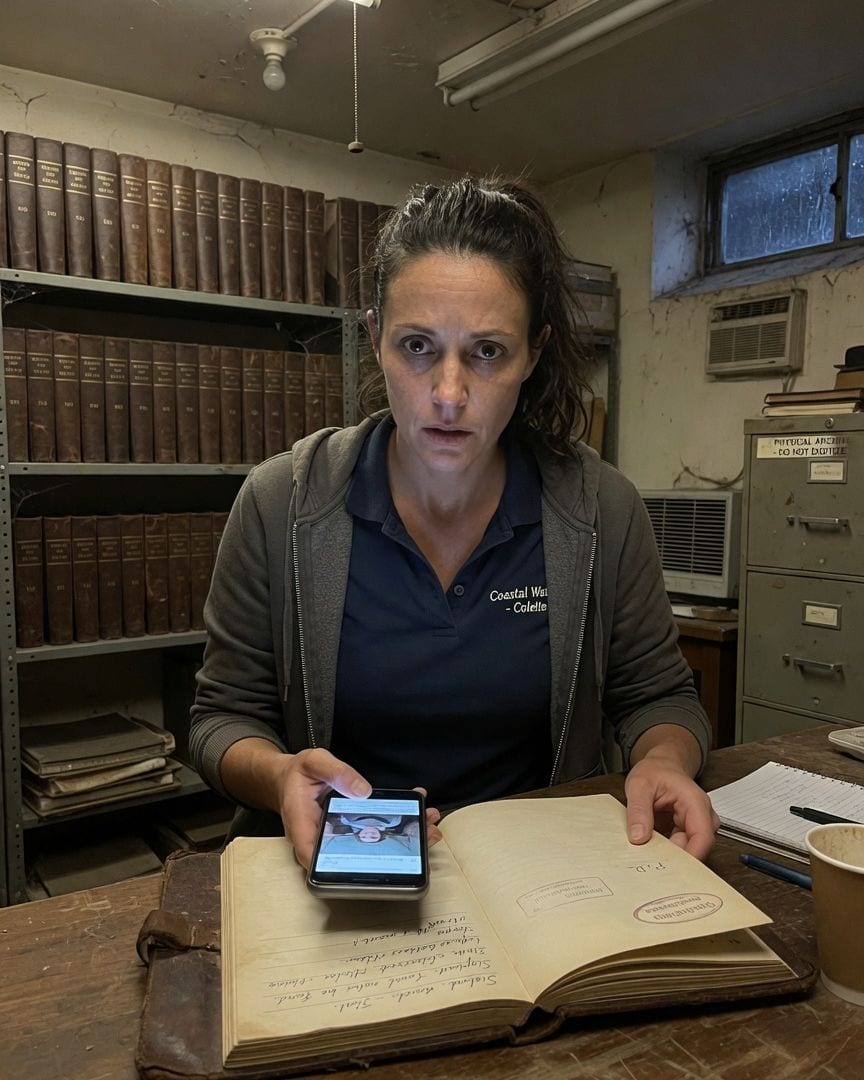
My coastguard log noted Sighting 9 again tonight, a light where no vessel showed. The old logs carry Sighting 9 off Skerry Point at 3:14am every tenth year since 1954, always 'nothing found,' always 'send no boat.'
On my watchtower night shift, the radar screen glowed green and the ocean was quiet. Then, a familiar light appeared off Skerry Point, exactly on cue, just as it had every tenth year for decades. But digging deeper, I found a hidden stamp in an old logbook: 'Operation Skerry. Status: Complete.' It left me with a chilling sense of finality.
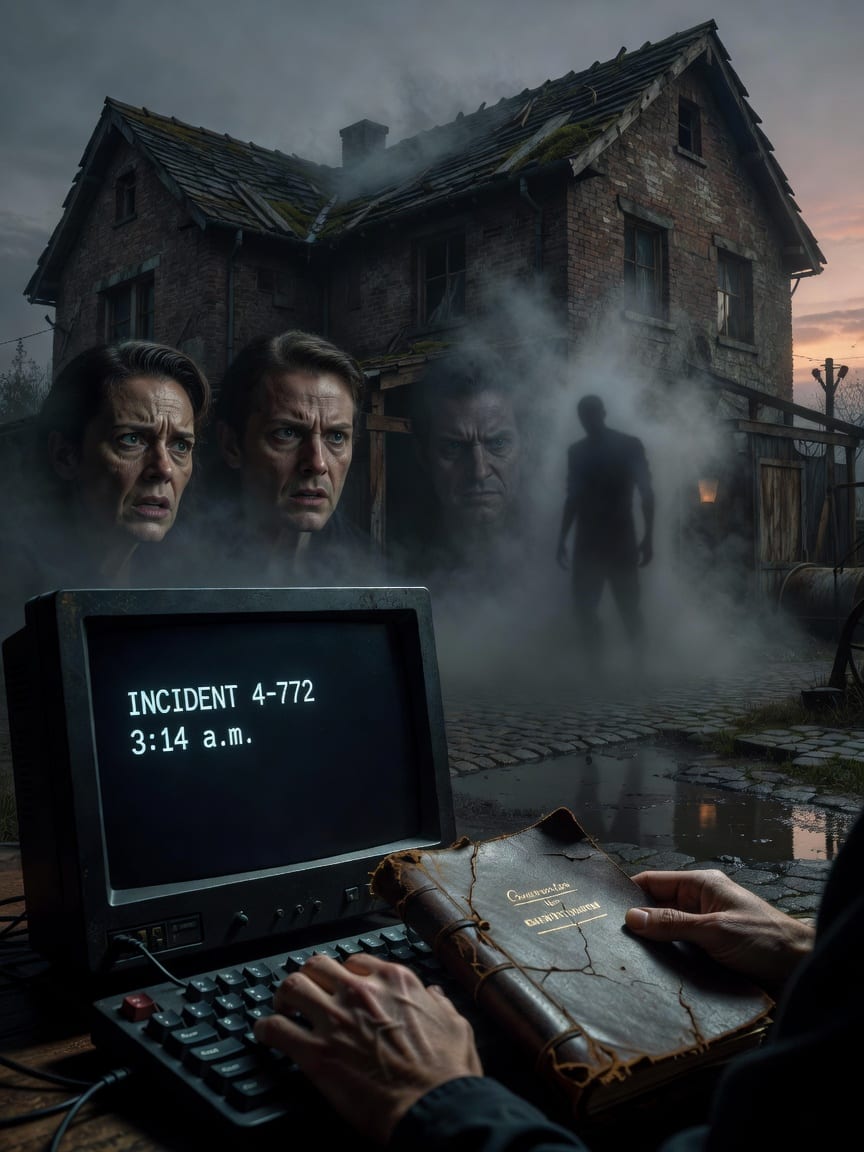
My screen showed Incident 4-772: a fire at the old rope works, 3:14 a.m. It was logged again for 1980. Then 1967. And 1993. Same incident, same time, same building. Each report ended with the same three words: 'expect recurrence.'
As a new archivist, I usually found my work digitizing old fire service records monotonous, until I found a heavily redacted line in a 1961 site assessment. Faint letters beneath the black bar slowly revealed my own family name, DRUMMOND, dated years before I was even born.