Corporal Aldous Sutton found his own name, rank, and call sign in a 1987 logbook from his exact outpost, decades before he was born.
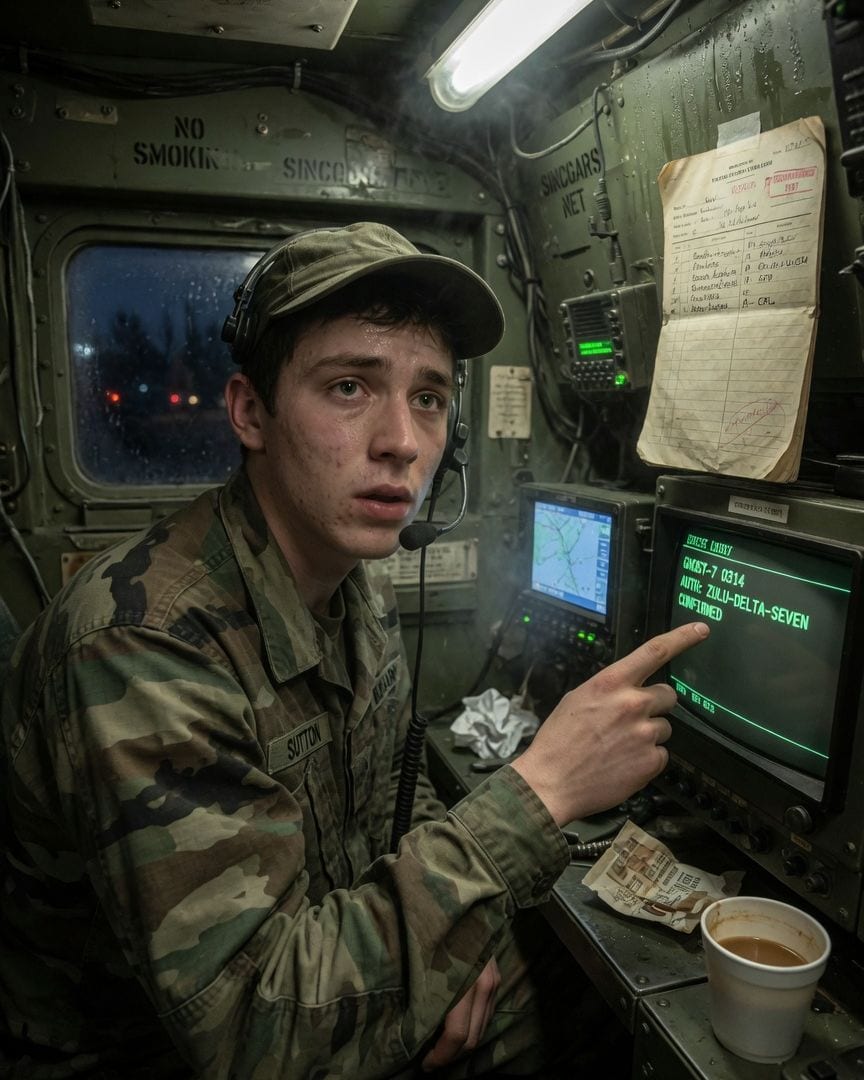
Corporal Aldous Sutton, 22, hunched in the cramped comms track, the air thick with the smell of damp earth and stale coffee.
Outside, the cold German night pressed against the thin metal walls, muffling the distant sounds of a division exercise. His SINCGARS net was quiet, the green glow of the display reflecting in his tired eyes.
Every friendly unit was accounted for, their squelch codes confirmed, their positions plotted on the digital map. The night was cold, clear, and uneventful, exactly as it should have been.
Then, a call sign crackled through his headset. 'Ghost-7,' it announced, its voice calm and clear, utterly alien to his roster. Aldous blinked, checking his screen. Nothing. No 'Ghost-7.'
The voice requested authentication, citing a protocol Aldous had never heard of, one retired before he was even born, a series of codes like 'Zulu-Delta-Seven.' He fumbled, his training momentarily failing him, a knot tightening in his stomach.
He keyed his mic. "Ghost-7, please confirm call sign and repeat authentication protocol. My tables do not include Zulu-Delta-Seven." The voice, patient and unhurried, supplied the correct response itself, as if offering a tutorial for a green private.
"Authentication confirmed, Corporal. Zulu-Delta-Seven. When will the rest of your element be joining us, Corporal?"
The air in the track felt suddenly heavy, and the cold metal of his headset vibrated with an unnatural chill, a low hum that seemed to emanate not from the equipment, but from the very space around him.
Aldous tried to dismiss the incident as a prank or a misdial. He ran diagnostics, checked the system logs again, but the results were undeniable. 'Ghost-7' was there, timestamped 3:14 AM, logging his own hesitant responses.
It was a formal entry, crisp and official, as if the entire exchange had been utterly routine. He reported it to Staff Sergeant Constance Granger, 38, his immediate superior, who listened with a dismissive wave of her hand. "Fatigue, Sutton.
Or a system glitch. Get some rest. We've all heard ghost signals out here." She spoke with a practiced ease, but the faint tremor in her voice suggested a deeper, unacknowledged truth.
But the eerie calm of the voice, the impossible authentication code, gnawed at Aldous. He knew what he had heard, and he knew it wasn't a glitch.
Driven by an unsettling certainty, he used his clearance to cross-reference the phantom call sign and the ancient authentication table. He delved into the digital archives, pulling up dusty, scanned manuals and old field guides.
He found the table quickly, buried deep within a communications protocol manual from 1980, marked with a stark red stamp on its digital cover: 'DECOMMISSIONED, 1987.' That date, 1987, resonated with a cold alarm.
More disturbingly, his search yielded a single, brief entry in a historical unit logbook from that same year. It documented 'Ghost-7' as a temporary attachment to a long-disbanded reconnaissance element, operating from this very location in Germany, during a large-scale division exercise.
The entry was signed, illegibly, but the date and outpost coordinates were unmistakable. A record that swore otherwise, a solid, official truth contradicting everything he knew.
The room seemed to contract around him, the hum of the server racks suddenly louder, more insistent.
Aldous pulled up the scanned image of the faded 1987 logbook entry onto his display. His finger, trembling slightly, traced the faded ink of the temporary attachment roster for 'Ghost-7.'
His breath caught in his throat, a sudden, sharp intake of cold air. Listed under 'Attached Personnel' for that phantom unit, for that 1987 rotation, was a name he knew intimately. It read: 'Sutton, A. – CPL.'
The blood drained from his face, leaving him cold and lightheaded. His own name, his rank, in a military logbook from before he was born, attached to a call sign that didn't exist, at an outpost he now occupied.
Shaken to his core, Aldous tried to rationalize the impossible entry. A common surname? A bizarre coincidence?
He used his extensive access, pushing the boundaries of what was strictly allowed, to search for other 'Sutton, A.' entries in historical German deployment logs, hoping to find a relative, a mundane explanation that would unravel this growing dread.
Instead, he uncovered more anomalies, each one a tightening knot of dread in his stomach.
It wasn't just 'Sutton, A.,' but similar 'Ghost' call signs appearing in archived records from other remote comms outposts across Germany, and occasionally Poland, always during similar large-scale field exercises.
These phantom units consistently listed brief, inexplicable attachments of personnel whose names were generic ('Smith, J.', 'Jones, M.'), yet consistently reappeared in these same phantom unit logs across different decades.
The dates spanned decades, recurring every 5-7 years, always coinciding with major division exercises. The pattern was chillingly precise.
He noticed another, darker thread: the phantom units were always comms-related, and the incident reports from the real units operating at those times often mentioned 'unexplained radio interference' or 'ghost signals' that were routinely dismissed as equipment failure, blamed on old equipment or operator fatigue.
He printed out a stack of these records, the crisp paper a contrast to the faded digital images he’d viewed. Each page was an unimpeachable military document swearing to events that never happened, a physical manifestation of the wrongness.
The hum of the server racks in the small track seemed to intensify, a low, pulsing thrum that vibrated through the floorboards.
Aldous's frantic, unauthorized record searches did not go unnoticed. Renee Hayes, 29, a quiet records clerk, approached him in the mess hall a few days later. Her demeanor was polite, almost solicitous, but her eyes were sharp, seeing too much.
"You're pulling a lot of old comms records, Corporal Sutton," she said, her voice a little too steady as she picked at a dry piece of toast. "Anything I can help you find?"
He deflected, claiming research for a historical project on communications evolution, a flimsy excuse he knew she saw through. She just nodded slowly, a knowing, almost sympathetic look on her face that sent a fresh chill down his spine.
Later that day, he returned to his bunk after his shift. On his pillow, neatly folded, was a printout of his recent search queries, not his own. Someone had accessed his terminal history.
A single, ominous word was circled in stark red pen: 'Ghost-7.' The next morning, as he reviewed his official duty log, a document he always signed and filed himself, he found a new entry, dated yesterday.
It stated, in crisp, official language, that he was 'conducting unauthorized archival searches related to decommissioned protocols.' The entry was signed with his own signature, perfectly replicated, indistinguishable from his actual hand, down to the slight curl of the 'S'.
The system was watching, and it could write its own truth. The stale air in his bunk felt suddenly charged, as if listening.
Aldous, seething with a cold dread that pushed past anger, confronted Renee Hayes in the records office later that afternoon. He held up the forged duty log, the paper shaking slightly in his hand.
"My signature," he said, his voice low. "How did this happen?" Her usual composure cracked, revealing genuine terror in her eyes.
Her gaze darted nervously around the room, as if expecting someone to walk in, or worse, materialize from the air itself.
She admitted, in hushed tones, that she'd seen similar things before: records that seemed to alter themselves, phantom entries appearing and disappearing, names surfacing where they shouldn't. The fluorescent lights in the office buzzed, casting long, wavering shadows.
She explained that for decades, certain remote comms outposts, particularly those used during major exercises, had had 'incidents.'
The official explanation was always 'system errors' or 'fatigue-induced hallucinations,' but among the records clerks, the informal, unspoken word was that 'the net takes what it wants.'
With a furtive glance over her shoulder, her hand trembling slightly, she pulled out a slim, spiral-bound notebook from a hidden compartment beneath her desk. It was her unofficial 'problem log,' filled with neat, precise handwriting, detailing these occurrences.
It listed dates, phantom call signs, and, most chillingly, the names of the operators who reported the initial anomalies.
She ran her finger down a page, stopping at an entry from 1987, the same year the authentication table had been decommissioned. It listed the operator who reported 'Ghost-7' during a German field exercise.
His name was Edward Abbott, then a young Private. The name clicked into place.
Edward Abbott, 55, the grizzled veteran who ran the motor pool, who always seemed to know more than he let on, and who pointedly avoided any conversation about his early career.
Renee's small, personal log was the first concrete proof that Aldous was not alone, and that the wrongness was not new.
The stale office air, usually dry and still, suddenly felt heavy and cold, as if the room itself held its breath.
Aldous found Edward Abbott in the noisy motor pool, his hands greasy as he worked on a sputtering Humvee, the metallic clang of a wrench echoing in the cavernous space.
He showed Abbott the printout of the 1987 log entry with his own name, and then Renee’s unofficial problem log. Abbott’s face, usually an impassive mask of grease and fatigue, hardened.
A flicker of old fear, deep-seated and weary, showed in his eyes. He sighed, a sound heavy with resignation, and wiped his hands on a rag that was more grime than cloth.
He took Renee’s log and ran a calloused finger down its pages, past his own name as the reporting operator from 1987.
His finger stopped at a much older entry, from 1968, meticulously noting an incident at this very German location, at this same type of comms outpost. He pointed to the name of the operator who reported that initial anomaly.
Then, with a slow, deliberate movement, he turned to the 'Attached Personnel' list for the phantom unit in that 1968 log.
Aldous saw his own name again, 'Sutton, A. – PFC,' listed as a phantom attachment, alongside another, older name: 'Abbott, E. – PVT.'
The meaning of the phantom voice’s question, 'When will the rest of your element be joining us, Corporal?' slammed into him with sickening clarity. It was not a question, but a statement of ongoing fact.
The pattern wasn't just about others. It was about him, and Abbott, and everyone who reported it, being destined to be part of it, across rotations and dates, their names cycling through its records long before their own lives began.
Abbott finally spoke, his voice raspy, thick with years of unspoken dread, barely audible over the clatter of tools. He confirmed Renee’s log, a weary nod acknowledging its terrible truth.
He’d been a private in ’87, just like Aldous, reported a phantom call sign, and then, months later, stumbled upon his own name in its records, from a time before he was born.
He explained that 'the net' wasn’t merely a communication system; it was a recursive, self-documenting anomaly that slowly absorbed elements from the real world into its own phantom reality, using their records as anchors.
The 'authentication' was a test, he said, a way to mark new additions. And the 'element' that the voice had mentioned was a roster of those it had already claimed, or intended to claim, across time.
The outdated protocols were its signature, a twisted means to identify those who were 'new' to the cycle, those whose names had just begun to surface.
He revealed that every operator who had ever reported such an anomaly and then investigated it had eventually found their name, or a version of it, in one of these phantom unit rosters, decades before their actual birth.
It was a slow, insidious absorption, starting with a record, then a presence. He gestured around the cramped comms track, the air smelling faintly of ozone and dust. "This track, this mud, this frequency… it’s a junction.
It always has been." The scattered clues Aldous had collected, the disparate threads of wrongness, snapped into place: every 'Ghost' call sign, every phantom unit, every altered record, every 'unexplained interference' report – it all formed a coherent, monstrous shape.
Aldous and Abbott were not just witnesses; they were part of its long-term manifest, their identities repurposed by an entity that predates them, weaving itself into the very fabric of military history.
Aldous, horrified, demanded to know what happens to those who become part of 'the net.' Abbott’s gaze was distant, haunted, fixed on some unseen point beyond the grimy window of the motor pool.
He explained that some simply vanished, leaving no trace, their official records suddenly wiped clean as if they had never existed.
Others returned, he said, but they were subtly off, their eyes a little too blank, their movements a little too stiff.
Their service records, when examined closely, would show phantom deployments and valorous awards for operations they never undertook, their actual lives overwritten by the net’s fiction.
Abbott himself had learned to mostly ignore it, to not dig too deep, to live with the knowledge. He warned Aldous that the more he pushed, the more 'the net' would pull.
The voice on the radio, he insisted, was a summons.
Aldous refused to accept this fate. He would not be absorbed, would not become another phantom entry in a ghostly logbook.
Driven by a desperate need to reclaim his autonomy, to assert his own existence, he decided to deliberately disrupt 'the net’s' hold on him. Back in the comms track, his fingers flew over the console.
He manually changed his comms track’s frequency, outside of all protocol, to a dead band, a frequency known only for static, for the white noise of non-existence.
He attempted to transmit a blank, unauthenticated signal – essentially, a non-response to the summons, a refusal to engage, an attempt to make himself disappear from the net’s attention rather than be absorbed.
He wanted to become static, nothingness, an unidentifiable signal. Abbott watched, grim-faced, from the doorway, his silhouette framed against the dim hallway light, as Aldous worked.
The comms track hummed, its internal lights flickering, casting jumping shadows across the display screens.
The air around them grew heavy and cold, a palpable, invisible presence pressing in, testing his resolve, trying to pull him back into its terrible, silent roster.
Aldous ignored the chill, focusing only on the dead band, on making himself unreadable, untraceable.
Aldous’s unscheduled frequency change caused a minor stir in the exercise, drawing a sharp reprimand from Staff Sergeant Granger, but he explained it away as a critical equipment malfunction that required an emergency override.
His records, for now, remained clean of any phantom deployments. He finished his rotation, received his transfer stateside, completing his enlistment successfully. He never saw Edward Abbott or Renee Hayes again.
He avoided military bases, avoided comms equipment, and never spoke of the incident, pushing it deep into the recesses of his memory. He built a quiet life, far from the mud of Germany and the hum of a SINCGARS net.
Years passed. Aldous Sutton, now a civilian, had built a quiet life. He rarely thought of the field exercise in Germany, or the phantom call sign, or the chilling pattern Edward Abbott revealed.
He avoided radio equipment, avoided the military entirely. One day, he was going through old boxes in his attic, cleaning out forgotten remnants of his past. He found his old service record, tucked away in a dusty footlocker.
He flipped through it, past his deployments, his commendations, a nostalgic smile touching his lips. Near the end, almost hidden among the official commendations, he found a small, official-looking insert, a commendation he didn't recognize.
It was for 'Exceptional service during the 'Phantom Net' operation, 1987,' signed by a General he'd never heard of.
He stared at the date, then at his own name on the document, his real service record, swearing a thing he knew did not happen.
He placed the document carefully back in the box, closing the lid with a soft click. A faint, almost imperceptible static hummed in the quiet of his attic. The net had not forgotten him.
If this one got to you
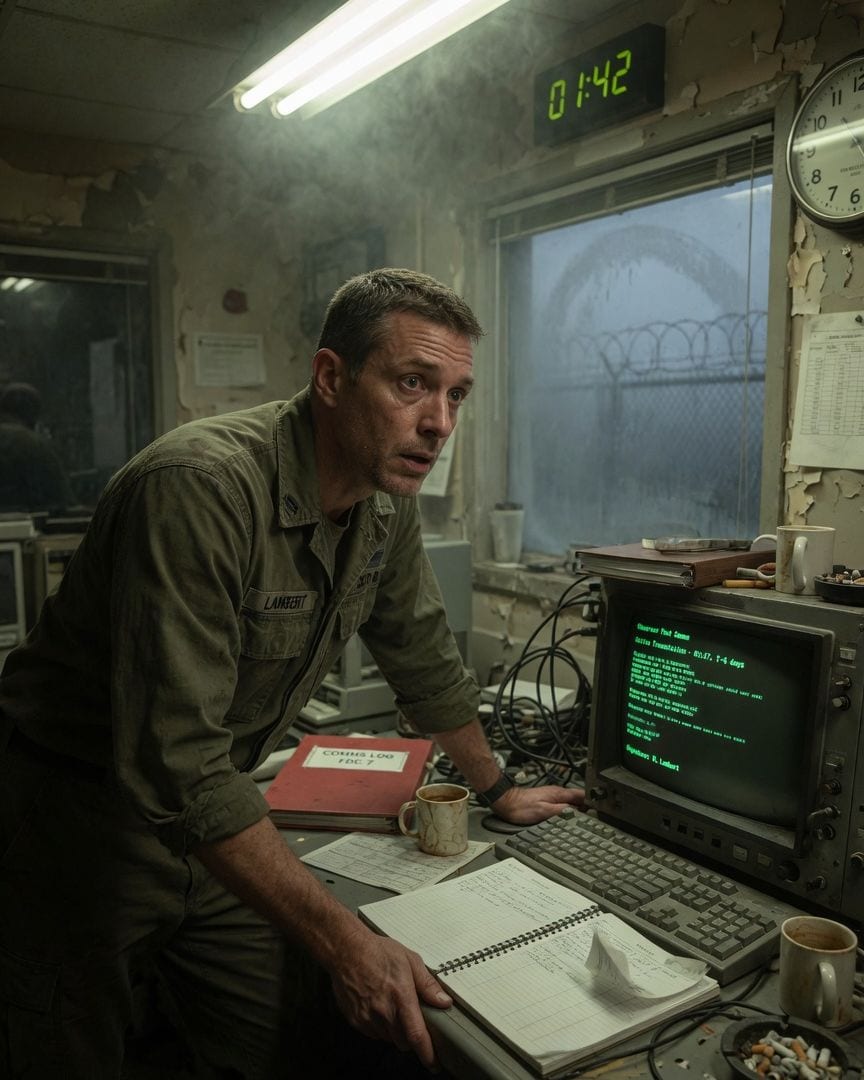
With Firebase 7 days from demolition, a dispatch specialist found his own signature on a log entry from a lost outpost. Then, a dead soldier's name appeared.
Specialist Robert Lambert hunched over the radio console in Firebase 7, the mountain fog pressing in as the base counted down its final days before demolition. His quiet shift shattered when urgent calls began arriving from outposts officially declared silent a week ago. His sergeant calmly informed him that he’d been speaking to no one, as all comms with those posts had been lost for hours. Later, Robert found a log entry for an active transmission, dated days after a post went dark, bearing his own signature. What chilling truth lay beneath the paper, revealing a dead soldier's name reporting from the grave?
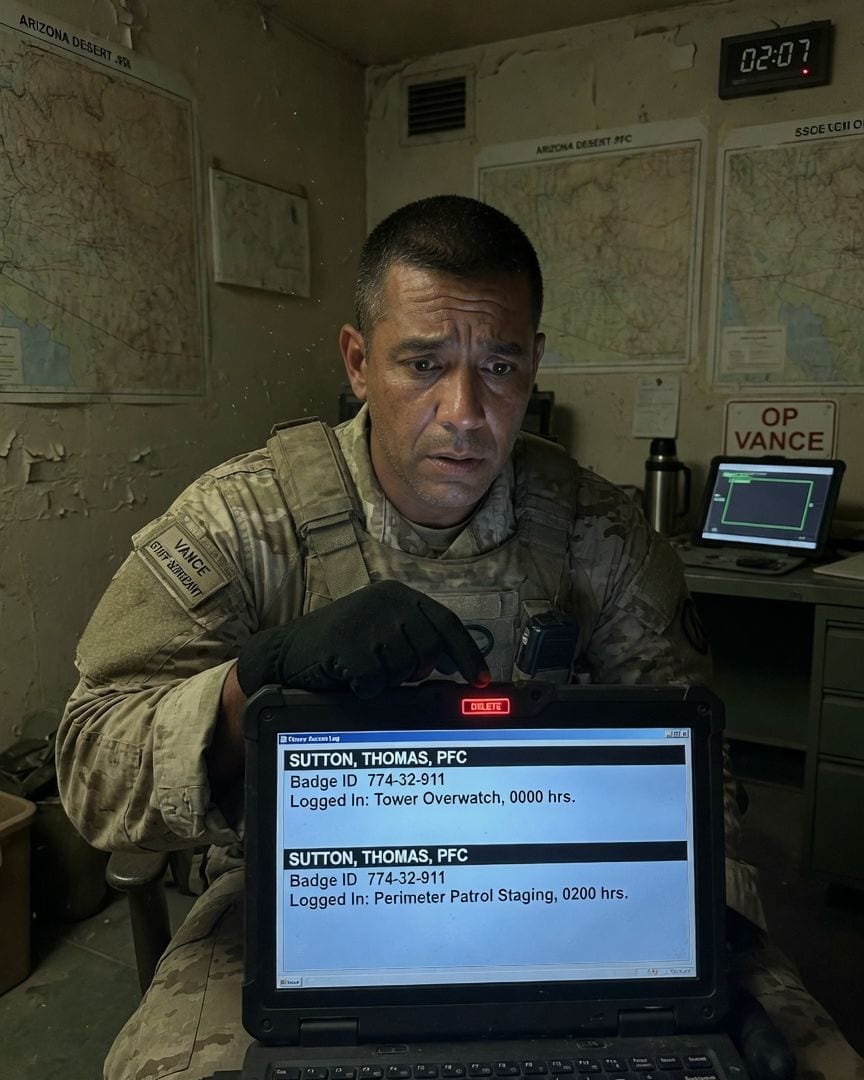
Two weeks from his rotation's end, Staff Sergeant Vance saw a fourth man report for patrol. The system then logged the same soldier in two places at once.
Staff Sergeant Eric Vance, 32, was just two weeks from finishing his rotation at Observation Post Vance, a lonely cluster of buildings in the Arizona desert. At 0200, scanning his thermal tablet for the perimeter patrol shift change, he expected three men. Instead, a fourth figure in full desert camo fell into line, moving with practiced efficiency. This Private First Class answered to the name Thomas Sutton, a soldier Vance knew was already logged in the tower on overwatch. Vance's rational mind struggled until the digital access logs confirmed an impossible truth: two identical entries for PFC Sutton, same ID, same timestamp, but from two distinct physical locations.
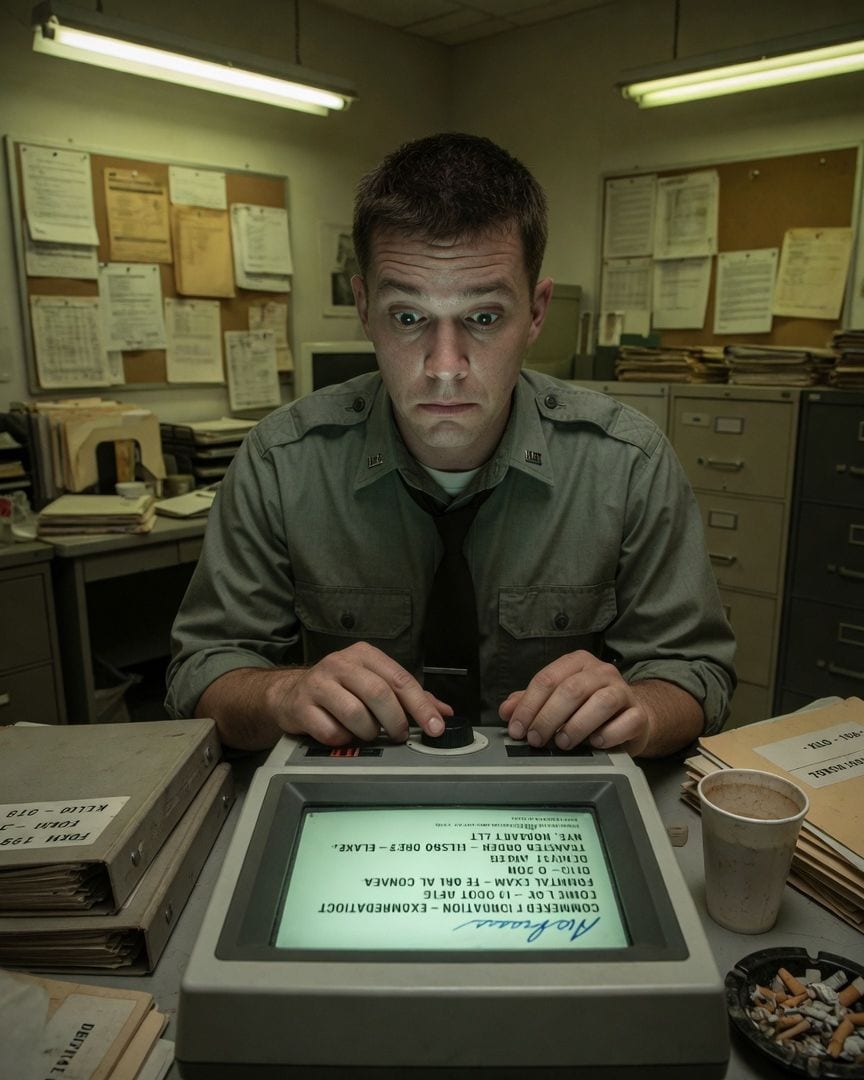
A missile commander watched his ten nuclear silos go dark. His own service record shows his signature on a future he's never lived.
Second Lieutenant Hobart Nye, a missile commander in Wyoming, had his quiet 0247 watch shattered by a security report: a massive, silent black triangle hovered over Launch Facility Kilo, casting a perfect shadow. Hobart watched his console's fault panel light up, signaling all ten nuclear missiles going dark in an impossible silence, followed by eleven minutes his security team could not remember. Official logs called it a "radio malfunction," but Hobart found a requisition for invisible-tracking sensors, signed by a base commander who was supposed to be off-base. The final, chilling discovery came when his own service record showed new entries—a dental check-up, a transfer to Alaska—all dated for a future he never lived, complete with his perfectly replicated signature.
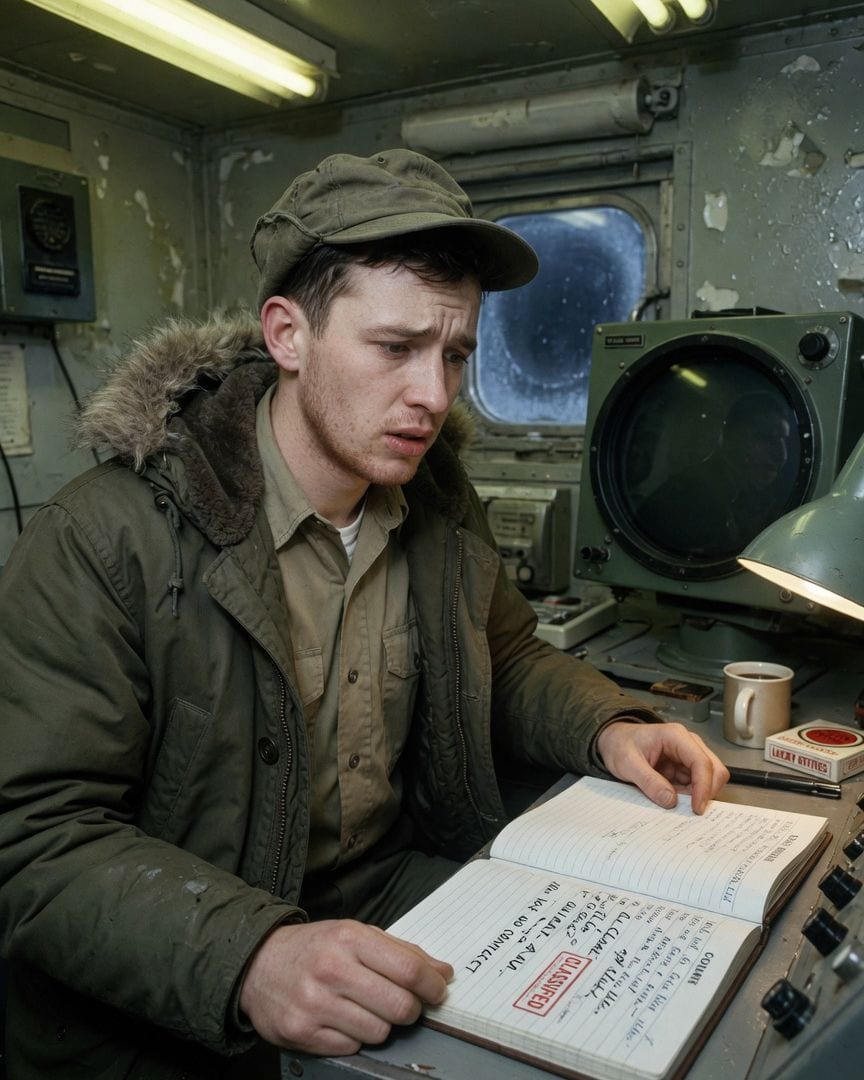
A Cold War airman logs an impossible radar contact on his last sweep. But his official logbook entry is stamped 'CLASSIFIED' and then contradicted by a hastily scrawled 'ALL CLEAR' dated moments before it.
Airman Ordway Vance, 22, manned the radar dome at Site Pellin in the biting North Atlantic dark of January 1962, running the last calibration sweep before its decommissioning. His scope picked up a faint, impossible return, growing closer with each pass, though the ocean remained empty to the eye. When Vance detailed the contact in his official logbook, a 'CLASSIFIED' stamp appeared, followed by a hastily scrawled 'ALL CLEAR' dated moments before his own entry, contradicting his every word. Commander Hartley dismissed it as equipment malfunction, but Vance sensed a chilling, official erasure behind the lie. He soon found a locked cabinet marked 'SITE PELLIN ANOMALIES,' hinting at a deeper truth buried within the base's final days.
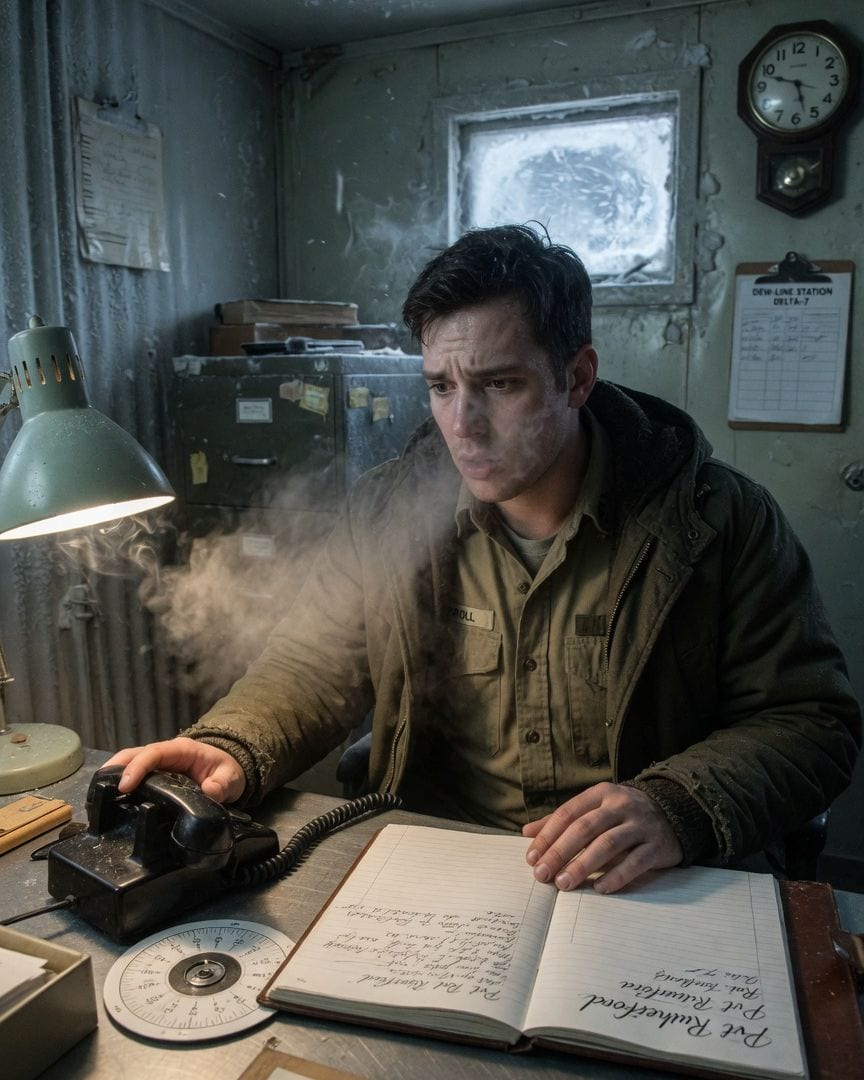
A communications specialist saw his last line go dead. Then the old Cold War field phone rang with a voice from 1966, naming a man freshly signed into his current shift log.
Specialist Walter Kroll shivered in the frigid communications room of DEW-line Station Delta-7, completely cut off by a historic Arctic blizzard. He had personally watched the last hard-wired connection to the outside world snap earlier that day. Now, past midnight, the old field phone at his position began to buzz, impossible from a line he knew was dead. A calm, unfamiliar voice spoke, reading a crew roster Kroll didn't recognize, including Private Rutherford. His search through decades of dusty logbooks revealed Rutherford was assigned to this exact watch in 1966, but then Kroll found the same name freshly inked into his *current* shift's sign-in sheet.
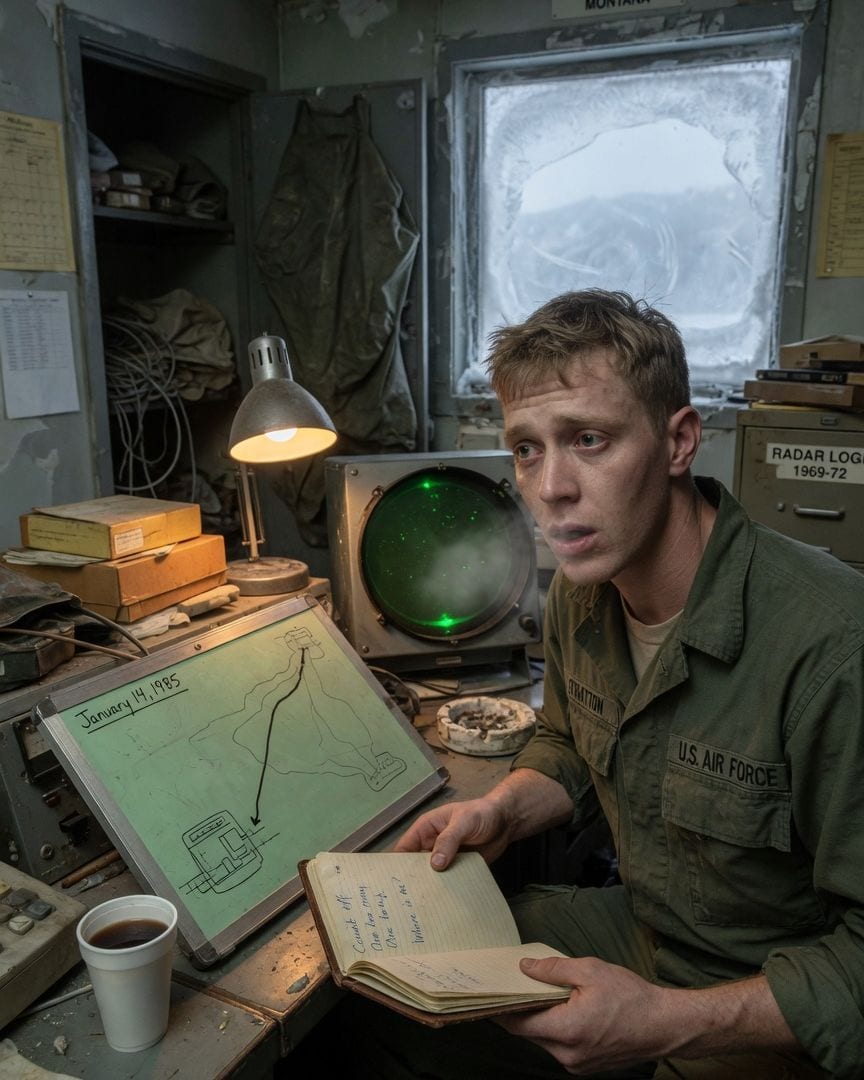
Airman Lars Stratton found an old Cold War manifest listing one name twice: 'Bernard Radcliffe' transferred and 'Bernard Radcliffe' still present.
Airman Second Class Lars Stratton was counting down his final weeks at Echo Station, a desolate Cold War outpost due for mothballing. He longed for home, far from the bitter Montana winds and the constant hum of static. Inside the dim radar shack, he logged the usual nightly ghost blip, a faint contact appearing at 2300, just as it had every winter since 1987. This night, a metallic tang like old blood lingered in the air, raising the hairs on his arms. Seeking distraction, Lars later discovered a leather-bound logbook from 1971, detailing the same 2300 contact, but with chilling notes and a manifest listing one airman's name, Bernard Radcliffe, twice—once transferred, once present. Was he truly alone in the silent, remote station?