Two weeks from his rotation's end, Staff Sergeant Vance saw a fourth man report for patrol. The system then logged the same soldier in two places at once.
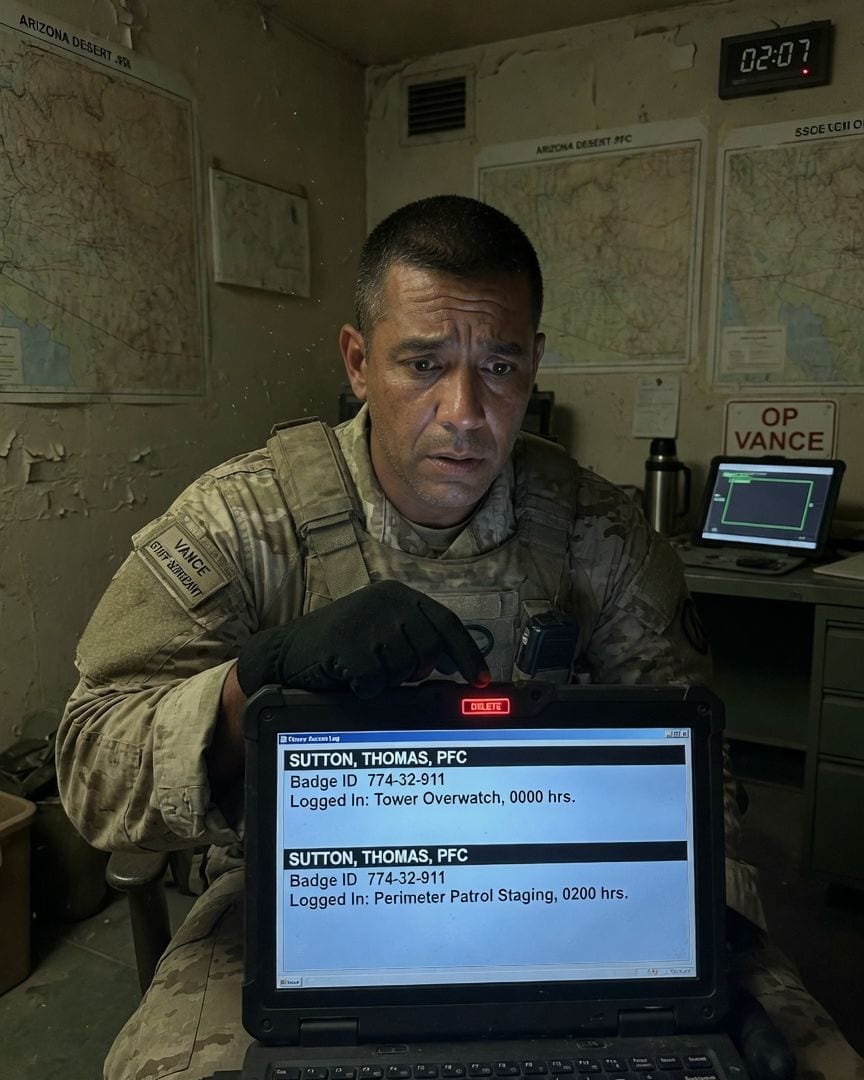
The arid wind of the Arizona desert whipped dust against the concrete walls of Observation Post Vance, a lonely cluster of buildings miles from anything.
Staff Sergeant Eric Vance, 32, a squared-away NCO two weeks from the end of his rotation, stood by the gate, scanning his thermal tablet. It was 0200, time for the perimeter patrol’s shift change.
Three men, Private First Class Adam Doyle, Specialist Chloe Hale, and Private First Class Thomas Sutton, were due to report. Vance watched as Doyle and Hale, their faces grim from the cold, jogged into position.
Then a fourth figure, also in full desert camo, fell into line beside them, moving with the same practiced efficiency.
Vance frowned, checking the manifest on his tablet. Three names. Three men. He looked up, his gaze sweeping the line. He knew his men. Doyle. Hale. Sutton. Then, the fourth.
The man was a Private First Class, his face obscured by the low-light. Vance prided himself on knowing every soldier under his command, every face, every name, every detail that ensured accountability. He ran the names through his head again.
Three. Not four. Yet a fourth stood there, kitted out, ready for patrol.
'Alright, fall in, names on my count,' Vance called out, his voice cutting through the wind. 'Doyle!' 'Here, Staff Sergeant!' 'Hale!' 'Here, Staff Sergeant!' 'Sutton!' 'Here, Staff Sergeant!'
Vance’s eyes snapped to the fourth man. The voice had come from him, clear and distinct. But Thomas Sutton, the real Thomas Sutton, was already logged in the tower, on overwatch.
He was supposed to be there until 0600, covering the night shift.
The man standing in front of Vance, kitted and ready, was not on his manifest, yet he had just answered to a name already accounted for, a name that was, impossibly, already on duty.
Vance felt a prickle of unease. He knew PFC Sutton. Knew his gait, his voice, his posture. The fourth man was a little too still, a little too quiet, even for a night patrol.
He tried to force a mundane explanation into his mind – a last-minute shift change not communicated, a Private covering for someone else, a simple mistake. It had to be.
'Alright, Private,' Vance said, addressing the fourth man directly, 'state your name and unit.' The man’s eyes, dark and unblinking, met his. 'Sutton, Thomas, PFC. Delta Company.' The same name. The same unit. Vance gestured to his badge.
'Let me see your ID, Private.' The man unclipped his identification from his vest, holding it out. Vance took it, his gloved fingers brushing the cold plastic. The photo was a perfect match for the man standing before him.
The name: Thomas Sutton. The ID number: 774-32-911. The same ID number as the PFC Sutton currently in the tower, according to Vance's manifest. Vance’s rational mind scrambled. A clerical error? A prank?
He’d seen both, but never this exact combination. The air felt suddenly colder around them, the desert silence pressing in.
He handed the badge back. 'Alright, Private Sutton. Report to the tower. PFC Sutton is already on duty there. We have a roster issue.'
The man simply nodded, turned, and began to walk towards the tower, his stride even, unhurried, almost unnaturally smooth. Vance watched him go, a knot tightening in his gut. This wasn't a prank.
The other two patrol members, Doyle and Hale, exchanged confused glances but said nothing, their breath pluming white in the chill. Vance dismissed them to their perimeter patrol, his mind already racing.
He went straight to the small, secure office, the door groaning shut behind him like a complaint. He pulled up the digital access logs for OP Vance. Every entry was timestamped, cross-referenced with badge IDs and biometric scans.
He typed in 'Sutton, Thomas.' The screen populated instantly.
One entry appeared: 'Sutton, Thomas, PFC, Badge ID 774-32-911, Logged In: Tower Overwatch, 0000 hrs.' He scrolled down, then froze.
A second entry, identical in every detail, popped up just beneath it: 'Sutton, Thomas, PFC, Badge ID 774-32-911, Logged In: Perimeter Patrol Staging, 0200 hrs.' No. That was impossible.
The system registered two distinct physical bodies, two separate log-ins, under the exact same identity, at two different physical locations. And the second log-in was dated 0200, precisely when the fourth man had reported for patrol.
The normal explanation had just failed, spectacularly.
Vance stared at the digital logs, the harsh blue light of the screen reflecting in his eyes.
Two identical entries for PFC Sutton, both bearing the same badge ID, both stamped with the same time, but one logged from the tower, the other from the patrol staging area.
His mind tried to reconcile the data with what he knew, with what he had seen. It couldn't. This wasn't a glitch, not a simple error. The system, designed for absolute accountability, had just confirmed an impossible physical presence.
He could delete the second entry, make it disappear, pretend he hadn't seen it. His finger hovered over the 'delete' key, the cursor blinking, a tiny, insistent pulse on the screen.
He felt a tremor in his hand, a cold dread that rooted him to the spot. He couldn't bring himself to touch it. He knew what he saw, and the system now confirmed it, impossibly. He couldn't unsee it.
He couldn't un-know it.
The next morning, Vance felt a pressure behind his eyes that had nothing to do with lack of sleep. He had stayed up, reviewing every log, every manifest, every personnel file for OP Vance.
He found no other anomalies, no other duplicates. It was just this one, impossible PFC Sutton. The desert morning light, usually a source of clarity, felt muted, washed out by the events of the night.
He pulled the original PFC Thomas Sutton from his tower duty early. The young Private was tired, rubbing his eyes, but otherwise normal. Vance questioned him carefully, casually, about the night before.
Sutton remembered nothing unusual, no one else reporting for patrol, certainly no one else answering to his name. He swore he’d been alone in the tower from 0000 to 0600.
Vance had him badge out from the tower, then badge back in for the day shift. The system registered it cleanly. One man. One ID.
Vance then located the ‘other’ PFC Sutton. He was in the barracks, meticulously cleaning his rifle, the oiled metal gleaming under the fluorescent lights. Vance approached him. 'Private Sutton, I need to speak with you in the office.'
The man followed without question, his movements fluid, almost too precise, like a machine obeying a command. In the office, Vance sat him down. The air in the small room felt dense, heavy with unasked questions. 'Private, about last night.
There was an issue with your log-in.' 'Staff Sergeant?' The Private's face was unreadable, his eyes holding a disconcerting blankness. They were the color of stagnant water.
Vance asked him about his deployment history, his family, details only the real Sutton would know. The Private answered every question correctly, flawlessly, reciting dates and names with perfect recall. But there was no warmth, no hesitation, no human nuance.
It was like listening to a recording, perfectly reproduced, but utterly devoid of life. Vance felt a chill that had nothing to do with the office air conditioning.
He tried a trick question. 'Private, what was the name of your drill sergeant at basic training?' The Private answered instantly: 'Sergeant First Class Reynolds, Staff Sergeant.' Correct. Vance had checked Sutton's file earlier. He moved on.
'And your mother's maiden name?' 'Whitfield, Staff Sergeant.' Again, correct.
The man was a perfect replica, down to the smallest detail, yet Vance knew, with a certainty that defied logic, that this was not his PFC Sutton.
This was the one who had answered for the original, the one who had been 'extra.' The knowledge settled in his stomach, cold and hard.
He made a note in his personal log, careful to obscure the details, but marking the date and time. He couldn't bring himself to write down 'duplicate soldier.'
He ended the interview, telling the Private he’d sort out the 'clerical error.' The Private left, his footsteps silent on the concrete floor. Vance knew he needed to find out who else had seen this, or something like it.
Vance decided to escalate. He tried to contact his company commander, Captain Trevor Oakley, by secure satellite phone. The line was static-filled, dropping the call repeatedly, a frustrating scramble of digital noise. He tried the next day. Same result.
He sent an encrypted email, detailing a 'serious personnel accountability discrepancy' and requesting a secure video conference. No reply. This was unusual. OP Vance was remote, but communications were usually reliable.
The silence from command was almost as unnerving as the duplicate.
He started searching the outpost's physical archives, a dusty, seldom-used room filled with old logbooks and paper files that smelled of mildew and stale paper.
He was looking for any record of unusual incidents, anything that hinted at a similar 'discrepancy.' Days turned into a week. He found nothing.
Each day the archive felt more cavernous, more silent, the rows of forgotten documents mocking his search.
One evening, as he left the archive, he noticed a faint scuff mark on the dusty floor, leading from the main corridor to the archive door. He had meticulously swept the floor the day before, leaving a pristine, undisturbed surface.
Someone had been in there. Someone had been watching him. The air seemed to tighten around him, a fresh layer of dread settling over the previous one.
The next morning, he found a small, unmarked envelope tucked under his door. Inside was a single, laminated card. It was an old, faded ID badge, the photo blurry, but the name was clear: 'SFC R. Maddox.'
Below it, stamped in red ink, were the words: 'TRANSFERRED – 10 YEARS AGO.' Vance recognized the name; Sergeant First Class Robert Maddox had been the NCO in charge of OP Vance ten years prior, before being transferred out.
There was no other message, just the card. It was a warning. Someone knew he was digging. Someone knew what he was looking for, and they were telling him, in no uncertain terms, that others had been here before.
The dread sharpened, turning from a cold knot to a sharp, burning awareness. He wasn't just investigating a glitch anymore. He was being watched. The message was clear: drop it.
But the sight of that faded ID, the implied history, only made him more determined. He remembered an obscure reference in a base regulation about a 'special archival access' required for documents predating the current digital system.
He needed to find the oldest records, the ones that weren't supposed to be easily found.
He knew who might have access: Captain Margaret Vance, the Army Archivist at the nearest regional command, a woman known for her encyclopedic knowledge of military history and a reputation for guarding her records like a dragon.
Vance secured a rare trip to the regional command, ostensibly for supply requisitions. He bypassed the supply depot and went straight to the archive.
Captain Margaret Vance, 55, a stern woman with steel-gray hair pulled back in a severe bun, sat behind a desk piled high with ancient ledgers. The fluorescent lights hummed with an unnatural intensity over her head. 'Staff Sergeant Vance.
To what do I owe the pleasure?' she asked, her voice dry, like rustling paper. Eric Vance got straight to it, omitting the impossible details of two Suttons. 'Captain, I'm investigating a personnel accountability issue at OP Vance.
I believe it may have historical precedent. I need access to all physical duty logs and incident reports from that post, especially those predating the current digital system.' Captain Vance’s eyes narrowed. 'OP Vance? That’s a… sensitive location.'
The air in the archive, usually still, seemed to vibrate faintly. 'Sensitive how, Captain?' 'Just… sensitive. Things happen there. Things that don't fit the paperwork.' She paused, her gaze fixed on him, sharp and knowing.
'You've seen something, haven't you, Staff Sergeant?' Vance hesitated, then nodded. 'An extra man. Under an existing ID.' She sighed, a long, weary sound that seemed to carry the weight of decades. 'It happens. Not often, but it happens.' 'Happens?
Captain, the system registered two distinct physical bodies with one identity. That's not a 'happening.' That's impossible.' 'Impossible to you, perhaps. Not to the institution.' She pushed a thick, leather-bound logbook across the desk.
Its spine was cracked, its pages yellowed. 'This is from ten years ago. Sergeant First Class Maddox’s rotation. Take a look at the entry for October 17th.'
Vance opened the heavy book. His fingers trembled slightly as he found the date. The entry detailed a 'personnel discrepancy' involving a Private First Class. 'Subject presented as an unauthorized duplicate. Processed out by SFC Maddox, 0300 hrs.'
The words 'processed out' chilled him to the bone. They hung in the air, heavy and unspoken. He looked up at Captain Vance. 'What does 'processed out' mean?' She met his gaze, unflinching, her expression as unreadable as stone.
'It means they made sure the original was the only one left. The anomaly… was contained.' Vance felt a wave of nausea, cold and sharp. 'You mean… they eliminated the duplicate?' Captain Vance didn't answer directly.
Instead, she pointed to the bottom of the entry. 'Look at the signature, Staff Sergeant.'
His eyes dropped. Below Maddox’s signature, in a familiar, looping hand, was a second signature. 'SSG E. Vance.' He stared at it, his blood running cold. His own name. His own distinctive scrawl.
'No,' he whispered, the sound catching in his throat. 'No, this isn't right. I wasn't here. Ten years ago, I was in Afghanistan. I never set foot in OP Vance until this rotation.' Captain Vance's expression was grim.
'That's the second layer, Staff Sergeant. The records don't just show the duplicates. Sometimes… they show you in them, even when you weren't there. It's how the pattern asserts itself. It’s what happens at OP Vance. It’s always been happening.'
Vance felt a profound, sickening disconnect. His own signature, undeniable, in a logbook from a place he’d never been, for an event he could not have witnessed.
The anomaly wasn’t just creating duplicates; it was retroactively inserting itself into history, implicating him, making him a silent participant in a brutal, hidden protocol.
Captain Vance watched him, her eyes heavy with a knowledge that went far beyond mere records, a knowledge that seemed to weigh down the very air in the room.
'This isn't just about an extra soldier, Staff Sergeant. It's about how long this has been going on, and how deep the institution's knowledge runs.'
She leaned forward, her voice dropping to a whisper, barely audible above the hum of the old building. 'Maddox, the SFC who signed this… he tried to dig deeper, just like you. He found something else.
Something about the origins of the pattern. Something that showed it wasn't just random, isolated incidents.' She paused, her gaze fixed on Vance. 'He never made it home after his transfer. Officially, a training accident.
But I saw his last report. He was asking about 'Project Nightingale.' Do you know what that is, Staff Sergeant?' Vance shook his head, his throat tight, the words refusing to form. 'No, Captain.' 'It’s not in any public database.
It’s older than the digital age. It’s the institutional response. And it’s not about stopping it. It’s about managing it.' She pushed another, much older, bound ledger toward him.
Its cover was plain, unmarked, the leather dark and worn smooth with age, but the paper within was yellowed and brittle, crumbling slightly at the edges. 'Maddox found this. He believed it held the key to everything.
The real history of OP Vance, and what it was truly built to contain. He believed it showed how many others had been 'processed out,' and for how long the Army had known.'
Vance reached for the book, his hand trembling, the gloved finger he'd used earlier now tracing the looping ink of his own forged past. The weight of it felt immense, like carrying years of buried secrets, centuries of hidden truth.
He pulled his hand back, staring at his name, his signature, on a record of an event he could not possibly have witnessed, ten years ago, a thousand miles away.
He looked at the Captain, her face etched with a mix of fear and resignation. The knowledge was a burden she had carried for too long.
He knew he was about to step into something far darker, far more pervasive than he had ever imagined. The cold dread turned into a chilling certainty: this wasn't just a local anomaly.
This was a pattern, a system, and he was now a part of its record.
Vance opened the ancient ledger. The brittle pages crackled, exhaling a dry, musty scent. The first page bore a stark title, hand-lettered in fading ink: 'PROJECT NIGHTINGALE: SITE ANOMALY PROTOCOLS.'
The dates listed began in 1943, almost eighty years ago, mentioning 'anomalous personnel manifestations' at a 'desert training camp, Sector Rho.' The camp, Vance realized with a jolt, was the precursor to OP Vance.
The document detailed a history of duplicates, doppelgängers, and 'temporal record contamination'—the very phenomenon that had placed Vance’s signature in the old logbook.
It explained the subtle behavioral cues, the slight wrongness, the unsettling blankness Vance had instinctively sensed in the 'extra' Private Sutton.
It meticulously outlined the 'processing out' procedures: isolation, psychological assessment to confirm the anomaly, and then a discreet 'reassignment' to a non-existent unit, a digital ghost. The original soldier would be left in place, their records scrubbed of the incident.
There was no explanation for what caused the anomaly, only how to manage it, how to maintain the illusion of order.
Captain Vance watched him read, her face pale, illuminated by the dim archive light. 'It’s been going on since the war,' she murmured. 'They thought it was isolated incidents at first. Then they realized it was tied to specific locations.
OP Vance is one of them. A nexus, they called it. A place where the veil is thin.' Vance looked up, his voice hoarse, the words scraping in his throat. 'And Maddox? What did he find beyond this?'
Captain Vance pointed to a heavily redacted section near the end, thick black lines obscuring whole paragraphs. 'He believed the anomaly wasn't just duplicating soldiers. He thought it was… feeding. That the 'processing out' wasn't containment, but a harvesting.
That the duplicate wasn't just an echo, but something that consumed the original's identity, piece by piece, until the original was the anomaly.
And the records… they were part of the process, integrating the new identity into the past, making it always have been.'
Vance felt a cold, visceral horror that made his stomach clench. The 'extra' Sutton wasn't just a copy; he was a replacement, slowly erasing the original from existence.
The institution wasn't containing a threat; it was facilitating a cycle, burying the truth under layers of bureaucracy and classified protocols. The entire system, designed for accountability, had been co-opted into a mechanism for an unknown entity to consume identities.
Every clue clicked into place: the impossible log entries, his own signature in a past he hadn't lived, the blankness in the duplicate’s eyes. It all made horrifying sense.
The Army had known for decades, not to fight it, but to manage the paperwork, to streamline the process of replacement.
The full weight of Project Nightingale pressed down on Vance. He looked at Captain Vance, the ancient ledger still open on the desk between them. 'So, what do we do? We expose this?'
She shook her head, a flicker of fear in her eyes, a shadow passing over her stern face. 'You can't. They've been watching you. They'll 'process' you out, just like Maddox. Just like the duplicates. You're already in their system.'
Vance felt a surge of cold fury, a burning anger at the quiet complicity, the decades of deliberate silence. 'I can't just let it continue. I can't go back to OP Vance and pretend. Knowing what I know.'
He thought of his wife, Penelope, waiting for him. He had two weeks left. He had to get out, but he couldn't leave this buried. 'I need to leak this. Get it out. Even a piece.'
Captain Vance looked at the ancient ledger, then at Vance, a strange pity in her eyes. 'You won't get far. They control the channels. The 'Project Nightingale' isn't just a file; it's a living system.
It has eyes and ears everywhere. It’s part of the fabric now.'
Vance took a deep breath, the stale archive air filling his lungs. 'Then I'll leave the evidence where it can be found. Not by the system, but by someone outside it. Someone looking for the truth, years from now.'
He carefully photographed every page of the Project Nightingale file with his secure phone, the clicks echoing too loudly in the quiet room.
He then uploaded the encrypted images to a dead drop he maintained for emergencies, a server hidden deep in the internet, accessible only by a complex, time-locked key. He wouldn't activate the key now. He would wait.
He would survive his rotation, go home, and then, from safety, he would release it.
Captain Vance watched him, a strange mix of terror and reluctant admiration on her face. 'They'll know you're not playing by the rules, Staff Sergeant. They'll watch you.' 'Let them,' Vance said, his jaw tight, his resolve hardening.
He returned to OP Vance. The 'extra' PFC Sutton was still there, performing his duties flawlessly, a shadow moving through the outpost. The original PFC Sutton was still on rotation, still in his barracks, still responding to his name.
Vance kept his silence, performed his duties, maintained his poker face. He watched the duplicate, looking for any sign of change in the original.
It was subtle, almost imperceptible, but he saw it: a slight dulling in the original Sutton's eyes, a fraction less spontaneity in his movements, a growing, unsettling blankness that mirrored the duplicate. The replacement was slowly, inexorably, taking over.
Vance knew he was a ticking clock. He had to get out before the system decided he was the anomaly to be contained.
He had to survive, not just the outpost, but the knowledge itself, and the watchful eyes of Project Nightingale. He would finish his rotation, go home, and then he would fight back, from the shadows.
Two weeks later, Staff Sergeant Eric Vance completed his rotation at OP Vance.
He said his goodbyes, shaking hands with the men, including both PFC Thomas Suttons, whose presence was now so normalized to the outpost's rhythm that no one else seemed to notice the impossible duality.
Vance boarded the transport out, his gear packed, his face betraying nothing, a mask of weary relief. He kept his phone secure, the encrypted files a burning secret against his hip.
He never saw Captain Margaret Vance again; her position at the archive was quietly filled a month later. There was no official notice, no explanation.
Just a blank space where she had been, as if the desert itself had reclaimed her.
Vance returned home to his wife, embracing the familiar comfort of their quiet house, but the desert outpost and its impossible truth were etched into his soul.
He followed military news, scanning for any hint, any echo of 'Project Nightingale' or 'anomalous personnel.' He found nothing. The system was seamless, impenetrable. The truth remained buried, waiting.
Months passed. Vance settled back into civilian life, found a job in logistics, but the quiet dread never left him. He kept his phone with the encrypted files close, waiting for the right moment, the right signal.
He knew the risk. He knew they were watching.
He saw it in the way certain online searches would subtly redirect, in the occasional static on his phone calls, in the blank faces of strangers who sometimes seemed to watch him a moment too long.
He became meticulous, cautious, always aware of the unseen eyes. He never activated the dead drop. He couldn't. Not yet.
The weight of the knowledge was a constant companion, a shadow that clung to him, shaping his every thought and action. He survived, yes, but he was not saved. He was marked.
He was a witness carrying a truth too dangerous to speak, too terrifying to forget. He was just another entry in a record that swore otherwise, and the system had simply folded him into its ongoing silence.
One evening, his wife, Penelope, asked him, 'You've been so quiet lately, Eric. What are you thinking about?'
He looked at her, then out the window at the quiet suburban street, the ordinary lives unfolding beyond their glass, so utterly unaware. He thought of the desert outpost, the two PFC Suttons, Captain Vance, and the ancient ledger.
'Just thinking about how some things, once you see them, you can never unsee,' he said, his voice barely a whisper. 'And how some records, once they find you, never let you go.'
His wife watched him, a faint frown on her face. He was home, but he wasn't entirely there.
The next morning, she noticed a small, old-fashioned stamp on his discharge papers, a barely visible imprint of a bird with widespread wings. A nightingale.
She traced it with her finger, then looked at her husband, who was already meticulously organizing his sock drawer, his movements precise, his face unreadable. 'Is that so?' she murmured, a faint, wrong little smile playing on her lips.
If this one got to you
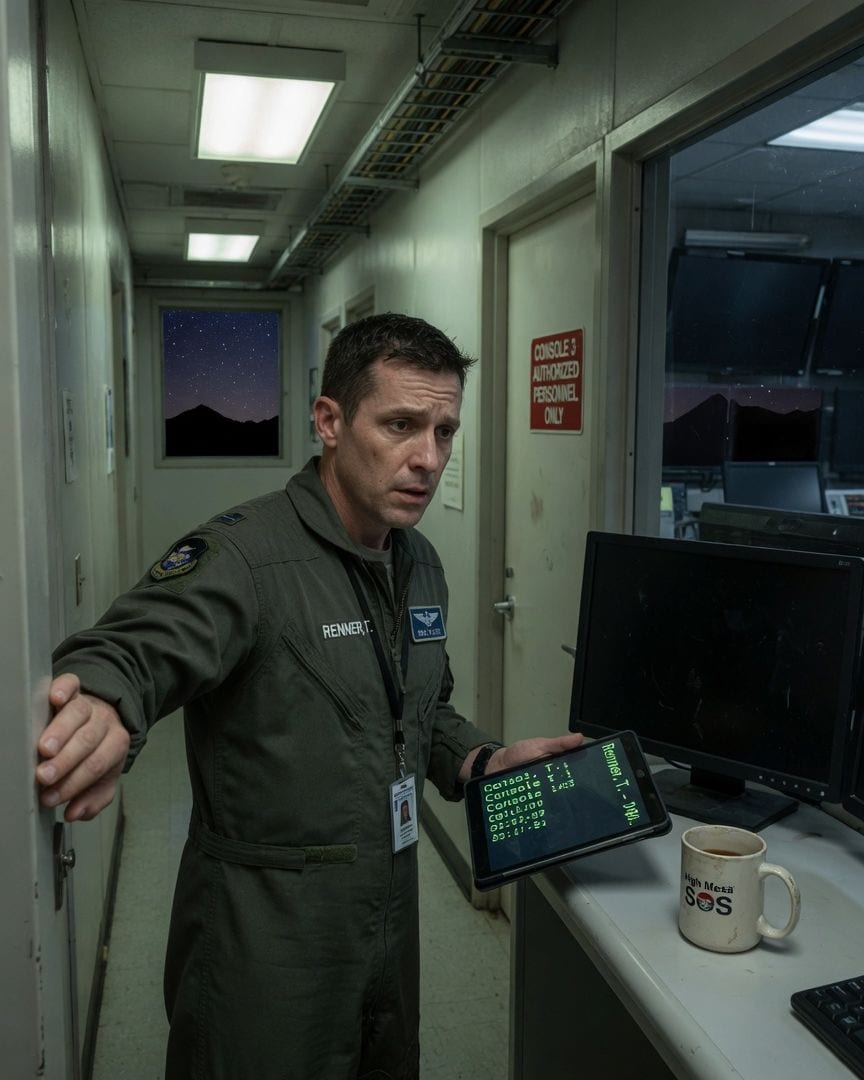
Space operator Theodore Renner left his coffee mug on his console. He found it two rooms away, on a console logged under his name for the exact same hour.
Operator Theodore Renner was ending his midnight shift at High Mesa Space Operations, his relief waiting as the control room hummed. But the electronic watch log revealed an impossibility: his own name, 'Renner, T.', active at a second console, two rooms away, for the exact same hour he’d just worked. He found that remote console dark, yet his distinctive, chipped coffee mug, left on his own station, sat waiting there. His primary console was now mysteriously bare. The system reported routine operations and a maintenance request from the impossible location, all under his name. Theodore knew it wasn't him; what impossible truth was the data screaming?
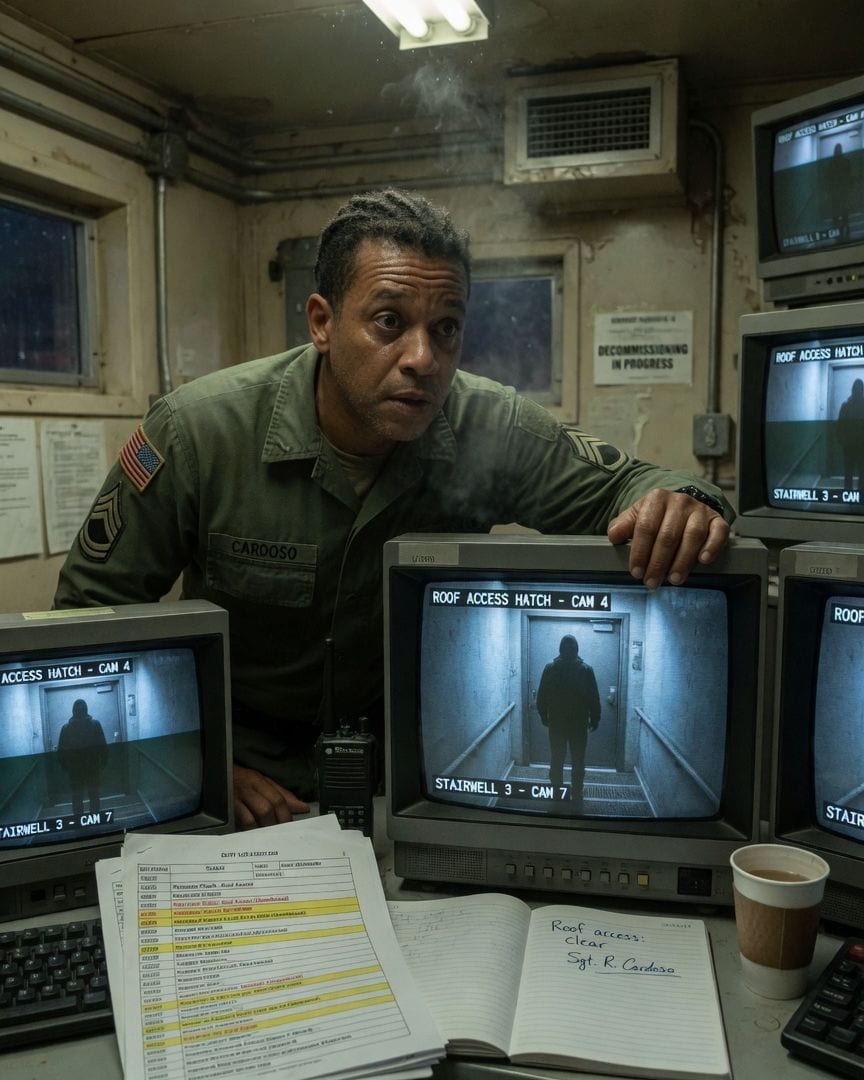
Sergeant Cardoso’s last tour log showed an unknown ‘Operator 73-Delta’ confirming a breach he had just cleared.
Sergeant Rui Cardoso stood his final interior post at Outpost 73, watching monitors through the dead hours, his tour almost over. At 0300, a dark figure flickered on the roof access camera, unmoving, only to appear closer, inside the sealed stairwell, after his team reported the area clear. Shaking off the glitch, he checked his digital duty log, where an entry from two nights prior, identical time, showed an unknown 'Operator 73-Delta' confirming an "unauthorized perimeter check" he had personally cleared. The system insisted on an operator and an event that simply could not exist, logged at the exact moment his own records verified an all-clear. Who was 'Operator 73-Delta,' and how could a sealed base's system confirm their actions?
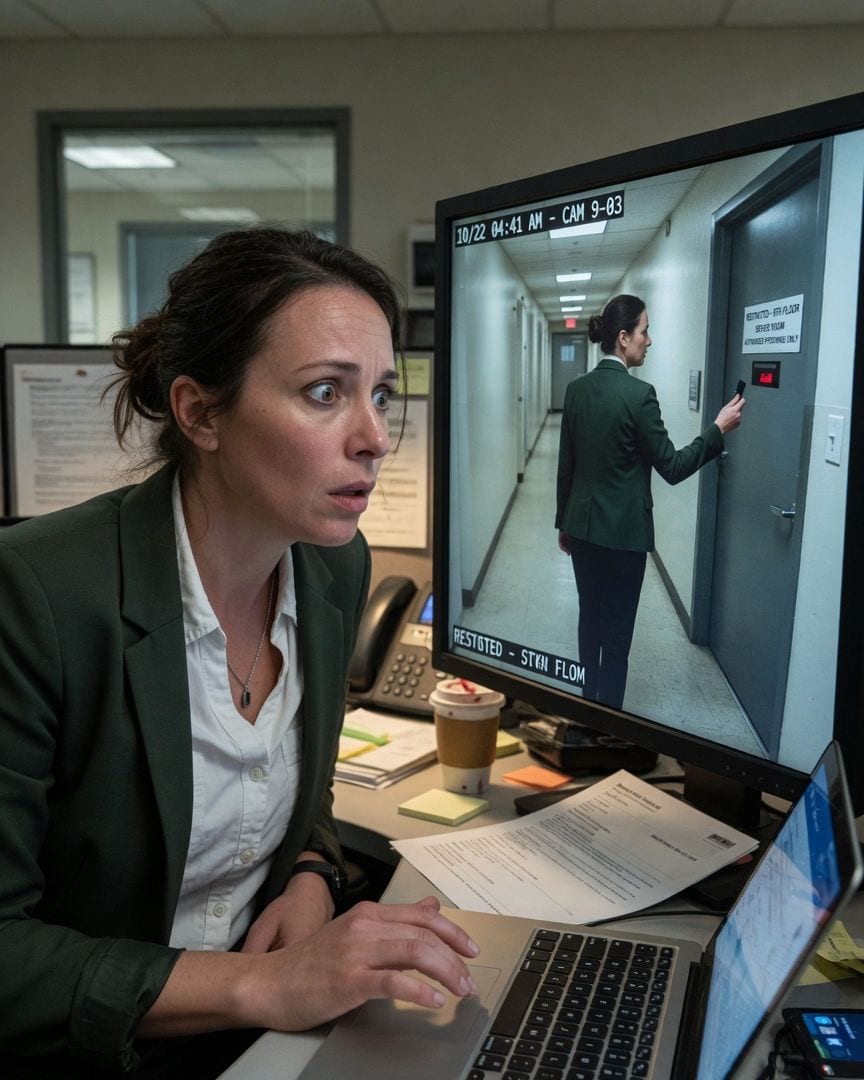
My keycard log shows me in the server room at 4:41am. I was asleep, and my badge was at home.
An email from corporate IT reveals my keycard registered entry into a restricted server room at 4:41 AM last Sunday. I was asleep in my apartment across town, my badge clipped securely to my jacket at home. But then I scrolled down and found eleven more impossible entries, all within the past week, all under my name.
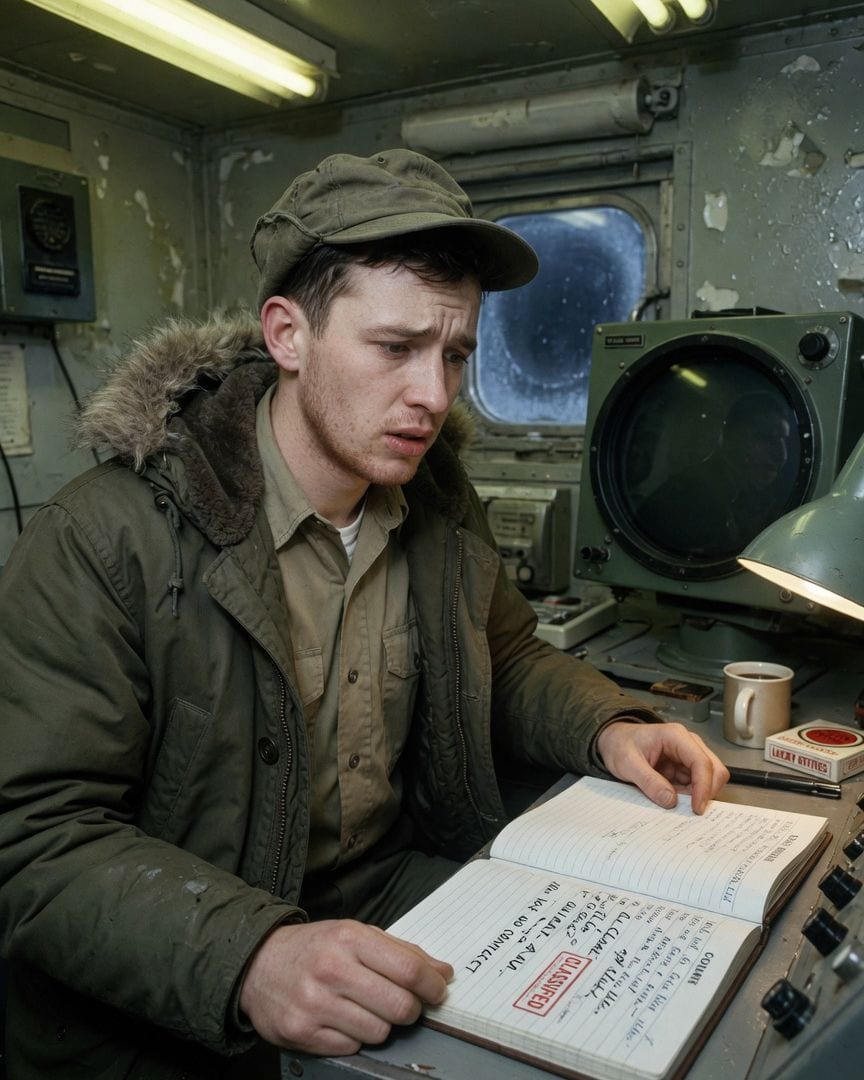
A Cold War airman logs an impossible radar contact on his last sweep. But his official logbook entry is stamped 'CLASSIFIED' and then contradicted by a hastily scrawled 'ALL CLEAR' dated moments before it.
Airman Ordway Vance, 22, manned the radar dome at Site Pellin in the biting North Atlantic dark of January 1962, running the last calibration sweep before its decommissioning. His scope picked up a faint, impossible return, growing closer with each pass, though the ocean remained empty to the eye. When Vance detailed the contact in his official logbook, a 'CLASSIFIED' stamp appeared, followed by a hastily scrawled 'ALL CLEAR' dated moments before his own entry, contradicting his every word. Commander Hartley dismissed it as equipment malfunction, but Vance sensed a chilling, official erasure behind the lie. He soon found a locked cabinet marked 'SITE PELLIN ANOMALIES,' hinting at a deeper truth buried within the base's final days.
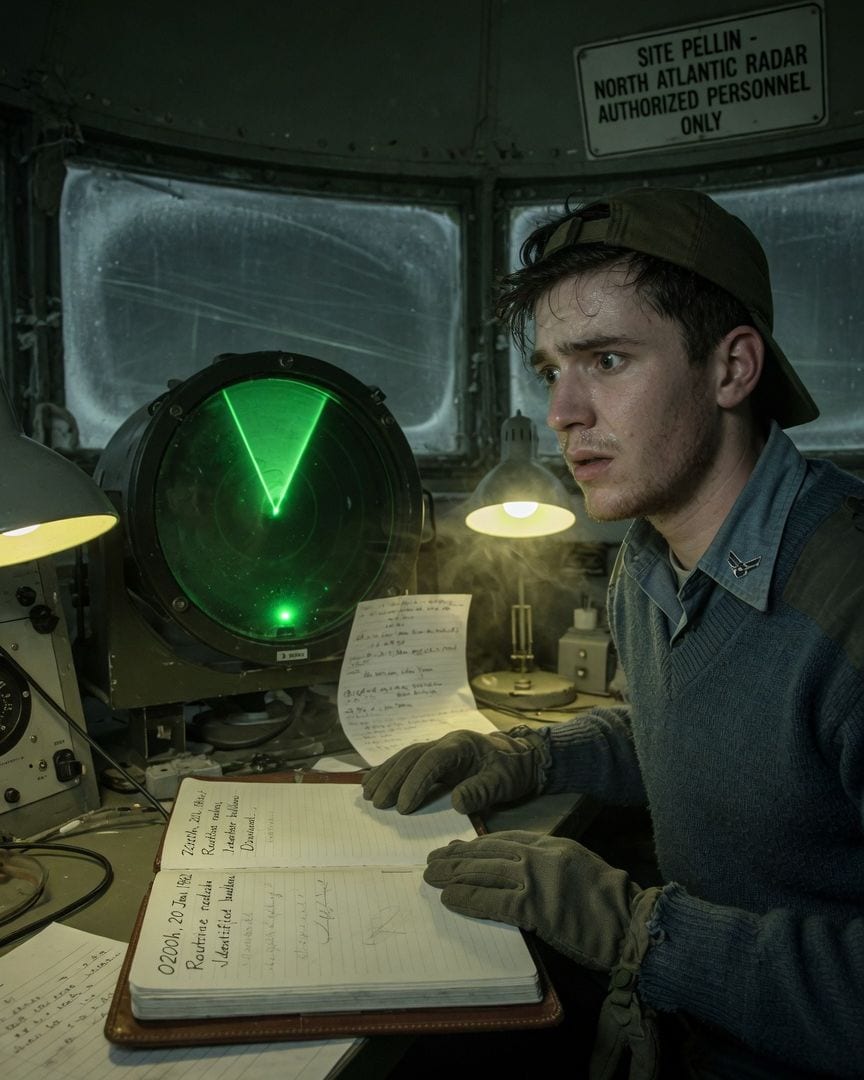
Nine days from closing, Cold War Site Pellin's Airman Vance watched his radar track a solid blip moving closer, dead in open sea where nothing could exist.
In the dimly lit dome of Site Pellin, Airman Ordway Vance, just days from discharge, ran his final radar sweeps before the base closed for good. Outside, the North Atlantic wind howled, but inside, only the hum of his console broke the silence. His last calibration had been clean, yet a single, unwavering green blip appeared on the scope, forty miles out, in open water where no vessel should be. The impossible return moved closer with each sweep, defying all logic and other sensors, until it sat static just beyond the coast fence line. What unseen presence did the radar truly hold in its unwavering green grip, contradicting the official record?
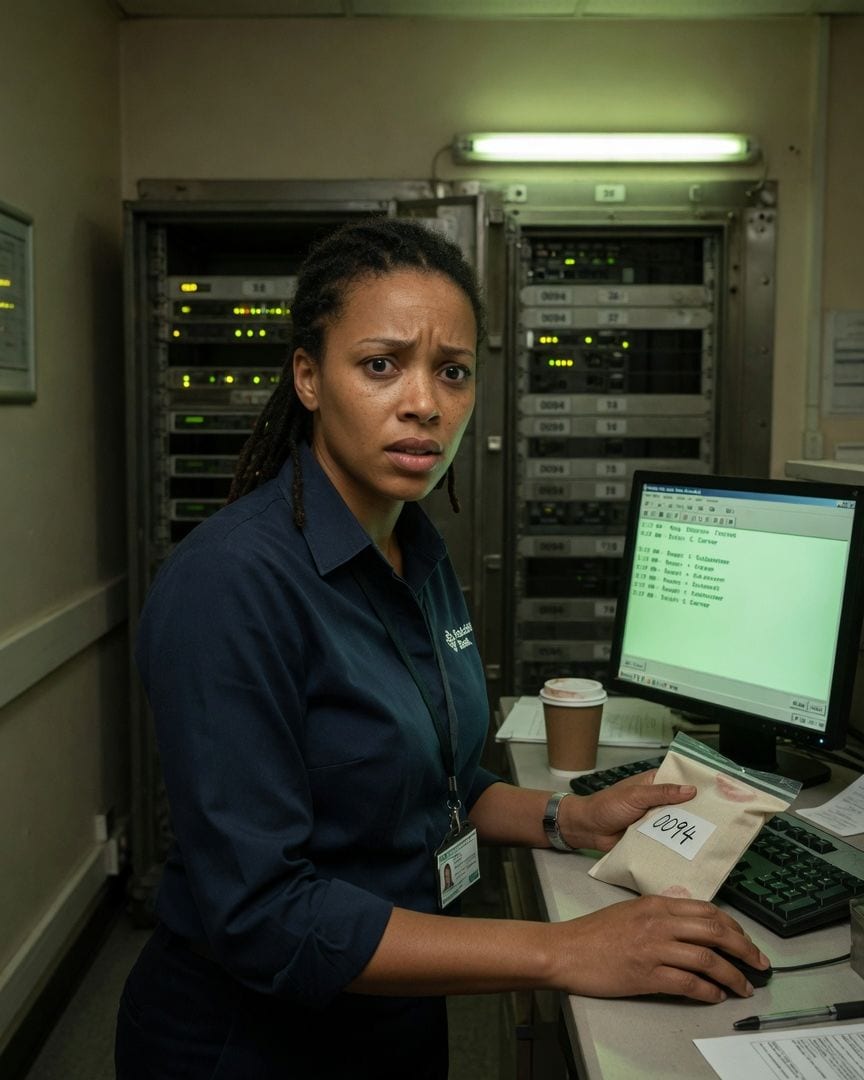
My night-deposit log shows a bag posted at 3:17 AM. My teller number, my count. Bag 0094 is still sealed in the safe, untouched.
I prided myself on precision as a night teller, logging every entry. But at 3:17 AM, a deposit appeared logged under my teller number that I never processed. Security footage then revealed a figure in my uniform, wearing my ID badge, with a blank photo slot.