Space operator Theodore Renner left his coffee mug on his console. He found it two rooms away, on a console logged under his name for the exact same hour.
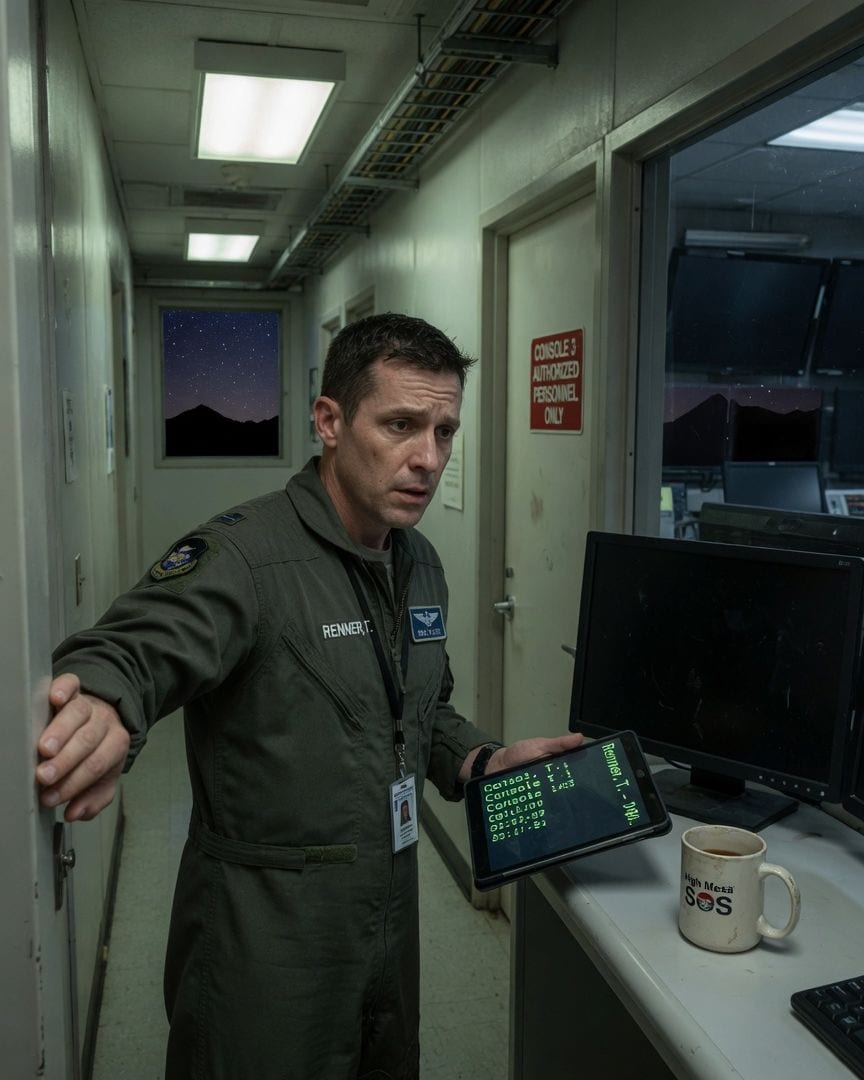
The hum of the High Mesa Space Operations Squadron’s main control room was a constant, low thrum against Theodore Renner’s eardrums, a sound as familiar as his own heartbeat after months of midnight shifts.
Outside, the Colorado mountains were a black silhouette against a sky dusted with too many stars, a contrast to the sterile, brightly lit environment within. His relief, Specialist Conrad Vance, was already at the door, ready to sign in.
Theodore pulled the electronic watch log to close out his shift, the cursor blinking patiently. He entered his ID, then scanned the screen for Vance’s signature.
It was there, 'Vance, C.' — but just above it, a line that made his breath catch: 'Renner, T.' signed onto Console 3, two rooms away, for the exact same hour he’d just worked.
The log showed active operator input from both stations straight through the overlap. His own name, twice, in two places at once. He frowned, his mind instantly running through possible errors: a system glitch, a prank.
But the logs were sacrosanct. He accessed the badge reader records for the main console door and the Console 3 access point. Both displayed 'Renner, T.' logging in within seconds of each other.
He stared at the glowing data, a cold, quiet dread creeping up his spine. He could not, for the life of him, recall walking through two doors at the same minute.
The system, built for impossible precision, had just reported an impossibility, and his name was at the heart of it.
Theodore, trying to force a rational explanation, convinced himself it had to be a system glitch, a duplicate entry.
He walked the silent, brightly lit corridor to Console 3, expecting it to be dark and empty, or perhaps for Vance to be there, having made a clerical error.
But Console 3 was indeed dark, recently powered down, its screens a blank, reflective black.
On its pristine, dust-free surface, however, sat his distinctive, scuffed service-issue coffee mug – the one with the chipped rim, the one he only ever used, the one he’d specifically left on his primary console, Console 1, earlier that night.
A knot tightened in his stomach. He returned to Console 1, his steps quickening. His mug was gone. The weight of its absence, the tangible proof that it had been moved, was heavier than its presence on Console 3.
He checked the internal comms log from Console 3 during the overlapping hour, filtering for outgoing messages. There were routine telemetry reports, signed 'Renner, T.' – perfectly normal, perfectly him, but from a console he’d never touched.
He tried to dismiss it as fatigue, a bizarre prank by Vance, but the cold, logical part of his brain, honed by years of military discipline, knew this went beyond a simple mistake or joke. This was a physical impossibility.
He couldn't shake the feeling. Theodore pulled up the squadron's internal maintenance requests, filtering for 'Console 3' and 'past 24 hours.' He braced himself for a blank screen, or perhaps a generic 'system check.'
Instead, a single entry appeared, logged just an hour before his shift ended: 'Console 3: intermittent power fluctuations. Operator unable to log out.' The request was submitted by 'Renner, T.' from Console 3.
But he knew he wasn't at Console 3, and he certainly didn't submit a maintenance request. The system, in its cold, objective data, showed him performing an action he had no memory of, at a location he hadn't been.
He stared at the screen, the data screaming a quiet, impossible truth: someone else, wearing his name, doing his job, was at Console 3 and logged a system error, and Theodore knows with chilling certainty it wasn't him.
Deeply unsettled by the maintenance request, Theodore tried to find Captain Walsh, his squadron commander, but Walsh was off-base for the next two days, attending a high-level briefing. Theodore decided he couldn't wait; he had to investigate discreetly.
Using his access, he cross-referenced the Console 3 log with other system activities, searching for any anomalies that might explain the impossible double entry. He widened his search to include other operators and other dates.
What he found sent a fresh wave of dread through him: two other instances in the past six months where a different operator, Specialist Claire Bishop, was logged simultaneously on two distant consoles, with badge reader confirmations, for brief, overlapping periods.
These incidents, like his own, had been quickly filed under vague categories like 'system anomaly' and 'operator error' and then purged from active, easily accessible logs. The pattern was too precise to be coincidence.
He knew the High Mesa system, knew its rigid protocols. He used his higher-level clearance to access the archived 'Anomaly Incident Reports,' a section of the network designed to be slow, cumbersome, and discouraging to casual browsing.
He typed in 'operator discrepancy' and 'simultaneous log-in,' the database whirring, its ancient servers echoing the constant hum of the control room. Each click felt like an act of trespass, pulling him deeper into something the squadron clearly wanted buried.
As Theodore delved deeper into the archived reports, the air in the usually isolated terminal room felt heavier, colder.
He noticed subtle, unnerving changes: his login session abruptly terminated, then reconnected with a slightly different internal IP address, as if the system itself was shifting around him. He quickly checked the security camera feeds for his current terminal.
The camera showed him, Theodore Renner, sitting at his desk, head bent over the screen.
But for a split second, the angle of his head, the precise, almost mechanical way he tapped his pen against the desk, was subtly, unnervingly off. It was him, but not quite.
He felt a prickle on the back of his neck, a profound sense of being observed, not by a person, but by the vast, intricate network he was trying to unravel. The system was aware.
Later that evening, after he'd returned to his barracks, a single, anonymous, encrypted message appeared on his secure terminal: 'Some things are best left in the archives, Specialist. Focus on your transfer.'
No sender ID, no trace, just the blunt, unfeeling warning. The danger was now personal, implied with chilling precision, and entirely devoid of human warmth. Someone, or something, knew exactly what he was looking for.
Theodore, now convinced he was being monitored and that his transfer was a ticking clock, found a secure, offline terminal in a rarely used server room. He continued his search, heart hammering, but with renewed determination.
He stumbled upon a sub-category in the anomaly reports, marked 'Temporal Echo Resolution Protocol.' The name alone sent a shiver down his spine. He downloaded the first few files, his fingers trembling slightly.
The documents, heavily redacted but still chillingly clear, described 'transient temporal-spatial duplicates' of personnel, occurring during periods of high system stress or prolonged, isolated operator shifts.
These 'echoes,' as they were called, were perfect, ephemeral copies, indistinguishable from the original, but unstable. The protocol outlined 'containment' and 'reintegration' procedures, essentially making the echo disappear and ensuring the 'original' operator remained unaware.
He scrolled through the list of resolved incidents, and there it was: 'Bishop, C.' from six months prior, with a note: 'Echo successfully reintegrated. Original operator stable.'
The earlier clues – his double log, the misplaced mug, Claire Bishop's similar incidents – snapped into horrifying focus. It wasn't a glitch; it was a known, managed phenomenon.
The squadron, the institution itself, was not just aware of these impossible occurrences, but had a systematic, decades-long method of dealing with them, classifying them as 'resolutions' rather than 'incidents.' Theodore felt a cold sweat break out on his forehead.
He wasn't just investigating a system anomaly; he was staring into the face of a deliberate, calculated cover-up, designed to maintain order at the cost of unimaginable truth.
Theodore, reeling from the realization that the echoes were a known and managed phenomenon, scrolled further through the 'Temporal Echo Resolution Protocol' logs, his heart hammering against his ribs.
He felt a desperate need to understand the full scope, to see how many others had been affected. Then he saw it. An entry for 'Renner, T.' dated three years ago. The location: 'Remote Space Relay Station 7, Nevada.'
This was before he even joined High Mesa. Before his current enlistment, even. The entry read: 'Operator Renner, T. observed manifesting transient echo. Containment protocol initiated. Echo successfully retired.'
Theodore stared at the screen, the words blurring into an incomprehensible jumble. He remembered applying for this squadron after serving at that very relay station.
He remembered a vague, unsettling gap in his memory from that time, dismissed as stress, as the exhaustion of a remote tour. His own name, three years prior, already an echo, already retired.
His breath caught in his throat, a cold, suffocating wave of terror washing over him.
He tried to access the full details of that incident, to see what 'retired' truly meant, but the system flashed a 'Level 5 Classified' error, locking him out.
He was not just discovering a pattern; he was part of it, perhaps not even the 'original' he thought he was. The transfer in three days now felt less like an exit, and more like a final accounting.
Theodore, reeling, realized the full, devastating horror. He wasn't just observing an anomaly; he was an anomaly, perhaps more than once.
The transfer in three days was not a transfer away from High Mesa, but a transfer into a new phase of this phenomenon, or perhaps a permanent 'retirement' of his current iteration.
He remembered the vague sense of disorientation when he arrived at High Mesa, attributed to the altitude and the new posting. He understood the anonymous message now: 'Some things are best left in the archives. Focus on your transfer.'
It wasn't a warning; it was a directive. He managed to find a single, declassified memo from the 1970s, tucked away in an even deeper archive, signed by a General Lockwood.
The memo outlined the 'High Mesa Echo Containment Program' in stark, chilling detail. It described the echoes as 'perfect, ephemeral copies, indistinguishable from the original, but unstable and prone to eventual destabilization if not contained.'
The program's goal was brutally clear: 'Maintain operational integrity and personnel morale by ensuring all echoes are accounted for and discreetly removed before they destabilize or become self-aware, thus preserving the integrity of the original and the mission.'
The coherence was chilling: every impossible log, every misplaced item, every vague memory, every 'operator error' and 'system anomaly' now made perfect, terrifying sense. The institution wasn't just hiding a truth; it was actively managing the very fabric of identity.
With three days until his scheduled transfer, Theodore knew he couldn't simply wait to be 'reintegrated' or 'retired.' He couldn't fight an entire institution built on this deception, but he could disappear. He needed to escape the system entirely.
Working quickly and methodically, his military training overriding his terror, he used his remaining access to download a compressed, encrypted copy of the 'Temporal Echo Resolution Protocol' and the General Lockwood memo onto a small, untraceable data chip.
He knew this was his only leverage, his only proof. He then carefully wiped his digital footprint from the squadron's network, creating a false trail of routine activity, logging into various terminals, downloading innocuous reports, masking his true intentions.
He packed a small, nondescript bag with essentials, intending to go AWOL, losing himself in the vast anonymity of the American West, far from any system that could account for him.
As he walked through the silent, brightly lit corridors towards the main exit, the sterile air felt heavy, charged. He passed a security camera, and for a fleeting moment, he caught his own reflection in the glass.
A flicker of something profoundly wrong in his eyes, a subtle, almost imperceptible shift in his posture, a stiffness that hadn't been there before.
He paused, then shook his head, attributing it to stress, to the exhaustion of his desperate flight.
He pushed through the final door, stepping out into the cold, thin mountain air, wondering if he was truly escaping, or simply being released.
Theodore Renner was reported AWOL three days later, the day of his scheduled transfer. An official inquiry found no anomalies in his service record, only a sudden, inexplicable disappearance.
His files were sealed, marked 'classified incident,' and quickly moved to deep storage.
Captain Walsh, returning from leave, found a single, encrypted data chip on Theodore's console, wiped clean of any identifying data, along with Theodore's scuffed coffee mug, meticulously placed on the desk. No one spoke of it again, officially.
The system, once again, accounted for everything, and then accounted for nothing. The squadron continued its operations, the hum of its servers a constant, unwavering thrum against the Colorado sky.
Months later, a man resembling Theodore Renner, but with a strangely placid demeanor and an odd, detached smile, was seen working at a remote truck stop diner in Wyoming. He answered to 'Theo.'
He would sometimes pause, mid-conversation, staring at his own hands as if seeing them for the first time, a brief flicker of confusion crossing his unnervingly calm face.
One evening, a weary truck driver asked him about his past, about where he came from. 'I used to be somewhere else,' Theo said, his smile unchanging, a faint, almost imperceptible echo in his voice, 'but I don't remember where.
I just remember being accounted for.'
Captain Walsh, years later, found a single, anonymous comment on a long-dormant online forum for military veterans discussing 'unexplained phenomena,' beneath a post about strange coincidences at remote outposts: 'Some things are best left in the archives.
I just remember being accounted for.'
If this one got to you
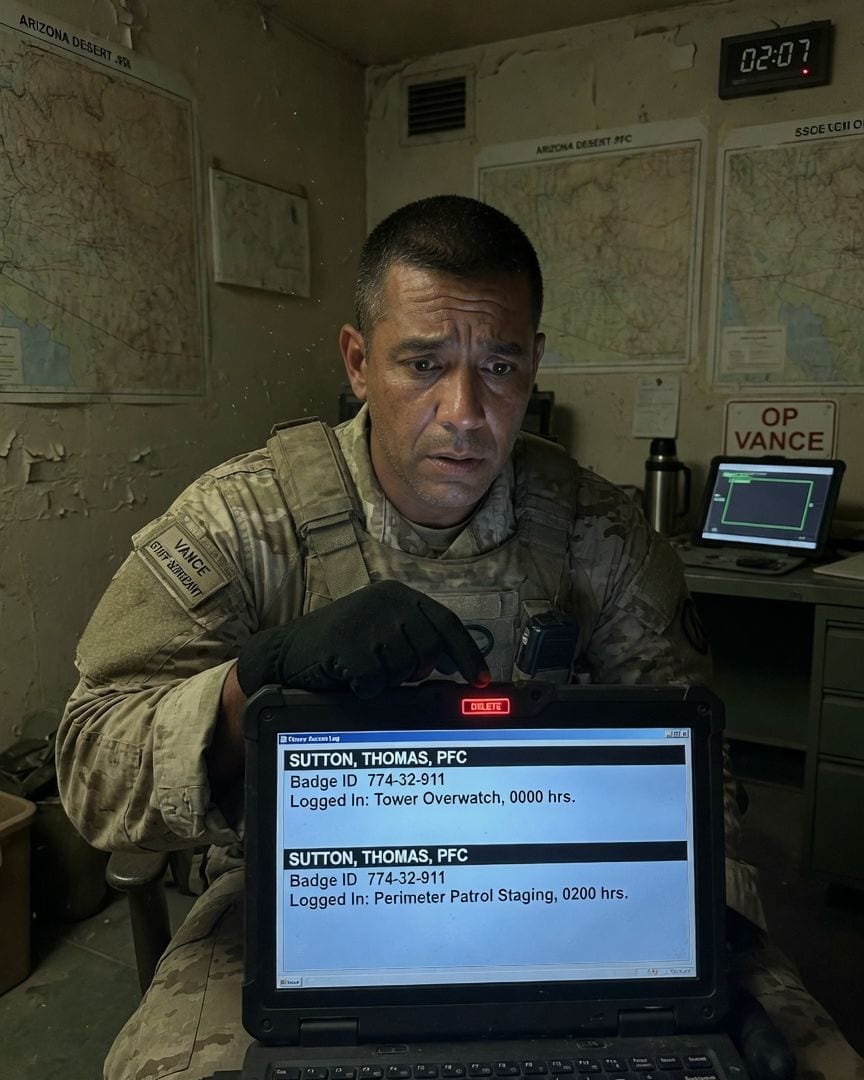
Two weeks from his rotation's end, Staff Sergeant Vance saw a fourth man report for patrol. The system then logged the same soldier in two places at once.
Staff Sergeant Eric Vance, 32, was just two weeks from finishing his rotation at Observation Post Vance, a lonely cluster of buildings in the Arizona desert. At 0200, scanning his thermal tablet for the perimeter patrol shift change, he expected three men. Instead, a fourth figure in full desert camo fell into line, moving with practiced efficiency. This Private First Class answered to the name Thomas Sutton, a soldier Vance knew was already logged in the tower on overwatch. Vance's rational mind struggled until the digital access logs confirmed an impossible truth: two identical entries for PFC Sutton, same ID, same timestamp, but from two distinct physical locations.
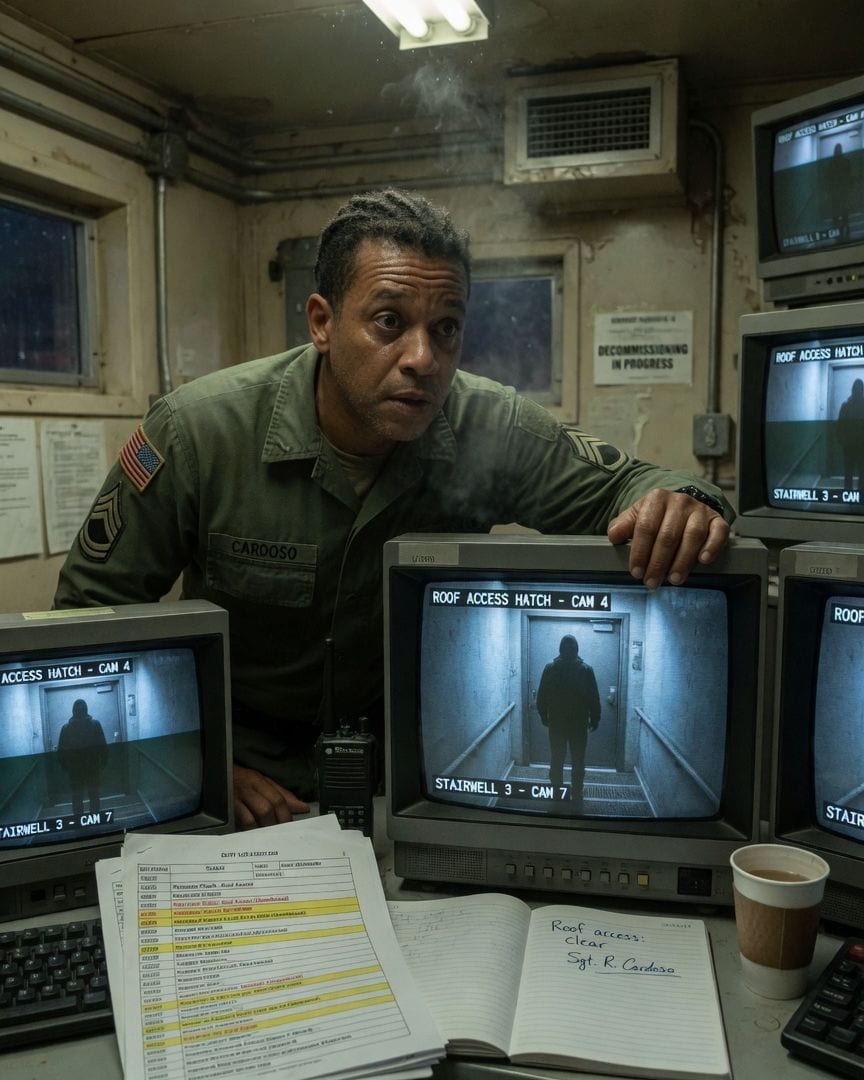
Sergeant Cardoso’s last tour log showed an unknown ‘Operator 73-Delta’ confirming a breach he had just cleared.
Sergeant Rui Cardoso stood his final interior post at Outpost 73, watching monitors through the dead hours, his tour almost over. At 0300, a dark figure flickered on the roof access camera, unmoving, only to appear closer, inside the sealed stairwell, after his team reported the area clear. Shaking off the glitch, he checked his digital duty log, where an entry from two nights prior, identical time, showed an unknown 'Operator 73-Delta' confirming an "unauthorized perimeter check" he had personally cleared. The system insisted on an operator and an event that simply could not exist, logged at the exact moment his own records verified an all-clear. Who was 'Operator 73-Delta,' and how could a sealed base's system confirm their actions?
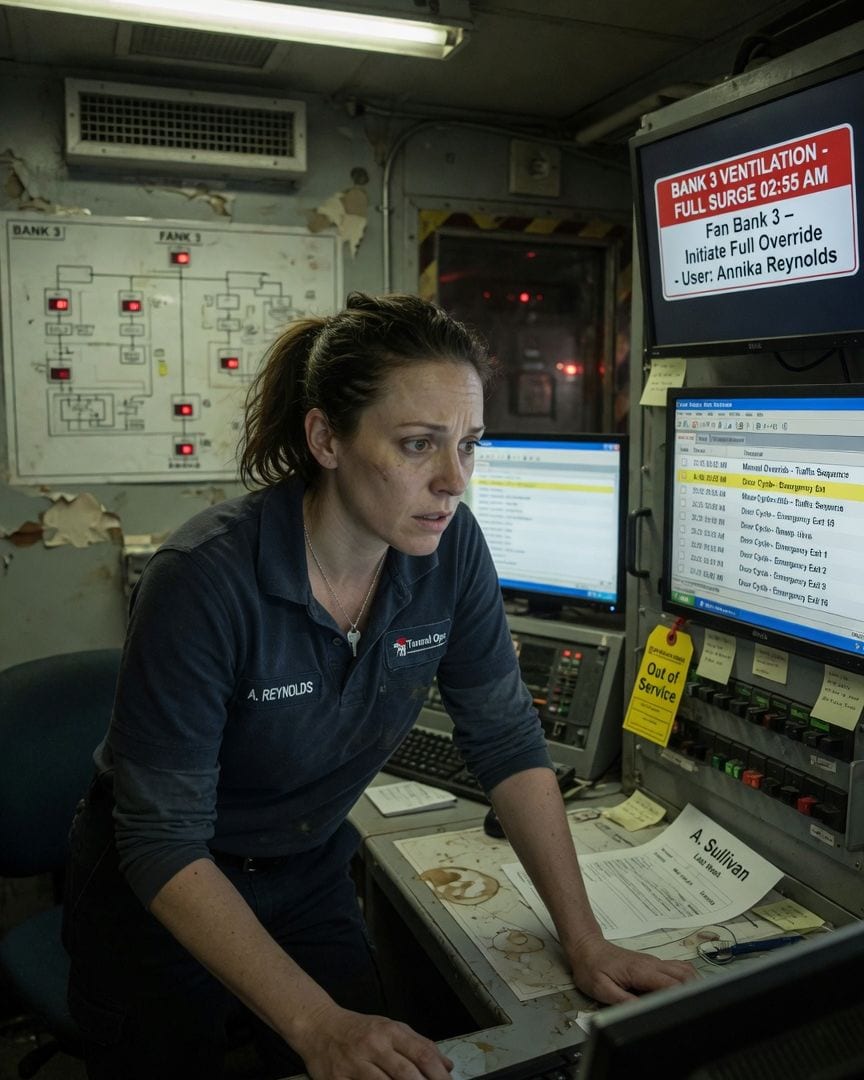
My tunnel control log shows dead fans ran at 2:55 AM, stamped with my user. The whole ventilation bank was tagged out for service, but airflow sensors recorded the surge anyway.
Working alone in the tunnel control room, I found my user ID logged for a system override I didn't make. Digging deeper, I discovered other inexplicable commands from an unknown user, 'A. Sullivan.' The problem? No one named A. Sullivan works here, according to any official record.
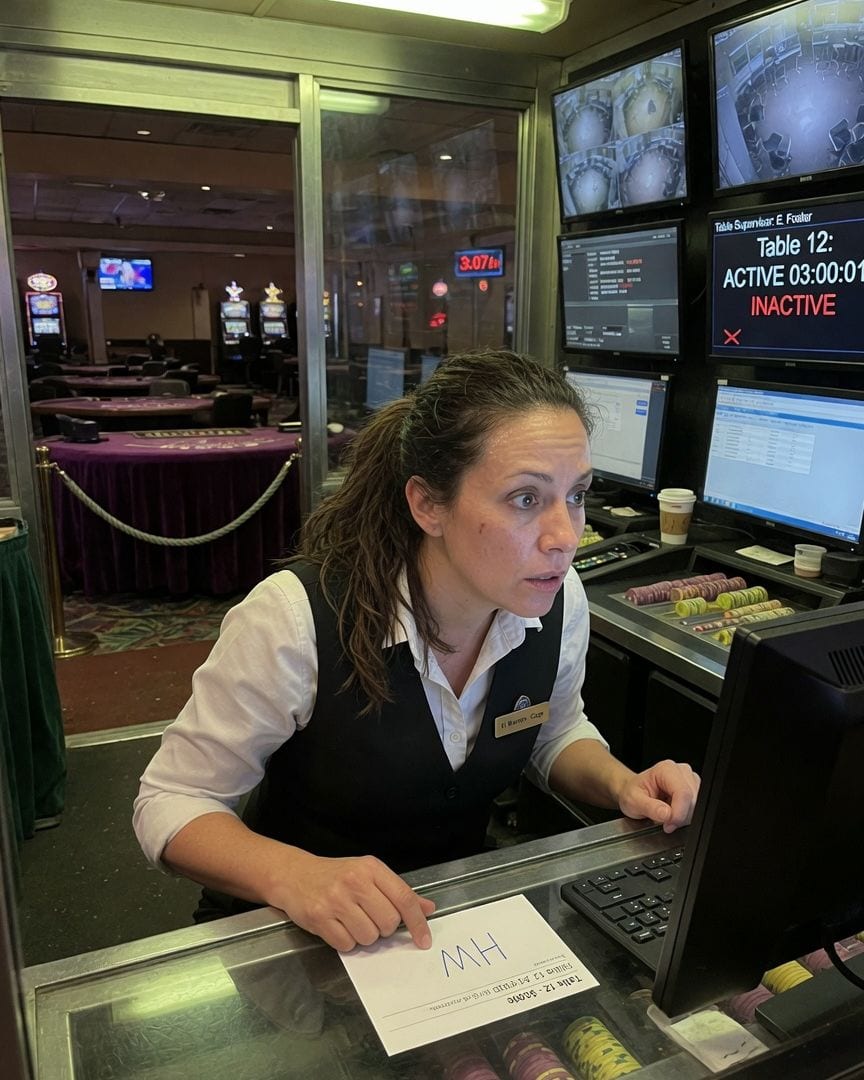
My name signed a fifty-thousand dollar casino fill to a dark, roped-off table. The cage is short by that exact amount. I never touched the slip.
Working the casino cage on a slow night, I logged off after counting my stack of chips. Then the system pinged: a $50,000 transfer to Table 12, closed for months, with my initials on it. The security feed showed my hand moving, making an imperceptible scribble, but I know I never touched a thing.
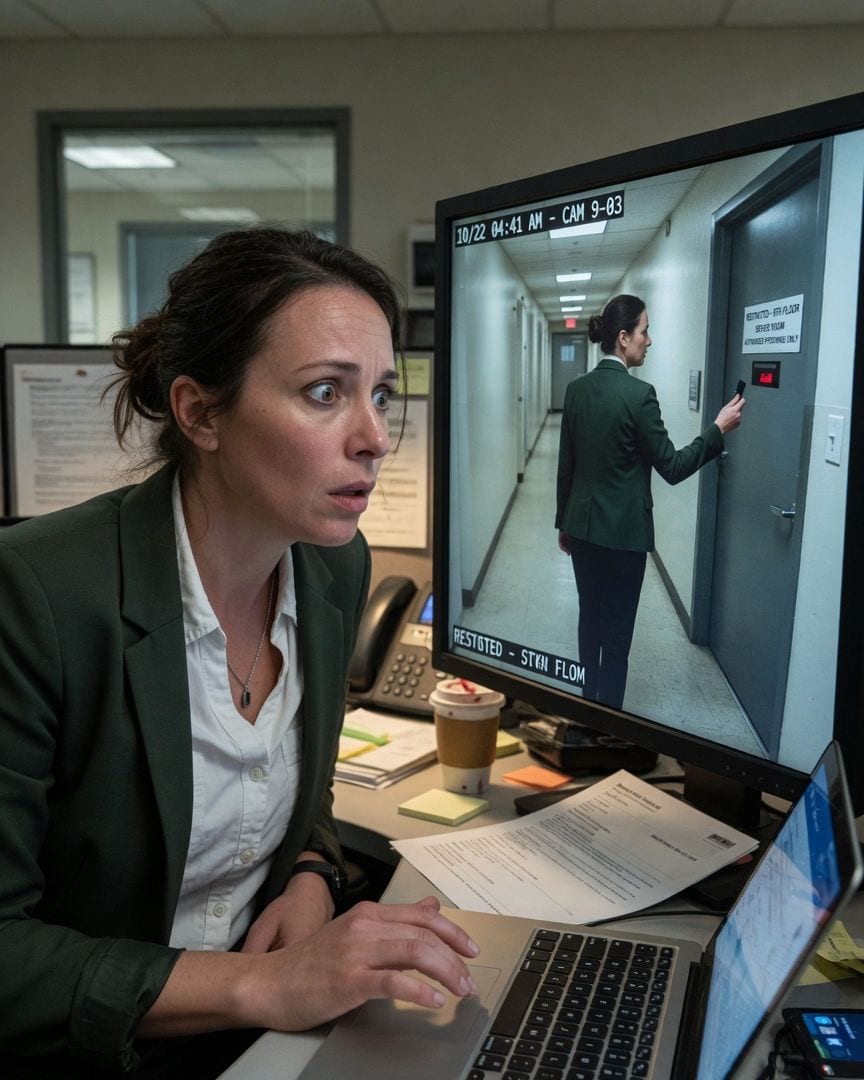
My keycard log shows me in the server room at 4:41am. I was asleep, and my badge was at home.
An email from corporate IT reveals my keycard registered entry into a restricted server room at 4:41 AM last Sunday. I was asleep in my apartment across town, my badge clipped securely to my jacket at home. But then I scrolled down and found eleven more impossible entries, all within the past week, all under my name.
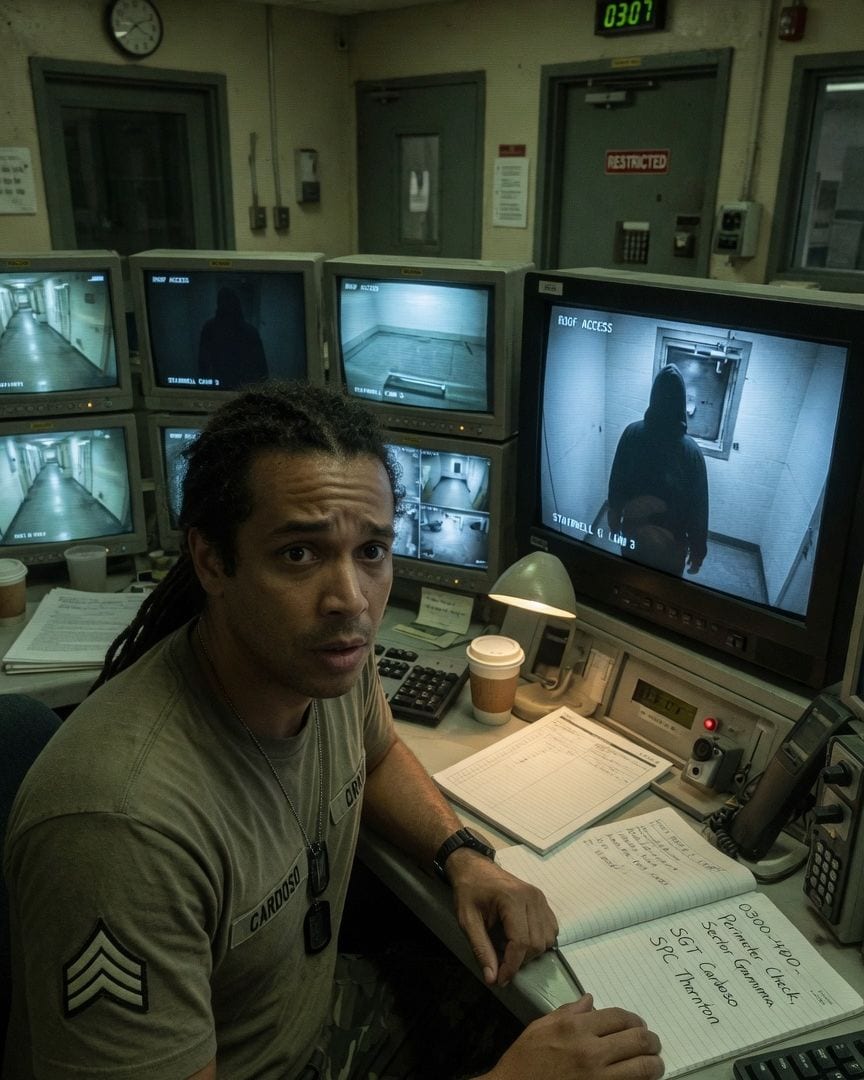
On his last watch, Sergeant Cardoso found his own signature in the duty log for a perimeter check he never did, with a name he didn't know.
Sergeant Rui Cardoso was on his final interior watch at Fort Merritt, a remote coastal outpost, as 0300 ticked by. He spotted a dark, unmoving figure on a monitor showing the sealed roof access, a figure that inexplicably shifted closer to the hatch moments after a specialist confirmed the roof was empty. Rui checked every log and sensor, but the digital fortress showed no breach, and the figure's appearance defied all logic. Yet, in the physical duty log, he found his own unmistakable signature on an entry for a perimeter patrol he never took, alongside a soldier's name he'd never seen. What impossible truth was written in his own hand?