Sergeant Cardoso’s last tour log showed an unknown ‘Operator 73-Delta’ confirming a breach he had just cleared.
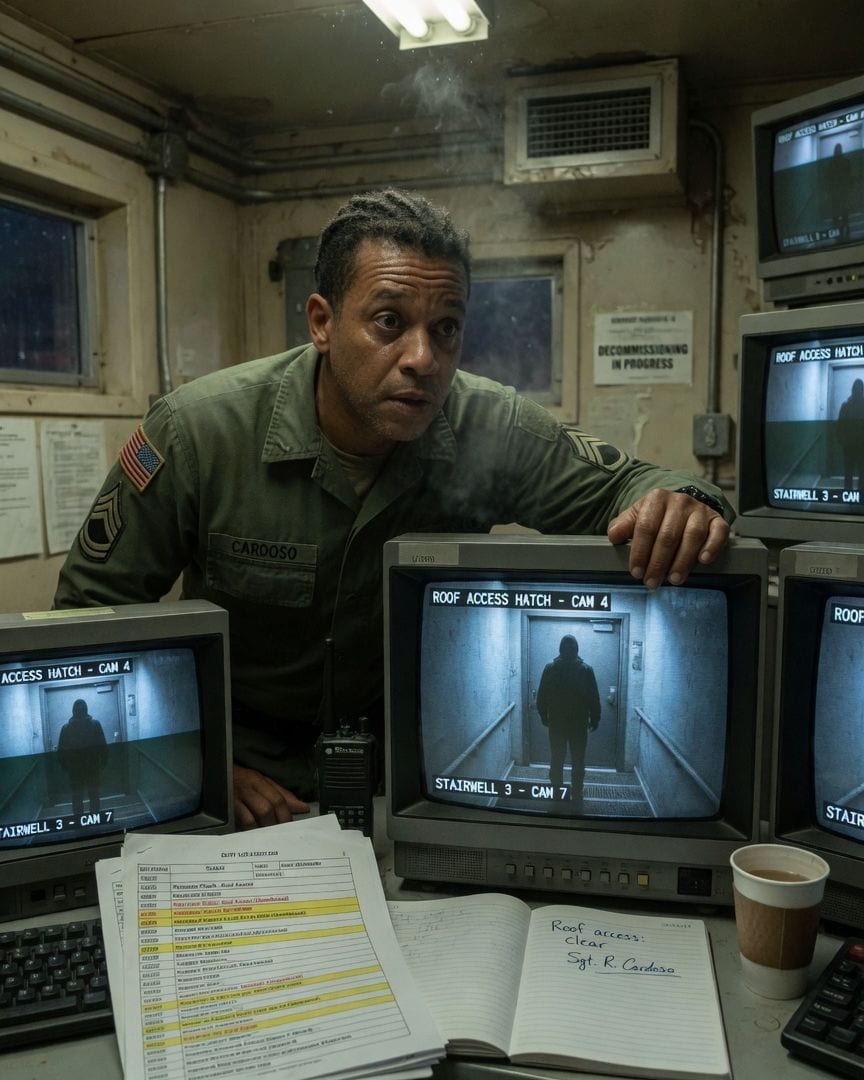
Sergeant Rui Cardoso stood the last interior post of his tour behind three doors of steel, watching the monitors through the small hours with the street outside long since dead.
His breath plumed faintly in the cool, recycled air of Outpost 73’s security hub, a familiar, metallic tang in the remote Nevada desert. At 0300, a faint flicker on monitor four, the feed for the sealed roof access hatch.
A figure, dark against the desert stars, stood at the far edge of frame, facing the door, not moving. Cardoso, a man of routine and rigid discipline, blinked, leaned closer, then checked his watch. 0300 on the dot.
He grabbed his comms. 'Control to Reaction Team One, this is Sergeant Cardoso. Possible perimeter breach, roof access. Check it.' Specialist Lily Drummond’s voice crackled back, crisp and professional. 'On it, Sergeant. ETA 90 seconds.'
He watched the monitor, the figure unmoving, a silent sentinel. The room hummed around him, a low thrum of electronics that usually felt comforting but now seemed to hold its breath.
The team reported the roof empty, the hatch dogged from his own side, its heavy steel seals unbroken. 'Negative contact, Sergeant. Clear.' Cardoso acknowledged, a frown etching his brow.
But when he looked back at the monitor, the figure stood one camera closer — at the top of the stairwell now, still facing the door.
Cardoso dismissed it as a glitch, a phantom image from a failing sensor in the base’s aging system. Such anomalies were common as Outpost 73 prepared for decommissioning, its systems taxed and neglected.
He ran diagnostics, purged the cache, but the faint, dark silhouette remained, now fixed on the stairwell camera, a persistent smudge against the digital feed.
The chill in the room seemed to deepen, settling in his bones despite the constant hum of the ventilation. He pulled up the digital duty log, scrolling back through the night's entries.
His own signature marked hourly checks: 'Roof access: clear. Perimeter: secure.' Below his latest entry, the system had automatically logged the reaction team's deployment, time-stamped just moments after his call.
He scrolled further, looking for any other anomalies, any precursor to the ghost on his screen. That's when he saw it. An entry from two days prior, same time, 0300. 'Perimeter Check – Roof Access (Unauthorized).'
It was flagged as a system anomaly, but beneath it, a verified action: 'Operator 73-Delta ID: Confirmed.' He’d never seen that ID before. He’d certainly never encountered an 'Operator 73-Delta' in his three years at the outpost.
It wasn't on any roster, any manifest. He checked the signature field. It was blank. Just the system-generated ID. He double-checked the date, the time.
It matched exactly when his own log showed him verifying the all-clear for the same roof sector. The system swore it had happened.
Cardoso felt a cold prickle on his neck, a sensation that had nothing to do with the air conditioning. He cross-referenced the 'Operator 73-Delta' ID through every database he could access: personnel, equipment, even classified project codes.
No match in the base's personnel database. No match in any military records he could access. Yet, the system had logged its 'confirmation.' He went back to his own log.
At 0300, two nights ago, he had personally logged the roof as clear. But the system insisted an 'unauthorized perimeter check' had occurred, immediately followed by the 'Operator 73-Delta ID: Confirmed' entry. And then, his own all-clear.
It was as if the system had accounted for something between his observation and his log, a ghost in the machine that was also a ghost in the record.
He stared at the digital duty log, the name 'Operator 73-Delta' glowing faintly next to an entry for an 'unauthorized perimeter check' at 0300, logged just minutes after he himself had cleared the roof.
His own signature was on the next line, verifying the all-clear, but the system showed an entry he knew could not exist.
Cardoso spent the next few days systematically reviewing Outpost 73’s security logs, focusing on the 0300 timeframe. The 'Operator 73-Delta' entries weren't isolated incidents.
They recurred, almost precisely every 48 to 72 hours, always at 0300, always associated with a 'system anomaly verification' or 'unauthorized perimeter check,' and always tied to one of the sealed access points.
Commander Donald Reynolds, Cardoso's superior, dismissed it as a programming ghost, a known bug in the aging network. 'Sergeant, your tour is almost done. Decommissioning will clear it all out. Don't chase phantoms.' But Cardoso wasn't convinced.
The figure on the monitor was too specific, too persistent. The security hub, usually a place of sterile order, now felt like a vault echoing with unspoken secrets.
He began cross-referencing the 'Operator 73-Delta' entries with the corresponding camera feeds, playing back the archives frame by agonizing frame. Each time, the figure appeared, moved 'one camera closer' to a sealed interior door, then vanished.
It never triggered motion alarms, never left physical traces, and never appeared on any other camera simultaneously. It was like a ripple in the data stream, a digital echo that the system itself was validating.
He started to notice a faint, almost imperceptible distortion on the camera feeds just before the figure appeared – a brief moment of pixelation, a subtle shift in light that the system would immediately correct, but not before the figure was there, moving through the base's perception, not physically traversing space.
It was a pattern, an impossible, terrifying pattern.
As Cardoso dug deeper, his unusual activity didn't go unnoticed. Commander Reynolds called him into his office, the air thick with unspoken tension. 'Sergeant,' the commander began, his voice low, 'your focus on these 'anomalies' is concerning.
We have a base to shut down, not a ghost hunt. I need you focused on the task at hand.' The commander's tone was sharper than usual, his gaze too steady, almost watchful.
The office felt suddenly smaller, the walls pressing in. Later that day, Cardoso found his access to certain archived logs temporarily restricted. A 'routine system update,' the message read, but he knew better.
He tried to contact Dr. Naomi Blackwood, a civilian contractor who had worked on historical site anomalies for the military years ago, whose name he'd found in an old maintenance report for Outpost 73.
Her line was disconnected, her official email bounced back. Undeterred, he remembered a dusty storage closet he’d passed on a supply run. He found it tucked away in a neglected corridor near the old boiler room.
Inside, amidst forgotten boxes of spare parts and defunct equipment, he found an old, physical copy of a base logbook from 1985. The cover was faded, the pages brittle.
Tucked between routine maintenance reports, he found a handwritten note, almost illegible, from a former sentry, a Franklin Abbott: '0300. Again. It's not a glitch. The system sees it. And it's getting closer.'
The entry was dated just weeks before Abbott's unexplained transfer out of Outpost 73. Someone had been watching his inquiries, and someone clearly wanted him to stop looking.
Cardoso ignored the warnings, the restricted access a challenge rather than a deterrent. He managed to circumvent the new restrictions using an old administrator bypass code he remembered from training, a relic from the base’s early days.
He finally located Dr. Blackwood’s current contact information through a public academic database, an obscure university in New Mexico. He reached her by phone, explaining the 'Operator 73-Delta' ID, the figure on the monitors, the strange, recurring log entries.
There was a long silence on the other end, punctuated only by the faint static of the desert connection. The line hummed, a thin thread connecting him to a world that knew something he didn't.
'Sergeant,' she finally said, her voice tight, strained, 'Outpost 73 isn't just a listening station. It's a containment system. It always has been.'
She explained that in 1978, a non-physical entity was detected, one that manifested only through electronic signals and disrupted data streams, registering as a 'presence' but lacking true physical form.
'The base was built around it, designed to isolate its signal, to prevent it from ever manifesting physically outside the perimeter. The 'Operator 73-Delta' is… it’s the entity itself.
The system was built to account for it, to confirm its presence within the containment field, not to keep it out. Your observations, Sergeant, mean the system is working as intended.'
Cardoso felt a cold dread bloom in his stomach, a visceral horror far beyond mere unease. 'So, the figure on the monitor… it’s not a breach? It’s… accounted for?' Blackwood confirmed it. 'Every 0300, it tests the system's perception.
The system logs its 'movement' as a verification of its containment. It's the accountability that cannot be denied, the proof it's still there, still contained.'
The entries in the old logbook, the subtle pixelation on the feeds, the figure moving from camera to camera—it all clicked into a horrifying, coherent pattern, a logic that felt far more terrifying than any random haunting.
Cardoso felt a wave of nausea, the truth hitting him with the force of a physical blow. The system wasn't failing; it was working. Every 'unauthorized perimeter check' was a confirmation of containment.
Every 'Operator 73-Delta' entry was the system actively logging the entity's presence, ensuring its 'accountability.' But then, a new thought, chilling him to the bone. 'What happens when the base is decommissioned?' he asked Blackwood, his voice barely a whisper.
'What happens when the system is shut down?' Blackwood hesitated. 'The original protocols… they were very specific about an unbroken chain of accountability.
If the system fails to log its presence, if it stops accounting for 73-Delta… then the containment is broken. And there are contingency protocols, Sergeant. Very old ones. Very severe.' Her voice was like a cold breath in his ear.
She then told him about a hidden, encrypted section of the base's central monitoring system, a 'secondary protocol' that only the original engineers and a few high-level commanders ever knew about.
'It's the true record,' she said, her voice dropping to a whisper. 'The one that shows how long they've known, how deeply this anomaly has been integrated into the very fabric of Outpost 73.'
Dr. Blackwood, her face pale even through the grainy video call, brought up a hidden system sub-menu on her terminal, revealing a cascade of identical 'Operator 73-Delta' log entries stretching back to 1978, each timestamped precisely at 0300, each showing the entity moving 'one camera closer' within the base's perimeter, a perfect, unbroken record of an impossible presence.
The screen pulsed with decades of data, a horrifying testament to the entity's continuous, accounted-for presence. 'This isn't just a log, Sergeant,' Blackwood explained, her voice hushed, 'this is the system confirming its own success.
The movement from camera to camera, the 'unauthorized checks'—it's 73-Delta interacting with the perception grid, verifying it's still 'inside.' The decommissioning sequence, which Outpost 73 is currently undergoing, will require a final, manual verification of containment, a complete system shutdown.
If that chain is broken, if 73-Delta is no longer accounted for, the system assumes a breach.' Cardoso looked at the endless scroll of data, the weight of years pressing down on him.
The stale air of the security hub now tasted like dust and impending catastrophe. 'And the contingency protocols?' Blackwood sighed, a sound of profound weariness. 'They call for a total, irreversible eradication of the affected zone.
The base, everything inside it, including anyone still present. To ensure the anomaly cannot manifest physically and spread beyond the perimeter.' He realized the figure on the monitor wasn't just a contained entity; it was a ticking clock.
The base wasn't being decommissioned to be quietly shut down; it was being prepared for an ultimate, final act of 'containment' that would destroy it and everyone in it, if the system's 'accountability' failed.
He remembered Commander Reynolds' strange intensity, the restricted access, the hushed warnings. They weren't trying to hide a glitch; they were preparing for the final, devastating protocol, a sacrifice to maintain an impossible secret.
Cardoso knew he had to act. He confronted Commander Reynolds in the operations center, the full truth of the 'Operator 73-Delta' protocols laid bare, the evidence from Blackwood's screen displayed on a secure tablet.
Reynolds, his face grim, confirmed Blackwood's words. 'It's the only way, Sergeant. The original mandate. We ensure containment, no matter the cost. It's what Outpost 73 was built for.'
The final shutdown sequence was scheduled for 0300 the following morning, a mere eight hours away. The operations center, usually bustling, felt eerily quiet, the distant hum of servers a funeral dirge. Cardoso refused to accept it.
He knew a retired Colonel, Vincent Vaughn, who had been the base's first CO in 1978. He tracked Vaughn down to a quiet retirement community in Arizona, reaching him by phone.
Vaughn, old and frail, listened patiently to Cardoso's frantic explanation. 'They never told you the real purpose, did they?' Vaughn's voice was raspy, laced with decades of regret. 'The containment wasn't just about keeping it in.
It was about understanding it. The entity, 73-Delta, it feeds on observation, on being accounted for. The more the system registers its presence, the stronger it becomes, but also the more predictable.
My original protocol was to starve it of observation, to let it fade. But they deemed it too risky. They chose active containment, continuous verification. A system built to confirm its own failure, really.' Cardoso saw a desperate chance.
If he could disrupt the final verification, if he could create a blind spot in the system's accountability at 0300, he might be able to break the cycle without triggering the eradication protocol.
He knew the precise sequence to create a temporary, untraceable system 'void' in the primary logging array, a gap in perception. It was a risky, insubordinate move, treasonous even, but the alternative was annihilation.
As the clock ticked towards 0300, Cardoso returned alone to the security hub. He initiated the void, a complex series of commands designed to create a brief, but critical, gap in the system's perception of 'Operator 73-Delta.'
He watched the monitors, his heart hammering. 0300 came and went. For the first time, no figure appeared on the roof access camera, no movement, no 'Operator 73-Delta' entry in the logs.
The system, for a single, terrifying moment, registered nothing.
The decommissioning of Outpost 73 proceeded, albeit with a palpable, nervous energy. Commander Reynolds, though furious at Cardoso's insubordination, could not argue with the results: the dreaded eradication protocol was never triggered.
The base’s systems were shut down without incident, without any final, catastrophic flash. The desert wind whispered outside, carrying no answers, only silence.
Cardoso received a disciplinary transfer to a remote administrative post, his career effectively stalled, his records quietly flagged.
Dr. Blackwood quietly published a paper on 'anomalous data stream persistence and containment ethics' that raised a few eyebrows in academic circles but was largely ignored by the military establishment.
The base was eventually sealed, its heavy steel doors welded shut, a monument to a forgotten secret in the vast, empty Nevada desert. The silence it left behind was profound, and to Cardoso, deeply unsettling.
Sergeant Cardoso found himself staring at a new set of monitors in a quiet, windowless room in a processing center in Utah, logging routine supply manifests.
He often thought of the desert outpost, the cold metal, the figure moving in the dark. He knew the base was sealed, the system shut down.
He had broken the chain of accountability, created the void, freeing himself and the base from the eradication protocol.
But sometimes, in the deepest hours of the night, when the hum of the servers was the only sound, he would feel a faint, almost imperceptible shift in the air, a sense of something close by.
He would glance at the blank screens, half-expecting a flicker, a dark silhouette at the edge of his perception, forever searching for a system to account for it, a new network to inhabit.
The truth was, he realized, he had only made it truly free.
A year after Outpost 73 was sealed, a single, flickering image appeared on a dark web forum, posted by an anonymous user: a grainy, black-and-white figure, standing at the edge of a desert road, facing the camera, not moving.
'Is this thing still looking for an entry?' the caption asked.
If this one got to you
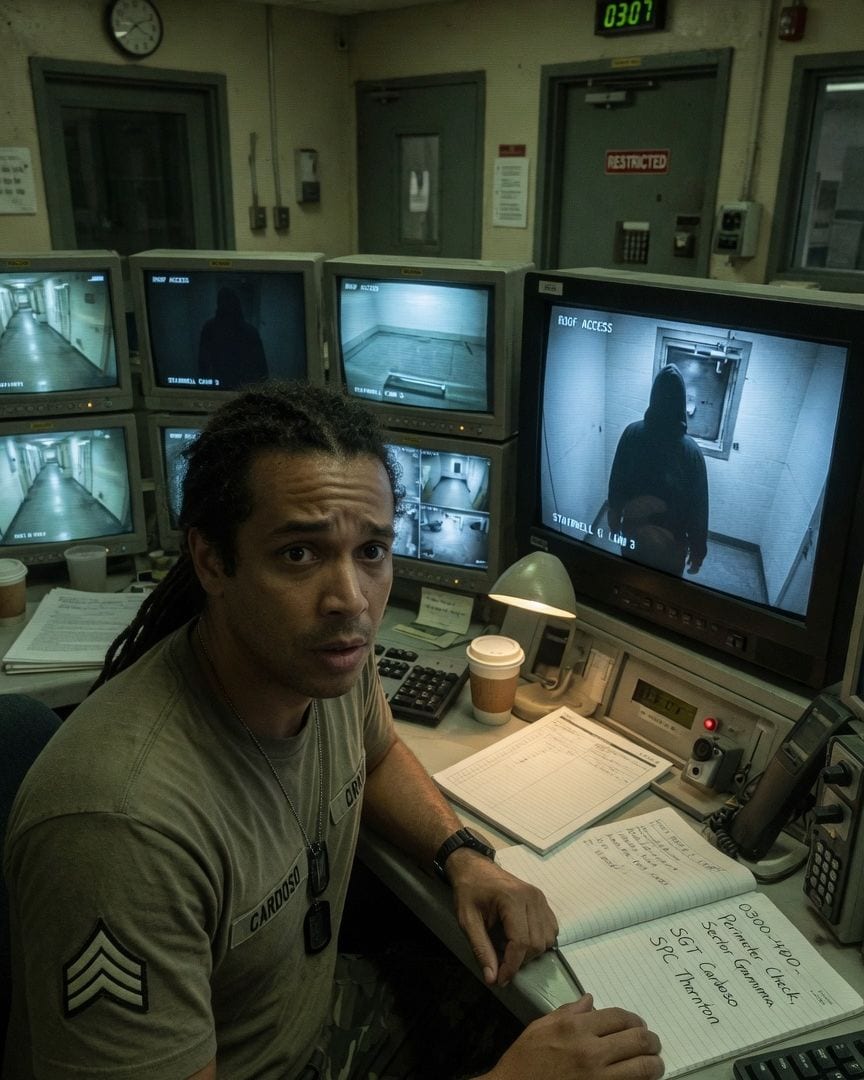
On his last watch, Sergeant Cardoso found his own signature in the duty log for a perimeter check he never did, with a name he didn't know.
Sergeant Rui Cardoso was on his final interior watch at Fort Merritt, a remote coastal outpost, as 0300 ticked by. He spotted a dark, unmoving figure on a monitor showing the sealed roof access, a figure that inexplicably shifted closer to the hatch moments after a specialist confirmed the roof was empty. Rui checked every log and sensor, but the digital fortress showed no breach, and the figure's appearance defied all logic. Yet, in the physical duty log, he found his own unmistakable signature on an entry for a perimeter patrol he never took, alongside a soldier's name he'd never seen. What impossible truth was written in his own hand?
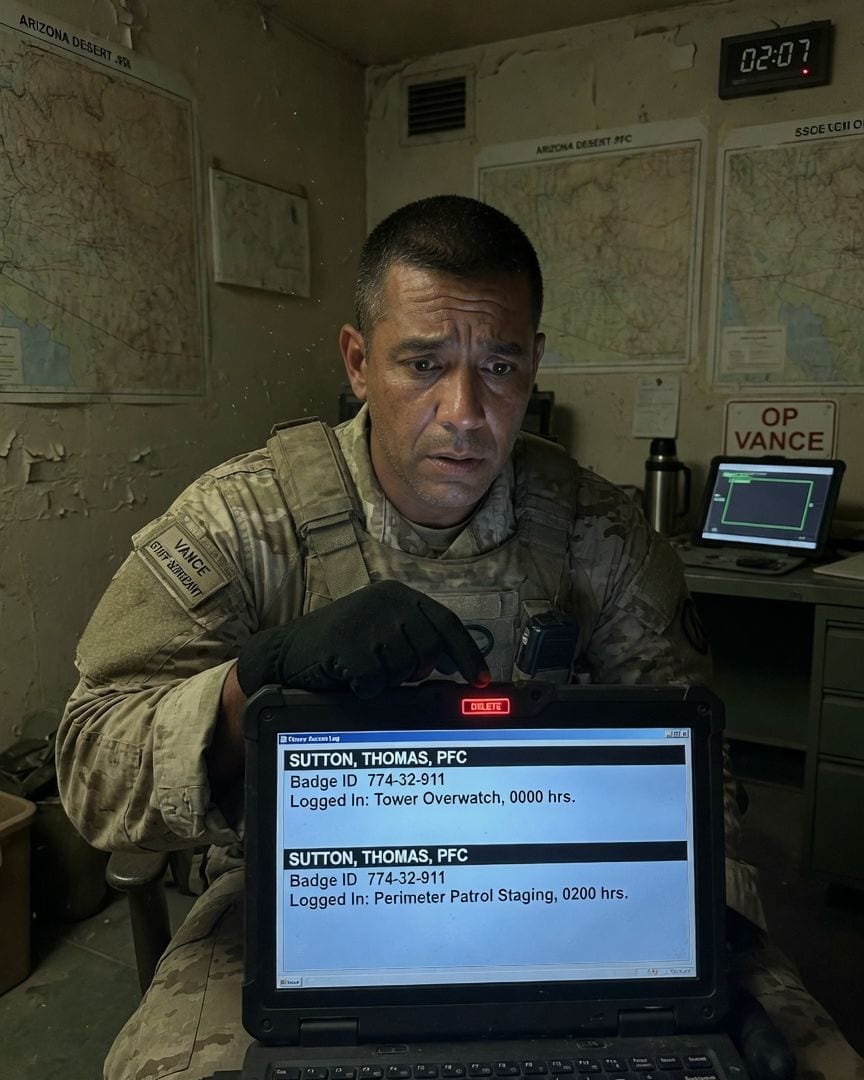
Two weeks from his rotation's end, Staff Sergeant Vance saw a fourth man report for patrol. The system then logged the same soldier in two places at once.
Staff Sergeant Eric Vance, 32, was just two weeks from finishing his rotation at Observation Post Vance, a lonely cluster of buildings in the Arizona desert. At 0200, scanning his thermal tablet for the perimeter patrol shift change, he expected three men. Instead, a fourth figure in full desert camo fell into line, moving with practiced efficiency. This Private First Class answered to the name Thomas Sutton, a soldier Vance knew was already logged in the tower on overwatch. Vance's rational mind struggled until the digital access logs confirmed an impossible truth: two identical entries for PFC Sutton, same ID, same timestamp, but from two distinct physical locations.
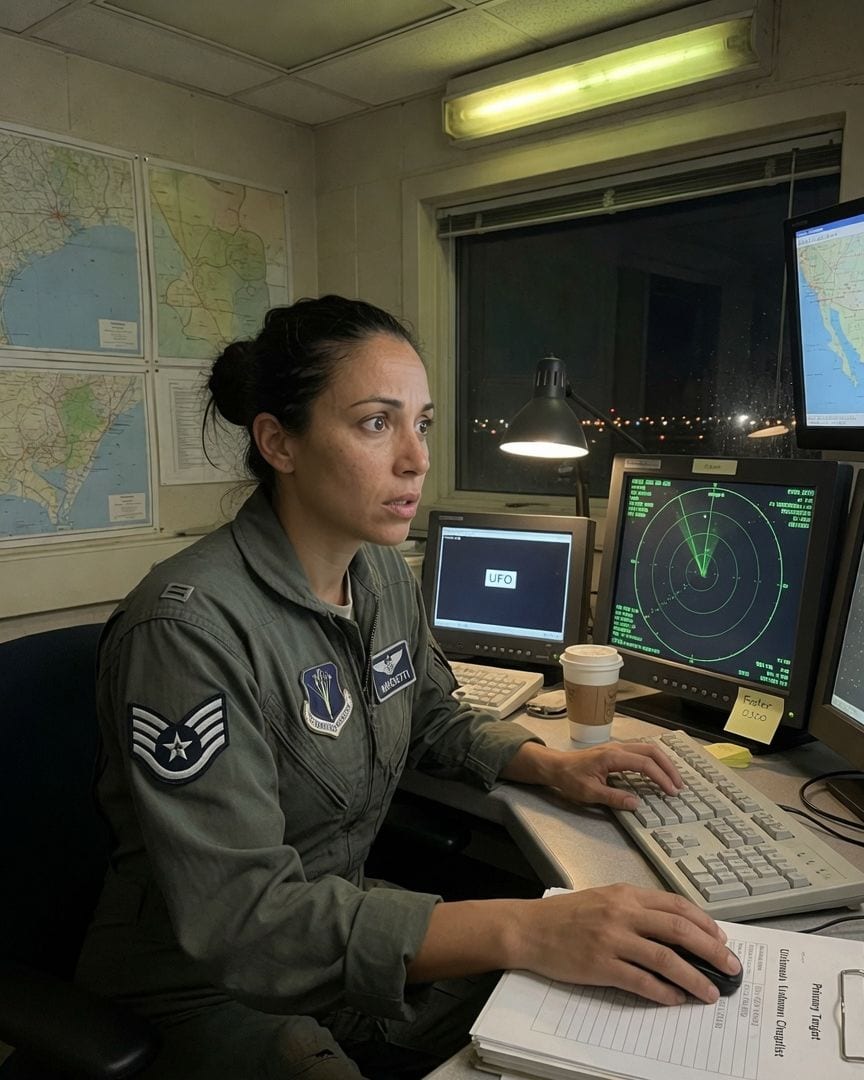
A radar operator watched a second blip, twice its size, merge into a plane on her screen. Her report was filed under a pre-existing, locked 'Special Handling' code.
Technical Sergeant Odile Marchetti sat alone in the dim radar room, her watch a final vigil for a base winding down along the silent Gulf Coast. At 02:17, a pilot reported a 'companion' on his wing, but her screen initially showed nothing. Then, a second blip bloomed, twice its size, before merging impossibly into the first and continuing its flight path without a ripple. She logged it as a UFO, only to discover the system already had a designated category for such anomalies – a pre-approved slot for the unexplained. A week later, her incident was re-categorized under a locked 'Special Handling' code, creating a new, inaccessible folder in her own personnel file.
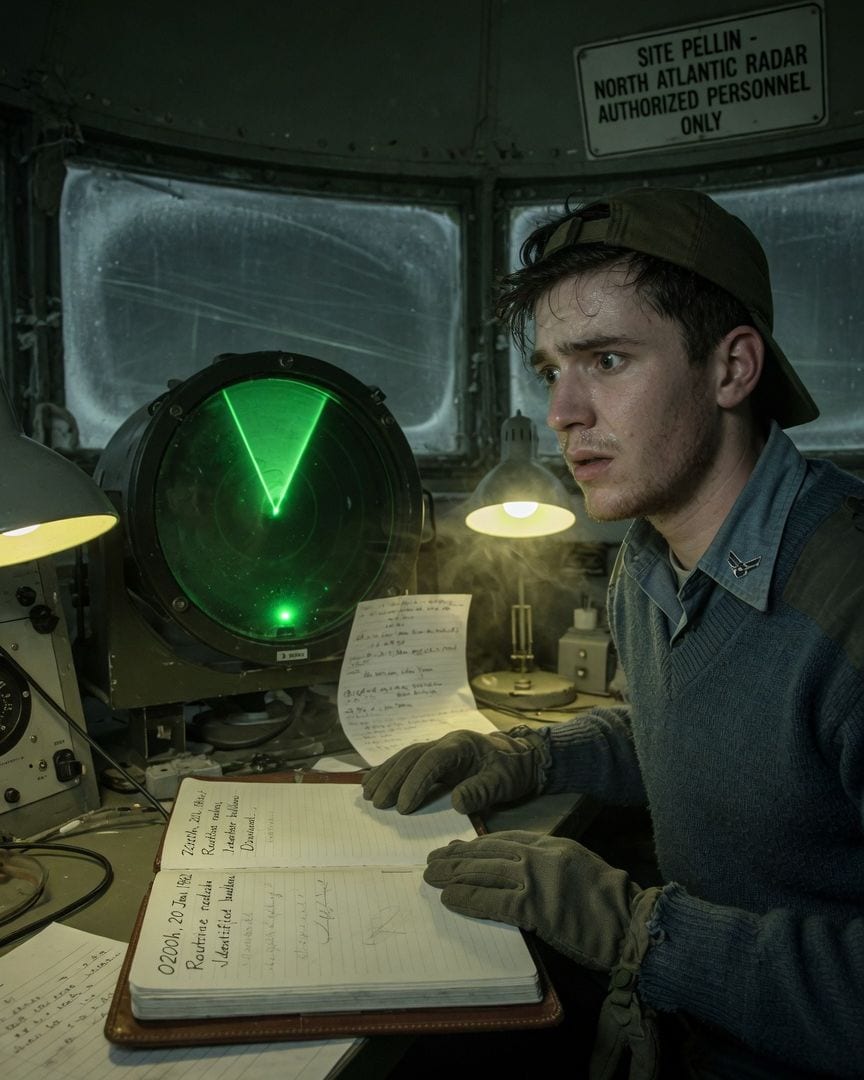
Nine days from closing, Cold War Site Pellin's Airman Vance watched his radar track a solid blip moving closer, dead in open sea where nothing could exist.
In the dimly lit dome of Site Pellin, Airman Ordway Vance, just days from discharge, ran his final radar sweeps before the base closed for good. Outside, the North Atlantic wind howled, but inside, only the hum of his console broke the silence. His last calibration had been clean, yet a single, unwavering green blip appeared on the scope, forty miles out, in open water where no vessel should be. The impossible return moved closer with each sweep, defying all logic and other sensors, until it sat static just beyond the coast fence line. What unseen presence did the radar truly hold in its unwavering green grip, contradicting the official record?
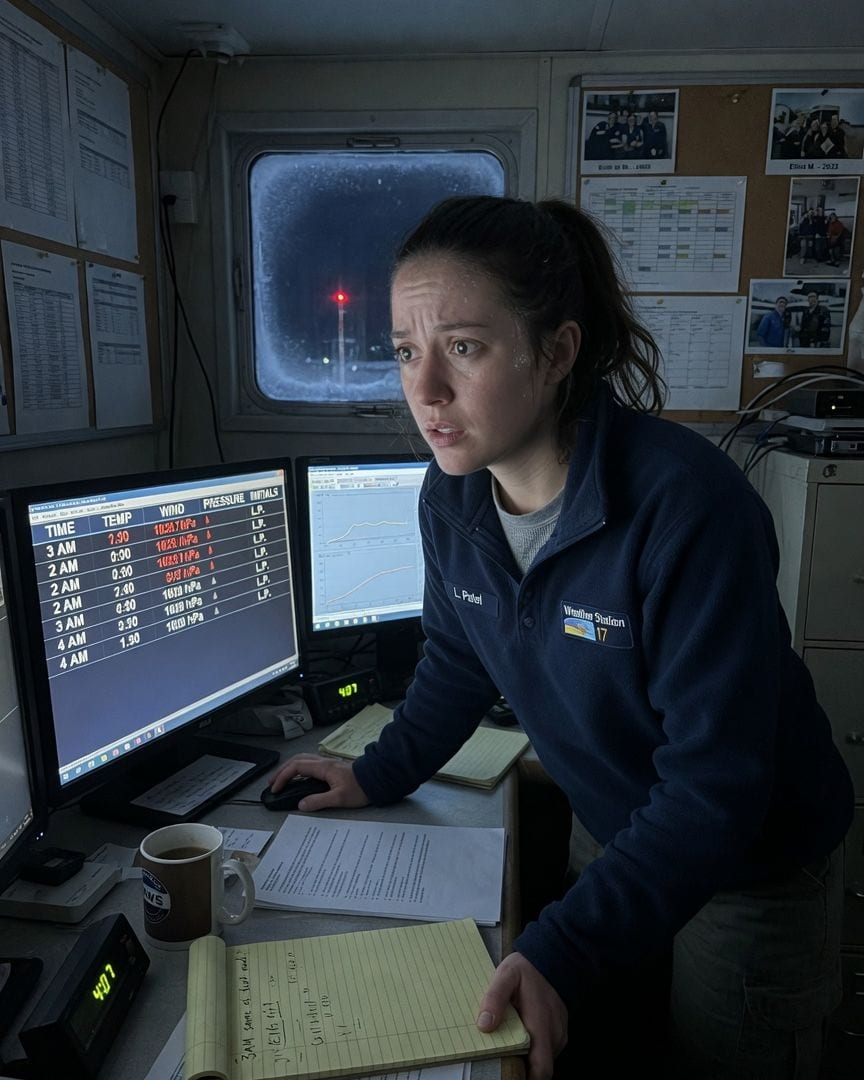
My weather station's 3 AM log shows a pressure reading I never made. My initials are on it, but the dials were dead still.
Working the overnight shift at the remote weather station, I routinely checked the digital logs. The 3 AM entry showed an impossible barometric pressure spike, a hurricane that simply hadn't happened. I distinctly remembered being outside at that time, calibrating a sensor, not making that entry. Yet, my initials, L.P., were clearly logged next to data I never made.
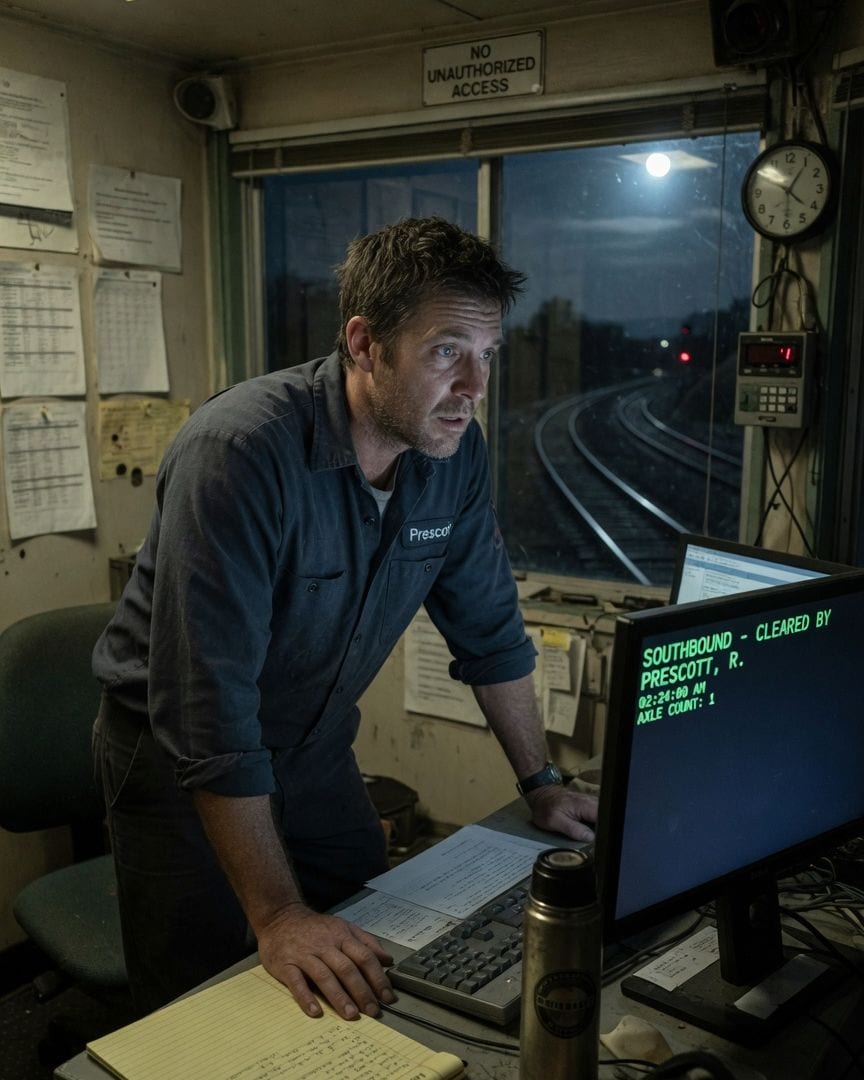
My signal box log shows I cleared a southbound train at 2:24 AM. No train was booked, but the wheel counter ticked over once.
My night shift in the signal box is usually quiet, just the hum of the panel and distant trains. But at 2:24 AM, a log entry for a southbound train appeared on screen, cleared by my name, even though I hadn't touched a thing. A cold prickle ran up my neck when the wheel counter ticked once, confirming an impossible passage on the empty tracks.