A communications specialist saw his last line go dead. Then the old Cold War field phone rang with a voice from 1966, naming a man freshly signed into his current shift log.
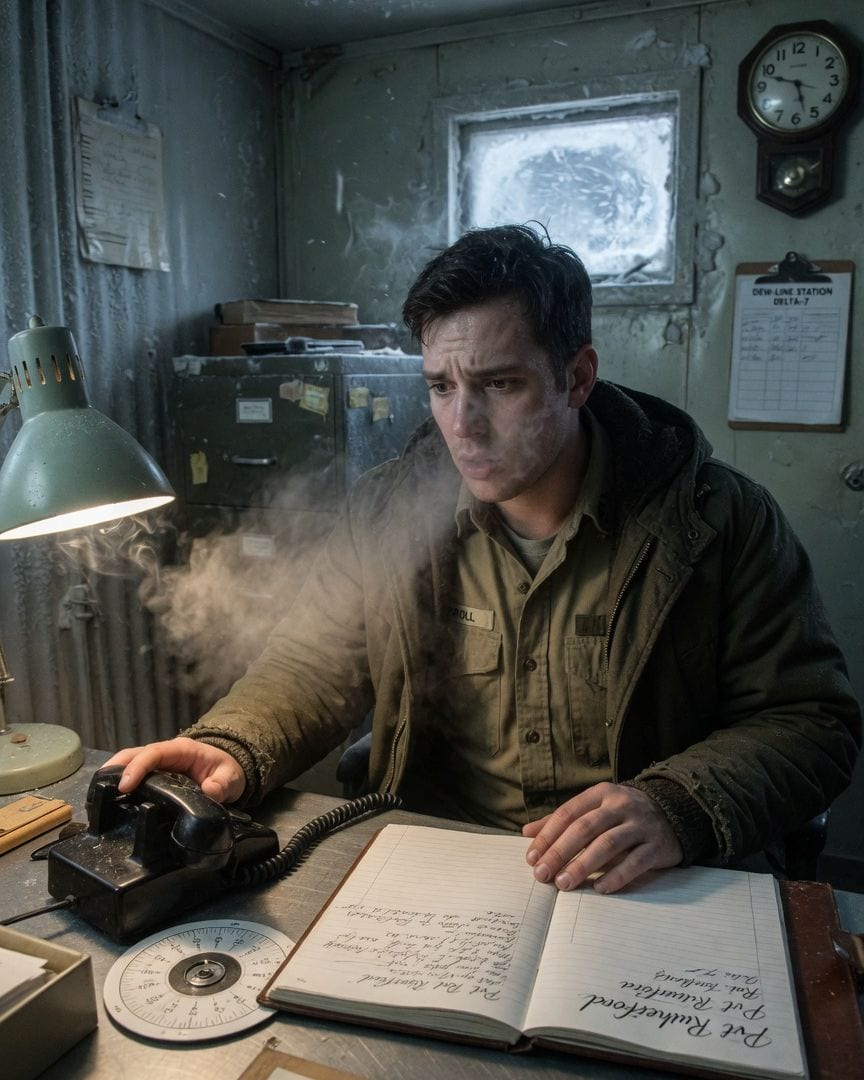
Specialist Walter Kroll, 26, shivered in the frigid communications room of DEW-line Station Delta-7, deep in the Arctic. A blizzard of historic proportions had been raging for three days, cutting the station off completely.
Earlier that afternoon, Kroll had watched an entire section of landline pole come down in the wind, severing the last hard-wired connection to the outside world.
He’d personally reported it to Commander Barlow, 40, before settling in for his night watch. Now, past midnight, the old field phone at his position began to ring.
It was a low, insistent buzz, impossible from a line he knew was dead. Kroll hesitated, then picked up the heavy receiver. The line hissed with static, then a clear, calm voice spoke.
It was a duty officer Kroll didn’t recognize, reading off a wake-up time and a watch rotation for a crew roster that matched no one currently assigned to Delta-7.
The voice paused, then added, “And tell Private Rutherford his gear check is at oh-five-hundred.” Kroll frowned, his breath fogging in the cold air. No Private Rutherford had ever served on Delta-7, at least not in his two years here.
He hung up, the handset feeling impossibly cold in his hand, and the low buzz of the dead line continued, a faint thrum beneath the howl of the storm.
Kroll tried to rationalize it: a prank, a crossed wire from some ancient, forgotten system, sleep deprivation. But the voice had been too clear, too official, too specific.
He pulled out the station’s main logbook, a thick, leather-bound tome, and flipped through the current day’s entries. No Rutherford. He checked the last month, then the last year. Nothing. The station was remote, but meticulously documented.
Every soul in and out was recorded. Kroll knew this system.
He remembered the duty officer’s precise, almost rhythmic cadence, and the specific names. He felt a chill that had nothing to do with the outside temperature.
He knew where the archived logbooks were kept: a dusty, unheated storage room in the basement level, filled with decades of records. Taking his flashlight, Kroll descended, the metal stairs groaning under his weight.
He found the shelf marked '1960-1970' and pulled out a volume for 1966. He flipped through, past weather reports and supply manifests, until he found the watch rotations for November.
His finger traced the entries, scanning for the names from the call. And there they were. Every single one. Including 'Pvt. Rutherford,' assigned to this exact comms watch, eleven years ago to the day.
The handwriting, a precise, almost calligraphic script, was identical to the one he’d heard on the phone. The dread tightened its grip, a cold knot in his gut. This wasn't a glitch. This was a record.
A record of a call he shouldn't have received.
Back in the comms room, Kroll laid the open 1966 logbook beside the current day's printed watch rotation sheet. He compared the names, the times. The pattern was unnerving.
He then looked at the current sheet again, specifically at the sign-in section for the shift that had just begun. His eyes caught on an anomaly.
Below the last living specialist’s signature, in a space that should have been blank, was another entry. A name, freshly inked. 'Pvt. Rutherford.' Beside it, the signature, a looping, old-fashioned script, perfectly matched the 'Pvt.
Rutherford' entry in the 1966 logbook open on his desk, a book he himself had just retrieved from deep archive storage.
The sound of the wind outside was the only thing moving, rattling the corrugated metal walls of the isolated station.
Kroll stared at the signature, then at the empty chair at the comms station. No one else was on duty. He checked the pen tray – a standard-issue ballpoint, no unique ink.
He tried to mimic the script himself, but his hand shook, the loops and flourishes impossible to replicate. He ran to Commander Barlow’s office, the blizzard still howling outside, shaking the very foundations of the station.
Barlow, a pragmatic man, dismissed it as a prank or Kroll’s fatigue. “Isolated stations, Kroll. Weird things happen. Someone’s messing with you.” Barlow, however, did agree to Kroll’s insistence on a full physical headcount.
The count came back as expected: 12 men. No 'plus one.' Kroll tried to explain the old logbook, the phone call, the impossible signature. Barlow merely sighed, “Correlation, not causation, Specialist. Get some rest.”
Unconvinced, Kroll started a meticulous, secret investigation. He began cross-referencing every station log from the last week – maintenance reports, supply manifests, mess hall sign-in sheets. He found small, almost imperceptible discrepancies.
A supply request for a specific type of radio tube that hadn't been used in years, filed under Barlow's ID, but Barlow swore he hadn't made it.
A maintenance report for a generator fault that hadn't occurred, logged for a time when Kroll himself had been performing a routine check.
Each anomaly, dismissed individually by others as a 'glitch' or 'clerical error,' started to form a faint, disturbing outline.
The pattern wasn't just about names; it was about the very operational fabric of the station, slowly, subtly, bending to an unseen will. Kroll felt the station itself was trying to tell him something, whispering through its own records.
As Kroll delved deeper, his late-night shifts in the archive became longer. He started to notice things.
A faint, metallic scent, like ozone and old oil, would sometimes fill the comms room when he was alone, a smell unique to the deep storage where the old equipment was kept.
He'd hear soft, rhythmic clicks from the old, decommissioned communication panels, as if they were still active, even though their power had been cut for years.
One night, while scrutinizing a 1966 weather report that eerily matched the current blizzard’s wind speeds, he felt a distinct drop in temperature behind him. The hairs on his neck prickled. He spun around, flashlight beam cutting through the dimness.
Nothing. But a shadow, too deep for the ambient light, seemed to linger at the edge of his vision, just outside the doorframe. He dismissed it as his imagination, frayed by lack of sleep.
The next morning, Kroll found a small, handwritten note tacked to his bunk locker. It read: 'Some things are better left undisturbed, Specialist. The system works.' No signature.
He immediately suspected Oscar Vance, 58, the senior communications technician, a quiet man who seemed to know every circuit and wire in the station, a man who had been here longer than anyone.
Vance had a peculiar, knowing look in his eyes whenever Kroll brought up the 'glitches.' Kroll felt the shift from investigator to target. Someone knew he was digging. Someone was watching.
The system wasn't just working; it was defending itself, or someone was defending it.
Kroll confronted Vance in the main generator room, the roar of the diesels muffling their voices. “Did you leave that note on my locker, Oscar?” Kroll demanded, holding up the slip of paper.
Vance, a wrench in his hand, barely looked up from the humming machinery. “Depends on what you mean by ‘leave,’ Walter. And what you mean by ‘note.’” His tone was flat, unconcerned. “I mean the warning. About leaving things undisturbed.
You know what’s happening, don’t you?” Kroll pressed, his voice rising above the din. Vance slowly set down his wrench. “Happening? The station is operating. As it always has.” He wiped grease from his hands with a rag.
“You’re seeing the patterns, aren’t you? The loops. The echoes.” Kroll felt a cold wave wash over him. “The 1966 roster. The phone call. The signature on the sheet.” Vance nodded, a faint, almost imperceptible smile touching his lips.
“Ah, Rutherford. He’s a regular. Always on time for his watch.” Kroll scoffed. “He’s not real. He’s a ghost from eleven years ago.” Vance chuckled, a dry, humorless sound. “Not a ghost, Walter. A presence. The station is… particular.
It records. It remembers. It repeats.” He gestured vaguely at the complex array of circuits and wires. “These old systems, they don’t just transmit signals. They resonate.
And sometimes, when the conditions are just right – extreme isolation, atmospheric pressure, the specific solar cycle – the resonance of a previous operational loop becomes… strong enough to manifest.
The station’s internal accounting system, its very core, starts to register the old crew alongside the new. It accounts for them. It logs them. It expects them.”
Kroll thought of the supply requests for obsolete parts, the phantom maintenance logs, the precise match of the old weather reports. It wasn't just a record; it was a re-enactment. Vance continued, his voice calm, almost educational. “Rutherford’s signature?
It’s the station’s own hand. The phone call? The station’s voice. It’s a closed loop, Walter. A perfect, self-sustaining system, ensuring continuity. Always has been. Always will be.” Kroll felt the world tilt.
The glitches, the errors, the impossible count – it wasn't a failure of the system. It was the system itself, working exactly as it was designed, just not in a way anyone understood.
Kroll tried to process Vance’s chilling explanation. The station wasn’t haunted; it was a machine caught in a terrifying, self-perpetuating cycle. The pattern across rotations or dates. He knew then that the 'plus one' in the headcount, the phantom Pvt.
Rutherford, was not just an anomaly, but a critical part of this repeating operational loop. Kroll retreated to the comms room, his mind racing.
He pulled up the station’s digital manifest, cross-referencing it with the daily physical headcounts from the past week. Every single day, the manifest recorded 13 personnel. Every single physical headcount, ordered by Barlow, returned 12. The discrepancy was always Pvt.
Rutherford, listed as present and accounted for, assigned to bunk 7, always due for the next watch rotation. As Kroll stared at the impossible number, the blizzard outside intensified, rattling the corrugated metal walls.
The emergency lights flickered, casting long, dancing shadows. Oscar Vance, his face unsettlingly calm in the flickering emergency light, slid a yellowed, hand-drawn schematic across the table.
It's a diagram of the station's original analog phone network, far more complex than the current digital system. Marked in pencil, at every junction point, is a small, handwritten date: 'NOV 1966.'
Below it, a scrawled notation reads: 'Cycle Re-Init. 11 yrs.' Vance looks directly at Kroll, a faint, almost imperceptible smile touching his lips, and says, “It’s not just the roster, Walter. It’s the whole damn station.
And it’s calling for its next.”
Kroll felt a cold dread settle deep in his bones. “Its next what, Oscar?” Vance picked up a soldering iron, its tip glowing faintly. “Its next loop. Its next caretaker.
The station needs someone to maintain the records, to ensure the continuity. To answer the calls.” He gestured to the old analog phone panel. “The physical lines, broken as they are, still hold a charge, a kind of memory.
During these deep freezes, when the station is truly isolated, the old system becomes dominant, overriding the new. It's not just a pattern, Walter. It’s a mechanism. The men from 1966, they’re not gone. They’re… part of the station now.
Their operational data, their very presence, is woven into its fabric. Pvt. Rutherford is merely the most persistent echo.”
Vance explained how the previous senior technician, a man named Carver, had understood this, quietly maintaining the old systems, dismissing the 'glitches' to outsiders. “He ensured the station’s mission, even as it consumed him.
He became part of the cycle, just like I have.” Kroll remembered Barlow’s easy dismissals, the way he’d been so quick to rationalize the impossible. “Barlow?” Vance chuckled. “He’s a good commander. He follows orders.
And the station ensures its orders are followed. It subtly influences the living, makes them dismiss what they can’t explain. It’s easier that way. Less… disruptive.” The ozone smell was strong now, the rhythmic clicking from the old panels louder.
Every clue Kroll had found, every impossible detail, snapped into horrifying coherence. The field phone ringing on a broken line, the names from the past, the impossible signature, the 'plus one' on the manifest – it all fit.
The station was a self-sustaining entity, using its own systems to perpetuate its existence and its phantom crew, with the living merely playing their part in the cycle.
Kroll stumbled back, the weight of Vance’s words pressing down on him. “You’re saying… you’re part of it? You’re keeping it going?” Vance nodded, his eyes strangely vacant, yet alert. “Someone has to. The station has a purpose.
It must remain operational. And for that, it needs its crew.” Kroll felt a surge of desperate anger. “I’m due for transfer! I’m going home!” Vance smiled, a slow, unsettling stretch of his lips. “Are you, Walter?
Or are you simply due for your next rotation?” The rhythmic clicking intensified, and the old field phone on Kroll’s desk began to buzz again, a low, insistent hum.
Kroll looked at it, then at Vance, whose gaze was fixed on the phone, a strange anticipation in his eyes. Kroll understood. The station was calling for its next. And he was the only one left to answer.
He lunged for the phone, not to answer it, but to rip it from the wall, to sever the connection, to break the cycle. Vance moved with surprising speed for a man his age, grabbing Kroll’s arm.
His grip was cold, unyielding. “Don’t fight it, Walter. It’s already here. It’s always been here.” Kroll struggled, but Vance’s strength was unnatural.
The buzzing of the phone grew louder, a vibrating hum that seemed to resonate in Kroll’s very bones. He could almost hear the duty officer’s voice, calm and clear, calling his name.
He wrestled free for a moment, his hand reaching for the phone, but Vance was on him again, his face inches from Kroll’s, his breath smelling faintly of ozone and old metal. “You’re a good specialist, Walter.
You’ll fit right in.” Kroll felt a profound chill, deeper than any Arctic cold, as Vance’s cold, strong hand closed over his own, guiding it towards the receiver, towards the insistent, rhythmic buzz.
He looked into Vance’s eyes, and saw not malice, but a quiet, ancient resignation. The phone continued to ring.
The blizzard eventually broke, and a relief crew arrived weeks later. Commander Barlow reported Specialist Kroll as having completed his tour and transferred out, despite no official orders or records for the transfer ever appearing.
Oscar Vance remained at his post, calm and efficient as ever. The station’s logbooks continued to be meticulously maintained, showing a consistent crew of thirteen, though physical headcounts still only ever found twelve living men.
The old analog field phones, deemed too obsolete for modern use, were left in place, their lines still ostensibly snapped, but occasionally, a faint, rhythmic buzz could be heard from them during the long, isolated Arctic nights.
Years later, when the DEW-line station Delta-7 was finally decommissioned and stripped for parts, the last technician to leave found a single, meticulously maintained logbook tucked away in a hidden compartment of the old comms desk.
Its entries were all in the distinctive, precise handwriting of Specialist Walter Kroll, detailing every watch rotation, every supply request, every weather report, spanning decades.
Its final entry, signed 'W. Kroll,' detailed a watch rotation eleven years in the future, with Pvt. Rutherford listed as present and accounted for.
If this one got to you
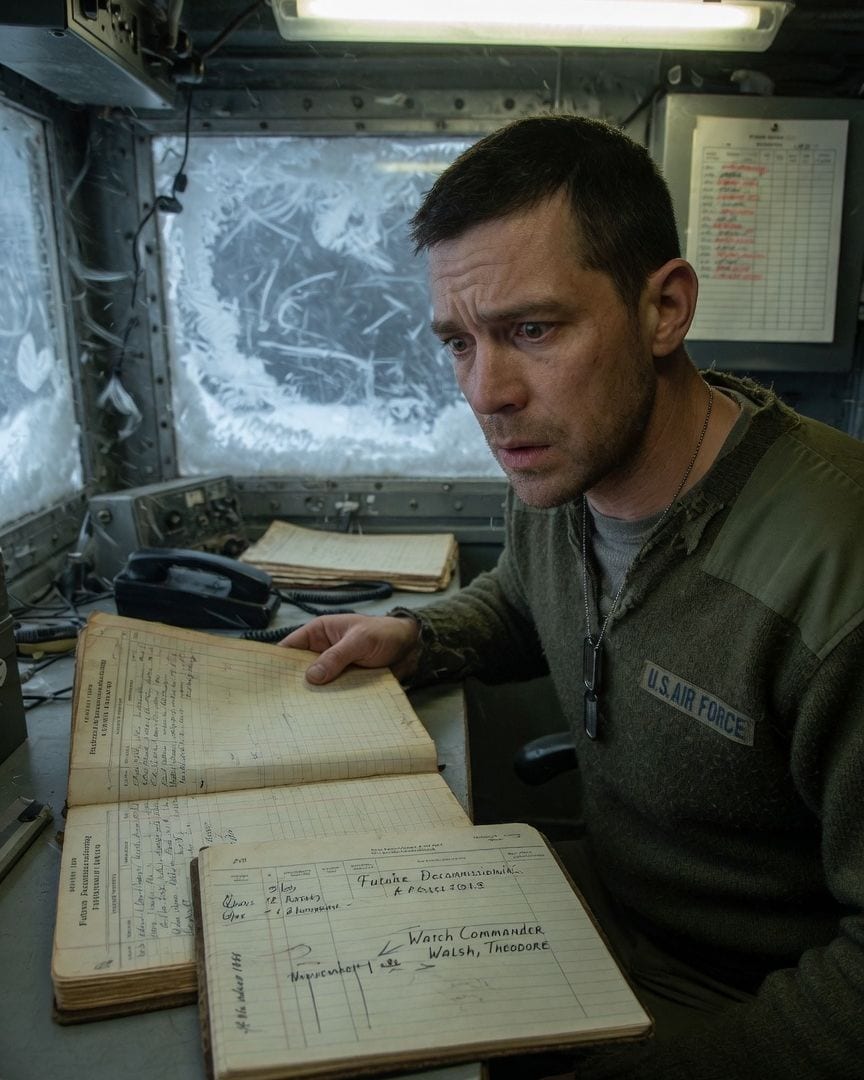
A Cold War DEW-line specialist's dead phone rings with a crew roster from eleven years ago, for a station that should be silent.
Specialist Theodore Walsh huddled in the radar shack, isolated by an Arctic storm that had severed the station's landline, leaving him cut off from the world. Suddenly, the field phone on his console, connected to that very dead line, rang with a sharp, insistent clarity. A voice crackled through, reading a watch rotation for a crew roster Theodore didn't recognize, names that didn't belong to anyone on the remote outpost. As he searched old logbooks for answers, he found those exact names listed for this station, on this date, eleven years prior, as if they had never left. But the true chill came when he saw his own name, assigned to a watch in a logbook dated eleven years in a future that couldn't possibly exist.
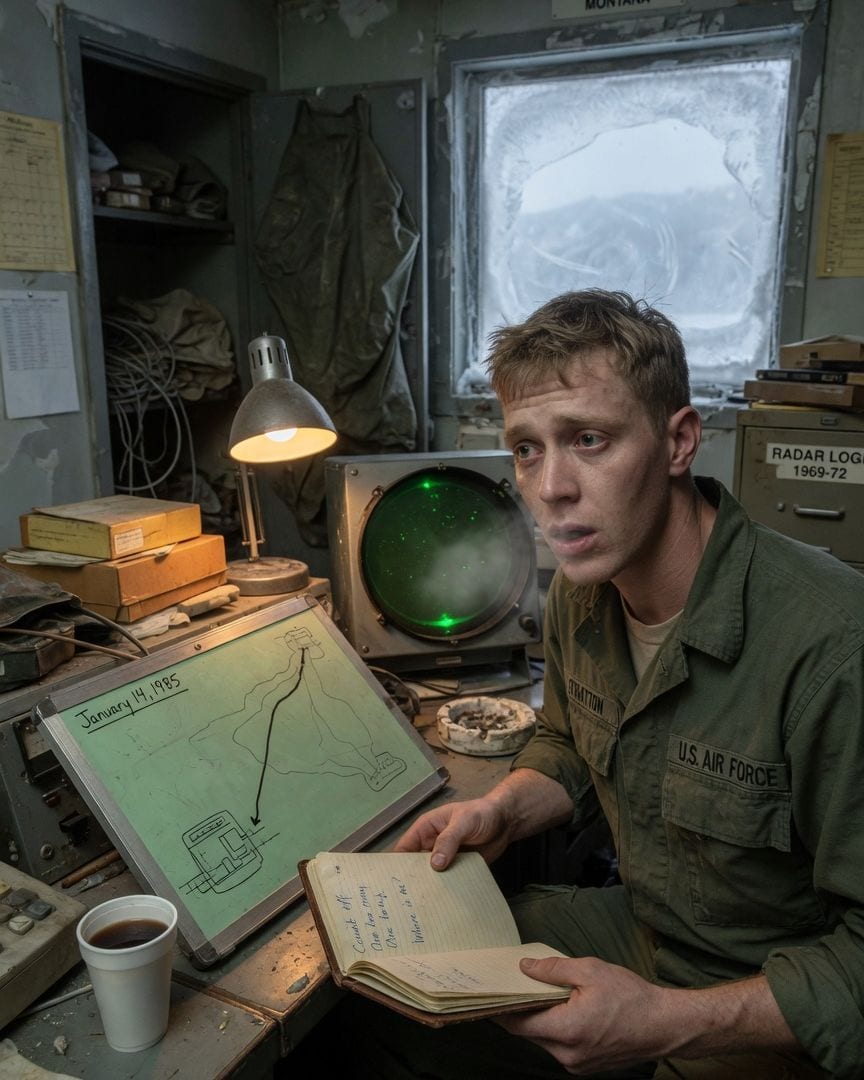
Airman Lars Stratton found an old Cold War manifest listing one name twice: 'Bernard Radcliffe' transferred and 'Bernard Radcliffe' still present.
Airman Second Class Lars Stratton was counting down his final weeks at Echo Station, a desolate Cold War outpost due for mothballing. He longed for home, far from the bitter Montana winds and the constant hum of static. Inside the dim radar shack, he logged the usual nightly ghost blip, a faint contact appearing at 2300, just as it had every winter since 1987. This night, a metallic tang like old blood lingered in the air, raising the hairs on his arms. Seeking distraction, Lars later discovered a leather-bound logbook from 1971, detailing the same 2300 contact, but with chilling notes and a manifest listing one airman's name, Bernard Radcliffe, twice—once transferred, once present. Was he truly alone in the silent, remote station?
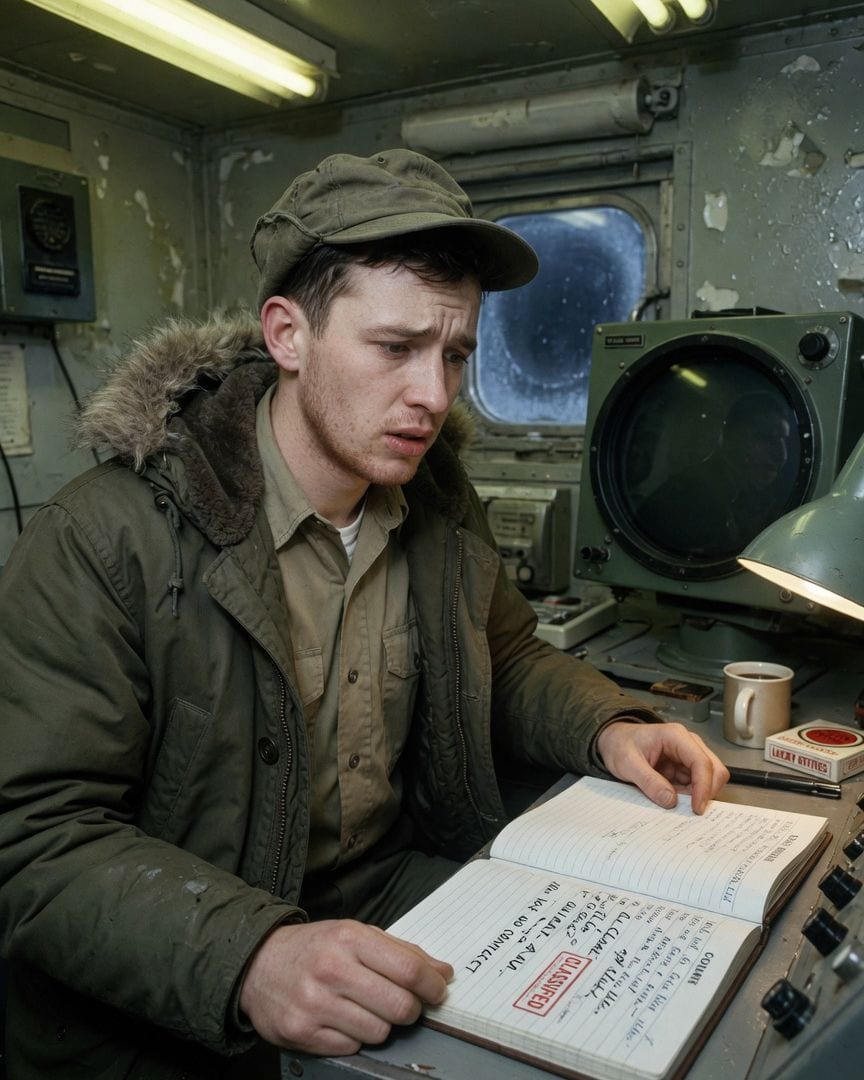
A Cold War airman logs an impossible radar contact on his last sweep. But his official logbook entry is stamped 'CLASSIFIED' and then contradicted by a hastily scrawled 'ALL CLEAR' dated moments before it.
Airman Ordway Vance, 22, manned the radar dome at Site Pellin in the biting North Atlantic dark of January 1962, running the last calibration sweep before its decommissioning. His scope picked up a faint, impossible return, growing closer with each pass, though the ocean remained empty to the eye. When Vance detailed the contact in his official logbook, a 'CLASSIFIED' stamp appeared, followed by a hastily scrawled 'ALL CLEAR' dated moments before his own entry, contradicting his every word. Commander Hartley dismissed it as equipment malfunction, but Vance sensed a chilling, official erasure behind the lie. He soon found a locked cabinet marked 'SITE PELLIN ANOMALIES,' hinting at a deeper truth buried within the base's final days.
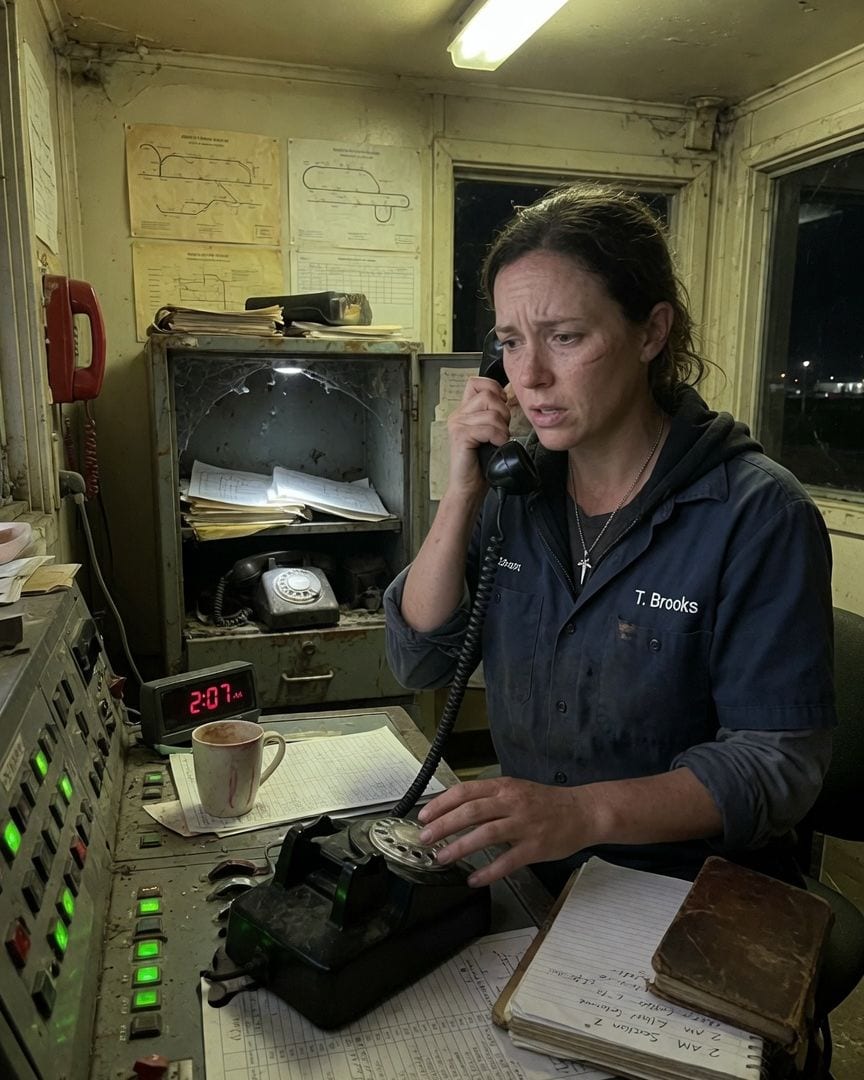
My signal box gets a 2 AM call every night from a man whose section was demolished eleven years ago. Now I found his logbook with today's date.
My night shift at the signal box is quiet and precise, defined by the routine 2 AM call from Ellis confirming Section 7 is clear. But when I asked my duty manager to log it, he said Section 7 hasn't had a track walker in eleven years, not since its cabin and phone were demolished.
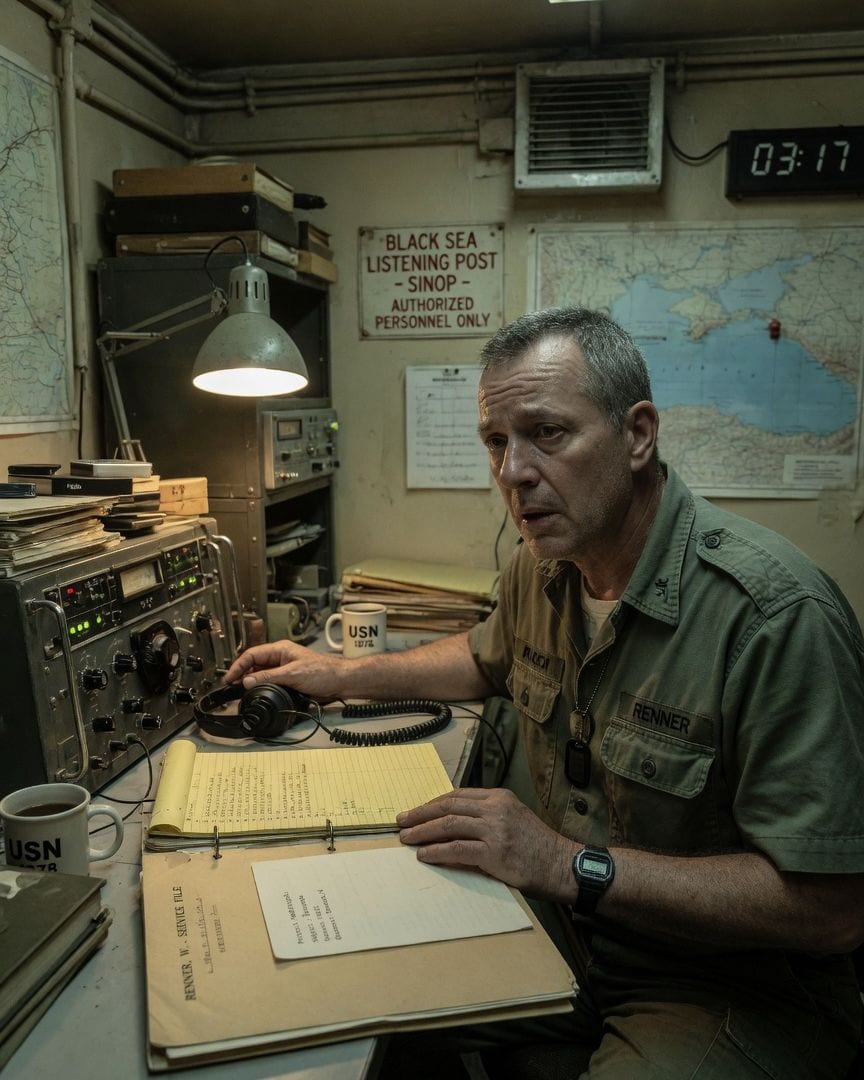
Specialist Walt Renner had six weeks left at Sinop when his Cold War numbers station stopped counting and spoke his mother's name: 'Walter.'
Specialist Walt Renner had just six weeks left at the Sinop station, anticipating the close of his thirty-year career. For almost two decades, he had tracked a mysterious numbers station, broadcasting from an impossible point in the Black Sea. Tonight, the woman's flat voice stopped counting, and the static cleared, replaced by a single, perfectly clear word: 'Walter.' It was the intimate name his mother had used, a name he hadn't answered to in decades. Yet, it emanated from the same empty water, a deeply personal address from the void itself.
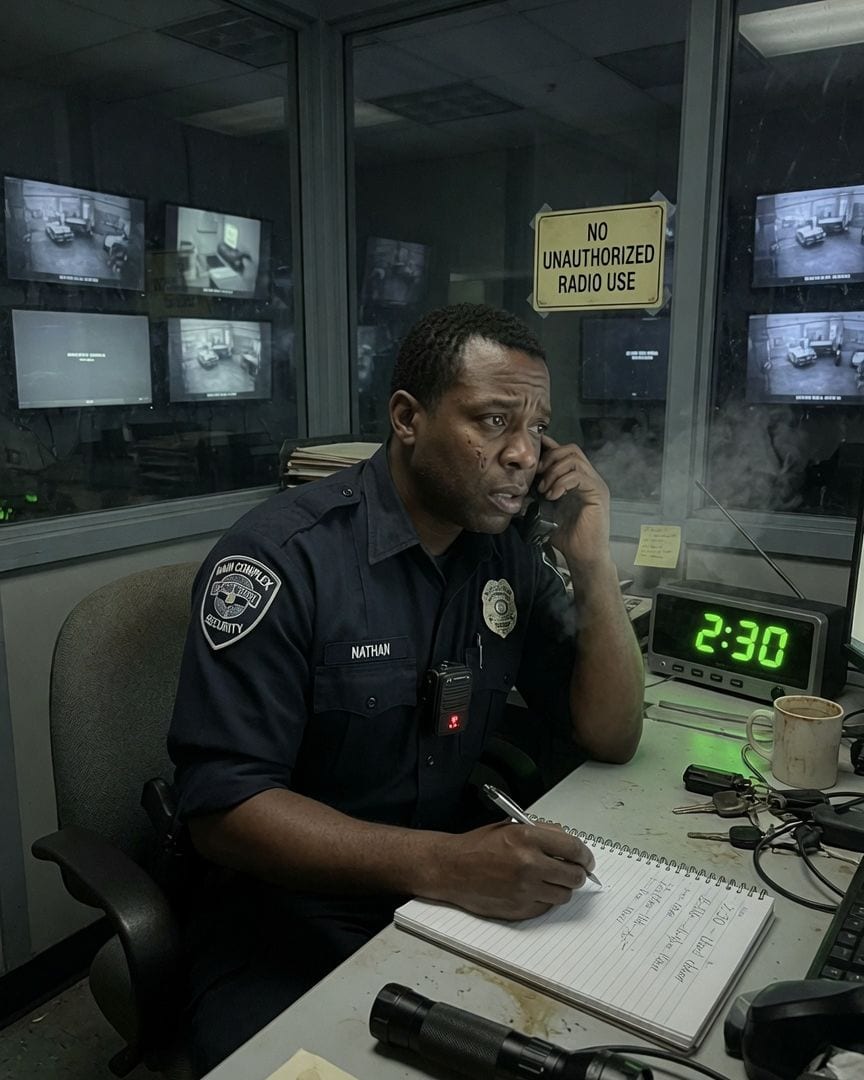
I radio Cole every night. My supervisor says his dock post was cut two years ago, and no Cole exists. But I just found Cole’s old logbook.
My graveyard shift usually consists of monotonous hourly check-ins with Cole, the guard at the loading dock. But my supervisor just revealed that the dock post was cut two years ago, and no one named Cole has ever worked for the company. I've been talking to someone who simply isn't there.