A corporal's promotion order arrived today, signed by a Cold War colonel who died last month. The system still says it's real.
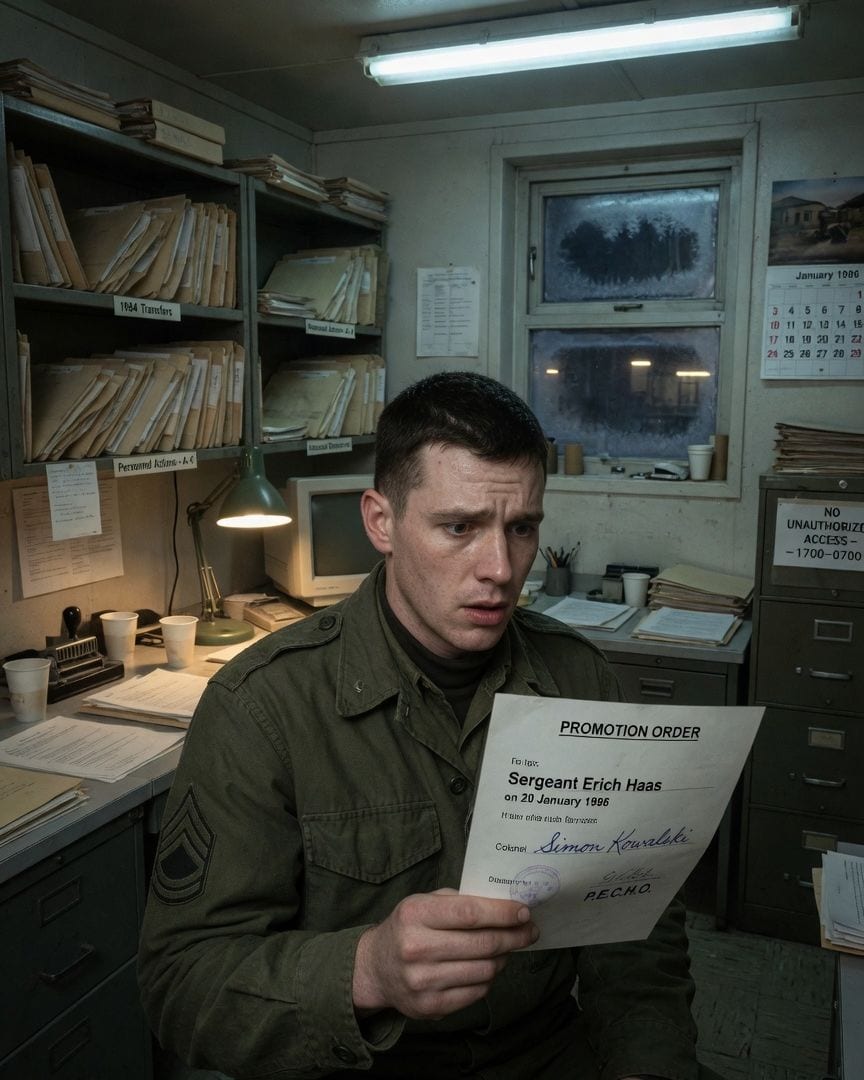
Corporal Erich Haas stood stiffly in Captain Rachel Ashford's office, the crisp, cold air of the German garrison winter seeping through the windowpane. He held a freshly cut promotion order, his name emblazoned as 'Sergeant Haas,' effective immediately.
The date was January 20, 1986. Haas knew his promotion board wasn’t scheduled until mid-February. Worse, the order bore the unmistakable signature of Colonel Simon Kowalski. Haas remembered Kowalski distinctly.
The colonel had rotated stateside in November and had died of a heart attack in December, news that had circulated through the barracks like a cold draft. The colonel was dead.
The paperwork in Haas's hand, however, was undeniably real, bearing a control number that traced cleanly through every official channel. A chill, colder than the January air, settled in Haas’s gut.
The system, designed for absolute, irrefutable accountability, had just failed in the most impossible way.
Haas tried the mundane explanation first. He reported the error to Captain Ashford, who, after a moment of stunned silence, sent him to Records Administration.
Specialist Vincent Harlow, a nervous young man with perpetually ink-stained fingers, sat behind a desk piled high with folders. The office hummed with the low thrum of old computers and the scent of toner and stale coffee.
Harlow pulled up Haas's file, his brow furrowed with concentration. He cross-referenced the control number, clicked through half a dozen screens, and finally looked up, bewildered. “Corporal… Sergeant Haas. The system shows this is valid. Fully processed. Clean trace.”
Haas insisted, his voice tight with unease. “But Colonel Kowalski is dead. He died last month. How could he sign this?” Harlow shrugged, a faint sheen of sweat on his forehead. He avoided Haas’s gaze. “I… I don’t know, Sergeant.
The signature’s verified. The control number’s valid.” He flipped through a physical folder, pulling out a duplicate order. The paper felt heavy, legitimate. “Sometimes… sometimes there are special processing codes for expedited transfers. Maybe it’s one of those.”
Harlow pointed to a faint, smudged stamp near the bottom, almost illegible, reading only 'P.E.C.H.O.' Haas stared at the stamp, a cold dread replacing his bewilderment. The ordinary explanation had just failed.
Haas couldn't shake the image of the smudged stamp or the impossible signature. That night, after hours, he found himself back in Records, using his new, unauthorized Sergeant's access to slip past the locked door.
The archives were a dusty maze of metal shelves, the air thick with the smell of old paper. Fluorescent lights flickered overhead, casting long, shifting shadows.
He searched for other 'special processing codes,' for other 'expedited transfers,' his fingers tracing the spines of countless folders. Hours later, deep in a forgotten corner, he found a box labeled 'Historical Discrepancies.'
Inside, beneath a layer of dust, was a promotion order for a Private First Class Gordon Stratton, dated 1984. Stratton was promoted to Specialist, then immediately transferred to an unspecified unit. The order bore a signature: Major General Damien Sinclair.
Haas remembered Sinclair. He’d died in a helicopter crash in 1983, a full year before the date on the order. Haas’s heart hammered against his ribs. This wasn't an error. It was a pattern, and he was holding the proof.
Haas spent the next few days pulling at the thread Gordon Stratton’s file offered. He learned Stratton had effectively vanished. His service record ended abruptly after the transfer, with no further entries, no discharge, no pension claims.
It was as if he’d been erased. Haas tried to discuss his findings with Captain Ashford again, presenting both his order and Stratton’s. She listened patiently, her expression a mix of concern and skepticism.
The desktop fan whirred softly, a sound too mundane for the documents lying between them. “Sergeant, I understand your unease. But these are isolated incidents, years apart. Clerical errors, perhaps.
Or, in the case of a deceased officer, a posthumous authorization that got misfiled.” She suggested he focus on his new duties. Haas knew it wasn’t enough.
He began spending his nights in the deserted records office, meticulously cross-referencing names, dates, and transfer codes. The faint 'P.E.C.H.O.' stamp on his own file, which Harlow had pointed out, became a focal point.
He found it on a handful of other files, all for soldiers who had subsequently disappeared from the system, their records terminating in vague 'special assignment' notes.
The humming of the server racks seemed to deepen with each discovery, a low, mechanical growl. The unease grew into a cold, specific dread. He was watching the system he trusted, and it was showing him ghosts.
Haas’s quiet investigation didn’t go unnoticed. Harlow, who had initially been helpful, grew increasingly distant. He avoided Haas’s eye in the hallways, his movements jerky and quick.
One afternoon, Harlow approached Haas in the mess hall, his voice low and tight, barely audible over the clatter of trays. “Sergeant, you need to let this go. Seriously. Some things… some things are better left alone.”
His eyes darted around nervously, checking faces at nearby tables. Haas pressed him, asking about the 'P.E.C.H.O.' stamp. Harlow just shook his head, looking genuinely frightened. “It’s not a code, not really. It’s… it’s a designation.
Just forget you saw it.” That night, Haas returned to his barracks to find a notice taped to his bunk. It was an official transfer order, dated for next week, assigning him to a 'Special Operations Detachment, Unspecified Location.'
It bore the same impossible signature, the same control number as his promotion. His promotion had been finalized. His old unit was already processing his departure. The system, far from correcting itself, was actively moving him, consuming him.
He was no longer just investigating; he was being moved into the very anomaly he was trying to understand.
Haas cornered Harlow in a deserted corridor, the urgency in his voice barely contained. The air conditioning unit rattled loudly, amplifying the tension. “What is Project Echo, Vincent? And why is my name on a transfer order for it?”
Harlow blanched, looking utterly terrified. He pressed himself against the cool, painted wall. “I can’t… I can’t tell you. They’ll know.” Haas grabbed his arm, the other man’s muscles stiff under his grip. “They already know, Vincent. They’re moving me.
Tell me what you know.” Harlow, trembling, finally broke. He led Haas to a maintenance closet, its cramped space smelling of cleaning solvents, pulling out a battered, dusty laptop hidden beneath a pile of old uniforms.
He booted it up, the screen flickering to life with a command prompt. “It’s not in the main system. It’s… a backdoor. A special channel.” With shaking fingers, he typed a series of commands, revealing a sparse, text-based interface.
“It’s how the orders get cut. They bypass all the regular checks. It looks legitimate in the main system because this channel feeds it just enough data to validate the control numbers and signatures.”
Haas stared at the screen, a cold realization dawning. “The dead officers… their names are used as a cover?” Harlow nodded, his voice barely a whisper. “They’re just… a signature of convenience. An authority that can’t be questioned.
It’s been going on for decades. Project Echo. It’s a recruitment program. They find soldiers, then they… they take them.” He pulled up a cryptic file. “It’s called 'The Watch That Won’t End.' That’s what they call the assignments.”
Haas felt the blood drain from his face. The impossible orders weren't errors. They were a deliberate, calculated subversion of the military’s own accountability, a perfect, untraceable mechanism for disappearance.
Haas, armed with the cryptic access code Harlow had provided, spent the night in the records office again, this time with the hidden laptop. The screen glowed, illuminating Erich Haas's face with a cold light.
He navigated the 'special processing channel,' the interface stark and unsettling in its simplicity.
He found a database of names, hundreds of them, each entry mirroring his own: a promotion or a transfer, an impossible signature, and a destination listed only as 'Project Echo.'
He scrolled through the list, seeing names from years past, some he vaguely recognized as rumored disappearances, others completely unknown. The sheer scale of it was horrifying.
This wasn't a few isolated incidents; it was a silent, ongoing hemorrhage within the military's ranks. He reached the bottom of the long list, his heart thumping against his ribs.
He traced his finger down the list of names, each tied to an impossible order, a ghost in the system.
At the very bottom, stark and undeniable, he saw his own name: 'Haas, Erich – Promoted Sergeant, Transfer to Project Echo, ETA 14 FEB 1986.' The impossible signature was there again.
The realization hit Haas with the force of a physical blow. Project Echo wasn't a glitch; it was a fully operational, clandestine recruitment pipeline.
The impossible orders, the dead colonels, the clean traces – it was all a meticulously designed system to siphon off specific personnel, making them disappear without a ripple. He found a linked file, brief and chilling, outlining 'Echo Protocol.'
It described a black ops intelligence unit operating entirely off-grid, its recruits identified by a specific psychological profile: disciplined, rational, exceptional at 'pattern recognition under duress.' Haas, with his relentless pursuit of the impossible order, had perfectly fit the profile.
His promotion wasn't a mistake; it was bait. His transfer wasn't an assignment; it was an absorption. Every clue, every impossible detail, every vague entry now clicked into place, forming a coherent, terrifying picture.
The very system he had sworn to uphold was now actively dismantling him, piece by piece, and folding him into its own shadow.
The military's accountability, the bedrock of his world, was not failing; it was being weaponized against its own. The horror was not that it was broken, but that it worked perfectly.
With his transfer date looming, Haas made a desperate attempt to expose Project Echo.
He printed out his own impossible transfer order, along with a selection of others from the 'Echo Protocol' database, hoping physical proof would break through the system's facade.
He rushed to Captain Ashford's office, bypassing protocol, the stack of papers clutched in his hand. The fluorescent lights in the hallway seemed to flicker with his urgency.
He laid them out on her desk, explaining everything, his voice urgent and strained, pointing to the dates, the names, the smudged 'P.E.C.H.O.' stamps. Ashford stared at the documents, her face paling as she recognized the impossible signatures and dates.
Her initial skepticism dissolved into horror. A tremor ran through the room, making a framed photo on her desk vibrate slightly. “This… this can’t be real,” she whispered, but the evidence was undeniable.
She picked up the phone, her hand shaking, but before she could dial, the office door burst open. Two MPs, their faces grim, stood in the doorway, their rifles held at the ready. “Sergeant Haas, you’re coming with us.
Unauthorized access to classified materials.” Haas knew it was over. He glanced at Ashford, a silent plea in his eyes, then at the printouts on her desk.
As the MPs moved in, he subtly nudged his own transfer order with the edge of his boot, letting it slide under a stack of routine reports on Ashford’s desk, hoping it might be overlooked, a final, desperate message left behind.
Erich Haas was processed out of the German garrison within hours. His official service record was updated to reflect a 'voluntary transfer' to an unspecified classified unit, effective February 14, 1986. No further entries were made.
Captain Ashford’s report on the incident was filed, then sealed, citing 'unsubstantiated claims of systemic anomalies.' The hidden laptop from the maintenance closet was gone.
The dusty archive box labeled 'Historical Discrepancies' remained, but the Gordon Stratton file Haas had found was no longer inside. A few weeks later, a new Corporal occupied Haas’s old bunk.
During a routine barracks inspection, a maintenance crew found a single, folded piece of paper wedged beneath the bottom bunk’s mattress.
The maintenance worker unfolded the paper. It was an official US Army transfer order, dated for February 14, 1986. The recipient was 'Sergeant Erich Haas.' The destination was 'Project Echo, Unspecified Location.'
And the signature, unmistakable in its anachronistic authority, was that of Colonel Simon Kowalski, deceased. The worker shrugged, assuming it was old, discarded paperwork, and tossed it into a burn bag.
Months later, a woman in a quiet American suburb received a letter from the Department of Defense. It confirmed her husband, Sergeant Erich Haas, had completed his service and was honorably discharged, effective immediately, citing 'classified operational requirements.'
The order, dated for a future he would never see, lay waiting.
If this one got to you
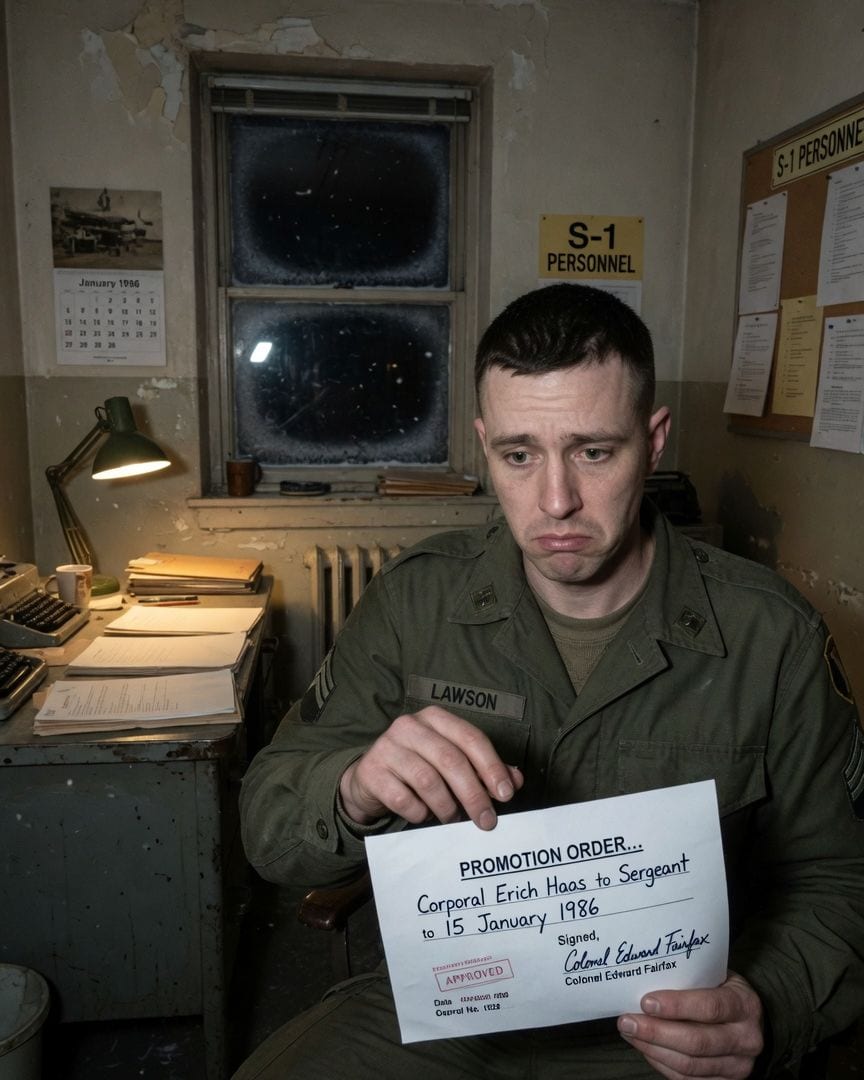
A German garrison NCO finds a promotion order signed by a Cold War Colonel who died last December. The document is impeccably valid, but the promoted corporal knows nothing.
Staff Sergeant Julian Lawson, a meticulous NCO in a cold German garrison, found his routine shattered by a new batch of promotion orders. Among them, a promotion for Corporal Erich Haas to sergeant bore an impossible date and the impeccable signature of Colonel Edward Fairfax, a man who had died last December. Despite the document's official validity, Julian's checks revealed no trace of the promotion in any real-world record. When Julian confronted him, Haas himself knew nothing of it, his eyes holding a vacant, unreadable flicker as he looked at the dead Colonel's signature and his phantom new rank.
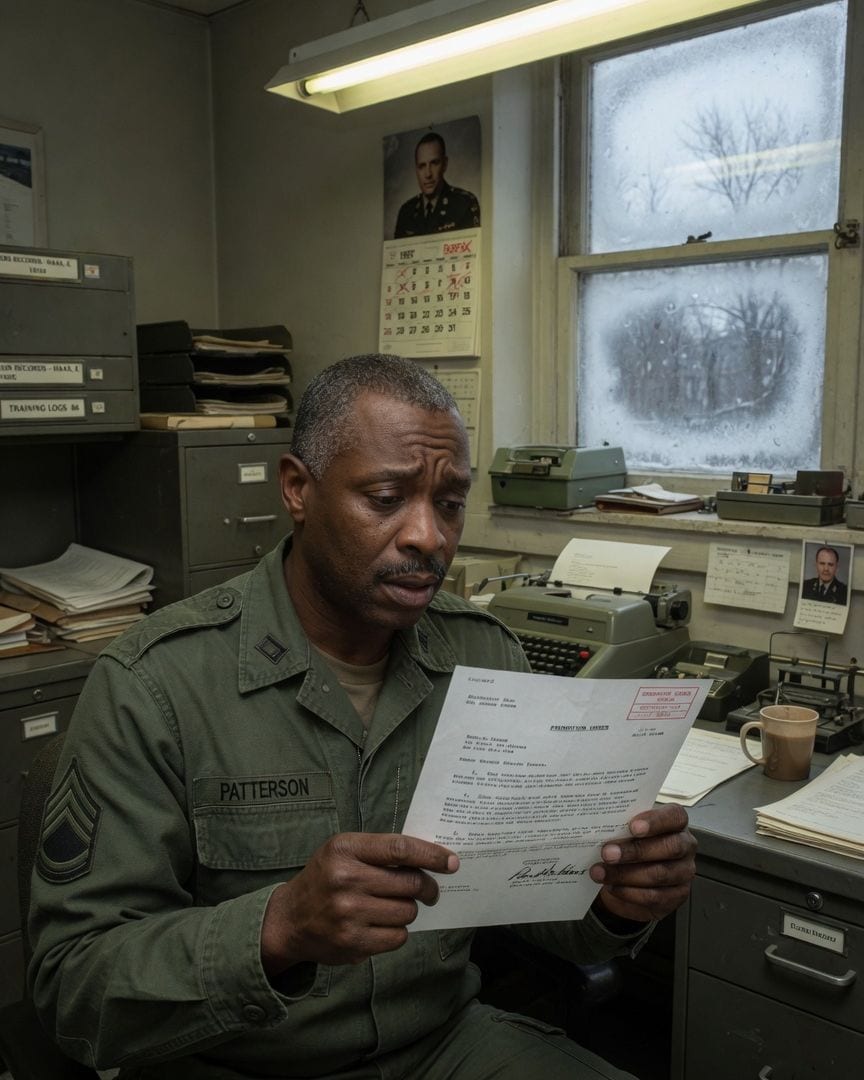
Staff Sergeant Felix Patterson held a promotion order for a young corporal, signed by a Cold War colonel dead for a full year.
Staff Sergeant Felix Patterson felt the German winter chill as he stood in the base admin office, holding Corporal Erich Haas’s promotion order. The young clerk, Private Davenport, wrung her hands, confirming the impossible: Colonel Fairfax’s signature was genuine, despite the colonel having been dead for a full year. A deep, cold dread settled in Felix’s gut, making the office air feel heavy and silent around him. He spent days scrutinizing Haas’s service record, soon uncovering a training certificate also bearing the deceased colonel’s signature, dated months after his death. This was no mere bureaucratic slip; these meticulously clean documents were fundamentally, impossibly wrong.
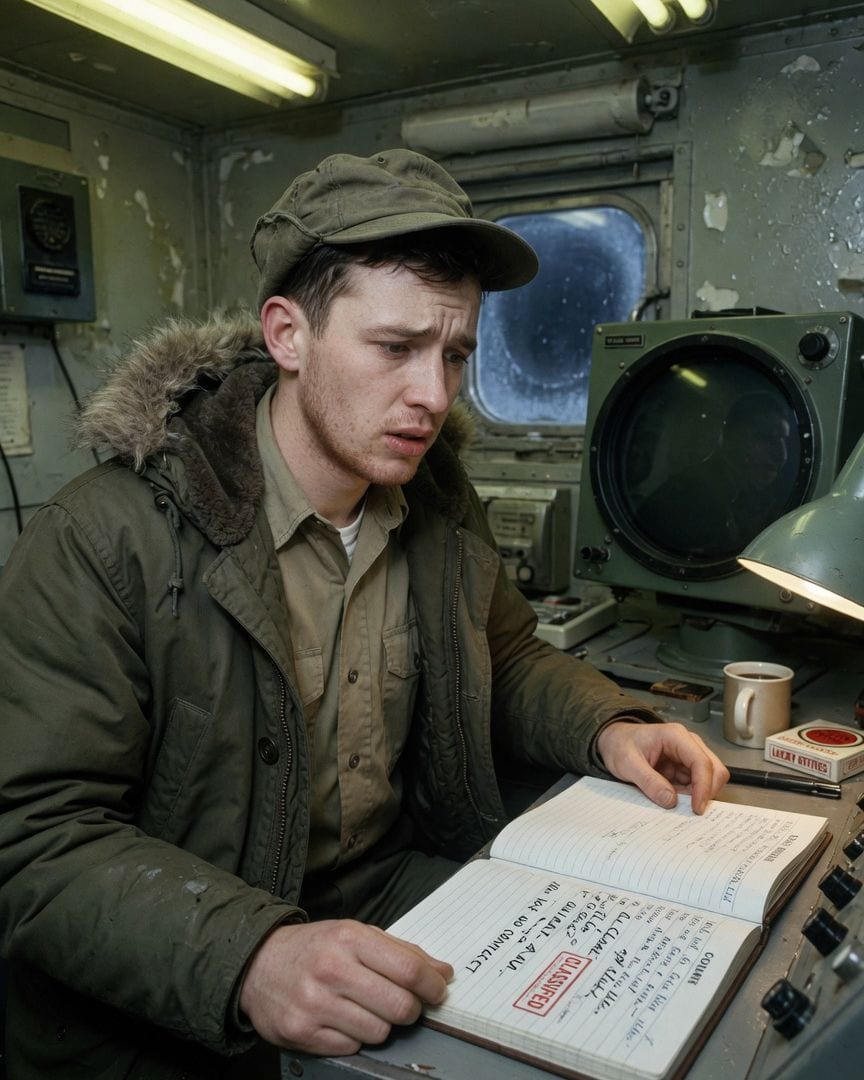
A Cold War airman logs an impossible radar contact on his last sweep. But his official logbook entry is stamped 'CLASSIFIED' and then contradicted by a hastily scrawled 'ALL CLEAR' dated moments before it.
Airman Ordway Vance, 22, manned the radar dome at Site Pellin in the biting North Atlantic dark of January 1962, running the last calibration sweep before its decommissioning. His scope picked up a faint, impossible return, growing closer with each pass, though the ocean remained empty to the eye. When Vance detailed the contact in his official logbook, a 'CLASSIFIED' stamp appeared, followed by a hastily scrawled 'ALL CLEAR' dated moments before his own entry, contradicting his every word. Commander Hartley dismissed it as equipment malfunction, but Vance sensed a chilling, official erasure behind the lie. He soon found a locked cabinet marked 'SITE PELLIN ANOMALIES,' hinting at a deeper truth buried within the base's final days.
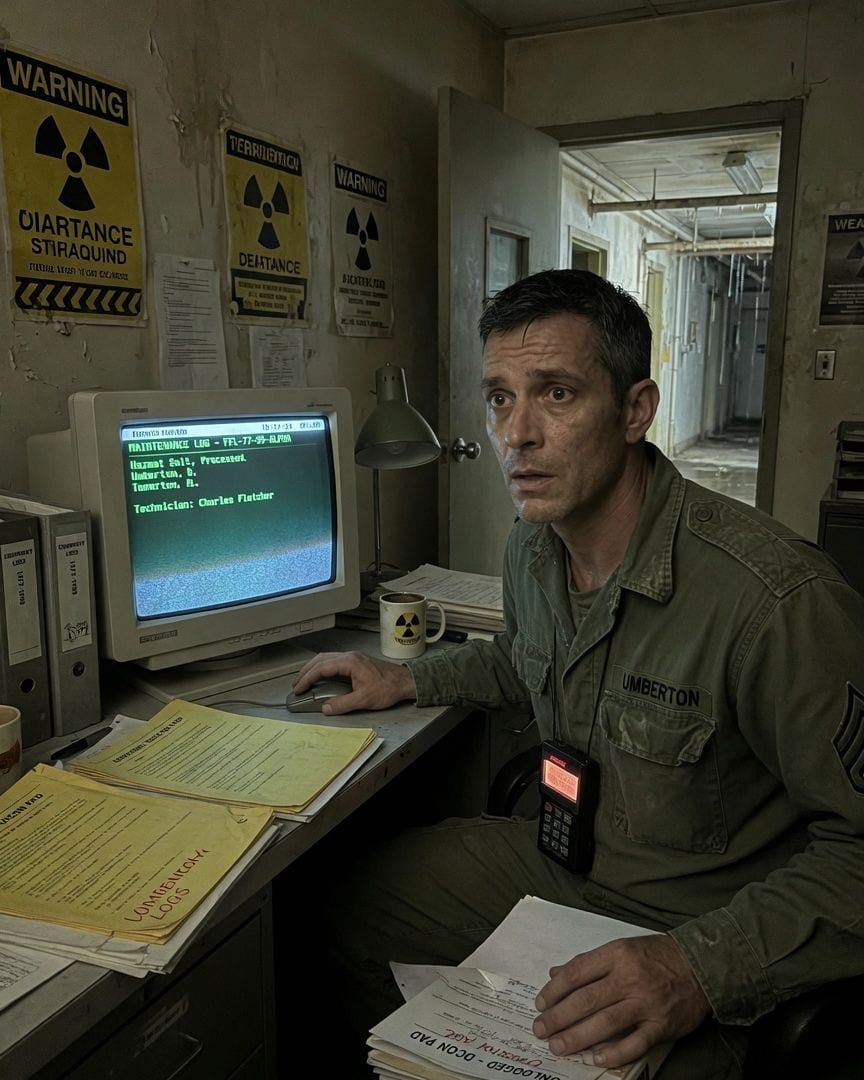
On his last shift at the closing Cold War facility, Sergeant Umberton found a hazmat suit glowing hot with his own name.
Sergeant Blaise Umberton walked his final shift at the soon-to-be-shuttered Ferriday Flats decontamination pad, the predawn air thick with ozone and the heavy silence of a closing era. His peace with the desolate site shattered when he discovered a hazmat suit, glowing faintly and shrieking on his Geiger counter, laid out with his own name stitched perfectly on the breast. Dismissed as a prank by his superior, Umberton followed protocol, but a cold dread compelled him to check the digital records of the facility's Cold War bureaucracy. There he found an entry for a hazmat suit processed under his name, dated for *tomorrow*, and signed by a technician who had retired a decade ago.
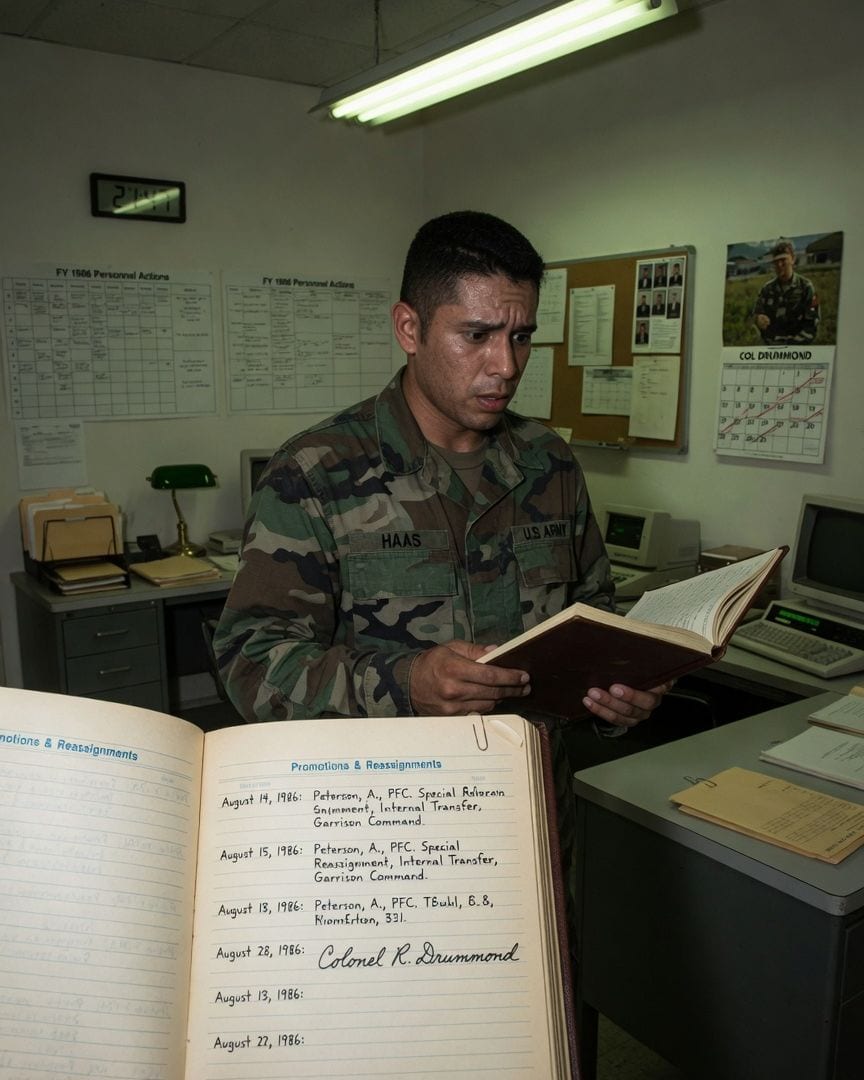
A Corporal finds a dead Colonel’s signature, the ink still dark and crisp, in an old 1986 logbook.
Corporal Marco Haas receives an impossible promotion order, signed by a Colonel who died months ago. The military system validates the dead man’s signature, leaving Haas to question how the impossible became official. He later finds the same crisp, dark signature in an old 1986 logbook, approving a transfer for a soldier already deployed.
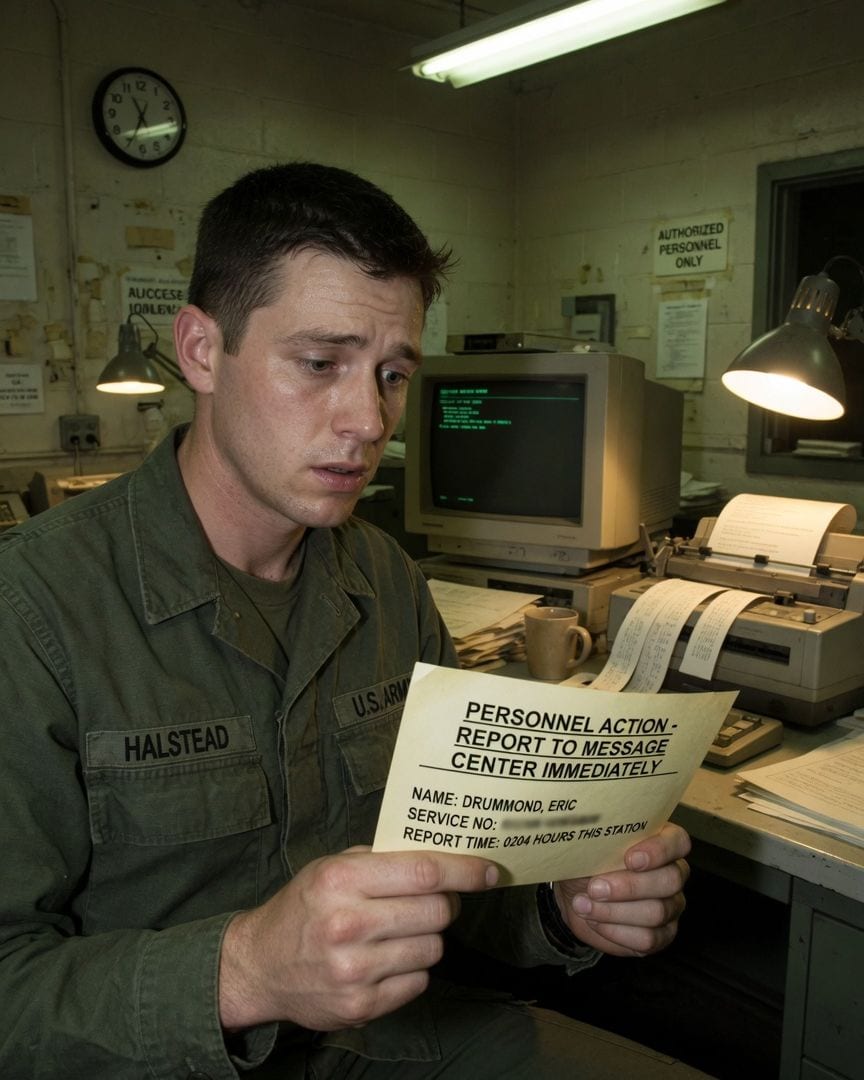
A private's log confirms a dead man's entry. Three years after his death, Private Eric Drummond just walked into the message center.
Private Ryan Halstead, alone on the graveyard shift, processes routine orders in the message center. His clattering machine delivers a personnel action for Private Eric Drummond, a soldier Ryan knows died three years ago. Yet the system insists the order is valid, an active command for Drummond to report — and then the access logs confirm his entry.