A Corporal finds a dead Colonel’s signature, the ink still dark and crisp, in an old 1986 logbook.
Corporal Marco Haas stood in Captain Sterling’s office, the crisp, official DD Form 214 clutched in his hand. It was his promotion order to Sergeant, effective September 1st. Captain Sterling, usually meticulous, frowned, her gaze fixed on the date.
Marco’s promotion board wasn’t scheduled until November. He pointed this out, a knot tightening in his stomach. “A clerical error, maybe?” he offered, but the Captain’s face was grim. She flipped to the signature block.
“And this…” Her voice trailed off.
Printed beneath the bold ‘Colonel R. Drummond’, the name of the previous garrison commander, was a date: ‘September 22, 1986.’ Colonel Drummond had rotated home to the States in January and died of a heart attack in February.
The colonel’s signature was solid, precise, utterly convincing. The control number traced cleanly back through S1 channels, validated, active. It was real, undeniable paperwork, swearing a dead man had signed his promotion a month before the board even met.
The dread was a cold, physical thing, settling in Marco's gut, not because of the impossible promotion, but because the system, which was supposed to be ironclad, had just swallowed a ghost and printed it on his record.
He looked at the Captain, who merely shook her head, a silent question hanging in the air: how could a dead man sign an official order?
The fluorescent light overhead seemed to flicker in response, casting a shadow that made the corner of her desk appear to bend.
Captain Sterling, after a tense call to S1 that yielded no immediate answers, ordered Marco to personally deliver the order back to Sergeant First Class Larsen, the S1 NCO in charge of personnel.
Larsen, a man whose desk was usually buried under meticulously organized stacks, seemed flustered, his usual cheerful demeanor replaced by a nervous twitch. He scanned the form, his eyes widening.
“Impossible,” he muttered, checking the control number against a thick, leather-bound logbook. “The system says it’s valid. Processed. But the board…” He trailed off, running a hand through his thinning hair. Marco pressed, “And Colonel Drummond?”
Larsen avoided his gaze, picking at a loose thread on his uniform. “Must be a signature stamp. Or a…a pre-signed batch from before he left. Happens sometimes.”
But the dates didn’t align. Drummond had left a month before the order’s effective date, and died two months before it was even ‘signed’. Larsen, clearly wanting to drop the matter, finally relented. “Look, Haas, I’ll pull Drummond’s service file.
See if there’s a note about pre-approvals, anything.” Marco waited, feeling the weight of the impossible document in his hands. The air in the S1 office felt suddenly heavier, as if the paper itself exerted a strange gravitational pull.
Larsen returned with a thin folder, its contents unsettlingly sparse. A service record, commendations, a transfer order back to CONUS, and a certified death certificate from February. No mention of any pre-approved promotions.
As Larsen shuffled the papers, a loose, yellowed memo slipped out. It was a routing slip for a ‘Special Personnel Action’ dated January 1986, just before Drummond left. The memo referenced a ‘PFC Peterson, A.’ for ‘internal reassignment’.
Larsen snatched it up, looking more agitated than before. “Old stuff. Nothing to do with your promotion, Haas. Just…paperwork.” But Marco had seen the signature on the memo.
It was the same bold, precise hand as on his own promotion order. The same Colonel Drummond, signing off on another impossible action, just before his death.
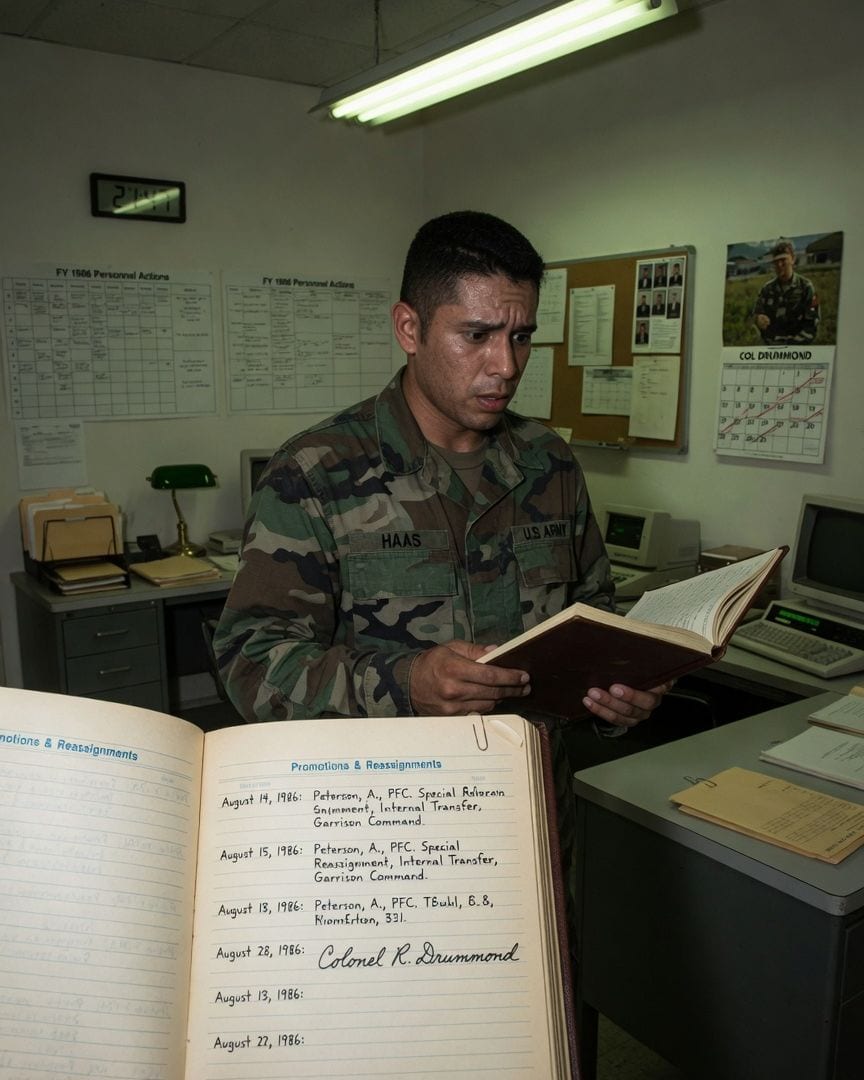
Marco, unable to shake the feeling, stayed late. Larsen had left the thick, leather-bound S1 logbook open on his desk, the one he’d checked the control number against. Marco knew he shouldn’t, but the compulsion was overwhelming.
He flipped back through its pages, past the November board dates, past October, and then to the August entries. He found a section titled ‘Promotions & Reassignments’. His breath hitched.
There, among the standard entries, was one for August 14, 1986: ‘Peterson, A., PFC. Special Reassignment, Internal Transfer, Garrison Command.’ And beneath it, the signature: ‘Colonel R. Drummond.’
The ink was dark and crisp, almost wet, standing out starkly against the faded, routine entries around it. PFC Peterson had officially deployed to Korea on August 10th.
Yet here was Colonel Drummond, dead since February, signing an ‘internal transfer’ for him four days later. Marco stood in the deserted S1 office, the flickering fluorescent light casting long shadows.
In his hand, he held the 1986 logbook open to the August entry.
The ink for ‘Colonel R. Drummond’ on the ‘Special Reassignment’ for PFC Peterson was still dark and crisp, as if signed yesterday, a stark, undeniable contrast to the faded handwriting around it, a signature from a man dead for six months.
The next morning, Marco, feigning a need to clarify his promotion status, returned to S1. Sergeant Larsen was back to his usual self, attributing the previous day’s oddities to ‘too much coffee and not enough sleep.’
Marco, however, couldn’t let it go. He subtly steered the conversation to PFC Peterson. Larsen confirmed Peterson’s deployment to Korea, showing Marco the official manifest. Marco then pointed to the August 14th ‘Special Reassignment’ in the logbook.
Larsen’s jovial facade cracked. He stammered, “That’s… that’s an anomaly. Must be a duplicate entry, or a misfiled form. Happens.” But the crispness of the signature, the specific ‘Internal Transfer’ notation, gnawed at Marco.
The office air, usually thick with the smell of old paper and stale coffee, seemed to tighten around him, making it hard to breathe.
He spent his lunch break in the garrison library, poring over old post newspapers and yearbooks. He found a photo of PFC Peterson in a 1986 yearbook, a young man with an eager, almost too-bright smile.
No mention of any special internal transfers. Marco then tried a different angle. He accessed the S1 archives, a dusty, rarely visited section in the basement, where the fluorescent lights were dimmer, buzzing with an almost painful drone.
He requested files related to ‘Special Personnel Actions’ from the early 80s, citing a ‘historical research project.’ Sergeant Larsen, though suspicious, couldn’t deny the request without specific cause. Marco spent hours in the gloom, surrounded by decades of forgotten paperwork.
He found other ‘Special Reassignment’ forms, similar to Peterson’s, all involving internal transfers for personnel who were simultaneously listed as deployed or transferred out of the garrison.
Each bore the signature of the then-current garrison commander, but invariably, the signature appeared on orders dated after their official rotation or after their documented death.
He found a pattern: always junior enlisted, always ‘internal transfers,’ always signed by a commander who was, by all accounts, no longer physically present to sign anything. The system wasn’t just making clerical errors; it was actively creating ghost paperwork.
The dread deepened, becoming less about an impossible promotion and more about an impossible process. The stacks of files around him seemed to lean in, whispering secrets he wasn't meant to hear.
Marco’s inquiries didn’t go unnoticed. A few days later, Captain Sterling called him into her office. Her tone was firm. “Haas, I understand your curiosity, but your focus should be on your duties, not on digging through old records.
Sergeant Larsen mentioned you’re spending an unusual amount of time in the S1 archives.” Her gaze was unnervingly steady. “These ‘anomalies’ are just the quirks of an old system. Nothing to worry about.” Marco felt a chill.
Her words were too precise, too rehearsed. The framed certificates on her wall, usually symbols of accomplishment, now felt like silent judges.
Later that day, while Marco was on patrol duty, he noticed a dark sedan, civilian plates, parked unusually close to the S1 building. The driver, a man in a plain suit, was watching the entrance.
Marco felt a prickle of unease. Was it related? He couldn’t be sure. The next morning, he found a small, unmarked envelope tucked under his barrack door. Inside was a single, folded piece of paper.
On it, typed in a precise, old-fashioned font, were two words: ‘DROP IT.’ No signature, no return address. Just the chilling command. The message was clear: someone knew what he was doing, and they wanted him to stop.
The barracks, usually a place of familiar routine, now felt like a cage. Marco felt the shift from investigator to target. The threat was no longer abstract, confined to old paperwork; it was personal, breathing down his neck.
He looked at his promotion order again, the one with Colonel Drummond’s impossible signature. Was this ‘promotion’ a reward for obedience, or merely a prelude to a different kind of reassignment, one from which no one ever returned?
Marco knew he couldn’t ‘drop it.’ The note only fueled his resolve.
He confronted Sergeant Larsen again, this time with the pattern he’d uncovered: multiple ‘Special Reassignments’ for junior enlisted, all signed by commanders who were either dead or long gone, always for ‘internal transfers’ that made them vanish from the official manifest.
Larsen, cornered in his small office, finally broke. His face pale, he admitted, “It’s been happening for decades, Haas. Not just here, but at other posts, too. Always quiet. Always through S1.”
He explained that the ‘Special Personnel Actions’ were a specific, rarely used subset of administrative codes. “They’re for personnel whose records… become difficult to reconcile. Easier to just… reassign them internally. Keep the books clean.”
He confessed to seeing these anomalies for years, always dismissing them as unique, isolated glitches. The rhythmic clicking of a distant typewriter in the office sounded like a slow, deliberate countdown.
Marco pushed, “But the signatures, Sergeant. How can dead men sign orders?” Larsen wrung his hands. “The signatures… they’re always perfect. Too perfect. Some of us, the older NCOs, we called them ‘ghost orders’. We just processed them.
You learn not to ask questions. It’s part of the system now. A… a quiet function.”
He revealed that the specific, isolated administrative office Marco had seen in S1, rarely used, was where these ‘Special Personnel Actions’ were often routed and ‘processed.’
He also mentioned a recurring, almost ritualistic ‘audit’ of specific archived files that happened every few years, always tied to rotation cycles.
He showed Marco a decades-old internal memo, stamped ‘For S1 Eyes Only,’ detailing the proper procedure for handling ‘irreconcilable personnel records’ through ‘Special Reassignments.’
The memo was unsigned, its origin obscure, but its instructions were chillingly clear: ‘Maintain continuity of service record. Integrate into standing command structure. Do not question.’
Marco felt the pieces click. The impossible promotion, Peterson’s ‘internal transfer,’ the ghost signatures—they weren’t errors. They were a deliberate, ongoing process, a hidden mechanism within the military’s own accounting system, designed to absorb individuals.
The ‘dead’ colonel’s signature wasn’t a stamp; it was a mark, a symbol of the system’s quiet, relentless efficiency. The room, full of stacked files and buzzing computers, suddenly felt like the inside of a vast, intricate machine.
Armed with Larsen’s confession and the ‘S1 Eyes Only’ memo, Marco delved deeper into the S1 archives, focusing on the ‘audit’ cycles Larsen mentioned. He found a pattern, undeniable and horrifying.
Every few years, coinciding with major rotation cycles, a cluster of ‘Special Reassignments’ would appear, always for junior enlisted, always signed by past, deceased, or rotated-out commanders. He pulled up files from the late 70s, the 60s, even the 50s.
The paperwork was consistent, the language identical. Each cycle saw a handful of soldiers ‘integrated.’ He noted the specific dates of these audits and the names of the ‘integrated’ personnel.
The air in the archive was cold and still, carrying the scent of dust and forgotten things.
Then, hidden behind a stack of moth-eaten supply requisitions in a forgotten cabinet, he found a brittle, yellowed document labeled ‘Special Personnel Directive - Garrison Command - 1958.’
It was an official-looking, though strangely unlisted, directive, detailing a process for ‘identifying and integrating’ promising junior personnel into ‘extended service protocols.’ Marco’s heart hammered as he scanned the names of the ‘integrated’ personnel listed for that cycle.
He saw ‘Peterson, A.’ listed under ‘Cycle 6 Pre-Ident.’ Then, his eyes locked onto another entry. Faint, typed in a precise, old-fashioned font: ‘Haas, M. - 425-XX-1197 - Cycle 7 Pre-Ident.’ His own service number, 425-XX-1198.
The difference was one digit. He felt a cold grip, not of fear, but of profound, inescapable recognition. The pattern hadn’t just claimed others; it had always been waiting for him.
The ‘Special Personnel Directive’ from 1958 was the key. It outlined a cyclical process, a ‘harvest’ of sorts, of specific individuals whose profiles met certain criteria—dedication, precision, a quiet competence.
These individuals were ‘pre-identified’ years in advance, their ‘promotions’ or ‘reassignments’ orchestrated through ghost paperwork by the entity that had co-opted the S1 administrative sub-section.
The ‘ghost signatures’ were not merely forgeries; they were a symbolic act, a mark of the entity’s claim on the individual, using the authority of the ‘dead’ or ‘absent’ to signify their removal from conventional human oversight.
Marco’s premature promotion was his activation, his ‘Cycle 7 Pre-Ident’ marking him as the next in line.
The entity, whatever it was, didn’t want bodies; it wanted records, identities, and the systematic assimilation of personnel into its own invisible structure.
The ‘internal transfers’ were literal: these individuals were still ‘serving’ within the garrison, but in an unseen capacity, their duties beyond human comprehension, their lives now fully integrated into the entity’s purpose.
The S1 office was merely the interface, the point of entry. The pattern across rotations and dates wasn’t just a historical oddity; it was the entity’s pulse, its ongoing, methodical expansion, using the military’s own meticulous bureaucracy against itself.
The ‘dead’ Colonel Drummond, PFC Peterson, and countless others weren’t missing; they were just serving a different, unsanctioned chain of command, their paperwork meticulously maintained by an unseen hand.
Marco realized his name wasn’t on the ‘pre-ident’ list as a coincidence; it was a prophecy. He was being processed, and soon, his own records would show him ‘transferred internally,’ his life quietly erased from the world he knew.
Marco knew he had to escape. The ‘promotion’ was not an honor; it was a trap, a slow, bureaucratic absorption. He couldn’t confront the entity directly; it had no physical form, only effects.
His only option was to sever his connection to the system before his ‘internal transfer’ became irreversible. He formulated a plan: a desertion, but one designed to leave an undeniable, yet unbelievable, trace.
He spent a frantic night gathering every piece of impossible paperwork he had found: his promotion order, the Peterson reassignment, the ‘S1 Eyes Only’ memo, and most crucially, the 1958 ‘Special Personnel Directive’ with his own near-identical name.
He packed a small bag, his military ID, and his service weapon, though he knew it would be useless against what he faced.
Under the cover of predawn darkness, Marco slipped out of his barracks. He made his way to the fence line, not to simply climb over, but to leave a message.
He meticulously arranged the documents in a waterproof pouch, burying it beneath a loose fence post near a seldom-patrolled section of the perimeter, marked by a specific, broken reflective marker.
He wrote a short, frantic letter, detailing everything he had found, naming the entity’s methods, and the cyclical nature of its ‘promotions.’ He sealed it with his dog tags, a final, desperate plea for someone, anyone, to believe him.
As the first hint of false dawn brushed the sky, Marco Haas cut through the wire. He left his uniform jacket, neatly folded, on the ground beside the cut wire, a silent declaration of his flight.
He ran, not toward a specific destination, but away from a system that had tried to claim him, carrying only the terrifying truth that no one would ever believe.
The cost was everything: his career, his identity, his past, all sacrificed to escape an unseen, bureaucratic maw. He was free, but irrevocably marked, a ghost in his own life. The crisp morning air felt both liberating and isolating.
The next morning, Marco Haas was declared AWOL. A routine search found his jacket and the cut wire. The military police processed the scene, noting the deliberate nature of his desertion.
The pouch with the documents remained undiscovered, hidden beneath the fence post, overlooked in the standard perimeter sweep. His promotion to Sergeant was officially revoked, his records flagged for desertion.
Captain Sterling sighed, officially closing his file, attributing his disappearance to stress or an undiagnosed mental break. Sergeant Larsen avoided eye contact whenever Marco’s name came up, his desk once again buried under meticulously organized stacks.
Life in the garrison continued, the meticulous paperwork flowing, the system absorbing the anomaly of Marco Haas’s disappearance with quiet efficiency.
Another name was added to the list of ‘irreconcilable personnel records,’ another ‘Special Reassignment’ silently processed, only this time, it was an escape, not an absorption.
Years later, in a small, anonymous town in the American Midwest, a man named Marco lived a quiet, solitary life. He worked odd jobs, never staying in one place too long, always looking over his shoulder.
He carried no ID, no official papers, a ghost in the civilian world. He had escaped the system, but the system had left its mark.
Sometimes, late at night, he would wake in a cold sweat, remembering the crisp, impossible signature, the pattern of dates, the near-identical service number.
He knew what he had run from, and he knew it was still out there, quietly processing, promoting, and reassigning. He knew the cost of his freedom was permanent vigilance, a life lived on the margins, forever outside the records.
He had proof, buried near a German fence line, proof no one would ever find, or ever believe. He would never truly be free of the system that had tried to claim him.
He just heard the quiet hum of it, sometimes, in the silence.
A few years later, a civilian hiker near the old German garrison stumbled upon a rusted metal box buried near a crumbling section of the perimeter fence.
Inside, amidst decaying documents and a set of dog tags, was a handwritten letter, its ink faded but still legible, detailing an impossible story.
The hiker took it to the local authorities, who dismissed it as a prank or the ramblings of a disturbed individual. The letter, along with the other papers, was eventually filed away, unread, in a forgotten municipal archive.
Some truths simply refuse to be accounted for.
If this one got to you
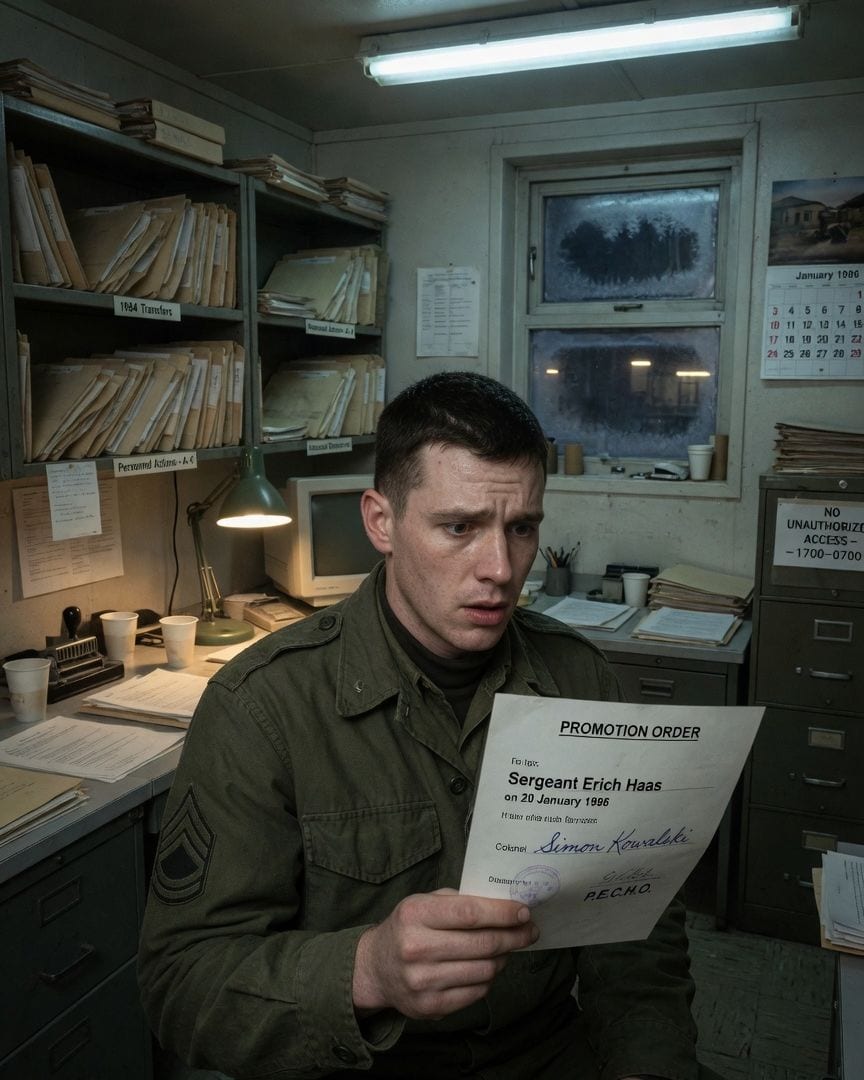
A corporal's promotion order arrived today, signed by a Cold War colonel who died last month. The system still says it's real.
Corporal Erich Haas suddenly found himself promoted to Sergeant, a full month before his board was even scheduled. The promotion order, dated January 20, 1986, bore the unmistakable signature of Colonel Simon Kowalski, a man who had died the previous December. Despite this impossible truth, the military's irrefutable system confirmed the order's absolute validity. Records administration staff could only show Haas a duplicate, stamped with a mysterious, smudged 'P.E.C.H.O.' code. Driven by a growing dread, Haas later unearthed another historical discrepancy: a promotion order for a soldier signed by a general who had died a year before the document's date.
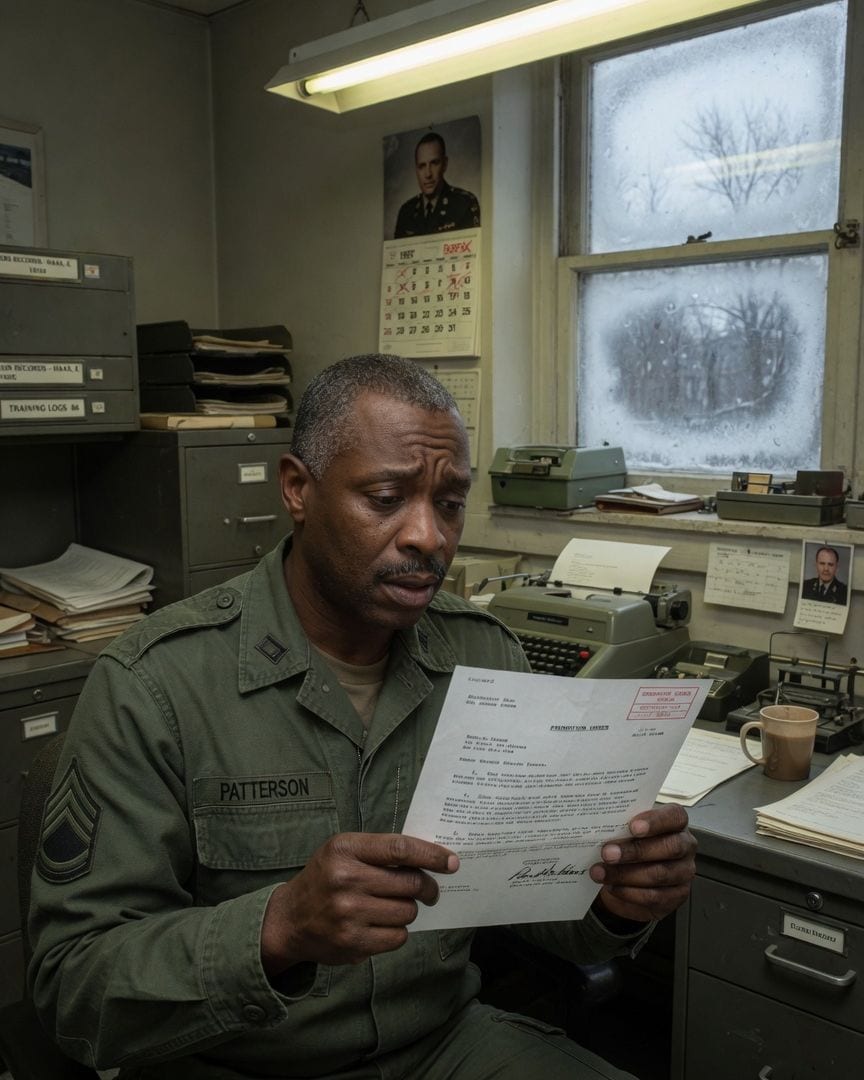
Staff Sergeant Felix Patterson held a promotion order for a young corporal, signed by a Cold War colonel dead for a full year.
Staff Sergeant Felix Patterson felt the German winter chill as he stood in the base admin office, holding Corporal Erich Haas’s promotion order. The young clerk, Private Davenport, wrung her hands, confirming the impossible: Colonel Fairfax’s signature was genuine, despite the colonel having been dead for a full year. A deep, cold dread settled in Felix’s gut, making the office air feel heavy and silent around him. He spent days scrutinizing Haas’s service record, soon uncovering a training certificate also bearing the deceased colonel’s signature, dated months after his death. This was no mere bureaucratic slip; these meticulously clean documents were fundamentally, impossibly wrong.
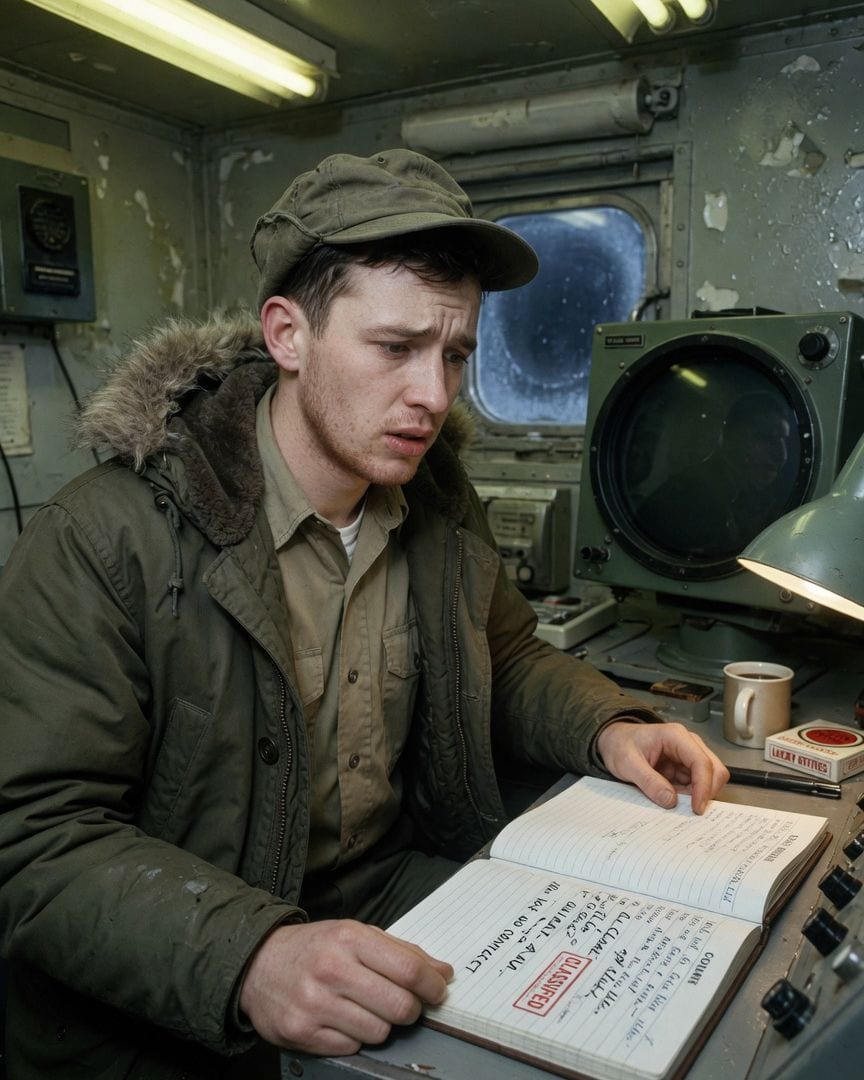
A Cold War airman logs an impossible radar contact on his last sweep. But his official logbook entry is stamped 'CLASSIFIED' and then contradicted by a hastily scrawled 'ALL CLEAR' dated moments before it.
Airman Ordway Vance, 22, manned the radar dome at Site Pellin in the biting North Atlantic dark of January 1962, running the last calibration sweep before its decommissioning. His scope picked up a faint, impossible return, growing closer with each pass, though the ocean remained empty to the eye. When Vance detailed the contact in his official logbook, a 'CLASSIFIED' stamp appeared, followed by a hastily scrawled 'ALL CLEAR' dated moments before his own entry, contradicting his every word. Commander Hartley dismissed it as equipment malfunction, but Vance sensed a chilling, official erasure behind the lie. He soon found a locked cabinet marked 'SITE PELLIN ANOMALIES,' hinting at a deeper truth buried within the base's final days.
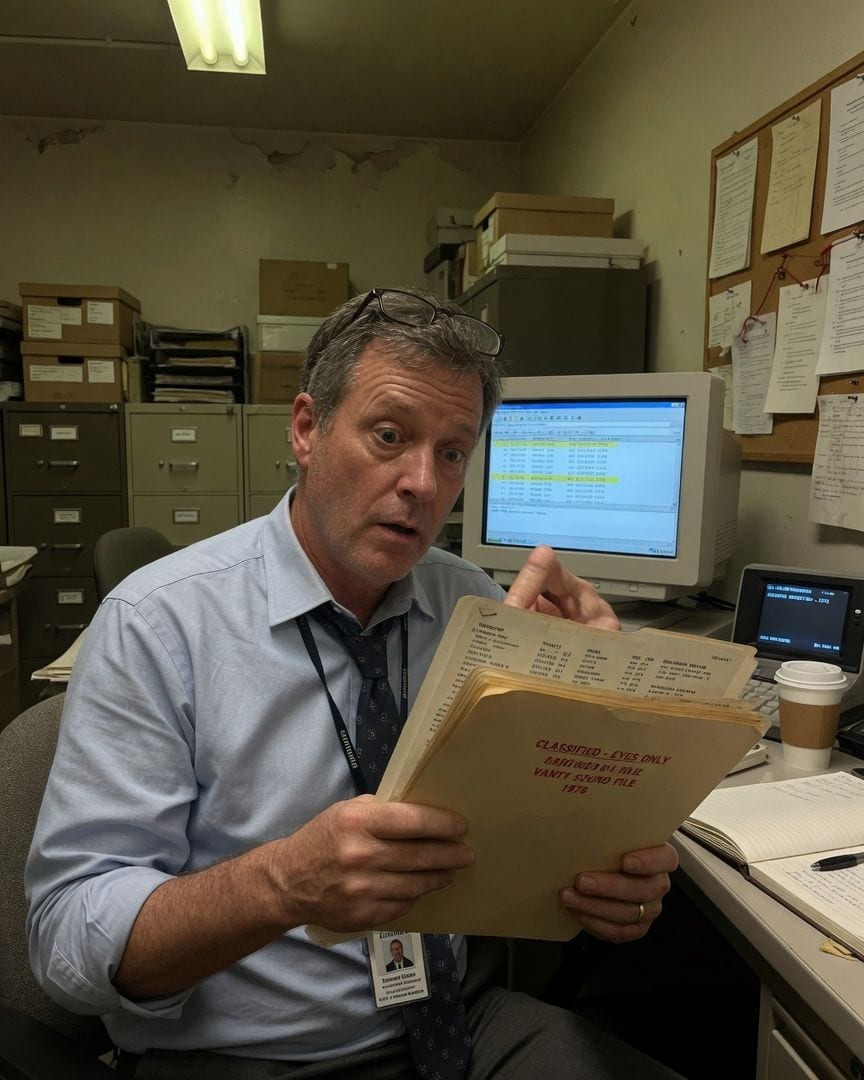
A retiring archivist, Emmett Doane, found a Cold War file from 1978 listing men who wouldn’t enlist until the 1980s. The last name on the classified roster was his four-year-old son’s.
With only six days left until his retirement, archivist Emmett Doane spent a quiet afternoon in the office reviewing old files. He finally pulled the Vantry Sound file, a classified folder from 1978 he'd long dismissed as a clerical error. Inside, the brittle onionskin pages revealed a roster of servicemen who, impossibly, had enlisted years after the file date. As a cold dread tightened his chest, he noticed the file felt warm in his hands, then saw the last name on the list: his own four-year-old son, Samuel. Could a decades-old document truly predict the future, or was something far more sinister at play?
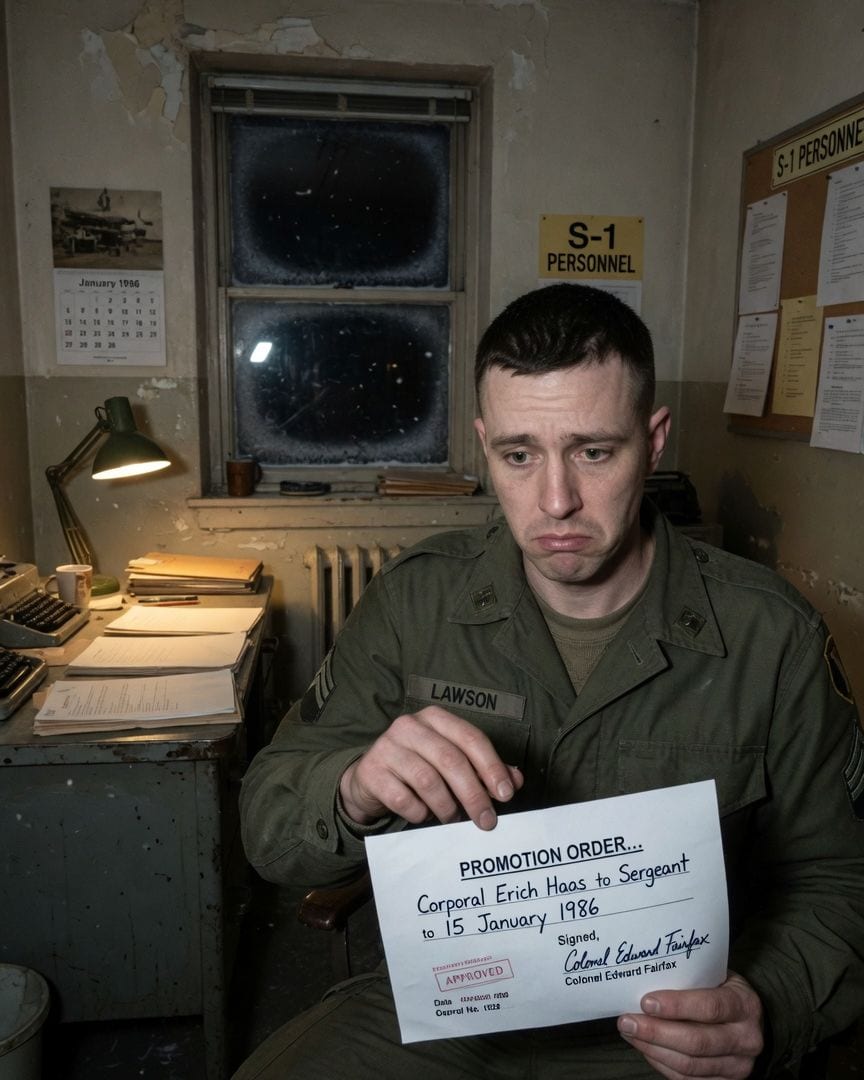
A German garrison NCO finds a promotion order signed by a Cold War Colonel who died last December. The document is impeccably valid, but the promoted corporal knows nothing.
Staff Sergeant Julian Lawson, a meticulous NCO in a cold German garrison, found his routine shattered by a new batch of promotion orders. Among them, a promotion for Corporal Erich Haas to sergeant bore an impossible date and the impeccable signature of Colonel Edward Fairfax, a man who had died last December. Despite the document's official validity, Julian's checks revealed no trace of the promotion in any real-world record. When Julian confronted him, Haas himself knew nothing of it, his eyes holding a vacant, unreadable flicker as he looked at the dead Colonel's signature and his phantom new rank.
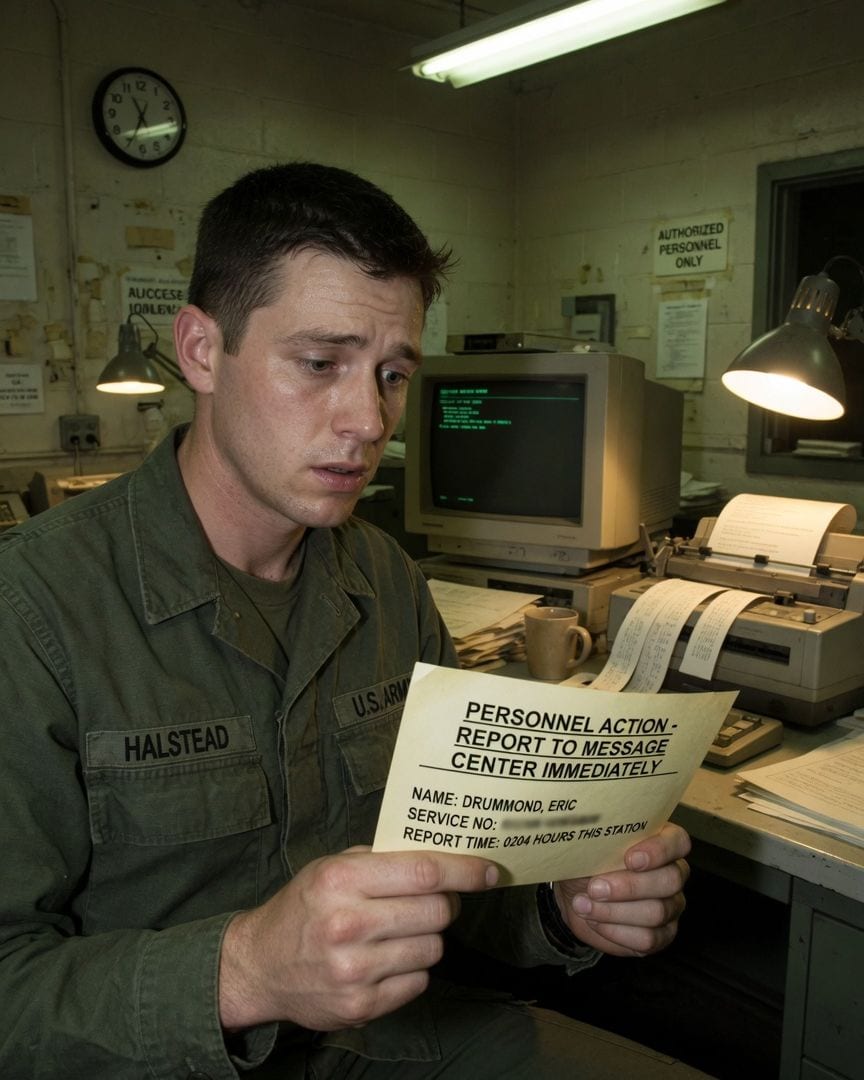
A private's log confirms a dead man's entry. Three years after his death, Private Eric Drummond just walked into the message center.
Private Ryan Halstead, alone on the graveyard shift, processes routine orders in the message center. His clattering machine delivers a personnel action for Private Eric Drummond, a soldier Ryan knows died three years ago. Yet the system insists the order is valid, an active command for Drummond to report — and then the access logs confirm his entry.