A retiring archivist, Emmett Doane, found a Cold War file from 1978 listing men who wouldn’t enlist until the 1980s. The last name on the classified roster was his four-year-old son’s.
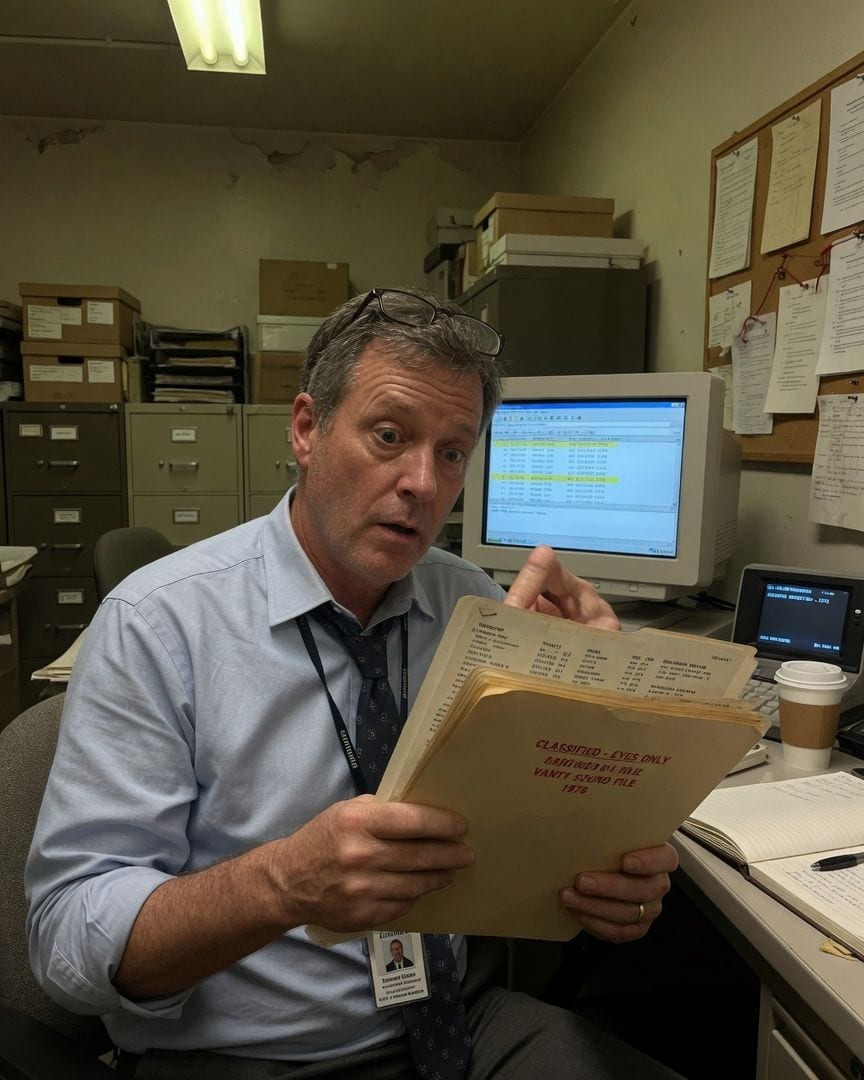
Emmett Doane had six days left until retirement, and he spent one of them doing what he had always done: reviewing old files. This one, the Vantry Sound file, sat in his hands, unassuming.
For thirty-one years, he had seen its listing in the digital catalog, always dismissing it as a clerical error, a misfiled anomaly from some defunct coastal air station. Now, with time on his hands, he finally pulled the physical folder.
The cover was thin, the words 'CLASSIFIED - EYES ONLY' stamped in faded red ink.
Inside, the pages were made of onionskin carbon, brittle with age. He noticed immediately that the letters had been typed with unusual force, the impressions pressed through the delicate paper, leaving a faint, legible relief on the sheets beneath.
He scanned the first page: a roster of twelve names, each with a service number beside it. Doane, methodical as always, began cross-referencing the first eleven against the central enlistment database. An old habit, a way to pass the time.
One by one, the impossible wrongness revealed itself. Every single man on the list had enlisted between two and nine years after the 1978 date typed boldly at the top of the page.
How could a 1978 file list servicemen who wouldn't join until the 1980s? It wasn't just a misfile; it was a temporal impossibility. He felt a prickle of unease, a familiar sensation when facing bureaucracy's deeper blunders.
Then he looked at the twelfth name, the last one on the roster. It read: DOANE, S. M. Service Number: 704-55-9321. A cold, physical dread tightened his chest. His son, Samuel, was four years old.
He hadn't even been born in 1978. The file, somehow, felt warm in Emmett’s hands.
Emmett sat frozen, the low hum of the archives office fading into a distant drone. His son’s name. A four-year-old’s name on a thirty-year-old classified roster. He took a deep, shuddering breath, trying to force himself into a rational mindset.
Misfile. A common name. A strange, family coincidence. He pulled up Samuel’s birth certificate on his tablet, his fingers trembling slightly as he typed. Samuel Michael Doane, born October 2006. The file simply read S. M. Doane.
It could be anyone, he told himself, but the service number felt too specific, too deliberately assigned.
He checked the other eleven names again, meticulously verifying their enlistment dates in the central database. He even ran a quick diagnostic on the database itself, half-expecting a system error. Nothing. No errors. All post-1978 enlistments.
The file wasn't just a misfile; it was a temporal impossibility that defied mundane explanation.
Emmett called Lydia Sterling, a younger reviewer in the next section, over to his desk. She was sharp, less jaded than most. “Lydia, can you double-check these enlistment dates for me?”
he asked, pushing the Vantry Sound file across the desk. “Vantry Sound file, 1978. Just the first few.” He watched her carefully, trying to gauge her reaction, hoping she would find some simple explanation he had overlooked.
She sat, picked up the brittle onionskin, and diligently cross-referenced the first few entries on her own terminal. Her brow furrowed almost immediately. “Mr. Doane, these dates… they’re all in the eighties. After the file date.”
She looked up, confused, a flicker of genuine bewilderment in her eyes. “Is this some kind of placeholder list? A projection?”
Emmett just shook his head, pointing to the last entry on the list. “And this name. S. M. Doane.”
Lydia squinted at the faded type. “Doane? Like… you?” She typed the name and service number into the database. “No current S. M. Doane in the military. Not with this service number.”
She paused, then her eyes widened slightly as she looked back at Emmett. “Wait. You said your son’s name is Samuel Michael, right?
He’d be too young, obviously, but…” The implications hung in the air, heavy and unspoken, like a sudden drop in air pressure. This wasn’t a clerical error. It was a deliberate, impossible record.
Emmett spent the rest of the afternoon poring over the file, seeking any explanation, any loophole that would let him dismiss the impossible record.
He found a single, thin addendum tucked deep inside the folder, almost hidden by the main roster. It was marked 'TOP SECRET - VANTY SOUND RECOVERY OPERATION - 1979.'
A short report, detailing the retrieval of 'unidentified debris' from the deep water off the Maine coast.
He scrolled through the scanned pages on the old microfiche reader, the machine humming softly, past the technical specifications and coordinates, until he reached the list of personnel involved. The 'Recovery Team' section caught his eye.
Three names were listed: Sterling, Granger, Doyle.
He froze. He knew those names. They were on the original 1978 Vantry Sound roster, the one with the impossible future enlistment dates.
How could men who hadn't even joined the service yet have been part of a recovery operation a year later?
The temporal paradox of the recovery team gnawed at Emmett. He couldn't dismiss it, couldn't explain it away as a fluke or a typo. It felt like a deliberate insult to logic.
He spent his next day, just five days from retirement now, digging deeper. He found the personnel files for Sterling, Granger, and Doyle, pulling them from deep storage.
All three had indeed enlisted in the early 1980s, years after the 1979 recovery operation they supposedly participated in.
All three had also been listed as 'Missing In Action - Presumed Lost' within five years of their enlistment, their disappearances clustered around the Vantry Sound area. The pattern, once seen, was horrifyingly clear.
Emmett requested access to the original, undeclassified records for Vantry Sound Air Station from the late 70s and early 80s. They were mostly dull, routine logs. Then he found a series of peculiar radar logs.
One entry, dated October 1979, just weeks before the 'recovery operation' addendum, detailed an 'unidentified contact' moving at impossible speeds, then hovering silently over Vantry Sound before vanishing from their screens.
The log noted a scramble order for two interceptors, both pilots reporting visual contact with a 'non-terrestrial object' before losing it over the water. The pilots' names were also on the 1978 Vantry Sound list.
The log was signed by a young radar operator, Conrad Rutherford.
Emmett found Rutherford in the veteran's database, still alive, living in a small, isolated coastal town in Massachusetts.
The pattern wasn't just about a few impossible dates; it was a manifest of men who had been marked, then disappeared, sometimes even before they existed in any official capacity.
The 'Thing on the Scope' was the common thread, appearing just before the disappearances, and the file seemed to predict its targets. He decided he had to speak to Rutherford.
Emmett drove to Massachusetts, the Vantry Sound file locked in a briefcase beside him. The drive was long, the landscape turning grim and gray under a persistent drizzle that seemed to seep into everything.
He found Conrad Rutherford’s small, weathered house perched on a bluff overlooking the choppy Atlantic. Salt-stained windows gazed out at the same bleak sea that swallowed those men.
Rutherford, now a man in his eighties with a face etched by time and a pair of unsettlingly sharp, haunted eyes, was initially reluctant. He opened the door a crack, his voice raspy. “Vantry Sound? That’s ancient history, son.
Nothing but static and bad coffee.” He started to close the door, the wood groaning.
But when Emmett mentioned the specific date of the radar contact, October 1979, and the names of the pilots — names that were on Rutherford’s own logs from decades ago — the old man’s demeanor shifted.
He went quiet, studying Emmett’s face for a long moment, then stepped back, a silent invitation. The air in the house was thick with the smell of brine and old paper.
Rutherford walked slowly to a closet in the corner of his living room and retrieved an old, tarnished metal box. It looked like a repurposed ammunition crate.
Inside, Emmett saw faded photographs, old service medals, and a small, worn reel of film. “Gun camera footage,” Rutherford rasped, his voice barely a whisper, as if speaking the words too loudly might summon something. “From one of the interceptors.
They said it was a malfunction. I knew better.”
He set up an old, rattling projector on a small table, the whirring sound filling the silent room. The grainy black-and-white footage flickered to life on the whitewashed wall: a dark, starless sky, then a sudden, impossible shape.
A perfect, seamless disc, filling the frame. It didn’t move like an aircraft; it simply was, suspended in the blackness, utterly silent.
Then, just as the pilot’s voice crackled, distorted by static, “Visual confirm, it’s…,” the disc rotated, and a single, unblinking aperture, like a lens, turned directly to face the camera. The footage abruptly cut to static.
Rutherford switched off the projector. The sudden silence was heavy. “They filed it away. Said it was weather, an optical illusion. They sent me a new reel, blank. But I kept this one.”
He looked at Emmett, his eyes filled with a deep, weary understanding that made the small room feel suddenly cold. “You’re digging where you shouldn’t, Mr. Doane. They don’t like that. They never did.”
Emmett felt a chill that had nothing to do with the sea breeze coming through the window. He was no longer just investigating; he was being watched.
Emmett returned to the archives, the gun camera footage reel hidden in his briefcase like a contraband truth. He knew he had to escalate this, had to lay it all out.
He requested an urgent meeting with his section chief, Felix Merritt. Merritt was a career bureaucrat, meticulous but utterly rigid, a man who saw the world in shades of gray procedure.
“Emmett,” Merritt said, not even looking up from his desk as Emmett entered, “you’re six days from retirement. This isn’t the time for conspiracy theories.”
Emmett ignored the dismissal. He laid out the Vantry Sound file, spreading the onionskin pages across Merritt’s polished desk.
He described the impossible enlistment dates, the temporal paradox of the recovery operation, the radar logs detailing impossible aerial phenomena, and finally, Conrad Rutherford’s testimony, his voice steady despite the tremor in his hands.
Merritt listened, his face impassive, occasionally interjecting with dismissive explanations: “Misfiled data… unreliable witness… pilot error…” The air in the room felt tight, heavy, as Emmett spoke.
Emmett finally placed the gun camera footage reel on Merritt’s desk, its metal surface glinting dully under the fluorescent lights. “This isn’t a theory, Felix. This is what they saw.”
Merritt stiffened, his eyes narrowing as he recognized the reel. “Where did you get this?” The question was sharp, edged with something Emmett hadn't heard before.
Emmett held his gaze. “From a man whose career was ruined for seeing it. The same man whose name, Conrad Rutherford, is on this file, marked for 'Vantry Sound Reassignment' in 1982, three years after he witnessed that thing.”
Merritt’s composure finally cracked. He pushed the file away, not with anger, but with a sudden, weary resignation. His voice was low and strained, barely a whisper. “Emmett, you don’t understand. This isn’t a mistake. It’s… protocol.”
He hesitated, glancing nervously at the door, then spoke in a hushed tone, leaning forward. “The ‘Vantry Sound’ designation isn’t a place. It’s a classification. For individuals. It means they’ve been… selected. The files don’t record what happened.
They record what will happen. The 'Thing on the Scope'… it’s a collector. We track its appearances, we document its targets. We don’t understand it, we can’t stop it. We just… manage the paperwork.”
The words hit Emmett like a physical blow, stealing the air from his lungs. The 'recovery operation' wasn't about retrieving debris; it was about managing the collection of the pre-selected.
The impossible dates, the disappearances, the 'Thing on the Scope' – it all clicked into horrifying focus, every disparate piece of data slamming together into a single, terrifying truth.
The government wasn't just hiding it; they were complicit in documenting it, processing the human manifest for an unknown collector.
Emmett felt sick to his stomach. The implications of Merritt’s admission were staggering. His own son’s name on that list wasn't a mistake; it was a death warrant, decades in the making. Merritt, seeing Emmett’s horror, tried to reassure him.
“Emmett, this is above our pay grade. We just follow procedure. You’re retiring, you can walk away from this.” The words echoed hollowly in the suddenly vast room. But Emmett couldn’t. Not now. Not with Samuel’s name on that file.
He left Merritt’s office, the weight of the truth crushing him, the stale office air suddenly tasting like ash. He knew what he had to do: copy the file, expose it, rip open the bureaucratic facade.
He returned to his desk, heart pounding a frantic rhythm against his ribs, and pulled out the Vantry Sound folder. He intended to digitize every single page, every impossible entry, every chilling detail.
But as he opened it, he noticed something. A single, fresh sheet of onionskin carbon, tucked carefully behind the original 1978 roster. It wasn’t there this morning. It couldn’t have been. He pulled it out, his fingers brushing the paper.
It was still warm to the touch, just like the original file had been, typed with the same heavy hand, the impressions visible through the sheet, deep and distinct.
Felix Merritt’s name was there, dated today, next to 'Reassigned: Vantry Sound Oversight.'
But below it, almost invisible, as if meant to be overlooked, was another line, dated just yesterday: DOANE, S. M. – Transfer: Vantry Sound Protocol.
He felt the blood drain from his face, realizing 'S. M.' was Samuel, his four-year-old son.
Emmett’s mind reeled. His son. Samuel was a target, actively marked. The file wasn't just an old, predictive manifest; it was a live document, a constantly updated ledger of the doomed. The onionskin carbon, still warm, was proof.
He understood now. The 'secrecy machine' wasn't just filing the lost; it was actively participating in the process, marking names, managing the 'transfers.' The 'Thing on the Scope' wasn't random; it followed the script written in these files.
The 'recovery operations' were merely the government's way of tidying up, making sure the 'selections' were complete and the records aligned. He remembered the specific wording: 'Transfer: Vantry Sound Protocol.'
Vantry Sound wasn't just a location; it was the process of being taken.
Merritt’s name, too, was on the new page. He had been 'reassigned' to 'Vantry Sound Oversight' – a chilling promotion, not a punishment. Merritt was now part of the active management of the 'selections.'
This wasn't a bureaucratic error; it was a deeply ingrained, decades-long system, cold and efficient, operating with an unsettling, inhuman precision. The file itself was the instrument, the interface between the unknown entity and the human world.
It dictated who would disappear, and when, and the government simply processed the paperwork. Every impossible date, every premature disappearance, every radar anomaly, every piece of gun camera footage – it all fit.
The horror was in the coherence, the undeniable precision of it all.
Emmett knew he couldn't simply walk away. His retirement, his son’s safety, everything was on the line. He had to expose it, or at least disrupt his part of the system.
He marched back to Merritt’s office, the new page clutched in his hand, his knuckles white. The fluorescent lights of the corridor seemed to hum with a frantic energy, mirroring his own.
Merritt looked up as Emmett entered, his face a mask of weary resignation, as if he had been expecting him. “Emmett, I told you to drop this.”
Emmett slammed the new page down on Merritt’s desk, the crisp onionskin crinkling. “You put my son on this list, Felix. You put yourself on it.”
Merritt flinched, glancing at the new entry, then slowly lifted his eyes to meet Emmett’s. “It’s not me, Emmett. It’s the system. It chooses. We just… facilitate.” His voice was flat, devoid of emotion.
Emmett’s voice was low, laced with a raw fury that surprised even himself. “No. You don’t facilitate. You hide. You enable. And you’re not taking my son.” He pulled out a thumb drive from his pocket, holding it up.
“I’ve copied everything. Every file, every log, every piece of footage. If Samuel disappears, this goes public. Everything.”
Merritt stared at the small thumb drive, then at Emmett’s determined face. He knew Emmett was serious. “You can’t. This will destroy everything.”
The words were spoken with a quiet intensity that suggested a far greater scope of destruction than just the files.
“Good,” Emmett said, his voice shaking with the effort of control. “Maybe it should be destroyed.”
Merritt sighed, running a hand over his face, looking older, more tired. “There are other files, Emmett. Other designations. Vantry Sound isn’t the only one. You expose this, and you’ll just reveal the tip of an iceberg.
And it won’t save your son.”
But Emmett was beyond reasoning, beyond the cold logic of Merritt’s institutional dread. He knew he couldn't stop the 'Thing on the Scope,' not directly, but he could fight the machine that fed it, that smoothed its path.
He stood firm. “Then I’ll start with this one. And I’ll fight every single one after that.”
Merritt slumped in his chair, defeated. “There’s a protocol for ‘non-compliant assets’ in oversight. You’ll be… reassigned.”
Emmett simply stared back, the silence between them heavy with unspoken threats. “Try it.” He knew he was making an enemy, an implacable foe within the very institution he served, but the alternative was far worse.
Emmett Doane did not retire six days later. Instead, he was immediately transferred to an obscure, windowless annex located in the deepest, most rarely visited part of the government building.
He was given a new desk, a single, locked filing cabinet, and a new, ambiguous job title.
Felix Merritt was never seen in the main archives again; his reassignment to 'Vantry Sound Oversight' seemed to have been a final, one-way journey.
The Vantry Sound file, along with Emmett's unauthorized copies, vanished from the system, its existence erased as if it had never been.
Emmett’s job now involved cross-referencing seemingly random data points from obscure government reports – weather patterns, demographic shifts, resource inventories – against long-dormant personnel records. No one else was in the annex.
He was alone, isolated, but he was still working. He knew they hadn't reassigned him to punish him; they had reassigned him to contain him, to keep him close, to keep him silent.
He was now part of the machine, but from the inside, he was still fighting it, searching for patterns, for other 'Vantry Sound' designations, for any way to disrupt the flow of names.
Years passed. Samuel grew, oblivious to the shadow that had once fallen over his name, a normal boy living a normal life.
Emmett continued his work in the annex, a ghost in the machine, tirelessly sifting through mountains of unrelated data, always looking for the tell-tale patterns, the impossible dates, the names that shouldn't be.
He never found another file quite like Vantry Sound, no single, coherent ledger of the doomed, but he saw echoes, faint impressions of similar 'designations' in other, seemingly benign documents, fragments of the vast, unseen system.
He knew the system was vast, ancient, and patient. He had survived, but he was marked, forever bound to the secret. He would never truly retire.
He knew the files weren't just records of the lost; they were the instructions for what was yet to be found.
If this one got to you
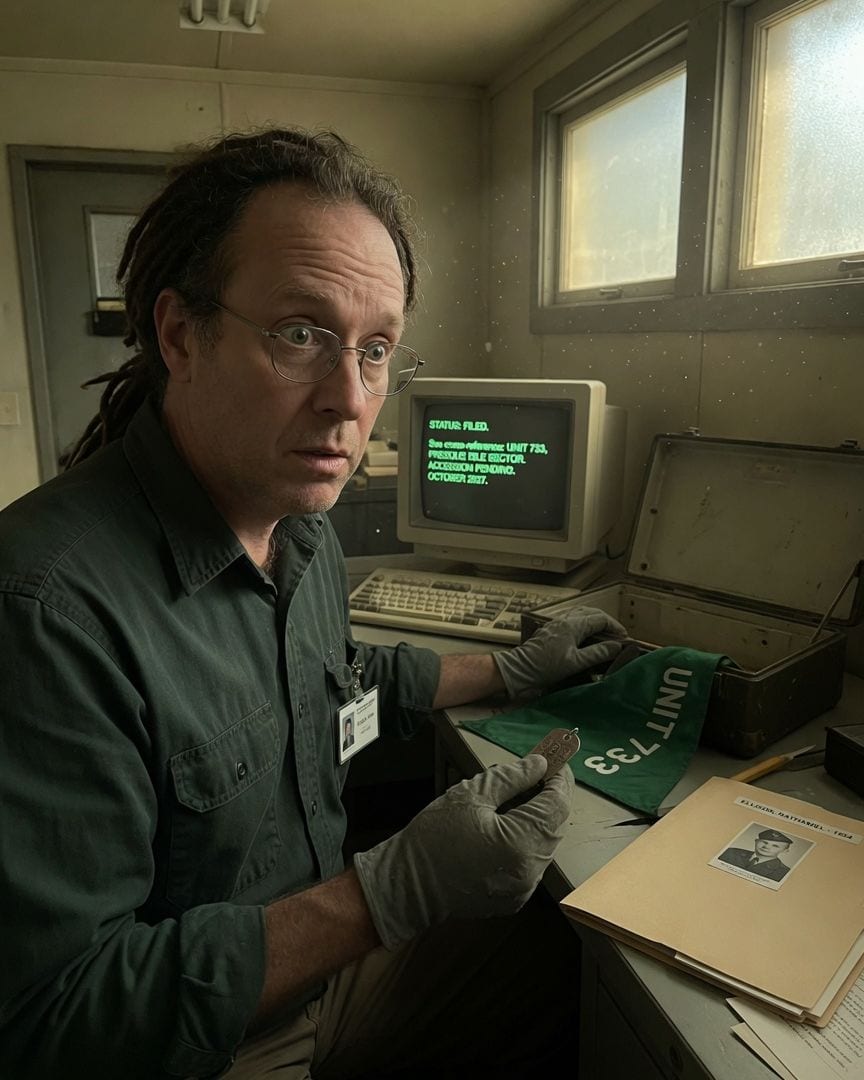
A museum curator finds a Cold War artifact with a missing airman's laundry tag dated March 2025.
Halden Roe, a meticulous museum curator, was carefully decommissioning the Cold War exhibit at Presque Isle. He reverently handled each artifact, preparing them for storage as dust motes danced in the weak sunlight. While unclipping a green guidon, his fingers brushed against an unexpected rigidity. Stitched inside was a laundry tag, bearing a missing airman's service number from 1954, but dated March 2025. The impossible future date on the Cold War artifact shattered everything Halden knew about history.
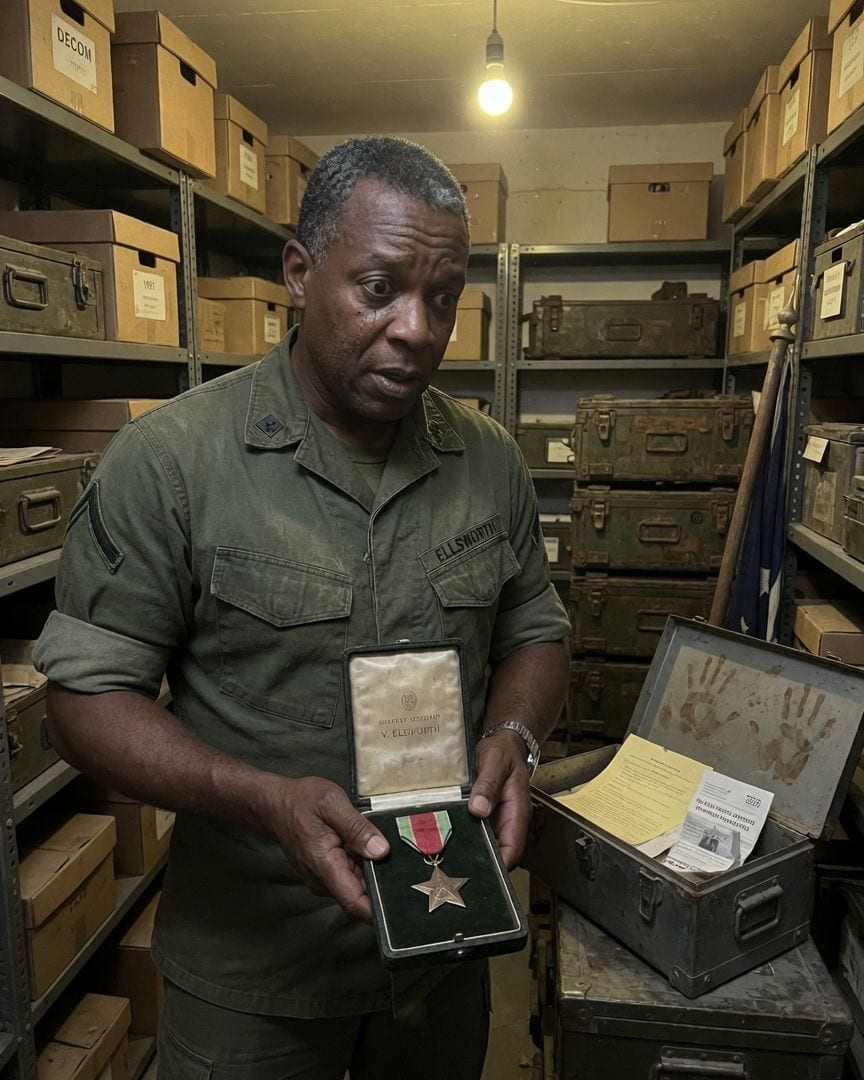
A photograph in Gunnery Sergeant Ellsworth's file shows him, older, with a future he never lived.
Gunnery Sergeant Victor Ellsworth, a veteran of twenty-two years, expected routine paperwork at the St. Louis personnel depot. Instead, a records clerk presented him with two identical files bearing his name and service number. One detailed a combat tour and commendations he had never earned, while a photograph inside showed him, unmistakably older, living a future he hadn't yet endured.
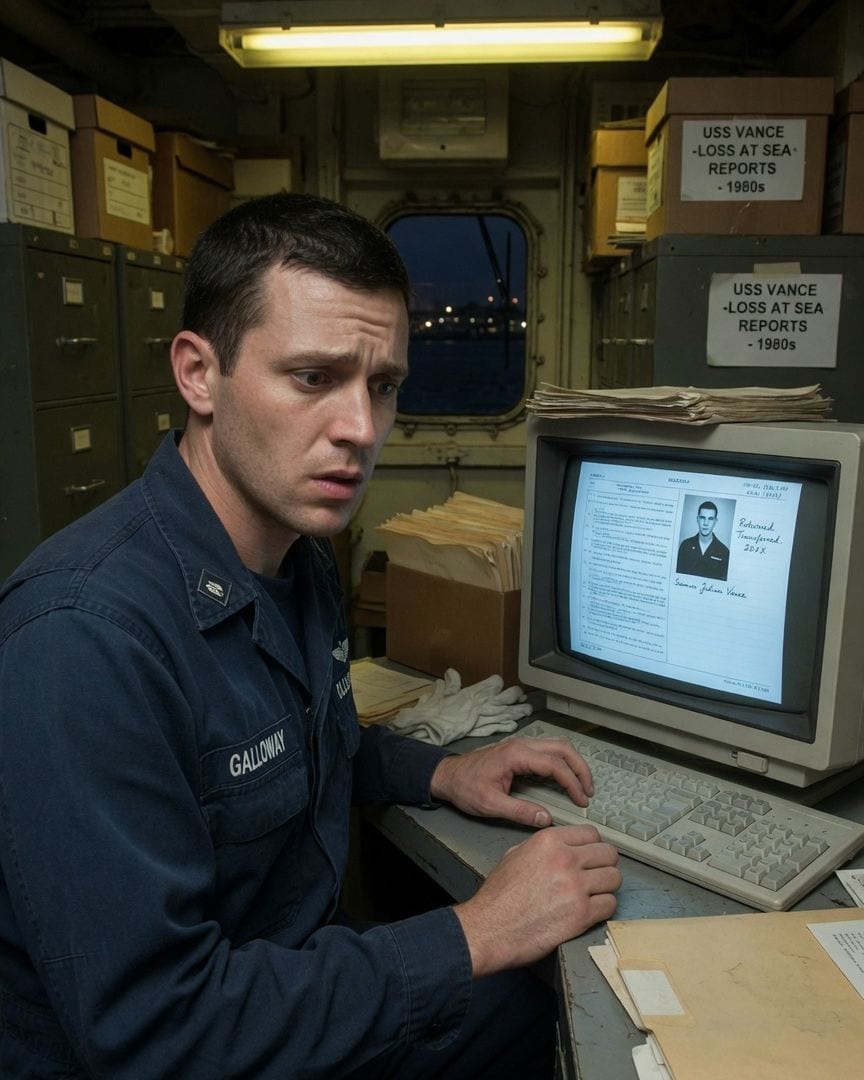
Petty Officer Galloway logged a sailor onto his ship. The man died at sea 40 years ago.
Petty Officer Joel Galloway scanned a sailor's ID on the USS Vance quarterdeck. The man's name, 'Seaman Julian Vance,' and his out-of-date uniform pricked at Galloway's memory. Later, the ship's berthing count came back one over, with an extra entry in the system but no physical body.
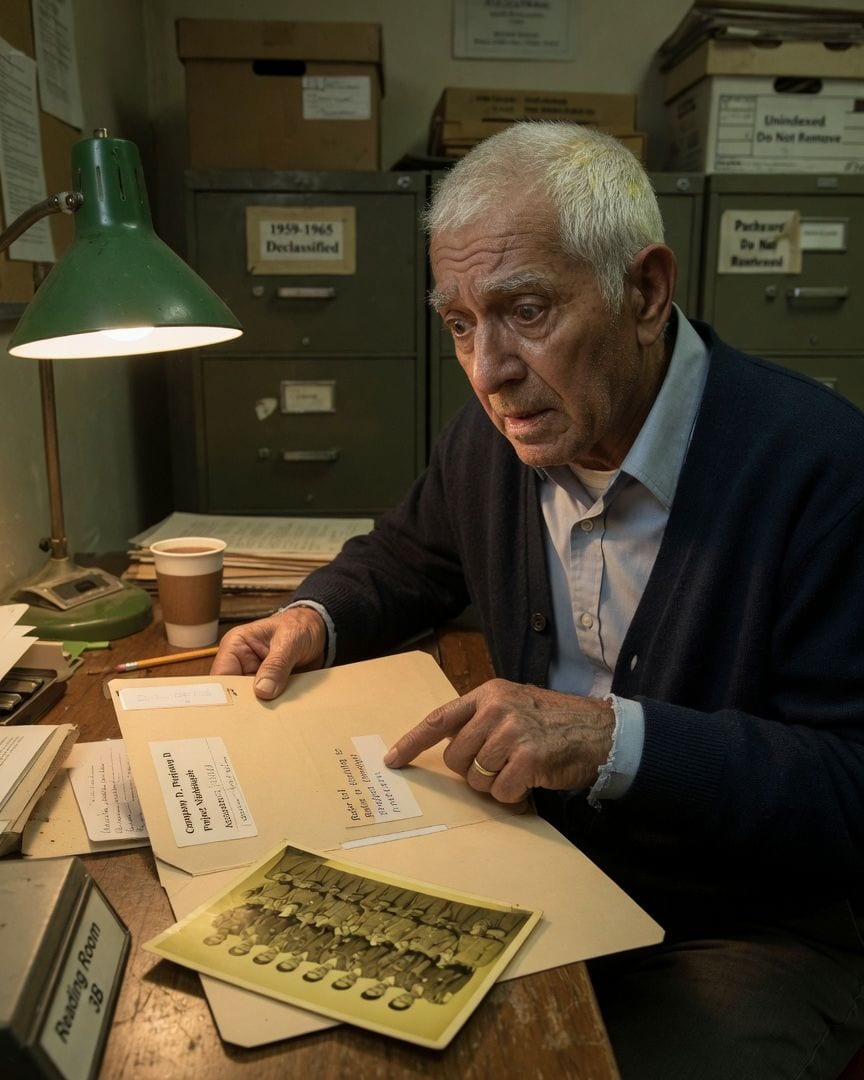
An archivist found her own name on a Cold War military record — dated decades before she was even born.
Eighty-four-year-old Trevor Machado clutched a yellowed photograph, his last hope to prove Company D existed before Friday's lineage board meeting. He knew the 1961 aerial survey of his unit’s parade field showed only grass and an impossibly sharp shadow with no object casting it. At the National Archives, a methodical archivist named Lorraine Sterling initially found no trace of Company D, but an unindexed sub-basement held a forgotten folder. Inside, Trevor's service record detailed his discharge from a unit officially deactivated the very year he joined, but a chilling handwritten note at the bottom, dated decades before Lorraine was born, bore her own name.
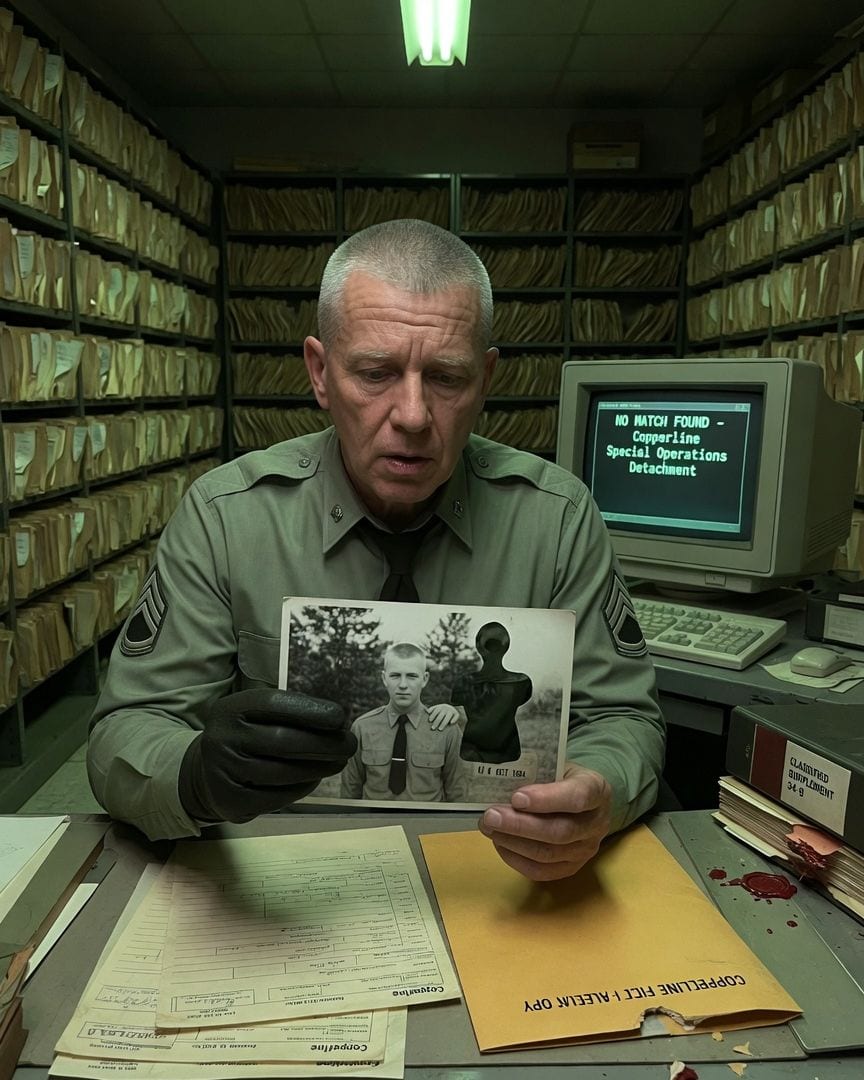
Sergeant Major Vance had two weeks to retirement when his old file felt warm. Inside, a photo showed him with a man precisely cut out from a unit that never existed.
Sergeant Major Teodor Vance had only two weeks left before his retirement, a lifetime of military order almost behind him. For thirty years, he'd pulled the 'Copperline' file, always finding it empty – until now. This time, a faint, impossible warmth radiated from the heavy manila, and inside, he found a faded photograph. It showed a younger Vance in an unrecognized uniform next to a man whose entire body had been precisely cut out of the print, from a company that officially never existed. After decades of silence, what did this warm, impossible file truly contain?
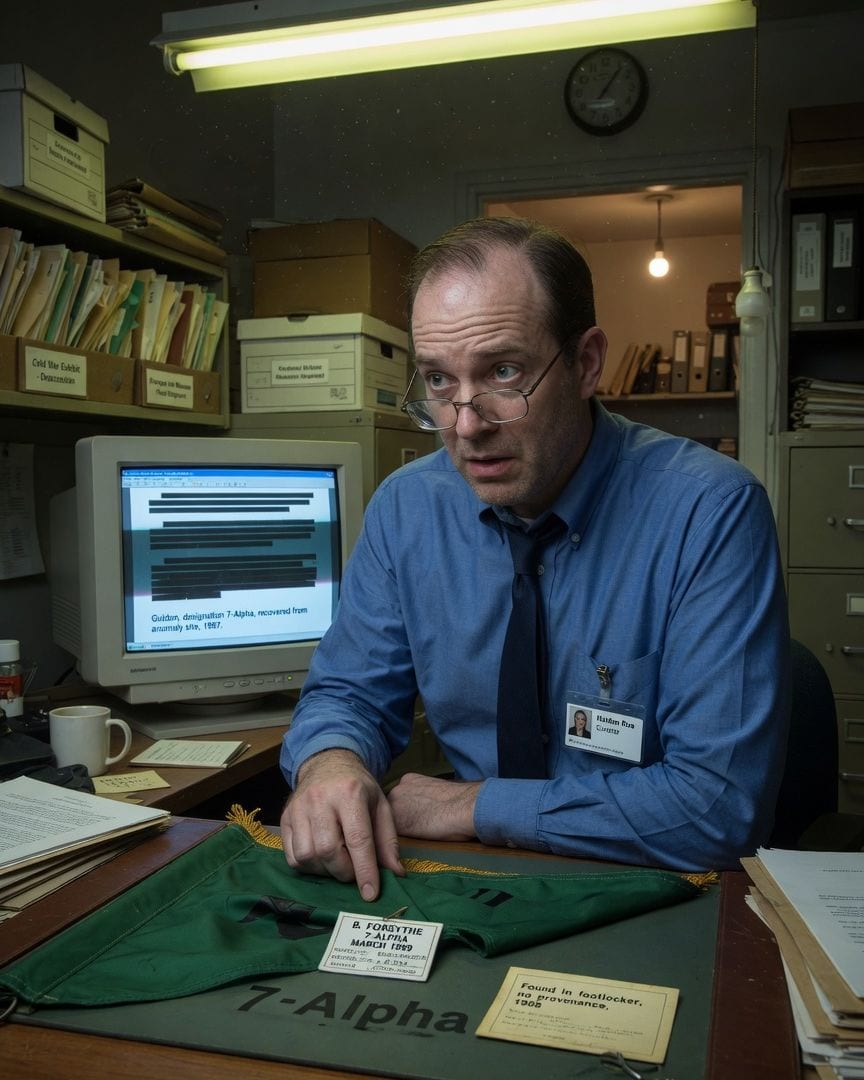
A curator found a guidon dated 1989. The museum took it in 1988, but the Cold War airman on its tag vanished in 1954.
Halden Roe, a meticulous curator, worked against a pressing deadline as the Presque Isle Museum's Cold War exhibit closed for good. In the dusty storage unit, under a single bare bulb, he discovered a small laundry tag sewn into an antique green silk guidon. Its crisp black stitching clearly read 'MARCH 1989' — a date a full year *after* the museum’s intake record for the artifact. As Halden's unease grew, he found the service number on the tag belonged to Benjamin Forsythe, an airman who vanished off Greenland in 1954. How could a museum piece found in 1988 bear a future date and belong to a ghost from decades past?