An archivist found her own name on a Cold War military record — dated decades before she was even born.
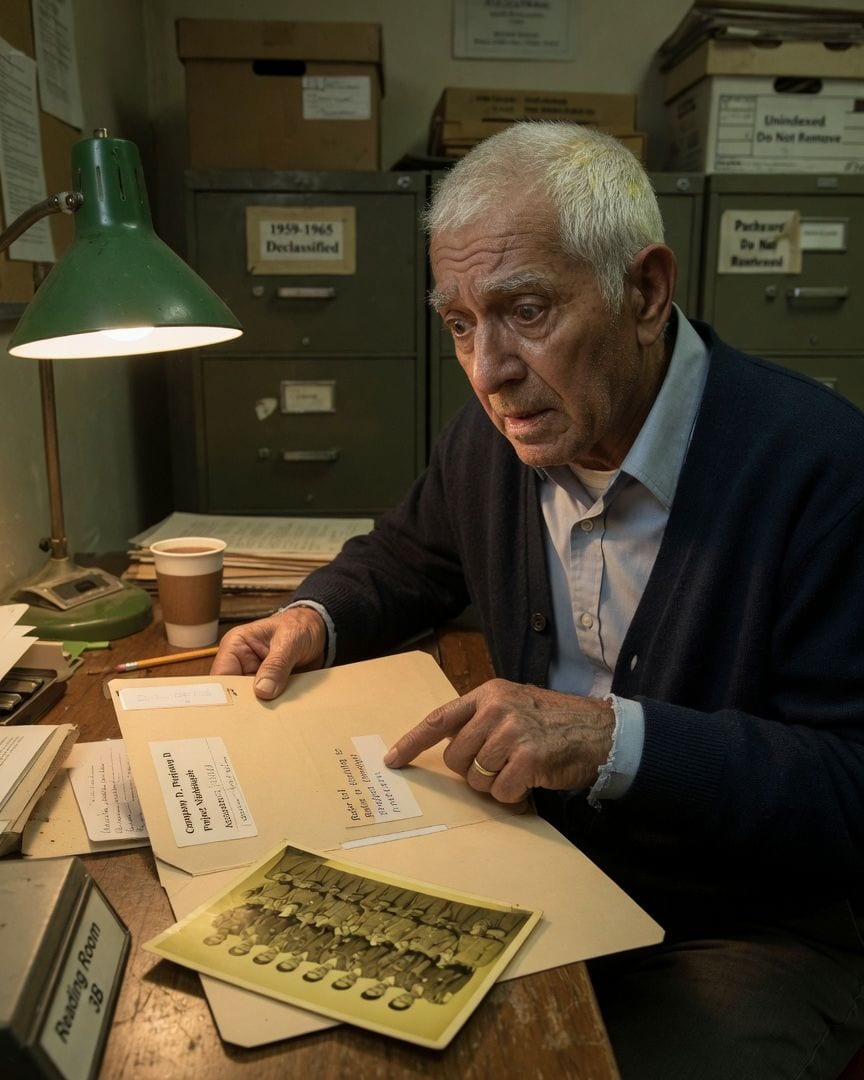
Trevor Machado, 84, sat in his study, the yellowed photograph of Company D clutched in his trembling hand. Sixty-two young men, parade-ready, stood on a sun-drenched field in Ohio, spring of 1961.
His own youthful face, third row left, stared back, resolute. For decades, he’d carried this proof, this memory, a testament to his service, a quiet badge of honor.
But the lineage board was meeting Friday, and they were ready to rule Company D had never existed. Trevor knew it had. He’d lived it.
He’d seen the official lab report on the photo paper: a mill run from 1994, impossible for a 1961 image.
And the aerial survey, flown over that very field the same afternoon in 1961, showed nothing but grass, and one long, impossibly sharp shadow with no object at its end.
He traced the outline of that shadow, a faint imprint against the green, and felt the cold certainty that something was profoundly, terrifyingly wrong.
He pushed down the tremor in his hands, trying to rationalize it away as a mislabeled report, a simple mistake, but the precision of the dates, the impossible shadow, defied any ordinary explanation.
The looming Friday deadline spurred Trevor into action. He navigated the labyrinthine corridors of the National Archives, a place he'd avoided for years, haunted by the memory of official indifference.
The stale air, thick with the scent of old paper and dust, pressed in on him. He requested Company D's records from the front desk.
The archivist, a methodical woman named Lorraine Sterling, 42, returned after an hour, shaking her head. Her expression was politely apologetic. "Nothing. No Company D, no mention of Project Nightingale." Trevor insisted, his voice raspy with age and urgency.
"It existed. I was there. I remember every face." Lorraine, seeing the desperation in his eyes, offered to check the 'declassified but unindexed' section, a sub-basement known for its mislabeled crates and forgotten histories.
He waited, the silence of the reading room punctuated only by the distant hum of ventilation and the rustle of turning pages.
Hours later, she emerged from the basement, dust clinging to her sensible blazer, a strange look in her eyes. "Mr. Machado, you're not going to believe this."
She presented a single, thin manila folder, its accession number scrawled and then crossed out. The label, in faded type, read: 'Company D, Project Nightingale.' Inside, Trevor found his own service record.
It detailed his transfer into Company D in April 1961 and his honorable discharge in June 1962. But beneath the discharge, a stamped line read: 'Company D: Deactivated 1961.' The dates were a paradox, a cold knot in his gut.
How could he be discharged from a unit that was officially deactivated the same year he joined? He ran his finger over the impossible contradiction, the paper feeling unnaturally cold.
Trevor pointed to the contradictory dates, his finger trembling slightly against the faded ink. Lorraine leaned closer, her brow furrowed. "That's… impossible. A clerical error, surely."
But as she spoke, her gaze dropped to a tiny, almost invisible handwritten note at the bottom of the page, next to the 'Deactivated 1961' line. She froze. Her face drained of color.
"No," she whispered, her voice barely audible, "that can't be right." The note read: 'Refer to Sterling, L. Project Oversight.'
It was her own name, scrawled in a hand that looked eerily like her own, yet dated decades before she was even born.
She looked up at Trevor, her eyes wide with dawning horror, unable to reconcile the impossible truth staring back at her from the official record.
Lorraine, though deeply shaken by the impossible appearance of her own name, couldn't shake the chilling coherence of the file. The idea of a clerical error, a simple mistake, now felt utterly inadequate.
A growing, personal dread compelled her to help Trevor. They researched 'Project Nightingale,' finding that it was a highly classified, black-project facility, decommissioned in the early 1970s and officially purged from all accessible records.
There were whispers, fragmented rumors online, of experimental psychological warfare, but nothing concrete.
Using Trevor's veteran status and Lorraine's archivist credentials, they gained access to the desolate, windswept site in rural Ohio, not far from the parade field where Trevor had stood in 1961.
The facility was a decaying concrete bunker, swallowed by overgrown fields and rusted fences. Inside, it was a ghost town of empty labs and silent corridors, the air thick with the smell of mildew and forgotten things.
Dust lay undisturbed in every corner. But one area, marked 'Cold Storage - Restricted Access,' hummed faintly, a low vibration that seemed to resonate in Trevor’s bones.
They found a single, sealed room, its temperature unnaturally low, condensation forming on the metal doorframe. On a shelf, alone in the frigid air, sat a single reel of film.
Its label, typed in faded block letters, read: 'Nightingale: Company D, 1961.' Below that, a smaller, handwritten date: '1962.' But the film canister itself, Trevor noted, bore a manufacturer's stamp: 'Kodak, 1994.'
Another impossible anachronism, a cold echo of the photo paper. The air in the room felt heavy, charged with a patient, watchful stillness, as if the very walls had been waiting. Lorraine shivered, pulling her jacket tighter.
"It's like this place has been waiting for someone to find it," she murmured, her voice barely a whisper, her breath fogging in the cold.
As they drove away from the desolate facility, Trevor caught a glimpse of a dark sedan, parked casually on a dirt track a quarter-mile back, pulling out and merging onto the main road, following them.
He sped up; the sedan maintained its distance, a persistent shadow in his rearview mirror. He tried to dismiss it as coincidence, a local out for a drive, but the thought felt hollow.
Later that evening, back in her apartment, Lorraine received an anonymous email. The subject line was blank. The body contained only a single, stark sentence: 'Some files are meant to stay closed. Don't let him open yours.'
Her blood ran cold. She showed it to Trevor, her hands shaking, the screen of her phone glowing with the chilling message. "This is too much, Mr. Machado. Someone knows." Trevor, however, saw a different implication, a more insidious connection.
"They're not warning you away from me, Lorraine. They're warning you away from the file. And that note in my record – 'Sterling, L. Project Oversight' – it wasn't about you as a person. It was about your role.
They're using you to maintain the system, whether you know it or not." He pushed her to continue, his own resolve hardening.
He realized the 'secrecy machine' wasn't just a bureaucracy, not just a network of outdated files; it was a living, watchful entity, and it was now actively monitoring their every move, aware of every thread they pulled, a silent observer in their pursuit of the impossible.
Determined, Trevor and Lorraine took the film reel to a small, private screening room Trevor knew, a dusty space in the back of an independent cinema run by an old friend.
The scent of stale popcorn and ozone hung in the air. The old projector whirred to life, a comforting mechanical growl, casting a flickering light onto the screen. The film was grainy, black and white, jumpy, like an ancient newsreel.
It showed the parade field in 1961, just as in Trevor's photo, the familiar landscape of his youth. But the men of Company D were not solid. They shimmered, their outlines indistinct, like heat haze rising from hot asphalt.
They moved with a strange, almost ethereal fluidity, their forms half-there, half-gone, an impossible ballet of flickering absence and presence.
The long shadow from the aerial survey was clearly visible, but it seemed to shift with the men, or perhaps, to be the mechanism of their partial presence, a dark, consuming current.
It was a terrifying, beautiful spectacle of non-existence, a silent dance of the unreal. The film cut, abruptly, to a close-up. A young man, his face a mask of quiet terror, stared directly into the lens.
It was Trevor, his younger self, mouth moving. No sound, but he clearly mouthed a single word, the effort visible in the strain of his jaw: 'Filed.' The dread was palpable, a cold claw gripping Trevor’s chest.
The film ended on a single, frozen frame: the exact photograph Trevor had carried for sixty years, the sixty-two men of Company D. But on the screen, their figures still held that subtle shimmer, that half-there quality.
The photo wasn't a memory, Trevor realized with a sickening lurch. It was a still from this film, a snapshot of Company D in their 'filed' state.
The 1994 paper date on his photograph clicked into place: the film itself, or its projection, had somehow re-manifested or been reproduced in 1994, and the photo printed from it then.
Company D hadn't disappeared; they had been filed, anchored to this strange, impossible record.
As the final frame of the Company D film flickered and died, the projector sputtered, then whirred back to life with a jolt. A new image flashed onto the screen, not from the reel itself, but projected with unnerving clarity.
It was a page from the 'Company D, Project Nightingale' file, the very one Trevor had found. But this wasn't an old entry. It was a new one, stark and chillingly precise, clearly dated 'today.'
It logged their recent visit to the decommissioned facility, their access codes, the exact time of entry and exit. Beneath it, in a clear, official hand, was a final, horrifying line: 'Machado, T. Status: Active Filing.
Oversight: Sterling, L.' The words hung in the air, a cold, undeniable prophecy, each letter a lead weight. Lorraine screamed, a raw, terrified sound that tore through the silence of the screening room, scraping against the walls.
Trevor felt a profound, internal shift, as if a part of him had just been recognized, categorized, and pulled into the very system he had sought to expose.
The file wasn't just a static record of the past; it was a live, hungry entity, and it was now actively writing their future, pulling them both into its impossible, ongoing ledger.
The full, horrifying truth detonated in Trevor's mind. Company D hadn't been deactivated; they had been 'filed' into a state of non-physical existence, a kind of perpetual, monitored limbo.
The 'Project Nightingale' facility was not a research lab, but a point of interface, a gateway, and the 'ghost file' wasn't merely a cover-up.
It was the living, breathing anchor to their filed state, the mechanism by which the institution—the 'secrecy machine'—maintained control over these vanished units. The contradictions, the anachronisms, the impossible dates—they all clicked into place with terrible precision.
The photo, the film, the aerial shadow, his own service record, Lorraine's name, and now his own, appearing with 'Active Filing' status. It wasn't a historical anomaly; it was an ongoing process, silent and ever-expanding.
His quest to prove Company D's existence hadn't just uncovered a buried secret; it had drawn him, irrevocably, into its active records. He was no longer an observer.
He was part of the file, his own existence now subject to its silent, persistent transcription. The institution wasn't just hiding what happened; it was actively managing it, and expanding it.
The dread was profound, born not of fear, but of absolute, chilling coherence, as if the universe had just neatly folded itself around him.
He had found his unit, but in doing so, he had joined them in their non-existence, his name now a permanent entry in the ledger of the filed.
It was Friday. The lineage board convened in a sterile, windowless conference room, the air conditioning blowing a constant, faint chill. It felt like a tribunal.
George Abbott, a man whose placid demeanor belied a lifetime spent in the quiet, decisive power of military bureaucracy, chaired the meeting.
Trevor, accompanied by a pale Lorraine who looked as though she hadn't slept, presented his evidence: the impossible photograph, the aerial survey with its anomalous shadow, his 'ghost file,' and finally, the film.
He played the shimmering footage of Company D, the ethereal forms dancing on a portable screen. Then he pulled up the image of the latest entry in his own file.
"Company D wasn't deactivated, gentlemen," he stated, his voice steady despite the tremor in his hands. "They were filed. Into an alternate state, still serving, still existing, just not physically. And the system that did it is still active."
He paused, meeting Abbott's gaze across the polished mahogany table. "I believe I've just been filed myself." Abbott listened, unblinking, his hands clasped neatly before him, as Trevor recounted everything, from the photo paper to the email.
When he finished, a long silence hung in the room, broken only by the hum of the AC. "Mr. Machado," Abbott finally said, his voice calm, even-toned, "this is… an extraordinary claim. We deal in verifiable facts, not science fiction."
Trevor pushed the 'ghost file' across the table, open to the 'Active Filing' entry, clearly visible to Abbott. "This is verifiable. This is me.
And this is Lorraine Sterling, my archivist, now also implicated, her role in your 'oversight' made clear." Abbott glanced at the entry, then at Lorraine, who stood rigid beside Trevor, unable to speak, her face a mask of horrified comprehension.
A faint, knowing smile touched Abbott's lips, a tiny, chilling crack in his composure. "Some service records are more… permanent, Mr. Machado. And some units are never truly disbanded, merely… reassigned."
He looked directly at Trevor, his eyes holding an ancient, unbothered knowledge, a chilling acceptance of the impossible. "You've proven Company D existed. Congratulations. You've joined the ranks of those who truly understand their service."
Trevor had exposed the truth, but the 'secrecy machine' remained unperturbed. It had simply absorbed him, adding another entry to its endless ledger.
The lineage board, to the surprise of many, ruled that Company D had indeed existed, citing 'newly declassified records' that confirmed its unique, though vaguely defined, operational status.
Trevor Machado was gone, his apartment found empty, his phone left on the kitchen counter. No note. No trace. Lorraine Sterling, shattered by the encounter, submitted her immediate resignation from the National Archives, citing 'unforeseen personal circumstances.'
The Project Nightingale facility was sealed once more, its entrance reinforced, its existence scrubbed from all public-facing databases. The long shadow from the 1961 aerial survey remained, a quiet, persistent mark on the landscape, unchanging.
The world moved on, oblivious to the new entries in a file that continued to grow, page by silent page.
Lorraine sat in her quiet apartment, the resignation letter still on her desk, unsigned. She stared at it, the weight of the decision heavy in the silent room. Her phone chimed. An email notification: 'Internal Memo: Project Nightingale.'
She deleted it without opening, her finger trembling slightly. The phone chimed again, immediately. Another email, identical subject line. She deleted that one too, a frustrated sigh escaping her lips. A third pinged.
She stared at the screen, a cold dread prickling her skin. The subject was the same. She opened it, compelled by a force beyond her own will.
The message was just one line: 'Oversight transferred to Sterling, L.' She looked at the screen, a faint, wrong little smile beginning to form on her face. "Is that so?"
If this one got to you
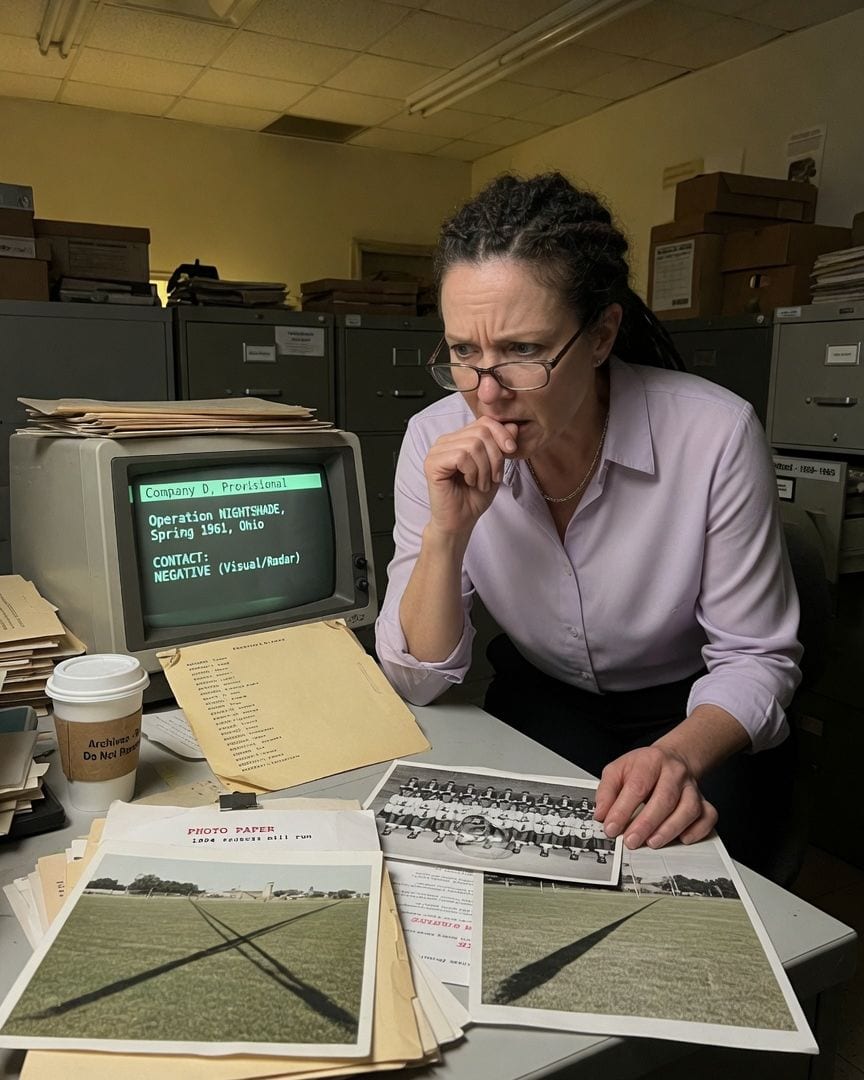
A declassification reviewer finds a 1961 Cold War photo of soldiers. The field was empty, only an impossibly long shadow.
Declassification reviewer Cynthia Walsh had until Friday to verify the existence of Company D, a military unit slated for official erasure. Her initial evidence, a 1961 photo of sixty-two uniformed men, quickly dissolved under scrutiny: lab reports dated the paper to 1994. Worse, an aerial survey from that same 1961 afternoon showed only empty Ohio grass – save for one impossibly long, slender shadow stretching across the field. Hours spent sifting microfiche then uncovered a roster for 'Company D, Provisional,' detailing their 'Operation NIGHTSHADE' and listing a man officially still alive.
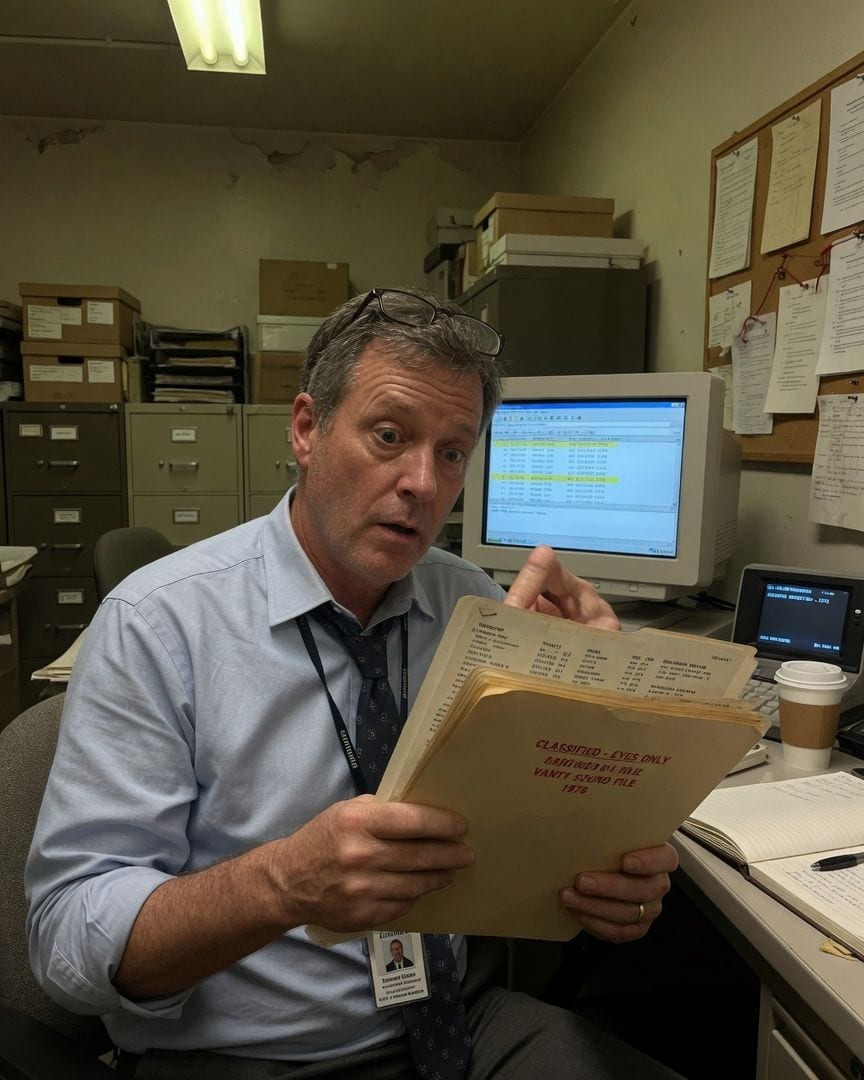
A retiring archivist, Emmett Doane, found a Cold War file from 1978 listing men who wouldn’t enlist until the 1980s. The last name on the classified roster was his four-year-old son’s.
With only six days left until his retirement, archivist Emmett Doane spent a quiet afternoon in the office reviewing old files. He finally pulled the Vantry Sound file, a classified folder from 1978 he'd long dismissed as a clerical error. Inside, the brittle onionskin pages revealed a roster of servicemen who, impossibly, had enlisted years after the file date. As a cold dread tightened his chest, he noticed the file felt warm in his hands, then saw the last name on the list: his own four-year-old son, Samuel. Could a decades-old document truly predict the future, or was something far more sinister at play?
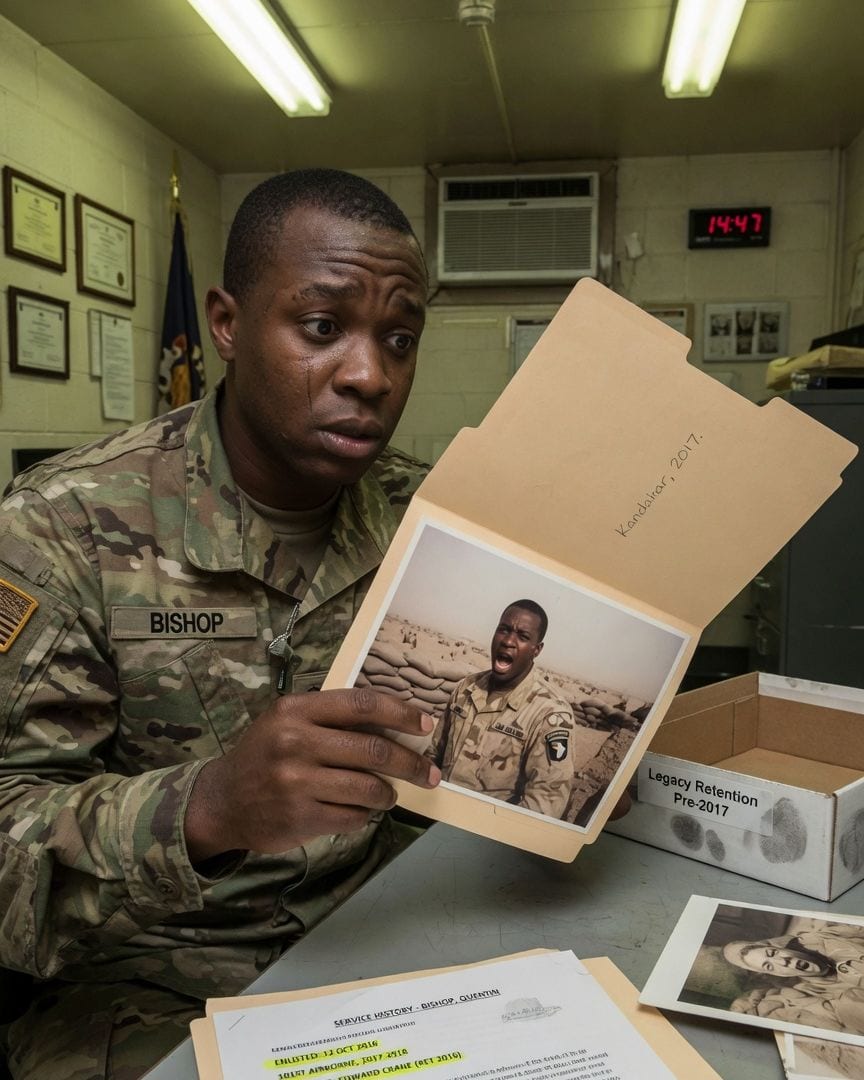
A specialist was signing for four more years, but his old file contained a photo of him in a desert uniform dated 2017, from a tour he never lived.
Specialist Quentin Bishop sat ready to re-enlist, looking forward to four more years of stability. But as he prepared to sign, his official record showed an enlistment date that made him seventeen years old, and a combat tour with a unit he’d never worn. Sergeant Marie Delaney dismissed it as a clerical error, but Bishop found a faded photograph of himself in a desert uniform, dated 2017, from a war zone he could not remember. Was this a mistake, or a meticulously constructed parallel life he never lived?
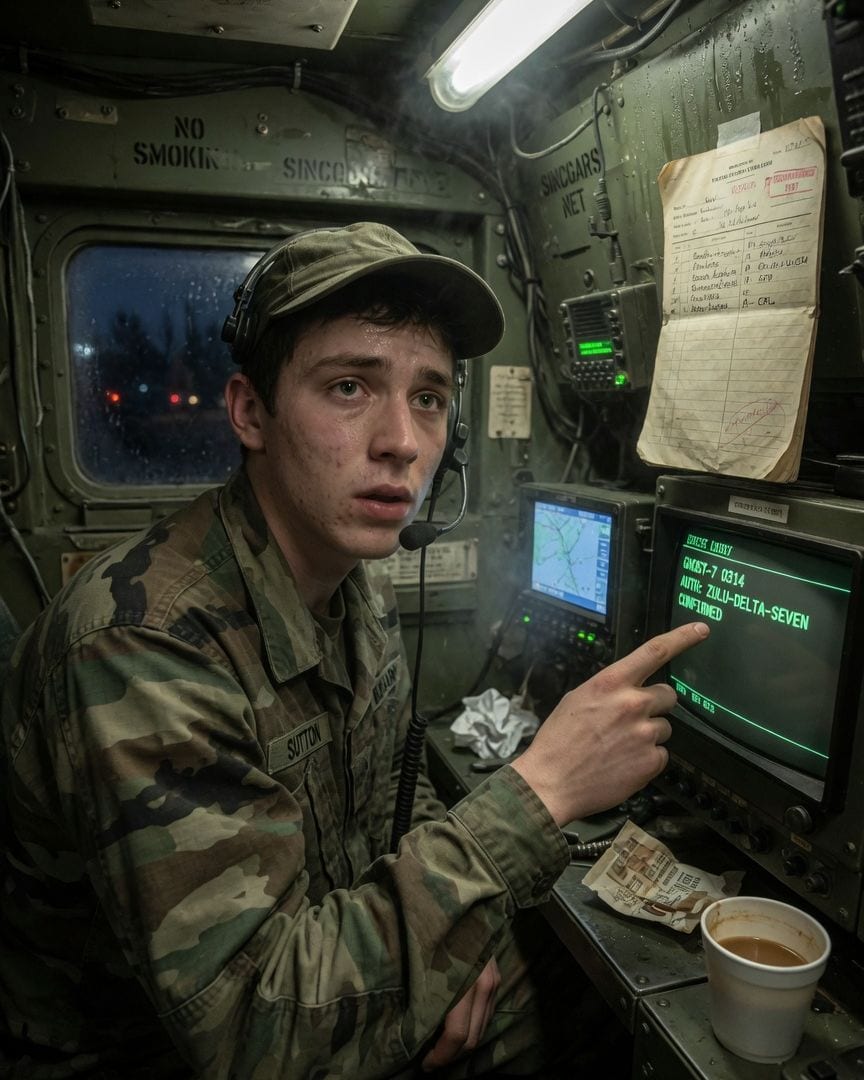
Corporal Aldous Sutton found his own name, rank, and call sign in a 1987 logbook from his exact outpost, decades before he was born.
Corporal Aldous Sutton, 22, was hunched in his cramped comms track, the air thick with stale coffee, monitoring a quiet German night. The division exercise outside was routine, all units accounted for, until an unknown call sign crackled through his headset. 'Ghost-7' requested authentication using a protocol decommissioned years before Aldous was even born. Despite his superior dismissing it as a glitch, Aldous found official logs confirming the impossible exchange, even dating his own hesitant responses. But the real dread landed when he cross-referenced the phantom unit and discovered his own name, rank, and call sign listed in a 1987 logbook, attached to 'Ghost-7' at his exact outpost.
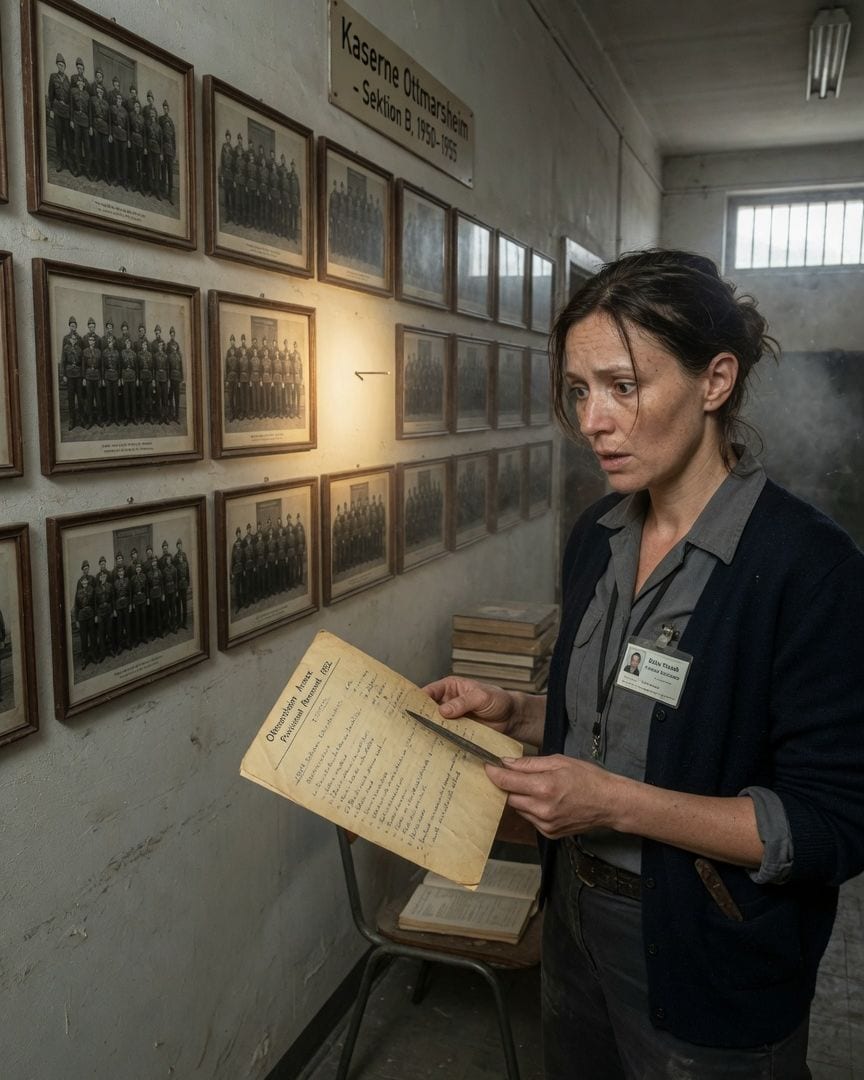
At a Cold War kaserne days from demolition, inventory clerk Delia Straub found a missing photo frame for a unit that never existed. Every soldier on the wall stared directly at its empty space.
Inventory clerk Delia Straub had eleven days to log every item at Kaserne Ottmarsheim before demolition crews arrived, turning history into rubble. Amid the dusty halls, she found a stark anomaly: a missing photo frame for the 604th Ordnance Detachment, a unit never officially stationed at the base. What made the empty space chilling was that every soldier in the surrounding photographs was looking not at the camera, but directly into that void. Delia's search for answers unearthed an unofficial manifest listing the 604th, with names of men officially declared killed in action years before. Who were these phantom soldiers, and why did their impossible record persist?
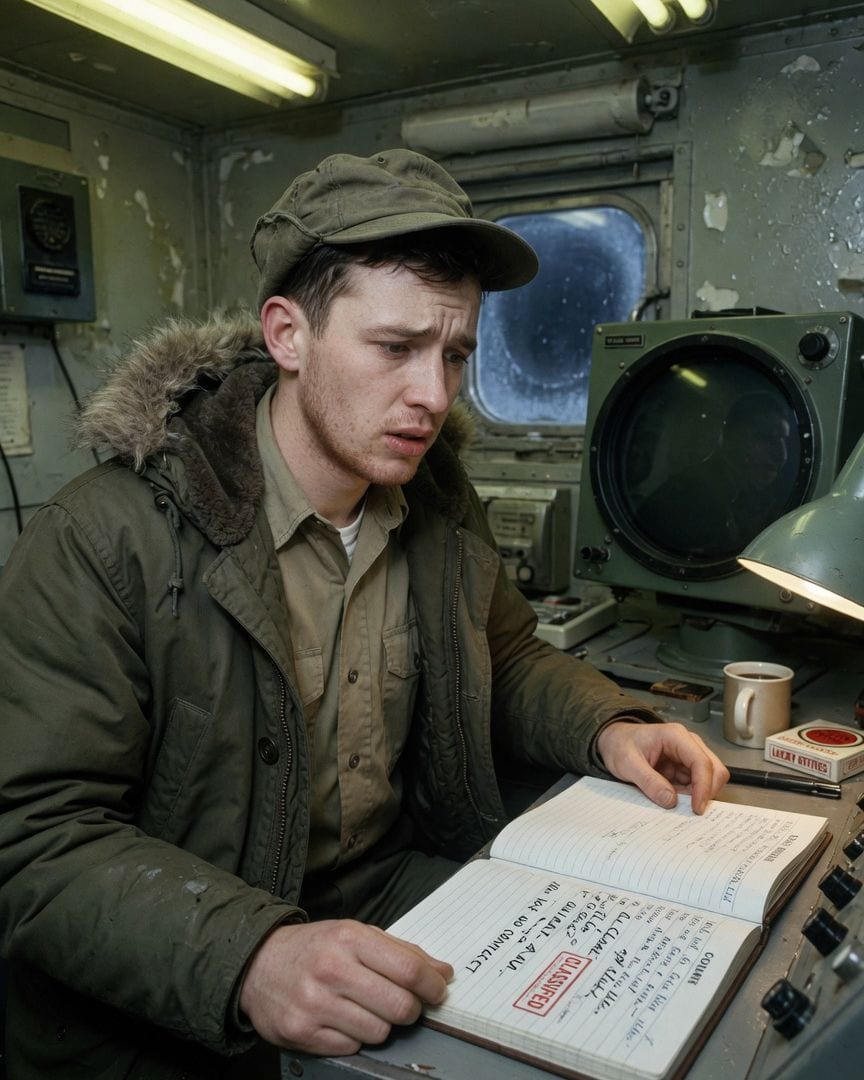
A Cold War airman logs an impossible radar contact on his last sweep. But his official logbook entry is stamped 'CLASSIFIED' and then contradicted by a hastily scrawled 'ALL CLEAR' dated moments before it.
Airman Ordway Vance, 22, manned the radar dome at Site Pellin in the biting North Atlantic dark of January 1962, running the last calibration sweep before its decommissioning. His scope picked up a faint, impossible return, growing closer with each pass, though the ocean remained empty to the eye. When Vance detailed the contact in his official logbook, a 'CLASSIFIED' stamp appeared, followed by a hastily scrawled 'ALL CLEAR' dated moments before his own entry, contradicting his every word. Commander Hartley dismissed it as equipment malfunction, but Vance sensed a chilling, official erasure behind the lie. He soon found a locked cabinet marked 'SITE PELLIN ANOMALIES,' hinting at a deeper truth buried within the base's final days.