A declassification reviewer finds a 1961 Cold War photo of soldiers. The field was empty, only an impossibly long shadow.
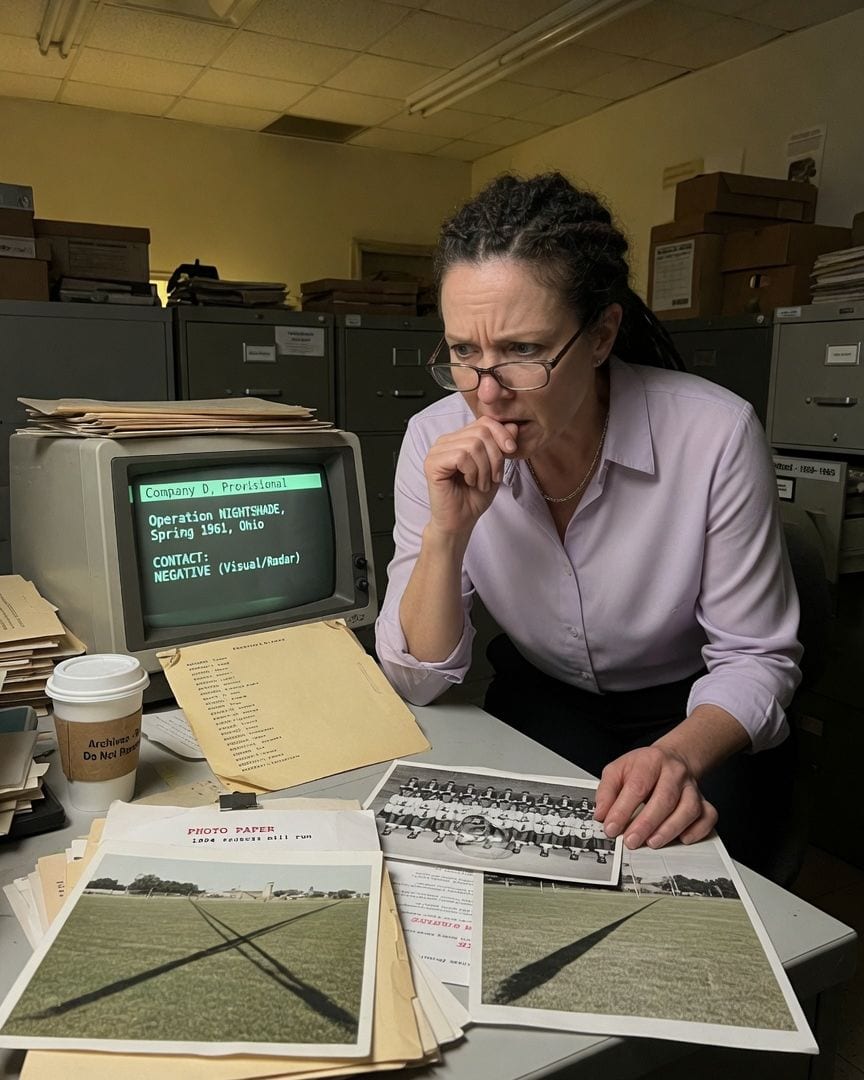
Cynthia Walsh, a declassification reviewer, adjusted her glasses, a slight frown creasing her brow as she examined the latest submission.
Trevor Machado, eighty-four, claimed to be the last living member of Company D, a unit the lineage board was set to declare non-existent by Friday. His evidence: a faded photograph.
Sixty-two men, in crisp uniforms, stood on a parade field under a bright Ohio spring sky in 1961. His own younger face, third row left, was clearly visible. Cynthia’s job was to verify.
The first discrepancy was immediate: the photo paper itself, according to the lab report attached, was from a mill run in 1994, not 1961.
She tried to rationalize it – a reprint, a family heirloom copied later – but the next detail made her throat tighten.
An accompanying aerial survey, flown over that exact Ohio field on the very same afternoon in 1961, showed nothing but empty grass. No men, no parade.
Just grass, and one impossibly long, slender shadow stretching across it, with no discernible object at its origin point. Cynthia zoomed in, then out, then in again.
The shadow was undeniably there, sharp and defined, but it ended abruptly, as if cut by an invisible blade, leading to nothing.
It was a contradiction etched in light and paper, a scene that had never happened, documented by a ghost of itself. She tapped the desk, the rhythmic sound doing little to dispel the growing unease.
Dismissing the photo for a moment, Cynthia searched the archives for any mention of ‘Company D.’ Her department’s database yielded nothing. No unit, no personnel, no orders. It was as if Trevor Machado had conjured it from thin air.
Yet, the lineage board’s request meant someone else had seen enough to warrant an official review. She decided to go analog, sifting through unindexed microfiche rolls, a painstaking process few bothered with anymore.
Hours later, in a dusty corner of a forgotten cabinet, her fingers brushed against a misfiled box. Inside, a single microfiche reel, hand-labeled in neat, precise script: 'Company D, Provisional.' Her breath hitched. She loaded it onto the ancient reader.
The first frames scrolled past, a sparse, almost deliberately incomplete file. A roster, listing all sixty-two names from Trevor Machado’s photograph, including his own. And then, an entry for 'Operation NIGHTSHADE, Spring 1961, Ohio.'
Below it, a single line, typed in all caps: 'CONTACT: NEGATIVE (Visual/Radar).' Cynthia frowned. How could contact be both visual and radar, yet simultaneously 'negative'? It defied logic, an oxymoron of observation.
It implied something was seen, tracked, but officially declared not to exist. The mundane explanation – a typo, a misread – felt flimsy against the weight of the impossible photo. The dread began to feel specific.
Cynthia scrolled through the roster again, cross-referencing names with publicly available records. Many of the men had death certificates, all dated within weeks of 'Operation NIGHTSHADE.' Causes of death were unsettlingly vague: 'unspecified trauma,' 'missing, presumed dead.'
A pattern of quiet, official erasure. But one name, buried in the middle of the list, caught her eye: Leonard Novak.
She found a current address, a rural route in western Ohio, less than fifty miles from where the phantom parade field was supposed to be.
Leonard Novak, also listed on the Company D roster, also in Trevor Machado's impossible photograph, was, according to official records, still alive. The microfiche hummed, projecting his name, a beacon in the darkness.
Cynthia stared at it, the single living proof of a company that didn’t exist, and suddenly felt a profound chill.
The next morning, Cynthia called in sick. She drove her aging sedan west, the Ohio landscape blurring into endless fields and isolated farmhouses.
Leonard Novak’s address led her down a long gravel lane, ending at a dilapidated farmhouse, paint peeling, windows dark. It looked abandoned, yet a fresh set of tire tracks marred the muddy driveway, leading to a recently locked shed.
She approached cautiously, the silence of the countryside oppressive. A faded 'No Trespassing' sign hung askew. The front door was unlocked. Inside, dust motes danced in the slivers of light.
The air was stale, but not entirely dead; a faint scent of old tobacco and something metallic, like ozone, lingered.
A worn uniform jacket, clearly military but devoid of any identifying insignia save for a crudely stitched 'Company D' patch, hung from a hook by the door.
On a cluttered table, amidst stacks of newspapers from the early 2000s, lay a leather-bound journal. Its pages were filled with a spidery, agitated script. Cynthia carefully opened it.
The entries spoke of disorienting 'lights in the sky,' 'the shadow that ate the sound,' and a pervasive sense of unreality. 'They said it was a drill,' one entry read, 'but the sky was wrong. The ground was wrong.
We weren't there, but we were.' The last entry, dated late Spring 1961, ended abruptly mid-sentence, a jagged line trailing off the page. Tucked into the back was a hand-drawn map, crudely marked with a red circle.
It was coordinates, less than five miles from the original 'parade field' location. This was where Company D had been. This was where the 'negative contact' occurred.
The journal felt warm in her hands, as if the dread of its author still emanated from the brittle pages.
As Cynthia backed out of Novak's long driveway, she glanced in her rearview mirror. Parked a quarter-mile down the road, partially obscured by a stand of dying oaks, was a black sedan. Unmarked. Its windows tinted.
She couldn't see the occupants, but she felt their gaze, heavy and deliberate. A shiver ran down her spine. She sped up, the feeling of being watched clinging to her like static electricity.
Back at her office later that evening, the incident at Novak’s farmhouse replayed in her mind. She tried to focus on her routine tasks, but the unease persisted. Her computer chimed: a new email, sender unknown. She hesitated, then clicked.
The attachment was a PDF. It was her own declassification request for Company D, verbatim, every detail she had meticulously typed out. But across the top, in stark, digital red, was a stamp: 'DENIED.' And below it, the date: 'TOMORROW.'
Not yesterday, not today. Tomorrow. A cold certainty settled over her. They knew. They weren't just watching; they were anticipating. The anonymous email was a warning, a chilling display of foresight and control.
The black sedan, the 'No Trespassing' sign, the locked shed – it all clicked into place. She was no longer just an investigator; she was a target. The secrecy machine wasn't a relic; it was a living, breathing entity.
The next morning, Cynthia walked into her supervisor Vincent Sterling’s office, the email printed in her hand. Sterling, a man whose default setting was 'mildly annoyed,' looked up, his expression hardening as he saw the printout.
“Walsh,” he said, his voice unusually low. “You’ve been digging where you shouldn’t.” Cynthia placed the printout on his desk. “This arrived last night. It’s my Company D request. Denied. Dated for today.”
Sterling picked it up, his fingers tracing the red stamp. “A hoax,” he mumbled, but his eyes darted to the door. “A very specific hoax.
How could someone know my request before I even submitted it for official processing, and stamp it for tomorrow?” she pressed. Sterling sighed, a deep, weary sound. “Company D,” he began, “is… a sensitive flag.
Officially, it was an experimental unit, disbanded due to budget cuts. Nothing more.” “Then why is there a microfiche file that says ‘CONTACT: NEGATIVE (Visual/Radar)’? Why are there death certificates for men who were supposedly just transferred?
Why is Leonard Novak still listed as alive?” Cynthia’s voice rose, edged with frustration. Sterling leaned back, his gaze fixed on some distant point. “Budget cuts,” he repeated, but without conviction.
He reached into a locked drawer and pulled out a single, aged manila folder. 'EYES ONLY,' it read, stamped repeatedly in black ink. He slid it across the desk. Inside was a memo, dated May 1961.
It detailed the immediate decommissioning of Company D, citing 'unforeseen operational parameters' and an 'urgent, total erasure of all personnel and records.' It was signed by a General Hayes.
“The operational parameters,” Sterling said, his voice barely a whisper, “were not budgetary. They were… beyond budget. Beyond explanation. The unit was not disbanded; it was unmade. The men were not transferred; they were… filed.”
He looked directly at Cynthia, his eyes holding a stark warning. “Drop it, Walsh. Some things are buried for a reason. And some files, once opened, don’t close.”
The earlier clues re-meaning on-page: 'Negative Contact' was the euphemism for the 'unforeseen operational parameters.' The 'unspecified trauma' was the result of those parameters. The impossible shadow was the 'Thing' that caused it all.
The secrecy machine was real, and it had acted with chilling efficiency.
Cynthia left Sterling’s office in a daze, the 'EYES ONLY' memo’s words echoing in her mind. 'Unforeseen operational parameters.' 'Urgent, total erasure.' The secrecy machine wasn't a conspiracy theory; it was a cold, efficient reality.
Back at her desk, she found her computer screen still active, the Company D microfiche file open. She hadn't left it that way. A new line of text was appearing, character by character, as if typed by an invisible hand.
Her breath hitched. The screen glowed, illuminating the words as they formed: 'STATUS UPDATE: WALSH, CYNTHIA. DECLASSIFICATION REVIEWER. ACCESS LEVEL: COMPROMISED. DISPOSITION: PENDING.' Her name. Her role. Her status. It was all there, in the very file she was investigating.
The cursor blinked, waiting for the next word, the next command. The file wasn't just a record of past events; it was a living document, a surveillance log. And she was its newest entry.
A cold, metallic taste filled her mouth. The dread escalated, no longer external, but internal, personal. She was no longer just reading the file. She was in it.
Cynthia’s fingers flew across the keyboard, a desperate energy seizing her. The 'DISPOSITION: PENDING' entry on her screen was a ticking clock. This wasn't just about Company D anymore; it was about her.
She quickly copied the new entry, and the entire Company D microfiche file, onto a secure USB drive she kept for personal backups. The file was a living thing, a digital sentinel.
She frantically searched for other 'Disposition' entries within the file, tracing the fates of the other Company D men. The answers were horrifying. Each entry was a chilling euphemism. 'Pvt. William Walsh: Re-integration complete, memory recalibrated, civilian identity assigned.' 'Sgt.
Benjamin Novak: Status: UNACCOUNTED FOR.' 'Pfc. Jeffrey Fontaine: Voluntary reassignment, identity reassigned, subject shows no recall.' Leonard Novak, the man whose journal she’d found, was listed as 'UNACCOUNTED FOR' – a chilling echo of the 'missing, presumed dead' death certificates.
The 'Thing on the Scope' hadn't just caused an erasure; it had fundamentally altered these men, and the secrecy machine had then attempted to 'file' away the evidence by manipulating their identities and memories.
The impossible shadow in the 1961 aerial photo wasn't an object casting a shadow; it was a residual effect, a tear in the fabric of reality that left its mark even on a photographic plate.
Company D hadn't been unmade; it had been absorbed, its personnel either repurposed or lost to whatever 'unforeseen operational parameters' they had encountered.
The coherence hit her like a physical blow: every clue, every contradiction, now snapped into a terrifyingly clear picture.
The file wasn't just a record of what happened; it was a record of what they did to make it unhappen, and to those who witnessed it. And now, she was next.
Cynthia knew she had minutes, maybe seconds. 'Disposition: Pending' meant they were coming for her. Her only option was to make the file public, to rip it from the hands of the secrecy machine.
She navigated to a secure, anonymous public server, her fingers flying, heart hammering against her ribs. She initiated an upload of the entire Company D microfiche, including the new entry with her name. The progress bar crawled, agonizingly slow.
Each percentage point felt like a lifetime. Just as the upload reached 78%, she heard footsteps in the hallway outside her office. Heavy, measured. They stopped at her door.
The metallic click of the handle turning was the loudest sound she had ever heard. She slammed her finger down on the 'Confirm Upload' button just as the door swung open.
Vincent Sterling stood there, his face grim, devoid of its usual mild annoyance. Behind him, two silent men in dark, ill-fitting suits, their expressions unreadable, filled the doorway.
Sterling’s eyes immediately fixed on her computer screen, where the upload confirmation message flashed green. He saw the 'STATUS UPDATE' entry with her name, still visible, stark against the dark background. His jaw tightened.
“Walsh,” he said, his voice flat, devoid of emotion. “What have you done?” Cynthia didn't answer. Her hand, trembling, snatched the secure USB drive from its port, clutching it tight.
The two men took a step forward, their faces still blank, their movements fluid and practiced. Cynthia bolted, not toward them, but past Sterling, a blur of motion. She dodged around his surprised form, hearing a shout from behind her.
She sprinted down the deserted corridor, the secure drive a burning weight in her hand, the proof of the secrecy machine’s decades-long operation, and her own imminent 'disposition,' now free.
She didn't know where she was going, only that she had to get out. The footsteps pounded behind her, relentless.
She had escaped, for now, but the cost was clear: her old life was gone, replaced by the terrifying knowledge that she was now one of the 'unaccounted for,' carrying a truth no one would ever believe.
Cynthia Walsh disappeared. Her apartment was found undisturbed, but her personal computer, phone, and all identification were gone. Vincent Sterling reported her as 'missing,' though his eyes held a deeper, unstated understanding.
The lineage board, after a brief, quiet deliberation, formally ruled that Company D had never existed.
The public server Cynthia uploaded to was quickly taken down, the files purged and dismissed by official channels as a 'sophisticated hoax' or 'digital vandalism.' No news agency picked up the story. The world, oblivious, moved on.
The black sedan was never seen again near the declassification office. The file, however, remained. It was always there, waiting.
Weeks later, on a forgotten corner of the internet, a niche forum dedicated to 'declassified anomalies' saw a new post. It was a link, untraceable, leading to a single, unindexed microfiche file. 'Company D, Provisional.'
A user, 'Ghost_Hunter_77,' commented: 'this looks familiar.' The file then updated, in real-time, beneath the post. A new line appeared, character by character, as if typed by an invisible hand, a chilling digital signature of an unseen presence.
'STATUS UPDATE: WALSH, CYNTHIA. DISPOSITION: UNACCOUNTED FOR. FILE: CLOSED. ACCESS LEVEL: COMPROMISED. NEW ENTRY: PENDING.'
The comment section beneath the post remained quiet for a long moment, until another user, 'Observer_Zero,' simply typed: 'the end.'
If this one got to you
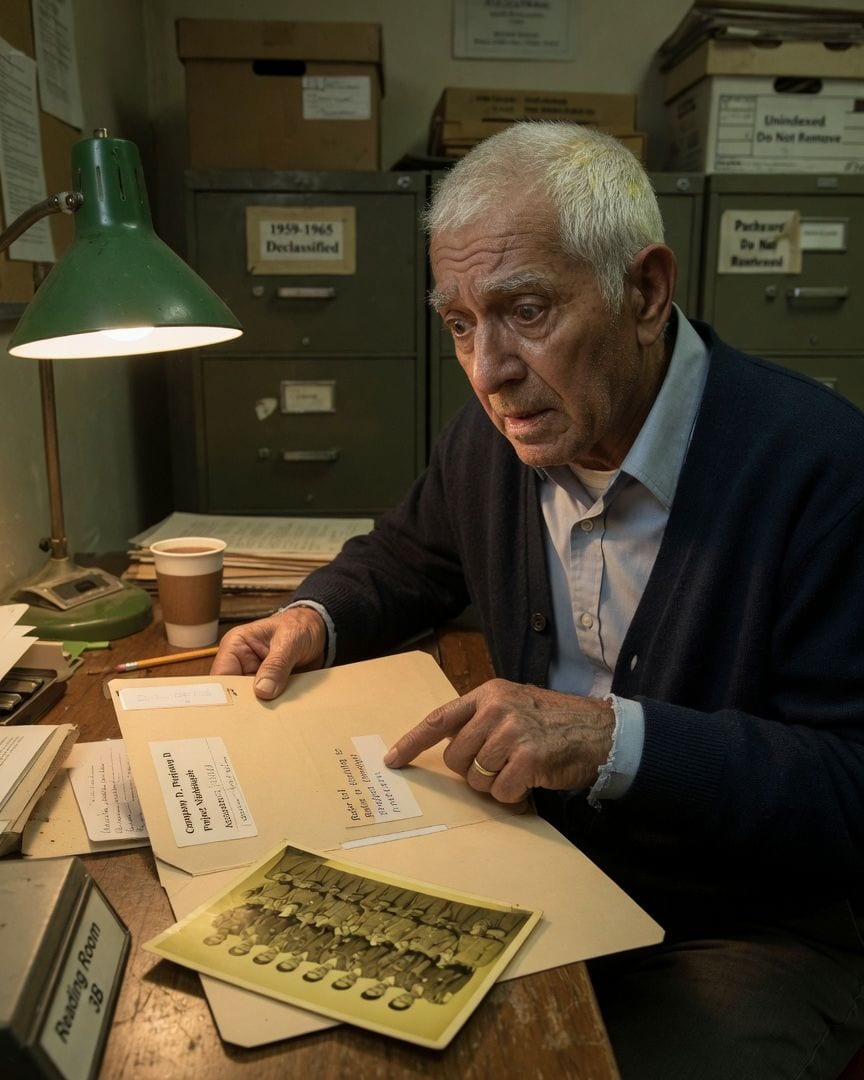
An archivist found her own name on a Cold War military record — dated decades before she was even born.
Eighty-four-year-old Trevor Machado clutched a yellowed photograph, his last hope to prove Company D existed before Friday's lineage board meeting. He knew the 1961 aerial survey of his unit’s parade field showed only grass and an impossibly sharp shadow with no object casting it. At the National Archives, a methodical archivist named Lorraine Sterling initially found no trace of Company D, but an unindexed sub-basement held a forgotten folder. Inside, Trevor's service record detailed his discharge from a unit officially deactivated the very year he joined, but a chilling handwritten note at the bottom, dated decades before Lorraine was born, bore her own name.
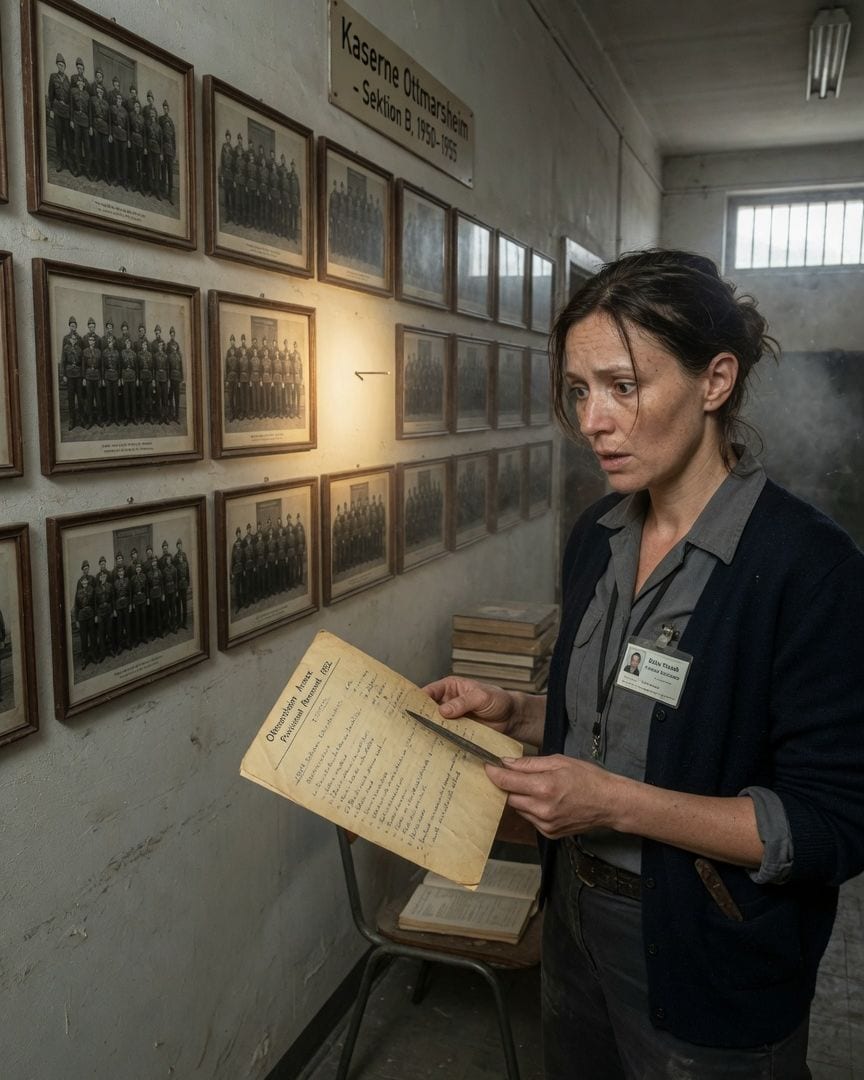
At a Cold War kaserne days from demolition, inventory clerk Delia Straub found a missing photo frame for a unit that never existed. Every soldier on the wall stared directly at its empty space.
Inventory clerk Delia Straub had eleven days to log every item at Kaserne Ottmarsheim before demolition crews arrived, turning history into rubble. Amid the dusty halls, she found a stark anomaly: a missing photo frame for the 604th Ordnance Detachment, a unit never officially stationed at the base. What made the empty space chilling was that every soldier in the surrounding photographs was looking not at the camera, but directly into that void. Delia's search for answers unearthed an unofficial manifest listing the 604th, with names of men officially declared killed in action years before. Who were these phantom soldiers, and why did their impossible record persist?
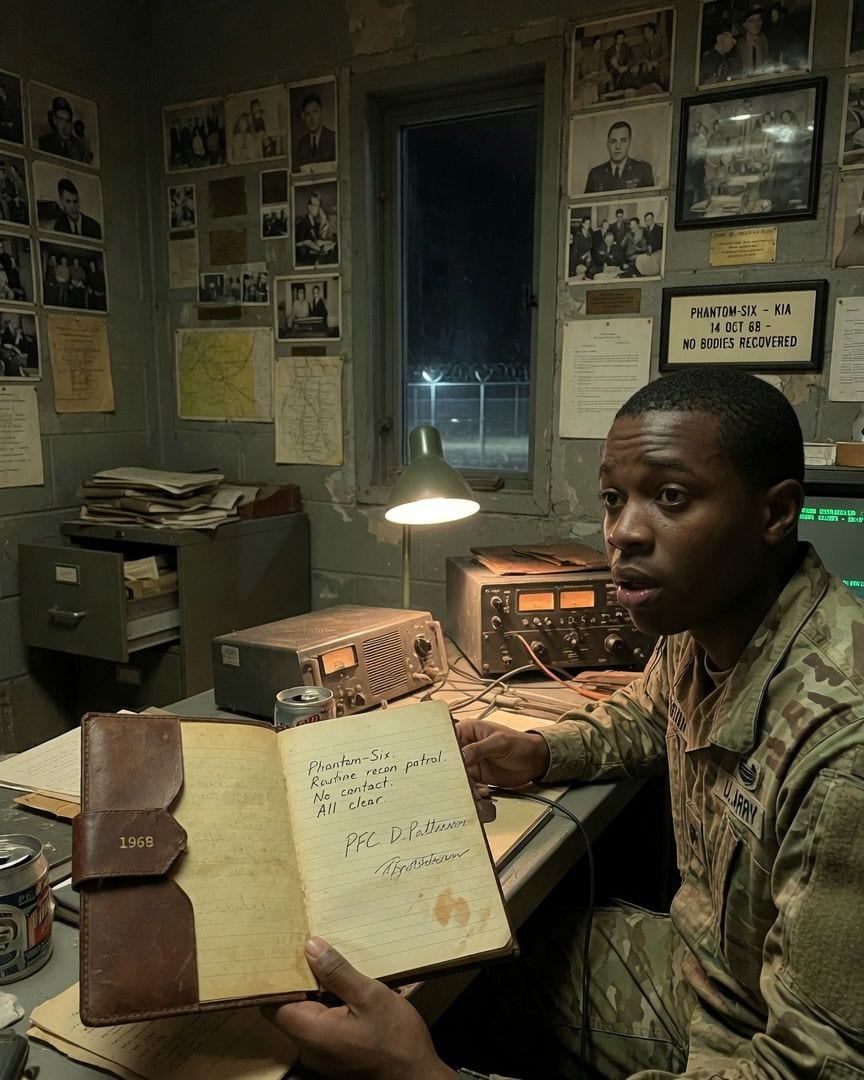
A DMZ specialist finds a 1968 Cold War logbook entry, signed by a lost soldier, its ink shimmering faintly.
Specialist James Farr, on a long night shift at a desolate Korean DMZ outpost, meticulously monitored his console, a squared-away soldier accustomed to the quiet hum of equipment. His focus shattered when a faint, static-laced whisper ghosted from a dead channel, calling out 'Phantom-Six' — a unit lost near this wire in 1968. The urgent voice then specifically mentioned his tower window light, asking him to turn it off before it drew fire. Later, an old logbook from 1968 revealed an entry dated three days *after* Phantom-Six was officially lost, signed by one of the vanished soldiers, its ink subtly shimmering with an unnatural gleam.
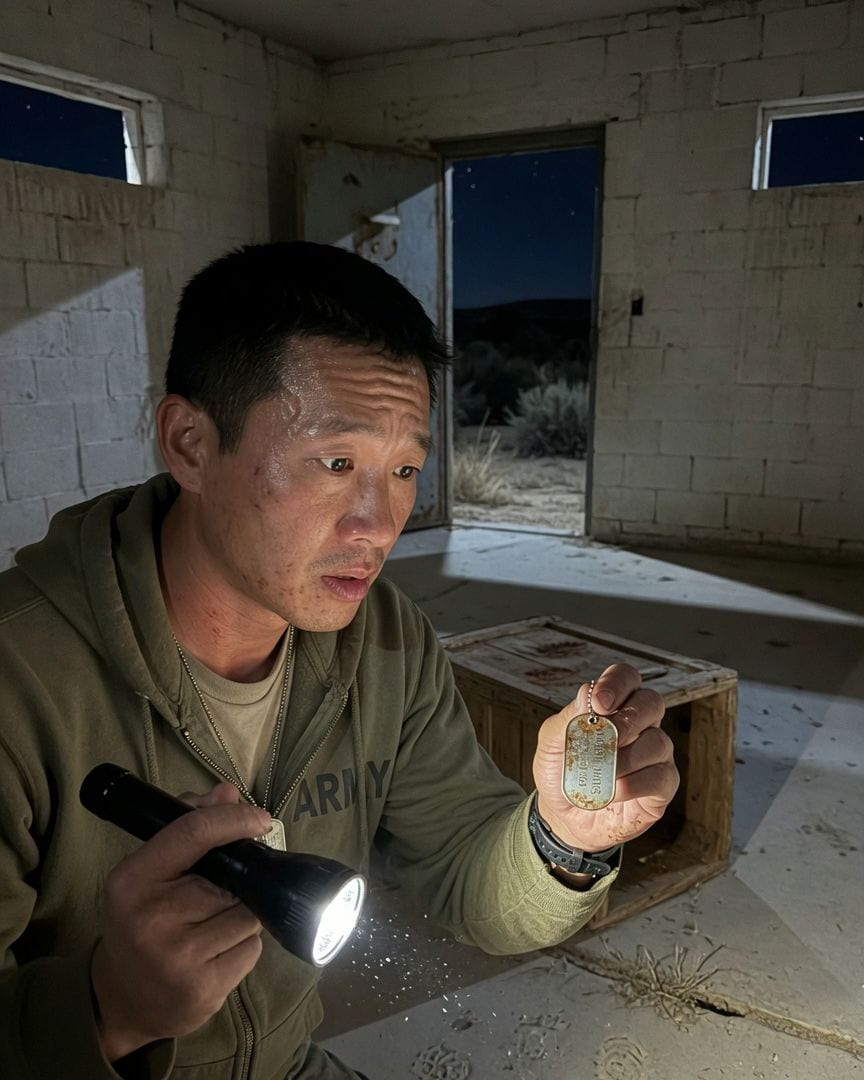
Staff Sergeant Rhee’s squad found a Cold War building not on their map. Range Control confirmed no structure. Minutes later, it vanished, leaving a foundation decades old.
Staff Sergeant Adam Rhee halted his squad at the Yakima Training Center, staring at a cinderblock building that simply wasn't on his map. Range Control confirmed there was no structure at his coordinates, leaving him to wonder what impossible thing stood before them. Moments later, after the range-safety truck arrived, the building vanished, leaving only a rectangular patch of earth with a foundation of decades-old weeds. That night, driven by an unsettling certainty, Rhee returned to find the building reappeared, its door ajar, holding a single, rusted dog tag from 1983. How could a place appear and disappear, leaving behind evidence from forty years ago?
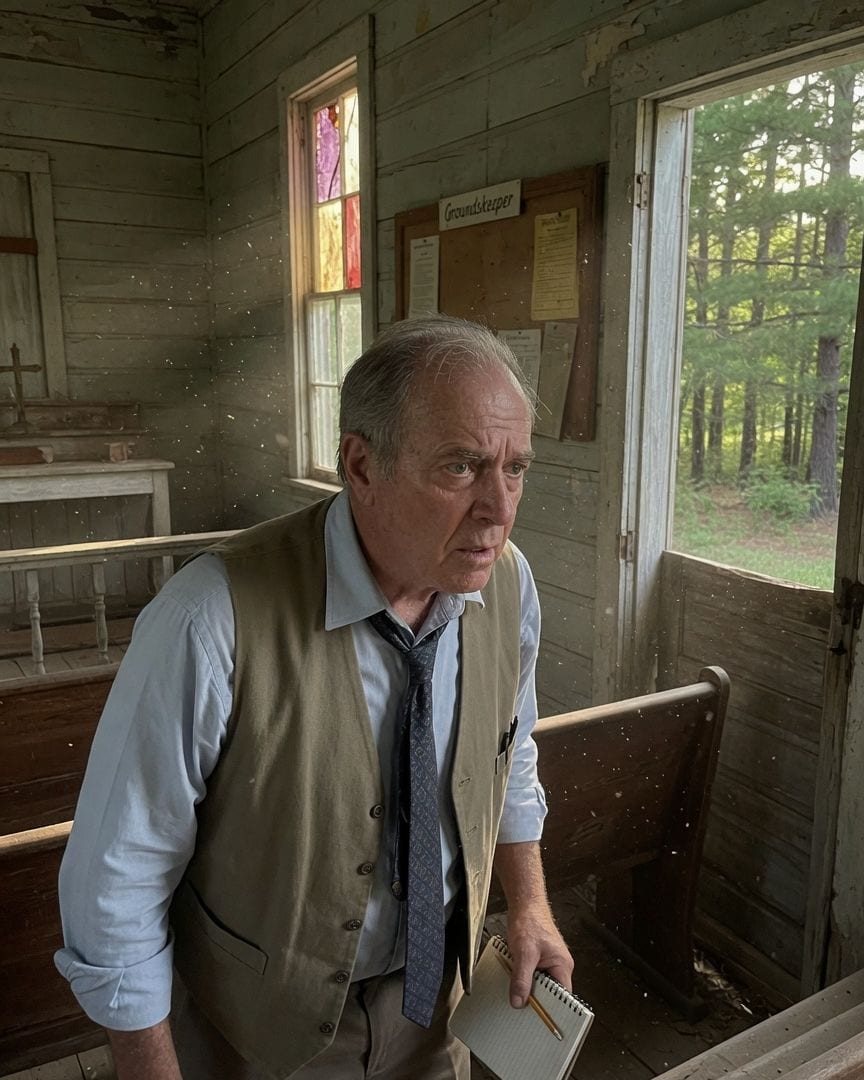
On his final project before retirement, a lineage historian found 41 soldiers buried in 1955 with no death dates. He then found their Cold War transfer order, dated *after* the burial.
Owen Sarkis, a lineage historian nearing retirement, sought to close his career with one final, simple project: resolving the mystery of the phantom 250th Chemical Company. His search led him deep into a Carolina pine forest, to an isolated chapel with a meticulously mowed plot. Forty-one headstones stood in neat rows, each bearing a name and regimental number, but beneath every name, the dates of birth and death were unsettlingly blank. The local groundskeeper hinted the men "just… left," and Owen found their names on no military lists after 1955; their lives seemed erased. But the true shock came with a "TOP SECRET" military transfer order, listing all 41 men from the chapel, ordered to a non-existent facility *two weeks after* their supposed burial. What really happened to the 250th Chemical Company?
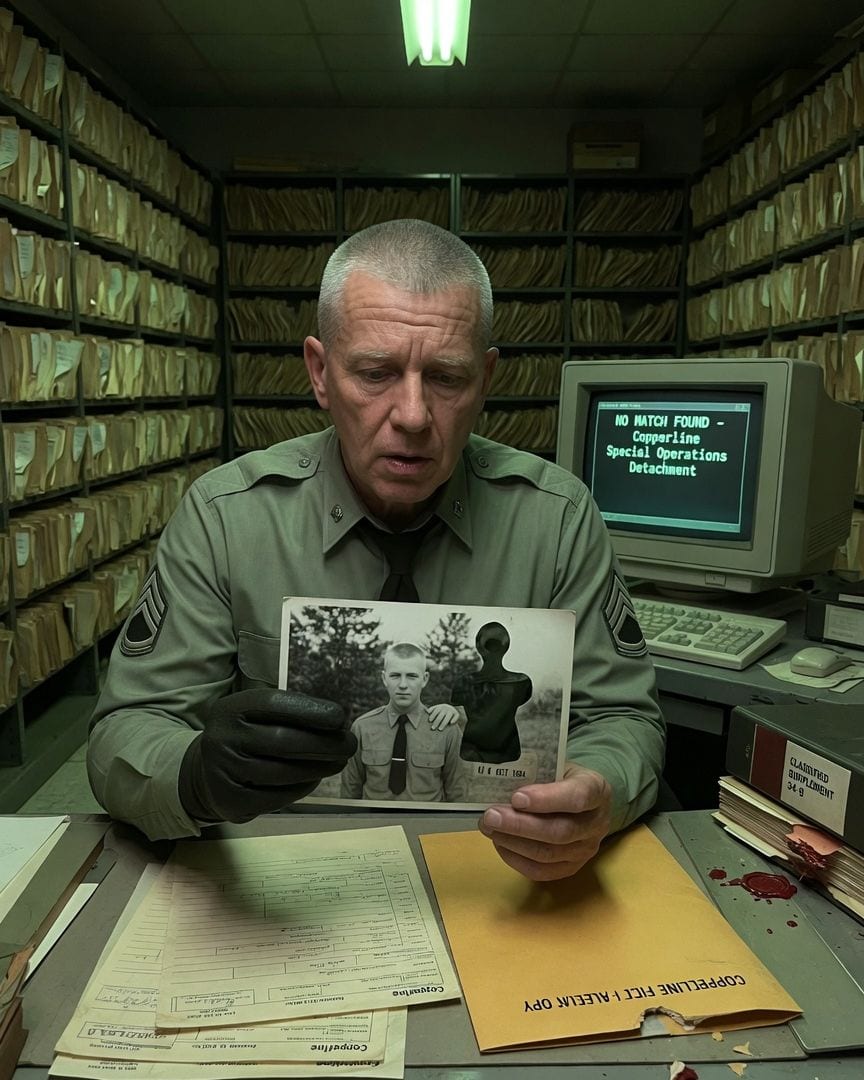
Sergeant Major Vance had two weeks to retirement when his old file felt warm. Inside, a photo showed him with a man precisely cut out from a unit that never existed.
Sergeant Major Teodor Vance had only two weeks left before his retirement, a lifetime of military order almost behind him. For thirty years, he'd pulled the 'Copperline' file, always finding it empty – until now. This time, a faint, impossible warmth radiated from the heavy manila, and inside, he found a faded photograph. It showed a younger Vance in an unrecognized uniform next to a man whose entire body had been precisely cut out of the print, from a company that officially never existed. After decades of silence, what did this warm, impossible file truly contain?