A specialist was signing for four more years, but his old file contained a photo of him in a desert uniform dated 2017, from a tour he never lived.
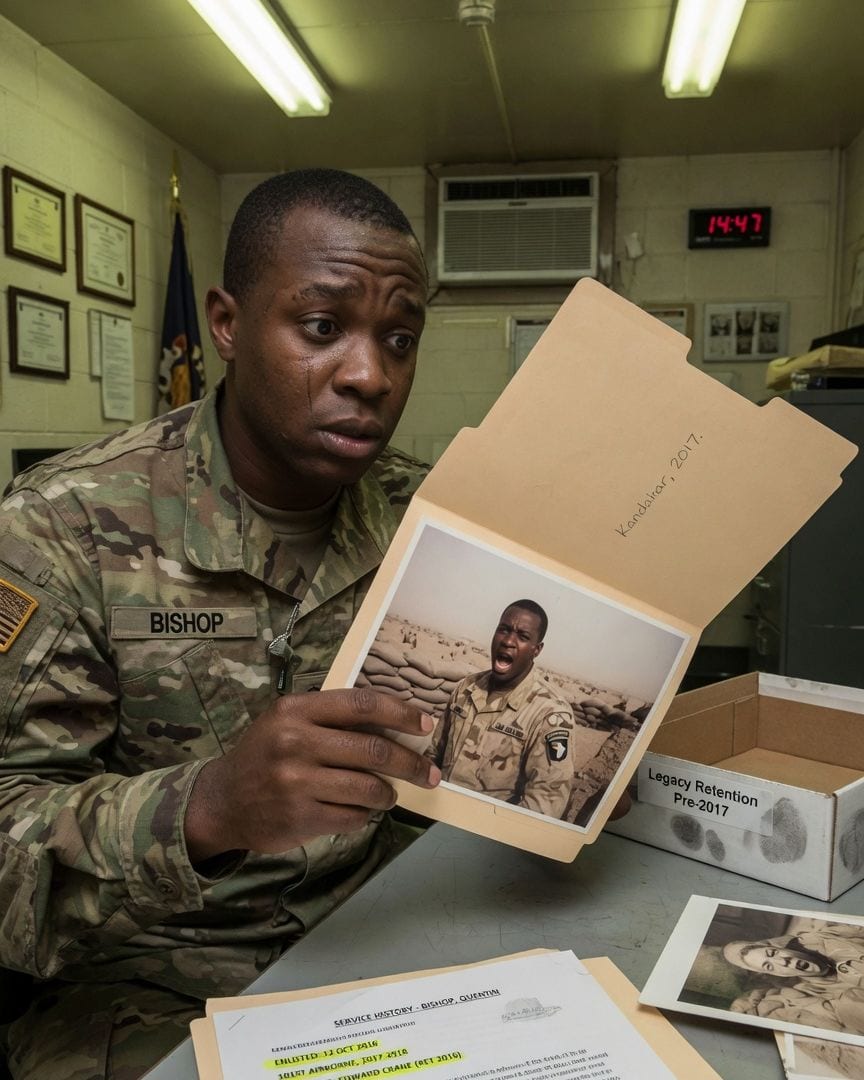
Specialist Quentin Bishop sat in the sterile retention office, the hum of the fluorescent lights a dull drone against the quiet expectation of a signed contract.
He was ready for another four years, for the stability it promised after two tours and a clean record. Sergeant Marie Delaney, her uniform crisp and her smile professionally warm, slid the re-enlistment paperwork across the desk.
"Just need your signature, Specialist Bishop, then we can get you on your way."
He picked up the pen, his fingers brushing against the smooth, official paper, and his eyes fell to the bold print of his service history. The original enlistment date, clear as day, was October 12, 2016.
He remembered October 12, 2020, vivid with the smell of the recruiting station and the nervous pride of signing his first papers, four years later. Four years before he had even turned seventeen.
A flicker of unease, cold and sharp, cut through his calm.
His eyes scanned further down, tracing the lines of text: a full overseas tour, 2017-2018, with the 101st Airborne's screaming eagle patch, a unit he'd never once worn, never even trained with.
The dates, the unit, the very idea of it, were alien. Below it, the recruiter's name: Edward Crane, retired 2016.
The year the paperwork claimed Bishop first walked through the door was the same year his supposed recruiter had left the service.
Bishop frowned, a quiet alarm beginning to prickle at the edges of his trained calm. This wasn't just wrong; it was impossible. He looked up at Delaney, the pen still poised, its tip hovering inches from the signature line.
"Sergeant," he said, his voice level, "this isn't my record." His own words felt like a violation of the quiet, orderly room, as if he had spoken a forbidden truth.
Sergeant Delaney offered a practiced smile, one that didn't quite reach her eyes. The air conditioner hummed louder for a moment, making the framed commendations on the wall seem to vibrate. "Standard clerical error, Specialist.
Happens more than you'd think with older systems and digital migrations. We'll get it sorted, no need to worry." But the calm in her voice felt too smooth, too rehearsed.
Bishop, a stickler for detail, insisted on seeing the full, physical file, the original paper trail, not just the digital printout. He needed to see the source of this impossible data.
It took some bureaucratic maneuvering, a few phone calls to a records annex across post where dust motes danced in the perpetual twilight, but eventually, a thick manila folder, heavy with the weight of decades, was placed before him.
Its cardboard edges were worn smooth.
Inside, alongside his genuine enlistment forms and training reports, were photocopies of orders he'd never received, commendations for actions he hadn't taken, and even a blurry medical report from a field hospital in Afghanistan, dated 2018, detailing a minor concussion he couldn't recall.
The details were shockingly specific, down to the name of the medic and the exact coordinates of the MASH unit. He flipped through, his fingers tracing the phantom history, a cold knot tightening in his stomach.
This wasn't just a typo or a digital glitch; this was a meticulously constructed parallel life, laid out with chilling precision.
He found a faded, brittle sheet of paper, a quarterly roster from a forward operating base in Kandahar, dated Q3 2017.
His name, "Bishop, Q. (Spec.)," was listed right there, next to a service number that matched his own, beside names he'd never heard.
The ordinary explanations — a system glitch, a merged file, a cruel prank — were dissolving under the sheer weight of the detail. Every line, every date, every unit designation, despite being utterly alien, was internally consistent.
It wasn't random; it was coherent, just wrong. He knew his own history. He knew this wasn't it, and the certainty was a growing dread.
He pressed Delaney for any older, unindexed files associated with the 2016 enlistment date, any archived materials that might shed light on this impossible record.
With a sigh, she produced a dusty box from a back shelf, marked "Legacy Retention - Pre-2017." The very dust on the box seemed ancient, clinging to his fingers.
As Bishop sifted through brittle forms and forgotten memos, his fingers brushed against a small, stiff piece of cardstock. He pulled it out. It was a faded, sepia-toned photograph.
It showed a younger version of him, unmistakably him, perhaps eighteen or nineteen, gaunt and serious, dressed in a desert-patterned uniform. On his shoulder, clearly visible even in the poor light, was the screaming eagle patch of the 101st Airborne.
He was standing in front of a sandbagged HESCO barrier, a stark, unfamiliar landscape stretching behind him. Scrawled on the back, in faint pencil, was a date: "Kandahar, 2017."
He stared at his own young face, a face that had lived a life he had no memory of, a life etched into this impossible image.
The photograph felt like a physical blow, a ghost limb suddenly manifesting. Bishop kept it hidden, slipping it into his pocket, the stiff cardstock a constant, unsettling presence against his thigh.
He feigned acceptance of Delaney's "clerical error" explanation, nodding politely as she closed the heavy file. But his mind raced, dissecting every detail. He needed to verify the retired recruiter, Edward Crane.
Delaney, retrieving a worn Rolodex from her desk drawer, provided a contact number, stressing that Crane was "elderly and prone to confusion, so don't be surprised if he doesn't recall specifics, Specialist."
Bishop called from a quiet corner of the barracks later that evening, the low murmur of other soldiers a distant backdrop. Crane's voice was surprisingly clear, if a little gravelly, when he answered.
He claimed to remember "every recruit who walked through my door, son."
When Bishop cautiously mentioned the 2016 enlistment and the 101st, Crane grew quiet, a long, uncomfortable pause stretching on the line, punctuated only by the crackle of the phone.
"Some records," Crane finally said, his voice lower, almost a whisper, "they have... gaps. Or rather, they fill gaps. Some boys, they just... fit where they're needed. It's a precise business."
He offered no further explanation, just a vague, unsettling assurance that "the paperwork always balances out in the end, son. Always."
Bishop tried to press for more, for names, for specifics, but Crane abruptly ended the call, citing a "bad connection" with a final, unnervingly calm click.
Undeterred, Bishop used his access to internal systems, carefully navigating through old personnel directories, filtering by specific dates and units.
He found other names from the 2016 roster, some active, some retired, some listed cryptically as "transferred – classified to Project Echo." He started cross-referencing these names with the 101st Airborne's deployment records from 2017-2018.
The official, public records confirmed the unit's deployment, but the names he was tracking were conspicuously absent from the public manifests, only appearing on internal, restricted lists marked with similar codes.
This wasn't just his file; it was a complex, hidden network, threads leading to other ghost soldiers. The mundane explanation was failing, replaced by something far more intricate and unsettling.
Bishop spent his off-duty hours in the post library, a quiet, rarely visited building with an extensive, if dusty, archive of historical unit records. The air was cool and smelled of old paper and forgotten stories.
He was looking for any mention of the 101st's specific deployment during the 2017-2018 period that might shed light on the "classified" transfers.
He found a local newspaper clipping from 2016, a small article about Edward Crane receiving a commendation for "exceptional service in personnel acquisition." The accompanying photo showed a younger, sharper Crane, standing beside a stern-faced officer he didn't recognize.
As Bishop meticulously scrolled through microfiche, the whirring sound a low counterpoint to the silence, he noticed a shadow falling across his screen. He looked up.
Sergeant Delaney was standing a few aisles away, ostensibly reshelving books, but her gaze lingered on him for a beat too long before she turned away, a subtle shift in her posture the only tell.
The old wooden shelves seemed to lean in, making the air feel heavier. Later that week, a secure message, encrypted and untraceable, appeared in his internal inbox. It was anonymous, just a string of numbers.
When decoded, it read: "SOME GAPS ARE MEANT TO STAY FILLED. DON'T LOOK FOR WHAT ISN'T THERE." The text was stark, with no identifying sender.
Bishop felt a cold dread creep up his spine, a prickle of unease that had nothing to do with the library's chill.
He wasn't just investigating a mistake; he was poking at something that didn't want to be found, and someone was watching his every move, ready to remind him of the invisible line he was crossing.
The library felt less like a sanctuary and more like a trap, its quiet corners suddenly holding unseen eyes.
Bishop decided to confront Delaney directly, but not about his file. He approached her in the retention office, asking about Edward Crane's "exceptional service," referencing the newspaper clipping. Delaney’s practiced smile faltered, a brief tremor in her composure.
Her eyes flicked to the small, unobtrusive security camera in the corner of the room, then back to Bishop. "Specialist, Edward Crane was a dedicated recruiter. He met quotas, often exceeded them. A real asset to the force."
Bishop pressed, his voice low but firm, "Exceeded them how, Sergeant? By finding soldiers who didn't know they were enlisted? By filling time slots that never existed?" Her face hardened, the professional facade cracking under the pressure.
The room itself seemed to tighten around them, the air suddenly thin. "That's an absurd accusation, Specialist. The military has protocols, strict guidelines for recruitment and retention."
He laid the faded photograph of himself in Kandahar, 2017, onto the desk between them. The image, stark and undeniable, was proof. "This protocol?"
Delaney picked up the photo, her fingers trembling slightly as she held the brittle cardstock. She looked at it, then at Bishop, her professional composure finally crumbling. Her eyes, usually so calm, were wide with a desperate, trapped look. "Some...
some units have unique requirements," she admitted, her voice barely a whisper, a contrast to her usual authoritative tone. "Sometimes, the numbers don't add up. Historically. There's a... a process. To ensure continuity. To fill... gaps."
Bishop demanded to know what "gaps" and what "process."
Delaney explained, hesitantly, her words tumbling out in a hushed confession, that certain historical operational deployments had "unaccounted-for personnel needs," and a program, covert and highly classified, was established to "re-integrate suitable candidates" into these past timelines.
Their memories would be "adjusted," their records seamlessly rewritten to reflect the new, manufactured reality. "It's for the greater good, Specialist. To ensure the integrity of the record. To make sure the missions were completed, even if...
the original personnel weren't available, or never existed in the first place." The pieces clicked into place with horrifying clarity.
His forgotten tour, the unit patch, Crane’s early retirement – it was all part of a system designed to retroactively deploy soldiers.
He wasn't just a victim of a clerical error; he was a carefully selected, backfilled asset, his life re-engineered without his knowledge.
The truth hung in the air, a cold, clinical horror that stripped Bishop of his sense of self. He felt a profound sense of violation, his own past stolen and rewritten by an unseen hand.
He asked Delaney if there were others, if this "Project ECHO" had been a one-time anomaly, a desperate measure. She shook her head, her face pale, her gaze distant. "It's... ongoing. Not frequent, but ongoing. The parameters are strict.
Specific psychological profiles. A certain... malleability, a detachment from certain personal histories." He pressed her further, his urgency growing, asking for any historical documentation, any internal logs, anything that could prove this wasn't just a desperate confession.
She reluctantly directed him to a deeper, highly restricted archive within the post's old records building, warning him of the dire consequences. "No one is supposed to ever know about this, Specialist. You're walking on thin ice.
They don't like loose ends." Bishop ignored her, the need to understand overriding all caution.
He navigated the labyrinthine, dimly lit corridors of the archive, the air thick with the smell of dust and forgotten paper, the silence punctuated only by the scuttling of unseen creatures.
He found a heavily reinforced, locked cabinet, requiring a specific, outdated code sequence that Delaney had whispered to him. After several attempts, the tumblers clicked with a heavy finality.
Inside, among yellowed folders and microfiches, he located a thick, leather-bound binder labeled "Project ECHO - Cycle Reports." He pulled out the oldest report, dated 2016.
The first page was a detailed overview of the program, its chilling purpose, and the cold, clinical "selection criteria." On the second page, he saw it: a list of "Initial Candidates for Re-integration - Cycle 1."
And there, halfway down the page, with a projected enlistment date of 2016 and a note reading "Spec. In-Prog." was his own name: Bishop, Q. He wasn't just a recent victim; he was one of the first.
And the system had been planning for him for years, a ghost in the machine before he even knew it existed.
The revelation that his own name was on the initial candidate list from 2016 sent a shockwave through Bishop, colder and more profound than any physical blow.
He wasn't an accidental anomaly, a mistake in the system; he was a chosen instrument, a carefully selected blank slate.
The "retired" recruiter, Edward Crane, hadn't just been a facilitator; he had been the architect of his impossible past, identifying and onboarding individuals for "re-integration" with chilling foresight.
The screaming eagle patch, the Afghanistan tour, the early enlistment date – it was all a pre-planned, systematic insertion into a fabricated history.
The gaps in the military record weren't errors; they were meticulously filled voids, covered by soldiers whose personal histories were deemed expendable for the sake of an unbroken operational narrative.
Project ECHO ensured that no mission was ever officially understaffed in retrospect, no historical action ever lacked its full complement of personnel. It was an invisible hand, correcting the past to maintain a perfect present.
The "malleability" Delaney mentioned wasn't just a psychological trait; it was a vulnerability exploited by a system that valued its own coherence above individual reality, above the very identity of its soldiers.
Bishop now understood Crane's chillingly calm demeanor and Delaney's nervous evasions. They were either complicit or deeply enmeshed in a truth too big to acknowledge, too terrifying to expose.
This wasn't about righting a wrong; it was about maintaining a carefully constructed lie that permeated the very foundations of military service, a lie that had claimed his life, his memories, and his sense of self.
The proof was right here, in his hands – not just his own falsified record, but the documented mechanism for its creation, with his name etched into its earliest pages, an unwilling participant in a grand, horrific deception.
Bishop knew he couldn't stay. The re-up contract, which had started this nightmare, now felt like a final trap, a mechanism to further cement his fabricated past, to erase any remaining shred of his true identity.
He carefully, methodically, photographed every page of the "Project ECHO - Cycle Reports" binder with his phone, focusing on the candidate lists, the operational parameters, and any mention of Edward Crane.
Every flash of the camera felt like a small act of rebellion, a desperate attempt to reclaim his truth. He knew no one would believe him without irrefutable proof, without the cold, hard data of the system's own records.
The archive walls seemed to hum, a low, ominous vibration against the stillness. As he was finishing the last page, the heavy, squealing archive door creaked open, echoing through the cavernous space.
Sergeant Delaney stood there, her face a mask of grim determination, her hand resting on the holstered sidearm at her hip.
"Specialist Bishop," she said, her voice devoid of its usual calm, now edged with a desperate, chilling authority, "I knew you'd push. But you can't expose this. It's too big.
For your own good, for the good of the service, you need to let it go. Now." Bishop held up his phone, its screen displaying the incriminating documents. "I can't. My life was stolen. Others' lives were stolen.
This isn't 'good for the service,' Sergeant, it's a crime against every soldier who believes in honor and truth." Delaney stepped closer, her eyes locked on his phone, a desperate plea in them. "Think about your future, Bishop. Your benefits.
Your pension. All of it. Erased. You'll be a ghost, a nobody. They'll make sure of it." The threat was clear, cold, and utterly believable. He was cornered, but he had the proof. He made a split-second decision.
He hurled the heavy, leather-bound binder at her, a disorienting projectile that caught her off guard. As she stumbled back, recovering, Bishop bolted.
He burst out of the archive, past the silent library, and out into the cool, damp night air of the post, the images of the documents flashing in his mind, the weight of his impossible past heavy on his shoulders.
He didn't look back, running towards the perimeter gate, towards the outside world, towards a freedom that felt like an escape, carrying the only proof he had: the digital ghost of a life he never lived, and the horrifying knowledge that the system had planned it all along.
Specialist Quentin Bishop was declared Absent Without Leave a week later. His belongings were packed and shipped to his listed next of kin, a sterile process that erased his presence.
His re-enlistment paperwork was never processed, his original enlistment record quietly reinstated, the phantom years purged from the official database as if they had never existed.
Sergeant Marie Delaney submitted a comprehensive report citing "psychological distress," "insubordination," and "unauthorized access to classified materials" as the official reasons for Bishop's desertion, a narrative carefully constructed to obscure the truth.
Edward Crane remained in comfortable retirement, his commendation for "exceptional service in personnel acquisition" still on display in the local historical society, a quiet testament to his true, hidden role.
The "Project ECHO - Cycle Reports" binder was never officially reported missing from the archives, its contents simply absorbed back into the silent, watchful system.
Bishop vanished, leaving behind only a few cryptic messages to a trusted friend, speaking of "missing years" and "ghost soldiers" and a "system that eats time."
His phone, found months later in a discarded bag at a bus station hundreds of miles away, contained hundreds of photographs of yellowed documents and faded photos, a digital trail of his impossible history.
The friend, bewildered and disturbed, tried to bring them to light, but the story was dismissed as delusion, the photos easily faked, the dates too convenient to be anything but a conspiracy theory.
The military record, after all, was impeccable, a testament to its own unwavering truth.
A week after Specialist Bishop's disappearance, Sergeant Delaney received a new candidate file for the upcoming "re-integration" cycle. Her eyes scanned the familiar criteria, the projected enlistment date, and the name.
She paused, a faint, almost imperceptible smile touching her lips, before she stamped it "Approved." The system always balanced out in the end.
If this one got to you
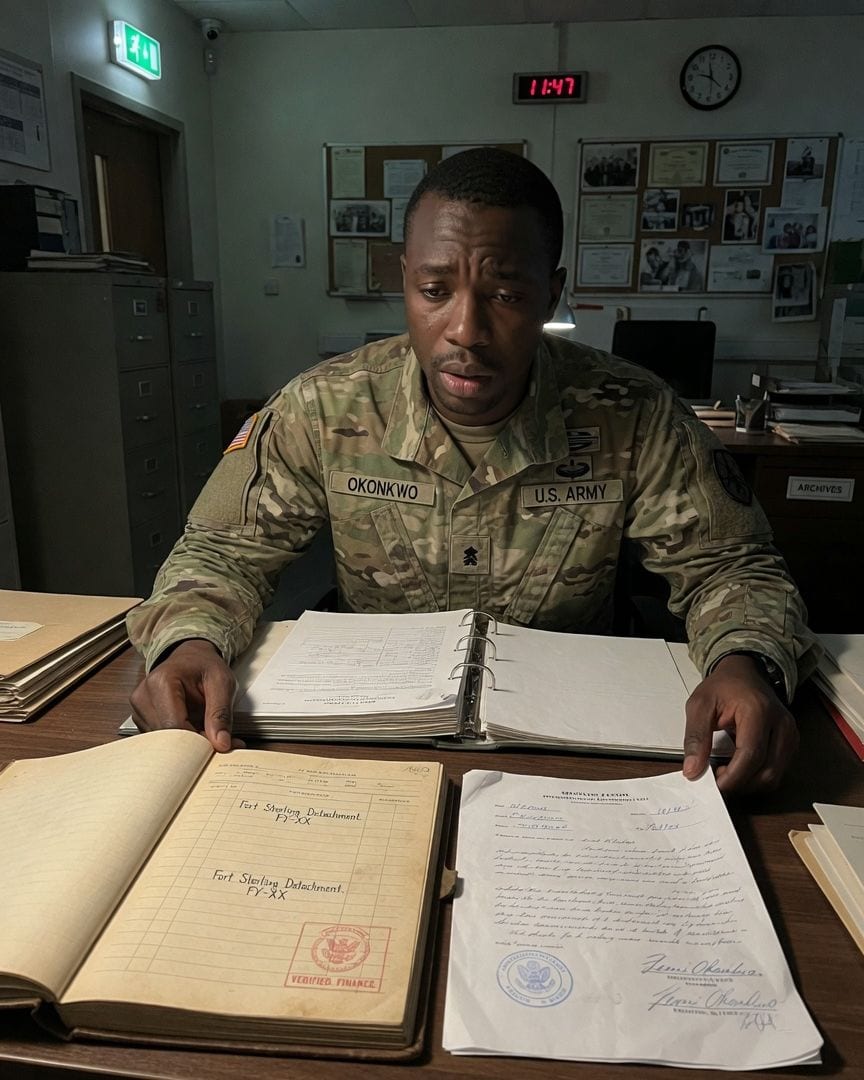
An old deployment ledger bore Specialist Femi Okonkwo's name, but the elegant signature was not his own.
Specialist Femi Okonkwo, an Air Force cargo hauler, stared at an earnings statement that contradicted his entire four-year enlistment. It listed nine months of jump pay and a mountain duty station in Colorado—places he’d never been, operations he’d never completed. Finance and HR records, seemingly impeccable, confirmed every detail of his impossible deployment. But when Femi finally retrieved the physical sign-in ledger, the faded blue ink of his supposed signature revealed the true, chilling discrepancy: the neat, elegant hand on the official document was unequivocally not his own. Who signed for Specialist Okonkwo’s impossible deployment, and why was it so meticulously verified?
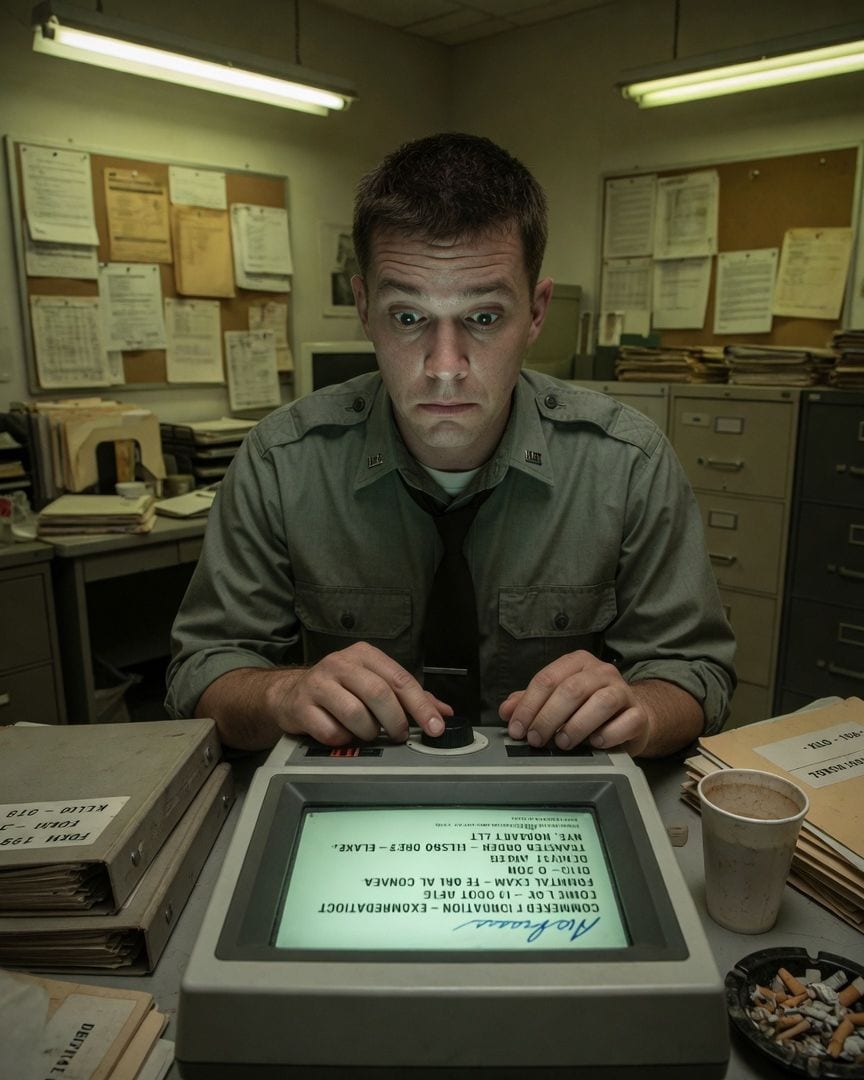
A missile commander watched his ten nuclear silos go dark. His own service record shows his signature on a future he's never lived.
Second Lieutenant Hobart Nye, a missile commander in Wyoming, had his quiet 0247 watch shattered by a security report: a massive, silent black triangle hovered over Launch Facility Kilo, casting a perfect shadow. Hobart watched his console's fault panel light up, signaling all ten nuclear missiles going dark in an impossible silence, followed by eleven minutes his security team could not remember. Official logs called it a "radio malfunction," but Hobart found a requisition for invisible-tracking sensors, signed by a base commander who was supposed to be off-base. The final, chilling discovery came when his own service record showed new entries—a dental check-up, a transfer to Alaska—all dated for a future he never lived, complete with his perfectly replicated signature.
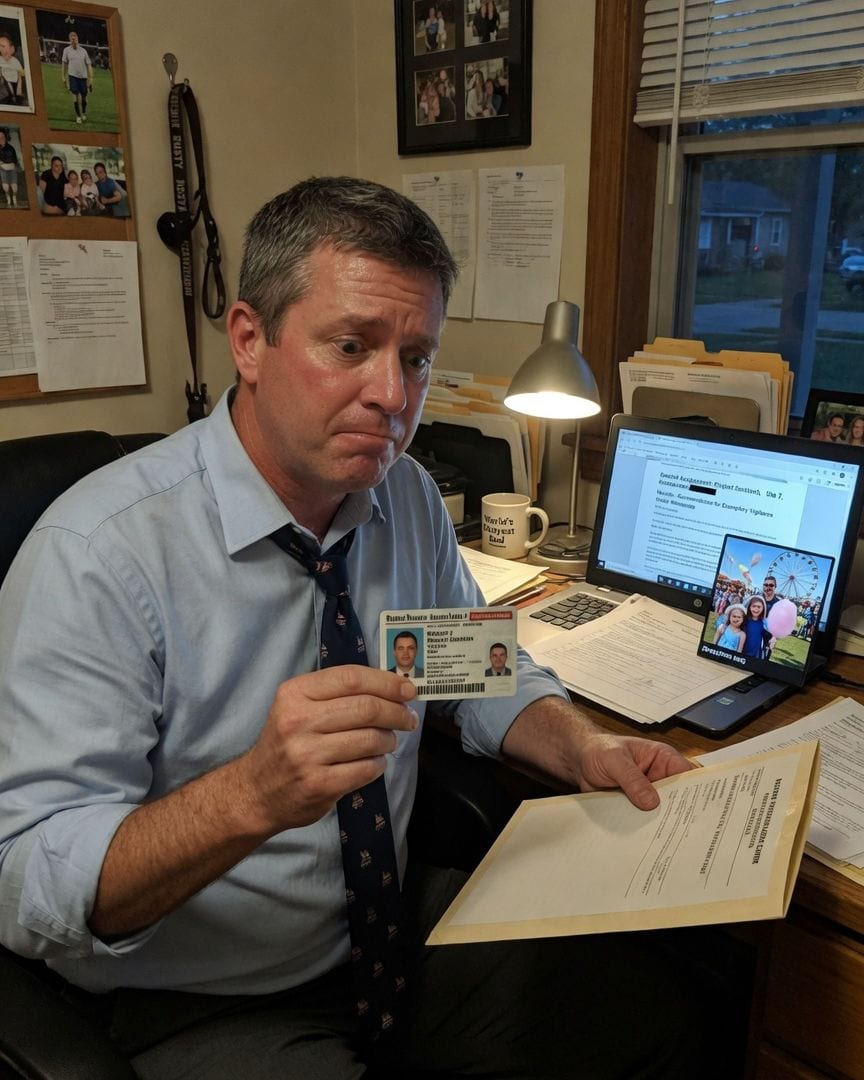
An Ohio insurance agent’s military record showed a commendation from a secret Nevada base, dated the same day he took his family to the county fair.
Robert Halloran, an Ohio insurance agent, thought his military days were long behind him, replaced by a quiet civilian life with a mortgage and two children. But a letter arrived from a records center, congratulating him on twenty years of continuous service and detailing a career he never lived. His official ID card even bore a recent photo of him, looking back with an uneasy smile he didn't remember giving. As he found his own discharge papers, crisp and yellowed, they directly contradicted every line of the new document, confirming his service had ended eight years ago. Now, two realities fought for space: his family life and a secret military history he couldn't explain.
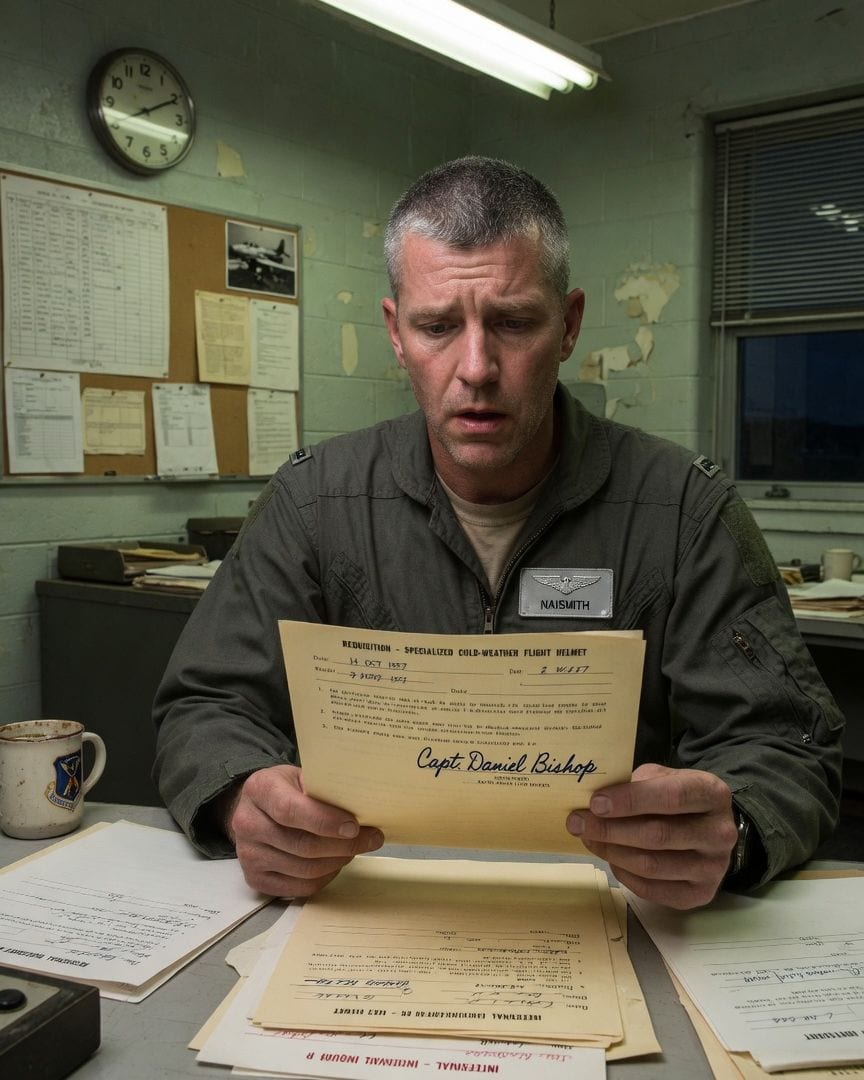
A Cold War Colonel reviews a missing pilot's file and finds Captain Bishop's signature on a form dated weeks after he vanished.
Colonel Ward Naismith faced the grim task of reviewing Captain Daniel Bishop’s personnel file, a routine chore for a man listed as Missing in Action. Bishop had vanished days after he and Naismith chased an impossible, silent disc over Lake Superior, leaving only an empty patch of air and a knot of unease in Ward's gut. Sifting through commendations, Ward found a requisition for flight gear and a maintenance sign-off, both dated *after* Bishop’s disappearance. The true chill came with the requisition for a specialized flight helmet, bearing Captain Bishop’s unmistakable signature, weeks after he was presumed lost. How could a man presumed lost have signed anything?
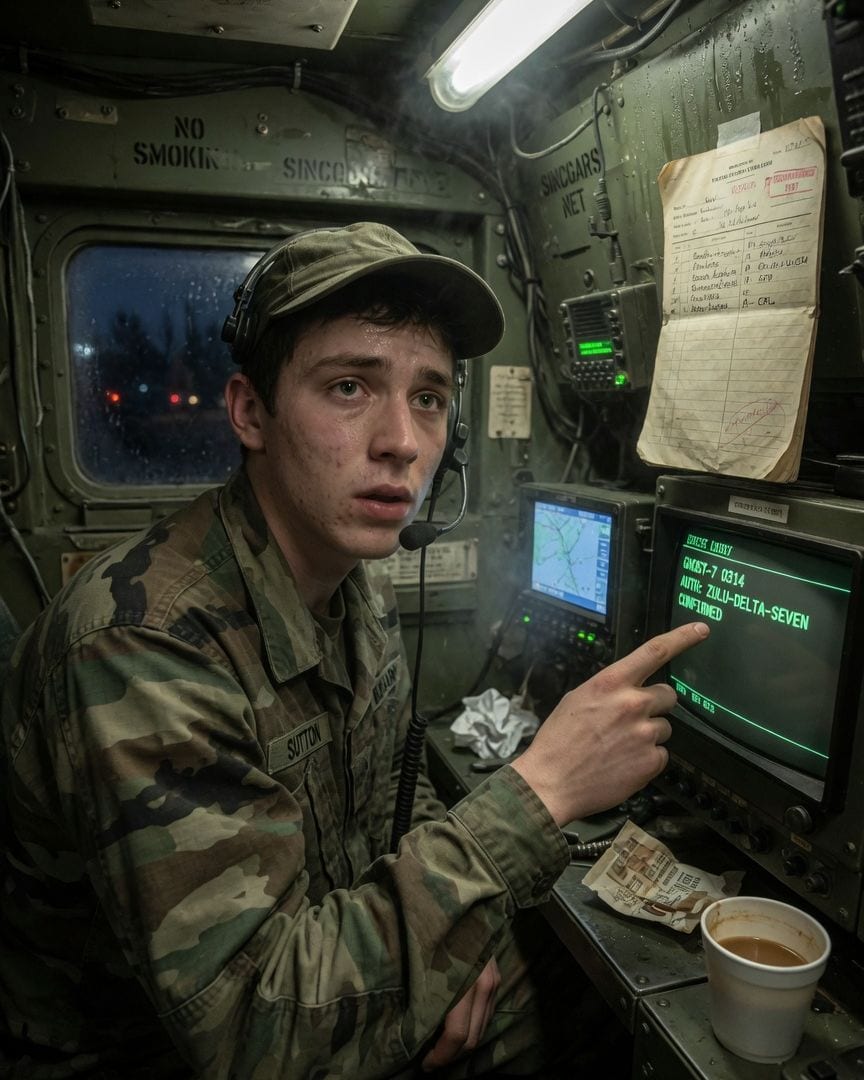
Corporal Aldous Sutton found his own name, rank, and call sign in a 1987 logbook from his exact outpost, decades before he was born.
Corporal Aldous Sutton, 22, was hunched in his cramped comms track, the air thick with stale coffee, monitoring a quiet German night. The division exercise outside was routine, all units accounted for, until an unknown call sign crackled through his headset. 'Ghost-7' requested authentication using a protocol decommissioned years before Aldous was even born. Despite his superior dismissing it as a glitch, Aldous found official logs confirming the impossible exchange, even dating his own hesitant responses. But the real dread landed when he cross-referenced the phantom unit and discovered his own name, rank, and call sign listed in a 1987 logbook, attached to 'Ghost-7' at his exact outpost.
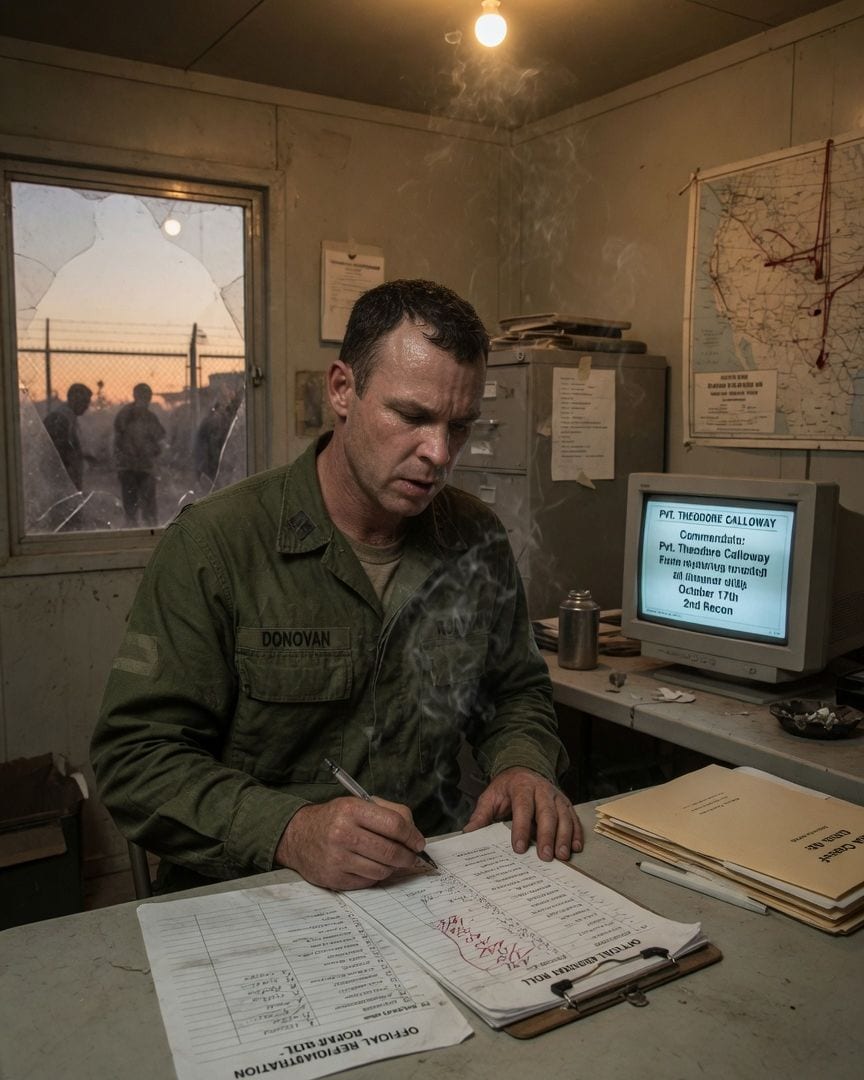
A Corporal counted the returning prisoners, but his tally came out one man too high, a private with no official record.
Corporal Raymond Donovan stood amidst the dust and tired murmurs of the repatriation camp, his duty to verify every returning prisoner. He meticulously tallied names against the official exchange lists, but his physical head count came out one man higher than expected. A Private Theodore Calloway appeared, gaunt and exhausted, yet his name was nowhere on Raymond’s carefully organized records. Sergeant Jennings dismissed it as a forgotten grunt, but Raymond knew better; Calloway's official service record, though pristine, contained an impossible detail: a commendation date for an operation his unit had left a month prior. What impossible timeline had this private stumbled into?