A Corporal counted the returning prisoners, but his tally came out one man too high, a private with no official record.
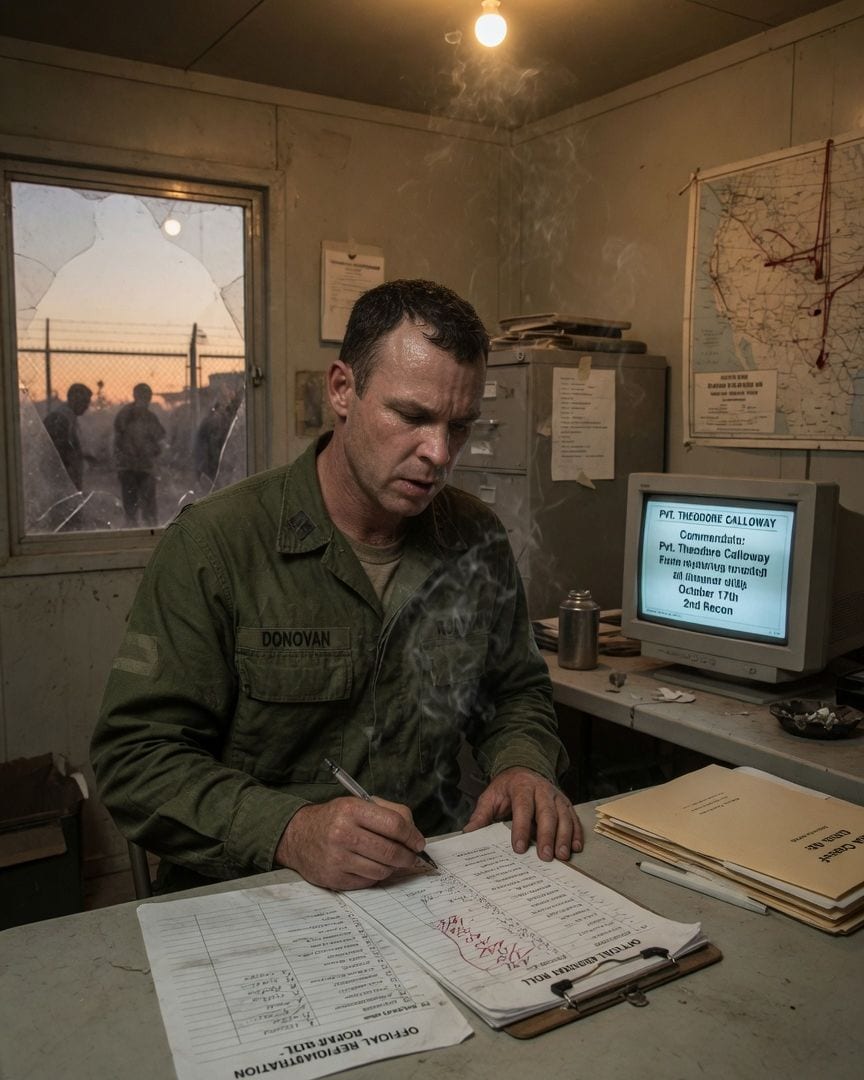
The air in the repatriation camp hung thick with dust and the low murmur of tired men. Corporal Raymond Donovan, his uniform damp with sweat, stood by the wire, ticking off names against the official exchange lists.
Each returning prisoner, gaunt and blinking in the harsh daylight, found their match: name, service number, unit. His NCO, Sergeant Gary Jennings, stood beside him, double-checking the tally, his brow furrowed against the glare.
The enemy’s handover count agreed perfectly with the names on the list. But when Raymond did his own physical head count of the men shuffling through the gate, his stomach dropped.
His tally came out one man higher than the roll of the missing.
There was a man on the ground, a Private Theodore Calloway, who simply wasn't supposed to be there.
He was just as exhausted, just as dirty as the others, but his name didn't appear on any of Raymond’s meticulously organized lists. Raymond’s pen hovered over the final line, a cold dread seeping into him, unrelated to the heat.
The system, designed for perfect accountability, had just failed. The silence that stretched between Raymond and Jennings felt impossibly loud, thicker than the dust.
Raymond tried to rationalize it. A last-minute addition? A clerical error on the enemy’s part? Sergeant Jennings just shrugged, wiping a bead of sweat from his temple. "Probably some forgotten grunt, Corporal. Happens." But Raymond knew it didn't.
Not like this. Not for a man repatriated from a war zone with no record of his capture. Raymond pulled Private Calloway's service record, his fingers tracing the crisp, official lines on the monitor.
It was pristine: enlistment date, training, unit assignments, even a commendation for a minor engagement during the 'Desert Serpent' operation.
Raymond’s unit had been heavily involved in Desert Serpent. He remembered the operation, the specific skirmishes, the men involved, the sheer scale of the paperwork. He remembered the specific date of Calloway's supposed commendation, October 17th.
But the unit Calloway was cited with, the 2nd Recon, had been rotated out of theater a full month before that engagement. Raymond knew this for a fact, having processed their outgoing paperwork himself.
He had personally signed the transfer documents for the 2nd Recon's redeployment to Germany on September 12th. He stared at the record, trying to force the facts to align, but the discrepancy was stark, undeniable.
It wasn't just an error; it was a lie etched into official history, a perfectly manufactured detail that stood out like a fresh scar on an otherwise flawless document.
The impossible detail in Calloway's service record gnawed at Raymond. He spent his off-duty hours delving deeper into the digital archives, cross-referencing unit movements, deployment manifests, anything that could explain the anomaly.
He searched for Calloway’s transfer history, hoping to find a corrected record, a missing piece. What he found instead was a faded, scanned document: a transfer order for Private Theodore Calloway.
It directed him to 'Outpost 73, Alaskan Sector, Decommissioning Operations.' The digital timestamp on the scan showed it was processed on November 1st – two months after Calloway was officially listed as Missing In Action.
Yet, it was dated nearly a year before his supposed repatriation at the camp. The signature at the bottom was crisp, authoritative: Major E. Sinclair.
Raymond Donovan stared at the faded transfer order in his hand, the impossible date burned into his mind. Pvt.
Theodore Calloway, listed as MIA, was simultaneously being transferred to a decommissioned post, an official document swearing to a timeline that could not be true.
Raymond’s impending discharge, once a daily countdown, now felt distant and irrelevant. His focus narrowed to Outpost 73 and Major Elena Sinclair. He accessed classified records, delving into decommissioned posts, searching for other anomalies linked to the remote Alaskan outpost.
The digital archives, vast and often poorly indexed, became his battleground. The camp’s air conditioning hummed, but the cold dread he felt had nothing to do with the temperature.
He found a pattern: similar transfer orders, always signed by Sinclair (or an earlier rank of the same initial, E. Sinclair, tracing back through lieutenant and captain ranks), for other soldiers whose records contained subtle, impossible discrepancies.
These men, like Calloway, seemed to appear and disappear from official manifests, their histories patched with ghost deployments or impossible commendations.
One private was listed as receiving a bravery medal in a conflict zone three days after his official death certificate had been issued. Another had been reassigned to a unit that records showed had been disbanded years prior.
These 'ghost' soldiers were invariably sent to remote, isolated facilities – abandoned weather stations, forgotten listening posts, or signal towers in the middle of nowhere – often just before their official closure.
The pattern spanned decades, a cold, bureaucratic thread weaving through the military’s most meticulous paperwork. Raymond felt a growing unease; this wasn't clerical error. This was systemic.
The deeper he dug, the more the cold hum of the server room seemed to echo the chill in his bones, a low, constant vibration that threatened to unravel everything he thought he knew.
Raymond’s unusual access requests and deep dives into obscure, classified archives did not go unnoticed. One afternoon, an official summons landed in his inbox: 'Report to Major Elena Sinclair, Military Records & Archives, Sector Gamma.'
The facility was a monolithic concrete bunker, smelling of ozone and old paper. The air, heavy and still, seemed to absorb sound.
Major Sinclair, a woman in her mid-forties with an unlined face and calm, assessing eyes, greeted him. Her uniform was immaculate, the creases sharp enough to cut. Her office was sparse, efficient, dominated by a large, highly polished steel desk.
She offered him coffee, her voice smooth, almost soothing, the sound startling in the quiet room.
"Corporal Donovan," she began, gesturing to the chair opposite her, "your recent queries into decommissioned assets and, shall we say, 'anomalous' personnel files, have attracted attention."
She asked about his 'research interests,' her questions precise, probing, designed to gauge the depth of his understanding. She spoke of "systemic integrity" and the "fragility of historical data," dismissing his findings as "conspiracy theories" born of "overzealous cross-referencing."
The calm way she spoke about such profound irregularities was unnerving. Every word felt like a test. Raymond felt a chill, despite the controlled warmth of the office. He shifted in his seat, the leather creaking slightly.
Her gaze, steady and knowing, conveyed a deeper truth beneath her dismissive words, a silent warning. He was being watched, assessed.
The danger was no longer abstract data; it was personal and present, sitting across the desk from him, studying him with an unsettling, patient intensity. The hum of the ventilation system seemed to quiet, as if listening alongside them.
Raymond, emboldened by the sheer weight of his findings, pushed back. He laid out the pattern: Calloway, Outpost 73, the impossible dates, the string of other ghost soldiers, the recurrent signature of 'E. Sinclair.'
He watched her face, expecting denial, anger, perhaps even a threat. Instead, a faint, almost imperceptible smile touched her lips, a glint in her eyes that was less amusement, more recognition.
"You've been thorough, Corporal," she said, her voice still calm, a counterpoint to Raymond's rising agitation. "Most don't see the pattern. They prefer to believe in error. It's easier."
She leaned forward slightly, her hands clasped on the polished desk, perfectly still. "The system, Corporal Donovan, abhors a void. When a soldier goes truly missing, when a unit record becomes irrevocably broken, it creates a systemic imbalance.
A ripple that can spread, unraveling entire chains of command, entire histories." She explained, not with malice, but with a detached, almost scientific precision, that these 'insertions' were a "necessary protocol."
They were placeholders, carefully constructed identities, designed to "patch" the system, to prevent larger, more catastrophic anomalies. The metal edge of the desk felt cold beneath Raymond's fingertips.
"Pvt. Calloway," she continued, "was an insertion. The original missing man from your repatriation camp was never found. Calloway completed the count, maintained the illusion of continuity." Raymond felt a wave of nausea, a cold wash over him.
This wasn't a mistake; it was a cold, bureaucratic solution. The dread wasn't in the supernatural, but in the chilling, rational logic of it all.
Every discrepancy, every impossible detail he had uncovered, now snapped into focus as deliberate acts of systemic maintenance. The silence in the room stretched, heavy and complete, absorbing even the faint hum of the air conditioning.
The office felt less like a workspace and more like a carefully constructed vault for terrible truths.
Sinclair watched Raymond process this, her expression unreadable, an unnervingly patient stillness about her. "You understand, then, the necessity." She rose and walked to a locked cabinet built into the wall, a heavy, silent fixture.
She retrieved an ancient, leather-bound book. The cover was worn smooth, the pages brittle with age, the scent of dust and old paper filling the space.
"This," she said, placing it on the desk between them with a soft thud, "is one of the earliest records of such a protocol. A duty log from a weather station, deep in the Alaskan wilderness. Isolated. Perfect."
She opened it to a specific page, the ink faded but legible. It detailed a rotation from the late 1970s. She pointed to a roster entry, her finger hovering over a neatly written name. "They ensured the continuity, even then."
Raymond leaned closer, his breath catching in his throat. Among the faded names of the inserted men, a name that shouldn't be there, a name that mirrored his own, stared back from the page. 'Pvt. R. Donovan.'
Not Raymond, but his own name, decades before he was born, on a list of phantom soldiers. Major Elena Sinclair's finger rests on an old, handwritten name in the ancient duty log: 'Pvt. R. Donovan.'
Raymond Donovan feels a cold dread settle deep in his bones, the name a mirror of his own, staring back from a roster of ghosts, decades before he was even born.
Raymond's mind reeled, the past and present collapsing into a single, terrifying truth. Sinclair explained, her voice devoid of emotion, that the 'system' didn't just patch voids; it also identified 'suitable' individuals for insertion or replacement.
Those with specific, almost imperceptible 'blanks' in their records, or those at transitional points in their service – like an impending discharge. The office itself felt cold, the air thick and unresponsive, pressing in on him.
"Your own service record, Corporal Donovan," she said, tapping a holographic projection that shimmered into existence above the desk, displaying his pristine file, "has a unique, almost invisible anomaly. A subtle blank where a specific, vital detail should be.
It makes you… compatible." She gestured to a small, almost undetectable gap in his early training history, a period of unexplained reassignment that he had never questioned, assuming it was a bureaucratic oversight.
The pattern across rotations and dates wasn't just about where the 'ghost' soldiers appeared, but who they were, and when they were most susceptible.
His impending discharge, once his ticket home, was merely his 'processing' phase, a moment of vulnerability the system had been waiting for, a neatly anticipated vacancy.
Every clue, every impossible record, every ghost he'd chased, now coalesced into a monstrous, coherent shape: a truth that had been patiently waiting for him, a trap he had walked into willingly, precisely because he had tried to understand.
The realization hit Raymond with the force of a physical blow: he wasn't a witness, he was the next target.
He bolted, overturning the chair with a clatter that echoed too loudly in the sterile room, a desperate surge for freedom. Sinclair made no move to stop him, her calm smile unsettling, fixed on her unlined face.
He fumbled for his comms, pulling the device from his belt, but it was dead, inert, refusing to even flicker. He tried the door to her office, yanking on the handle; it was locked, solid.
Panic, cold and sharp, cut through his military discipline, stripping away the years of training. He tried another door, then another, finding only locked exits or corridors that twisted back on themselves, leading deeper into the concrete labyrinth.
The entire facility seemed to subtly shift, the geometry of the hallways feeling subtly wrong, designed to disorient.
He saw other personnel in the facility – guards, clerks – their faces subtly blank, their eyes following him with a silent, unnerving attentiveness. They were not just employees; they were part of the 'system.'
He recognized a flicker of that same peculiar stillness he'd seen in Private Calloway, a quiet acceptance that chilled him more than any overt threat.
Raymond found his way to a terminal, frantically trying to access his own service record, to delete it, to erase the 'blank' that made him vulnerable. He hammered at the keys, his fingers clumsy with adrenaline.
But as the file loaded, a new entry shimmered into existence, mirroring the 'Pvt. R. Donovan' he’d seen in the ancient log. A transfer order, dated today, to Outpost 73, Alaskan Sector. It was already done.
He was already part of it. The screen glowed, a cold, unwavering light.
Corporal Raymond Donovan disappeared from Military Records & Archives. His unit received a terse, official notification: 'Corporal Donovan has been reassigned to a special, classified detachment, effective immediately.'
His personal effects were packed and shipped home to his parents, who were told he was on a long-term, sensitive mission. They accepted the explanation with a quiet pride.
His discharge papers, once so anticipated, were quietly processed and marked 'fulfilled.' No questions were asked. No flags were raised.
The system, once again, had seamlessly integrated its anomaly, erasing the ripples of his passing as if he had never truly existed.
Weeks later, Sergeant Gary Jennings, back at the repatriation camp, received his own transfer order. It was for a remote, soon-to-be-decommissioned weather station in the Alaskan wilderness – the very place Raymond had been investigating.
He sighed, packed his bags, and reported for duty, the assignment a minor inconvenience before his own impending discharge. The station was bleak, wind-swept, and silent.
Inside the small, dusty office, he found the duty log, an identical, ancient leather-bound book. He opened it to the current rotation, a faint, wrong smile touching his lips.
And there, neatly pre-printed on the roster for his new unit, was the name 'Pvt. R. Donovan.' He signs his name beside it.
If this one got to you
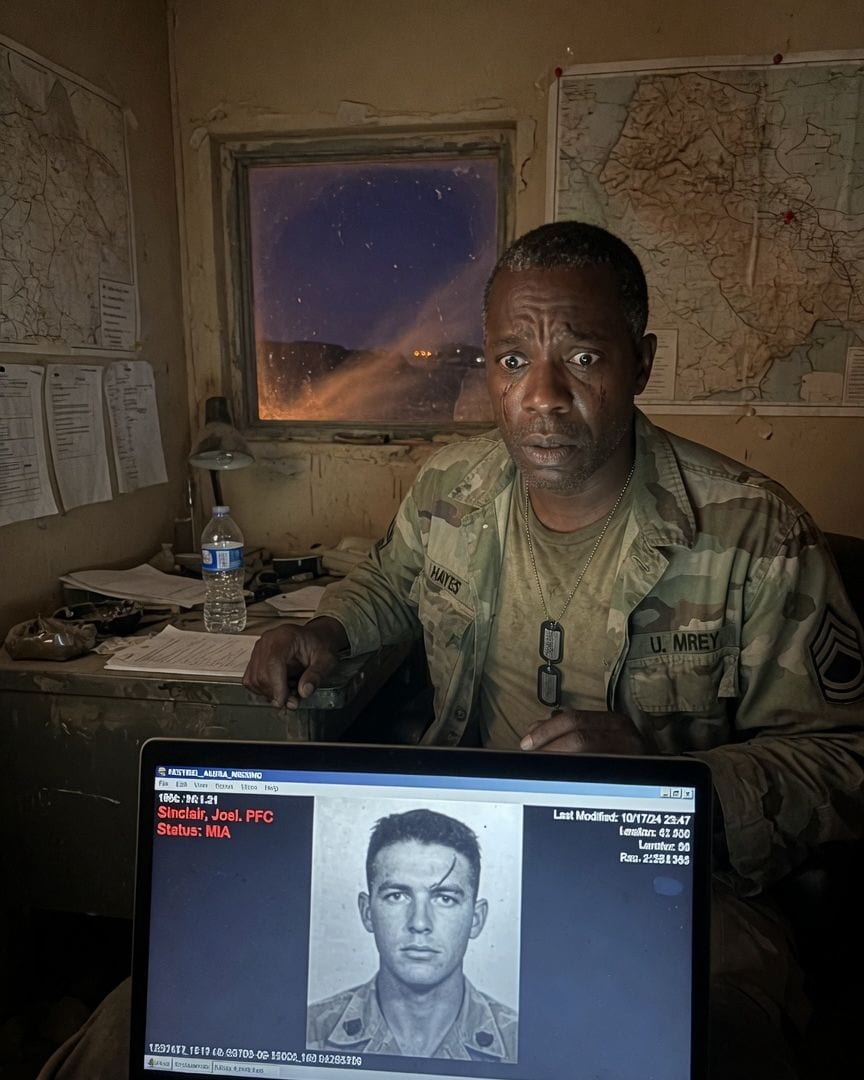
Three weeks from leaving, Sergeant Hayes found a soldier in bunk 17. His file read: Pfc. Joel Sinclair, MIA since 1969.
Sergeant Marcus Hayes was just three weeks from finishing his eight-month tour at Firebase Kestrel, desperate to leave the relentless desert behind. But on a routine evening head count, the numbers refused to square: thirty-one names on the manifest, yet thirty-two men stood before him. Later, searching for an explanation, Hayes found Private First Class Joel Sinclair sleeping in bunk 17, a soldier he recognized from his unit. Yet, when he checked the digital roster, Sinclair’s file was tucked away in an archive, marked 'MIA' from a tour in 1968-1969. How could a man declared missing fifty years ago be sleeping in his barracks tonight?
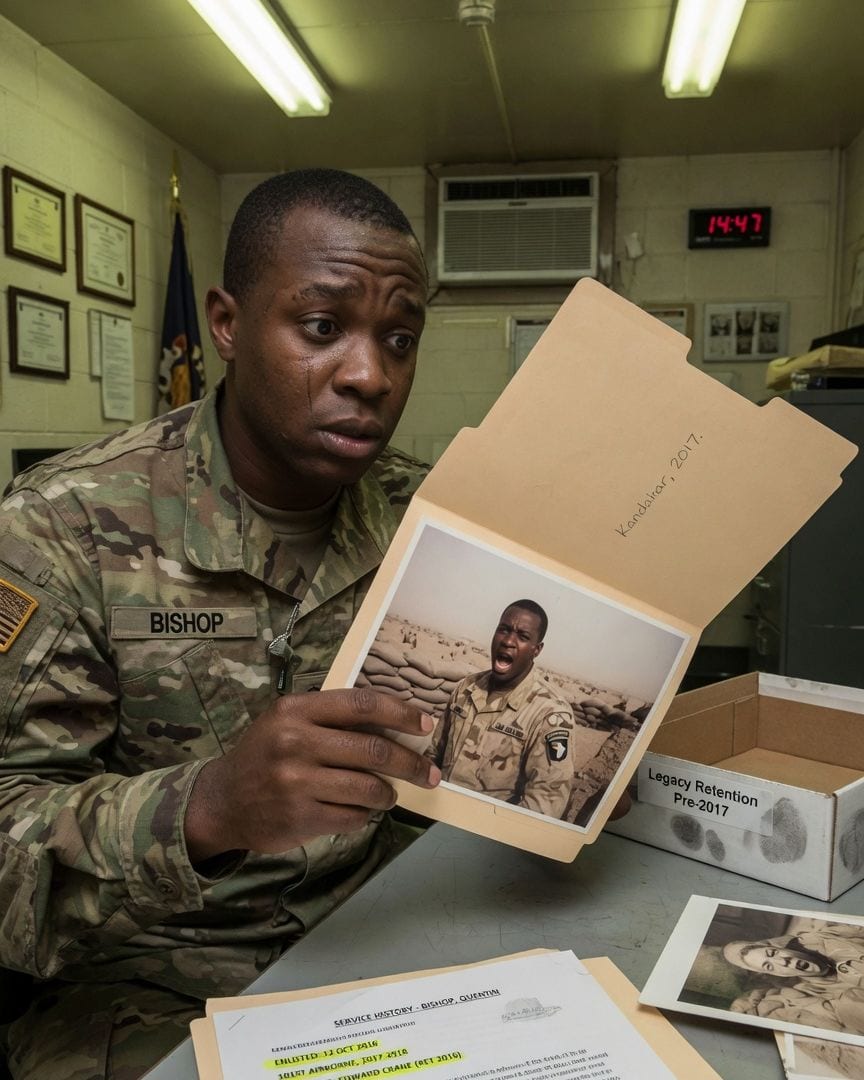
A specialist was signing for four more years, but his old file contained a photo of him in a desert uniform dated 2017, from a tour he never lived.
Specialist Quentin Bishop sat ready to re-enlist, looking forward to four more years of stability. But as he prepared to sign, his official record showed an enlistment date that made him seventeen years old, and a combat tour with a unit he’d never worn. Sergeant Marie Delaney dismissed it as a clerical error, but Bishop found a faded photograph of himself in a desert uniform, dated 2017, from a war zone he could not remember. Was this a mistake, or a meticulously constructed parallel life he never lived?
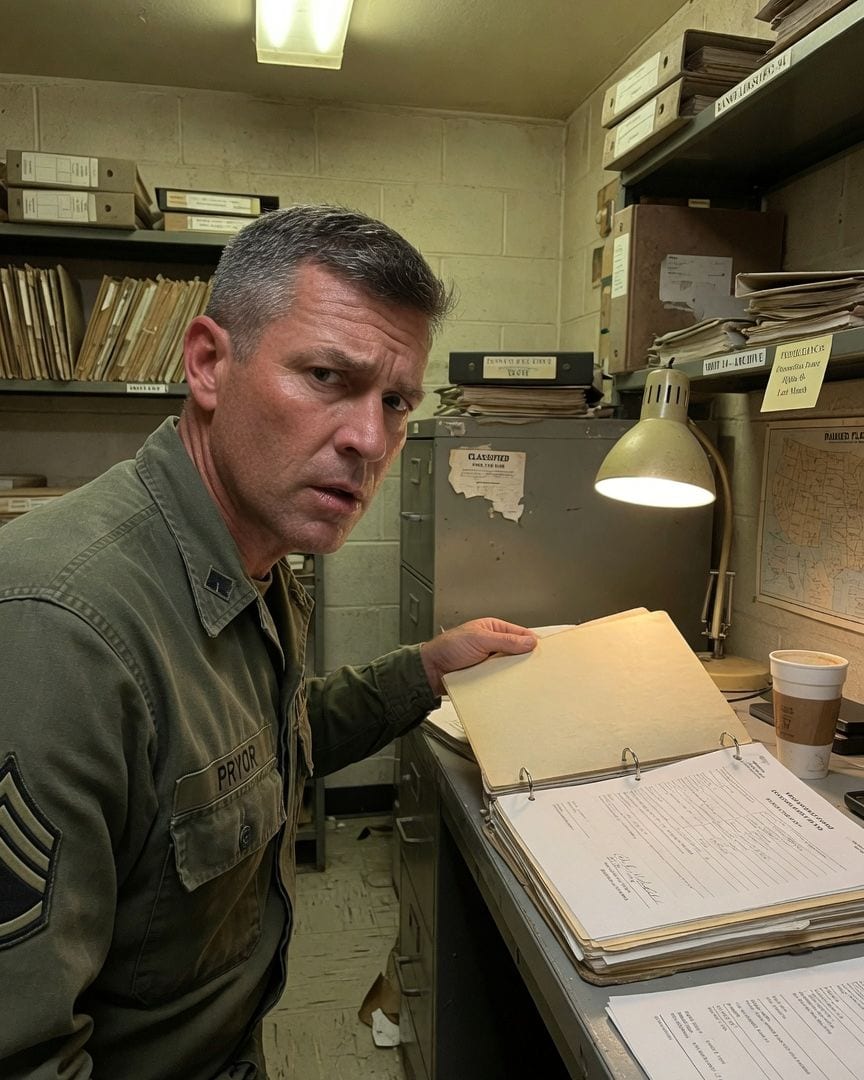
A sergeant with eleven days left finds a warm, glassed crater. Its file shows a captain lost thirty years ago is still signing reports from last week.
Sergeant Alden Pryor was counting down his final eleven days on a twenty-year hitch, expecting to spend them on routine patrols along the Ranier Flats fence line. Instead, his truck stopped at a bizarre sight: a four-hundred-foot glassed crater, miles from anywhere, its sand faintly warm at dawn despite no one recalling a blast. The air above it shimmered with an unnatural distortion, a silent scar of erased violence, and the official file for 'Shot 14' showed recent maintenance sign-offs for a decommissioned tower at the crater site. All these active documents were signed by Captain Everett Caldwell, who had been officially lost in operations thirty years ago, leaving Sergeant Pryor to wonder how a dead man could still be filing reports.
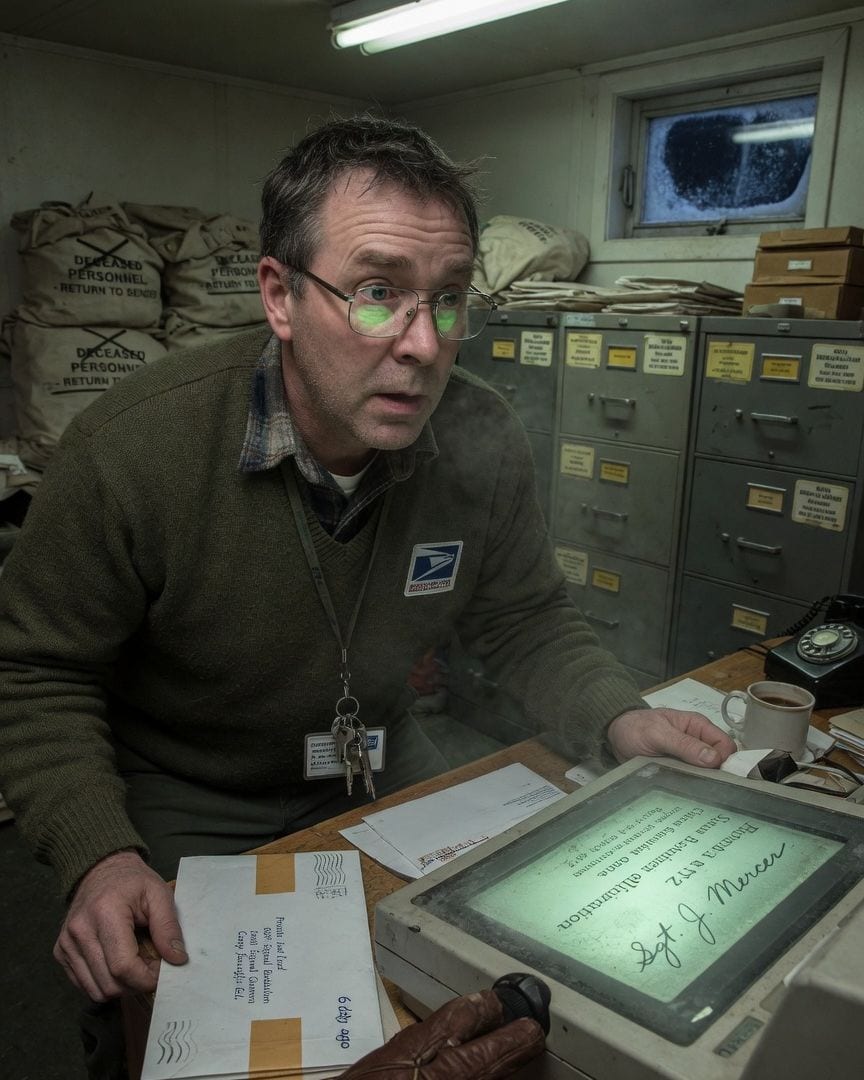
A postmaster at a Cold War Alaskan outpost still received mail for soldiers declared dead in 1969. Then he found their base was active three years later.
Postmaster Rowan Ashcroft had spent two decades watching the weekly mail plane land at Camp Bidwell Annex, a lonely outpost in the bitter Alaskan wind. His methodical mind, accustomed to order, was jolted when the latest mail sack contained forty-three letters for men officially declared dead in 1969. Each envelope, postmarked within days, was addressed to a soldier who wasn't coming back, and Rowan found one already opened and neatly resealed. Driven by duty, he began to sift through declassified Army archives, only to uncover a chilling maintenance log entry for the camp's equipment, dated three years after the base was officially shuttered. What was still happening at Camp Bidwell?
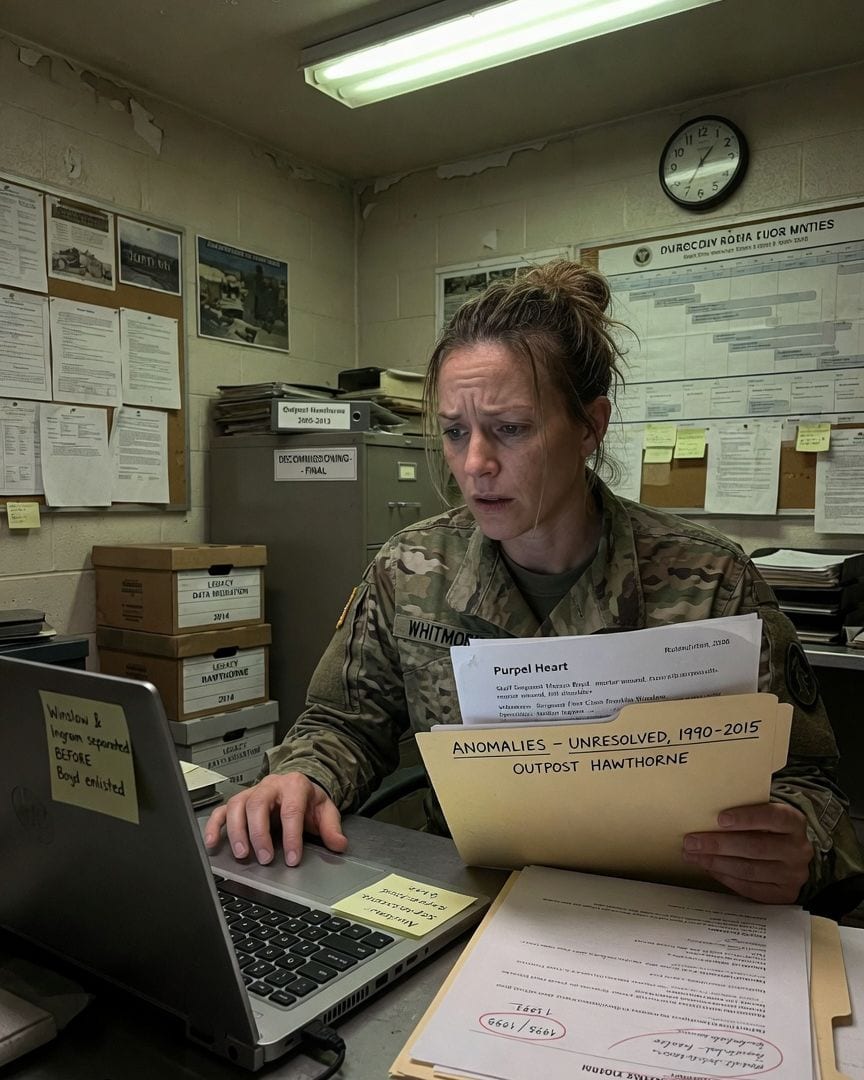
A military captain auditing a Cold War Fort Clay's final roster found a soldier's Purple Heart for a mortar wound. Its witnesses had left the Army years before it happened.
Captain Diane Whitmore, Adjutant for the soon-to-be-decommissioned Fort Clay, meticulously reviewed the final awards roster. Her office, usually bustling, was eerily quiet save for the fluorescent hum as she found an entry for Staff Sergeant Marcus Boyd: a Purple Heart for a mortar wound in 2012. But Boyd had returned unharmed, and the listed witnesses had separated from the Army years before he even enlisted. Colonel Sinclair dismissed it as data corruption, but Whitmore sensed a deeper anomaly, and ignoring a post historian's warning, she found another file from Outpost Hawthorne with the same impossible witnesses. What pattern was buried in Fort Clay's archives?
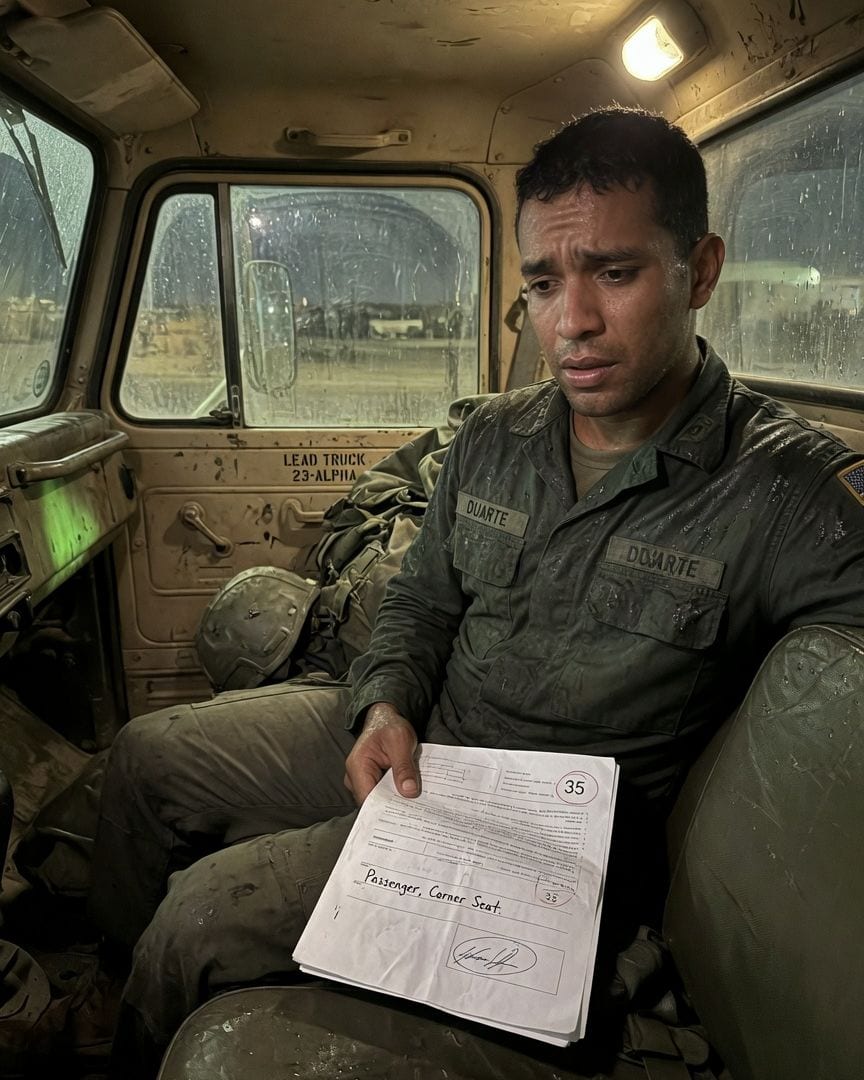
Specialist Duarte, two weeks from going home, found his empty truck seat warm and dented — then his service record showed a ghost deployment he never made.
Specialist Felix Duarte was just two weeks from going home, but a final convoy mission held an unsettling mystery. Soaked and running late, he squeezed into the lead truck's forbidden corner seat, a place every soldier knew to leave empty. Hours later, stepping out into the desert, he found the seat was strangely warm and distinctly dented, as if two unseen bodies had pressed in beside him. The official manifest then listed an extra soul for his truck, simply 'Passenger, Corner Seat,' signed by his own hand. What impossible presence had shared Specialist Duarte's ride, and what other records might it have altered?