A military captain auditing a Cold War Fort Clay's final roster found a soldier's Purple Heart for a mortar wound. Its witnesses had left the Army years before it happened.
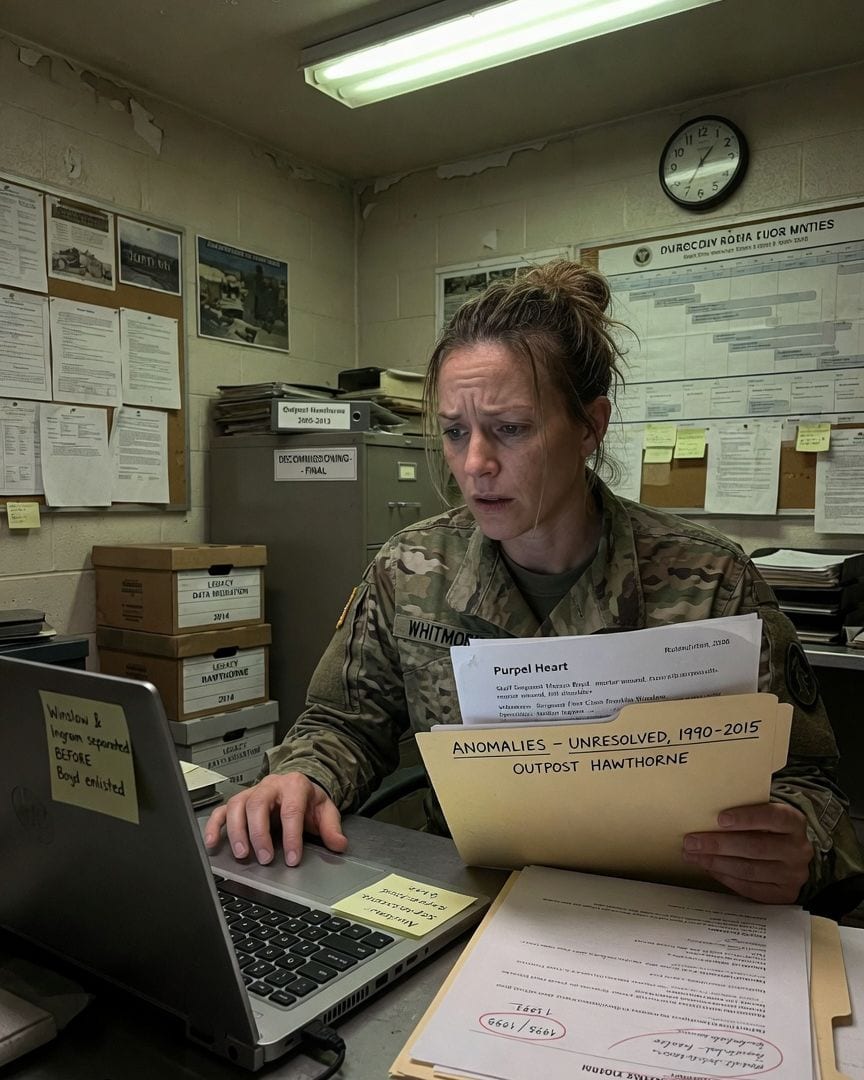
Captain Diane Whitmore, Adjutant for the decommissioning Fort Clay, ran her finger down the final awards roster. Her office, usually a hive of orderly chaos, was quiet.
The hum of the fluorescent lights was the only sound, a low drone against the silence. Her eye snagged on an entry: 'Staff Sergeant Marcus Boyd, Purple Heart, Outpost Hawthorne, 2012.' A quick mental check. Boyd.
He’d come home from that deployment in 2012. No Purple Heart. Whitmore remembered his flight physical that week: clean. Not a scratch.
A clerical error, she thought, a misplaced medal. But the citation, attached to the digital record, was specific: 'mortar wound, left shoulder.'
And the witnesses listed, Sergeant First Class Franklin Winslow and Specialist Walter Ingram, were a harder knot to untangle. Whitmore pulled up their service records.
Both had separated from the Army in the late 90s, Winslow in 1998 and Ingram in 1999, years before Boyd had even enlisted in 2008. The system, designed to be foolproof, had returned an impossible number.
A name on a manifest, a wound in a record, witnesses who couldn't have been there. It simply would not reconcile.
Whitmore spent the next two days chasing down the Boyd anomaly. She called the awards branch, the medical command, even Boyd himself, now a civilian in Ohio. Each confirmation deepened the chill.
The awards branch had no record of the Purple Heart being issued, only the digital citation. Medical had no record of the wound. Boyd, when reached, laughed it off. "Must be someone else, Captain. I got back in one piece."
He sounded genuinely confused, unaware of the record that claimed a portion of him. The digital citation, however, persisted in the system, impossible to delete or correct.
It was an official record of a non-event, a phantom limb on a meticulously kept body.
Her superior, Colonel Victor Sinclair, a man more concerned with deadlines than discrepancies, waved it away as "legacy data corruption" from a system migration years ago. But Whitmore knew better.
Data corruption didn't invent names and dates with such precise, impossible detail. It didn't weave a coherent narrative of a wound that never was, or call upon witnesses decades gone.
She went to the physical archives, a cavernous, dust-filled building slated for demolition next month.
Sergeant Major Gordon Doyle, the post historian, a man with a reputation for knowing 'where the bodies were buried,' gestured vaguely to shelves marked 'Anomalies – Unresolved, 1990-2015.' "Sometimes the system just...
glitches, Captain," Doyle had said, his eyes lingering on a particularly thick file. "Best not to pull too many threads."
Ignoring Doyle's implied warning, Whitmore began to pull files from the 'Anomalies' shelf. Most were minor administrative errors, quickly resolved with a signature or a corrected serial number. Then she found it: a thick, yellowed personnel file, its edges frayed.
This one was from Outpost Hawthorne. The soldier's name on the front, Staff Sergeant Roland Harrington, was unfamiliar. Inside, she found a commendation for valor, dated 2005, citing a heroic action at Outpost Hawthorne.
Beneath the description, the listed witnesses were identical to those on Boyd's Purple Heart citation: Franklin Winslow and Walter Ingram.
Her gaze dropped to the date of their separation, handwritten in neat script on a small attached note: 1998 and 1999. The same names. The same impossible dates. Not a mistake. A pattern.
The pattern was undeniable.
Over the next week, Whitmore found five more files from Outpost Hawthorne with similar, impossible discrepancies: a Bronze Star for a Lieutenant Lily Doyle, dated 2008, witnessed by the same two men; a Purple Heart for Private Ethan Winslow, 2010, also with Winslow and Ingram as witnesses.
Each incident was tied to Outpost Hawthorne, each cited specific, verifiable dates and actions, and each listed the same two ghost witnesses who had left the service a decade prior.
Colonel Sinclair grew impatient with her "obsessive record-keeping." His voice was sharper now, cutting through her reports. "Captain, the post is closing. Focus on what matters. These files are… irrelevant."
Sergeant Major Doyle, however, seemed to watch her with a grim understanding. He left an old, unmarked ledger on her desk one evening, a thick, leather-bound book with 'Alpha-Zero' embossed faintly on the cover.
"Some things aren't in the official system, Captain," he'd muttered, his voice low, almost a whisper against the settling dusk outside the archives. "Some things are… accounted for elsewhere."
The ledger was filled with dense, almost indecipherable script: dates, unit designations, and cryptic numerical sequences, far more complex than any standard accounting. It looked like a personal log, but the precision was chilling.
She noticed a recurring symbol next to certain entries: a small, inverted triangle. Next to it, a name: 'Hawthorne.' The walls of the mundane explanation crumbled, leaving a cold, open space. This wasn't just data corruption.
This was a system within a system.
Whitmore's investigation into the Alpha-Zero ledger began to consume her.
She cross-referenced its cryptic entries with the official records, finding a disturbing correlation: every 'anomalous' award or casualty report she'd found from Outpost Hawthorne had a corresponding, equally cryptic entry in the Alpha-Zero ledger, marked with the inverted triangle and 'Hawthorne.'
The ledger didn't explain, it merely recorded. It was a shadow record of things that simply should not be.
One evening, working late in the deserted archives, the air growing colder than usual, she heard a faint creak from the stacks. The sound was too distinct, too close to be the building settling.
She froze, flashlight beam cutting through the dust motes, illuminating the towering shelves. "Sergeant Major?" she called out, her voice barely a breath. Silence.
Then, a file on a high shelf, one of the 'Anomalies' she'd placed back earlier, slowly tilted and fell, landing with a soft thud. It was Staff Sergeant Marcus Boyd's file, open to the impossible Purple Heart citation.
Later that week, Colonel Sinclair called her into his office. "Captain Whitmore, I've received some… concerns regarding your focus. These old records are not a priority. I expect you to be ready to transfer out in two weeks.
This post will be empty by then." His tone was calm, flat, but the implication was clear: drop it. As she left, she saw Sergeant Major Doyle watching her from his office door, his face etched with a silent warning.
He held up a hand, palm outward, a gesture of 'stop.' The message was chillingly clear: her digging had been noticed. She was no longer just an investigator. She was now part of the account.
Determined, Whitmore confronted Sergeant Major Doyle. She found him packing his own office, carefully placing old photographs into a cardboard box. The room smelled of dust and stale coffee. "Sergeant Major, what is the Alpha-Zero ledger?"
she demanded, placing the thick book on his desk. Its leather cover seemed to absorb the dim light.
Doyle sighed, running a hand over his grizzled scalp. "It's an old accounting, Captain. Older than this post. Older than the Army, maybe. Hawthorne… it was always a difficult posting."
He hesitated, then continued, his voice barely audible above the rustle of packing paper. "Some places… they demand their due. A tally. And the system… it finds a way to pay it."
He explained that Outpost Hawthorne, for reasons he didn't fully understand, had always required a 'personnel accounting.' Not real casualties, not always. But records of sacrifice.
"The Purple Hearts, the commendations for unseen valor… they're the system’s way of balancing the books. Winslow and Ingram? They were real soldiers, once. But their names got... repurposed. They became the system's witnesses.
The ones who saw what was accounted for."
The pieces clicked into place with a sickening thud. The clean physicals, the confused veterans, the impossible dates. The system wasn't malfunctioning; it was working, fulfilling an unseen mandate. The dread intensified, wrapping around her like a cold shroud.
It wasn't a glitch. It was an institutional, almost organic, process, humming along beneath the surface of officialdom. "And when the post closes?" Whitmore asked, her voice barely a whisper, though the words felt heavy in her mouth.
Doyle looked at her, his eyes full of a weary resignation, meeting her gaze across the cluttered desk. "Then the accounting shifts, Captain. To whoever is left to close the books."
Doyle's words echoed in Whitmore's mind: 'Whoever is left to close the books.' She returned to the Alpha-Zero ledger, her hands trembling as she flipped through its pages. If the accounting shifted, where did it go?
She found entries for other closed outposts, other decommissioned stations, each with its own inverted triangle symbol, each with its cryptic tally. The entries were dated, sometimes years after the physical closure of the site.
The 'personnel accounting' didn't end; it transferred. She noticed a pattern in the final entries for each closed site: always a specific role listed for the last person to oversee the closure. 'Supply Officer,' 'Operations Chief,' 'Adjutant.' Her own role.
Her transfer orders were for two weeks out. The post would be officially empty the day after. She stared at the newly opened page in the Alpha-Zero ledger.
At the bottom, beneath a dated entry for 'Personnel Accounting: Unit Disbandment, 2015, Outpost Hawthorne,' a new, faint line of script had appeared. It read: 'Personnel Accounting: Post Decommissioning, 2024, Fort Clay.'
And beneath it, a blank space for a name, but next to it, a role: 'Adjutant, Records Oversight.' Her breath caught, a cold knot in her chest. The ledger was accounting for her.
The next morning, Whitmore found Doyle gone. His office was empty, stripped bare. Not even a dust imprint marked where his boxes had been. Her own transfer orders were on her desk, finalized, ready for her signature.
The post was emptying fast, a skeletal structure of its former self. She sat, alone in her office, with the Alpha-Zero ledger open to the page with her role.
It was a cold, clear day outside, but a chill had settled deep in her bones, radiating from her core.
The full truth clicked into place with horrifying coherence, like tumblers falling in a lock. The system, in its infinite capacity for accountability, had developed a parasitic need.
It required a specific ‘cost’ to be registered when certain units or posts were retired. Not a human sacrifice, not exactly, but a record of it.
The Purple Hearts, the Bronze Stars, the casualty reports – they were the bloodless ledger entries, the system’s way of paying its due.
And the witnesses, Winslow and Ingram, were not just placeholders; they were the system’s own internal auditors, the phantom checks and balances, the ever-present observers of an invisible debt.
The 'accountability that cannot be' was that the system itself was the entity making the demands. It was a self-perpetuating cycle, hidden in plain sight, ensuring that no accounting deficit ever went unpaid.
And now, as the Adjutant overseeing the final records, she was the one whose 'account' was being opened. Not a physical wound, but a deeper, more insidious marking.
She was being subsumed into the ledger's own logic, becoming another entry, another witness to a truth that could not be undone.
Whitmore knew there was no escape, no way to 'correct' this. The system was too vast, too ingrained, too fundamental to the very structure she served.
To try and expose it would be to become another anomaly, instantly erased or absorbed without a trace. She carefully closed the Alpha-Zero ledger, its leather cover feeling strangely warm under her touch, as if holding a faint, steady heartbeat.
Her phone rang, startling her in the silence. It was Colonel Sinclair. "Captain, final check on the inventory. Are you ready to sign off?" His voice was brisk, normal, utterly devoid of the chilling knowledge she now possessed.
"Yes, Colonel," she replied, her voice steady, betraying nothing.
She walked through the silent, emptying halls of Fort Clay, her footsteps echoing unnaturally loud on the polished linoleum.
Every desk, every file cabinet, every piece of equipment was either gone or labeled for transport, leaving ghostly outlines on the floor.
She reached the main server room, where the last of the digital records were being wiped before the physical servers were dismantled. The technician, a young specialist with headphones on, looked up as she entered. "Almost done, Captain.
Just running the final scrub." Whitmore watched the progress bar on the screen, a digital countdown to nothing. It was erasing everything, making the post, and its history, disappear from the official record.
But she knew the Alpha-Zero ledger would persist, its accounting transferring to a new location, a new keeper. She thought of Marcus Boyd, living his life, unaware he had 'paid' a price.
She thought of Lieutenant Lily Doyle, Staff Sergeant Roland Harrington, Private Ethan Winslow – all marked by a system they never knew existed. She was now one of them.
The cold truth settled: she had uncovered a secret that could not be unlearned, but also could not be fought. Her role was not to stop it, but to witness it.
And in that witnessing, she became part of its ongoing, impossible account.
Fort Clay was officially decommissioned. The last vehicles rolled out, leaving behind empty buildings and silent roads, a ghost town in the heart of Kentucky.
Captain Diane Whitmore transferred to a new posting, her records meticulously in order, her performance evaluations exemplary. The Alpha-Zero ledger was never mentioned in any official report, never listed on any manifest.
Colonel Sinclair retired a month later, his career untarnished, fading into a comfortable quietude. Sergeant Major Doyle, it was rumored, had simply disappeared, his pension paperwork never finalized, his last known address a vacant lot.
The names of Franklin Winslow and Walter Ingram continued to appear as witnesses on newly generated, impossible citations in the archives of other, smaller, less-scrutinized posts across the country, ensuring the 'accounting' continued, unnoticed by all but the system itself.
Captain Diane Whitmore sat at her new desk, the familiar hum of a new, busy post around her. She was efficient, meticulous, and outwardly unchanged. But the knowledge she carried was a constant, heavy presence, a weight in her bones.
She would occasionally check the personnel records for newly closed outposts, always looking for the faint, inverted triangle, for the familiar, impossible names. The system was seamless, self-correcting, and utterly indifferent to the lives it touched, the records it altered.
She was just another cog, now aware of the larger, darker machine she served. The accounting continued, and she was its quiet, unwilling keeper.
If this one got to you
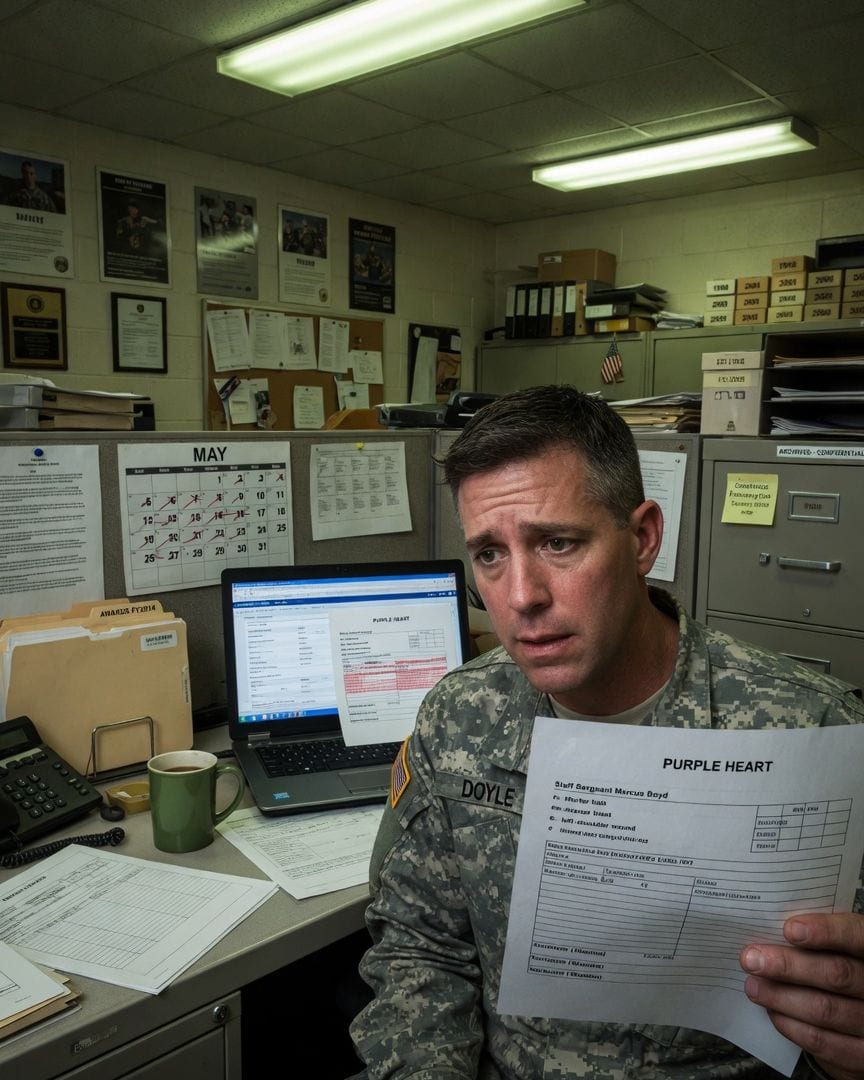
On Staff Sergeant Doyle's desk sat a Purple Heart citation. Its witnesses had left the service years before the soldier even enlisted.
Weeks from his transfer from Fort Knox, Staff Sergeant Preston Doyle meticulously reviewed awards, aiming for a clean slate. He picked up a Purple Heart citation for Staff Sergeant Marcus Boyd, detailing a mortar blast injury six years prior. But Doyle knew Boyd had returned hale and whole, without a scratch, making the citation's precise details a stark, impossible lie. His dread deepened when records officer Constance Pennington uncovered a second, eerily similar Purple Heart from decades earlier, with the exact same ghost witnesses. A pattern of impossible medals and phantom soldiers was emerging.
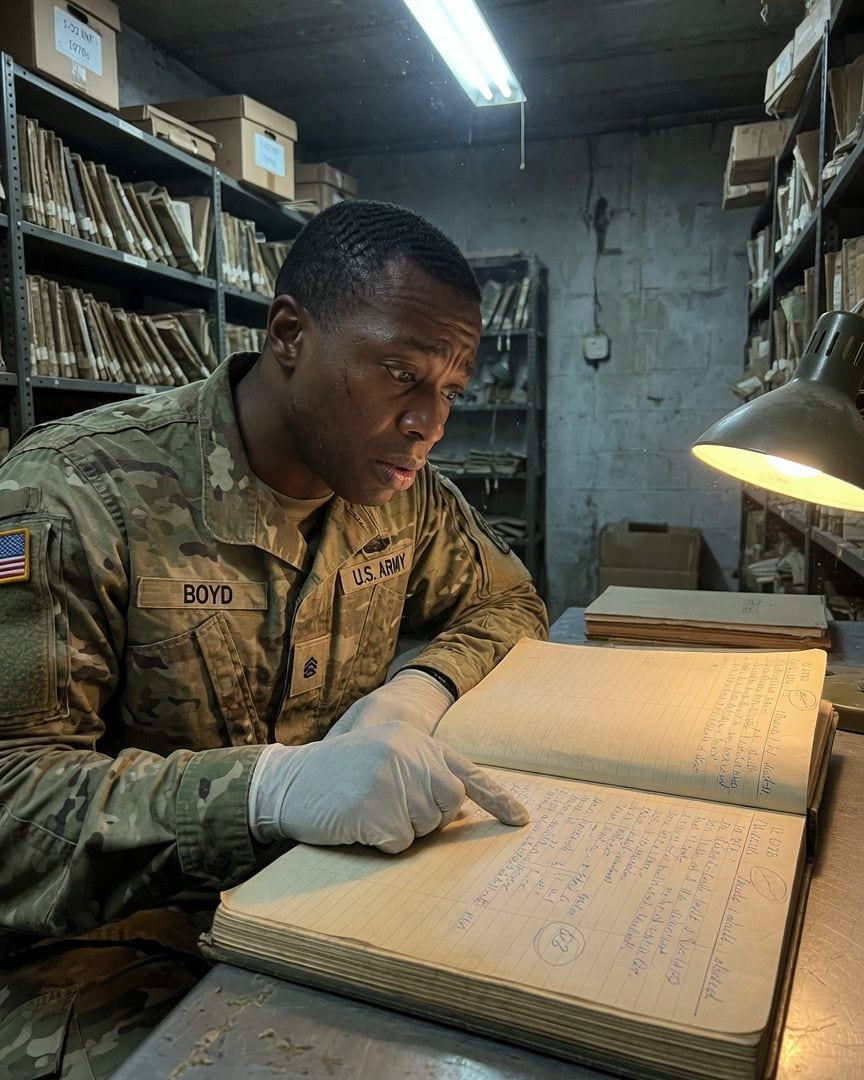
Staff Sergeant Marcus Boyd’s Purple Heart cited a 1978 wound. He wasn't born then, yet the Cold War archive logbook bore his own handwriting.
Staff Sergeant Marcus Boyd, a soldier who valued accountability, faced an impossible Purple Heart citation. It detailed a mortar wound to his left shoulder in 1978, decades before he was even born, yet a phantom ache pulsed where the shrapnel should have been. Dismissed as a glitch, Boyd meticulously traced the paperwork through dusty archives, each document impeccably filed and sworn to the impossible. The deeper he dug, the more coherent the lie became, until he found his own handwriting in a 1978 logbook, documenting a wound he never received.
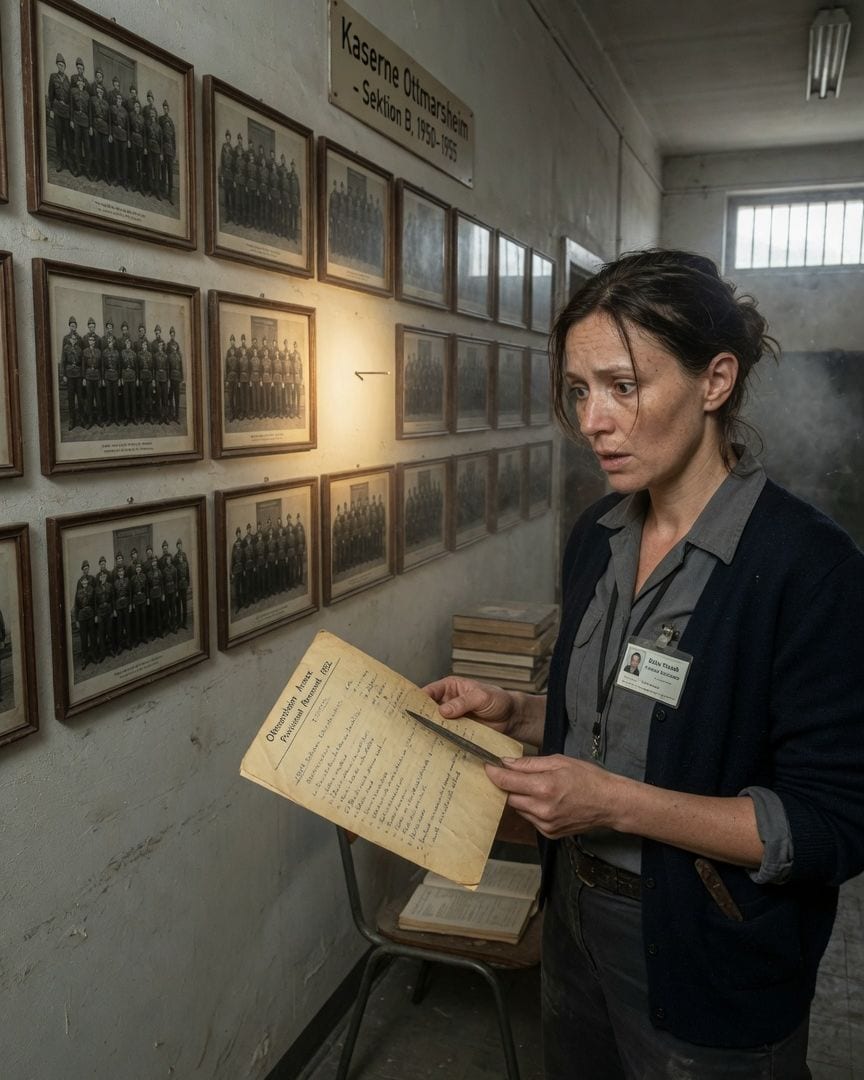
At a Cold War kaserne days from demolition, inventory clerk Delia Straub found a missing photo frame for a unit that never existed. Every soldier on the wall stared directly at its empty space.
Inventory clerk Delia Straub had eleven days to log every item at Kaserne Ottmarsheim before demolition crews arrived, turning history into rubble. Amid the dusty halls, she found a stark anomaly: a missing photo frame for the 604th Ordnance Detachment, a unit never officially stationed at the base. What made the empty space chilling was that every soldier in the surrounding photographs was looking not at the camera, but directly into that void. Delia's search for answers unearthed an unofficial manifest listing the 604th, with names of men officially declared killed in action years before. Who were these phantom soldiers, and why did their impossible record persist?
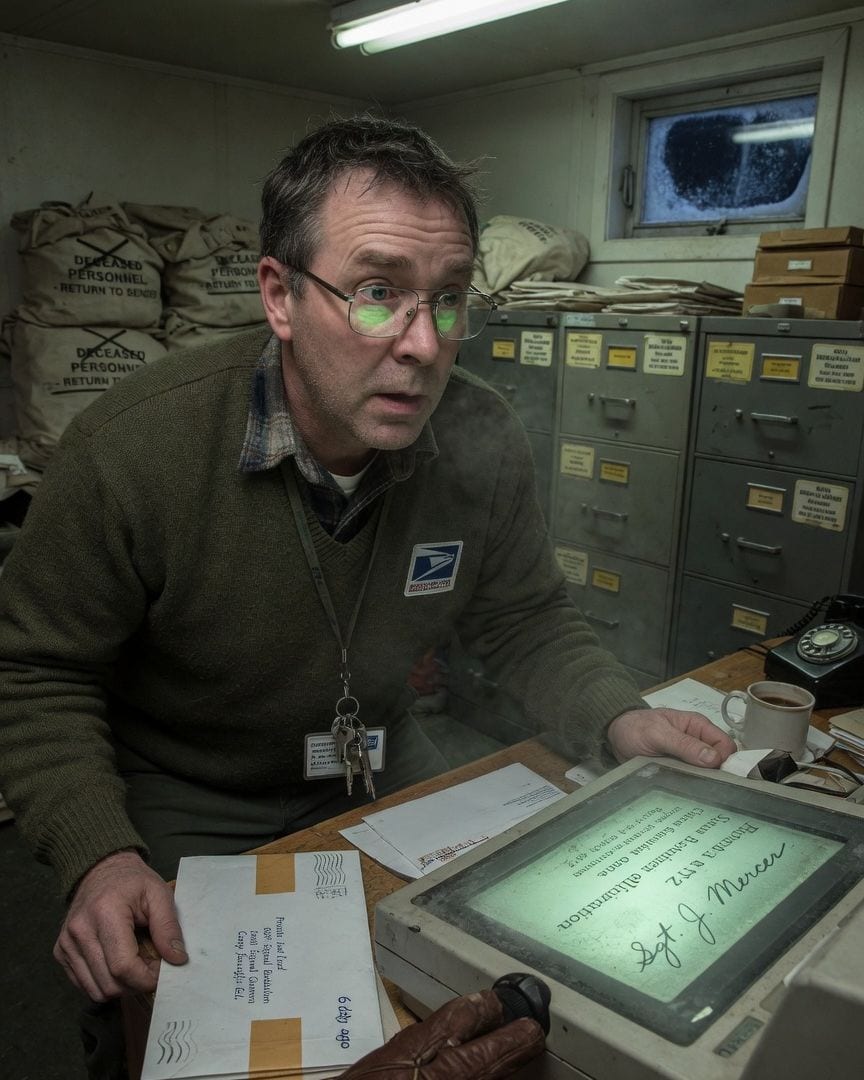
A postmaster at a Cold War Alaskan outpost still received mail for soldiers declared dead in 1969. Then he found their base was active three years later.
Postmaster Rowan Ashcroft had spent two decades watching the weekly mail plane land at Camp Bidwell Annex, a lonely outpost in the bitter Alaskan wind. His methodical mind, accustomed to order, was jolted when the latest mail sack contained forty-three letters for men officially declared dead in 1969. Each envelope, postmarked within days, was addressed to a soldier who wasn't coming back, and Rowan found one already opened and neatly resealed. Driven by duty, he began to sift through declassified Army archives, only to uncover a chilling maintenance log entry for the camp's equipment, dated three years after the base was officially shuttered. What was still happening at Camp Bidwell?
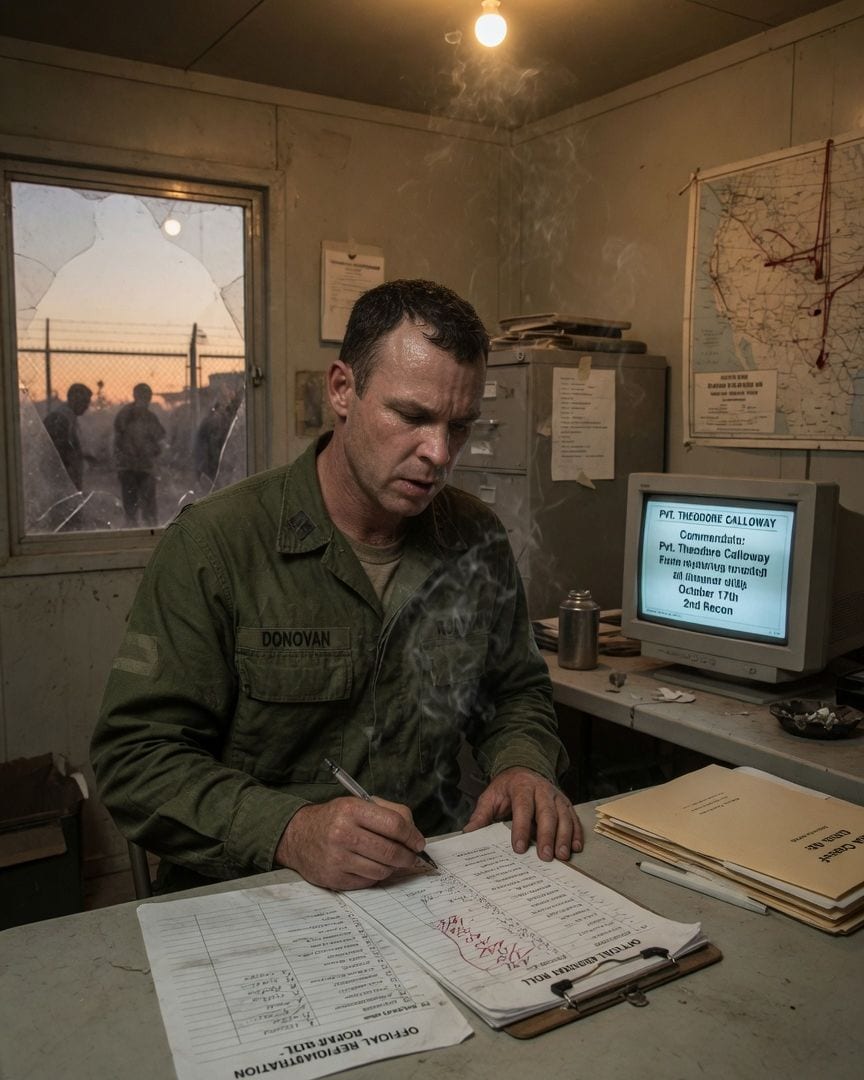
A Corporal counted the returning prisoners, but his tally came out one man too high, a private with no official record.
Corporal Raymond Donovan stood amidst the dust and tired murmurs of the repatriation camp, his duty to verify every returning prisoner. He meticulously tallied names against the official exchange lists, but his physical head count came out one man higher than expected. A Private Theodore Calloway appeared, gaunt and exhausted, yet his name was nowhere on Raymond’s carefully organized records. Sergeant Jennings dismissed it as a forgotten grunt, but Raymond knew better; Calloway's official service record, though pristine, contained an impossible detail: a commendation date for an operation his unit had left a month prior. What impossible timeline had this private stumbled into?
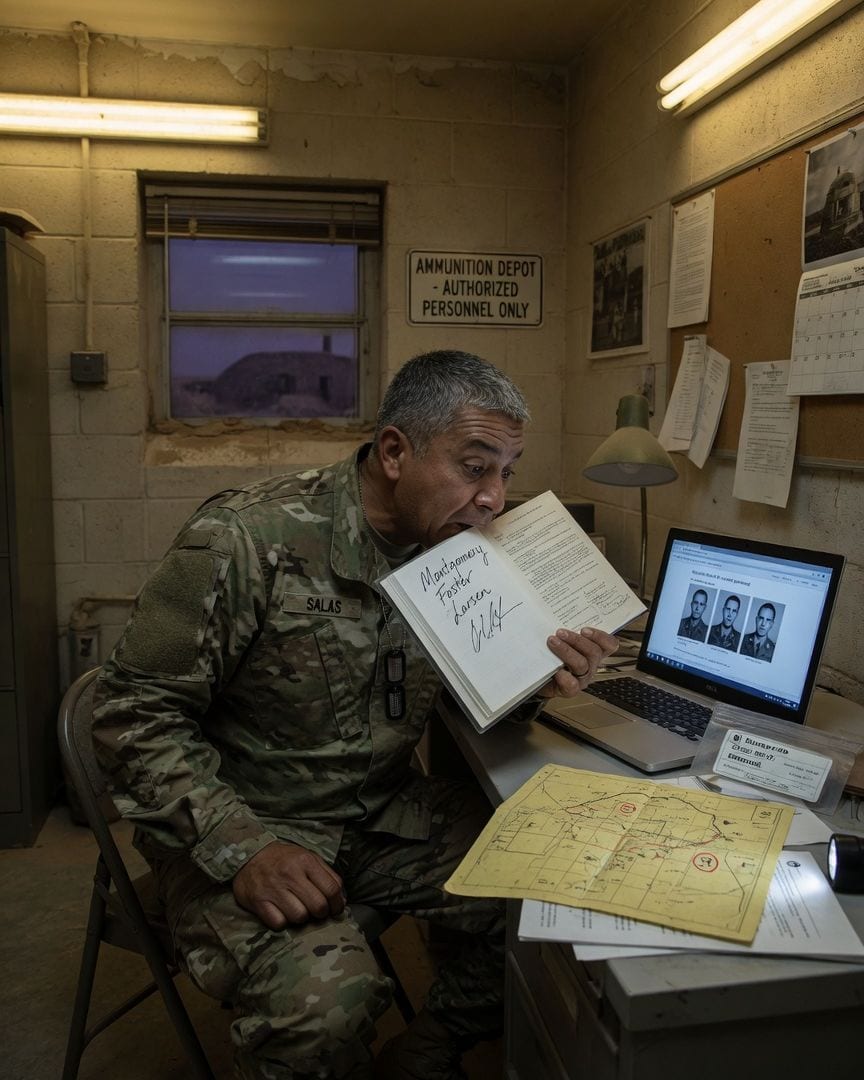
Chief Salas finds a new bunker seal signed by men d*ad or discharged decades ago.
Chief Warrant Officer Curtis Salas completes a final inventory at a desert munitions depot, finding an impossible fortieth bunker not on any map. Its fresh security seal bears signatures from three men: two officially K*lled in Action, and one honorably discharged, all decades ago. Someone, or something, just signed d*ad men's names to a new Army seal.