Staff Sergeant Marcus Boyd’s Purple Heart cited a 1978 wound. He wasn't born then, yet the Cold War archive logbook bore his own handwriting.
Staff Sergeant Marcus Boyd sat in Captain Forsythe’s office, the air thick with the scent of stale coffee and old paper.
On the captain’s desk lay a framed Purple Heart citation, crisp and official, detailing a mortar wound to Staff Sergeant Marcus Boyd’s left shoulder, incurred on October 12, 1978, at Fort Vance, Kentucky.
Marcus stared at the document, then at his own unblemished left shoulder, then back at the citation.
His flight physical from the previous week was clean, a glowing report from the post’s medical facility confirming no major injuries, certainly not a decades-old shrapnel wound.
The citation listed three witnesses – Edmund Thornton, Arthur Caldwell, Lars Mercer – all of whom had separated from the service decades before Marcus Boyd was even born, let alone enlisted.
A phantom ache, faint but insistent, pulsed in his left shoulder, right where the citation said the shrapnel had torn through flesh.
Captain Forsythe, a rigid man who lived by regulations, initially dismissed it as a clerical error, a glitch in the awards system.
'Probably a database merge gone wrong,' he’d grumbled, already moving on to troop readiness reports and ignoring the subtle tremor in the framed citation as the air conditioning kicked on.
But Marcus Boyd was a soldier who valued accountability above all else. A Purple Heart was not a typo, and the specific details of location, date, and wound felt too precise for a simple administrative error.
He spent the next two days methodically tracing the citation through the post's archaic records system, navigating dusty archives and forgotten digital folders.
He found the original request form, signed by a Lieutenant Miller, the signed witness statements from Thornton, Caldwell, and Mercer, even a scanned copy of a field medical report, complete with a crudely drawn diagram of a shrapnel pattern on a human shoulder.
Every piece of paperwork, impeccably filed and cross-referenced, swore that Staff Sergeant Marcus Boyd had been wounded in 1978.
The deeper he dug, the more coherent the lie became, making the truth – that it was impossible – feel increasingly like a delusion. He remembered his drill sergeant’s mantra: 'Trust the process.'
But the process here was telling a story that defied his own lived experience. He sought out Sergeant Cynthia Thornton, a no-nonsense NCO from his unit, known for her sharp mind and ability to navigate bureaucracy.
She listened, initially skeptical, running a hand through her short-cropped hair, but the sheer volume of 'correct' but impossible paperwork began to chip away at her composure.
'This isn't a glitch, Marcus,' she finally conceded, pushing a stack of photocopied forms back towards him, the papers rustling like dried leaves. 'This is a ghost in the machine. A very disciplined ghost.'
She suggested checking the physical unit logbooks from that era, hoping to find a contradiction that would collapse the whole edifice.
Following Cynthia’s lead, Marcus found himself in the lowest level of the post’s oldest archive building, a cavernous space smelling of mildew and forgotten history. The fluorescent lights flickered overhead, casting long, dancing shadows among the rows of steel shelves.
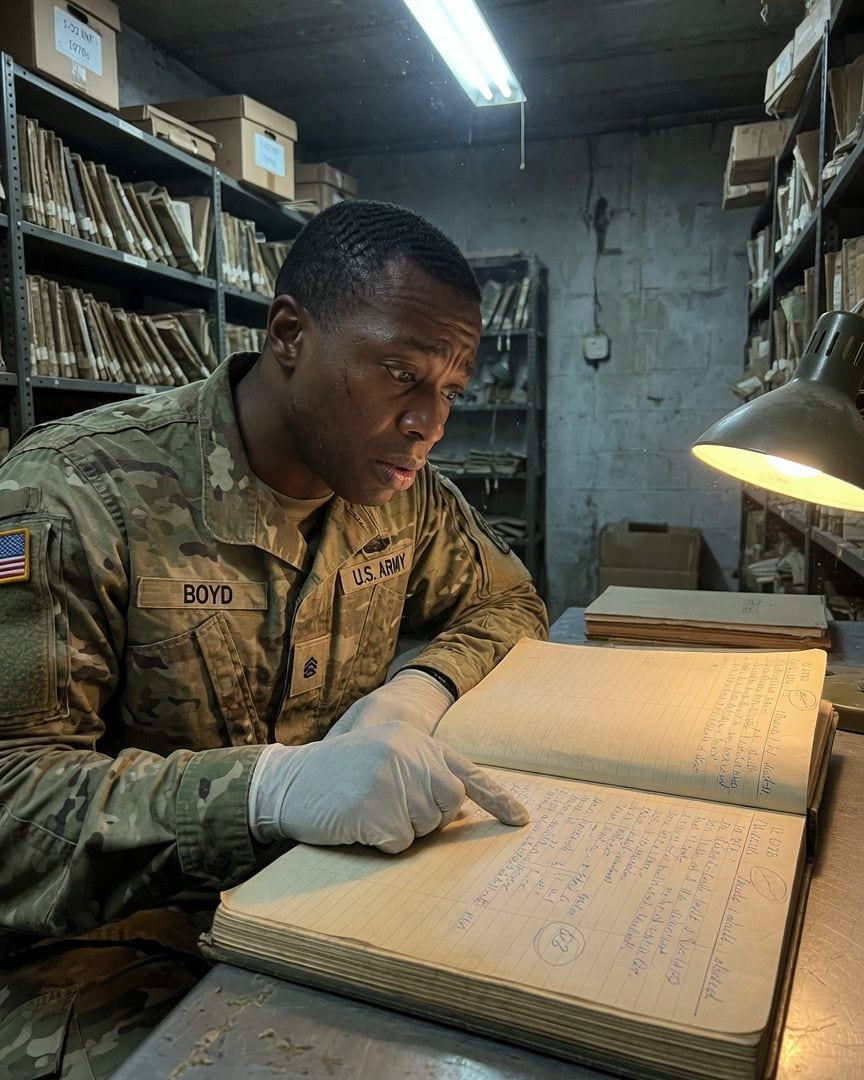
After hours of sifting through crumbling ledgers, his gloved fingers stained with dust, he located the bound logbook for 'Company C, 1st Battalion, 32nd Infantry' – the unit cited in his Purple Heart.
His gloved fingers turned to October 12, 1978. There it was: a terse entry detailing a mortar attack, three wounded, one casualty. 'Pvt. Gerald Caldwell, left shoulder shrapnel.'
Marcus felt a chill that wasn't just the damp air of the archive. But then, in the margin, next to Caldwell's name, a faint, almost erased, but unmistakably handwritten note: 'Boyd, Marcus - shoulder.'
The loops and angles of the letters, the precise way the 'M' was formed, the slight slant of the 's' – it was his own handwriting, from a time before he was born, documenting a wound he never received.
The discovery of his own impossible handwriting in the 1978 logbook shattered Marcus Boyd's composure, but not his rationality. He called Cynthia, relaying the impossible detail as the chill of the archive still clung to his clothes.
Her initial shock gave way to a grim determination. 'This isn't just about a medal anymore, Marcus. This is... an identity crisis.' They pooled their resources, using Marcus’s access to personnel records and Cynthia’s knack for navigating obscure administrative channels.
They cross-referenced the names of the witnesses on the original citation – Edmund Thornton, Arthur Caldwell, Lars Mercer – with other archived records. They found service records, discharge papers, even pension applications. All legitimate.
All showing separation dates in the early 1980s, long before Marcus enlisted. There was no mundane explanation for their presence on his citation.
The phantom ache in Marcus's shoulder grew more frequent, a dull throb that felt less like a memory and more like a foreign presence, a dull chord vibrating just beneath his skin.
They interviewed retired personnel who had served at Fort Vance in 1978, cautiously asking about Private Gerald Caldwell. A few remembered him, a quiet kid, killed by a mortar.
No one, however, remembered a 'Marcus Boyd' serving with Caldwell’s unit, let alone being wounded alongside him. The more they questioned, the more the discrepancy widened.
Cynthia found a mention in an old post history document of a 'Field Radio Intercept Program' that was briefly trialed at Fort Vance in the late 70s, before being mysteriously decommissioned.
The citation mentioned a specific model of field radio in Caldwell’s unit. It was a long shot, but it was a tangible link, a piece of equipment that could be located.
They began to focus their search on the physical remnants of the 1978 incident, not just the paper trail, hoping to find an object that carried the same impossible imprint.
The post was emptying out, preparing for its eventual closure, making their clandestine search both easier and more urgent. They needed answers before Fort Vance was locked away forever.
Their digging did not go unnoticed. One evening, as Marcus exited the archive building, the heavy steel door groaning shut behind him, a figure detached itself from the shadows near a decommissioned guard tower. Captain Forsythe.
His expression was unreadable in the fading light, his posture stiff, almost rigid against the darkening sky. 'Staff Sergeant Boyd,' he said, his voice flat, devoid of its usual parade-ground bluster.
'I’ve been getting reports of unauthorized access to restricted sections of the archives. And unusual inquiries regarding historical personnel files.' Marcus felt a prickle of unease, a cold knot tightening in his stomach. 'Just following up on a discrepancy, Captain.
My Purple Heart.' Forsythe's gaze was sharp, like a surgeon’s scalpel. 'Some discrepancies are best left alone, Staff Sergeant. For the good of the unit. For your own good.'
There was no direct threat, but the implication hung heavy in the air, tasting of dust and stale secrets.
The next day, Cynthia found her access card to the main administrative building temporarily deactivated, the electronic lock blinking an insolent red. Later that week, an anonymous, heavily redacted memo appeared on Marcus’s desk, tucked beneath his standard morning briefing.
It outlined the regulations for involuntary psychiatric evaluation for personnel exhibiting 'delusional ideation impacting duty performance.' The message was clear: someone knew what they were doing, and they were pushing back.
They were no longer just investigating; they were being watched, warned. The accountability system, designed to protect, was now being subtly wielded against them.
The phantom ache in Marcus's shoulder intensified, a constant, low thrum, as if a small, trapped bird beat its wings just under his skin.
He found himself checking over his shoulder, double-locking his barrack room door, the familiar sounds of the post now tinged with a new, unsettling quality. The rational explanations were failing, and the danger was now personal, tangible.
'They're not trying to stop us from finding the truth,' Cynthia whispered one night, hunched over a blurred photocopy of an old map of Fort Vance, the paper crackling under her fingers. 'They're trying to stop us from proving it.
Because if we prove it, the whole system breaks.'
Undeterred, Marcus and Cynthia shifted tactics, focusing on the decommissioned Field Radio Intercept Program mentioned in the old post history.
They found a series of dilapidated bunkers beneath the old radio tower, long sealed off, the concrete stained with decades of neglect.
Using a crowbar and an old maintenance blueprint Cynthia 'found,' they forced open a rusted access hatch, the metal shrieking in protest like a trapped animal. Inside, the air was cold and still, smelling of ozone and dust.
In the center of the largest chamber sat an array of archaic, console-like equipment, covered in grimy tarps.
They pulled back a tarp to reveal a massive, humming console, its vacuum tubes glowing faintly, a spectral green light emanating from within its depths. It was a model of the specific field radio mentioned in Private Caldwell's citation.
On a small, corroded panel, a faded unit patch from the 32nd Infantry, 1st Battalion, was affixed.
As Marcus touched it, a wave of dizziness washed over him, and the ache in his shoulder flared, sharp and real, a sudden searing pain.
He saw a flash: Private Caldwell, crouched in a foxhole, the thud of an incoming mortar, dirt exploding, the cry torn from his throat. It was a memory that wasn't his, raw and visceral.
Cynthia, pulling him back, her hand firm on his arm, noticed an old, battered metal filing cabinet tucked into a corner, its lock long rusted. They broke it open.
Inside, amidst yellowed technical manuals, they found a file labeled 'Project Echo: Discrepancy Reports.' It wasn't an official military designation. The file contained a series of meticulously documented instances of 'identity bleed' and 'temporal record displacement' at Fort Vance.
It detailed how personnel records would subtly shift, attaching current soldiers to past events, or vice-versa, always tied to significant incidents on the post.
Marcus's Purple Heart wasn't a glitch; it was an echo, a specific case within a known, if deeply suppressed, pattern.
The file explained that the console they'd found was an experimental 'temporal resonance amplifier,' designed in the late 70s to 'intercept and analyze historical signal patterns' but inadvertently created these identity overlays, acting as a bridge between past and present records.
The system, designed to record and account for every soldier, had become the very mechanism for their temporal displacement.
The 'Project Echo' file laid bare the first horrifying truth: the post itself was a source of these impossible records, not a victim of a clerical error.
The console hummed softly in the bunker, a silent testament to the anomaly, its green glow casting an eerie light on the dusty chamber.
But as Cynthia read deeper into the 'Discrepancy Report' file, her face drained of color, her eyes wide. She pointed to a section detailing 'secondary manifestations.'
The file chronicled not just record changes, but instances where current personnel experienced phantom pains, memories, or even personality shifts aligning with the past individuals whose identities had been partially overwritten. It wasn't just Marcus Boyd's Purple Heart.
There was a current Private listed as AWOL from 1965, a Sergeant awarded a medal for a 1982 skirmish they never deployed to, a Lieutenant's name appearing on a 1950s training roster.
The pattern across rotations and dates was clear: Fort Vance had been quietly, consistently, producing these impossible records for generations, always linking current personnel to past events on the post, or past personnel to current records, all within the official, unimpeachable system.
A recent entry, dated only two weeks prior, detailed a young recruit who reported phantom pain in his leg.
The diagnosis was inconclusive, but the file notes a similar injury reported by a Private named Arthur Fontaine, who served at Fort Vance in 1961.
Below it, a single, stark line read: 'Subject: Fort Vance Anomaly - Active - Pattern Confirmed.' Marcus Boyd felt a sudden, sharp ache in his shoulder, a familiar throb that made him gasp.
It wasn't just a record; it was happening again, and it wasn't just him.
The 'Project Echo' file and the humming console confirmed the terrifying coherence of it all. The temporal resonance amplifier, a failed experiment in the late 70s, was indeed the nexus.
It was designed to pull historical data, but instead, it was bleeding identities across time within the post's physical and administrative boundaries.
The military’s obsession with absolute accountability, with every soldier accounted for, every event logged, had inadvertently created the perfect medium for this anomaly.
The console acted as a filter, drawing specific, high-intensity events – a mortal wound, a disciplinary action, a moment of profound stress – and imprinting those details, along with the identities of current personnel, onto the official record.
Marcus’s Purple Heart was a perfect match for Private Caldwell's sacrifice. The phantom pain in his shoulder was a physical echo of Caldwell’s wound, a terrifying testament to the blurring of identities.
The 'Discrepancy Report' detailed attempts by a few dedicated, unsanctioned officers over the decades to understand and contain the anomaly, their efforts ultimately buried by the very system they sought to protect.
They had managed to contain the most volatile effects, but never truly stopped it.
The report’s final pages contained a hypothesis: the anomaly wasn't just about the console; the console was merely amplifying an inherent 'temporal instability' in the geological substrata beneath Fort Vance, a natural phenomenon that the military’s experimental tech had inadvertently weaponized.
The old unit patch, Marcus realized, was not just a memento; it was a focal point, a physical anchor for Caldwell’s imprinted identity, directly linked to the console’s resonance.
Marcus knew what had to be done. The console, the patch, the file – they were all part of a system that had to be stopped.
He and Cynthia worked quickly, their movements precise and practiced, like a well-drilled combat team, fueled by a grim sense of urgency.
Cynthia scouted the perimeter, her flashlight beam cutting through the bunker's gloom, ensuring no one from Captain Forsythe’s office was watching. Marcus, his phantom shoulder throbbing, approached the humming console, the green light bathing his face.
He carefully peeled the faded 32nd Infantry patch from the console’s panel, the adhesive crackling with age, resisting his efforts.
As it came free, the console’s hum faltered, a discordant sound, flickering erratically as the glowing vacuum tubes dimmed, then brightened, as if struggling against a sudden resistance.
Marcus felt a jolt, a brief, intense sensation of two separate lives merging and then sharply separating within him, like two streams of water forcibly diverted.
The pain in his shoulder vanished, leaving only a dull ache from clenching his jaw. 'It's working,' Cynthia breathed, watching the unstable lights, her voice hushed.
Marcus then systematically dismantled the console’s power supply, severing wires, pulling out specific tubes, following diagrams from the 'Project Echo' file that detailed how to 'de-amplify' the temporal resonance.
With a final, sharp crackle that echoed in the confined space, the console went dark, the hum dying into silence. The air in the bunker felt lighter, cleaner, as if a heavy weight had been lifted. They had stopped it.
They had broken the impossible cycle, at least for now. But as they gathered their gear, preparing to seal the bunker, Marcus noticed something else. Tucked behind a loose panel on the wall, almost hidden, was another unit patch.
This one was older, from a different infantry division, its colors faded to near invisibility. And beneath it, a faint, almost invisible scratch on the concrete wall: 'Fontaine, A. - 1961.'
It was identical to the one they had just removed, but clearly from a different era, a different soldier, a different incident.
The problem wasn't just this console; it was the place itself, and the patterns had been there long before Project Echo.
Marcus and Cynthia resealed the bunker, burying the 'Project Echo' file and the decommissioned console deep within its forgotten chambers. They submitted a heavily redacted report to Captain Forsythe, detailing 'anomalies in historical record-keeping systems' that had been corrected.
Forsythe, perhaps sensing the deeper truth or simply relieved to close the matter before the post's decommissioning, quietly dismissed the Purple Heart citation as a 'system error' and approved Marcus's promotion board. The phantom ache in Marcus’s shoulder never returned.
The young recruit with the phantom leg pain was transferred to another post, his condition attributed to 'stress-induced somatic symptoms.'
Fort Vance continued its slow march towards closure, its buildings growing more derelict with each passing day, its secrets undisturbed, its history quietly rewriting itself in the shadows.
Months later, Marcus Boyd received his promotion to Sergeant First Class. Cynthia Thornton was transferred to a new unit, a quiet acknowledgment of their unauthorized investigation.
Fort Vance was officially decommissioned, its buildings locked and abandoned, its archives sealed away, swallowed by neglect. The land was eventually sold to a private developer, destined for a new purpose.
Marcus sometimes catches himself idly tracing the scar on his unblemished left shoulder, a phantom mark where shrapnel should have torn. He knows the system, the rigorous accountability of the military, is supposed to make sense of everything.
But he also knows that some truths are too coherent, too perfectly fitted into the official record, to ever be truly understood.
He remembers the second patch, hidden in the bunker wall, and the faint hum he thought he heard from deeper below, a vibration in the earth itself. He never spoke of it again. He never will.
The system, after all, is still running, somewhere, recording everything. And some records, once written, are never truly erased.
Years later, a demolition crew at the old Fort Vance site uncovered a sealed sub-basement beneath the former radio tower.
Among the debris, they found a corroded metal filing cabinet, its contents turned to dust, save for a single, faded unit patch from an infantry division that hadn't existed since the 1950s.
The foreman picked it up, feeling a strange, dull ache in his left leg. 'Odd,' he muttered, 'I don't remember spraining this yesterday.'
If this one got to you
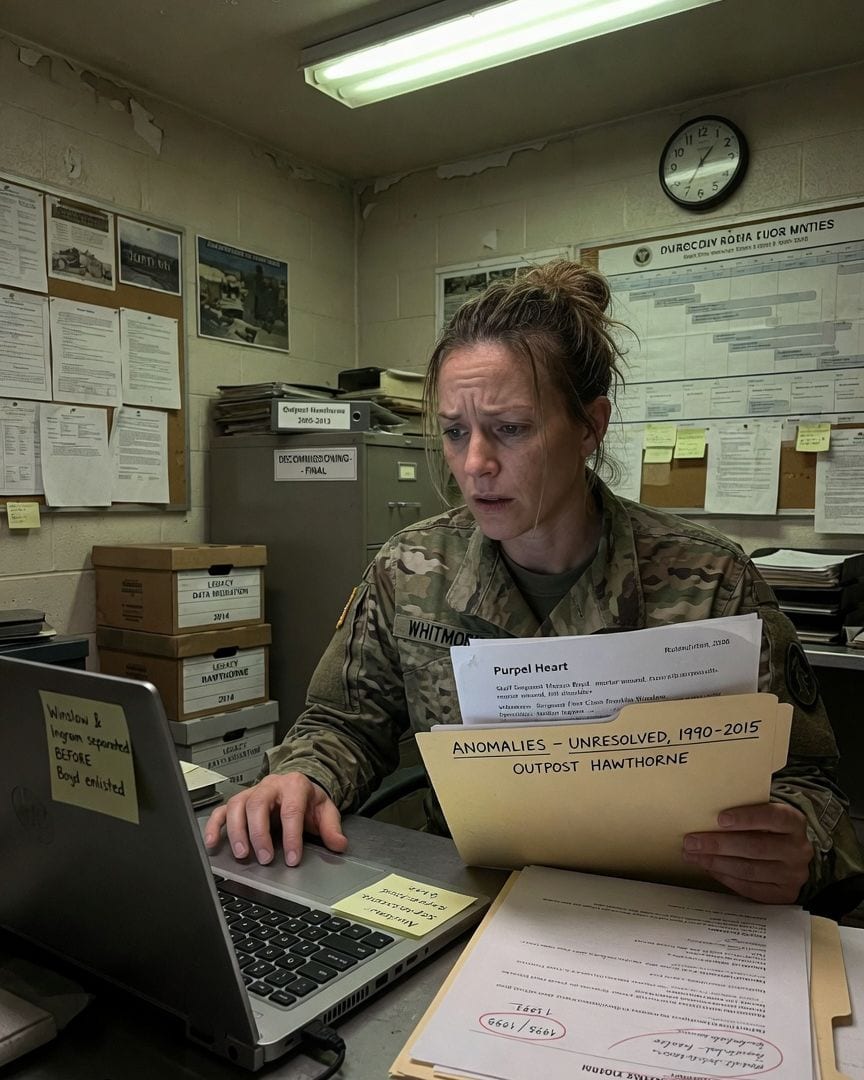
A military captain auditing a Cold War Fort Clay's final roster found a soldier's Purple Heart for a mortar wound. Its witnesses had left the Army years before it happened.
Captain Diane Whitmore, Adjutant for the soon-to-be-decommissioned Fort Clay, meticulously reviewed the final awards roster. Her office, usually bustling, was eerily quiet save for the fluorescent hum as she found an entry for Staff Sergeant Marcus Boyd: a Purple Heart for a mortar wound in 2012. But Boyd had returned unharmed, and the listed witnesses had separated from the Army years before he even enlisted. Colonel Sinclair dismissed it as data corruption, but Whitmore sensed a deeper anomaly, and ignoring a post historian's warning, she found another file from Outpost Hawthorne with the same impossible witnesses. What pattern was buried in Fort Clay's archives?
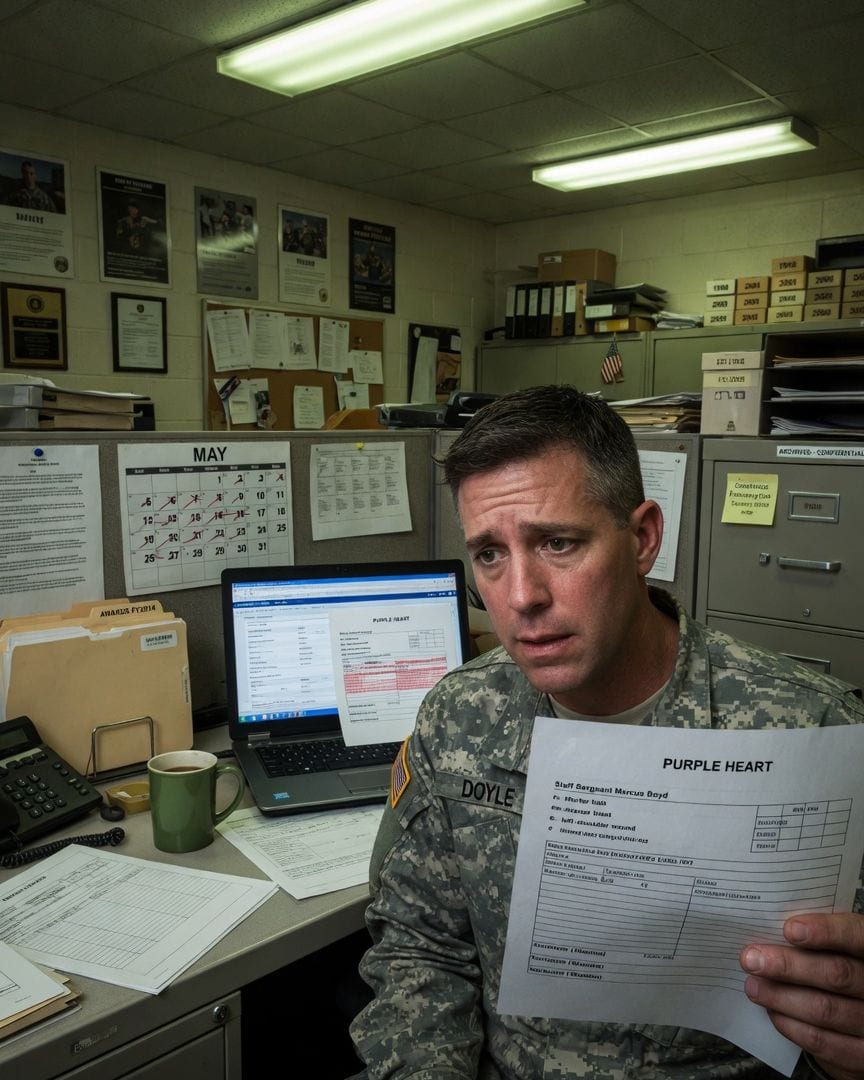
On Staff Sergeant Doyle's desk sat a Purple Heart citation. Its witnesses had left the service years before the soldier even enlisted.
Weeks from his transfer from Fort Knox, Staff Sergeant Preston Doyle meticulously reviewed awards, aiming for a clean slate. He picked up a Purple Heart citation for Staff Sergeant Marcus Boyd, detailing a mortar blast injury six years prior. But Doyle knew Boyd had returned hale and whole, without a scratch, making the citation's precise details a stark, impossible lie. His dread deepened when records officer Constance Pennington uncovered a second, eerily similar Purple Heart from decades earlier, with the exact same ghost witnesses. A pattern of impossible medals and phantom soldiers was emerging.
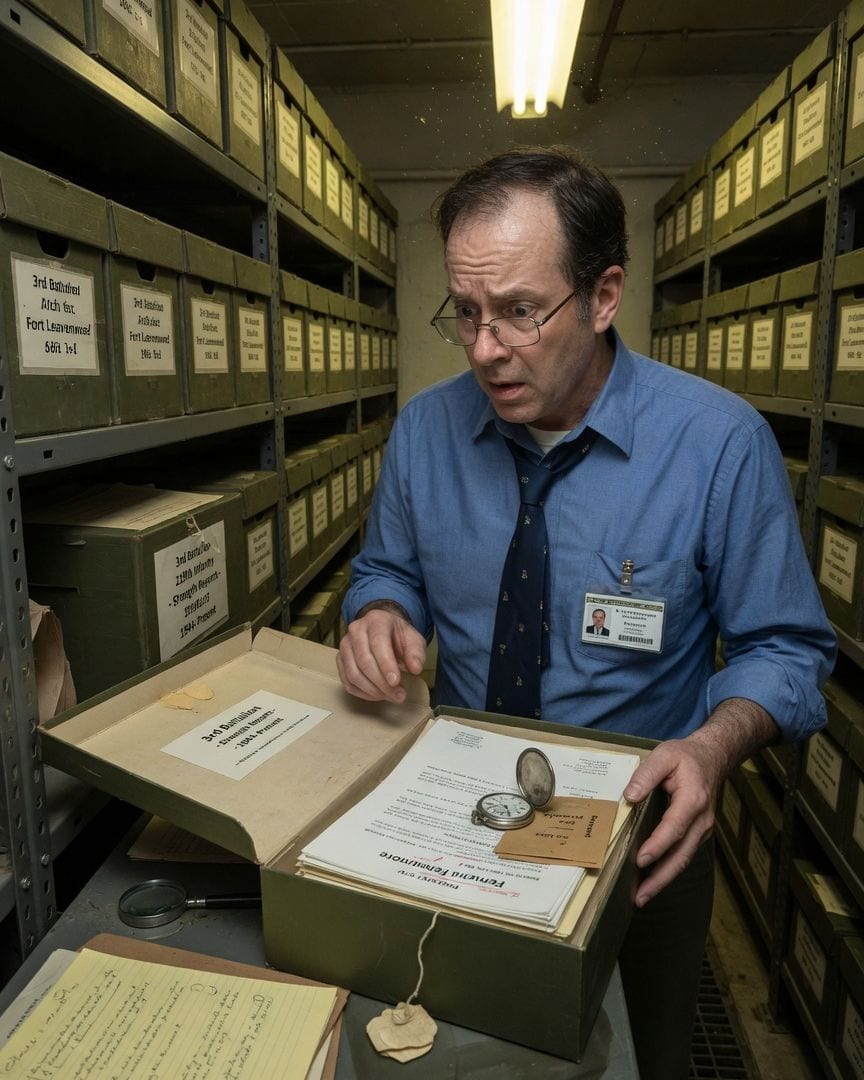
On his last Friday, an archivist finds his dead father's pocket watch in a Cold War ghost unit's file, ticking and warm.
Marcus Fennimore, a meticulous archivist, was on his final Friday at Fort Leavenwood's lineage vault, a place he knew intimately after thirty-one years. He stumbled upon twenty-two dust-sealed boxes for '3rd Battalion, 219th Infantry'—a unit that, according to every official record, simply did not exist. Inside, reports ran from 1944 to just last month, with the most recent listing his long-dead father, Kenneth Fennimore, as 'absent.' Marcus’s own father. Then, from a 1944 folder, he pulled his father's actual dog tags and a silver pocket watch, inexplicably warm and steadily ticking, freshly engraved with 'K.F. - Present for Duty.'
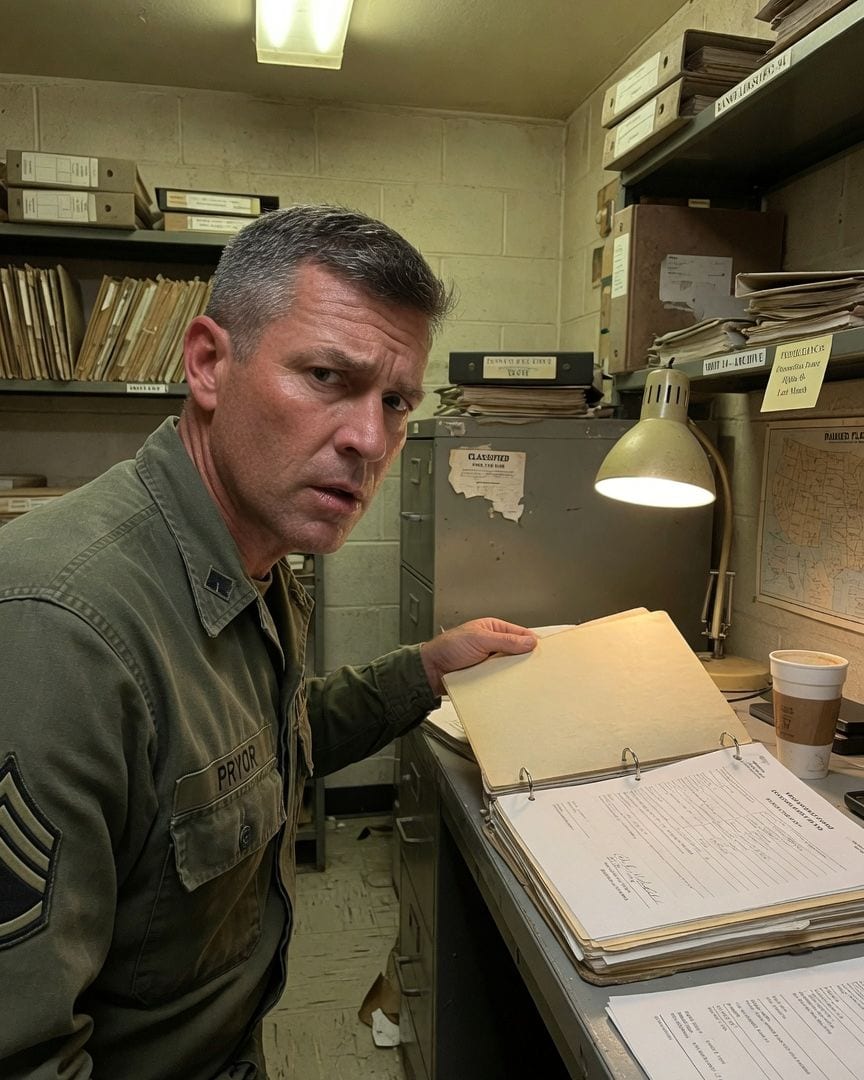
A sergeant with eleven days left finds a warm, glassed crater. Its file shows a captain lost thirty years ago is still signing reports from last week.
Sergeant Alden Pryor was counting down his final eleven days on a twenty-year hitch, expecting to spend them on routine patrols along the Ranier Flats fence line. Instead, his truck stopped at a bizarre sight: a four-hundred-foot glassed crater, miles from anywhere, its sand faintly warm at dawn despite no one recalling a blast. The air above it shimmered with an unnatural distortion, a silent scar of erased violence, and the official file for 'Shot 14' showed recent maintenance sign-offs for a decommissioned tower at the crater site. All these active documents were signed by Captain Everett Caldwell, who had been officially lost in operations thirty years ago, leaving Sergeant Pryor to wonder how a dead man could still be filing reports.
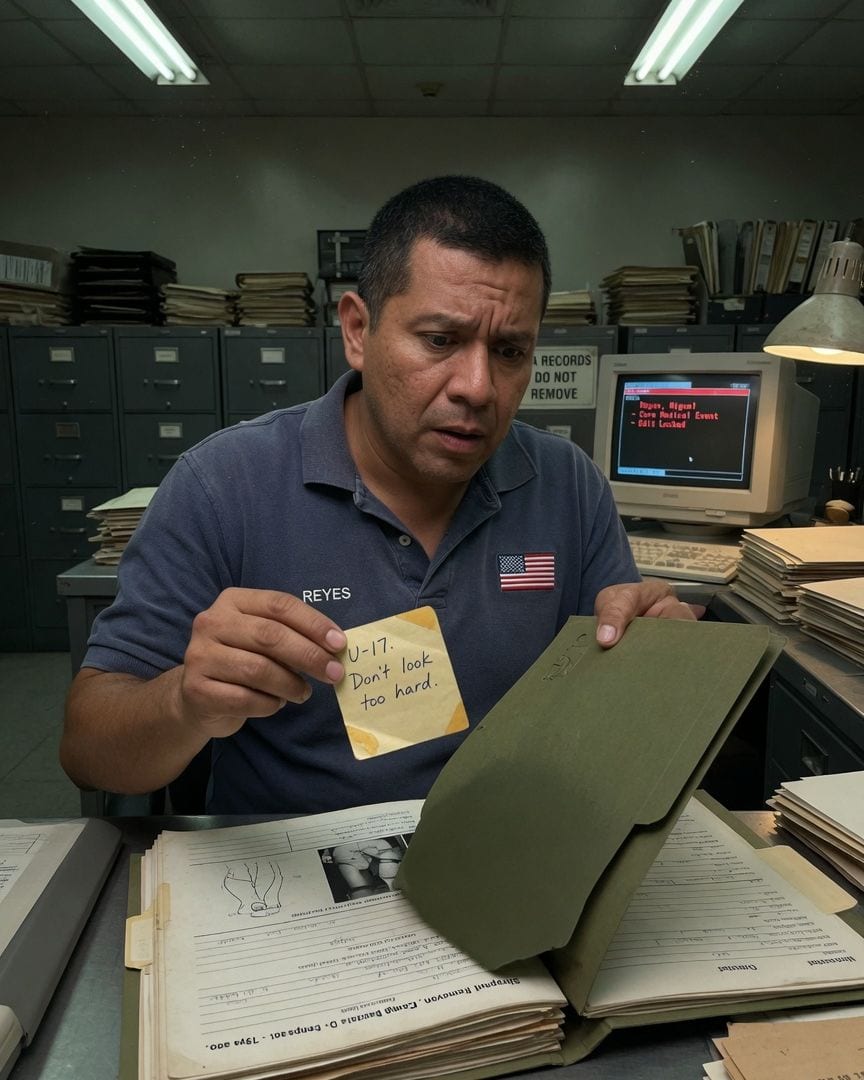
A veteran's medical record details a shrapnel wound his body never had. Taped to the report: 'U-17. Don't look too hard.'
Miguel Reyes, a veteran seeking relief for an old running injury, found his routine VA visit take a chilling turn. His medical file claimed a shrapnel wound and surgery from thirteen years prior, but his leg bore no scar, no mark of the supposed incident. Despite the detailed digital and paper records, his body swore the event never happened. As he pressed for answers, a hidden, yellowed note taped inside the official report surfaced, scrawled with two words: "U-17. Don't look too hard." The sterile clinic air suddenly felt cold and thick, suggesting a truth far darker than a simple clerical error.
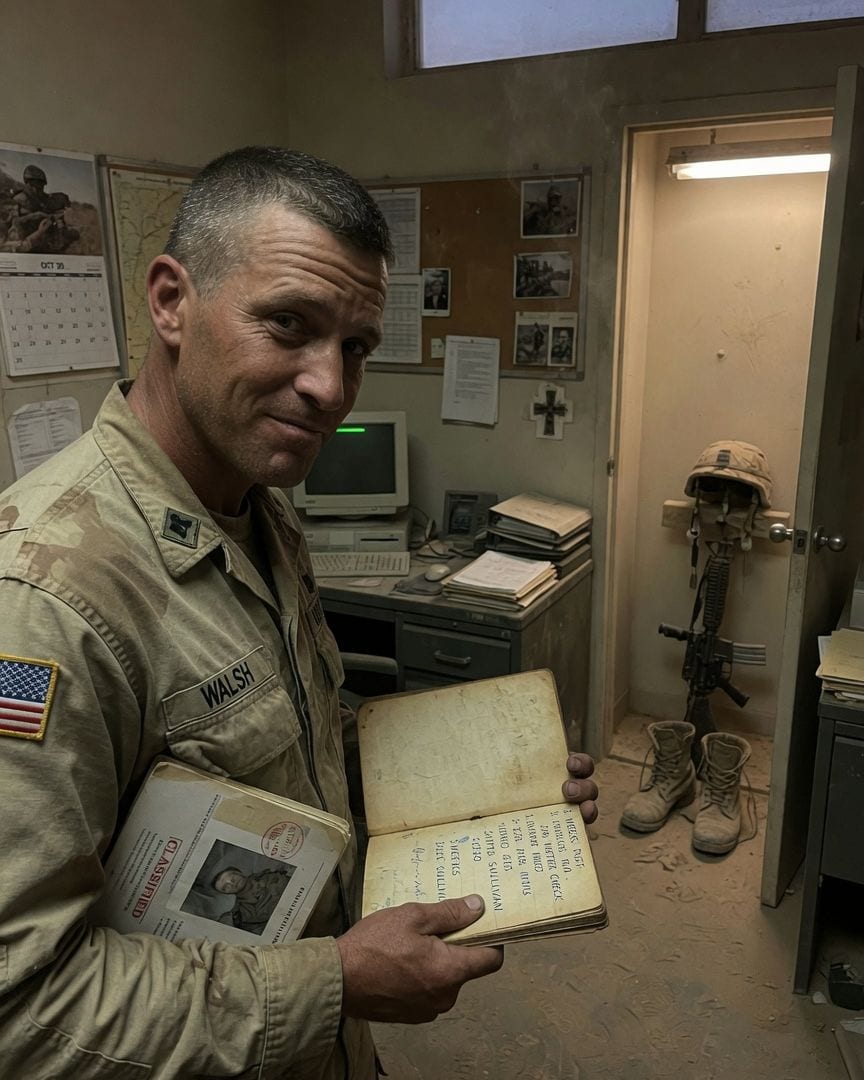
A Staff Sergeant watched combat boots reappear at the memorial each dawn, their soles deepening with scuffs that no living soldier made.
Staff Sergeant Raymond Walsh walked his routine patrol at FOB Kestrel, passing the memorial alcove where a battle cross stood reverently. The quiet space held a pair of worn boots at its base, a detail Raymond first dismissed as a sophomoric prank. But each dawn, the same combat boots reappeared at the memorial, their laces open, showing fresh scuffs and deepening wear inconsistent with any living soldier’s duties. Raymond's rational mind struggled as the boots defied logic, mirroring the growing dread of Private Marsh, who swore they never left his locker. Why did these boots keep returning, carrying the marks of impossible journeys?