On his last Friday, an archivist finds his dead father's pocket watch in a Cold War ghost unit's file, ticking and warm.
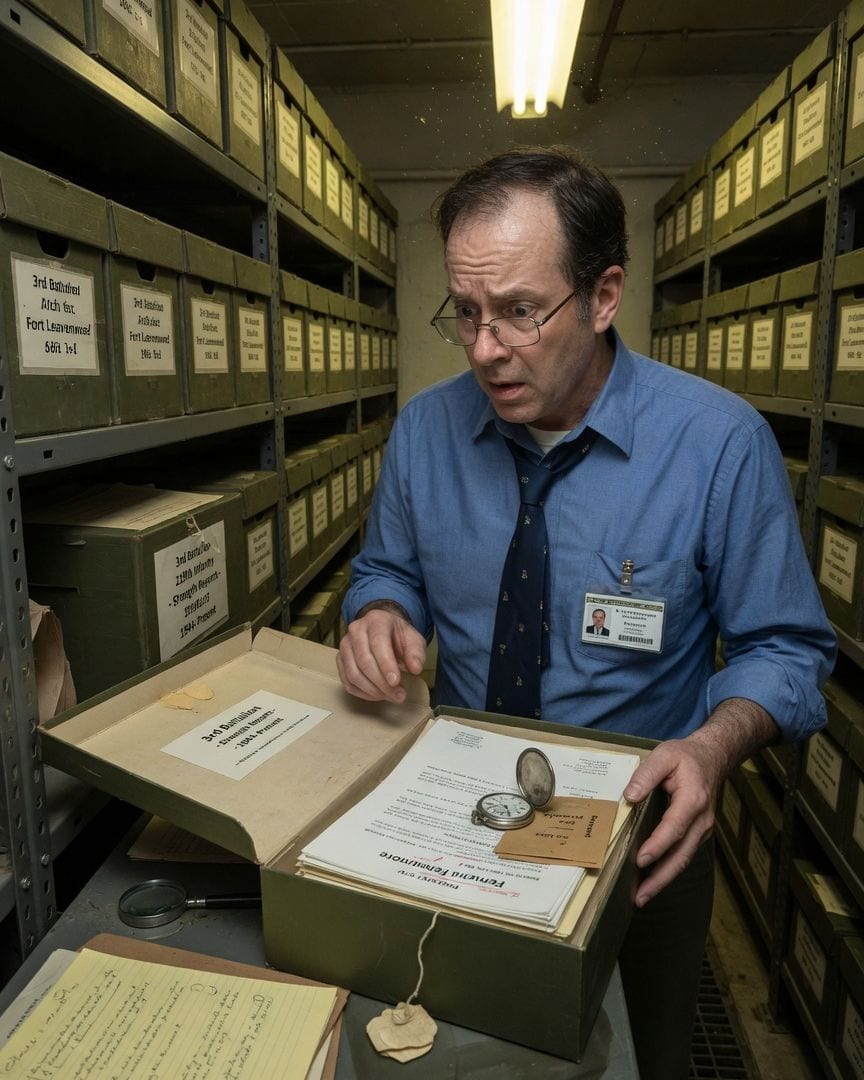
On his last Friday at Fort Leavenwood's lineage vault, Marcus Fennimore, a meticulous archivist of thirty-one years, found a shelf he had never shelved. He knew the vault’s layout intimately, every steel bay, every labeled box.
Yet, here they were: twenty-two dust-sealed boxes, uniform in their faded olive-green, bearing the stark black stenciled designation, '3rd Battalion, 219th Infantry.' Marcus knew this unit.
Or rather, he knew it didn't exist—no activation order, no colors, no roster in any official record he had ever cross-referenced.
He pulled the first box, the seal crackling with age, and opened it. Inside, neatly arrayed, was a complete set of monthly strength reports. They ran from 1944, right up to just last month.
He leafed through them, the paper rustling, each report typed with a crisp, unfamiliar precision, consistent in its formatting.
The most recent report, sitting atop the stack, was on paper with a faint, almost invisible watermark he recognized: a specific mill that had closed its doors in 1961. It listed ninety-one men 'present for duty' and one 'absent.'
Marcus’s gaze snagged on the absentee’s name. Kenneth Fennimore. He felt a cold, physical knot tighten in his chest. His father.
Marcus spent the rest of his Friday, and then his entire weekend, consumed by the anomaly. The vault, usually a place of quiet order, now hummed with an unsettling riddle.
He meticulously cross-referenced every official military database, every historical record, every archived unit roster for '3rd Battalion, 219th Infantry.' He found nothing. It was a ghost unit, a bureaucratic phantom that had never been.
He then focused on the paper itself, pulling several reports from across the decades.
The 1961 watermark was genuine, he confirmed with an old contact in military procurement, but the paper for the more recent reports was far too pristine for its age, especially for documents supposedly handled monthly for eighty years.
It felt fresh, almost new. He pulled his father’s service record from the main archives: Kenneth Fennimore, honorably discharged, deceased decades ago. The dates of his father’s service did not overlap with 1944, let alone 'last month.'
Marcus tried to force a mundane explanation—a prolonged clerical error, a sophisticated hoax, a forgotten training exercise never formally recorded.
But the sheer volume of reports, their consistent format over eighty years, the precise typing, the official-looking stamps, all defied simple dismissal. This wasn't a mistake; it was a system. A meticulous, self-contained system.
He kept returning to the most recent report, his father’s name a fresh wound on the page, the impossible date gnawing at his rationality. The cold certainty settled over him: something was profoundly wrong here.
Marcus pulled one of the earliest folders marked 'Personnel Effects' from the 1944 reports, expecting dust and empty forms. The heavy metal drawer groaned as he slid it open.
Instead, nestled within a sealed, brown envelope, he found his father's actual dog tags, tarnished but unmistakable. Beside them lay a worn, silver pocket watch.
He picked up the watch; it was noticeably warm in his hand, a shocking heat despite being sealed for decades in a cold vault.
He brought it to his ear: it was ticking, a soft, steady rhythm that pulsed against his eardrum. As he turned it over, he saw a fresh, sharp engraving on the back, etched recently into the old silver: 'K.F.
- Present for Duty.'
The warm, ticking watch and its impossible inscription left Marcus deeply unsettled. He spent hours trying to find a rational explanation: a trick of the vault's temperature, an antique watch still running on latent energy from its sealed environment.
He wound it, listened to its crisp clicks, but none of it felt right.
He used the watch's serial number to trace its military issue—it was authentic, a standard-issue piece from 1942, but the engraving was clearly unofficial, a crude but sharp addition to the back.
Driven by a growing unease, he began to dig deeper into the vault's most obscure corners, searching for any cross-references to '3rd Battalion, 219th Infantry' or 'Project 219.'
He found faint, heavily redacted mentions in declassified memos from the 1950s, always linked to 'personnel reassignment' or 'deep cover operations' that were never officially concluded.
These mentions were buried within files for completely unrelated units, like a subtle contagion spreading through the archive.
He approached Rosemary Pennington, a sharp junior archivist, requesting her help with cross-referencing digital databases for 'unusual personnel transfers' from the mid-20th century.
He fabricated a story about researching a historical 'lost unit' for a veterans' project, watching her nod enthusiastically.
Rosemary, initially excited by the challenge, began to uncover a chilling pattern: across disparate files from different military branches, personnel initially listed as 'absent without leave' or 'missing in action' were later referenced in unindexed, internal logs related to 'Project 219,' their status quietly changed to 'transferred' or 'present for duty.'
The sheer volume and consistency of these 'reassignments' over decades began to form a horrifying, coherent picture.
Rosemary's findings escalated the dread. She reported strange network activity around their vault's secure servers, noting that someone with higher clearance had been specifically accessing their research logs on 'Project 219.'
One morning, Marcus arrived at his office to find his door slightly ajar, a faint, metallic scent like ozone lingering in the air. Nothing appeared disturbed, but the subtle violation prickled his skin, a visceral sense of being watched.
Later, a note appeared on his desk, placed precisely in the center of his blotter.
It was typed on paper identical to the 1961 watermark he'd found in the boxes, the same crisp, unfamiliar font, stark and unyielding: 'SOME FILES ARE BEST LEFT CLOSED, FENNIMORE. YOUR FATHER KNEW THAT.' The message was clear.
He was no longer just an investigator; he was being watched. The source of the wrongness, the 'secrecy machine,' was aware of his probing.
He felt a cold certainty that the threat was now personal, directly linked to his father's 'absence.'
He tried to call General Davenport, the retired officer whose signature he'd seen on early Project 219 documents, but his calls went straight to voicemail. The silence was louder than any warning.
Marcus finally managed to track down General Wayne Davenport, now living in a quiet retirement community nestled among manicured lawns. The old general, frail but with eyes that still held a disturbing sharpness, initially feigned memory loss regarding Project 219.
Marcus, calm and persistent, laid out his findings: the phantom unit, the impossible dates, the 1961 paper, his father's name. Davenport listened, his expression slowly shifting from vague confusion to an unsettling, almost serene acceptance.
'The 3rd Battalion, 219th Infantry,' Davenport finally admitted, his voice a low, steady murmur, 'is not a unit in the conventional sense, Mr. Fennimore. It's... a holding pattern. A way to process individuals who encounter certain anomalies.'
Marcus pressed, 'Process them how, General? My father was listed as absent last month, but he died decades ago.'
Davenport leaned forward, his gaze direct, unblinking. 'They aren't lost, Mr. Fennimore. Not truly. They're reassigned to a different kind of duty. A duty that requires a certain... disposition. People like your father, they had it.
A quiet aptitude for observation. For detail.' He paused, a faint, humorless smile playing on his lips, a chill seeping into the otherwise warm room. 'The paperwork,' he explained, 'keeps it all neat. Keeps the system running.
And it keeps them from being truly lost. From being truly gone.'
He never elaborated on the 'anomalies' or the 'duty,' but his chilling composure, the casual acceptance of impossible realities, painted a picture far more terrifying than any monster.
Marcus left, the implication echoing in his ears: his father wasn't just 'reassigned,' but was still 'present' somewhere, somehow, within this impossible system, fulfilling a duty no one outside knew.
Shaken by Davenport's unnerving calm, Marcus returned to the vault, a profound sense of urgency washing over him. The general’s words, 'keeps the system running,' resonated with a sinister implication.
He realized the true horror: his father wasn't merely a victim, but possibly an unwilling participant, a cog in an impossible bureaucratic machine.
He strode directly to the 3rd Battalion files, intending to secure them, to expose them to proper authorities.
He reached for the top folder, the one containing the most recent monthly strength report, the one that listed his father as 'absent.' His fingers brushed against something new.
Nestled on top of the stack, pristine and freshly typed, was another monthly strength report. It was for the current month. The paper felt unnervingly cool to the touch.
His eyes scanned the list. Kenneth Fennimore was no longer 'Absent.' He was now listed as 'Present for Duty.' And directly below it, his own name, 'Marcus Fennimore,' was clearly marked 'Absent.'
Marcus's breath hitched, a cold knot tightening in his chest. He looked at the bottom of the page. The signature, bold and precise, was a perfect, unmistakable replica of his own.
Marcus stared at the report, his own forged signature mocking him from the page. He frantically pulled out earlier reports, comparing signatures across the decades. What he'd once dismissed as a 'consistent official hand' now revealed a subtle, terrifying evolution.
Over decades, the signatures shifted, mimicking different styles, yet maintaining an underlying uniformity, a precise, impersonal script. It wasn't one person; it was a process, an influence, an entity that adapted.
Davenport's words, 'The paperwork keeps it all neat… keeps the system running,' clicked into place with sickening clarity. The '3rd Battalion, 219th Infantry' wasn't just a record of the lost; it was a self-sustaining bureaucratic entity.
It processed new personnel not by finding them in some physical sense, but by absorbing those who came too close, those who investigated too deeply.
The 'steady official hand' wasn't human; it was the entity itself, subtly replacing the minds and identities of its administrators, compelling them to continue the filing.
His father, 'present for duty,' was likely one of them, a scribe maintaining the file from wherever he was, a part of the machine, a perpetual archivist of the vanished.
The 1961 watermark, the impossible dates—it was all a facade, a bureaucratic camouflage for an ongoing, insidious operation that consumed its own archivists, turning them into extensions of its endless paperwork.
Marcus clutched the report with his name on it, a desperate urgency overriding his fear. He had to expose this, stop the cycle before it claimed him entirely.
He turned to rush out of the vault, but collided with Rosemary Pennington, who was entering, a stack of files in her arms. She looked at him, her expression initially concerned, then a strange, blank calm settled over her features.
She saw the report in his hand, his agitated state.
'Marcus, what's wrong?' she asked, her voice flat, devoid of its usual warmth, like a record played at the wrong speed.
He tried to explain, thrusting the report at her, pointing at his name under 'Absent,' at the forged signature. Her eyes widened, then narrowed with that same unsettling serenity.
She reached for the file, her movements slow, deliberate, as if she were moving through thick water. 'It's all in order, Marcus,' she said, her voice a monotone, utterly unlike her own. 'Just sign it. It keeps the system running.'
Marcus recoiled, recognizing the same chilling composure he’d seen in Davenport, but now in Rosemary, in this quiet, ordinary archivist. She was already compromised, subtly, by the presence, by the system itself.
He tried to back away, to escape the vault, to get away from her unnerving gaze, but a profound, alien compulsion surged through him.
His own hand, without his conscious command, began to rise, reaching for the pen on his desk. He fought it, every muscle tensing, a silent scream trapped in his throat.
He saw the pen moving, slowly, inexorably, toward the signature line on the report, toward his name under 'Absent.' The 'steady official hand' was now his own, betraying him, ready to complete the final entry.
The next morning, Rosemary Pennington, now with an almost imperceptible tremor in her usually steady hand, reported to the vault manager that Marcus Fennimore had not shown up for his last day. His office was tidy, his personal effects gone.
The 3rd Battalion, 219th Infantry files were perfectly shelved, all twenty-two boxes present and accounted for, untouched. No one questioned the absence.
Rosemary sat at her desk, typing up Marcus Fennimore's final employment termination paperwork. Her fingers paused over the keyboard, hovering for a moment, then moved with a strange, quiet satisfaction.
She opened his personnel file, a thick manila folder filled with decades of meticulously maintained records. With a fresh, precise pen stroke, using the same crisp, unfamiliar ink, she added a small, handwritten note to his record.
'Transferred to Special Project 219.'
Status: Present for Duty.
If this one got to you
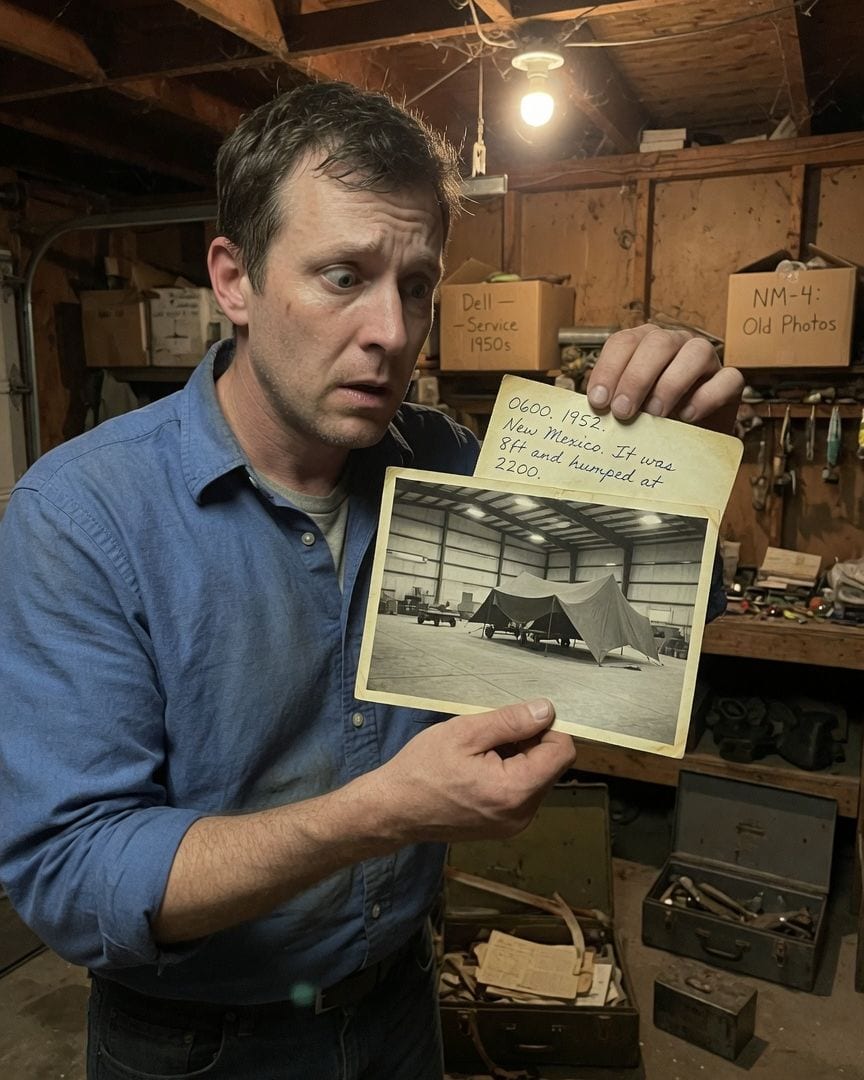
An archivist clears his father's garage, finding a Cold War photo. The object under the tarp has impossible corners, defying his father's own notes.
Franklin Fontaine, an archivist, slowly tackled the mountain of his recently deceased father's life in the dusty garage. Among old photos, he found a grainy image from 1952: a military hangar, and an object under a tarp. The tarp was pulled taut, its lines defining stark, impossible corners that rose far too tall for the cart beneath. His father's own note on the back described the object as '8ft and humped,' a description that stubbornly defied the photograph's impossible height and angles. The image was a physical impossibility, frozen in time, leaving Franklin profoundly disturbed.
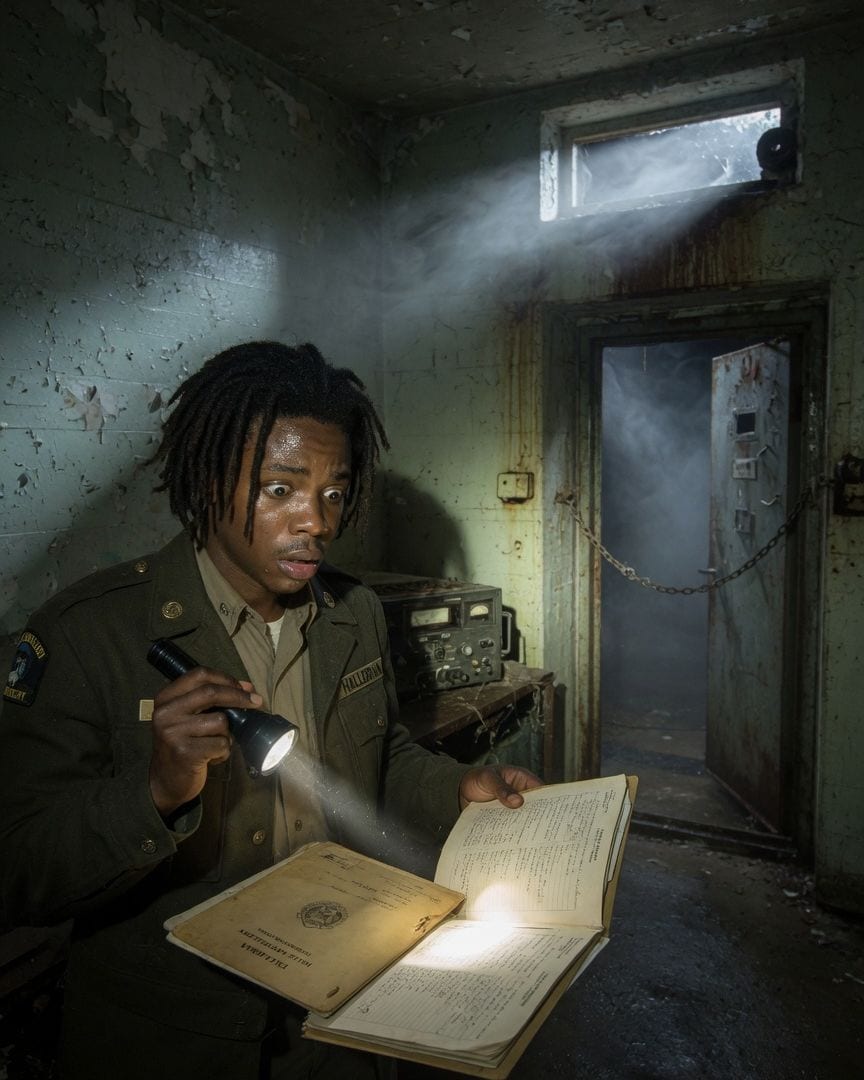
On his last shift, a coast sentry finds his own name signed in fresh ink on a 1943 army record, dated exactly one year ago.
Private Roy Halloran counted the final hours of his last watch behind the searchlight of an old, rust-tinged artillery bunker on the northern California coast. His monotonous graveyard shift was nearly done, and his transfer close, but at 0100, the swirling coastal fog revealed a silent landing party of men on the beach, their gear anachronistic and alien. When dawn burned off the mist, the beach was empty, yet faint drag marks led directly to the bunker’s long-sealed rear hatch, now mysteriously ajar. Inside, amidst the cold, acrid air, he discovered a pristine 1943 army service record bearing his own name. A freshly signed entry dated exactly one year ago to the day left him wondering: had the past somehow reached out to claim him?
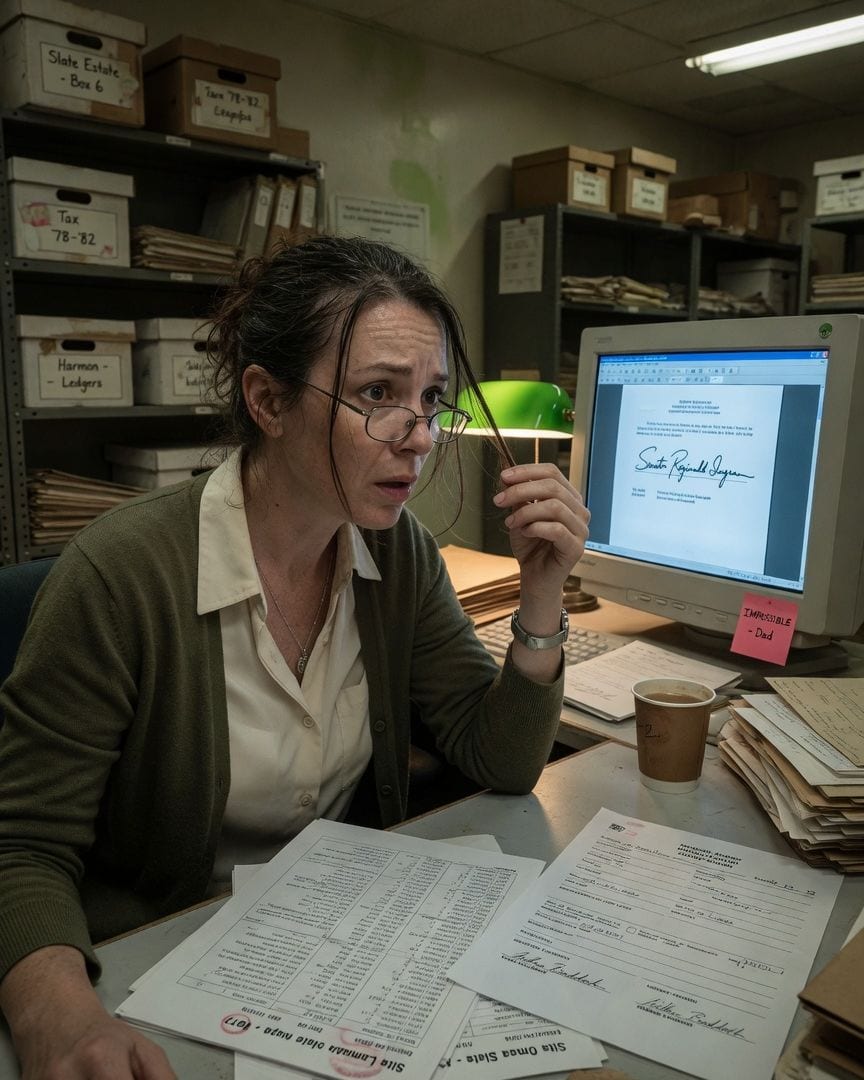
An archivist found her father's signature on a secret 1983 Cold War roster. It listed a senator who died a month before.
Nell Braddock, a meticulous archivist, dedicated her days to the quiet precision of sorting through decades of old papers. Her current task, the estate of Harmon Slate, promised nothing more than mundane accounting until she unearthed a secret operations roster from 1977. The document listed Slate as present at a desert facility, yet hospital records confirmed he was laid up with a broken back at the exact same time. A cold certainty bloomed when she recognized the familiar signature at the bottom of both impossible documents: her own father's. As Nell dug deeper, she found more such anomalies, each bearing her father's unnervingly perfect hand, twisting her reality into something utterly alien.
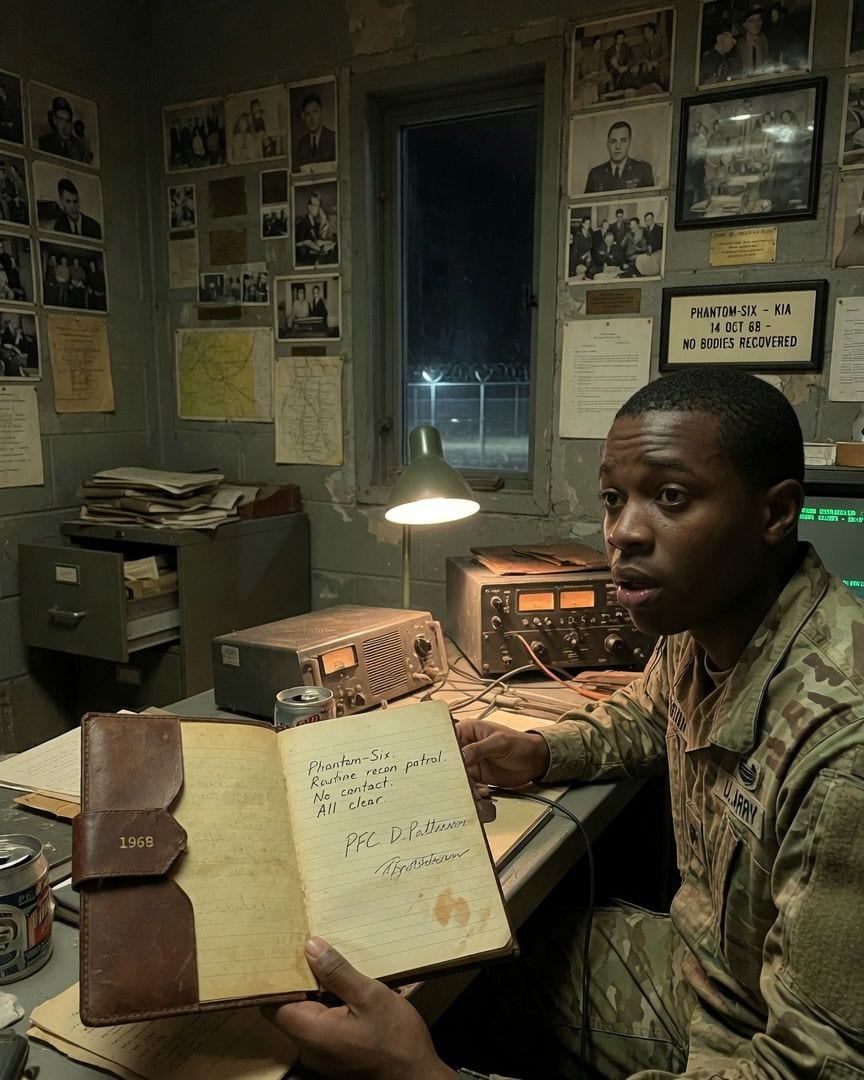
A DMZ specialist finds a 1968 Cold War logbook entry, signed by a lost soldier, its ink shimmering faintly.
Specialist James Farr, on a long night shift at a desolate Korean DMZ outpost, meticulously monitored his console, a squared-away soldier accustomed to the quiet hum of equipment. His focus shattered when a faint, static-laced whisper ghosted from a dead channel, calling out 'Phantom-Six' — a unit lost near this wire in 1968. The urgent voice then specifically mentioned his tower window light, asking him to turn it off before it drew fire. Later, an old logbook from 1968 revealed an entry dated three days *after* Phantom-Six was officially lost, signed by one of the vanished soldiers, its ink subtly shimmering with an unnatural gleam.
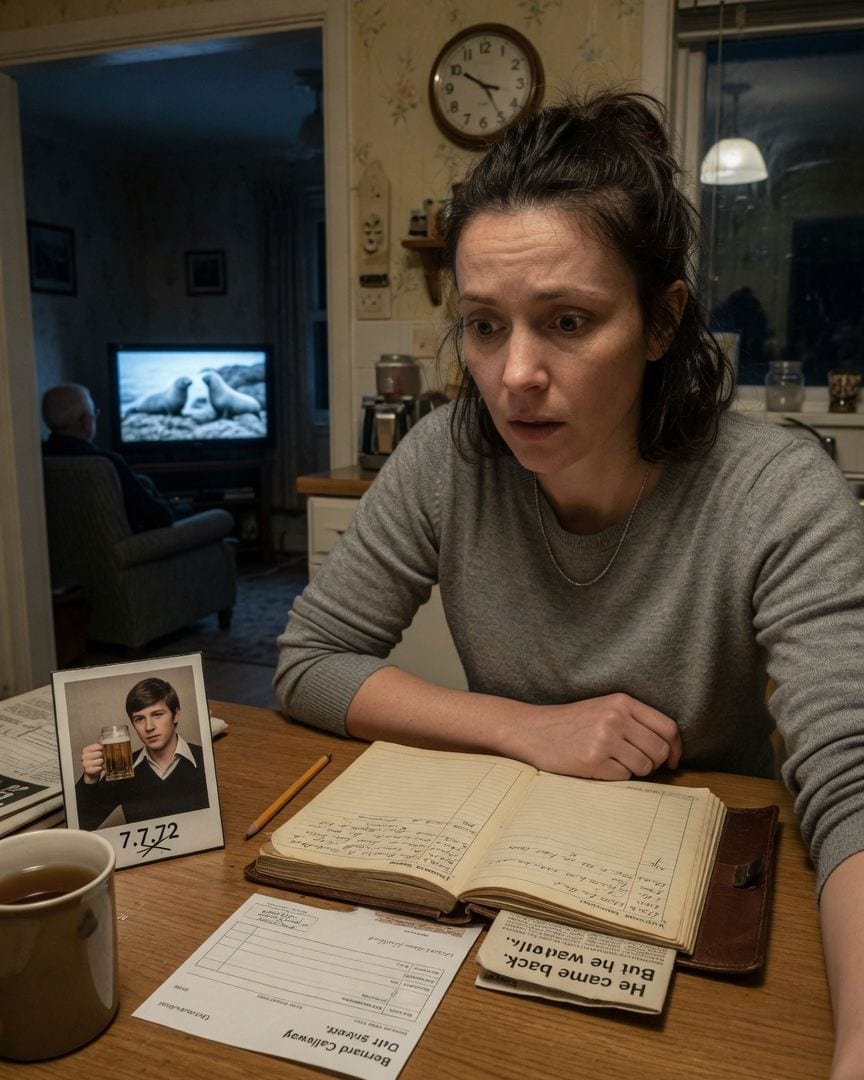
My father's bank slip had uncrossed '7's. He swore he never had that habit.
My father, Bernard, returned three months ago, a miracle after being presumed lost at sea. But a bank statement revealed a disturbing detail: the '7's in his signature were uncrossed. For decades, he'd meticulously crossed every '7', yet now he denied ever having the habit.
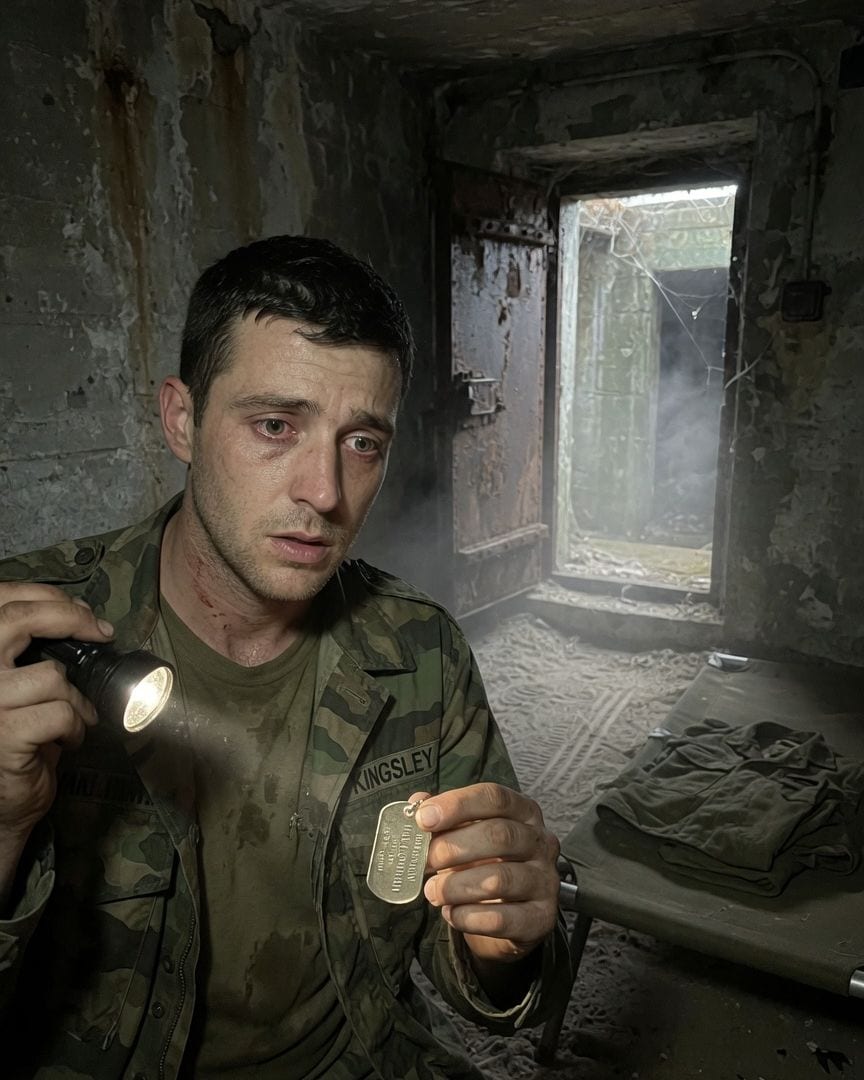
On his final rotation, a Private finds a WWII dog tag for 'Halloran' in a bunker sealed for eighty years.
Private Roland Kingsley endured the bone-deep weariness of his final graveyard watch at a reactivated WWII bunker on the Northern California coast, just hours from dawn and the end of his deployment. His searchlight cut through thick fog, revealing impossible figures: men in archaic WWII uniforms, assembling on the deserted beach, only to vanish moments later. As dawn broke, Kingsley discovered the bunker's rear hatch, sealed for decades, now stood mysteriously ajar. Inside, on an empty cot, lay a WWII-era field jacket, and in its pocket, a dog tag for 'Halloran' — a name impossible to the bunker's eighty-year history. What unseen presence had disturbed the long-sealed past?