On his last shift, a coast sentry finds his own name signed in fresh ink on a 1943 army record, dated exactly one year ago.
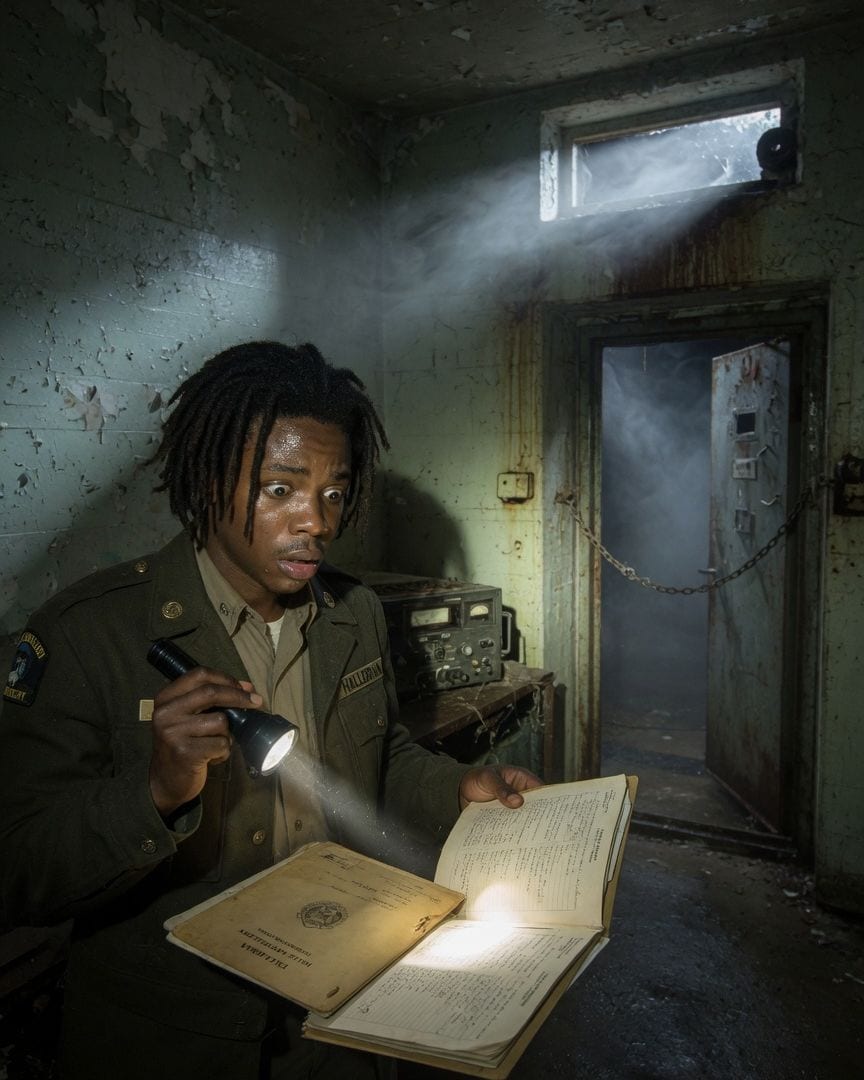
Private Roy Halloran, twenty-three years old and counting the hours until his last watch was done, drew the graveyard shift behind the searchlight at the old northern California coast-artillery bunker.
The air was thick with salt and the metallic tang of rust from the eight-inch guns, long silent. The bunker, a concrete behemoth hunched against the Pacific, felt less like a defense post and more like a tomb.
At precisely 0100, as if on cue, the famous coastal fog began to roll in, a silent, creeping wall that swallowed the beach below.
Roy kept the searchlight’s slow, rhythmic arc sweeping the water, a habit ingrained by months of uneventful duty. It was a monotonous, lonely post, and he was eager for his transfer.
But tonight, the beam caught something in the swirling mist, something that made his breath catch in his throat. Out of the white-gray maw, a landing party began to form on the sand.
Silhouetted figures, indistinct through the fog, but clearly men, standing in formation. Their gear was wrong; not US Army, not Navy, nothing he recognized from any allied or enemy force.
It was bulky, anachronistic, and utterly alien, like something from an old, forgotten war. They simply stood there, waiting.
Roy rubbed his eyes, convinced it was fatigue or the fog playing tricks. He swung the light back, a tight knot of dread beginning to form in his gut.
But they were still there, motionless, their shapes more defined now that his eyes were accustomed to the shifting light.
He watched them, a cold certainty seeping into him that this was no trick, until the fog consumed them again, leaving only the sound of the surf.
When dawn finally burned the fog off, revealing the wet, empty beach, Roy ran a hand over his face, dismissing it as a hallucination brought on by the long night.
But then his eyes caught something else: faint, distinct drag-marks hauled up the beach, leading directly to the bunker’s rusted-shut rear hatch. And the hatch, which hadn't been opened in decades, stood ajar.
Roy Halloran’s training screamed at him to report the open hatch immediately, but a cold, irrational fear held him. The sight of those drag marks, so real and tangible after the spectral figures, had solidified the dread.
He grabbed his service pistol and a flashlight, descending into the bunker's damp, echoing interior, every creak and drip amplified in the sudden silence.
The drag marks ended at the hatch, scuffing the concrete floor as if something heavy had been hauled through.
The air inside was colder, heavier with the smell of damp earth and something else, metallic and faintly acrid, like old blood and ozone. It was a smell he couldn't quite place, but it prickled the hairs on his arms.
He swept his flashlight across the peeling paint and corroded equipment, searching for an intruder, for any explanation. Nothing. The bunker seemed undisturbed, save for the open hatch and the lingering scent.
He checked the old radio console, long dead, its dials frozen in place beneath a film of dust. And there, lying incongruously on its rusted surface, was a pristine, meticulously kept US Army service record.
It was old, yellowed at the edges, but otherwise perfectly preserved, as if it had been placed there moments ago. He picked it up, his gloved fingers tracing the embossed seal.
The name on the cover sent a jolt through him: 'Halloran, Roy, Private.' But the unit listed was long decommissioned, a Coast Artillery battery from 1943. His own name, a year before he’d even enlisted.
He flipped it open, scanning the entries.
Most were standard, detailing transfers and commendations, but one line stood out, typed in a crisp, clean font that seemed impossible for a 1943 document, completely out of sync with the record's age: 'Present for Muster, 0100, 15 SEP 1943.'
A chill ran down his spine. This had to be a prank, an elaborate joke set up by one of the other men, knowing it was his last watch.
But the record felt too real, too meticulously forged, its edges too sharp. And the date… September 15th, 1943. Exactly one year ago to the day, at the same time the fog had rolled in.
Roy tried to rationalize the impossible record, his mind grasping for any mundane explanation. A prop from an old training exercise? A forgotten prank, resurrected for his benefit? But the dread persisted, a cold weight in his chest.
He examined the record again, looking for any clue, any tell in the paper itself. The crispness of the type, the unnatural preservation.
As he gently turned a page, a second, decaying piece of paper, folded and brittle with age, slipped from between the pristine sheets. It was a handwritten roster, faded and difficult to read, titled 'Personnel for Muster.'
The date at the top, scrawled in looping cursive, read '15 SEP 1943.' He scanned the list of names, mostly unfamiliar, until his eyes landed on the very last entry, scrawled beneath the others: 'Roy Halloran.'
The ink of this final entry, unlike the faded script above it, was darker, fresher, as if it had been added far more recently than 1943, almost wet to the touch. Roy’s blood ran cold.
He stood frozen, the papers trembling in his hands, the implications of what he held shattering his rational mind.
Roy stumbled out of the bunker, the anachronistic record and the impossible roster clutched tight. He tried to confide in Captain Carl Galloway, his commanding officer, a gruff but fair man whose face was perpetually etched with fatigue.
Galloway listened patiently to Roy’s wild tale of the landing party and the strange documents, occasionally rubbing his temples. He dismissed it all as 'bunker fever' and 'old debris,' suggesting Roy was overtired and stressed about the decommissioning.
'Those old bunkers collect all sorts of junk, Halloran,' Galloway said, his tone firm but kind. 'Probably some reenactors, or just a trick of the light.'
He even suggested a few days of R&R, a gesture of paternal concern that only deepened Roy’s frustration.
Unsatisfied, Roy decided to investigate on his own, driven by a gnawing certainty that Galloway was wrong. The ink, the dates, the drag marks – they were too specific.
He spent his off-duty hours poring over dusty archives in the base library, sifting through old unit histories and local newspaper microfiches.
He found scattered, vague mentions of 'unexplained transfers' and 'desertions' from the bunker's unit, always occurring during periods of dense coastal fog, always a lone sentry.
The records were sparse, almost deliberately so, with pages missing or redacted, but a chilling pattern emerged: these incidents seemed to recur roughly every twenty to thirty years, often coinciding with specific celestial alignments or unusual tidal patterns noted in obscure meteorological logs.
He found a local newspaper clipping from 1923, yellowed and brittle, reporting on a missing fisherman whose boat was found beached near the headland, with 'unusual drag marks leading up to the old fort.'
Another, from 1898, spoke of a 'phantom company' seen marching from the fog before a lighthouse keeper vanished, leaving only his abandoned lantern. The official explanations were always mundane: foul play, accidents, mental breakdowns.
But to Roy, the coherence was terrifying. He cross-referenced the names from the old roster he’d found with historical manifests, finding several of them listed as 'transferred without trace' or simply 'missing in action' from the bunker's historical records.
The 'count that won't reconcile' wasn't just about his own watch; it was a recurring anomaly, a persistent, impossible addition to the ranks of the vanished.
Driven by his discoveries, Roy returned to the bunker under the cover of night, a portable camera slung over his shoulder. He needed proof.
The air was still and heavy, the fog already beginning to creep inland, clinging to the cypress trees like wet wool. He bypassed the main entrance, heading straight for the rear hatch.
It was closed now, rusted shut as it should be, but a faint, almost imperceptible line of fresh rust dust lay on the concrete beneath it, as if it had been forced open and then re-secured, disturbing decades of grime.
He pressed his ear against the cold metal, hearing nothing but the distant drone of the surf, a mournful whisper.
Then, from deep within the bunker, he heard it: a faint, rhythmic thudding, like the slow, heavy cadence of marching boots on concrete, echoing from a place that should be empty, utterly silent.
He shone his flashlight into the narrow gap of the hatch, seeing only darkness.
But on the ground, just outside, half-buried in the damp sand, he spotted it: a peculiar, tarnished brass button, unlike any military insignia he’d ever seen, etched with a symbol he couldn't identify – a coiled serpent around a stylized anchor.
It was clearly from the 'unrecognized gear' he’d seen the landing party wearing. He pocketed it, his heart pounding a frantic rhythm against his ribs.
As he backed away, a sudden, sharp crack echoed from inside the bunker, like metal twisting, or something heavy being shifted. He froze, his flashlight beam sweeping the entrance.
A fleeting shadow, too tall, too gaunt, flitted across the darkened opening, just at the edge of his vision, vanishing into the gloom.
He felt an intense, cold sensation, as if he was being watched, not just by an intruder, but by something ancient and patient, something that had been waiting for a very long time.
The fog, now dense and swirling, began to press in around him, obscuring the headland, swallowing the very air.
The faint thudding inside the bunker seemed to quicken, growing louder, more urgent, a steady beat that felt like a drum leading to a terrible parade.
The next morning, Roy confronted Captain Galloway again, the strange button from the bunker clutched in his hand, his voice tight with barely suppressed terror. 'Captain, this isn't a prank. This is real.
This button, the dates, the disappearances… it's all connected.' Galloway, seeing the raw, unadorned fear in Roy's eyes, and recognizing the unusual symbol on the button from some suppressed report he’d glanced at years ago, finally relented.
He sagged in his chair, his movements slow and heavy. 'There's an old story, Halloran,' Galloway began, his voice low, almost a whisper, 'a piece of unit folklore they try to bury. The 'Muster.'
They say it happens when the fog is thickest, when the moon and tide are just right.'
He rose, walked to a locked cabinet in the corner of his office, and pulled out a worn, unmarked file, its manila cover brittle with age. 'They say the bunker isn't just a bunker. It's… a gateway. A fixed point.'
He opened the file, revealing a single, brittle page, covered in cramped, precise script. It also bore a crude, almost child-like drawing of the landing party Roy had seen, their strange gear rendered in stark, unsettling lines.
Beneath it was a meticulous, chilling list of names, each one accompanied by a date and the designation 'Muster.' Galloway pointed to the names. 'These are the 'transfers' and 'desertions' from the old records. They weren't transfers, Halloran.
They were taken.' He traced a finger down the list, names from the 1890s, the 1920s, the 1940s. 'Every twenty, thirty years. Always a lone sentry. Always during the fog, always at 0100.'
Roy recognized several names from his own research, names from the old roster he’d found, the pieces clicking into place with horrifying precision. The anachronistic service record, the impossible roster, the strange button – it all cohered.
The terror wasn't just that something was wrong; it was that it was a patterned, repeating wrongness, a system of disappearance, a cold, indifferent cycle.
Galloway’s finger stopped at the bottom of the list, at a blank line marked 'Next: [Date/Time].' He looked at Roy, his face pale, his eyes filled with a weary, ancient sorrow. 'Nobody knows what they are, or where they go.
Just that they take one, and the count comes out wrong, forever after.'
Roy leaned closer, his eyes fixed on the blank line. 'Next: [Date/Time].' His heart hammered against his ribs, a frantic drum in the sudden silence of the office. He looked at Galloway, a silent question in his eyes.
Galloway swallowed hard, his Adam's apple bobbing, then pointed to the faded, almost invisible pencil marks beneath the blank line. There, scrawled faintly, was '0100, Tonight.' Roy felt a cold, sickening lurch in his stomach.
It wasn't just a pattern; it was an appointment. He traced the faint pencil marks with a trembling finger, his skin crawling. He then looked up at Galloway.
'And my name, Captain…' Galloway’s face was grim, his eyes holding a profound, helpless pity. He reached into the file again, pulling out another brittle sheet.
It was a faded, handwritten log from the bunker, dated 1943, its pages brittle and yellowed. He pointed to a small, almost hidden margin note, barely legible. 'They always leave a placeholder, Halloran.
A trace for the next cycle, for those who know how to look.' And there, scrawled in a familiar hand, the same hand that had written the last entry on the impossible roster, was his own surname: 'Halloran.'
Roy stared at it, his world tilting. His name had been in it all along, a silent, chilling prophecy waiting to be fulfilled. He wasn't just uncovering a truth; he was the next step in its terrible, inescapable cycle.
The distant wail of a foghorn cut through the silence, a mournful, ominous sound that seemed to resonate deep within his bones.
Outside, the first tendrils of the night's fog were already swirling past the window, thick and hungry, reaching for the land.
Roy Halloran returned to the bunker for his graveyard watch, not in uniform, but in his fatigues, carrying his service pistol, his camera, and the strange brass button.
He kept his mind deliberately blank, focusing only on the next action, the next breath.
The fog was a palpable entity now, pressing against the concrete bunker, muffling all sound, making the world feel small and contained, focused entirely on this desolate stretch of coast.
At precisely 0100, the rear hatch, which Galloway had confirmed was welded shut for decades, groaned open with a chilling, metallic shriek that tore through the silence. Roy gripped his pistol, his knuckles white, the cold steel a thin comfort.
The rhythmic thudding started, growing louder, closer, the distinct sound of many feet moving in unison, a slow, inexorable march. Then, through the swirling mist, the landing party formed again on the beach.
This time, Roy didn't just see 'unrecognized gear.'
He saw distinct elements he now recognized from the classified file: a peculiar buckle on one figure's belt, a specific design of boot from a long-lost 1920s uniform, the cut of a tunic from a German U-boat crewman, a gas mask canister from the Great War.
He saw faces, too. Distorted, pale, and unnervingly still, but recognizable. One face, gaunt and hollow-eyed, perfectly matched the faded photograph of a Private from 1943 that Galloway had shown him, the one listed as 'missing without trace.'
These weren't entities from another dimension; they were the previous sentries, returned, now part of the muster, their bodies and gear subtly warped, their eyes reflecting only the swirling, hungry fog. They were waiting for him to join their ranks.
The 'count that won't reconcile' wasn't just a number; it was the addition of one more soul to this impossible, eternal formation.
He realized the 'landing party' wasn't landing; it was forming up, ready to march, and they were one short. They were waiting for Private Roy Halloran.
The landing party began to advance, a silent, shuffling line of figures emerging from the fog, their movements unnervingly precise, like automata.
Roy raised his pistol, but knew it was useless; what would bullets do to a ghost, a pattern, a recurring wrongness? He had to escape, and he had to bring proof, something tangible.
He ran to the searchlight, swinging its massive arc away from the sea and directly onto the advancing figures.
The powerful beam cut through the thick fog, illuminating the grotesque faces of the former sentries, their expressions frozen in a rictus of unnatural calm. For a moment, they faltered, their slow, methodical march breaking.
The intense light seemed to hurt them, or at least disrupt their eerie coherence, making them recoil, their forms shimmering at the edges. As they recoiled, Roy fumbled for his camera, raising it and snapping frantic photos.
The flash momentarily added to the disorienting light, catching the unnatural stillness in their eyes, the archaic details of their gear, the subtle glint of the brass buttons he now knew.
He saw the face of the 1943 Private turn directly towards the lens, an empty, accusing stare that seemed to bore into his very soul. He knew he had only seconds.
He scrambled out of the bunker's main entrance, leaving the searchlight blazing, its beam fixed on the spectral formation, holding them at bay.
The sounds of the 'muster' seemed to echo behind him, a faint, rhythmic thudding that resonated not just in his ears, but in his bones, a beat just out of sync with his own pulse.
He reached his jeep, fumbling with the keys, his hands shaking so violently he almost dropped them into the sand.
He started the engine, throwing the vehicle into reverse and speeding away from the headland, the bunker's searchlight a fading, desperate beacon in his rearview mirror.
He felt a profound, chilling sense of something having latched onto him, a subtle change, a lingering presence that hummed just beneath his skin, as if a part of the fog had taken root.
He had escaped, but a piece of him felt irrevocably altered, his spirit infused with the cold, damp dread of the Muster.
Roy Halloran reported the incident, his account detailed and chillingly coherent, even through his visible terror. Captain Galloway, seeing the haunted look in Roy’s eyes and clutching the strange, anachronistic button Roy had given him, was visibly shaken.
But the photographs Roy had taken, despite his frantic attempts to capture proof, were dismissed by higher command as blurry, underexposed, or the result of 'double exposure' caused by his trembling hands and the thick fog.
They were declared 'inconclusive,' evidence of nothing more than 'visual artifacts and overactive imagination.' Roy was honorably discharged for 'stress-related trauma,' his service record stamped with a mental health evaluation that implied hallucination and instability.
He was explicitly forbidden to speak of the bunker or his 'delusions,' a gag order cloaked in medical terms.
The bunker itself was swiftly and quietly sealed, its rear hatch not just welded but filled with concrete, its guns dismantled, the entire headland declared off-limits under a spurious ecological preservation order.
The 'Muster' was a secret to be buried, its existence denied by the very institution designed to account for everything.
Years later, Roy Halloran lived a quiet life far from the coast, a veteran haunted by unspoken truths.
He kept the strange brass button and the blurred, impossible photographs hidden in a locked box beneath loose floorboards, rarely looking at them, preferring not to stir the memories.
He was a good husband to Renee, a steady, dependable man, but sometimes, he would catch his reflection in a window, or a darkened storefront, and see a flicker of an unfamiliar expression, a subtle, cold stillness in his eyes, a shadow of the faces from the beach.
He sometimes heard the distant, mournful call of a foghorn on certain nights, even inland, miles from any sea, and a faint, rhythmic sound, like marching, would echo in his memory, a beat just out of sync with his own heart.
He knew he had escaped, but the muster had left its mark.
On a cool autumn evening, his wife, Renee, glances at him across the dinner table. 'You're quiet tonight, Roy,' she says gently. He looks up, a faint, wrong little smile playing on his lips.
'Just remembering the old days,' he replies, his voice a little too flat, his gaze unfocused, as if seeing something far away, on a foggy beach.
If this one got to you
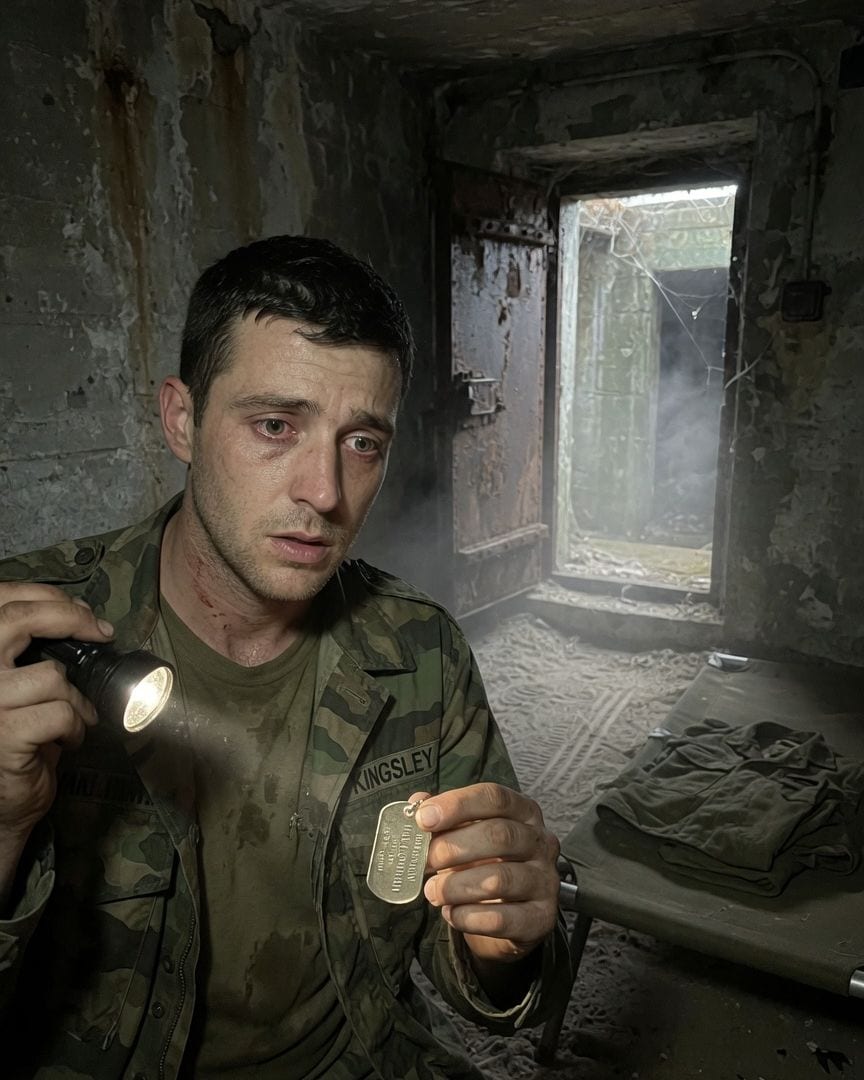
On his final rotation, a Private finds a WWII dog tag for 'Halloran' in a bunker sealed for eighty years.
Private Roland Kingsley endured the bone-deep weariness of his final graveyard watch at a reactivated WWII bunker on the Northern California coast, just hours from dawn and the end of his deployment. His searchlight cut through thick fog, revealing impossible figures: men in archaic WWII uniforms, assembling on the deserted beach, only to vanish moments later. As dawn broke, Kingsley discovered the bunker's rear hatch, sealed for decades, now stood mysteriously ajar. Inside, on an empty cot, lay a WWII-era field jacket, and in its pocket, a dog tag for 'Halloran' — a name impossible to the bunker's eighty-year history. What unseen presence had disturbed the long-sealed past?
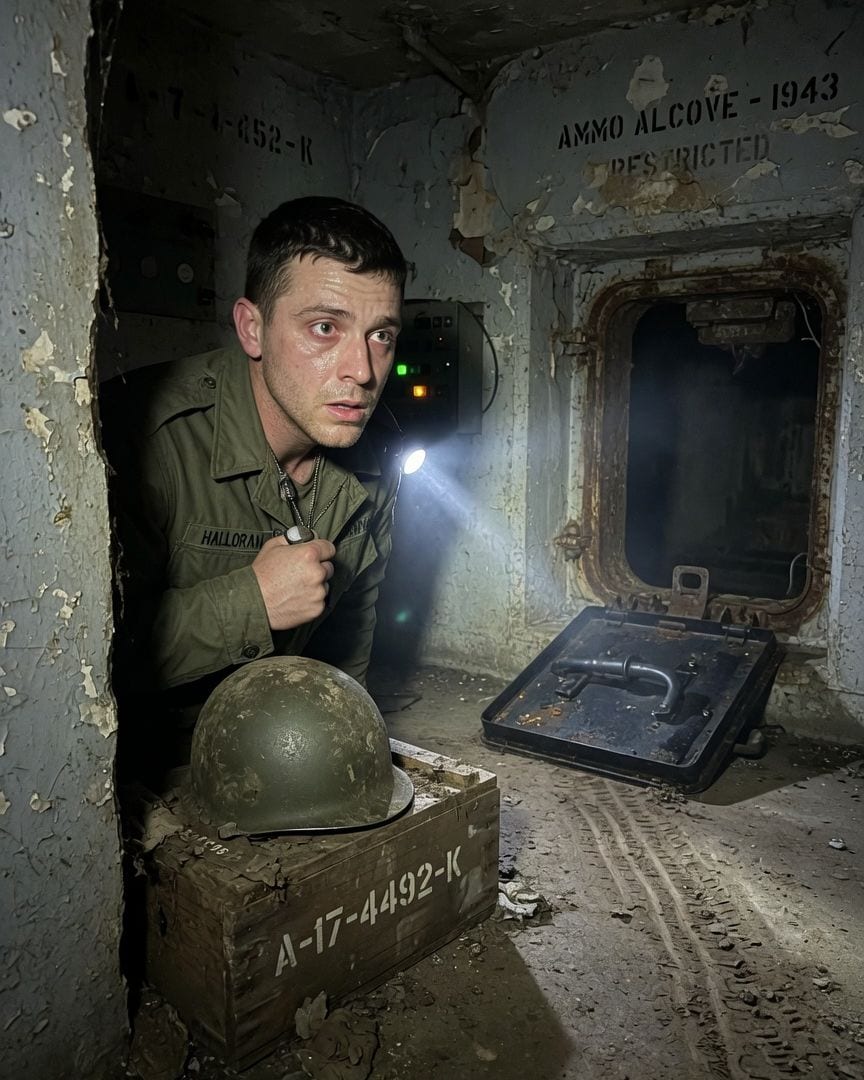
A coastal sentry on his last watch found the bunker's decades-sealed hatch ripped open by impossible strength.
Private Daniel Halloran shivered through his final hours on watch at the old WWII coast-artillery bunker, counting down to his discharge and going home. The pre-dawn fog rolled in thick, and through its swirling white, he watched a landing party form on the beach below, their outdated gear impossibly clean, their forms unmoving. After dawn burned off the mist, the beach was empty, but up the embankment, the bunker's rear hatch—sealed for decades—stood violently ripped open, its locking bar twisted. Inside the dark, silent chambers, Daniel's flashlight found a mud-caked military helmet, unlike any he'd ever seen, bearing a faded serial number that felt sickeningly familiar.
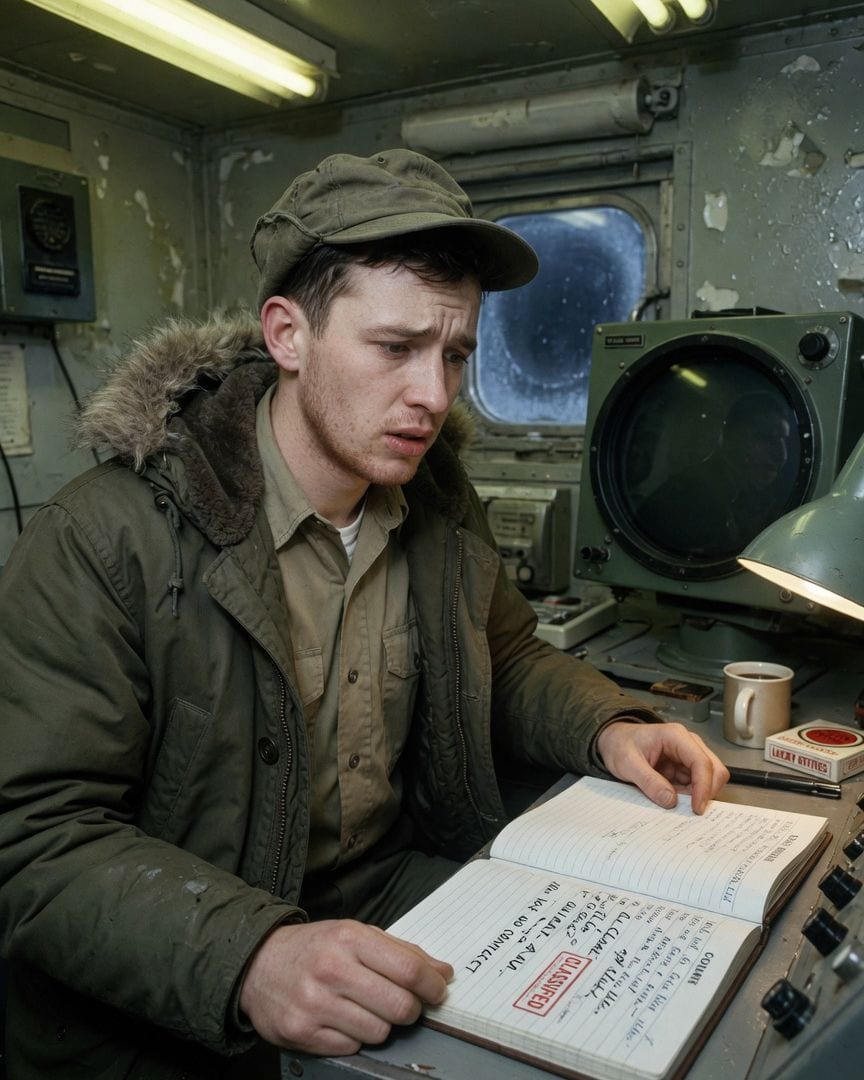
A Cold War airman logs an impossible radar contact on his last sweep. But his official logbook entry is stamped 'CLASSIFIED' and then contradicted by a hastily scrawled 'ALL CLEAR' dated moments before it.
Airman Ordway Vance, 22, manned the radar dome at Site Pellin in the biting North Atlantic dark of January 1962, running the last calibration sweep before its decommissioning. His scope picked up a faint, impossible return, growing closer with each pass, though the ocean remained empty to the eye. When Vance detailed the contact in his official logbook, a 'CLASSIFIED' stamp appeared, followed by a hastily scrawled 'ALL CLEAR' dated moments before his own entry, contradicting his every word. Commander Hartley dismissed it as equipment malfunction, but Vance sensed a chilling, official erasure behind the lie. He soon found a locked cabinet marked 'SITE PELLIN ANOMALIES,' hinting at a deeper truth buried within the base's final days.
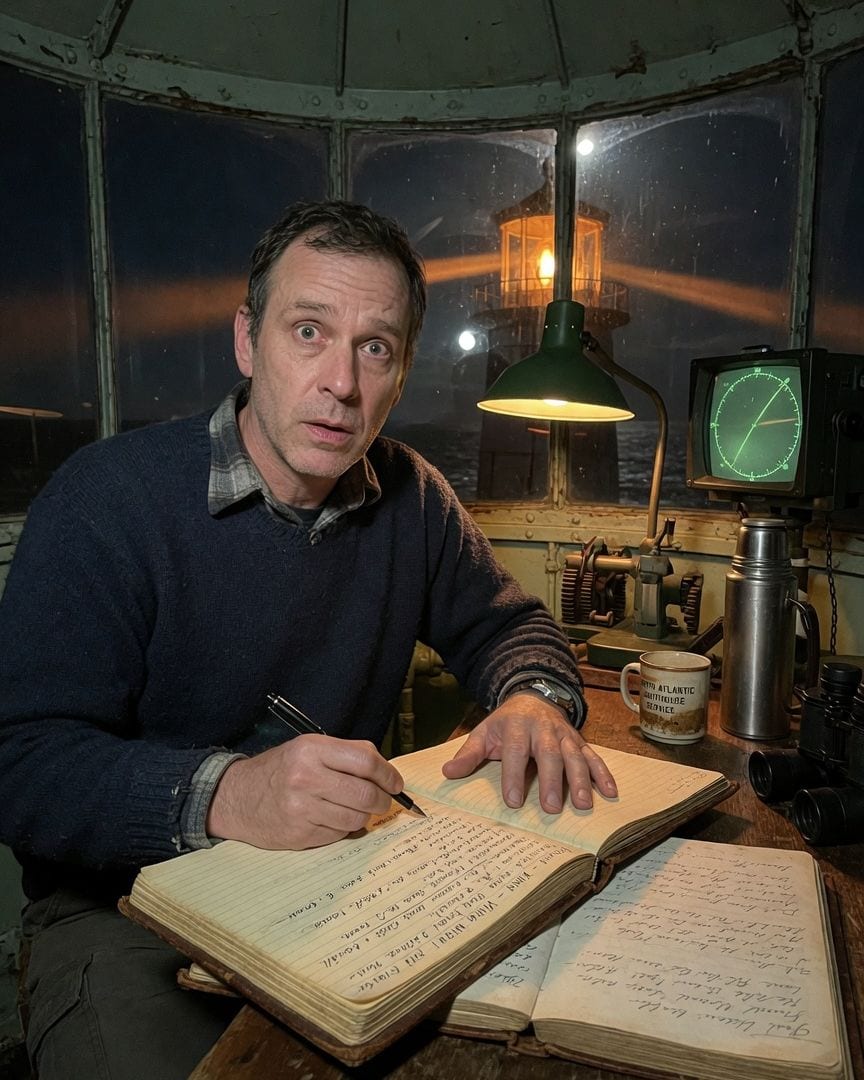
My lighthouse log has my own 3 AM entry for a phantom ship. I was alone in the tower, and I wrote no such thing.
Perched in the lantern room for my usual 2-6 AM watch, I reached for the thick logbook. But the 3:00 AM entry, under my own name, detailed a vessel I never saw. The words were in my own ink, yet I had never written them.
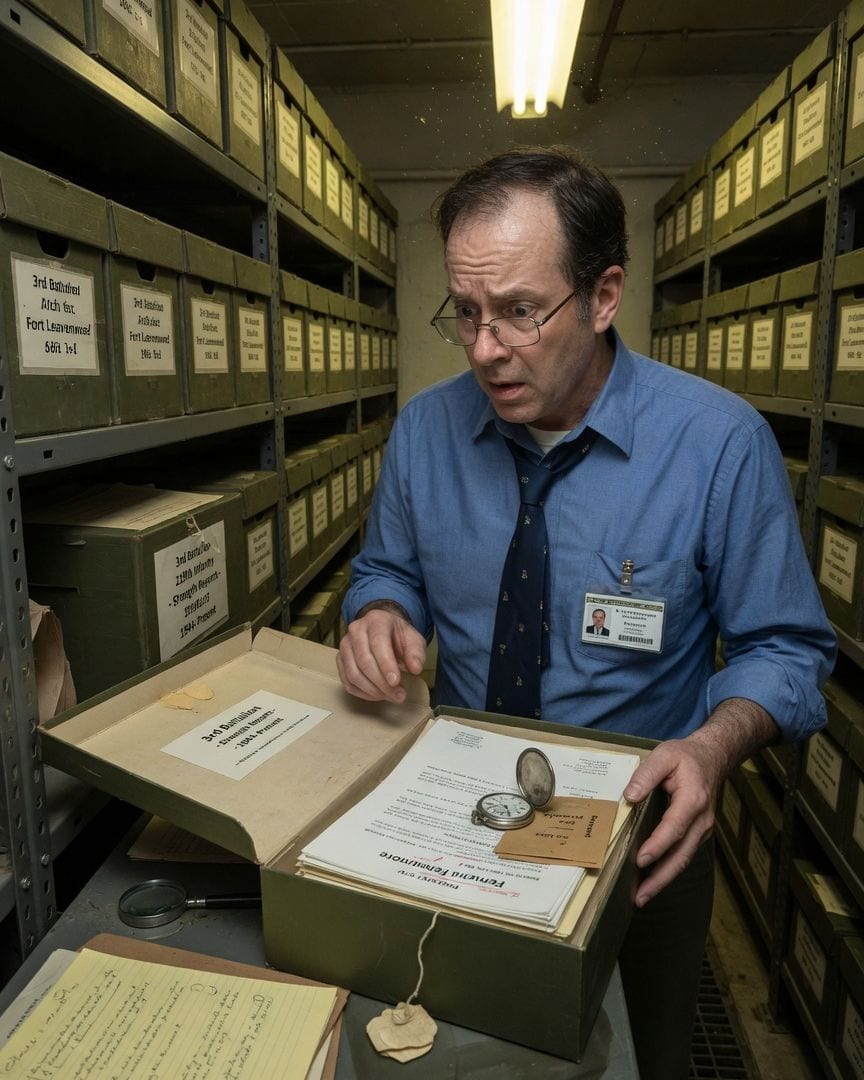
On his last Friday, an archivist finds his dead father's pocket watch in a Cold War ghost unit's file, ticking and warm.
Marcus Fennimore, a meticulous archivist, was on his final Friday at Fort Leavenwood's lineage vault, a place he knew intimately after thirty-one years. He stumbled upon twenty-two dust-sealed boxes for '3rd Battalion, 219th Infantry'—a unit that, according to every official record, simply did not exist. Inside, reports ran from 1944 to just last month, with the most recent listing his long-dead father, Kenneth Fennimore, as 'absent.' Marcus’s own father. Then, from a 1944 folder, he pulled his father's actual dog tags and a silver pocket watch, inexplicably warm and steadily ticking, freshly engraved with 'K.F. - Present for Duty.'
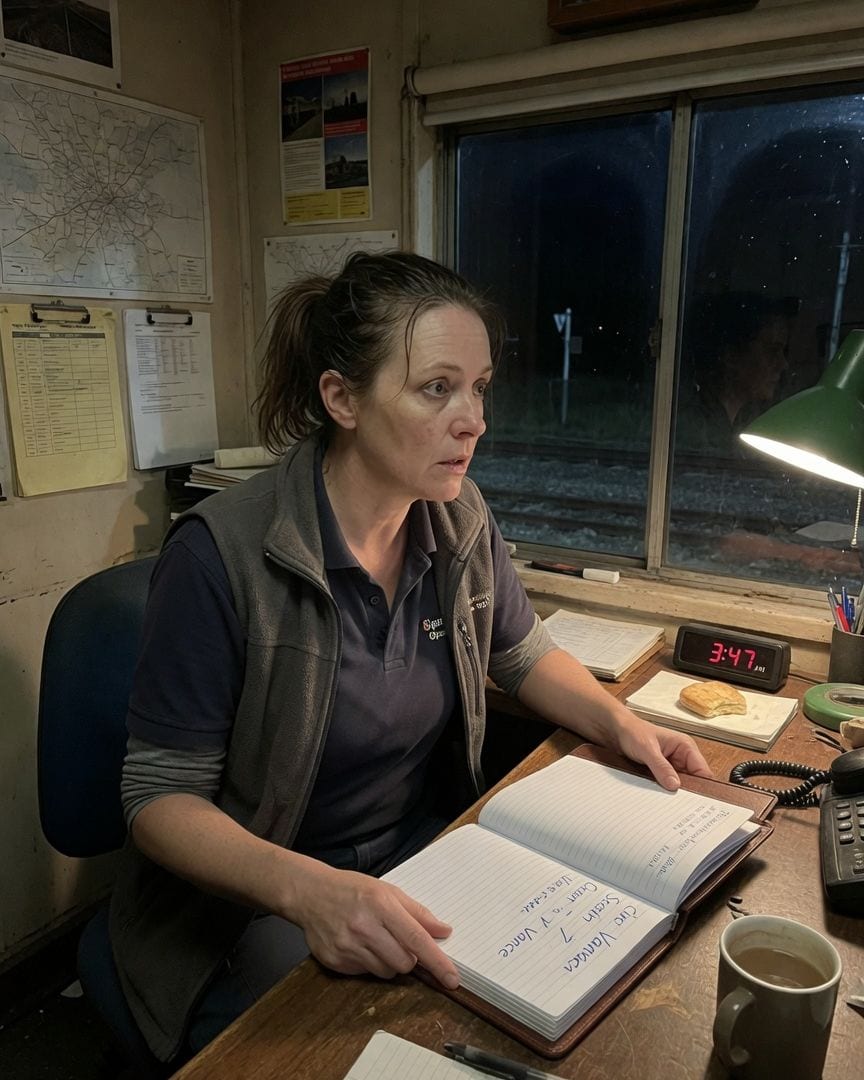
My linesman taps twice on my window at 3 AM. Control says he retired and passed years ago.
My routine at the rural signal cabin was regular: the linesman's double tap on the window at 3 AM. But then my supervisor called, revealing the linesman I knew, Warren Vance, had died five years ago. Now, an impossible entry in my official logbook, with his signature and timestamped from my shift, proves someone else was there.