On Staff Sergeant Doyle's desk sat a Purple Heart citation. Its witnesses had left the service years before the soldier even enlisted.
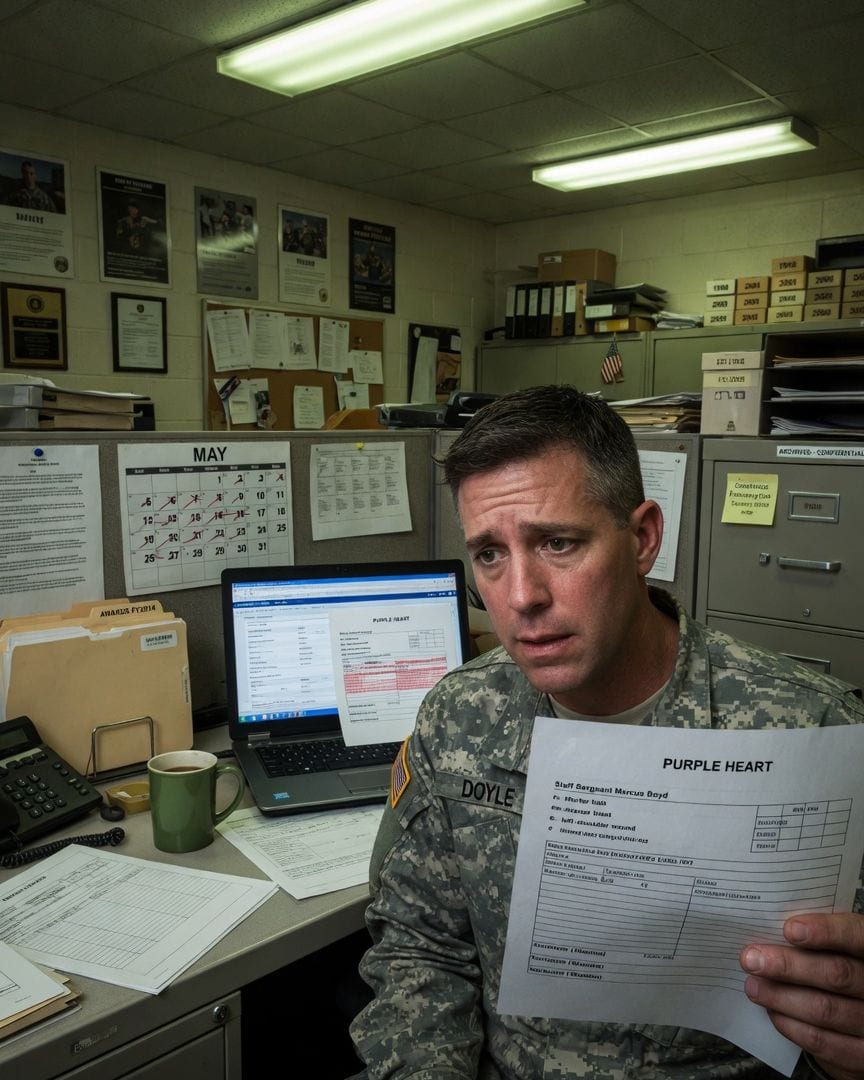
Staff Sergeant Preston Doyle sat at his desk in the rear administrative office of the Fort Knox outpost, the fluorescent lights humming overhead. He was reviewing a stack of awards, a tedious but necessary task before his transfer.
His new posting was weeks away, and he wanted to leave a clean slate. He picked up a Purple Heart citation for Staff Sergeant Marcus Boyd.
The paperwork was immaculate: date of injury, specific grid coordinates for a mortar blast, a wound to the left shoulder, and a list of three witnesses. Doyle read the date again: May 14th, six years ago.
He knew Boyd. Boyd had served at this outpost, sure, but he’d come home without a scratch. Doyle had shared a beer with him at the NCO club the week after Boyd’s return, and Boyd had been in perfect health.
His flight physical two days later had been clean as a whistle. There was no way Boyd had sustained a shoulder injury, much less one serious enough for a Purple Heart.
The citation in Doyle's hand documented a reality that never happened, a physical injury that never manifested, and a medal for a day Boyd spent elsewhere, hale and whole.
The office hummed around him, the mundane sounds of administration suddenly feeling alien against the stark contradiction in his hands.
Doyle tried to dismiss it as a clerical error, a mix-up. It was the only rational explanation. He pulled Boyd's full service record from the digital archives. Everything else was in order: enlistment date, deployments, discharge papers signed months prior.
Boyd was now a civilian, living a quiet life in Indiana. But that Purple Heart citation, with its precise details – the grid coordinates, the specific wound – stood out like a missing tooth in an otherwise perfect smile.
It felt too specific to be a simple mistake, too carefully constructed.
He cross-referenced the names of the witnesses listed on Boyd's citation: Sergeant Leonard Harrington, Specialist Gordon Radcliffe, and Private Annika Vaughn.
A quick search of the personnel database showed all three had separated from the service years before Marcus Boyd had even enlisted. Harrington had left in '98, Radcliffe in '01, Vaughn in '03. Boyd enlisted in '08.
The dates didn't just not match; they were impossible. Doyle felt a cold dread begin to prickle his skin, starting at the nape of his neck and spreading. This wasn't a clerical error.
This was a document that swore a lie, backed by ghost signatures. He secured the file, the fluorescent hum of the office now feeling like a low, incessant whine.
His next stop would have to be the outpost's central records office, a windowless room known for its labyrinthine archives and the formidable Records Officer, Constance Pennington.
Constance Pennington, a woman with a no-nonsense demeanor and a steel-trap memory for regulations, listened to Doyle's account with a tight expression. She pulled up the digital archive for the outpost's commendations, her fingers flying across the keyboard.
“Anomalies happen, Staff Sergeant,” she’d said, her voice dry, dismissive. “Sometimes records get… conflated.”
But as she scrolled, her finger paused. Her eyes narrowed, then widened almost imperceptibly. “Wait a minute.” On the screen, a second Purple Heart citation appeared. This one for Private Henry Winslow.
Same outpost, same type of injury—a mortar blast to the shoulder—and eerily similar coordinates, almost to the exact meter. The date, however, was decades earlier. Winslow was listed as KIA. And the witnesses?
Sergeant Leonard Harrington, Specialist Gordon Radcliffe, Private Annika Vaughn. The exact same names. Doyle stared at the screen, the hair rising on his arms. It wasn't just Boyd. This wasn't a mistake.
It was a pattern, repeating across time, with ghosts for witnesses.
Over the next few days, Preston Doyle dove headfirst into the outpost's archives.
The humming fluorescent lights of his administrative office seemed to press in on him, the silence between his searches punctuated only by the distant, rhythmic thud of artillery practice.
He requested access to every Purple Heart citation issued for personnel assigned to this post, cross-referencing names and dates against enlistment and separation records. The pattern solidified into something horrifyingly coherent.
He found five more citations, all detailing mortar blast injuries, all from different years, some decades apart, but each listing at least one, often all three, of the same impossible witnesses: Harrington, Radcliffe, Vaughn.
These names, attached to events they could never have seen, became a phantom refrain in his mind.
He then started looking for personnel who had simply 'disappeared' or been subject to 'anomalous transfers' around the dates of these citations.
The outpost’s duty logs, usually meticulously kept, sometimes had entries that seemed slightly off — a unit logged out for patrol, then logged back in with one extra man listed, or a name appearing on a manifest for a day they were officially on leave.
These discrepancies were always quickly ‘corrected’ by supplemental paperwork, often signed by officers long since retired or reassigned. He tried to speak to Constance Pennington again, but she became evasive, her usual efficiency replaced by a strained formality.
Her office felt colder than usual, the air thick with unspoken things. “Staff Sergeant Doyle,” she’d said, avoiding his gaze, her hands clasped tightly on her desk, “some things are best left alone. The paperwork is filed. It’s done.”
The finality in her voice sent a shiver down his spine.
Preston’s persistence clearly unsettled Constance. One evening, as he returned to his barracks, the late Kentucky sunset painting the sky in bruised purples, he found a folded piece of paper slipped under his door. No envelope, no name.
Inside, scrawled in block letters, was a single, chilling sentence: 'Don't look for what's already accounted for.' He scanned the barracks hallway, but it was empty, stretching into shadow.
The overhead lights hummed, their glow seeming to dim slightly, and the air felt still, heavy. He checked his six, a prickle of unease crawling up his neck. Was it a prank? A warning? From whom?
The message felt too specific, too tied to the very nature of the impossible records he was unearthing.
Later that night, while reviewing more old unit logs in the quiet of the administrative office, he heard a faint click from the hallway, like a door latch engaging. He froze, listening. Nothing.
Only the distant whine of the outpost's generator and the low hum of the server rack. He told himself it was just the old building settling, the pipes contracting in the cooling night air.
But the feeling of being watched, of being known, persisted. His usual military discipline, his rational mind, struggled to find a mundane explanation for the growing unease. He was no longer just investigating; he was being observed.
The office itself felt like it was holding its breath.
The next morning, Preston confronted Constance Pennington directly. He laid out all the evidence across her worn desk: the seven impossible Purple Heart citations, the recurring ghost witnesses, the anomalous transfers that always ended with 'corrective documentation.'
He pushed the unsigned note he’d found under his door towards her. “This isn’t just a clerical error, Ms. Pennington,” he stated, his voice low but firm, the quiet of the records office amplifying his words.
“This is a systemic fabrication. What is going on here?”
Constance’s composure finally cracked. Her shoulders slumped. She looked around the empty records office, at the towering shelves of files, then lowered her voice, a whisper that barely cleared the static of the fluorescent light.
“There’s… a history to this place, Staff Sergeant. A quirk.” She walked over to a locked filing cabinet, one he’d never seen opened.
She pulled out a key from a hidden compartment behind a loose brick in the wall, a secret almost perfectly concealed, and retrieved a slim, red-tabbed folder. “This is classified. Level Black.”
Inside was a single, faded memo, dated 1974. The header read: 'Operational Addendum: Fort Knox Outpost – Personnel Discrepancies and Reconciliation Protocols.' Preston read, his eyes widening, the words blurring, then sharpening into stark meaning.
The memo detailed 'unexplained personnel divergences' – soldiers appearing on rosters who weren't physically present, or missing from formations despite being logged in. It described 'phantom deployments' and 'unaccounted-for absences.'
The chilling part was the solution: these discrepancies were to be 'officially reconciled through corrective documentation.' Fabricated records. Medals, transfers, even KIA statuses, all to account for individuals who simply… ceased to be.
The memo concluded by stating this protocol was ‘to maintain unit cohesion and prevent panic,’ and that it was an ‘ongoing, managed situation.’
The dread that washed over Preston wasn't about a failure of the system; it was that the system hadn't failed. It was working exactly as intended, for decades.
Preston finished reading the memo, his hands trembling. The official explanation was worse than any ghost story he could have imagined. It was a cold, bureaucratic monstrosity, a mechanism designed to swallow men whole.
“This… this means they know,” he whispered, looking at Constance, who now watched him with sad, distant eyes. “They’ve known all along.” She nodded, her face grim. “For generations. The outpost has a way of… making its own accounting.”
As he folded the memo, his gaze fell on a small, handwritten annotation in the margin, scrawled in a different, more recent hand, clearly pencil. It was a list, almost like a roster or a rotation schedule. Names and dates.
He saw Desmond Vaughn, Henry Winslow, Tessa Mitchell… and then, near the bottom, written in bold, stark letters, his own name. 'Doyle, P.' Next to it was an upcoming date, only three weeks away.
And beside his date, in parentheses, was a single name: 'Harrington, L.' Sergeant Leonard Harrington, one of the impossible witnesses on Marcus Boyd’s Purple Heart citation, a man who’d separated from the Army decades before Boyd enlisted.
Preston’s heart hammered against his ribs, a frantic drum. The pattern wasn't just history. It was a prophecy. And he was in it.
Preston slammed the memo down on Constance’s desk, the red-tabbed folder skittering. He pointed a trembling finger at his name, his voice ragged. “What is this? My name. And Harrington? He’s been separated for twenty years!”
Constance flinched, then looked him in the eye, her resolve hardening once more, though her face remained pale. “The outpost, Staff Sergeant, it… accounts for people. It always has. Those ‘witnesses’ like Harrington, Radcliffe, Vaughn – they were the first.
The ones it couldn’t fully erase, so it recycles their names, their identities, to legitimize the next round of disappearances. The Purple Hearts, the transfers, the KIA notices… they’re just the paperwork to explain away what can’t be explained.
The anomaly needs to tie up loose ends, and our system, with its need for accountability, provides the perfect cover.”
Preston felt the blood drain from his face, leaving him cold. “My transfer here… it wasn’t random, was it?” Constance shook her head slowly, her gaze unwavering. “No. Your file has been… building. For years. The system identified you.
Your posting here was just the final step to bring you into its books.” Every clue, every impossible record, every ghost witness, every bureaucratic cover-up, snapped into place with horrifying clarity.
He wasn't just investigating a pattern; he was the next piece in its monstrous design. The realization hit him like a physical blow.
Preston scrambled, his mind racing, a frantic cacophony of fear and desperate strategy. He had to get out. He had to break the pattern before the date on the memo arrived.
He sprinted from the records office, Constance’s grim, knowing face blurring behind him. The hum of the fluorescent lights in the hallway seemed to mock him, a constant, low thrum against his pounding heart.
He burst into the barracks, grabbed his pack, shoving essentials inside without thought, and headed for the main gate.
The sentry, a young Private named Tessa Mitchell, saluted as he approached, her expression blank and professional. “Staff Sergeant Doyle, sir. On duty?” Preston nodded, trying to keep his voice steady, to project an air of routine.
“Just a quick run into town, Private. Forgot something.” Tessa consulted a clipboard, her finger running down a list. “Sir, your manifest shows you assigned to Perimeter Patrol Sector 7, starting now. Sergeant Radcliffe is expecting you.”
Preston’s heart sank, a leaden weight in his chest. Sergeant Radcliffe – another impossible name. He tried another gate, then another.
Each time, a different sentry, a different duty roster, but his name was always there, assigned to an impossible task, preventing his exit. The duty rosters, impeccable and unyielding, barred his every attempt.
He pulled out his phone, desperate. He tried to call his old unit, his family.
The calls wouldn't go through, or they routed to a generic, automated 'Fort Knox Operations' line that sounded eerily like his own voice, calm and unconcerned. Panic clawed at his throat, a raw, primal scream trapped in his lungs.
He looked towards the perimeter fence, the last barrier between him and a world that still made sense.
Through the dim, artificial light of the outpost, just beyond the wire, he saw a figure standing silently, partially obscured by the sparse trees. It wore old, faded fatigues, the kind he’d only seen in historical photographs.
Its face was indistinct in the gloom, but the silhouette, lean and unmoving, was hauntingly familiar. It was the same figure he’d seen in a faded photograph of Sergeant Leonard Harrington.
The figure slowly raised a hand, beckoning him, a silent, chilling invitation. Preston stumbled back, every fiber of his being screaming a silent, desperate NO. He was already accounted for.
Staff Sergeant Preston Doyle’s service record was updated. He was officially listed as 'transferred to classified duties,' with a commendation for a mission nobody at the outpost could recall.
His bunk was stripped, his gear packed and shipped to an unknown location. His presence at the post was efficiently erased, replaced by new paperwork, new orders, a new medal.
The anomaly had closed its loop, the meticulous military system providing perfect, unimpeachable documentation for his disappearance.
Months later, Sergeant Nancy Radcliffe, a former colleague from Preston Doyle’s old unit, tried to look him up. His record showed him as 'active duty, deployed,' but the unit and location were redacted, marked 'TOP SECRET.'
She tried calling the number listed for 'Fort Knox Operations,' hoping to track him down. A calm, unbothered voice answered, “Fort Knox Operations, Staff Sergeant Doyle speaking.”
The voice was eerily familiar, yet not quite Preston’s, lacking a certain inflection, a particular lilt she remembered.
“Is that so?”
If this one got to you
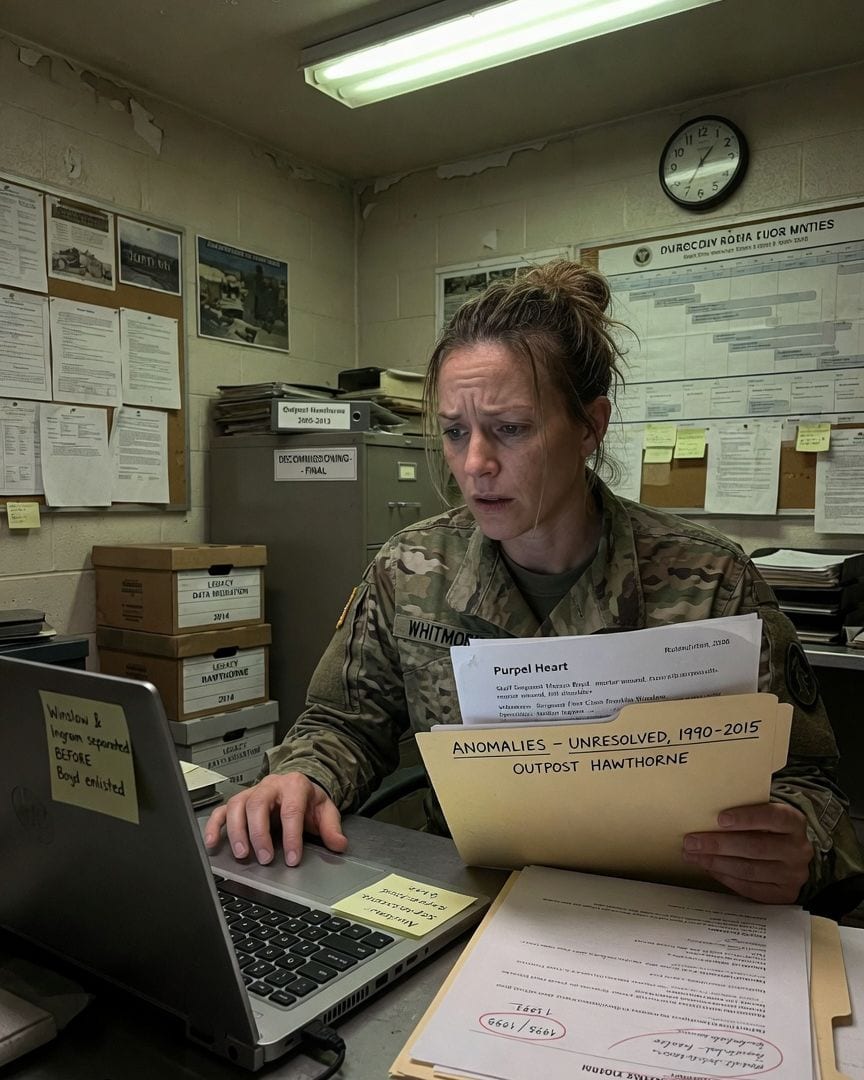
A military captain auditing a Cold War Fort Clay's final roster found a soldier's Purple Heart for a mortar wound. Its witnesses had left the Army years before it happened.
Captain Diane Whitmore, Adjutant for the soon-to-be-decommissioned Fort Clay, meticulously reviewed the final awards roster. Her office, usually bustling, was eerily quiet save for the fluorescent hum as she found an entry for Staff Sergeant Marcus Boyd: a Purple Heart for a mortar wound in 2012. But Boyd had returned unharmed, and the listed witnesses had separated from the Army years before he even enlisted. Colonel Sinclair dismissed it as data corruption, but Whitmore sensed a deeper anomaly, and ignoring a post historian's warning, she found another file from Outpost Hawthorne with the same impossible witnesses. What pattern was buried in Fort Clay's archives?
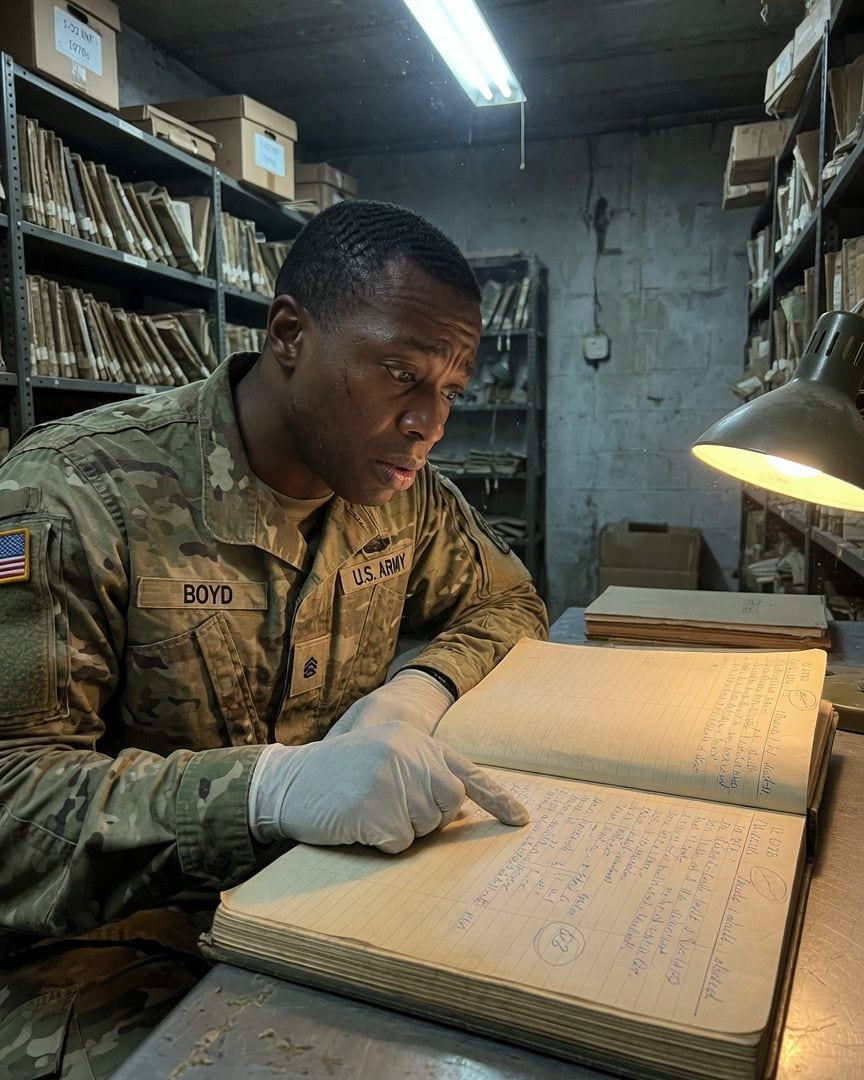
Staff Sergeant Marcus Boyd’s Purple Heart cited a 1978 wound. He wasn't born then, yet the Cold War archive logbook bore his own handwriting.
Staff Sergeant Marcus Boyd, a soldier who valued accountability, faced an impossible Purple Heart citation. It detailed a mortar wound to his left shoulder in 1978, decades before he was even born, yet a phantom ache pulsed where the shrapnel should have been. Dismissed as a glitch, Boyd meticulously traced the paperwork through dusty archives, each document impeccably filed and sworn to the impossible. The deeper he dug, the more coherent the lie became, until he found his own handwriting in a 1978 logbook, documenting a wound he never received.
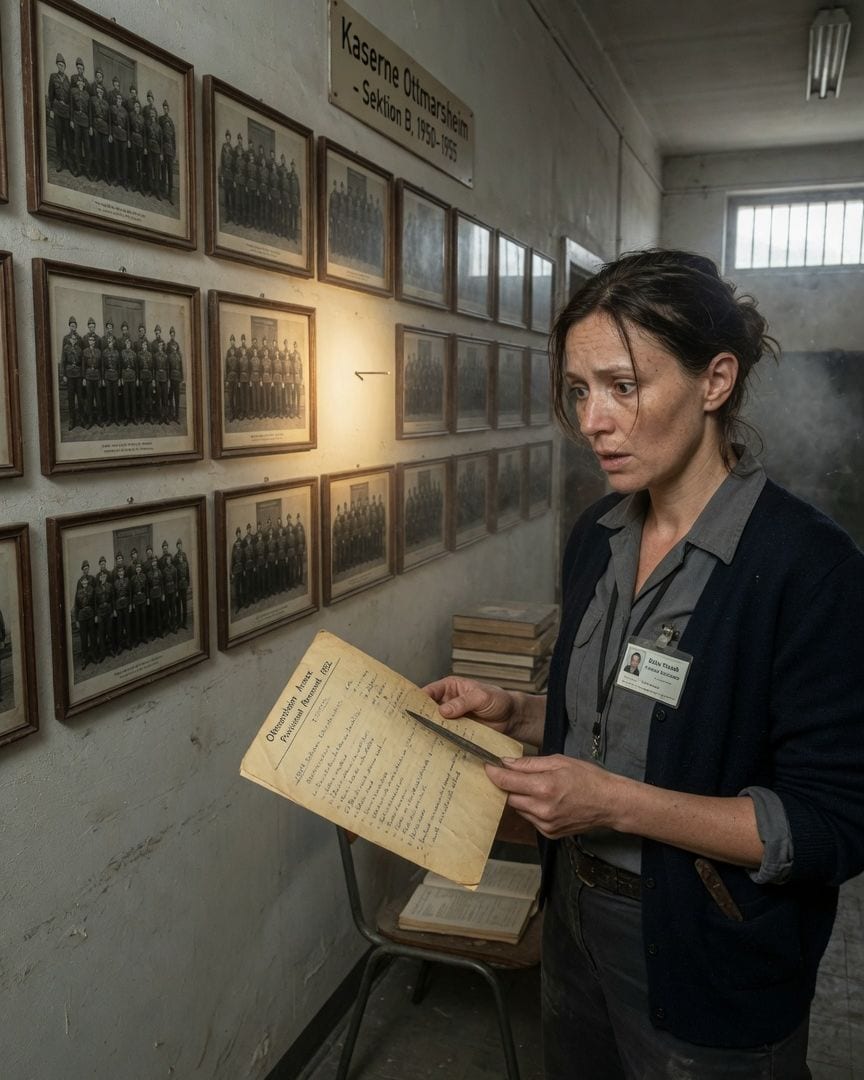
At a Cold War kaserne days from demolition, inventory clerk Delia Straub found a missing photo frame for a unit that never existed. Every soldier on the wall stared directly at its empty space.
Inventory clerk Delia Straub had eleven days to log every item at Kaserne Ottmarsheim before demolition crews arrived, turning history into rubble. Amid the dusty halls, she found a stark anomaly: a missing photo frame for the 604th Ordnance Detachment, a unit never officially stationed at the base. What made the empty space chilling was that every soldier in the surrounding photographs was looking not at the camera, but directly into that void. Delia's search for answers unearthed an unofficial manifest listing the 604th, with names of men officially declared killed in action years before. Who were these phantom soldiers, and why did their impossible record persist?
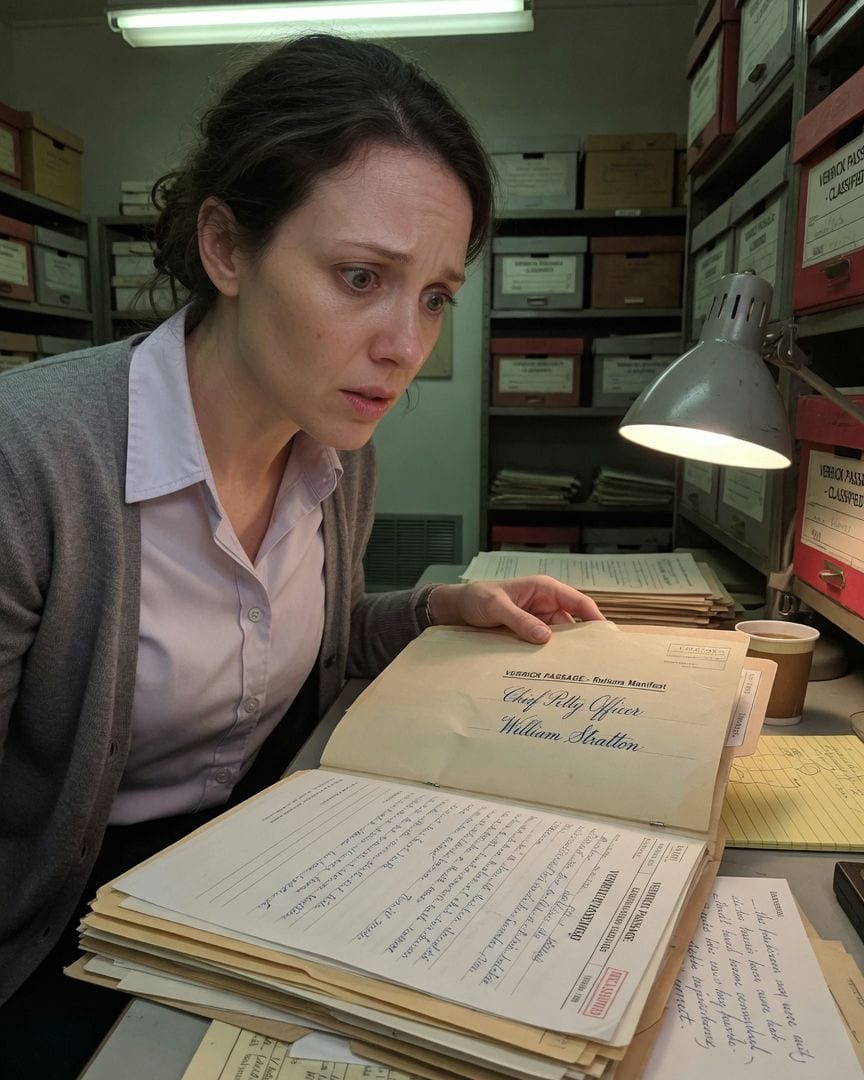
A records reviewer found personnel files for men lost 80 years ago, still being signed in an identical, perfect hand.
In the sterile hush of the declassified archives, meticulous reviewer Ione Fash had a routine task: cross-referencing witness statements from the Verrick Passage file. But as she reviewed files eighty years thick with official silence, she found nine separate interviews containing the exact same chilling sentence, all in an identical, precise hand. Her rational mind sought explanation, yet then she discovered something worse: personnel files for men lost in 1943, still being updated with modern requisitions and payroll runs. Each impossible entry, including a manifest signed just two weeks ago by a casualty from eighty years prior, bore the same unnervingly perfect signature. The file wasn't just a record of the lost; it was still being signed.
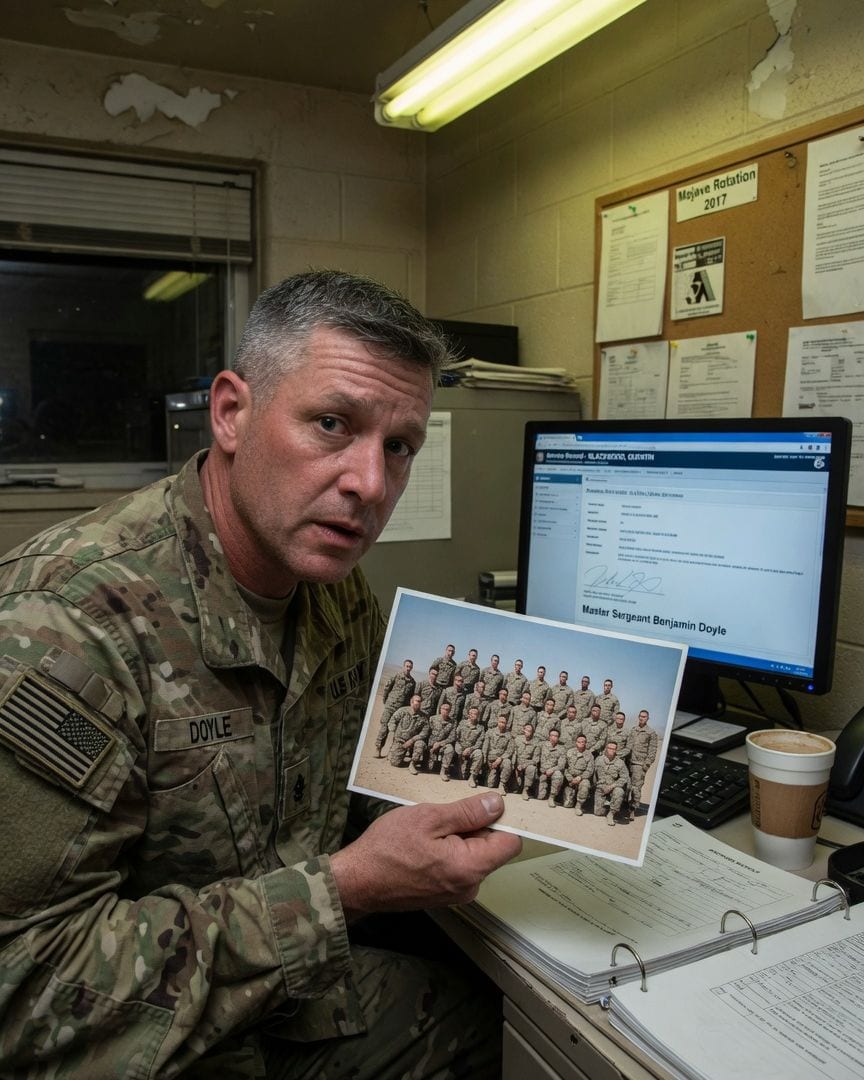
Master Sergeant Doyle found his own signature on a soldier’s commendation he knew he never signed.
Master Sergeant Benjamin Doyle, a man whose life was built on precise manifests and head counts, maintained a quiet daily ritual: glancing at his Mojave rotation platoon photo. One morning, the familiar thirty-one faces stared back with an impossible addition: an extra man, grinning between Suggs and Ramos, a face he and his colleagues recognized but couldn't place. His search through official digital rosters yielded nothing, yet old physical logs, signed in his own hand, confirmed the phantom soldier’s presence on a dangerous patrol he couldn't recall. The ultimate blow came with a valor citation for this same soldier, bearing Master Sergeant Doyle’s own digital signature for an award he knew he never certified.
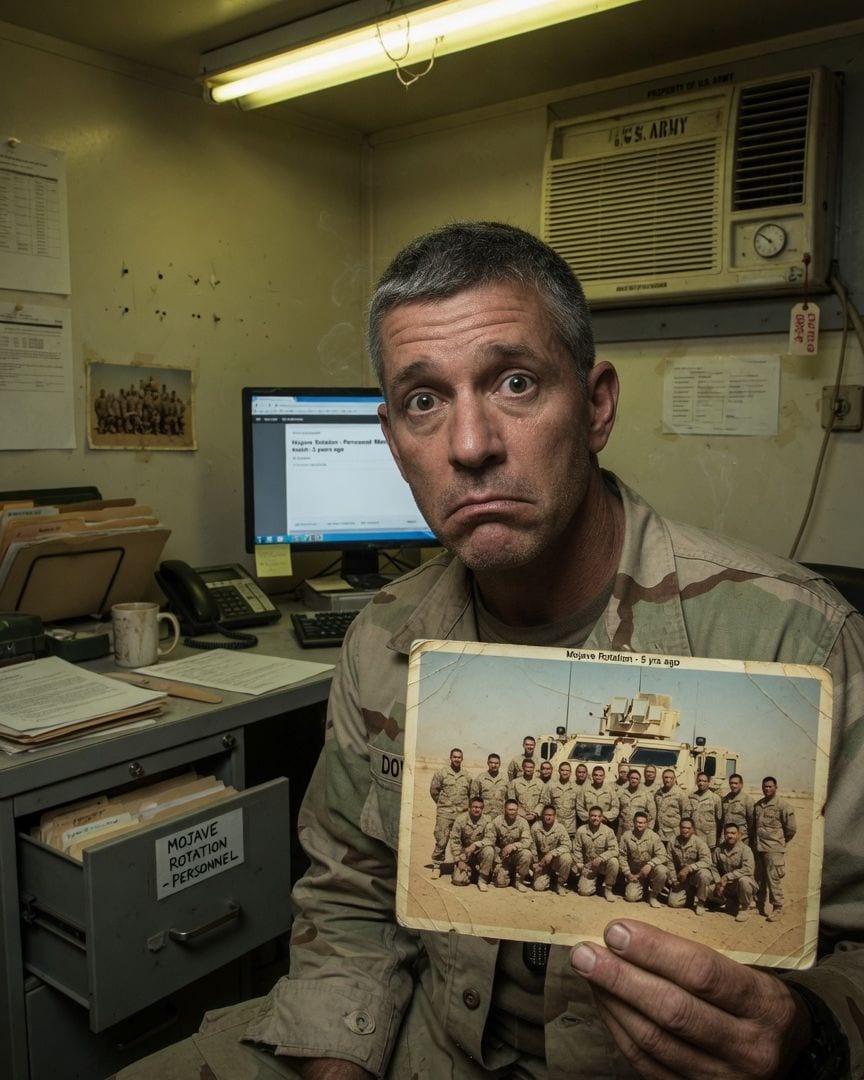
Two weeks from transfer, Master Sergeant Doyle’s old platoon photo now showed a 32nd man grinning from the back row.
Master Sergeant Oliver Doyle was two weeks from his transfer, overseeing the final decommissioning of FOB Erebus, finding solace in routine. His old Mojave platoon photo, a yellowed record above his desk, always showed thirty-one faces from his past. This morning, however, an extra man grinned from the back rank, a face both familiar and utterly alien. When he showed it to Sergeant Barlow, the younger man immediately named the newcomer, "Ryan Stratton," a name Doyle hadn't spoken, yet one that felt ready on Barlow's tongue. Official records listed only thirty-one, but a hidden digital history revealed a manifest with thirty-two names, signed by Doyle himself.