Two weeks from transfer, Master Sergeant Doyle’s old platoon photo now showed a 32nd man grinning from the back row.
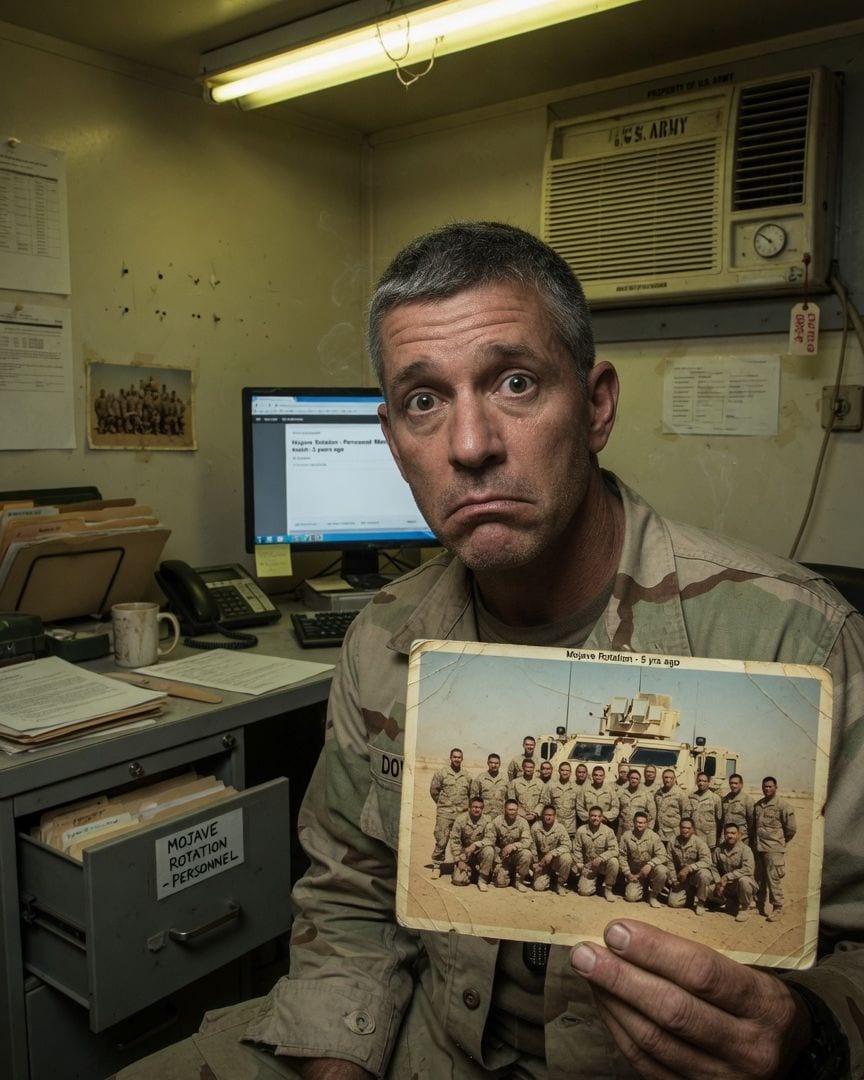
Master Sergeant Oliver Doyle, just two weeks from overseeing the final decommissioning of FOB Erebus and transferring to a desk job, found a strange solace in the routines.
Every morning, he’d glance at the old Mojave rotation platoon photo tacked above his desk, its plastic frame yellowing under the fluorescent lights. Thirty-one faces stared back, every one a ghost he could name in the dark.
It was a tangible record of his past, immutable. This morning, however, there were thirty-two. An extra man stood in the back rank, between Suggs and Ramos, grinning broadly, his face a disconcerting blend of familiar and utterly alien.
Doyle picked up the photo, his thumb tracing the new face, the paper slightly fuzzy from age. The base’s ancient air conditioning unit hummed a low, erratic tune in the background, making the silence in his office feel heavy.
He carried the photo to Sergeant Eric Barlow, who was checking the digital manifests at the command center's main console. Barlow, a younger man focused on the glowing screen, barely looked up. Doyle held the photo out. 'Who's that?'
he asked, his voice low, a strange tightness in his chest. Barlow finally took the photo, his eyes widening as he spotted the extra man. He frowned, then, without prompting, said, 'Ryan Stratton? Why’s he in your old photo?'
Doyle felt a cold knot tighten in his gut. He hadn't said a name. Barlow couldn't place where he'd learned it, only that the name felt ready on his tongue.
The hum of the servers seemed to drop a register, a deeper thrumming filling the room.
Doyle questioned Suggs and Ramos next. Both privates, still green and barely out of training, stared at the photo. Suggs mumbled, 'Stratton? Yeah, I remember him. Good guy.' Ramos nodded, 'He always had that smile.'
Neither could offer a single concrete memory of Ryan Stratton—no shared patrols, no specific conversations, no details beyond a vague, unshakeable sense of familiarity. They recalled a presence, a name, a smile, but nothing more.
Doyle tried the rational: a prank. But the photo was old, faded at the edges, its surface yellowed and brittle. The extra man's presence was seamlessly integrated, not pasted in.
His uniform matched the others, the desert dust on his boots no different from the rest of the platoon.
He pulled the hard copy of the Mojave rotation's final personnel manifest from his locked file cabinet. The heavy steel drawer scraped open with a sound like a low growl. Thirty-one names, all accounted for, inked in a familiar hand.
No Ryan Stratton. He cross-referenced with the digital archives, a system designed for flawless accountability, housed in the humming server room next door. The system whirred, then displayed the same manifest. Thirty-one names.
He scanned the digital file's properties, looking for a recent edit, a timestamp anomaly, any sign of tampering. Nothing. The record was clean, pristine, showing no changes since its creation.
He returned to the physical photo, the extra man’s grin now seeming less jovial, more like a confident, knowing smirk, as if it held a secret that the rigid military paperwork could not. It wasn't a prank.
It was a contradiction that gnawed at the very fabric of military order. If the paperwork was right, the photo was wrong.
If the photo was right, the paperwork was lying, and Doyle couldn't shake the feeling that the paperwork was never wrong.
Doyle decided to check the digital manifest one more time, using an older, more granular search protocol. He typed 'Mojave Rotation - Personnel Manifest - 5 years ago' into the search bar. The system returned the same document.
But this time, nestled in the corner of the interface, he noticed a tiny, almost imperceptible icon, shaped like a clock, indicating a 'version history.' He clicked it.
A dropdown menu appeared, showing not one, but three distinct versions of the manifest from that exact date. The first two listed thirty-one names, identical to the paper copy and the primary digital record.
The third, archived just hours after the second, listed thirty-two. Doyle clicked it open. There, nestled between Suggs and Ramos, was the name: RYAN STRATTON.
Beside it, a valid service number, a rank (PFC), and a date of entry that matched the rotation. And at the bottom, the digital signature, crisp and clear, emblazoned in bold font: 'M.Sgt. O. Doyle.'
He stared at the screen, the cursor blinking steadily next to 'Ryan Stratton,' his own signature affirming the impossible, the system itself swearing that Ryan Stratton had been there, and that he, Oliver Doyle, had signed off on its impossible truth.
Doyle felt a cold sweat prickle his skin. He hadn't signed that version. He knew he hadn't. The digital imprint was perfect, an exact replication of his own, yet it affirmed a reality he did not recognize.
He tried to pull up Ryan Stratton's service record. The system whirred, a brief, hollow sound from the server rack, then returned 'No Matching Records Found.' A name on a manifest, signed by a Master Sergeant, yet no service history?
It was impossible. Every soldier had a record. He showed Captain Lydia Coleman, the current CO of FOB Erebus, the photo and the two versions of the digital manifest.
Coleman, a by-the-book officer with a crisp uniform and an even crisper demeanor, initially scoffed. 'A glitch, Sergeant Doyle. Database corruption, maybe. Or a clever hack.'
She ordered Sergeant Barlow to run a full diagnostic on the manifest system, but the results came back clean. No anomalies, no intrusions. The system was functioning perfectly. Yet, the third manifest remained, immutable, a concrete digital lie.
Doyle started digging into the physical duty logs for the Mojave rotation, stored in the dusty archives of Erebus, in a back room that smelled of old paper and dry desert air.
He found no mention of Ryan Stratton in any daily muster, no patrol rosters, no sick call entries. It was as if he existed only on that one digital manifest.
He then compared the handwriting in the physical logs to the digital signatures on the manifests. His own signature on the original two digital manifests was identical to entries in the physical log.
But the signature on the third manifest, though an exact digital reproduction of his, felt… too perfect, too uniform, a flawless copy devoid of any natural variance.
He spent hours cross-referencing every name on the third manifest with every official document from that rotation. Every name, except Stratton's, had a corresponding paper trail. The absence was deafening.
The more he pulled at the thread, the deeper the gap widened between what the system showed and what he knew to be true.
He started to feel a growing unease, not just about Stratton, but about the very ground he stood on, the records he’d always trusted implicitly.
Doyle's relentless digging didn't go unnoticed. Captain Coleman, while maintaining her 'glitch' theory, began to eye him with a subtle suspicion, her gaze lingering a moment too long during morning briefings.
One evening, as Doyle worked late in the command center, cross-referencing old supply requisitions against personnel counts from five years prior, Sergeant Barlow approached him.
The silence of the base felt stretched, broken only by the distant, rhythmic clang of something metal against metal in the motor pool.
'Sir, Captain Coleman asked me to remind you about the decommissioning schedule,' Barlow said, his voice unusually stiff, his eyes avoiding Doyle's. 'She said to focus on the active personnel, not ghosts.' Doyle looked up, a chill running through him.
'Ghosts?' Barlow's face was unreadable, a carefully blank canvas. 'Just a figure of speech, sir. She's concerned about your focus. We're on a tight deadline.' The warning was clear, delivered with a precision that went beyond routine.
Later that night, Doyle was still reviewing old physical duty logs, the desert wind rattling the single, grimy window of the archive room, making the glass vibrate in its frame.
He heard a soft scrape outside the door, followed by the faint sound of boots on gravel, moving away. He froze, listening. The sound stopped. The silence that followed was absolute, heavier than before.
He waited, his breath held tight in his chest, then cautiously opened the heavy door. The desert night was silent, the moon casting long, stark shadows that seemed to bend and stretch like living things. No one.
But on the dusty concrete floor, just outside the doorframe, were fresh boot prints, distinct and deep, leading away from the building. They were too large to be Barlow’s, too defined to be the wind.
Doyle felt a prickle on his neck, a cold sensation that spread across his scalp. Someone had been watching him. Someone knew he was digging.
The feeling that he was no longer just investigating, but being observed, settled over him like the heavy desert air, thick and suffocating.
He wasn't just chasing a phantom; he was being hunted by the very silence that surrounded its existence.
The next morning, Doyle confronted Captain Coleman. 'This isn't a glitch, Captain. Someone's covering something up.' Coleman’s composure finally cracked.
Her shoulders slumped, and she sighed, leading him away from the bustling command center to a secure terminal in a small, windowless room. The air in there felt stale, heavy, as if secrets accumulated in its very density.
'Sergeant Doyle, there are things… protocols. For certain remote sites.' She typed a series of codes, her fingers moving with practiced speed, bringing up a highly classified military directive. Its title was innocuous: 'Standard Operating Procedure: Discrepancy Personnel Management (DPM).'
Doyle scanned the document, his eyes racing over the official jargon. It described a procedure for handling 'personnel anomalies'—individuals who appeared on official manifests but lacked corresponding service records, often at isolated outposts like Erebus.
The directive outlined strict protocols: no active investigation, no public acknowledgment, and systematic erasure from general databases after a fixed period. It was designed to maintain the integrity of the broader military record, to 'contain' the impossible.
'It's not a cover-up, Sergeant,' Coleman said, her voice strained, barely above a whisper. 'It's containment. These… anomalies… they just appear. They're accounted for, then they're gone. It's been happening for decades at sites like this.'
Doyle’s mind reeled. Ryan Stratton wasn't a mistake; he was a 'discrepancy personnel.' The military, the most accountable system on Earth, had a protocol for the unaccountable.
The entries in the duty log where Stratton was absent, the photo where he was present, the names Suggs and Ramos had offered unbidden—it all clicked into place.
The system wasn't broken; it was operating precisely as designed, integrating the impossible into its own logic, a quiet horror woven into the very fabric of bureaucracy. The dread deepened, taking on a new, colder edge.
He wasn't dealing with a one-off anomaly, but a systemic, almost bureaucratic, horror. Coleman then showed him a specific appendix, 'DPM-7: Historical Anomaly Cross-Reference.'
It listed dozens of remote sites across the globe, and for each, specific dates and types of 'discrepancy events.' FOB Erebus was listed multiple times, across different years, always with a similar 'one extra man' entry.
The pattern across rotations and dates was undeniable, stark in its repetition.
Doyle felt a chilling coherence settle over him. The extra man, the half-familiar names, his own signature on a phantom manifest—it was all part of this 'Discrepancy Personnel Protocol.'
He was looking at a hidden layer of military reality, a system designed to manage shadows. But then, Coleman scrolled further down the DPM-7 appendix, past columns of dates and site codes.
'There's something else, Sergeant Doyle,' she said, her voice barely a whisper, her eyes fixed on the screen, not him. 'Sometimes… sometimes the anomaly isn't an addition. Sometimes it’s… an echo.' She pointed to a section titled 'Echoed Personnel Events.'
It detailed instances where actual service members, with full, verified records, would inexplicably appear on 'Discrepancy Personnel' lists for rotations they never attended.
Their main records would show them elsewhere, performing their assigned duties, but the DPM system would register their phantom presence at an anomalous site. 'It’s rare,' Coleman explained, her finger tracing a line on the screen.
'But it suggests… a bleed-through. As if the system tries to pull in what it can’t generate, to fill a void.' Doyle’s eyes scanned the list of 'Echoed Personnel.'
His heart hammered in his chest, a frantic drum against his ribs. A decade ago, a remote training exercise in the Nevada desert, a site similar to Erebus in its isolation and purpose. A specific rotation date.
And there, listed as 'Discrepancy Personnel,' with a DPM-assigned service number, was 'Doyle, Oliver.' His own name. His own rank. For a rotation he knew, with absolute certainty, he had never attended.
He was staring at a record that swore he was a phantom, an echo, a discrepancy, a decade before he ever even knew such a thing existed.
The realization hit Doyle like a physical blow, a cold punch to the gut. He wasn't just an investigator; he had almost been one of them.
The system, in its relentless, unfeeling drive for accountability, wasn't just containing anomalies; it was generating them. And occasionally, it was 'echoing' real personnel, drawing them into its phantom architecture, a subtle siphoning of identity.
Coleman watched his face, her own etched with resignation, with the burden of long-held knowledge. 'The Mojave photo… Ryan Stratton… he's a DPM. A generated anomaly.
The familiarity you felt, the names Suggs and Ramos knew—it's a subtle bleed, a pre-cognition the system implants. It makes their appearance less jarring, easier to account for.'
Doyle understood. The horror was not a monster in the shadows, but the system itself, a vast, indifferent machine that could conjure personnel into existence and then erase them, weaving them into the fabric of official records.
The 'echoed' entry for his own name a decade ago wasn't a mistake; it was the system's attempt to 'recruit' him, to make him a part of its phantom roster, perhaps at a vulnerable moment, a moment of transition or isolation.
His final assignment at FOB Erebus, a site notorious for DPM activity, wasn't a quiet send-off; it was a trap, a final opportunity for the system to claim him, to complete the 'echo.'
The decommissioning of Erebus wasn't just about shutting down a base; it was about containing a perpetual source of these anomalies, or perhaps, preventing the system from replicating them elsewhere.
Every scattered date, every half-remembered face, every impossible record snapped into one monstrous, coherent shape. He was always inside it, a potential phantom among the real, his existence already partially documented by a parallel, sinister bureaucracy.
The quiet dread he'd felt was the unconscious recognition of his own impending erasure, his own potential absorption into the accountability that cannot be undone.
Doyle knew he had to get out, and fast. The decommissioning of Erebus had become less about closing a base and more about escaping a recursive nightmare.
He told Coleman his theory: that Erebus, as a 'hotspot' for DPM activity, was actively trying to 'echo' him again, to fully integrate him into its phantom ranks before the base was shut down.
The closer they got to final closure, the more intense the system's pull would be. Coleman, now convinced, her face pale, agreed. Their escape wasn't a fight against a physical enemy, but a race against an invisible, bureaucratic tide.
They moved to accelerate the final stages of decommissioning, pushing the remaining personnel to work faster, to evacuate equipment.
Doyle felt a growing pressure, a subtle disorientation, the familiar desert landscape seeming to shimmer at the edges of his vision, the distant mountains wavering like heat haze.
He constantly checked manifests, his own service record, looking for any new 'discrepancy' entries, any sign of his impending integration. Each check was a tiny confrontation with the system, a defiant act of proving his own reality.
On the final day, as the last convoy prepared to leave, its engines rumbling impatiently, Doyle saw Sergeant Barlow, who had been acting increasingly withdrawn for days, staring intently at him from across the base perimeter, his uniform blending into the dusty backdrop.
Barlow gave a faint, unnerving smile, a flicker of something almost like Ryan Stratton's grin. Doyle felt a chill that had nothing to do with the desert wind.
He knew Barlow was still real, a flesh-and-blood soldier, but the smile was wrong, a subtle shift that implied the system's insidious influence, a hint of something else looking out from behind Barlow's eyes.
Doyle boarded the lead vehicle, his hand on the door, his gaze fixed on Barlow.
As the convoy rolled out, leaving FOB Erebus a skeletal shell in the dust, Doyle felt a profound sense of relief, but also a lingering, unsettling question: how much of him had the system already claimed, and how much of it had he left behind, still grinning, in the desert?
Doyle completed his transfer, retiring from active duty two months later, his paperwork meticulously in order. He never spoke of the Discrepancy Personnel Protocol again, nor did Coleman.
The official report on FOB Erebus’s decommissioning was meticulously clean, no mention of anomalies, no 'personnel discrepancies.' Ryan Stratton’s name vanished entirely from the digital Mojave manifest, leaving only the original thirty-one names.
Doyle’s own 'echoed' entry from a decade prior was scrubbed from the DPM-7 appendix, replaced by a blank space, as if it had never existed.
It was as if the system had corrected itself, or perhaps, simply absorbed and then discarded the evidence, leaving no trace.
He tried to settle into civilian life, buying a small house near the coast, but the quiet hum of his new reality was always underscored by the ghost of what he’d learned.
He avoided old photos, digital archives, anything that could reveal another 'extra' face or an impossible signature. He knew the system had moved on, found new remote sites, new personnel to 'account for.'
Years later, Oliver Doyle was at a small gathering of retired veterans. The air was thick with camaraderie and old stories. An old photo from a different rotation, a training exercise in Germany, was passed around.
Doyle instinctively scanned the faces, a habit he couldn't quite shake. Thirty-eight men, all accounted for, their younger selves grinning from the faded print. Then, his gaze lingered on a man in the background, half-obscured by another.
A face he didn't immediately recognize, yet felt a flicker of something, a familiar, unsettling grin. He shook his head, dismissing it as fatigue, a trick of the light, the result of too many years scanning manifests and faces.
He handed the photo back. Later that evening, his wife, Rachel, looked at him across the dinner table, the clink of silverware against ceramic the only sound. 'You've been quiet tonight, Oliver. Something on your mind?'
He smiled, a faint, almost imperceptible shift in his expression. 'Is that so?'
If this one got to you
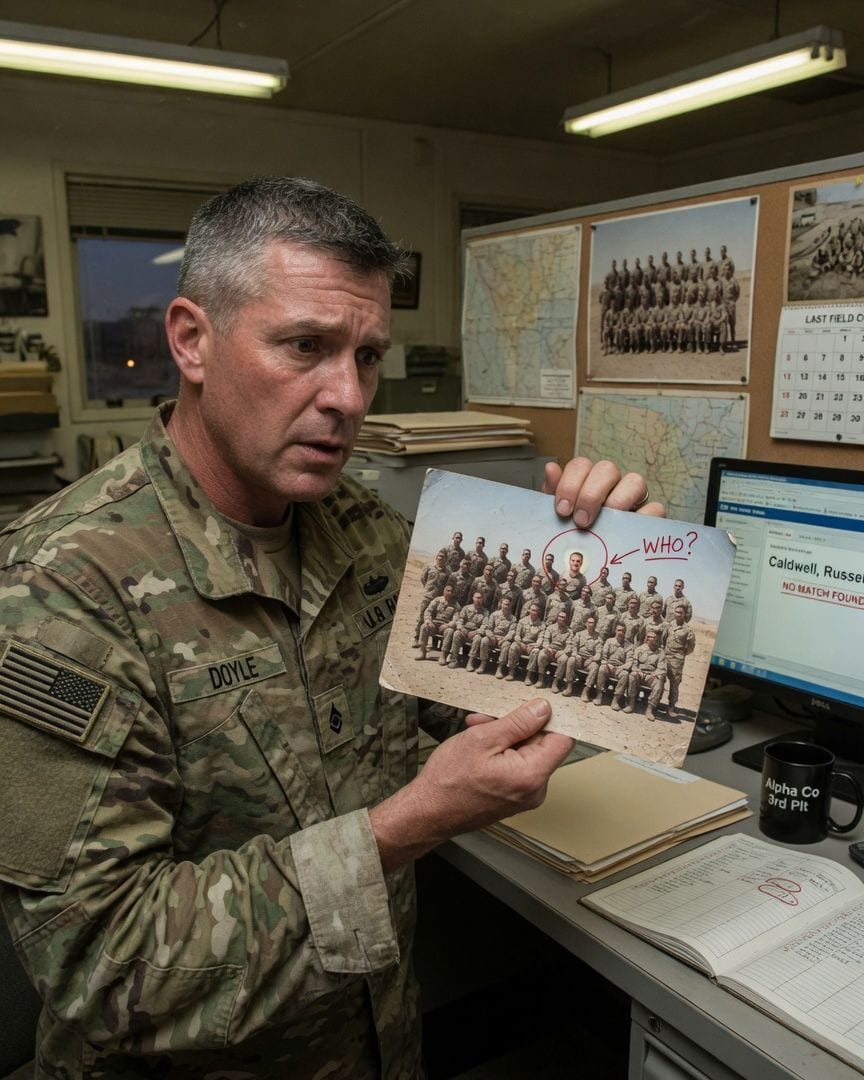
Weeks from his transfer, Master Sergeant Arthur Doyle's platoon photo had an extra man, grinning between Suggs and Ramos.
Master Sergeant Arthur Doyle, weeks from a quiet desk job, performed his usual ritual: staring at his platoon photo. He knew every one of the thirty-one faces from his last Mojave rotation by heart, but this morning, a thirty-second man grinned blandly between Sergeant Suggs and Private Ramos. When pressed, his soldiers named the man instantly as 'Caldwell,' yet couldn't explain how they knew him or when he'd joined. Doyle's personal logs and official unit manifests held no record of a Private Russell Caldwell, leaving him to question everything he thought he knew.
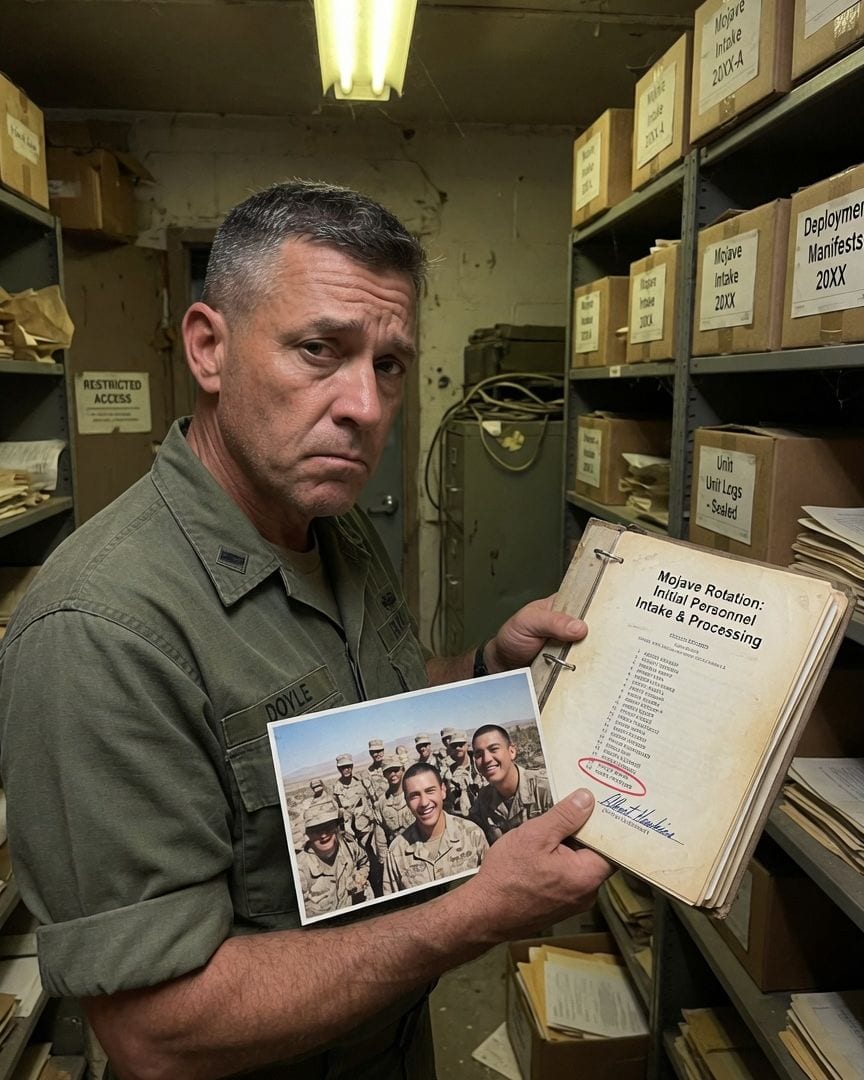
Master Sergeant Doyle's old platoon photo showed 31 men. But between Suggs and Ramos, a 32nd man stood grinning, named on Doyle's own signed manifest.
Master Sergeant Vincent Doyle was packing away twenty-five years of service, each box holding memories of the men he'd led. He paused at a faded platoon photo from the Mojave, a familiar thirty-one faces staring back. But then, a thirty-second man, Albert Hawkins, stood grinning between two of his men, a face Doyle couldn't place. His memory, usually perfect, insisted only thirty-one were there. Despite his colleagues recognizing the name, their own recollections dissolved, pushing Doyle to scour every record he'd personally signed – each one confirming thirty-one men, until he opened the very first intake manifest, bearing his signature, listing thirty-two.
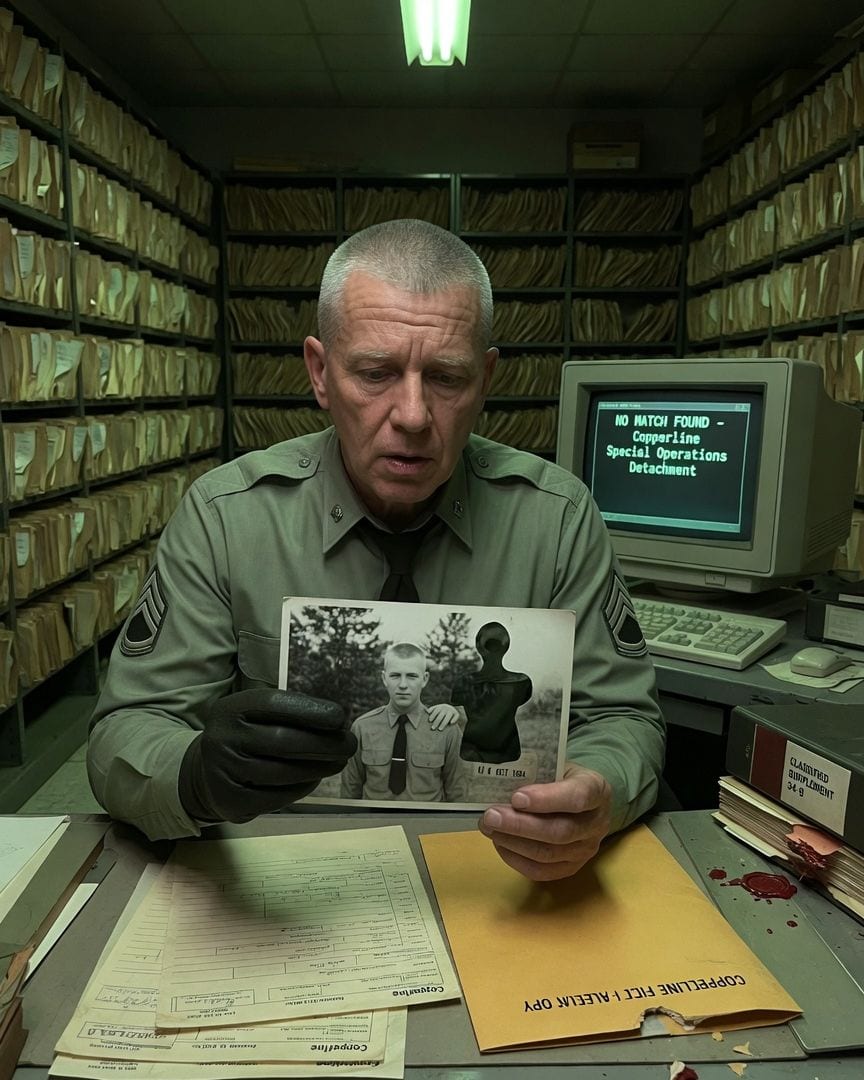
Sergeant Major Vance had two weeks to retirement when his old file felt warm. Inside, a photo showed him with a man precisely cut out from a unit that never existed.
Sergeant Major Teodor Vance had only two weeks left before his retirement, a lifetime of military order almost behind him. For thirty years, he'd pulled the 'Copperline' file, always finding it empty – until now. This time, a faint, impossible warmth radiated from the heavy manila, and inside, he found a faded photograph. It showed a younger Vance in an unrecognized uniform next to a man whose entire body had been precisely cut out of the print, from a company that officially never existed. After decades of silence, what did this warm, impossible file truly contain?
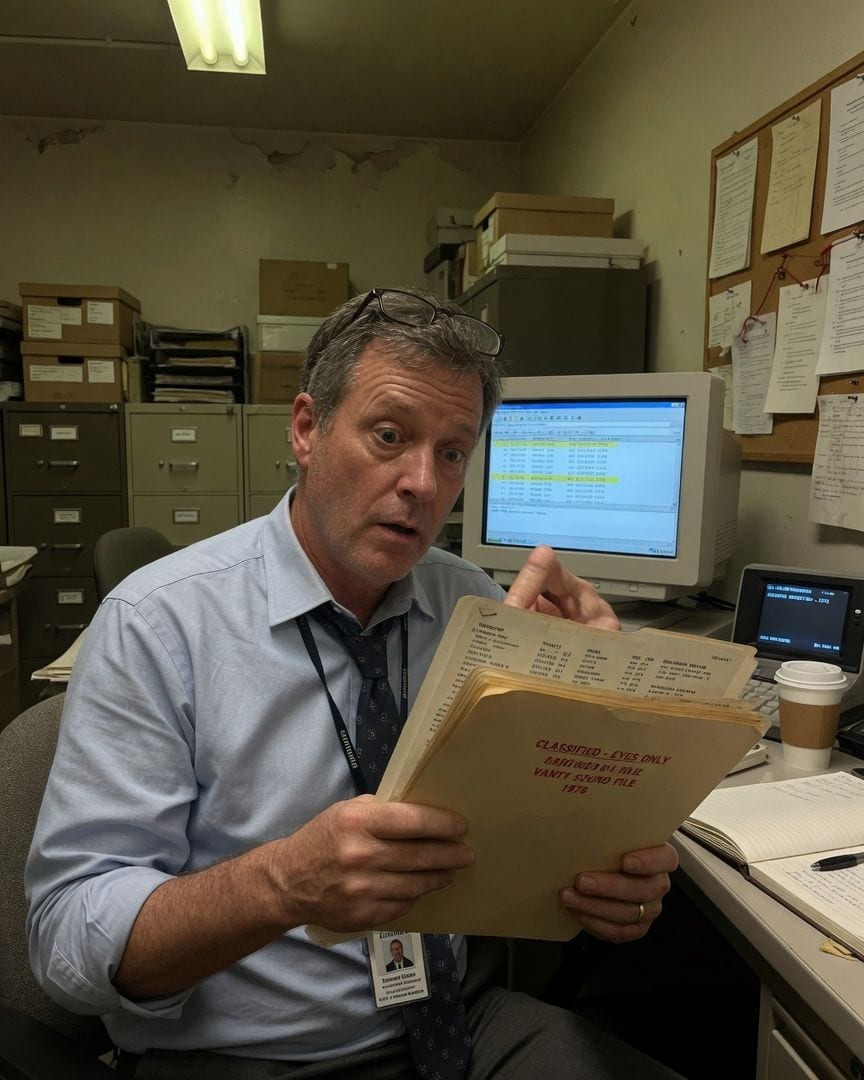
A retiring archivist, Emmett Doane, found a Cold War file from 1978 listing men who wouldn’t enlist until the 1980s. The last name on the classified roster was his four-year-old son’s.
With only six days left until his retirement, archivist Emmett Doane spent a quiet afternoon in the office reviewing old files. He finally pulled the Vantry Sound file, a classified folder from 1978 he'd long dismissed as a clerical error. Inside, the brittle onionskin pages revealed a roster of servicemen who, impossibly, had enlisted years after the file date. As a cold dread tightened his chest, he noticed the file felt warm in his hands, then saw the last name on the list: his own four-year-old son, Samuel. Could a decades-old document truly predict the future, or was something far more sinister at play?
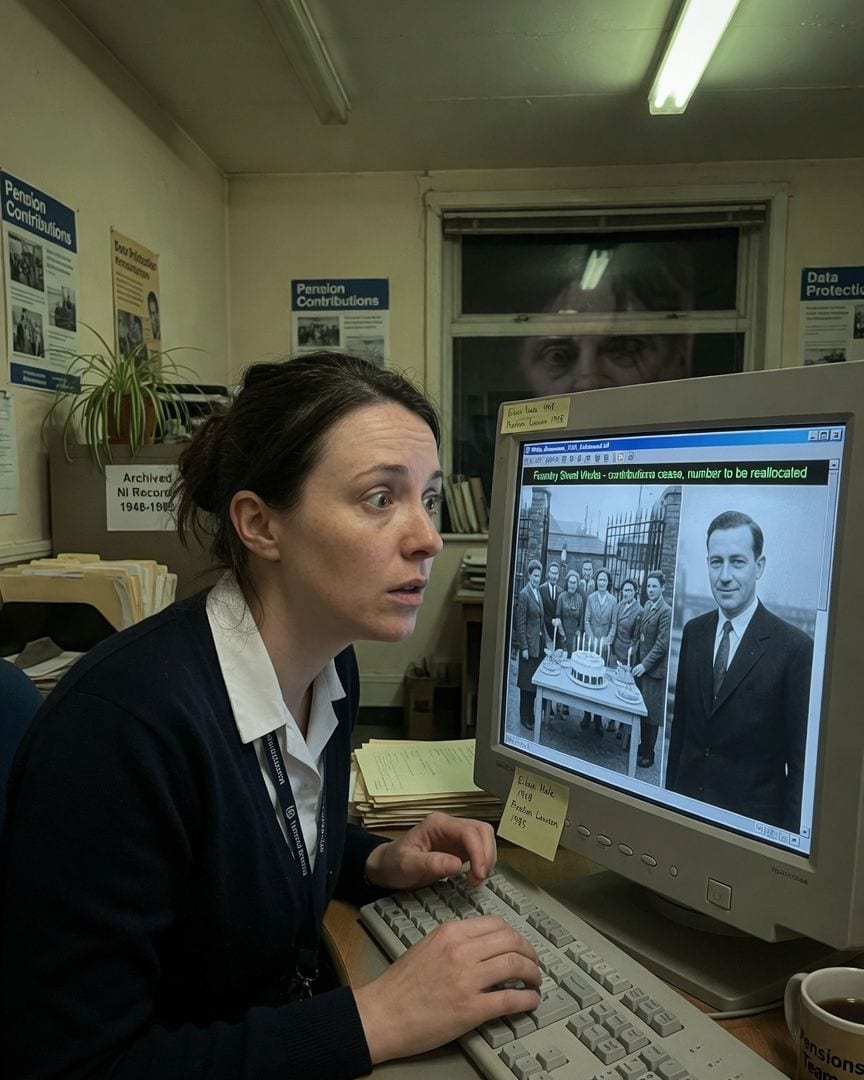
My National Insurance number has been used by four people since 1948. Each one worked at the same Foundry Street works, and none ever drew a pension.
I was just sorting out my new National Insurance number, a routine task I expected to take minutes. But the clerk found it had been used four times since 1948. Even stranger, all four previous holders worked at the defunct Foundry Street Works and never drew a penny of pension.
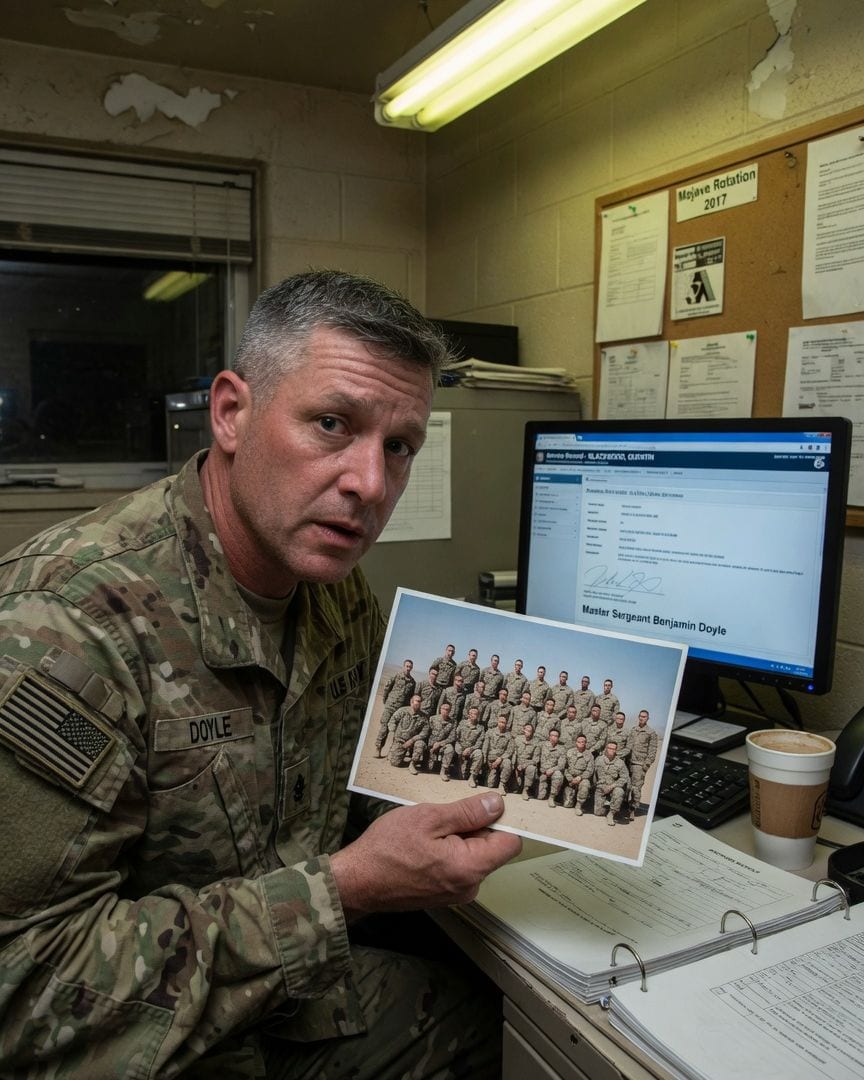
Master Sergeant Doyle found his own signature on a soldier’s commendation he knew he never signed.
Master Sergeant Benjamin Doyle, a man whose life was built on precise manifests and head counts, maintained a quiet daily ritual: glancing at his Mojave rotation platoon photo. One morning, the familiar thirty-one faces stared back with an impossible addition: an extra man, grinning between Suggs and Ramos, a face he and his colleagues recognized but couldn't place. His search through official digital rosters yielded nothing, yet old physical logs, signed in his own hand, confirmed the phantom soldier’s presence on a dangerous patrol he couldn't recall. The ultimate blow came with a valor citation for this same soldier, bearing Master Sergeant Doyle’s own digital signature for an award he knew he never certified.