Weeks from his transfer, Master Sergeant Arthur Doyle's platoon photo had an extra man, grinning between Suggs and Ramos.
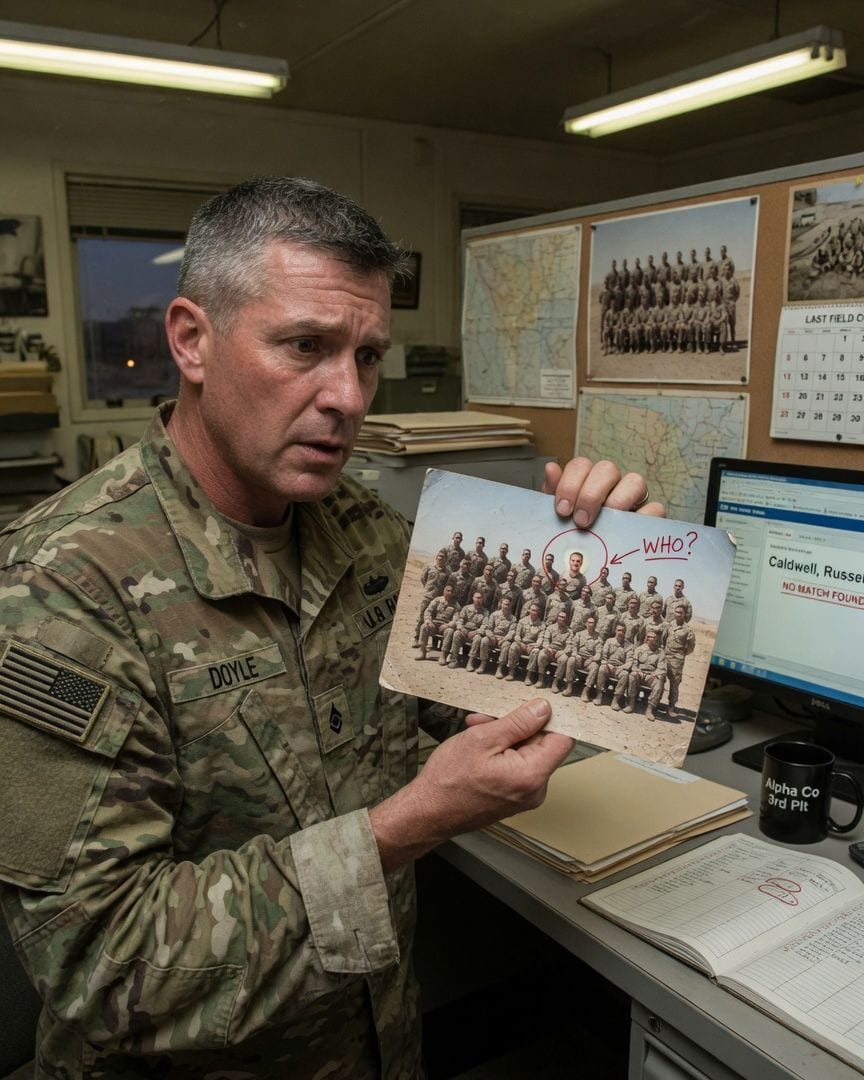
Master Sergeant Arthur Doyle, weeks from his transfer to a desk job, stared at the platoon photo from his last Mojave rotation, tacked above his office desk.
Thirty-one faces, every one of them etched into his memory, names he could call out in the dark. He’d looked at it a thousand times, a small ritual marking the end of his last field command.
But this morning, there were thirty-two. An extra man stood in the back rank, between Sergeant Suggs and Private Ramos, grinning with a kind of bland familiarity.
Doyle hadn't noticed him before, couldn't place him, yet a prickle of recognition traced his jawline. The fluorescent hum of his office lights seemed to deepen, a low thrumming that made the air feel heavy.
He carried the photo to the mess tent, the familiar laminate cool against his fingers. The morning chaos of clanking trays and shouted orders seemed to recede as he held it out. 'Anyone know this man?'
he asked, pointing to the extra face.
Sergeant Suggs, mid-bite of a bagel, squinted at the image. 'Oh yeah, that's Caldwell,' he said, mouth full.
Private Ramos, across the table, nodded. 'Russell Caldwell. Good guy.'
A third voice, Corporal Holloway, walking past, glanced over. 'Private Caldwell? Sure.'
Doyle felt a strange tightening in his chest. 'Caldwell?' he pressed. 'From where? When was he assigned to us?'
Suggs frowned. He swallowed hard. 'Uh… I don't know, sir. He was just… there.' He looked to Ramos, who shrugged, a flicker of confusion clouding his face. 'Yeah, just… Caldwell. I can't really place it, but the name's right.'
Corporal Holloway had already moved on, her nod a dismissive confirmation of a fact that apparently needed no explanation.
Three different voices, almost in unison, had named the man, then, when pressed, they couldn't say where they’d learned the name, only that it just was Caldwell, like a word they’d always known.
Doyle dismissed the men, the photo clutched in his hand. The weight of it felt different now, heavier than it should have been. He returned to his office, the low thrum of the lights seeming to follow him.
He pulled out his personal duty logbook, a thick, worn volume meticulously kept since his first deployment. Every man on his roster was listed, every head count recorded in his neat, squared hand.
He flipped to the Mojave rotation: Alpha Company, Third Platoon. Thirty-one men. No Caldwell.
He checked the official unit manifest, archived digitally on his desktop. The screen glowed an icy blue. He clicked through the files, cross-referencing names, deployment dates, transfer orders. Thirty-one names. Not a single Russell Caldwell.
The digital records were stark, absolute.
He tried the mundane explanation: a prank. But who would go to the trouble of doctoring a physical photograph and planting a false memory in three different soldiers, none of whom were known for their elaborate humor?
He knew Suggs and Ramos wouldn't be in on anything so complex, and the third man, Corporal Holloway, was too by-the-book to participate in such a hoax. The idea dissolved, leaving behind a colder, sharper anxiety.
He pulled up the personnel database, searching for 'Caldwell.' Dozens of them populated the screen, an impersonal sea of service members. He refined the search: 'Caldwell, Russell. Mojave rotation, Alpha Company, Third Platoon.' Nothing.
Not a single 'Caldwell' assigned to their unit during that period. The dread started small, a knot in his gut, growing with each failed search. He knew his men. He knew his records.
They were the bedrock of his command, the very foundation of his trust in the military’s order. If they were wrong, what wasn't?
He decided to cross-reference the photo's physical print date with the official unit roster. It was a long shot, but if the photo was older, from a different deployment, it might explain the extra man.
He took the photo to the supply room, the air in the long corridor oddly still. The clerk took the photo, examined the back under a lamp.
'Looks like this one was printed on March 14th, sir,' the clerk said, handing it back. 'Standard issue, sir. From this rotation. Like all the others.' The date was a week before their official deployment ended.
The explanation, mundane as it tried to be, slid away, leaving an unsettling void.
Doyle’s rational explanations were failing, each one crumbling in his hands. He spent the next hour in the records room, the fluorescent lights buzzing overhead, making the air feel thin.
He manually cross-referenced every single manifest from their unit's Mojave deployment. He pulled up the master roster, the sick call sheets, the leave requests, the gear issue logs.
He was looking for any anomaly, any misfiled name, any hint of a Private Caldwell.
Then, buried deep in a supplemental manifest for a special reconnaissance detail—a manifest he distinctly remembered signing off on and which had accounted for only three men—he found it. A fourth name. 'Caldwell, Russell.' Rank: Private. Unit: Alpha Company.
Deployment: Mojave. Date of assignment: The exact day of the photo. And next to it, his own signature, clean and unmistakable, authorizing Caldwell’s presence.
Doyle stared at his own handwriting, the loops and angles familiar, yet alien. A cold sweat broke out on his neck, because he knew, absolutely, that he had never signed off on a Private Russell Caldwell.
He hadn't just missed him; he had no memory of him existing at all.
The signature was real. Doyle’s own. He traced the looping 'D' of his last name, a phantom ache in his wrist. He remembered that recon detail: three men, a simple sweep, nothing more.
A fourth man would have been logged, briefed, equipped. He would have known him. The air in his office, usually a familiar comfort, now pressed in on him, thick and cold.
He pulled Caldwell’s full service record from the digital archives. It was sparse, almost skeletal: enlistment in 2022, a few basic training entries, then the Mojave deployment.
But the dates for Caldwell’s prior assignments were a jumble, overlapping with other units, other theaters. One entry placed him in Afghanistan in late 2022, another in Eastern Europe simultaneously. It was impossible.
A clerical error, he tried to tell himself, a major one. But the military system, for all its bureaucracy, was designed to prevent exactly this kind of impossible overlap.
He felt a growing unease, an itch he couldn't scratch, deep in his bones.
He contacted the records department at HQ, requesting clarification on Caldwell’s file. He spoke to Captain Genevieve Holloway, a sharp, no-nonsense officer he’d known for years.
Holloway promised to look into it, her voice calm but with an underlying note of something he couldn't quite place, like a distant, low frequency.
Doyle spent the next few days re-interviewing Suggs and Ramos, pressing them harder on Caldwell. They grew agitated, shifting in their seats, insisting they knew him, that he was 'just there.'
Ramos even described a specific, minor incident with Caldwell, a dropped rifle magazine during a drill, a detail Doyle knew for a fact had involved only Ramos, a moment he remembered clearly.
The details were too specific to be invented, yet entirely impossible, woven into their shared history. It was as if Caldwell had been inserted into their memories, a ghost in the machine of their shared experience.
The dread wasn’t just about the records anymore; it was about the integrity of his own memory, and the memories of his men.
The orderly world he trusted was beginning to warp, and the reflection he saw in it was subtly, chillingly wrong.
Doyle's queries about Caldwell escalated through official channels. He began to feel a subtle shift in the atmosphere around him. His requests for historical data were met with unusual delays. Emails went unreturned for longer than normal.
His calls to Captain Holloway were returned with increasing formality, her answers clipped and evasive, as if she were reading from a script.
One evening, as he was reviewing a dusty archive box, the paper smelling faintly of old coffee and forgotten records, a junior officer, Private Kowalski, approached him. Kowalski shifted uncomfortably, his gaze darting around the empty room.
He leaned in, his voice barely a murmur. 'Sir, I heard you were asking about that... that Private Caldwell. Just… be careful, sir. Some things are better left alone.'
Kowalski quickly excused himself, his boots scuffing on the concrete floor, leaving Doyle with a prickling sensation that traveled from the back of his neck down his spine.
The air in the room felt suddenly charged, as if static electricity had built up around him.
Later that week, Doyle found a small, unmarked envelope tucked under his office door. The paper felt thick, expensive, yet anonymously blank. Inside was a single printed page, a partial excerpt from an old, classified document.
The title at the top read: 'Project Shepherd: Anomaly Integration Protocol - Unit 734.'
The text below was heavily redacted, black bars obscuring most of the information, but one unredacted sentence stood out, stark and chilling: 'The collective memory imprint of the subject often aligns with existing unit dynamics, facilitating seamless, if temporary, inclusion.'
There was no sender, no signature. Just the chilling implication that someone knew exactly what he was looking for, and was subtly warning him off, while also giving him a piece of the impossible puzzle.
The danger was no longer abstract; it was personal, a shadow watching his every move, whispering secrets in coded documents.
Doyle confronted Captain Holloway directly, the Project Shepherd excerpt clutched in his hand. He walked into her office unannounced, the classified document laid flat on her desk, its stark black redactions a silent accusation. Holloway’s composure, usually unshakeable, fractured.
Her eyes flickered to the paper, then to Doyle, a flicker of fear in their depths, like light catching on fractured glass. 'Where did you get that?' she asked, her voice tight, barely above a whisper.
Doyle simply pushed the Caldwell file across the desk, its impossible dates and overlapping assignments glaring up at them. 'This man. This file. The impossible dates. The phantom presence in my photo.
My signature, for God's sake, on a manifest I never signed. What is Project Shepherd, Genevieve?'
Holloway sat back, her shoulders slumping. The polished surface of her desk, usually gleaming, seemed to dim. She took a deep breath, a sound heavy with resignation.
'It’s… an accounting,' she explained, not in a rush, but with the weary cadence of someone repeating a long-held, terrible truth. 'Sometimes, under specific conditions—extreme isolation, high stress, certain environmental factors—a unit will… manifest an extra. A 'plus one.'
We call them Phantom Personnel. They’re not hostile, not truly alive in the way you understand it. They just… exist. And the military, Sergeant, accounts for everything. Every man, every bullet, every minute. We have to.
So, when they appear, we integrate them. We create a record. We ensure they are accounted for.'
Doyle felt a cold dread spread through him, seeping into his very bones. 'You mean you invent them? You create a ghost in the system?'
Holloway shook her head slowly, her gaze distant. 'No. We log what is. The system tries to make sense of an anomaly it cannot reconcile. The records become… convoluted. Contradictory. But they are official.
They swear otherwise, but they are still the record.' He understood now why Suggs and Ramos had recognized Caldwell. The 'memory imprint' from Project Shepherd.
The system wasn't just failing; it was actively incorporating the failure, making it real, making it official, making it undeniable. The air in the room grew heavy, suffocating.
The buzzing of the fluorescent lights outside her office seemed to intensify, a high-pitched whine.
Doyle felt a wave of nausea, the world tilting slightly on its axis. The entire, orderly world of military accountability was a lie, compromised from within, not by malice, but by an impossible, undeniable fact. 'How many?'
he asked, his voice barely a whisper, raw with disbelief. 'How many 'Phantom Personnel' have you... accounted for?'
Holloway sighed, a sound heavy with decades of institutional burden. She reached into a locked drawer in her desk, the click of the tumbler unnaturally loud in the sudden quiet. 'More than you can imagine, Arthur.
This isn't a new phenomenon. It's been happening for a long, long time. We have protocols. We have records.'
She pushed a thick, unmarked binder across her desk. The cover was plain, a dull gray, devoid of any text.
Inside, Doyle found dozens of identical service records for 'Phantom Personnel,' each bearing impossible dates and deployments stretching back to the late 1970s, all coded under 'Project Shepherd.'
He saw his own Mojave rotation listed, then one from the Gulf War, another from Vietnam, and realized the 'extra man' was not a singular event but a repeating shadow, a system error that has never been fixed, only managed.
The chill in the room deepened, the silence like a physical weight.
Holloway watched him, her face grim, as he turned a page to a new entry, a current deployment, and saw the name of a unit he knew was deploying next month, a unit his own son, Private James Pierce, was transferring into.
The name of his son's new unit, 'Task Force 9-Gamma,' on a Project Shepherd manifest, hit Doyle like a physical blow, stealing the air from his lungs.
He looked up at Holloway, his face ashen, the color drained from his skin. 'My son… he’s transferring to that unit next month.'
Holloway’s gaze softened with genuine regret, a flicker of humanity in her otherwise impassive face. 'I know, Arthur. That’s why I brought you in. The conditions for manifestation are specific. Extreme isolation, high stress, certain environmental factors.
And that unit, that deployment… it matches the historical pattern perfectly. It’s a certainty.'
She explained that 'Project Shepherd' wasn't about eliminating the Phantom Personnel, but about predicting their appearances and managing the fallout.
The military had learned that attempting to deny or remove them only caused greater systemic instability, sometimes leading to outright psychological breaks in the affected units.
So, they accounted for them, integrated them, and then, after a certain period, quietly retired their records. The 'memory imprint' was a side effect, a natural human tendency to reconcile an impossible presence, a subconscious adaptation to the anomaly.
Caldwell wasn’t a single ghost; he was a template, a recurring statistical ripple in the fabric of military order.
The reason his name was familiar to Suggs and Ramos was because their minds, subconsciously, had already begun to make room for the anomaly, to rationalize the impossible 'plus one' in their ranks.
The dread now felt like a crushing weight, pressing down on him, suffocating.
His son, unknowingly, was walking into a unit where an 'extra' soldier was predicted to appear, to be accounted for, to subtly alter the reality of everyone around him.
Doyle refused to accept it, his voice tight with desperation. 'There has to be a way to prevent it,' he insisted, pushing the binder away. 'To warn them. To pull my son.'
Holloway shook her head, her expression one of deep, weary certainty. 'We’ve tried, Arthur. Every intervention has proven worse. The system corrects itself, often violently. And once a unit is within the window, the 'imprint' begins.
Even if your son was pulled, another would take his place, and the conditions would still be met for someone else.'
She showed him historical data: units where 'Phantom Personnel' had been forcibly removed saw spikes in desertion, friendly fire incidents, and inexplicable suicides. The anomaly, once integrated, became essential, a horrifying, invisible cog in the machine.
'The best we can do,' Holloway continued, her voice low, 'is ensure the unit is well-prepared, highly disciplined. That’s why you’re retiring, Arthur. That’s why you’re transferring to HQ. You’re too close. You know too much.'
Doyle understood. His long-awaited transfer wasn't a reward; it was a containment measure, a way to move him away from the field, away from the unpredictable, while keeping him within the system's control.
He couldn't fight the system that created and maintained these ghosts, not without breaking it entirely, without unleashing untold chaos.
He couldn't warn his son without condemning him to a life of paranoia, or worse, making him an anomaly himself, a marked man within the very structure that would try to account for him.
He saw the photograph in his mind's eye: Caldwell, grinning, half-familiar, a reflection of the system's terrifying coherence.
He had to make a choice: expose the truth and risk untold chaos, or let his son walk into the shadow, trusting the very system that created the horror to manage it.
He chose the latter, a silent surrender to the greater, darker order, to the cold logic of the unfixable. He couldn’t escape the truth, but he could try to ensure his son's survival within it.
Master Sergeant Arthur Doyle completed his transfer to HQ without incident. His new office was quiet, far from the desert heat and the unsettling echoes of his last command. He never spoke of Project Shepherd, never mentioned Private Russell Caldwell.
Captain Holloway ensured his records were flawless, his transfer seamless. His personal logbook, once a source of comfort, now sat in a dusty box in his new office, unread.
His son, Private James Pierce, deployed with his new unit as scheduled. Doyle received regular, if infrequent, updates. James sounded well, focused. Normal. The system, in its horrifying way, was working.
The anomaly was accounted for, integrated, and the world kept turning, oblivious to the quiet, impossible truths maintained within its most rigid structures.
Doyle kept a small, framed photo on his desk at HQ: a recent snapshot of his son, James, in his new unit. Thirty men, all accounted for.
He looked at it every day, searching for a subtle wrongness, a half-familiar grin among the faces, a shadow out of place. He never found it. He knew the anomaly was there, or would be.
He knew the system would log it, integrate it, and keep the secret. He had survived, but the knowledge was a permanent brand, a cold weight in his chest.
He understood that the greatest horror wasn't the ghost, but the fact that the army, in its infinite pursuit of order, had found a way to make it official, to make it just another part of the unbreakable machine.
One evening, his wife asked him about the photo, 'Is that James’s new unit? All of them?' Doyle looked at the photo, then at his wife, and offered a faint, wrong little smile. 'Yes,' he said. 'All of them.'
If this one got to you
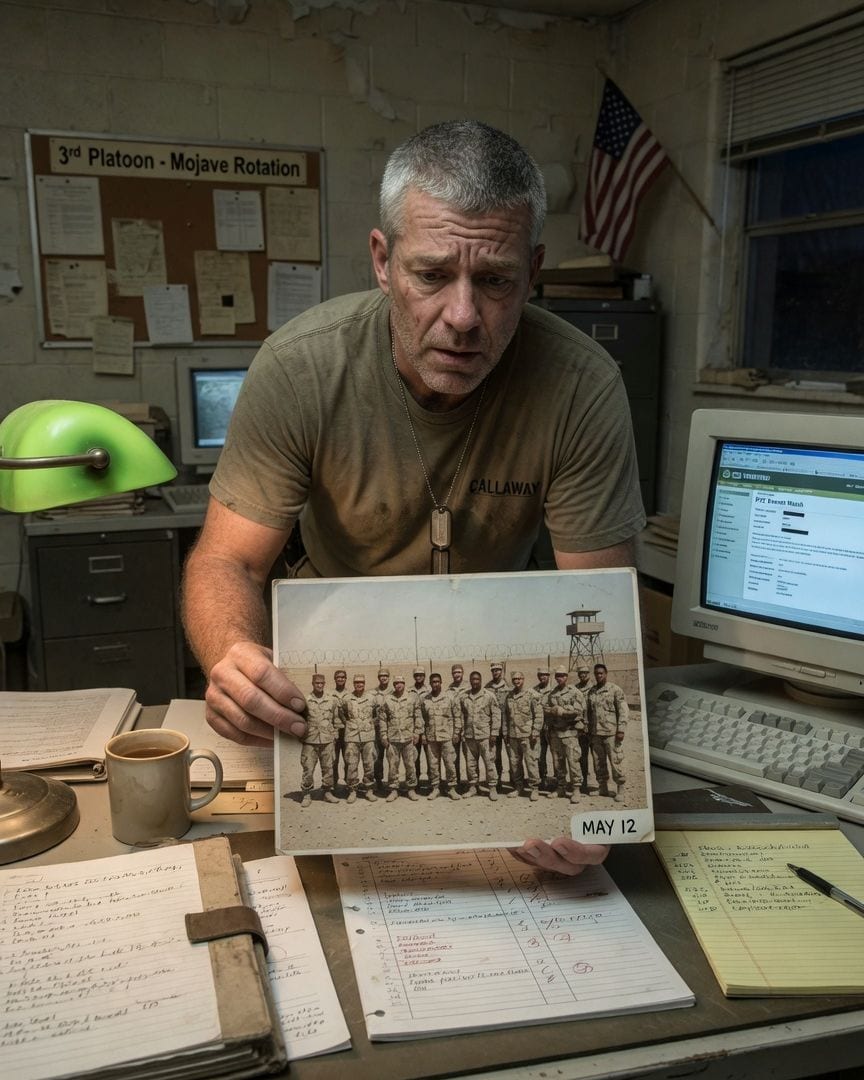
An extra man grinned from Master Sergeant Calloway's old platoon photo. His own men named the stranger he'd never seen.
Nearing retirement from the U.S. Army, Master Sergeant Trevor Calloway kept his platoon photo from the Mojave rotation tacked over his desk, every face a familiar memory. But a week before his final deployment, a casual count revealed a chilling impossibility: an extra man, grinning broadly, stood perfectly positioned in the back rank. His own soldiers, Suggs and Ramos, readily named the stranger "PFC Everett Walsh," yet Calloway knew with undeniable certainty that no such man had ever served under him. The question of the extra soldier, known by his men but unknown to him, solidified a cold, hard knot in Calloway’s stomach. How could a man exist in their shared history, yet be entirely absent from his memory?
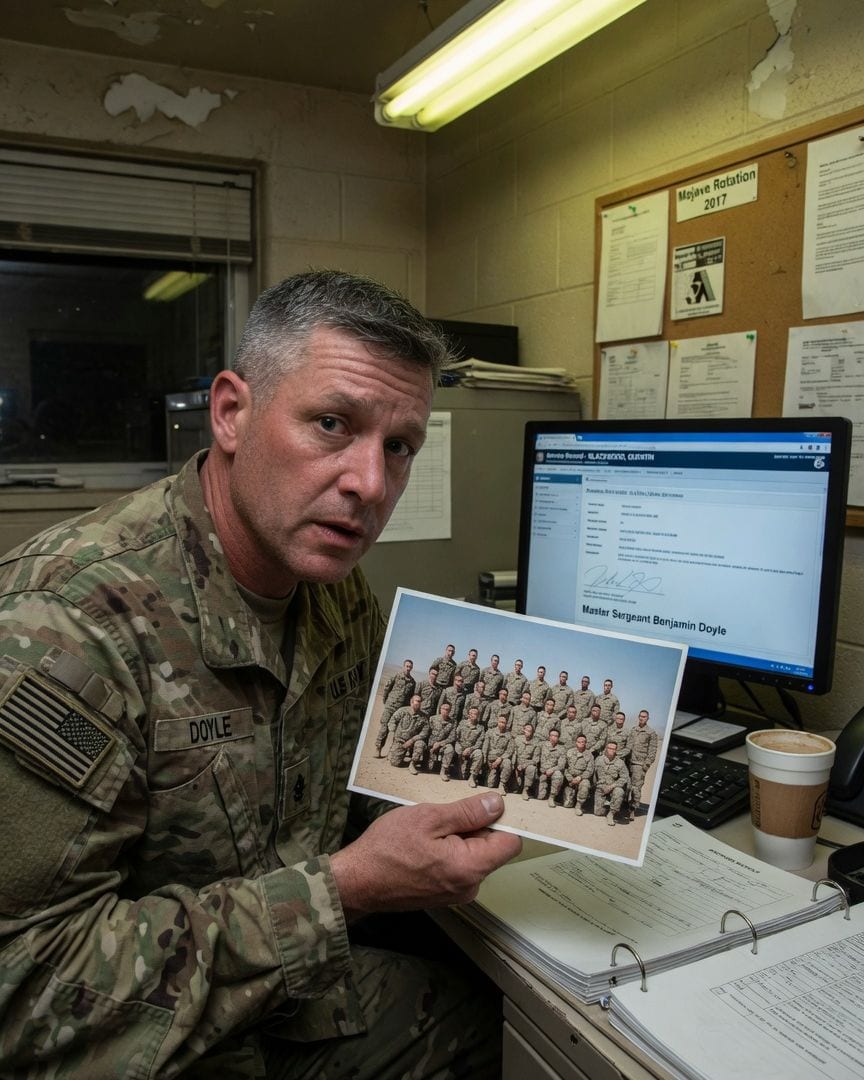
Master Sergeant Doyle found his own signature on a soldier’s commendation he knew he never signed.
Master Sergeant Benjamin Doyle, a man whose life was built on precise manifests and head counts, maintained a quiet daily ritual: glancing at his Mojave rotation platoon photo. One morning, the familiar thirty-one faces stared back with an impossible addition: an extra man, grinning between Suggs and Ramos, a face he and his colleagues recognized but couldn't place. His search through official digital rosters yielded nothing, yet old physical logs, signed in his own hand, confirmed the phantom soldier’s presence on a dangerous patrol he couldn't recall. The ultimate blow came with a valor citation for this same soldier, bearing Master Sergeant Doyle’s own digital signature for an award he knew he never certified.
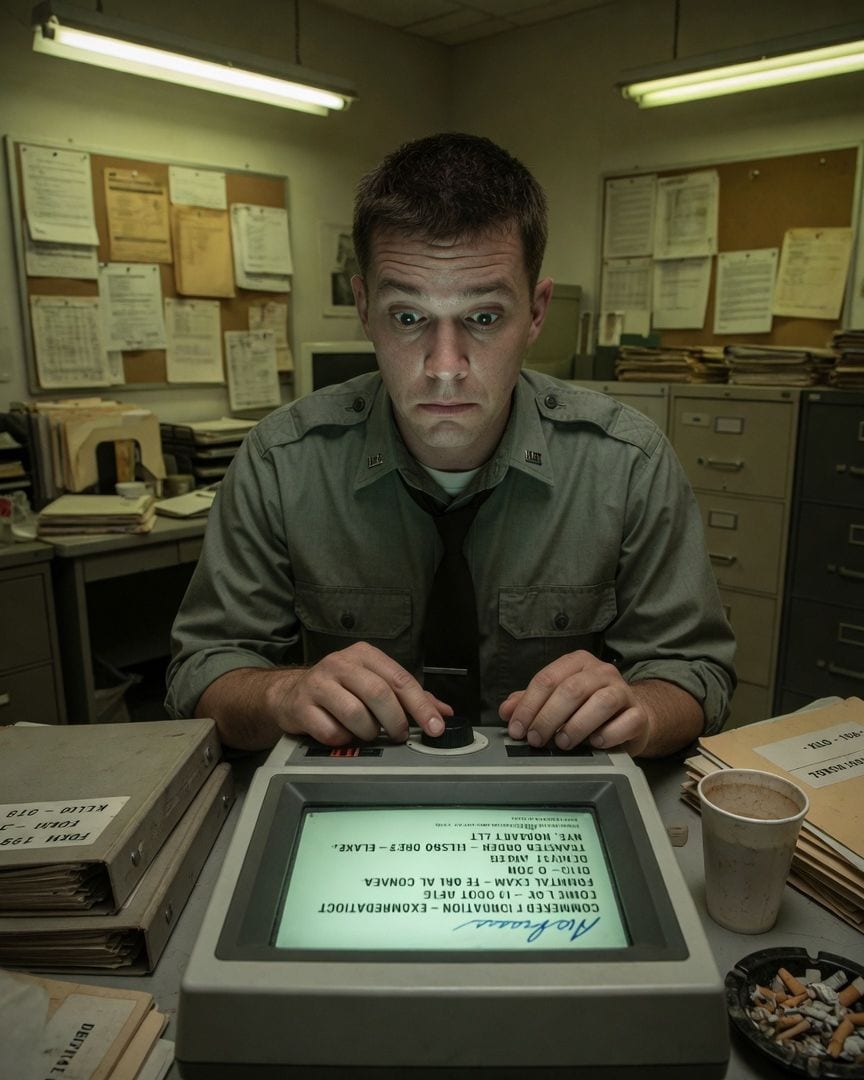
A missile commander watched his ten nuclear silos go dark. His own service record shows his signature on a future he's never lived.
Second Lieutenant Hobart Nye, a missile commander in Wyoming, had his quiet 0247 watch shattered by a security report: a massive, silent black triangle hovered over Launch Facility Kilo, casting a perfect shadow. Hobart watched his console's fault panel light up, signaling all ten nuclear missiles going dark in an impossible silence, followed by eleven minutes his security team could not remember. Official logs called it a "radio malfunction," but Hobart found a requisition for invisible-tracking sensors, signed by a base commander who was supposed to be off-base. The final, chilling discovery came when his own service record showed new entries—a dental check-up, a transfer to Alaska—all dated for a future he never lived, complete with his perfectly replicated signature.
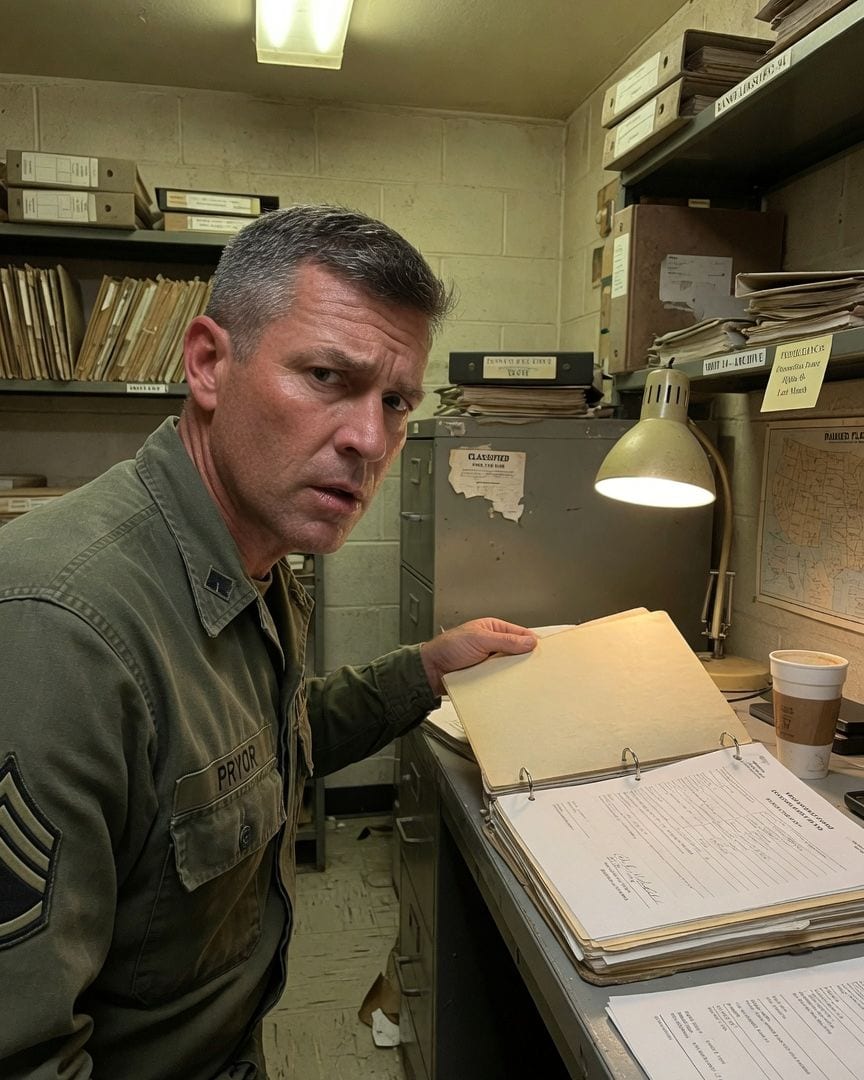
A sergeant with eleven days left finds a warm, glassed crater. Its file shows a captain lost thirty years ago is still signing reports from last week.
Sergeant Alden Pryor was counting down his final eleven days on a twenty-year hitch, expecting to spend them on routine patrols along the Ranier Flats fence line. Instead, his truck stopped at a bizarre sight: a four-hundred-foot glassed crater, miles from anywhere, its sand faintly warm at dawn despite no one recalling a blast. The air above it shimmered with an unnatural distortion, a silent scar of erased violence, and the official file for 'Shot 14' showed recent maintenance sign-offs for a decommissioned tower at the crater site. All these active documents were signed by Captain Everett Caldwell, who had been officially lost in operations thirty years ago, leaving Sergeant Pryor to wonder how a dead man could still be filing reports.
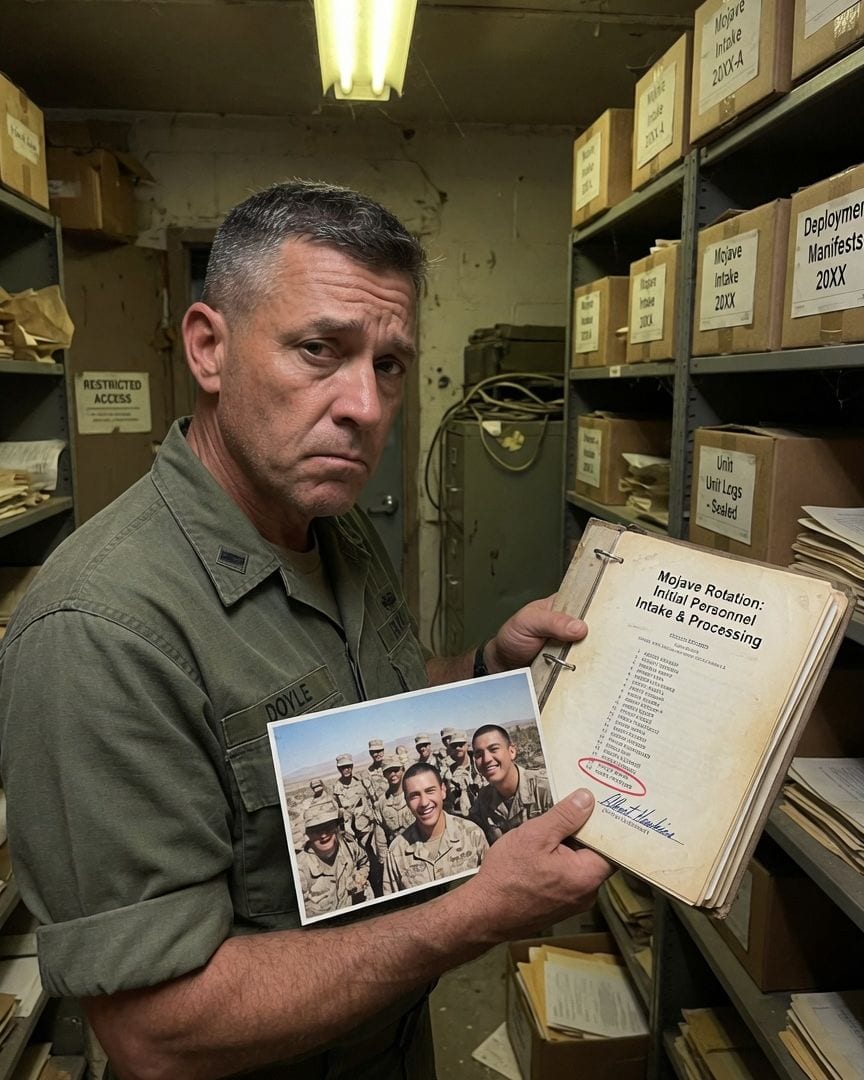
Master Sergeant Doyle's old platoon photo showed 31 men. But between Suggs and Ramos, a 32nd man stood grinning, named on Doyle's own signed manifest.
Master Sergeant Vincent Doyle was packing away twenty-five years of service, each box holding memories of the men he'd led. He paused at a faded platoon photo from the Mojave, a familiar thirty-one faces staring back. But then, a thirty-second man, Albert Hawkins, stood grinning between two of his men, a face Doyle couldn't place. His memory, usually perfect, insisted only thirty-one were there. Despite his colleagues recognizing the name, their own recollections dissolved, pushing Doyle to scour every record he'd personally signed – each one confirming thirty-one men, until he opened the very first intake manifest, bearing his signature, listing thirty-two.
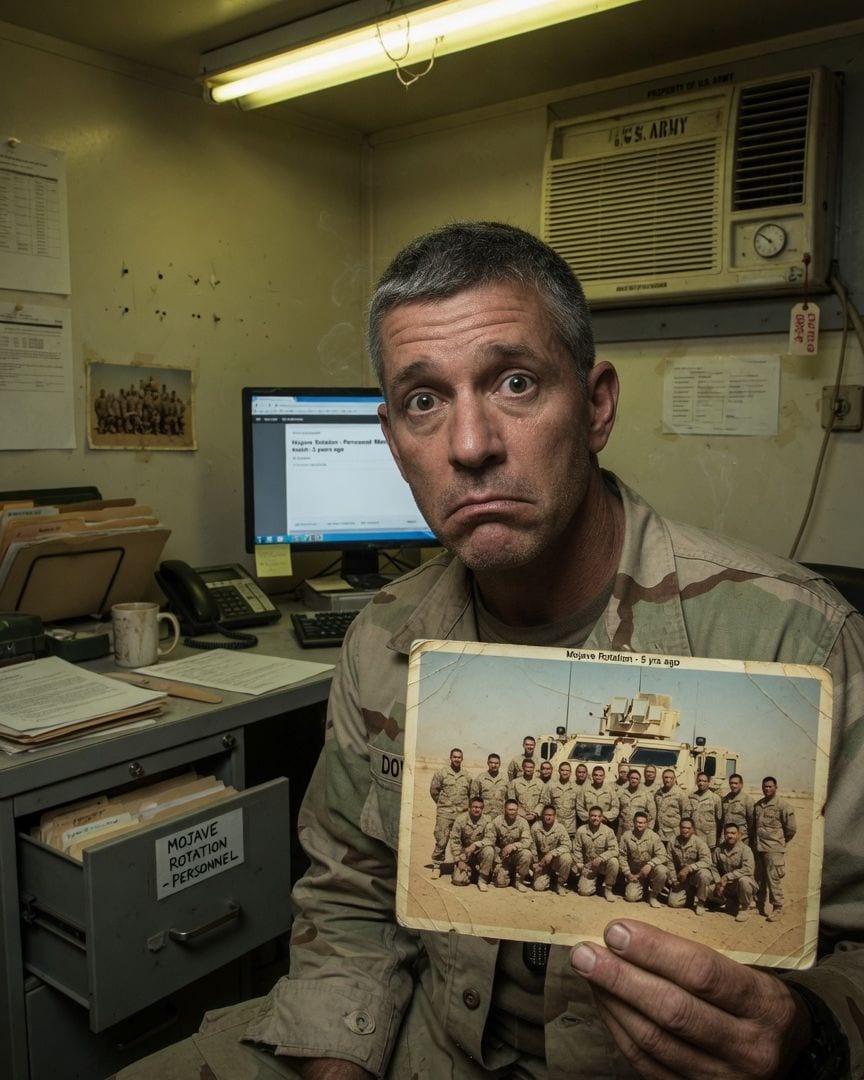
Two weeks from transfer, Master Sergeant Doyle’s old platoon photo now showed a 32nd man grinning from the back row.
Master Sergeant Oliver Doyle was two weeks from his transfer, overseeing the final decommissioning of FOB Erebus, finding solace in routine. His old Mojave platoon photo, a yellowed record above his desk, always showed thirty-one faces from his past. This morning, however, an extra man grinned from the back rank, a face both familiar and utterly alien. When he showed it to Sergeant Barlow, the younger man immediately named the newcomer, "Ryan Stratton," a name Doyle hadn't spoken, yet one that felt ready on Barlow's tongue. Official records listed only thirty-one, but a hidden digital history revealed a manifest with thirty-two names, signed by Doyle himself.