Master Sergeant Doyle found his own signature on a soldier’s commendation he knew he never signed.
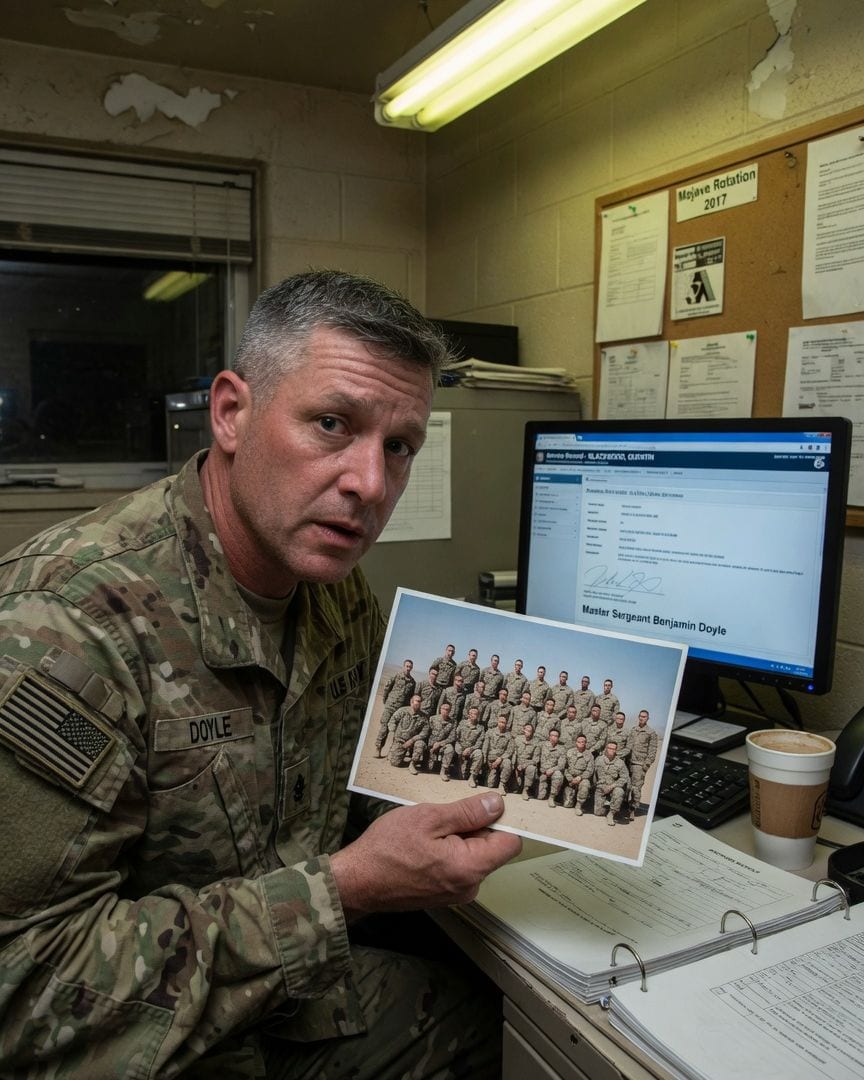
Master Sergeant Benjamin Doyle, a man whose life was built on manifests and head counts, kept his Mojave rotation platoon photo tacked over his desk. Thirty-one faces, each one a name he could call in the dark.
Every morning, he’d glance at it, a quiet ritual of acknowledgment. This morning, the ritual broke.
There were thirty-two faces. An extra man stood in the back rank, between Suggs and Ramos, grinning, his face half-familiar, like a name on the tip of his tongue. Doyle frowned, leaning closer. He knew every man in that photo.
He had known every man. The fluorescent lights of his office hummed, casting a flat, unchanging glow, but the photo seemed to shift, the extra face asserting its presence.
Doyle carried the photo to Staff Sergeant Walsh’s office, a woman whose memory for faces and files was as sharp as his own. He held it out, the glossy print feeling suddenly heavier in his hand.
“You recognize him?” he asked.
Walsh squinted, taking the photo. Her eyes traced the ranks, then landed on the smiling interloper. “Yeah, sure. That’s… that’s Blackwood, right? Quentin Blackwood.” She looked up, her brow furrowed, a flicker of something unplaceable in her gaze.
“Wait, where do I know him from?”
Doyle felt a cold knot tighten in his gut. He tried Sergeant Thomas Russo, another Mojave veteran, found sorting supply requisitions in the adjacent bay. Russo, too, named Blackwood instantly, a quick nod of recognition, then stammered. “Blackwood?
Yeah, good guy. Small guy, but tough. Wait… what unit was he in? I can’t… I can’t place him, Master Sergeant.” Russo frowned, scratching his head, genuinely bewildered.
The rational explanations, like a bad prank or a photoshopped image, crumbled under the weight of shared, unplaceable memory. How could three people recognize a man who wasn’t supposed to be there, yet recall nothing about him?
Doyle returned to his office, the photo now feeling heavy in his hands, its smiling mystery growing denser. He pulled it from the wall, flipped it over, then carried it to his computer.
He accessed the Mojave deployment roster, a digital record of every man, every serial number, every transfer. Thirty-one names. No Quentin Blackwood. He cross-referenced the names of every unit on that rotation, every attached personnel file. Nothing.
Blackwood simply didn’t exist in the official system for that deployment. The database, usually an unyielding arbiter of truth, offered only silence.
But then, a thought struck him, a faint whisper of memory. He remembered a specific, unusually hot patrol, a scouting mission deep into the desert, an ambush that had gone sideways. A chaotic firefight.
He pulled up the archived physical duty logs from that period, meticulously scanned into the system. The digital file loaded slowly, the pixels of the old paper record swimming before his eyes.
He found the entry for the patrol, signed by him, detailing the roster of the four-man team. And there, scrawled in what looked undeniably like his own handwriting, was ‘Pvt. Q. Blackwood, attached.’
Doyle stared at it, a chill running through him. He had signed this. He had no memory of it.
His office, usually a bastion of order, suddenly felt vast and unsettling, the hum of the server racks sounding like a distant, knowing whisper.
The discrepancy gnawed at Doyle. He spent the rest of the day in a digital rabbit hole, chasing the ghost of Private Blackwood through the labyrinthine military database.
He tried every permutation of the name, every possible service number, every unit attached to the Mojave rotation. His fingers flew across the keyboard, the screen a blur of names and dates, each search yielding nothing.
The office grew dark around him, the only illumination the harsh blue glow from his monitor. Fatigue began to set in, blurring the edges of his vision, making him question if he was simply seeing things.
He leaned back, scrubbing a hand over his face.
Finally, late into the evening, a hit. A full, unimpeachable service record for a ‘Quentin Blackwood,’ complete with a valid service number, commendations, and a full deployment history that included the Mojave rotation. Doyle’s breath caught in his throat.
Blackwood had been awarded a Valor Citation for the very ambush Doyle had just found in the duty logs. Doyle clicked to view the citation.
And there it was, at the bottom of the official document, certifying the award: his own name, Master Sergeant Benjamin Doyle, followed by his rank and a digital signature identical to his own.
He stared at the screen, the fluorescent lights of the deserted office humming around him, the silence pressing in. He had signed this. He knew he hadn’t. He knew it with every fiber of his being.
The next morning, Doyle laid out his findings for Staff Sergeant Walsh. She listened, her usual meticulous composure slowly eroding into a tight frown, her gaze fixed on the screen where Doyle’s signature mocked him from the Valor Citation.
“A service record that’s perfect, but the man doesn’t exist in any of our manifests? And your signature… that’s impossible, Ben.”
Walsh, a master of military bureaucracy, began pulling every thread. They cross-referenced Blackwood’s service number with every known unit, every assignment roster, every medical file.
Each search returned a valid match for the service number, but zero personnel attached to it, as if the number itself was real, but the human behind it was a phantom. They checked pay stubs, leave requests, even uniform requisitions.
Blackwood existed only as data, a perfect, unassailable, yet utterly untraceable digital ghost.
The air in the records office, usually thick with the scent of old paper and toner, seemed to grow thin, the quiet hum of the computers suddenly unnerving.
Walsh, her curiosity now fully engaged, suggested they check the access logs for Blackwood’s digital file. Who else had been looking at this impossibility? She typed in the parameters, and the screen populated with a list of recent accesses.
Near the top, a familiar name. General David Easton. Doyle’s stomach dropped.
General Easton was a high-ranking officer, known for his long tenure and his almost legendary memory for military history, but he had no direct connection to their unit or the Mojave rotation.
His presence in the access logs was deeply unsettling, a sign that this anomaly reached far higher than a simple clerical error.
The following days brought a subtle shift. Doyle found his office door ajar more often than he left it.
Files on his desk, meticulously organized, would be subtly out of place, a memo shuffled into the wrong folder, a pen moved from its holder. He dismissed it as paranoia, the stress of the investigation playing tricks on him.
The chill in the office, usually a consistent, regulated temperature, seemed to fluctuate, a cold draft brushing his neck even with the door closed.
Then, a call came. General Easton’s aide requested Doyle’s presence. In Easton’s cavernous office, filled with relics and commendations from decades of service, the General sat behind a polished desk, his expression unreadable.
Easton offered Doyle coffee, spoke briefly of his upcoming transfer and the promising future in a training command. Then, without preamble, he shifted, his posture straightening slightly, the air in the room seeming to thicken.
“Master Sergeant Doyle,” Easton began, his voice calm, even. “I understand you’ve been looking into some… irregularities. Personnel matters from your Mojave rotation.”
Doyle felt a prickle of unease, a cold sensation spreading through his chest. “Sir, I’m just trying to square away some discrepancies before my transfer. Professional integrity.”
Easton smiled faintly, a tight, thin line. “Of course. A commendable trait. But sometimes, Master Sergeant, some discrepancies are best left undisturbed. They can become… complicated. For careers. For the institution.” His gaze was steady, unwavering, holding Doyle’s.
“You’re a good soldier, Doyle. Don’t let a phantom spoil a promising future.” The implicit threat hung in the air, cold and clear, the weight of it pressing down like the heavy, unseen hand of the institution itself.
Doyle left the office with the distinct, chilling sensation of being watched, not just by Easton, but by something larger, unseen, that had already taken notice of his digging.
Doyle and Walsh knew Easton’s warning wasn’t a dismissal. It was confirmation. They requested another meeting with the General, this time armed with the physical duty log, the digital service record, and the photograph.
Easton greeted them with a cool, resigned air, his eyes already betraying a deeper knowledge. “Still pursuing this, Master Sergeant?”
Doyle laid the evidence on his desk, spreading the photo, the scanned log, and the printout of the service record. “Sir, with all due respect, this isn’t a discrepancy.
This is a man who exists on paper, with a valor citation signed by me, but who was never physically present in my platoon. And you accessed his file.”
Easton sighed, the calm facade cracking for a moment, revealing a profound weariness. “Very well. You’re persistent. And you’re right, Master Sergeant. It’s… an anomaly.”
He paused, choosing his words carefully, his gaze drifting to the framed photos of past commanders on his wall. “Quentin Blackwood was an 'unaccountable personnel event.' It’s rare. Very rare. A glitch in the system, you might say.”
Walsh interjected, her voice tight with disbelief, “A glitch, sir? That leaves a perfect service record and influences the memories and signatures of other personnel?”
Easton leaned forward, his voice dropping to a near whisper, compelling them closer. “These events… they manifest. Briefly. They integrate, for a time, into units, into records. Then they dissipate. The records are… adjusted. Contained. To prevent panic.
To preserve the integrity of the chain of command. We call them Echo-Class Personnel Manifestations.” He pushed a hand through his thin, graying hair. “It’s an isolated phenomenon, Doyle. A ghost in the machine.
It’s been happening for decades, but always contained. Always rare.” He looked at Doyle, a flicker of something close to pity in his eyes. “You’ve seen more than most. Now, you understand the need for discretion.”
Doyle felt a profound shift in his understanding. It wasn’t a mistake. It was real. And it was being managed. The room suddenly felt smaller, airless, as if the walls themselves were closing in on the impossible secret.
Easton’s explanation, delivered with a chilling calm, was meant to close the book. But Doyle and Walsh were soldiers, trained to question, to verify. “Isolated?”
Walsh muttered as they left Easton’s office, the heavy door thudding shut behind them like a final judgment. “A phenomenon for decades, but always rare? That doesn’t track.” They knew the military.
Nothing, not even a glitch, went unrecorded, especially if it recurred. There had to be something more. They needed to find the deeper records, the ones Easton hadn’t shown them, the true history of these “Echoes.”
Their search led them to the oldest part of the base, a forgotten annex housing physical archives that predated digital systems.
The air inside was thick with the scent of mildew and decaying paper, cold despite the warm desert day outside. Dust motes danced in the sparse beams of light filtering through grimy windows.
Row after row of heavy, leather-bound unit logbooks, dating back to the Korean War, lined the shelves, monuments to forgotten campaigns. It was a needle in a haystack, but Walsh had a hunch.
“If it’s a pattern,” she reasoned, her voice echoing in the cavernous space, “there has to be a way they identified it, even before computers.”
They worked for hours, sifting through brittle pages, their hands coated in the fine grit of history. Then, Walsh let out a sharp gasp, her finger freezing on a page.
On a unit roster from a 1971 deployment to Vietnam, neatly typed beside a dozen names, was a handwritten entry for ‘PFC Q. Blackwood.’
And next to it, stamped in fading red ink, the exact same cryptic symbol and the word 'UNACCOUNTABLE' that they had found in a dozen other logs from disparate units and dates.
Doyle and Walsh returned to General Easton's office, carrying not just the single 1971 logbook, but a stack of others, each bearing the same 'Q. Blackwood' entry and the 'UNACCOUNTABLE' stamp, spanning different wars, different units, different decades.
They laid them out on his polished desk, the weight of history pressing down. The old leather covers, some cracked and faded, formed a grim mosaic across the gleaming wood.
Easton looked at the stack, his face etched with a weariness that went beyond his years. He didn't deny it. He didn't try to explain it away. He simply conceded.
“You found the markers,” he said, his voice barely above a whisper, the sound lost in the sudden, heavy silence of the room. “The system. The containment.”
“These are 'Echo-Class Personnel Manifestations,' Master Sergeant,” he continued, his gaze sweeping over the old logbooks. “They are not a threat, not in the way you understand. They are simply… echoes.
They appear, they integrate, they exist for a time, then they fade. They leave behind these traces – the records, the faint memories. They are never violent, never malicious. But they are impossible.”
He opened a hidden drawer in his desk and pulled out a slim, classified binder, its cover a stark, featureless gray. “This is the protocol. Established in 1968, refined over the decades.
It outlines how to identify, track, and, most importantly, contain the information surrounding these events. To prevent mass hysteria, to maintain the integrity of our forces. We’ve known for generations.”
The binder contained internal memos, after-action reports, and detailed instructions for 'record adjustment' and 'memory containment protocols,' all meticulously documented, all stamped with the highest classification.
Every clue, every impossible signature, every half-remembered name, every cryptic stamp, clicked into place with horrifying coherence.
The pieces of the impossible puzzle fit together perfectly, forming a picture of an institution managing a truth too vast and unsettling for the world to bear.
The full truth was not a monster to be fought, but a systemic, unexplainable reality that stretched back decades, a silent, impossible current beneath the surface of military order.
Easton, now calm and almost paternal, looked at Doyle and Walsh, his expression softened by a strange blend of resignation and understanding.
“You have a choice now,” he said, his voice gentle but firm. “You can try to expose this. But what would that achieve? Panic? A collapse of trust in the institution?
Or you can understand that this, too, is a form of service. To maintain order. To protect what we can.” He gestured to the binder, then to the stack of old logbooks.
“We have an ongoing need for discreet, meticulous personnel to manage these events. To ensure the records are maintained, the patterns are tracked, and the public remains… undisturbed. There are roles for people like you, Master Sergeant.
And Staff Sergeant Walsh, your skills with records would be invaluable.”
Doyle felt a profound sense of defeat, not in a battle lost, but in the crushing realization that there was no battle to be won. The anomaly wasn’t evil; it was simply… a fact.
An impossible truth woven into the very fabric of the institution he had dedicated his life to, a silent, pervasive wrongness. His faith in the absolute order, the perfect accountability of the military, was shattered.
He couldn’t fight a phenomenon that simply was. He looked at Walsh, who met his gaze with a mixture of terror and grim understanding, her face pale in the stark office light. He knew what he had to do.
“No, sir,” Doyle said, his voice hollow, barely a whisper in the silent room. “I won’t expose it. But I won’t join your… containment either.”
He pushed himself away from the desk, the heavy weight of the knowledge settling in his bones. “I’m taking my transfer. And I’m leaving this behind.”
He had found the truth, but it came at the cost of his certainty, his belief in the squared-away world. He was getting out, but he was leaving a piece of himself, the unquestioning soldier, behind.
Doyle’s transfer to the training command went through without a hitch, Easton’s influence ensuring a quiet departure.
He left the Mojave platoon photo on his desk, its extra face a permanent fixture he no longer had the heart to confront, a silent testament to the impossible.
Staff Sergeant Walsh, too, was quietly reassigned, not to the containment program, but to a newly created, highly specialized records department focused on “historical anomalies.”
The military machine continued its relentless grind, the vast, ordered system absorbing the impossible truth, containing it, and moving forward as if nothing had fundamentally changed.
The Echoes, an unseen current beneath the tide of human endeavor, remained a secret, a controlled variable in the greatest accounting system on Earth.
Weeks later, at his new post in a sun-drenched training facility, Doyle found himself staring at a fresh stack of incoming personnel rosters for a new platoon of recruits.
He was running through the names, ensuring every detail was accurate, every service number accounted for.
It was routine, comforting work, the kind he had always excelled at, a bastion of order in a world he now knew was fundamentally untidy.
As he reached the bottom of the last page, his eyes snagged on something almost imperceptible. A faint, almost erased entry, just below the last recruit’s name. A service number, followed by ‘Pvt. Q. Blackwood.’
And next to it, faded but unmistakable, the same cryptic symbol and the word ‘UNACCOUNTABLE.’ Doyle paused, his hand hovering over the entry, the silence of the office suddenly absolute. He knew it was there.
He knew it would always be there. He picked up his pen, a heavy sigh escaping him. He carefully erased it, knowing it would simply reappear.
If this one got to you
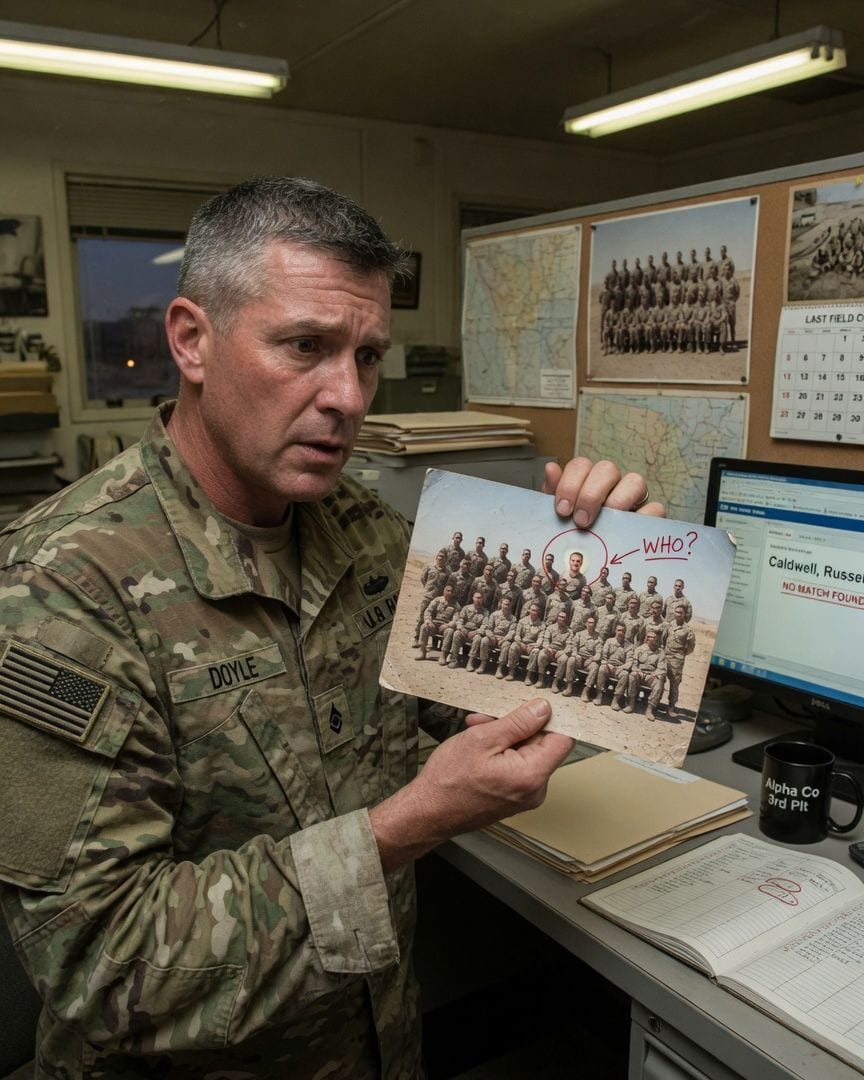
Weeks from his transfer, Master Sergeant Arthur Doyle's platoon photo had an extra man, grinning between Suggs and Ramos.
Master Sergeant Arthur Doyle, weeks from a quiet desk job, performed his usual ritual: staring at his platoon photo. He knew every one of the thirty-one faces from his last Mojave rotation by heart, but this morning, a thirty-second man grinned blandly between Sergeant Suggs and Private Ramos. When pressed, his soldiers named the man instantly as 'Caldwell,' yet couldn't explain how they knew him or when he'd joined. Doyle's personal logs and official unit manifests held no record of a Private Russell Caldwell, leaving him to question everything he thought he knew.
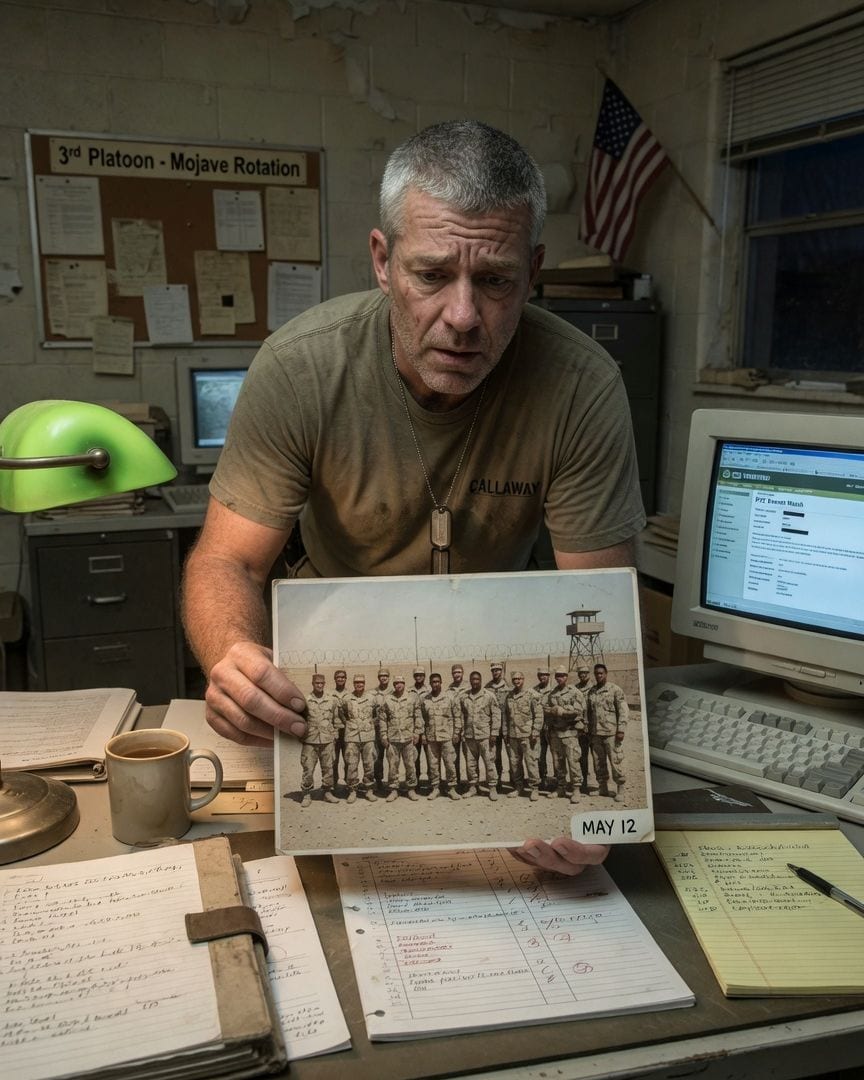
An extra man grinned from Master Sergeant Calloway's old platoon photo. His own men named the stranger he'd never seen.
Nearing retirement from the U.S. Army, Master Sergeant Trevor Calloway kept his platoon photo from the Mojave rotation tacked over his desk, every face a familiar memory. But a week before his final deployment, a casual count revealed a chilling impossibility: an extra man, grinning broadly, stood perfectly positioned in the back rank. His own soldiers, Suggs and Ramos, readily named the stranger "PFC Everett Walsh," yet Calloway knew with undeniable certainty that no such man had ever served under him. The question of the extra soldier, known by his men but unknown to him, solidified a cold, hard knot in Calloway’s stomach. How could a man exist in their shared history, yet be entirely absent from his memory?
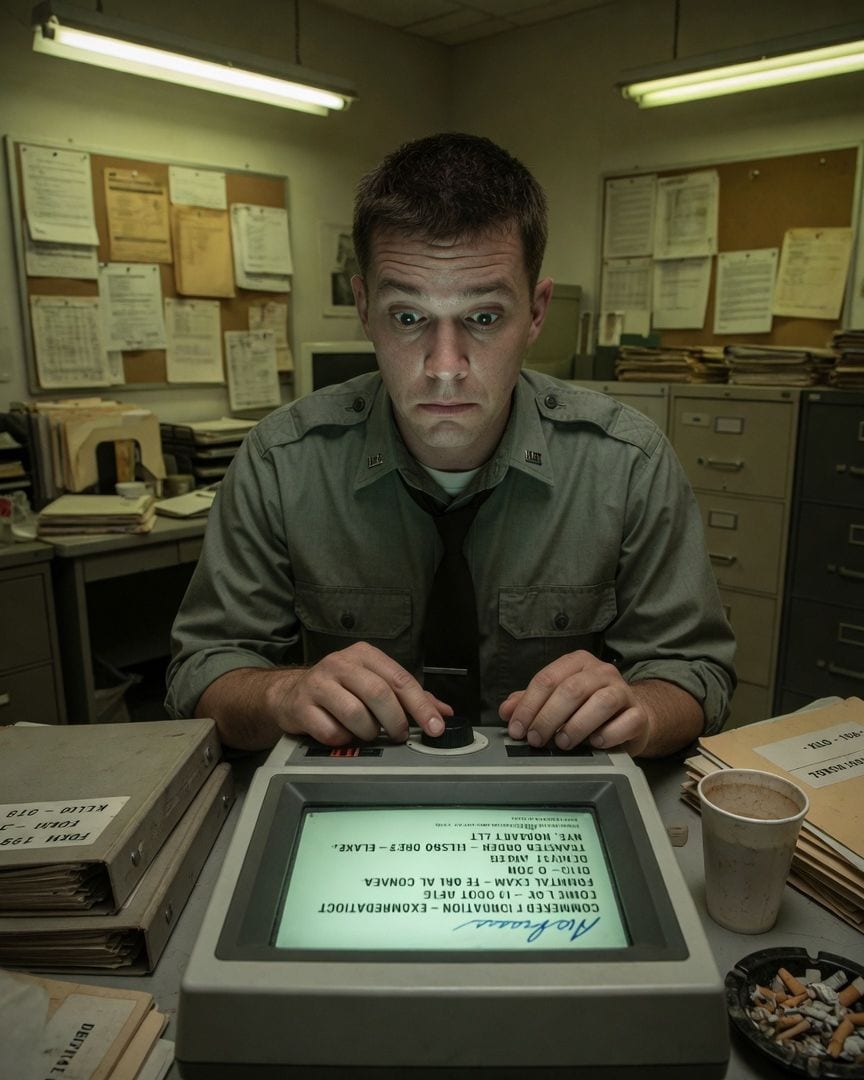
A missile commander watched his ten nuclear silos go dark. His own service record shows his signature on a future he's never lived.
Second Lieutenant Hobart Nye, a missile commander in Wyoming, had his quiet 0247 watch shattered by a security report: a massive, silent black triangle hovered over Launch Facility Kilo, casting a perfect shadow. Hobart watched his console's fault panel light up, signaling all ten nuclear missiles going dark in an impossible silence, followed by eleven minutes his security team could not remember. Official logs called it a "radio malfunction," but Hobart found a requisition for invisible-tracking sensors, signed by a base commander who was supposed to be off-base. The final, chilling discovery came when his own service record showed new entries—a dental check-up, a transfer to Alaska—all dated for a future he never lived, complete with his perfectly replicated signature.
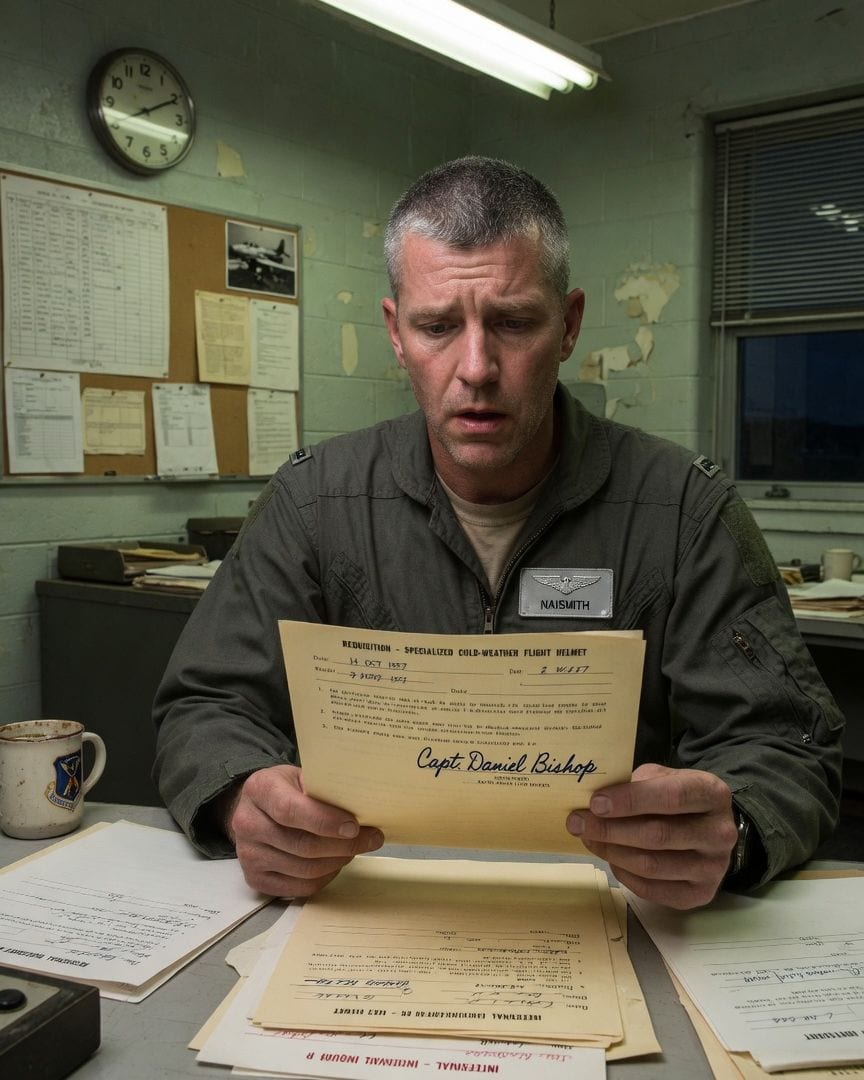
A Cold War Colonel reviews a missing pilot's file and finds Captain Bishop's signature on a form dated weeks after he vanished.
Colonel Ward Naismith faced the grim task of reviewing Captain Daniel Bishop’s personnel file, a routine chore for a man listed as Missing in Action. Bishop had vanished days after he and Naismith chased an impossible, silent disc over Lake Superior, leaving only an empty patch of air and a knot of unease in Ward's gut. Sifting through commendations, Ward found a requisition for flight gear and a maintenance sign-off, both dated *after* Bishop’s disappearance. The true chill came with the requisition for a specialized flight helmet, bearing Captain Bishop’s unmistakable signature, weeks after he was presumed lost. How could a man presumed lost have signed anything?
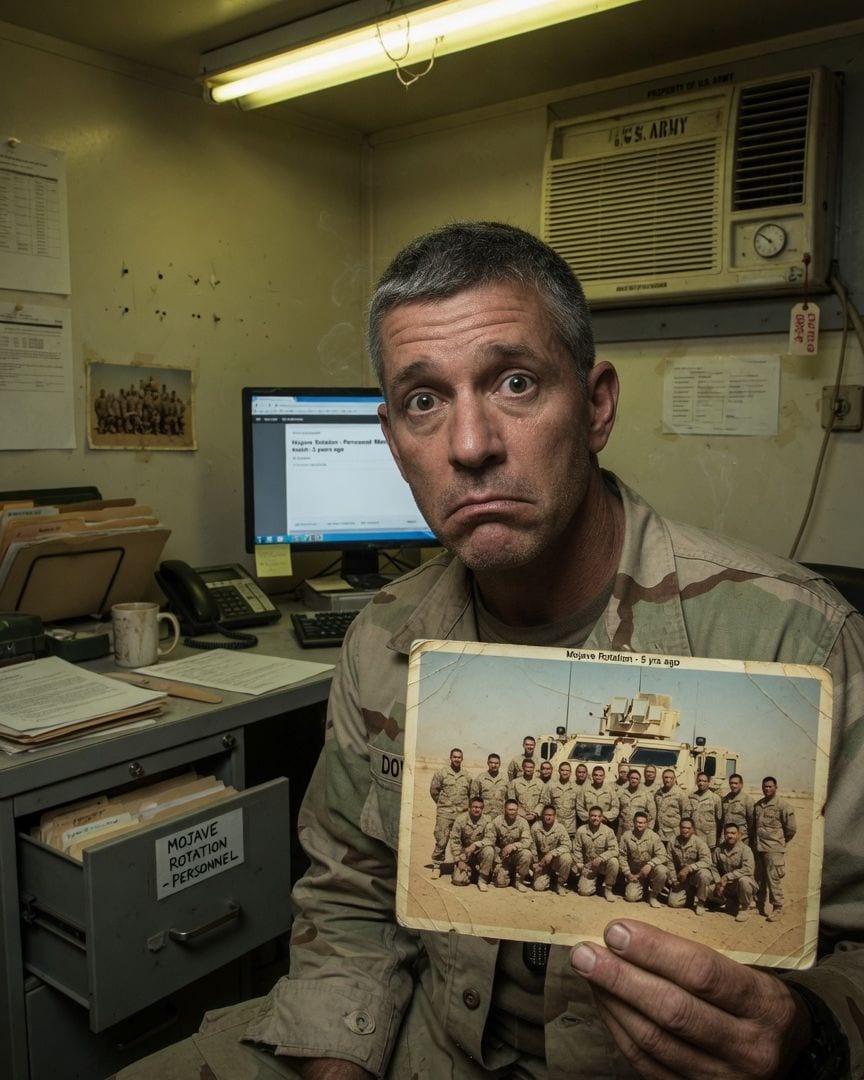
Two weeks from transfer, Master Sergeant Doyle’s old platoon photo now showed a 32nd man grinning from the back row.
Master Sergeant Oliver Doyle was two weeks from his transfer, overseeing the final decommissioning of FOB Erebus, finding solace in routine. His old Mojave platoon photo, a yellowed record above his desk, always showed thirty-one faces from his past. This morning, however, an extra man grinned from the back rank, a face both familiar and utterly alien. When he showed it to Sergeant Barlow, the younger man immediately named the newcomer, "Ryan Stratton," a name Doyle hadn't spoken, yet one that felt ready on Barlow's tongue. Official records listed only thirty-one, but a hidden digital history revealed a manifest with thirty-two names, signed by Doyle himself.
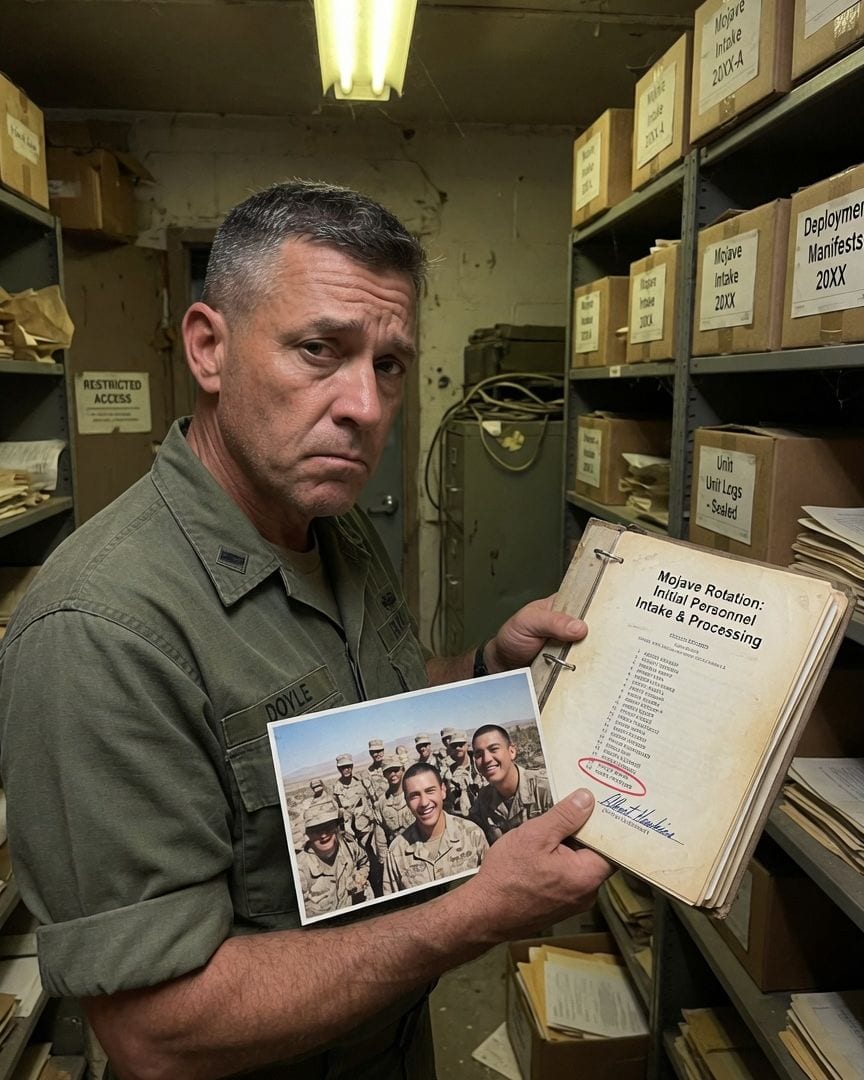
Master Sergeant Doyle's old platoon photo showed 31 men. But between Suggs and Ramos, a 32nd man stood grinning, named on Doyle's own signed manifest.
Master Sergeant Vincent Doyle was packing away twenty-five years of service, each box holding memories of the men he'd led. He paused at a faded platoon photo from the Mojave, a familiar thirty-one faces staring back. But then, a thirty-second man, Albert Hawkins, stood grinning between two of his men, a face Doyle couldn't place. His memory, usually perfect, insisted only thirty-one were there. Despite his colleagues recognizing the name, their own recollections dissolved, pushing Doyle to scour every record he'd personally signed – each one confirming thirty-one men, until he opened the very first intake manifest, bearing his signature, listing thirty-two.