A curator found a guidon dated 1989. The museum took it in 1988, but the Cold War airman on its tag vanished in 1954.
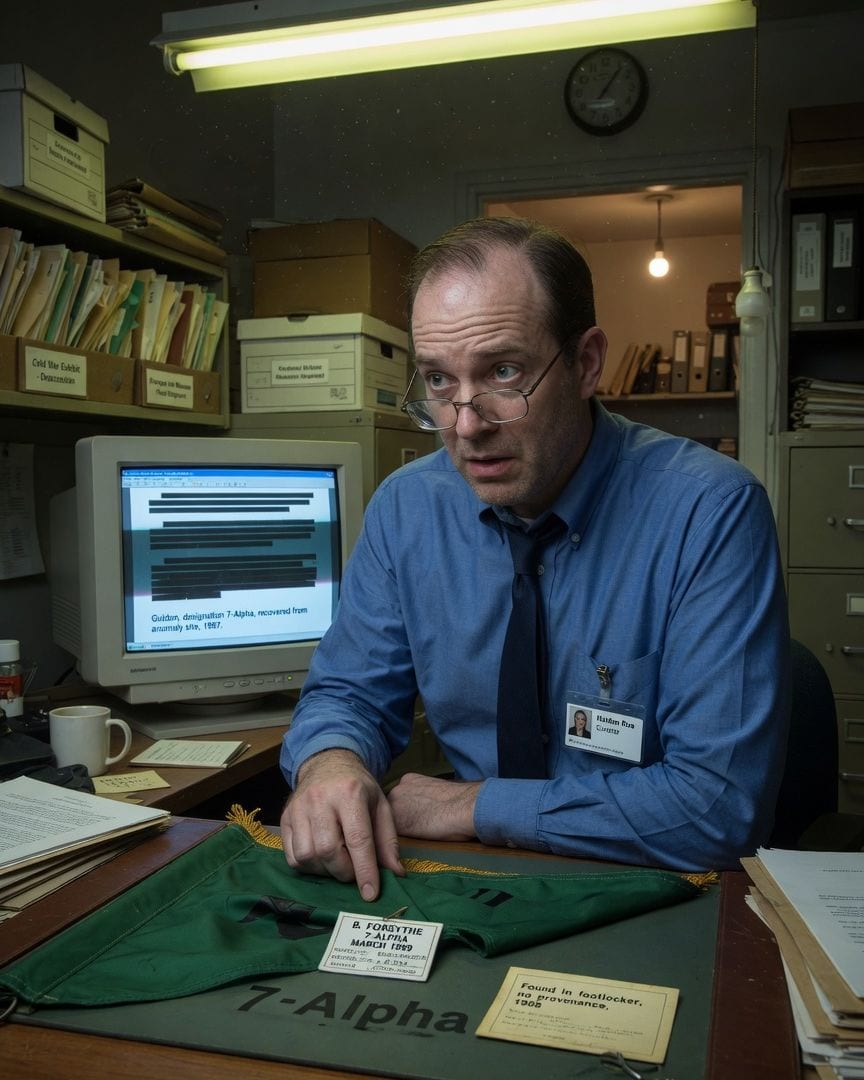
Halden Roe, a meticulous curator, carefully slid the last boxed artifact into the storage unit, the dust motes dancing in the single bare bulb's glare.
The Cold War exhibit at the Presque Isle Museum was closing, a deadline pressing down on him. He reached for the final item: a guidon, its green silk surprisingly supple despite what its age should have dictated.
Emblazoned on its field was a stark numeral, 7-Alpha, a designation no military lineage board Halden knew recognized.
He pulled the guidon from its pole, intending to fold it. As his fingers smoothed the fabric, he felt a slight, unexpected bulge in the sleeve that held the pole.
Tucked flat against the channel, barely visible, was a small, crisp laundry tag. It was sewn into the fabric with fine, precise stitching. Halden’s brow furrowed. He hadn't noticed this tag before.
He slid it out, revealing a service number, a company designation, and then, in perfectly legible black stitching, a date: 'MARCH 1989'.
Halden paused, his breath catching in the chilly storage room air. He stared at the date, then back at the guidon. The museum’s intake record was explicit: the guidon had arrived in 1988, discovered in a footlocker with no provenance.
This tag bore a date from the future. The silk itself, he now realized, was too perfect. Not faded, not worn, but pristine, as if it had simply… appeared. A cold thread of unease began to unravel in his gut.
Halden’s curator’s mind, trained in precision and the rigorous verification of historical artifacts, immediately sought a rational explanation. A misprint, perhaps? A replica’s tag mistakenly sewn into an authentic piece? But the silk, under his expert touch, was undeniably genuine.
The intricate stitching, the slight variation in the weave – it all spoke of an older, authentic manufacture. It wasn’t a replica.
He retreated to his office, the guidon carefully laid across his desk, the impossible tag glaring up at him. He pulled up the museum’s limited records for the piece. "Found in footlocker, no provenance, 1988," it read.
Not a single mention of a laundry tag, let alone a date that defied its own discovery. The fluorescent lights hummed with an unusual intensity, making the silence in the room feel heavier.
Halden then focused on the service number from the tag, typing it into a military personnel database. The search returned a single, clear hit: Benjamin Forsythe. A nineteen-year-old airman. Reported missing off Greenland in 1954.
The dates slammed into each other with the force of a physical blow. 1954: Benjamin Forsythe vanishes. 1988: The guidon is found. 1989: The date stitched on its tag.
The discrepancy wasn't a clerical error Halden could explain away; it was an impossibility, a direct contradiction of chronology. He tried searching for "guidon" and "7-Alpha," the designation on the guidon’s field. Nothing matched.
No unit, no expedition, no historical record bore that particular numeral. It was as if the guidon, and the numbers it carried, existed in their own impossible sphere.
Driven by a cold, building dread that felt entirely out of place in his orderly world, Halden broadened his search. He dug deeper into cold case files from the 1950s, specifically those related to disappearances off the coast of Greenland.
The hours bled into one another, his fingers flying across the keyboard, the glow of the monitor reflecting in his unblinking eyes. He sifted through digitized records, cross-referencing names and dates, chasing ghosts in the archives.
Then, late into the night, he stumbled upon it: a heavily redacted military document from 1955. The title, barely visible through the digital degradation, read: 'Operation Northern Light - Forsythe, B. - Asset Recovery'.
Most of the text was blacked out, solid blocks of digital censorship obscuring any real detail. The air in the office seemed to grow colder, the silence deeper.
But a single, unredacted line near the bottom stood out, a stark beacon in the darkness of the classified material.
It read: 'Guidon, designation 7-Alpha, recovered from anomaly site, 1987.'
Halden stared at the screen, his finger tracing the date. 1987. A full year before the museum’s 1988 intake record, before it was officially 'found'. Before he had ever laid eyes on it.
The 1987 date gnawed at Halden, a splinter of impossibly sharp fact lodged in his meticulous mind. He couldn't shake it. The museum, usually a place of comfort and order, now felt like a stage set for something deeply wrong.
He reached out to Sophia Thornton, a sharp archivist at the National Archives whom he’d collaborated with on obscure historical projects.
He carefully described the guidon’s impossible tag, the future date, and the redacted 1955 document. He framed it as a fascinating historical anomaly, trying to keep his own rising anxiety out of his voice, but the tremor was there.
Sophia, a stickler for verifiable facts, listened patiently. Initially skeptical, she promised to look into ‘Operation Northern Light’ and the ‘7-Alpha’ designation, her voice professional, if a little bemused.
Days later, her call came, jarring him out of a fruitless research spiral. Her voice, usually calm and measured, was tight, stripped of its usual composure. "Halden," she began, "Public records for ‘Operation Northern Light’ yield absolutely nothing.
It's like it never existed. But…" She paused, and Halden imagined her thumbing through index cards, deep in the archives. "I found a cross-referenced index card, buried deep in a Cold War-era manifest.
It points to 'Restricted Access - Project Siren - Guidon Anomaly - 1987'."
The classification, she explained, was highly unusual, almost unheard of for a mere museum artifact. "It's not just classified, Halden," Sophia said, the phone feeling cold against Halden’s ear, despite the warmth of his office. "It’s beyond normal security protocols.
Such a designation typically indicates something far more sensitive than a simple military recovery. Something deliberately obscured."
Halden's inquiries had stirred something. A week after Sophia's unnerving call, an anonymous, unmarked envelope arrived at the museum. It was thick, heavier than a normal letter, and bore no return address, only a generic postmark from a neighboring state.
Halden opened it with a precise utility knife, the paper rasping loudly in the quiet office.
Inside, nestled against a piece of thin cardboard, a single, grainy black-and-white photograph lay. It depicted a younger Halden, perhaps in his mid-twenties, standing in front of a museum display case.
The guidon, unmistakable with its '7-Alpha' numeral, was clearly visible behind him, a familiar, unsettling green. The photograph was dated 1995.
Beneath it, typed on an old manual typewriter, was a chilling message: 'Some things are better left filed.'
Halden felt a cold grip on his chest, a sensation that froze his breath. He remembered that exhibit. He remembered the guidon. But he had never publicly discussed the guidon's oddities before his recent inquiries.
He had, in fact, barely thought about it until he found the impossible tag. Someone had been watching him for decades, silently observing his path, waiting for him to get too close.
The photograph was not a warning, not an attempt to intimidate. It was far worse. It was a testament to patience, to a system that had always been there, observing him before he even knew to look.
The faint click of the office clock suddenly sounded like a timer.
Shaken to his core, Halden knew he needed to speak to someone with deeper connections, someone who might understand the shadows Sophia had uncovered.
He contacted James Holloway, a retired military historian he occasionally consulted, a man whose network extended into the murkier corners of Cold War intelligence. He drove to Holloway's secluded cabin upstate, the anonymous photograph clutched in his hand.
He presented Holloway with the photograph, the heavily redacted 1955 document, and Sophia's 'Project Siren' discovery. Holloway, usually jovial and prone to garrulous anecdotes, grew silent. His eyes, typically twinkling with amusement, hardened as he examined the evidence.
The rustic cabin, usually cozy, now felt heavy with an unspoken truth.
After a long silence, Holloway admitted that 'Project Siren' was not a myth. He spoke in a low, almost hushed voice, as if the walls might be listening.
It was, he explained, a shadow agency, known only to a select few, tasked with 'managing' impossible events and disappearances that defied conventional explanation.
"They don't lose things, Halden," Holloway said, his gaze fixed on a distant point beyond the window. "They file them."
He explained that the '7-Alpha' numeral wasn't a unit designation, as Halden had initially assumed. It was a Bureau classification, an internal identifier for 're-designated assets' – items that had passed through their unique system.
The guidon, he revealed, had been 'returned' by this system, not recovered in the traditional sense. The future date, 'March 1989', was an internal timestamp, a 'return stamp' from their non-linear temporal operations.
Holloway looked Halden dead in the eye, his expression grave. "Stop digging, Halden. The Bureau has a way of absorbing loose ends. They don't want their files reopened."
The fire in the hearth seemed to crackle louder, as if emphasizing Holloway’s warning.
Ignoring Holloway's stark warning felt like a profound betrayal of his own survival instincts, yet Halden felt an irresistible pull towards the truth. He couldn't unsee the dates, couldn't unfeel the chilling implications of the photograph.
He called Sophia, his voice strained with urgency, urging her to access the 'Project Siren' files, specifically the 'Guidon Anomaly - 1987' entry.
He knew he was asking her to cross a dangerous line, but the need for answers eclipsed all caution.
Sophia, now as unnerved as Halden, agreed. Her own archivist's integrity seemed to demand she see this through.
Using her high-level security clearance and a secure terminal deep within the archives – a room so far removed it felt like a vault – she located the file.
It was extensive, hundreds of pages of heavily encrypted data, protected by layers of ancient, analog-sounding protocols. The air in the small, windowless room felt strangely compressed.
Scrolling through the first few pages, they saw Benjamin Forsythe's original missing person reports, detailed descriptions of the 'anomaly site' off Greenland, and cryptic analyses of the guidon's inexplicable properties.
Halden recognized the careful, detached language, far from military jargon, more like a scientific study of a natural phenomenon.
Then, under a section titled 'Known Interested Parties - Current Monitoring,' a list appeared. Sophia gasped, her hand flying to her mouth, a small, choked sound escaping her lips.
The first entry, stark and undeniable on the green-tinted screen, read: 'Roe, Halden. Museum Curator. Initial observation: 1995.'
Halden leaned closer, his own name staring back at him from the screen, chilling him to the bone.
Halden and Sophia stared at the screen, the implications of the file rippling through them like a cold current.
The entry under Halden’s name wasn’t just a casual note; it was a detailed dossier, outlining his career trajectory from his early days, his specific research interests, and even his personal connections.
The file meticulously documented his growing fascination with ‘anomalous historical objects,’ a term clearly coined by the Bureau. It outlined a chilling pattern: individuals who showed sustained interest in ‘re-designated assets’ were eventually ‘processed’ themselves.
The silence in the archive room was absolute, the air thick with unspoken fear.
The '7-Alpha' numeral on the guidon, the file confirmed, was indeed a Bureau classification, marking items that had passed through their unique temporal-spatial processing.
‘March 1989’ was the Bureau’s internal timestamp for when the guidon was released back into the conventional timeline, a date that indicated its departure from their non-linear operations, not its creation or discovery.
Benjamin Forsythe wasn’t merely lost; he was ‘filed’ by this system, categorized, analyzed, and absorbed. The guidon was one of the few things that ever made it back, a receipt from an impossible transaction.
The true horror wasn't in the anomaly itself, Halden realized, but in the meticulous, coherent system that managed it, a system that had been watching him for decades, waiting for this moment.
Every impossible date, every unanswered question, clicked into a horrifyingly logical place.
As the full, horrifying coherence of the file clicked into place, the terminal screen suddenly went black.
The fluorescent lights in the archive room flickered violently, then died, plunging them into near-total darkness, save for the faint glow of emergency exit signs.
A low, rhythmic hum began, a deep vibration that resonated up through the floorboards, seemingly emanating from deep within the building’s ancient foundations.
Sophia gasped, a small, terrified sound, and frantically slammed keys on the dead terminal, but it was unresponsive, cold to her touch.
Then, they heard it: slow, deliberate footsteps approaching their isolated section, echoing eerily in the sudden silence. Each step felt heavy, unhurried, as if the approaching presence knew exactly where they were, knew they couldn't escape.
The hum grew, a resonant thrum that seemed to make the very air dense around them.
Halden instinctively grabbed Sophia’s arm, pulling her towards a service exit he remembered from a fire drill years ago – a heavy, unmarked steel door at the back of the archives.
They burst through it, stumbling into a deserted loading dock behind the National Archives, the hum now a pervasive, physical vibration in the very ground beneath their feet, shaking the concrete.
They ran, the sound of their own pounding footsteps loud in the sudden openness, not knowing if they were truly escaping the building, or merely delaying the inevitable grasp of the Bureau.
Halden Roe and Sophia Thornton disappeared. The Presque Isle Museum quietly reopened its Cold War exhibit, the guidon now missing from its storage locker, its absence noted only in a dusty inventory sheet marked 'unaccounted for'.
Sophia’s position at the National Archives was listed as 'vacant', her office cleared of personal effects as if she had never been there, a blank space where a life once was.
James Holloway, the retired military historian, received a curt, unsigned note in his mailbox: 'The file is closed.' He burned it without a word, the familiar dread settling over him like a shroud, knowing exactly what it meant.
The silence of his cabin felt deeper than before.
Halden found himself in a small, anonymous apartment in a different city, far from any museum or archive. He tried to live a normal life, a routine devoid of history or inquiry.
But every shadow felt like a watchful eye, every official document a potential trap. He avoided history, avoided the news, avoided anything that might hint at the patterns he now saw everywhere, the coherence of the unexplainable.
One evening, he sat at his kitchen table, staring at a blank piece of paper. He picked up a pen, and without thinking, began to write.
Not a report, not a memory, but a series of numbers and an unfamiliar designation, over and over, in a steady, official hand. He couldn’t stop.
Weeks later, a neighbor found the apartment empty, the door unlocked. On the kitchen table lay a single sheet of paper, covered in precise, repetitive markings.
The last line, written in perfect, unhesitating script, read: "The file was still being signed, and now his name was on the next page."
If this one got to you
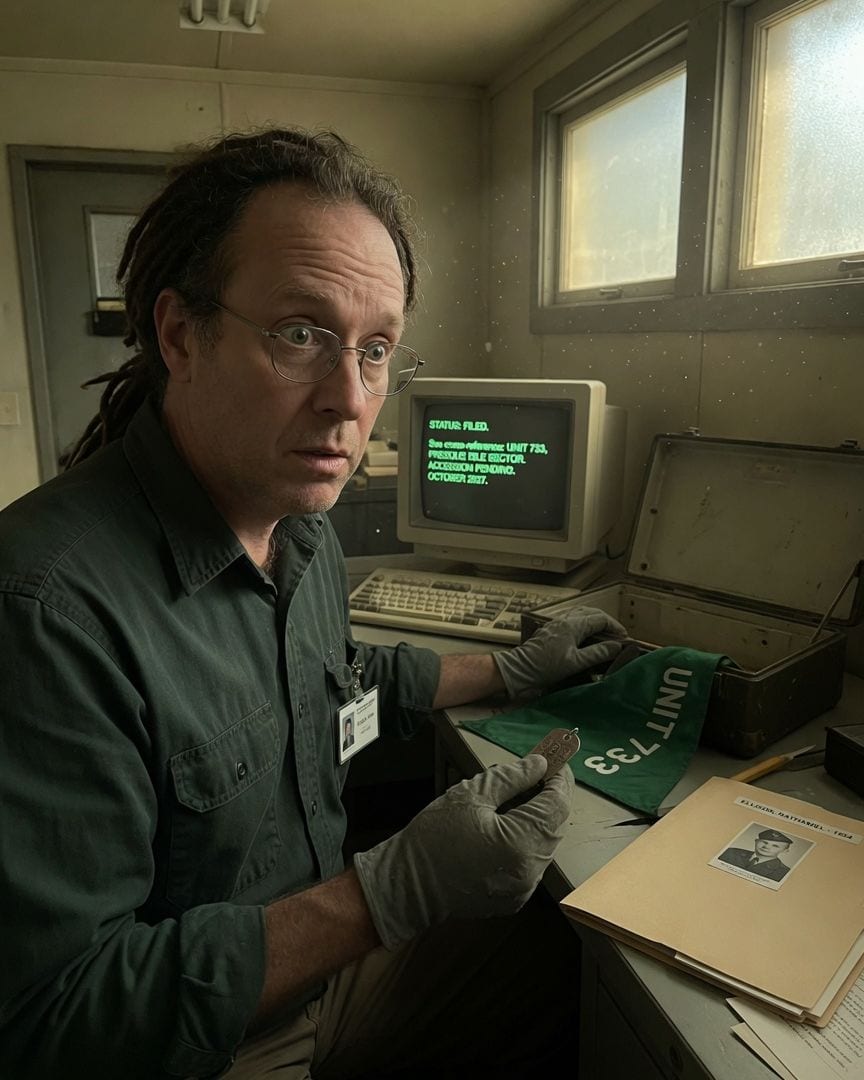
A museum curator finds a Cold War artifact with a missing airman's laundry tag dated March 2025.
Halden Roe, a meticulous museum curator, was carefully decommissioning the Cold War exhibit at Presque Isle. He reverently handled each artifact, preparing them for storage as dust motes danced in the weak sunlight. While unclipping a green guidon, his fingers brushed against an unexpected rigidity. Stitched inside was a laundry tag, bearing a missing airman's service number from 1954, but dated March 2025. The impossible future date on the Cold War artifact shattered everything Halden knew about history.
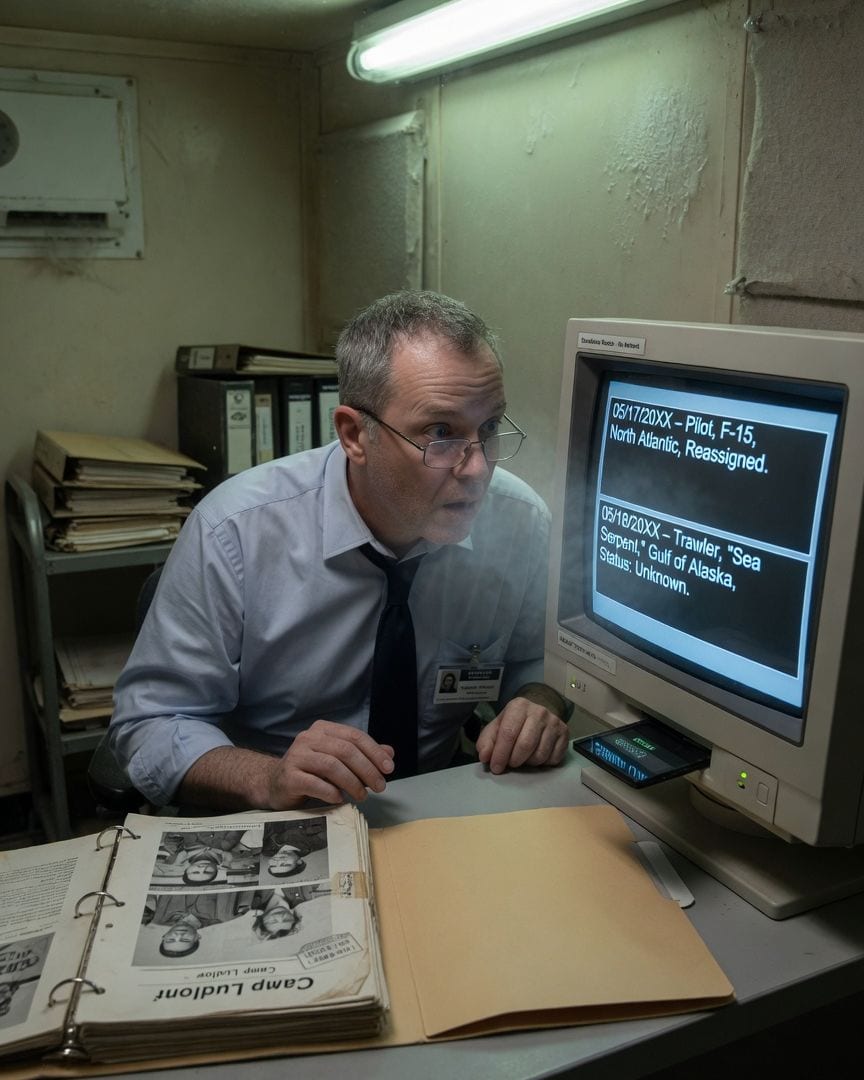
A declassification reviewer opened a Cold War 1959 file. A modern data chip inside showed a pilot missing yesterday.
Declassification reviewer Samuel Vance, whose world was built on the rigid order of official history, smoothed a letter confirming Camp Ludlow’s 1959 closure was a lie. Despite decades of records, the Air Force insisted the Greenland base remained active, its last radio check logged just four days prior. Driven by this profound wrongness, Samuel unearthed the base's ancient physical file, only to find a pristine, modern data chip hidden within its brittle pages. When he inserted it into a secure reader, the screen didn't show history, but a scrolling list of current missing persons—a pilot from yesterday, a trawler from today. How could an archived file hold a living record of the world’s most recent disappearances?
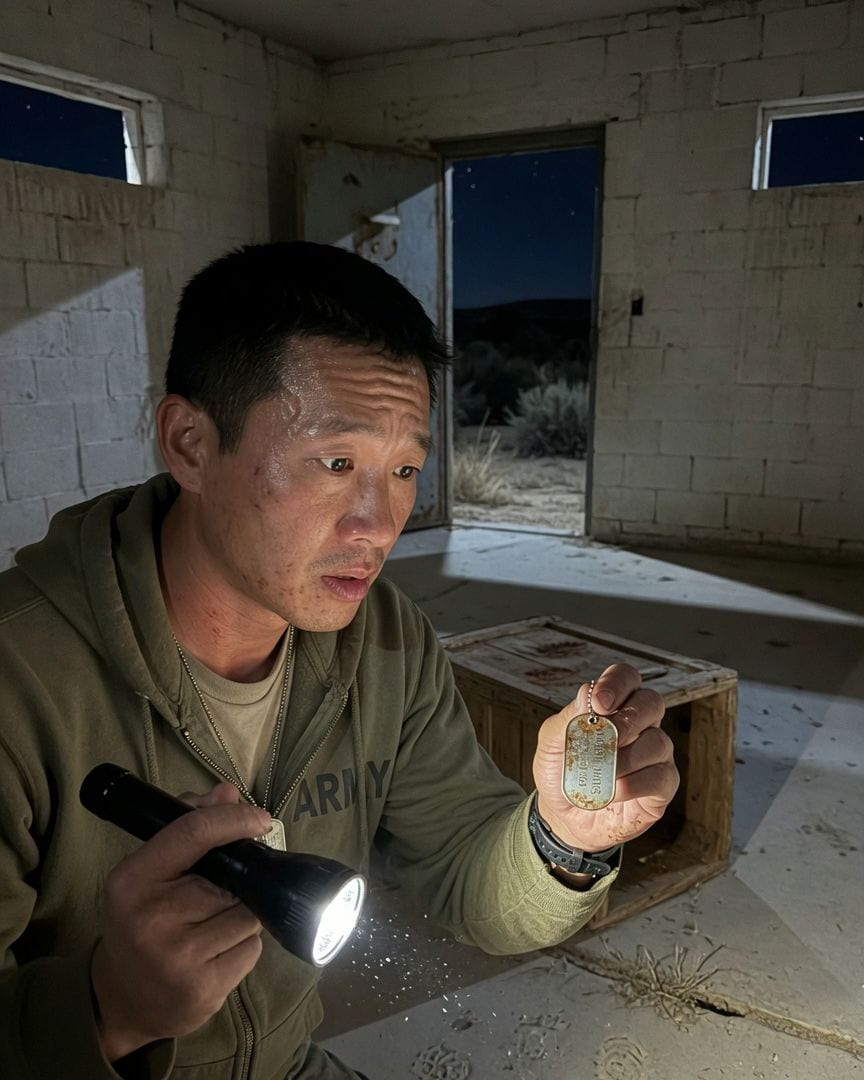
Staff Sergeant Rhee’s squad found a Cold War building not on their map. Range Control confirmed no structure. Minutes later, it vanished, leaving a foundation decades old.
Staff Sergeant Adam Rhee halted his squad at the Yakima Training Center, staring at a cinderblock building that simply wasn't on his map. Range Control confirmed there was no structure at his coordinates, leaving him to wonder what impossible thing stood before them. Moments later, after the range-safety truck arrived, the building vanished, leaving only a rectangular patch of earth with a foundation of decades-old weeds. That night, driven by an unsettling certainty, Rhee returned to find the building reappeared, its door ajar, holding a single, rusted dog tag from 1983. How could a place appear and disappear, leaving behind evidence from forty years ago?
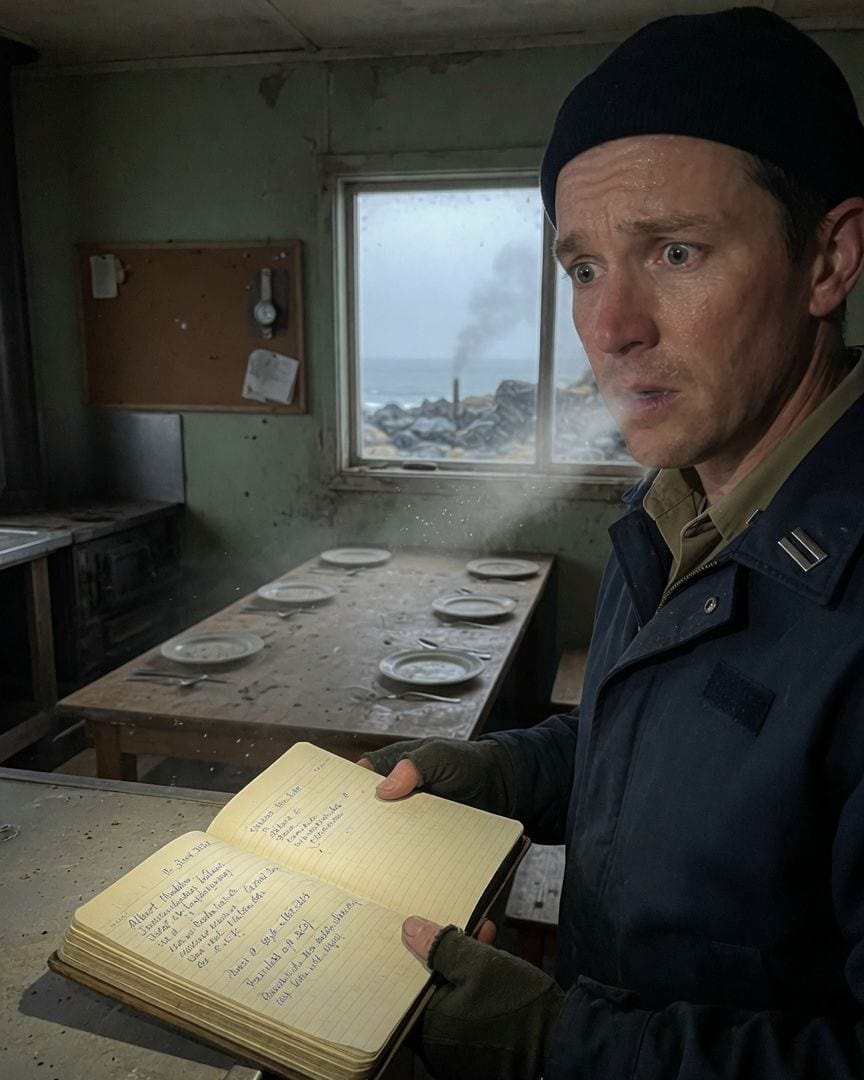
Coast Guard Lieutenant Thatcher finds an old crew photo dated today, June 15, 2024.
Lieutenant Daniel Thatcher leads a survey crew to a derelict LORAN station in the frigid Aleutians, officially abandoned for over a decade. But as they enter, a heavy-bound station log lies open on a counter, its ink startlingly wet, detailing a routine watch from today with names unknown to the Coast Guard.
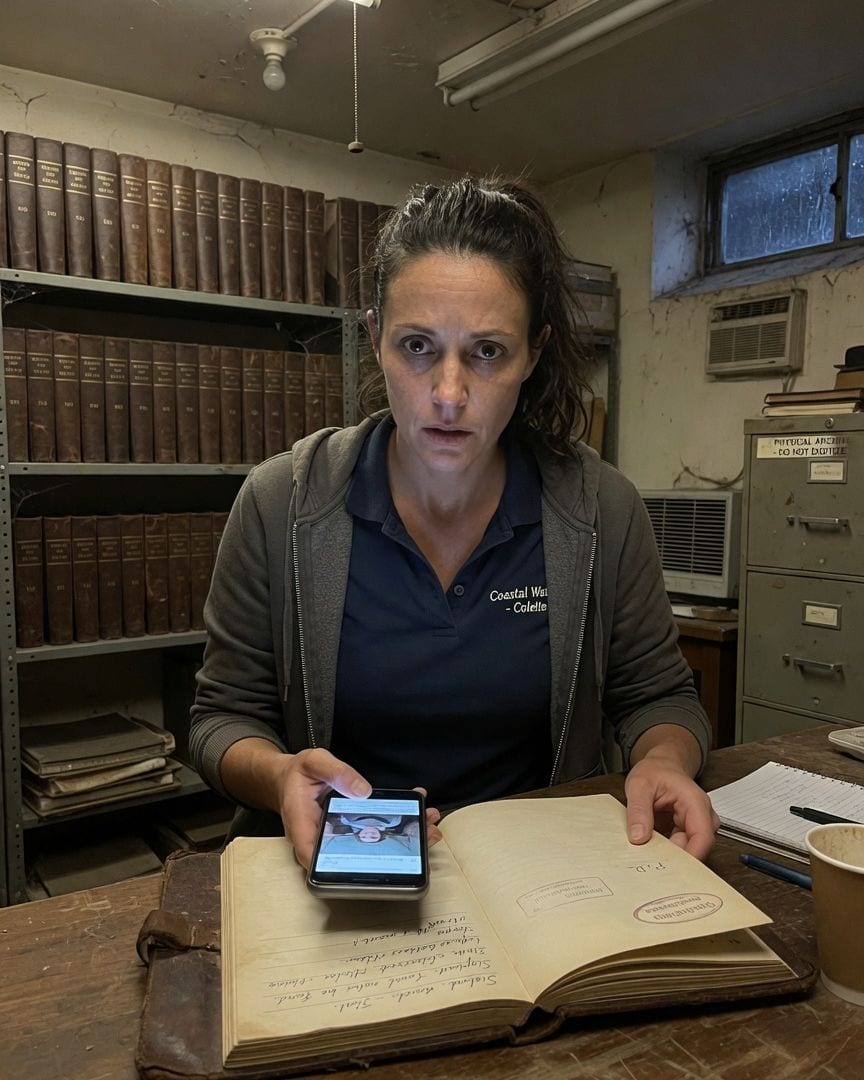
My coastguard log noted Sighting 9 again tonight, a light where no vessel showed. The old logs carry Sighting 9 off Skerry Point at 3:14am every tenth year since 1954, always 'nothing found,' always 'send no boat.'
On my watchtower night shift, the radar screen glowed green and the ocean was quiet. Then, a familiar light appeared off Skerry Point, exactly on cue, just as it had every tenth year for decades. But digging deeper, I found a hidden stamp in an old logbook: 'Operation Skerry. Status: Complete.' It left me with a chilling sense of finality.
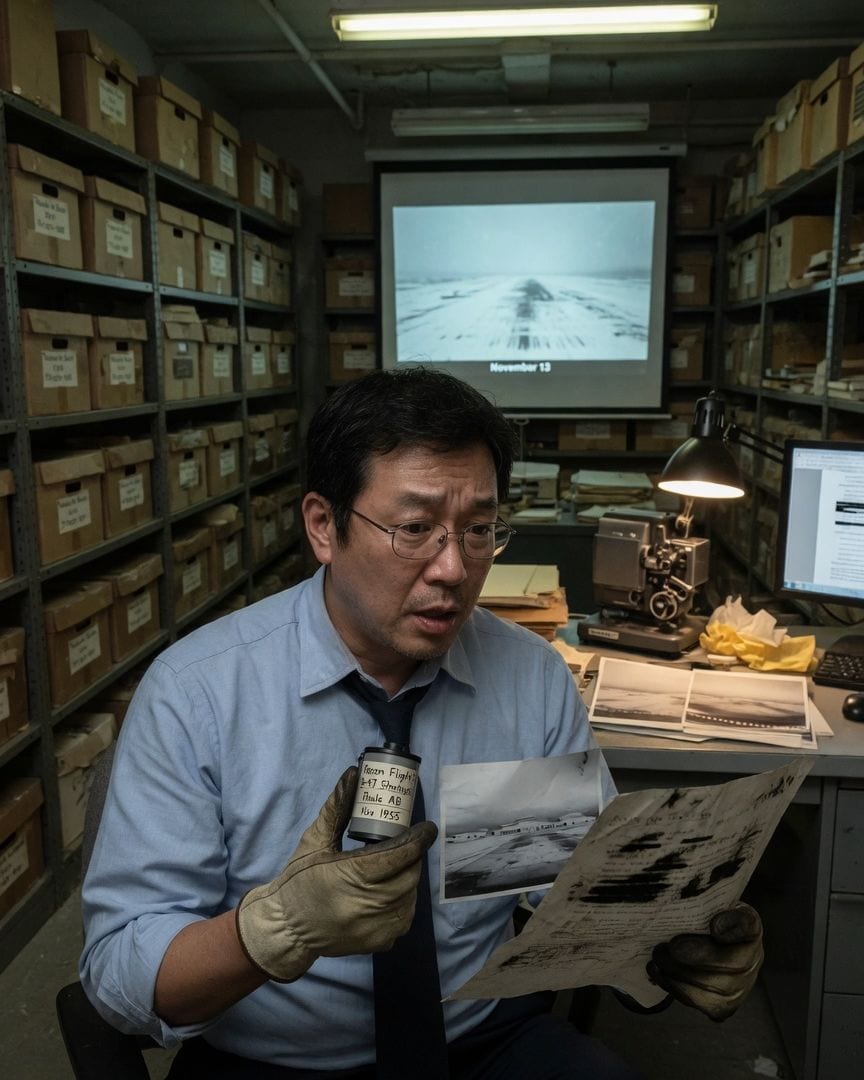
A Cold War archivist's last project reveals an ice cap airfield – the recon flight was lost the day before.
Ken Sudo, an archivist nearing a long-awaited transfer, meticulously sorted Cold War documents in the sprawling National Archives Annex basement. His final Thule project unearthed an unlabeled carton containing an old 16mm film canister, marked 'Recon Flight 734, Nov 1955.' On screen, an impossible airfield appeared carved into the featureless ice cap, dated November 13. A cold dread settled as Ken realized official records declared Recon Flight 734 lost the day before, on November 12, 1955. How could a lost crew record an airfield a full day after their official disappearance?