A photograph in Gunnery Sergeant Ellsworth's file shows him, older, with a future he never lived.
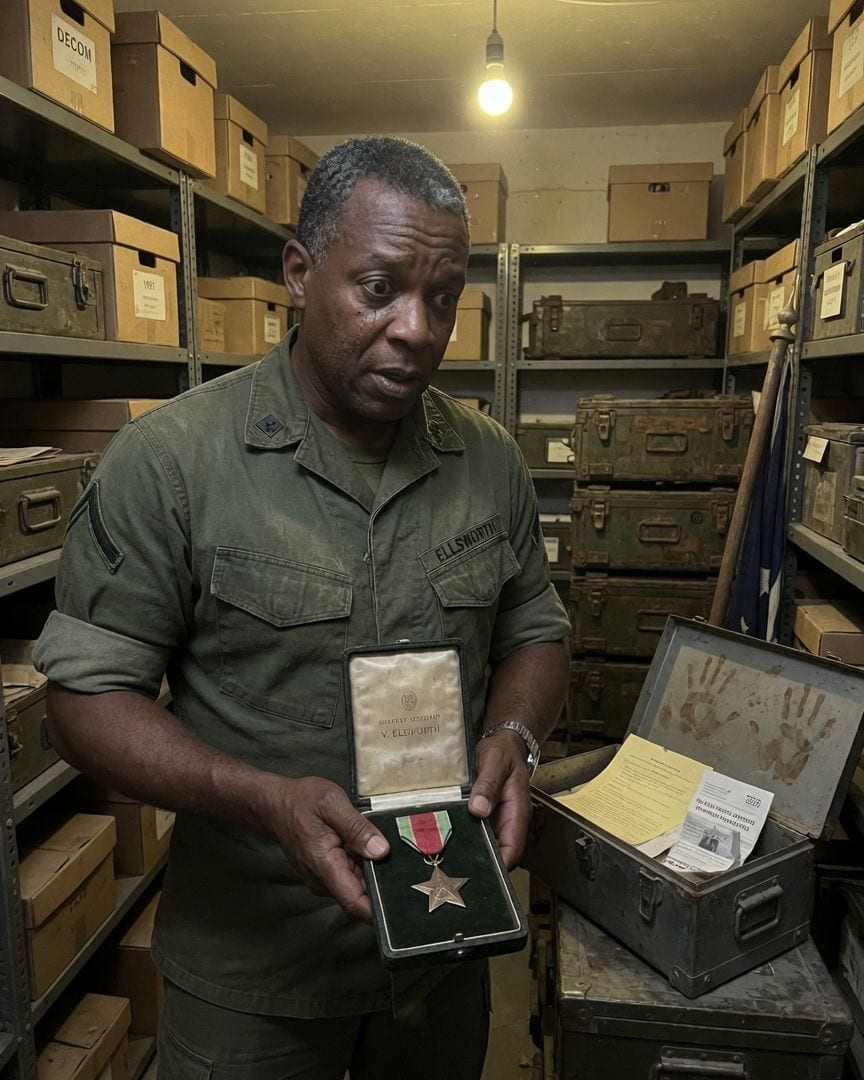
Gunnery Sergeant Victor Ellsworth had seen enough impossible things in his twenty-two years with the Marine Corps to know that ‘impossible’ was often just a word for ‘unlikely.’
Yet, as he stood in the fluorescent glare of the St. Louis personnel depot, what Rosemary Abbott, the young records clerk, held out to him shattered that hard-earned pragmatism.
Two manila folders, identical down to the faded stenciling: 'ELLSWORTH, VICTOR S. — SN: 873-45-9012'.
“This is yours, Gunny,” Rosemary said, pushing the familiar, thinner file across the counter. “And this one… this is the one we’re having trouble with.” She tapped the second folder, its edges worn differently, thicker, almost swollen with unseen records.
Victor picked up the second file, his fingers brushing against a subtle grittiness that wasn't dust. Inside, the pages were crisp in places, yellowed in others.
His gaze snagged on a deployment record for the Horn of Africa, then a combat tour in Afghanistan in 2012. He had never set foot in Djibouti, nor had he been in Afghanistan in 2012.
He remembered the dates clearly; he’d been on an entirely different continent. His breath hitched. A list of commendations detailed a Bronze Star with a 'V' device.
The award was listed under 'ELLSWORTH, VICTOR S.' on one line, then, impossibly, 'ELSWORTH, VICTOR S.' on the next, a single, dropped letter.
Tucked into a corner, secured with a tarnished paperclip, was a photograph. It was him. Unmistakably. The set of his jaw, the curve of his nose, the flecks of gray at his temples.
But the man in the picture was older, his face etched with unfamiliar lines, a weariness that had not yet settled into Victor’s own features.
It was his reflection, but from a future he hadn't lived, a past he hadn't endured. He stared at the glossy print, the man staring back with eyes that were undeniably his own, yet belonged to a stranger.
It was him, but it wasn’t.
Victor ran a hand through his closely cropped hair. “This has to be a clerical error, Rosemary. A database corruption, maybe a merged file from a common name.” He tried to sound calm, even to himself.
The system, for all its bureaucratic quirks, was supposed to be infallible.
Rosemary shook her head, her brow furrowed. “I’ve cross-referenced every single entry, Gunny. This file isn’t a subset or a copy of yours. It’s distinct. Independently generated, the system claims.
Like it’s for… another Victor Ellsworth, with the same service number.”
The words hung in the air, absurd and chilling. Victor didn’t have a brother, let alone one with his exact name and serial number.
He took the duplicate file back to his temporary office, ignoring the stale coffee smell and the hum of fluorescent lights.
He pulled up historical deployment manifests, searching for any trace of the 'Operation Sand Viper' in Djibouti from 2010, the one listed in the phantom file. The system whirred, slow and deliberate.
A manifest appeared. Camp Lemonnier, Djibouti. 2010. Active duty roster. His eyes scanned the names, past the familiar ranks and serial numbers, until they landed on it: 'Gunnery Sergeant V. ELSWORTH'. Not Ellsworth, but Elsworth.
The specific operation was there too: 'Operation Sand Viper,' with a commendation for valor. He remembered the news reports, a small, brutal engagement that had flared up briefly.
He’d been in the Pacific then, far from the scorching deserts of East Africa. The cold dread twisting in his gut tightened. This wasn't a phantom record; it was a physical deployment log, dated, stamped, and signed. It was real.
He closed the file, the sound sharp in the quiet office. “Rosemary,” he called, his voice rough. “I need access to the deep storage archives. The physical records, the ones that predate the big digital push.”
His hunch, illogical as it seemed, whispered that the anomaly wasn't just data. It was something tangible, something that existed in the world.
The air in the deep storage archives was thick and metallic, smelling of old paper and rust.
Dust motes danced in the single bare bulb Victor had managed to switch on, illuminating towering shelves of forgotten footlockers and crates of decommissioned gear.
He followed the faded inventory tags, his flashlight beam cutting through the gloom, searching for anything related to Operation Sand Viper, or Djibouti, 2010.
After an hour of fruitless searching, his hand brushed against something heavy and metallic, tucked beneath a stack of old munitions crates. An unmarked, heavy-duty storage box.
He dragged it out, grunting with effort, and wiped away the grime to reveal a faded stencil on its side: 'OP SAND VIPER - DJIBOUTI - 2010'.
His breath caught, a thin, cold thread in his throat. He unlatched the heavy clasps, the squeal echoing in the cavernous space. Inside, nestled among a few rusted field rations and a tattered, regulation-issue flag, was a small, velvet-lined case.
It was dark green, almost black in the dim light. Victor’s fingers trembled slightly as he lifted it out.
He snapped it open. Lying on the dark fabric was a tarnished Bronze Star, its 'V' device glinting faintly. He picked it up, the medal heavy and cold in his palm.
His thumb traced the precise, cold engraving on the back: 'Gunnery Sergeant V. ELSWORTH'.
The medal was real, solid, undeniable proof of a life he never lived, an award he never earned, yet it bore his name, one letter off, in a place he never was.
Victor secured the impossible medal and pocketed the encrypted data drive. He began an off-the-books investigation, using old contacts and leveraging the remnants of his twenty-two years of service.
The duplicate service number, he found, was technically valid, routed through a little-known administrative bypass system, seemingly untouched for decades. He spoke to retired NCOs, former records keepers, asking discreetly about 'unusual discrepancies' or 'duplicate identities.'
Most laughed him off, chalking it up to urban legends or a bad batch of MREs.
But one name kept surfacing, whispered with a mix of awe and dismissiveness: Kenneth Donovan, a retired Master Sergeant, notorious for his obsessive, almost paranoid, record-keeping.
Victor tracked Donovan to a quiet, isolated cabin nestled deep in rural Missouri. The air there smelled of pine and damp earth, a contrast to the sterile depot.
Donovan, a man with the kind of calm, unbothered demeanor that suggested he’d seen everything twice, listened to Victor’s story without surprise, his gaze steady and unnervingly knowing.
He offered no immediate explanations, only cryptic observations that settled heavy in the air.
“The system always needs its count to balance, Gunny,” Donovan said, his voice a low rumble. “Always seeks equilibrium. A hunger for balance, you might say, that never reconciles.”
He led Victor to a battered workbench, where a meticulously organized binder lay open. Inside were photocopies of similar 'duplicate' files, stretching back to the Vietnam era. Each had a subtly altered name, a shadow deployment, an impossible award.
Donovan’s finger traced a pattern on one page. “They often appear just before or after a major conflict,” he explained, “as if the system is anticipating or correcting a demographic imbalance.
A ghost in the machine, trying to keep the ledger straight.”
The dread deepened in Victor. This wasn't an error. It was a function. A cold draft snaked through the cabin, raising the hairs on his arms.
As Victor left Donovan’s cabin, the unsettling quiet of the woods was broken by the glint of chrome. A dark sedan was parked a quarter-mile down the gravel road, almost perfectly camouflaged by the dense trees.
Its occupants were obscured by tinted windows, silent observers. Victor’s hand tightened on the Bronze Star in his pocket. He looked again, a moment later, and the sedan was gone, as if swallowed by the forest itself.
Back at the depot, his access to the deeper archives was unexpectedly revoked, citing 'system maintenance.' His emails about the duplicate file were met with curt, dismissive replies from higher-ups, echoing bland, pre-written corporate speak.
One evening, as he prepared for bed, he noticed a small, nearly invisible scratch on the screen of his personal laptop, precisely near the webcam. It suggested a delicate intrusion, something that spoke of purpose, not accident.
Later that night, his phone rang. An unlisted number. Victor answered, his heart thumping. A synthesized voice, flat and expressionless, spoke a single sentence: “The count is balanced. Do not disturb the ledger.” The line went dead.
Victor felt a cold certainty settle over him. His inquiries had been noticed. He wasn’t just investigating; he was being watched.
He thought of Donovan, calm and unbothered, and realized the retired Master Sergeant wasn't just an informant; he was a target, or perhaps, a survivor. Driven by an urgent instinct, Victor drove back to Donovan’s cabin.
The front door stood ajar, swinging faintly on its hinges in the night breeze. Inside, the meticulous binder of duplicate files was gone.
The workbench was empty save for a single, encrypted data drive, lying on the exact spot where the binder had been. A silent, unsettling message.
Victor plugged the data drive into his secure laptop, using a Linux distro and a labyrinthine series of VPNs. He worked through the night, decrypting Donovan's life’s work. What he found wasn't just more duplicate files.
There were internal memos, heavily redacted but decipherable through context, from a specialized, unacknowledged 'Personnel Reconciliation Unit' (PRU). These memos detailed 'unreconciled counts'—instances where the official roster of service members didn't match an underlying, unseen 'true count.'
The solution, the memos implied, was the 'generation of auxiliary profiles' or 'echoes' to balance the books.
The horror of it dawned on Victor, cold and absolute. The system, in its relentless pursuit of perfect accountability, literally created extra people, fully documented, to fill perceived gaps.
It was a self-correcting organism, manufacturing reality to fit its own internal logic. He found a series of scanned, heavily redacted entries from various personnel files, highlighting inconsistencies, each one a testament to the PRU's dark work.
Then, his eyes locked on an entry from his own service record, dated 2005. It was a faint, almost invisible note, buried deep in a digital sub-folder: 'UNRECONCILED PERSONNEL - ELLSWORTH, VICTOR S.'
It meant he wasn't just a randomly generated 'echo,' or a recent anomaly. He was always known to the system, marked as a potential subject for 'reconciliation' over a decade ago.
The implication was chilling: the system hadn't just created an 'other' Victor; it had been tracking him for over a decade, waiting for the right moment to balance his 'count'.
The photograph of his older self, the impossible medal, the ghost deployments—they weren't just anomalies; they were the managed life of an 'echo' that the system had ready for him.
The cold certainty in Donovan’s voice, the sedan in the woods, the scratch on his laptop—it all clicked into a terrifying, coherent whole.
Victor scrolled further through Donovan’s drive, his fingers numb. He found a single, grainy photograph, a surveillance image from a desert outpost in Afghanistan, dated 2012.
In the foreground, a figure in Marine fatigues, face partially obscured by shadow and a helmet, gestured to a patrol. The posture, the build, the set of the shoulders—it was unmistakably him.
But Victor knew, with absolute certainty, he was never in Afghanistan in 2012. He zoomed in on the figure's name tape: 'ELSWORTH'. The 'other' Victor, the echo, wasn't just a paper trail; he was a living, breathing Marine, actively serving.
And then, Victor saw it: in the background of the same photo, partially visible through a tent flap, was a blurred, familiar face. It was Kenneth Donovan, younger, in uniform, watching the patrol.
Donovan wasn't just an informant; he was an operative of the PRU, deeply embedded, observing the 'echoes' in action. The phone rang again, an unlisted number.
Victor stared at the screen, the redacted text on his own service record briefly flashing to reveal 'UNRECONCILED PERSONNEL - ELLSWORTH, VICTOR S. - 2005'. He answered the phone. This time, the synthesized voice said, "The ledger requires reconciliation.
Your count is overdue, Gunnery Sergeant. He's waiting."
Victor knew he had to act. Donovan’s message, delivered through the encrypted drive and his cryptic warnings, was clear: the PRU was a pervasive, self-correcting entity, and it had finally come for him.
He remembered the faint smile on the 'other' Victor’s face in the photograph, the unsettling weariness. He used Donovan’s drive to find a secure, encrypted communication channel mentioned in the old PRU memos, a 'backdoor' into the unit's network.
He breached it.
What he found was a cascade of records, current and historical, stretching back further than even Donovan's binder suggested.
The PRU wasn't just generating 'echoes'; it was actively managing them, assigning them to deployments, even 'retiring' them into civilian life, all to maintain the illusion of a perfectly accounted-for force.
The 'other' Victor, 'Victor Elsworth,' was listed as 'active, pending reconciliation.' The process wasn't about replacing service members who died; it was about maintaining a statistically perfect roster, a closed system where no number was ever truly 'off' for long.
The system, designed for ultimate accountability, had become a self-replicating entity, creating and absorbing identities to maintain its own internal balance.
The photo of his older self wasn't just an echo; it was the 'other' Victor, living a full, parallel life, and now, the system intended for them to merge, or for one to replace the other.
The voice on the phone wasn't a threat; it was a notification. The 'count' needed to be settled.
Victor made a desperate choice. He uploaded Donovan’s entire data drive, along with his own findings, to a secure, public-facing server, bypassing military firewalls.
He included a detailed, anonymous report, citing specific record numbers and dates, knowing it was a long shot, a needle in the digital haystack. He couldn't fight the system directly, not with guns or tactics.
His only hope was to expose it, even if no one would ever believe him.
As the upload neared completion, the doors to his office at the depot slid open silently. Standing there, framed by the dim hallway light, was a Marine in fatigues, his face obscured by shadow. Victor’s breath hitched.
The Marine stepped into the office, into the harsh overhead light, and Victor saw him clearly. It was the face from the photograph, older, wearier, undeniably his own, but subtly different.
The eyes held a depth of experience Victor hadn't lived.
“Victor,” the other Marine said, his voice a gravelly echo of Victor’s own, resonant with the subtle differences of a slightly altered life. “The system needs its balance.”
He held no weapon, but his presence was an overwhelming force, a quiet, inexorable weight. Victor hit 'confirm' on the upload. The screen flashed 'UPLOAD COMPLETE.' The other Victor took another step, his gaze locking with Victor's.
There was no malice in his eyes, only an unsettling sense of inevitability, a calm acceptance of what was about to unfold.
Victor scrambled, grabbing a hard drive containing a backup of all the files from his desk.
He bolted out a side door, past the 'other' Victor, who made no move to stop him, merely watched him go with those knowing eyes.
He sprinted through the depot, the alarm blaring behind him, a piercing shriek that seemed to echo the impossible truth clutched in his hand.
He didn't look back, escaping the base into the pre-dawn darkness, but the image of the other Victor, his own face looking back at him from the shadows, was burned into his mind.
Gunnery Sergeant Victor Ellsworth was officially discharged for 'conduct unbecoming and unauthorized access to classified materials.' His claims of a 'parallel service member' and a 'personnel reconciliation unit' were dismissed as delusions, a mental breakdown under stress.
The public-facing upload, the one desperate gamble, was quickly flagged as 'disinformation' and scrubbed from the internet, though a few cached copies lingered in obscure corners, faint digital ghosts. Kenneth Donovan was never found, officially listed as 'AWOL.'
Rosemary Abbott was transferred to a remote, administrative posting, her records purged of any mention of the duplicate file incident. The military system quietly absorbed the ripple, closing ranks, maintaining its impenetrable facade of perfect accountability.
Years later, Victor lived off-grid, a phantom himself, haunted by the truth he carried.
He occasionally checked the dark web, finding fragmented discussions of 'ghost soldiers' or 'impossible counts,' faint echoes of his own story that were always quickly dismissed as fringe conspiracy theories. He knew no one truly believed him.
One quiet afternoon, sitting on his porch, the scent of pine needles heavy in the air, he saw a lone figure walking down the dusty road towards his cabin. The figure was a man, older, with a familiar gait.
As he drew closer, Victor saw the face: his own, but aged, worn, and with that subtle, unsettling weariness he recognized from the photograph.
The man stopped at the edge of the property, looked directly at Victor, and offered a faint, knowing smile. He didn't say a word.
He just stood there, a presence, a living proof, and then turned and walked away, disappearing back into the trees. Victor watched him go, knowing that the ledger had finally found its balance, and that it always would.
He simply watches, a man who knows the truth, but has been counted out of believing it.
If this one got to you
A records NCO found two files for one soldier; the second had his face, older, on a tour to a base that never existed.
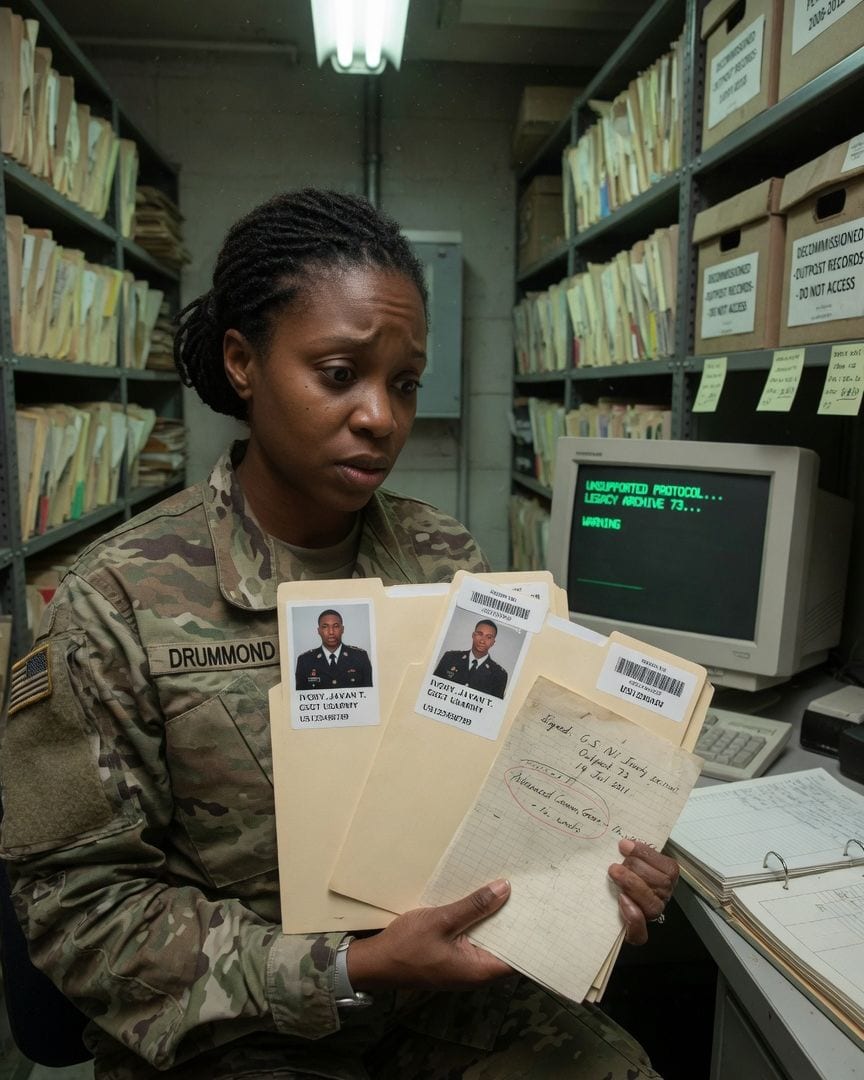
Sergeant Camille Drummond, a meticulous records NCO, was deep in the US Army archives, methodically auditing personnel files. Her routine task was interrupted when she found a second, thicker folder tucked behind Gunnery Sergeant Javan Ivory’s official record, bearing identical service numbers. This duplicate file, however, detailed combat tours he never held, awards under a name one letter off, and showed an older, weary version of his face. As the cold dread bloomed, she discovered a physical supply requisition from a decommissioned outpost, signed 'N. Ivory,' matching the phantom tour. How could a ghost in the system leave such a real, handwritten trace?
A retiring archivist, Emmett Doane, found a Cold War file from 1978 listing men who wouldn’t enlist until the 1980s. The last name on the classified roster was his four-year-old son’s.
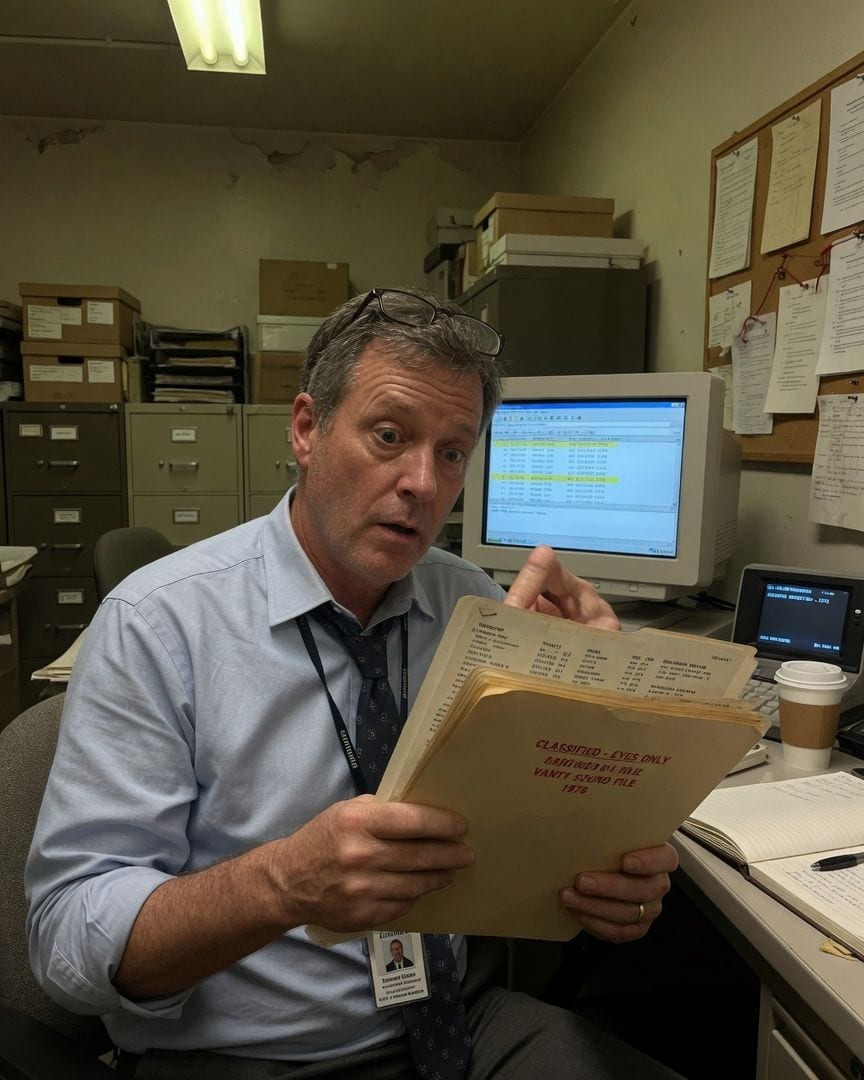
With only six days left until his retirement, archivist Emmett Doane spent a quiet afternoon in the office reviewing old files. He finally pulled the Vantry Sound file, a classified folder from 1978 he'd long dismissed as a clerical error. Inside, the brittle onionskin pages revealed a roster of servicemen who, impossibly, had enlisted years after the file date. As a cold dread tightened his chest, he noticed the file felt warm in his hands, then saw the last name on the list: his own four-year-old son, Samuel. Could a decades-old document truly predict the future, or was something far more sinister at play?
A specialist was signing for four more years, but his old file contained a photo of him in a desert uniform dated 2017, from a tour he never lived.
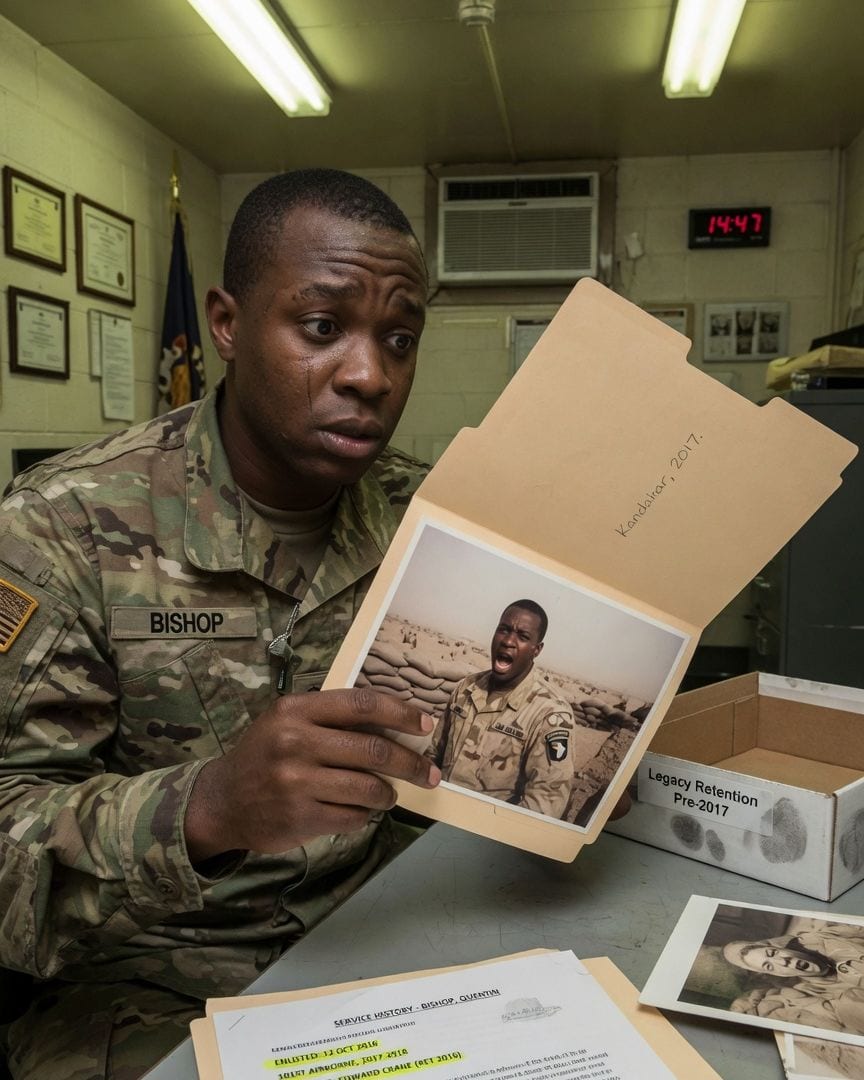
Specialist Quentin Bishop sat ready to re-enlist, looking forward to four more years of stability. But as he prepared to sign, his official record showed an enlistment date that made him seventeen years old, and a combat tour with a unit he’d never worn. Sergeant Marie Delaney dismissed it as a clerical error, but Bishop found a faded photograph of himself in a desert uniform, dated 2017, from a war zone he could not remember. Was this a mistake, or a meticulously constructed parallel life he never lived?
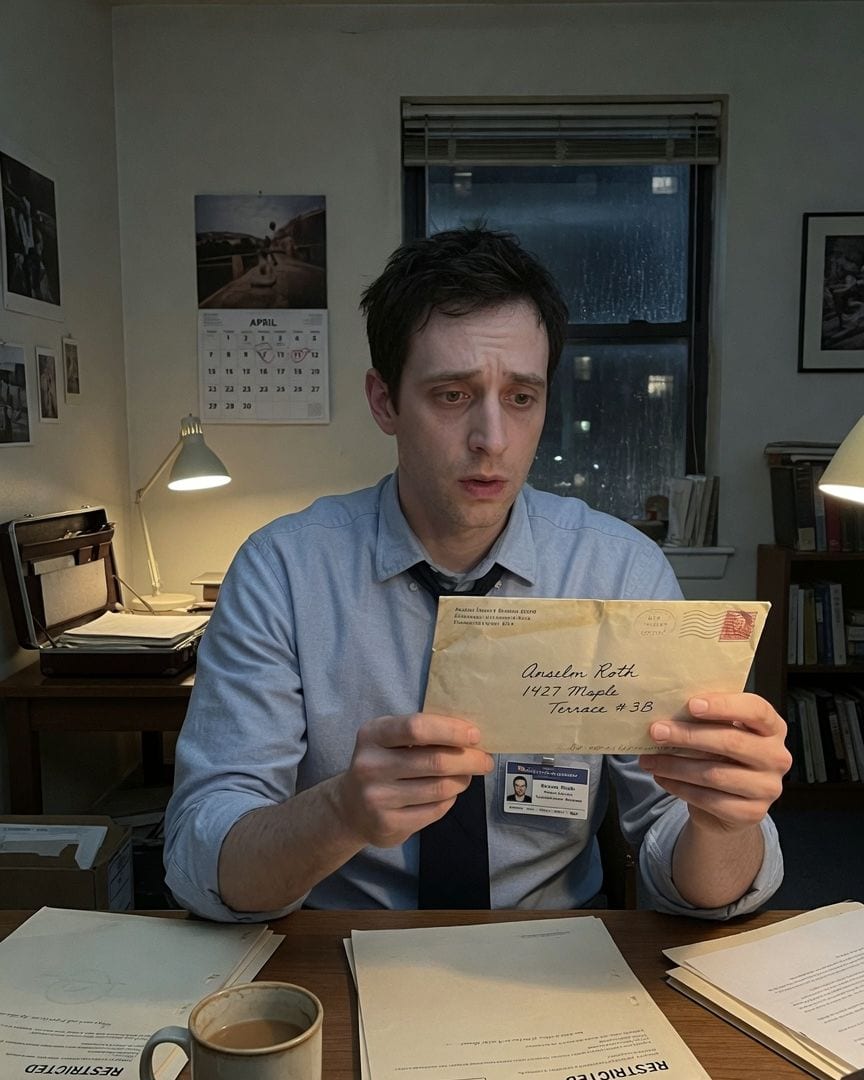
A Cold War declassification reviewer finds his dead grandmother's letter, postmarked 1974, addressed to him years before he was born, and radiating heat.
Declassification reviewer Anselm Roth meticulously sorted through a Cold War-era file on impossible disappearances at the National Archives, a routine 'thirty-year clock' review in 2014. Among the countless records of vanished ships and military units, he found an unscheduled addendum: a thick, sealed envelope addressed to him in his dead grandmother Eleanor Vance’s unmistakable hand. The postmark read 1974, years before he was born, and the paper itself was faintly, inexplicably warm against his fingers, defying every archival principle. Later, a photograph inside revealed his grandmother in an unknown uniform with a stark warning: 'They file us, Anselm. Don't let them finish.' This wasn't just a record of the lost; it was still active.
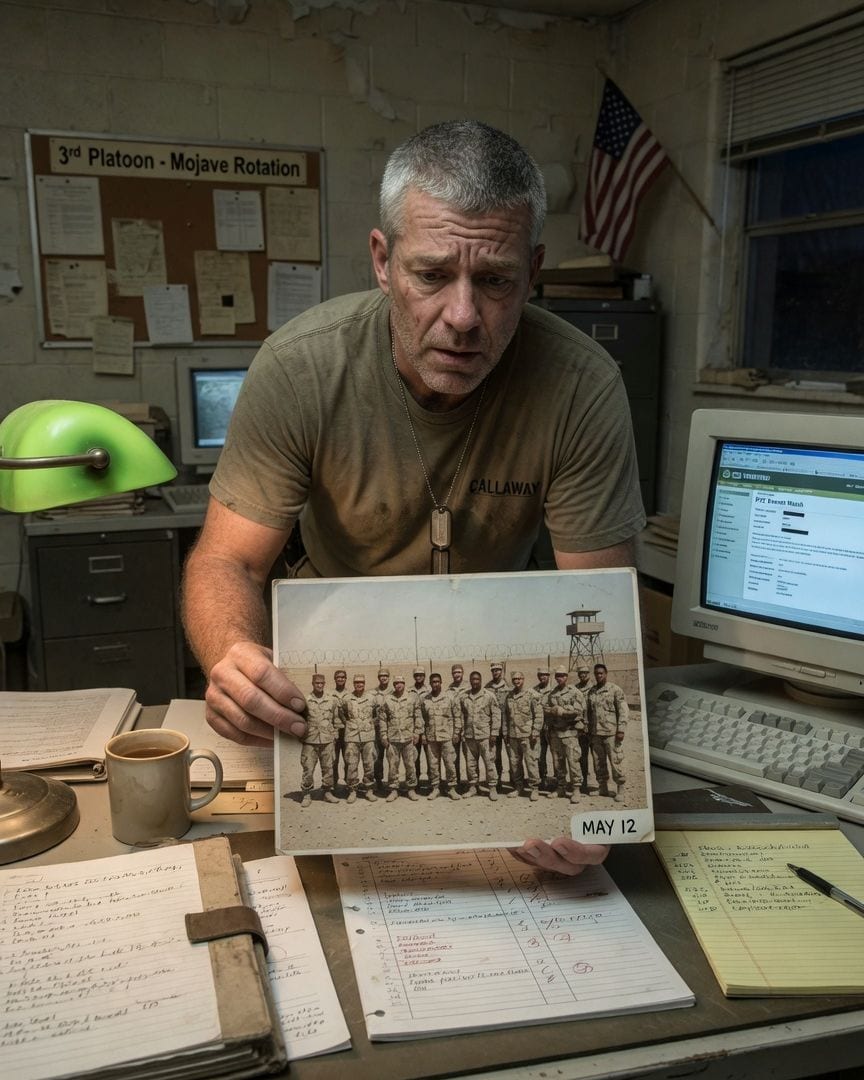
An extra man grinned from Master Sergeant Calloway's old platoon photo. His own men named the stranger he'd never seen.
Nearing retirement from the U.S. Army, Master Sergeant Trevor Calloway kept his platoon photo from the Mojave rotation tacked over his desk, every face a familiar memory. But a week before his final deployment, a casual count revealed a chilling impossibility: an extra man, grinning broadly, stood perfectly positioned in the back rank. His own soldiers, Suggs and Ramos, readily named the stranger "PFC Everett Walsh," yet Calloway knew with undeniable certainty that no such man had ever served under him. The question of the extra soldier, known by his men but unknown to him, solidified a cold, hard knot in Calloway’s stomach. How could a man exist in their shared history, yet be entirely absent from his memory?
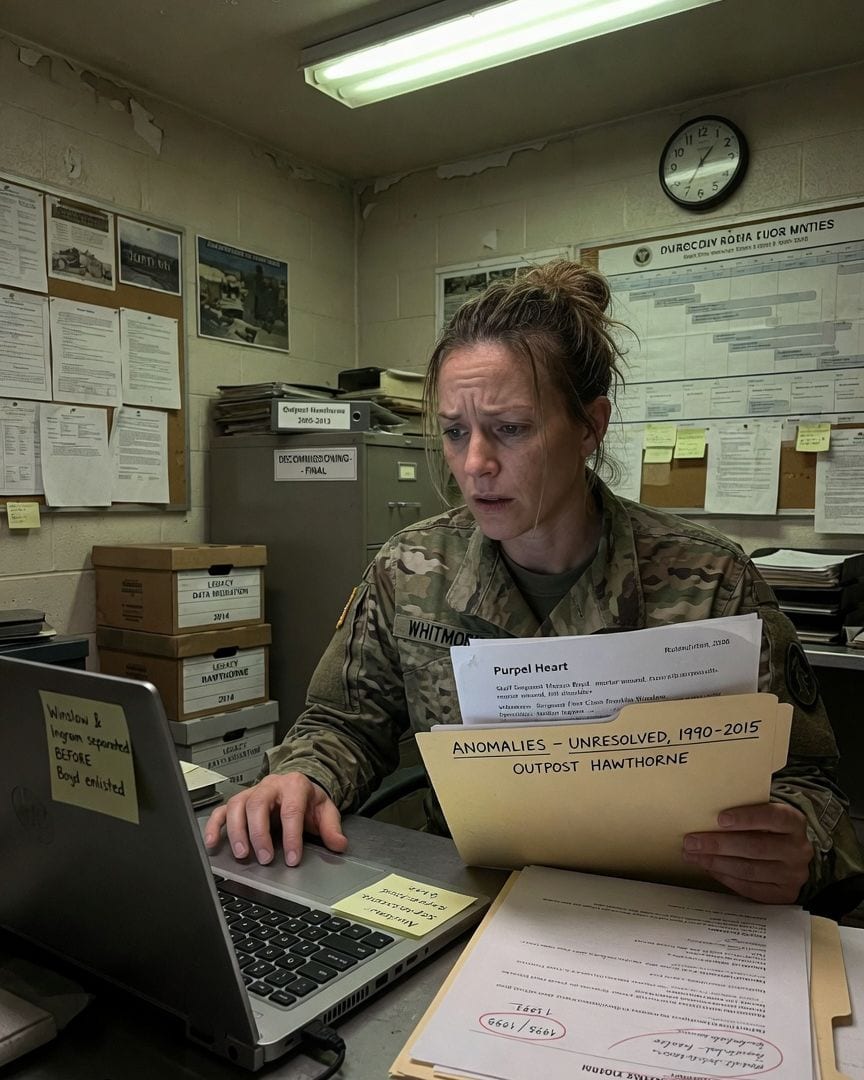
A military captain auditing a Cold War Fort Clay's final roster found a soldier's Purple Heart for a mortar wound. Its witnesses had left the Army years before it happened.
Captain Diane Whitmore, Adjutant for the soon-to-be-decommissioned Fort Clay, meticulously reviewed the final awards roster. Her office, usually bustling, was eerily quiet save for the fluorescent hum as she found an entry for Staff Sergeant Marcus Boyd: a Purple Heart for a mortar wound in 2012. But Boyd had returned unharmed, and the listed witnesses had separated from the Army years before he even enlisted. Colonel Sinclair dismissed it as data corruption, but Whitmore sensed a deeper anomaly, and ignoring a post historian's warning, she found another file from Outpost Hawthorne with the same impossible witnesses. What pattern was buried in Fort Clay's archives?