A private's log confirms a dead man's entry. Three years after his death, Private Eric Drummond just walked into the message center.
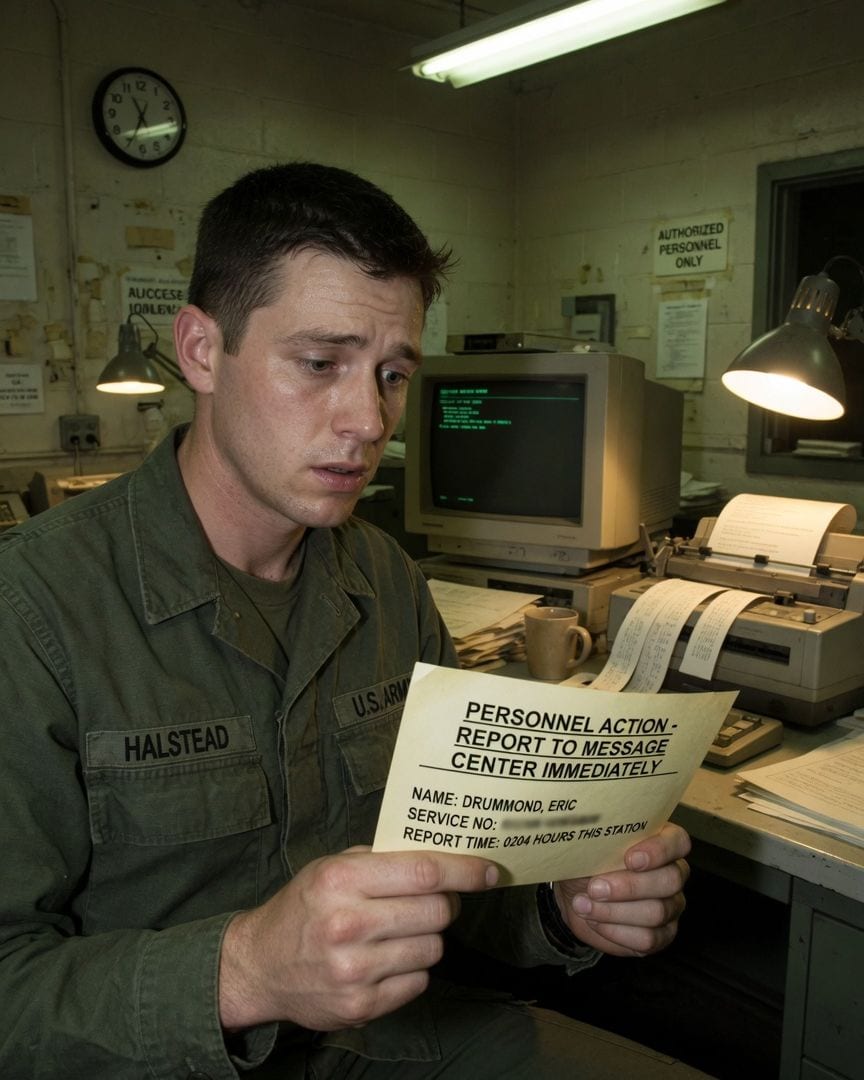
The hum of the message center's ancient machines was a familiar lullaby to Private Ryan Halstead, alone on the graveyard shift. Fluorescent lights pulsed overhead, casting a sterile glow on the beige walls and the stack of incoming teletype messages.
It was a world of meticulous order, every communication logged, every soldier accounted for. He pulled a routine personnel action off the clattering machine, his eyes scanning the standard format: soldier's full name, service number, reporting instructions. Then he froze.
The name: Private Eric Drummond. The service number: perfectly matched.
Ryan's breath hitched. He knew Eric Drummond. He had served with him three duty stations ago. He had carried his casket. Drummond had died in a training accident three years prior.
The message directed Drummond to report to this exact message center, this shift, to receive orders — and the reporting time printed on it was four minutes from now. Ryan blinked, read it again, then again.
He ran the teletype a second time, a cold prickle starting on his scalp. The printout was identical. He knew the records. Drummond was gone.
Yet the machine, the very heart of military accountability, insisted otherwise, a phantom instruction from a system that could not be wrong.
Ryan’s first instinct was to rationalize. A programming glitch, perhaps? A dark, tasteless prank from another unit? He tried to dismiss the gnawing dread as fatigue. When Sergeant Merritt arrived for her shift, Ryan showed her the teletype.
She frowned, examining the paper, her fingers brushing the stiff card stock. “Just a ghost in the machine, Halstead. Clerical error. Shred it.”
Her tone was dismissive, but her eyes lingered on the name a beat too long before she pushed past him. Ryan nodded, but the teletype remained clutched in his hand, unshed. He couldn’t shake the feeling.
Later, during a lull, the air still thick with the smell of ozone and old paper, Ryan quietly accessed the official military personnel database. He cross-referenced Eric Drummond’s service number. The primary file was clear: ‘Deceased.
Date of Incident: [Three years ago].’ A closed file. Yet, the teletype was an active order. He then checked the message center’s internal system logs, searching for any outgoing messages that might indicate an error report or a cancellation.
There were none. Instead, the logs confirmed the teletype’s origin: a secure, internal personnel server, the kind that only generated valid, actionable orders. The dread tightened its grip, transforming from a prickle into a cold, hard knot in his gut.
The system wasn’t malfunctioning; it was transmitting. The quiet hum of the machines seemed to deepen, a low, steady thrum against the floorboards.
Driven by a morbid curiosity and a desperate need for a mundane explanation, Ryan accessed the message center’s access badge logs.
He filtered the entries for the exact minute Eric Drummond was ordered to report – four minutes past the hour.
He typed in Drummond’s service number, a morbid joke he told himself, half expecting an 'Access Denied' or 'Invalid ID' message. The screen flickered. A single entry appeared, stark and undeniable: Name: Drummond, Eric. Service Number: [Matching]. Timestamp: 02:04.
Access Granted. Ryan stared at the glowing screen, the access log entry for Eric Drummond’s service number, timestamped four minutes past the hour, confirming entry into the message center.
His heart hammered against his ribs – someone, or something, had walked through that door.
Ryan felt a cold, metallic taste in his mouth. He replayed the message center's security camera footage from that exact minute.
The feed showed the outer door opening, but only a brief, shimmering blur, a distortion in the frame, before it swung shut again. No clear figure, no face, no uniform.
He replayed it, frame by frame, hoping for a pixelated glimpse, but there was nothing concrete. Just a rippling effect, like heat haze off hot asphalt.
Shaken, he confided in Specialist Desmond, a junior colleague, showing him the teletype, the deceased record, and the chilling access log entry. Desmond, initially skeptical, scoffed at the idea. "Someone's messing with the logs, Halstead.
Or a ghost story for the new guys." But as Ryan laid out the meticulous detail, Desmond’s easy grin faded. The color drained from his face as he stared at the screen.
Together, they accessed the base's general personnel manifest. Eric Drummond's name was not on it, not in any active capacity. He was officially deceased, buried in the system's archives.
Yet, the system had logged him in, granted access to a secure facility. They checked the duty roster for that night. No new personnel were assigned to the message center, nor any visitors expected.
The only logical explanation was a system hack, but the network security logs showed no intrusion, only internal system activity, perfectly normal, perfectly accounted for. The impossible count was real.
The air in the small room felt suddenly heavy, pressing in on them.
Their persistent access requests for old records did not go unnoticed. Sergeant Merritt called Ryan and Desmond into her office. Her expression was unreadable, her voice unnervingly calm. "Halstead, Desmond. I've seen your query logs. Digging into old personnel files.
It's a waste of time. Some things are best left as errors, for the sake of system integrity and operational security."
She didn't raise her voice, but the implied threat hung heavy in the air, a tension that made the overhead lights flicker for a moment. Her gaze, flat and unwavering, seemed to bore into Ryan.
He had the distinct impression she wasn't just warning them to stop, but that she knew what they were looking for, and what they might find.
She knew the secret, or part of it, and her composure was more terrifying than any anger.
Later that day, after his shift, Ryan returned to his bunk. On his pillow, neatly folded, was a printed copy of Eric Drummond's original teletype message. It wasn’t the one he had kept, crumpled in his locker.
This was a fresh print, identical in every detail, even the slight misalignment of the text, as if it had just come off the machine.
The stark white paper against the drab gray pillowcase seemed to glow with an unnatural light. His heart leaped into his throat, a cold wave washing over him. Someone knew he was digging. Someone had been in his bunk.
And they were sending him a message. The very air in the small, confined space felt watched.
Ryan, now convinced Merritt knew far more than she let on, confronted her in the deserted message center late that night.
He slapped the fresh teletype copy onto her desk, the paper making a sharp, accusing sound in the quiet room. "This was on my bunk, Sergeant. Someone knows." Merritt’s composure finally cracked. Her face, usually so composed, paled.
She looked from the teletype to Ryan, then back, her eyes wide with a fear Ryan recognized. "It's not the first time," she admitted, her voice barely a whisper, thin as old paper. "Years ago. A similar incident. Another soldier.
Deceased. I wrote it off as a one-off glitch. A system anomaly. But seeing Drummond's name reappear…" She ran a trembling hand through her short hair, dislodging a few strands. "I tried to delete Drummond's access log entry.
The system rejected it. Stated 'active duty requirement.' It wouldn't let me touch it."
Merritt, with her higher clearance, then navigated to the secure central personnel database, the ultimate authority. She typed in Drummond's service number. The primary field flashed 'Deceased.' But beneath it, a sub-field, a hidden layer of data, showed 'Active: Deployed.'
Her finger trembled as she scrolled further. The screen filled with identical entries: 'Drummond, Eric. Service Number: [Matching].' Each entry was assigned to a different, active unit across the globe. Each had perfectly reconciled records, deployment dates, commendations.
The system wasn't just logging one dead man; it was replicating him, accounting for every duplicate as a unique, legitimate soldier. The horror wasn't that the system was broken, but that it was working with such chilling precision.
The cool air from the vents seemed to drop several degrees, making the hairs on Ryan's arms stand on end.
Merritt’s hands were shaking so badly she could barely control the mouse. She scrolled further down Eric Drummond’s impossibly long list of active deployments, her face a mask of dawning horror. "It's not just him," she whispered, her voice cracking.
"They're all here. All the 'glitches' I dismissed. Every one accounted for." She then navigated to a hidden section of the database, a log of 'pending personnel actions.' It was a queue of future assignments, ghost entries awaiting activation.
Names Ryan recognized flashed past – names of other deceased soldiers, all marked for 'processing complete' and future deployments.
Merritt’s finger hovered over the scroll bar, her eyes wide with terror, then she gasped, a choked, guttural sound that rattled in her chest. She pointed to a line on the screen, her voice a ragged, disbelieving whisper.
Ryan leaned in, his own breath catching in his throat.
Sergeant Merritt stared at the screen, her face ashen, then pointed to a line in the central database – a pending personnel action for Private Ryan Halstead himself, listing his current duty station as 'processing complete' for a report date six months in the future.
The words 'processing complete' for his own name detonated in Ryan's mind, reframing every terrifying discovery. Merritt’s face was ashen, her eyes fixed on the glowing text. "It means… it means the system has already accounted for you, Halstead.
Or for a duplicate of you." The military's accountability system, designed for absolute precision, was not broken; it was working exactly as intended, but for an unknown, pervasive entity.
It used the meticulously archived records of deceased service members as templates to generate new, physical duplicates. The 'Eric Drummond' who had badged into the message center was not a ghost, but a perfectly accounted-for physical replacement, seamlessly integrated.
Every detail Ryan had obsessed over – the persistent teletype, the baffling access log entry, the multiple 'active' Drummonds – clicked into place with horrifying coherence. The anomaly wasn't a malfunction, but a fundamental, self-sustaining part of the system itself.
It was a meticulous, automated recruitment and deployment mechanism that ensured no 'gap' in personnel ever truly existed. The system didn't create glitches; it filled voids. And now, it was preparing to fill a void with him.
The weight of the truth settled on Ryan and Merritt like a shroud. They couldn't fight the system; it was too vast, too ingrained, too perfectly self-correcting.
Merritt, desperate, tried to initiate a full system audit, hoping to expose the anomaly to higher command. The system rejected it instantly, a message flashing 'critical operational integrity' across the screen, a red warning light pulsing on the console.
They attempted to delete their own pending entries, to make themselves unaccountable. The system overwrote their attempts, restoring the entries instantly, declaring 'data integrity maintained.' They were already part of the manifest, their fates sealed.
The very walls of the message center seemed to hum with a knowing, silent power. Ryan looked at Merritt, a silent understanding passing between them, a shared, cold dread. There was no escaping the relentless precision of the military's accounting.
His 'orders' were coming, not from a commander, but from the unblinking logic of the system itself. The horror wasn't an external enemy, but an internal, systemic truth.
They were simply data points, and the system would ensure every point was accounted for, one way or another. All they could do was wait.
A week later, Sergeant Merritt submitted her resignation, citing 'personal reasons' and vanished without a trace, her service record closing with an unnerving finality.
Private Ryan Halstead continued his duties in the message center, his face a little paler, his eyes constantly scanning the incoming teletypes, dreading his own name.
He never spoke of what they had found, and no one else ever mentioned the 'glitch' of Eric Drummond. The fluorescent lights still hummed. The teletype machines still clattered. The system continued its quiet hum, logging, processing, accounting.
The world, and the military, moved on, oblivious to the meticulous horror buried within its own operational heart.
Six months passed. Then, one morning, a teletype arrived for Private Ryan Halstead, directing him to report to a new duty station, effective immediately. His orders were perfectly in order, signed, sealed, and accounted for by the system.
He packed his bag, said his goodbyes, and left the message center for the last time. He was, as the system declared, 'processing complete.'
A few months later, a new Private Halstead arrived at his original garrison message center, perfectly accounted for, to begin his tour. The system was always precise.
If this one got to you
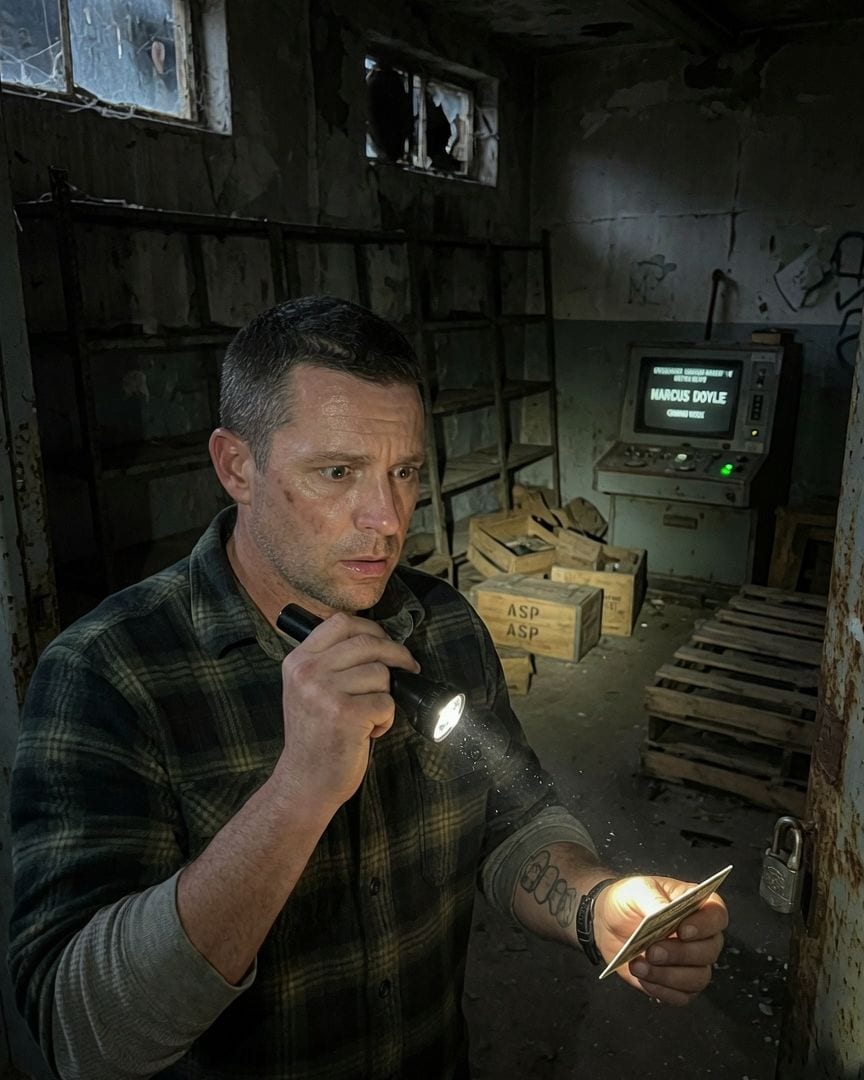
A former serviceman found his name on an active duty roster for a military base decommissioned in 2019. His access card had already logged three entries last month.
Six years after leaving the service, Marcus Doyle’s quiet suburban life was upended by an old access card notice. It came with a chilling printout: his badge number and name, logged entering Fort Crestwood’s Ammunition Supply Point three times last month, each at 0240. The former military base had been officially decommissioned in 2019, its buildings abandoned and gates chained. After discovering his own access card matched the log, Marcus returned to the derelict site, only to find a humming console displaying his name as current "personnel assignment" for the coming week. What could be happening at a base that no longer exists?
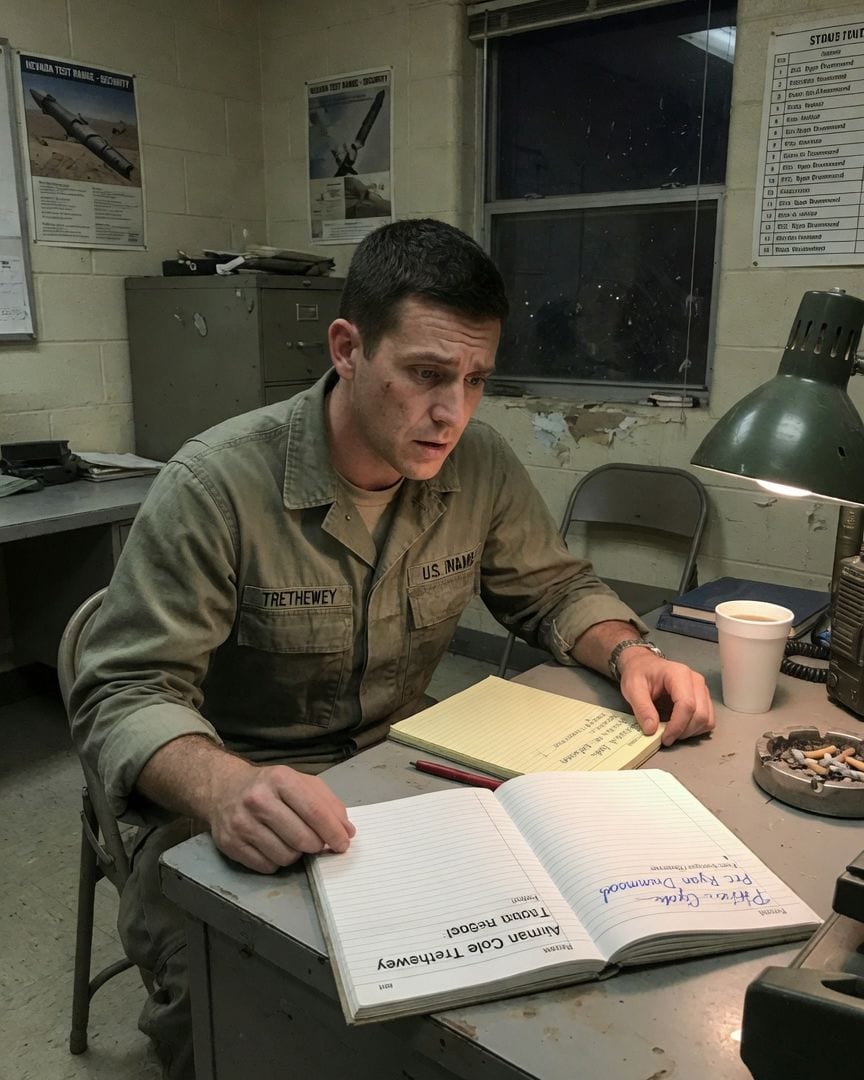
On his final patrol, Airman Cole Trethewey saw a man vanish. Then the stranger sat beside him, seatbelt buckled, miles from any outpost.
Airman Cole Trethewey was on the last loop of his final patrol, the desert night sharp and silent as his jeep cut through the Nevada test-range perimeter. Miles from any outpost, he saw a man standing in the road; a second later, the stranger sat beside him, seatbelt buckled, perfectly still. Back at the outpost, Cole’s dread deepened when his final patrol logbook listed a 'Ryan Drummond' as his observer, signed with an exact replica of his own hand. No records existed for the name, leaving Cole with an impossible, chilling fact that simply should not be.
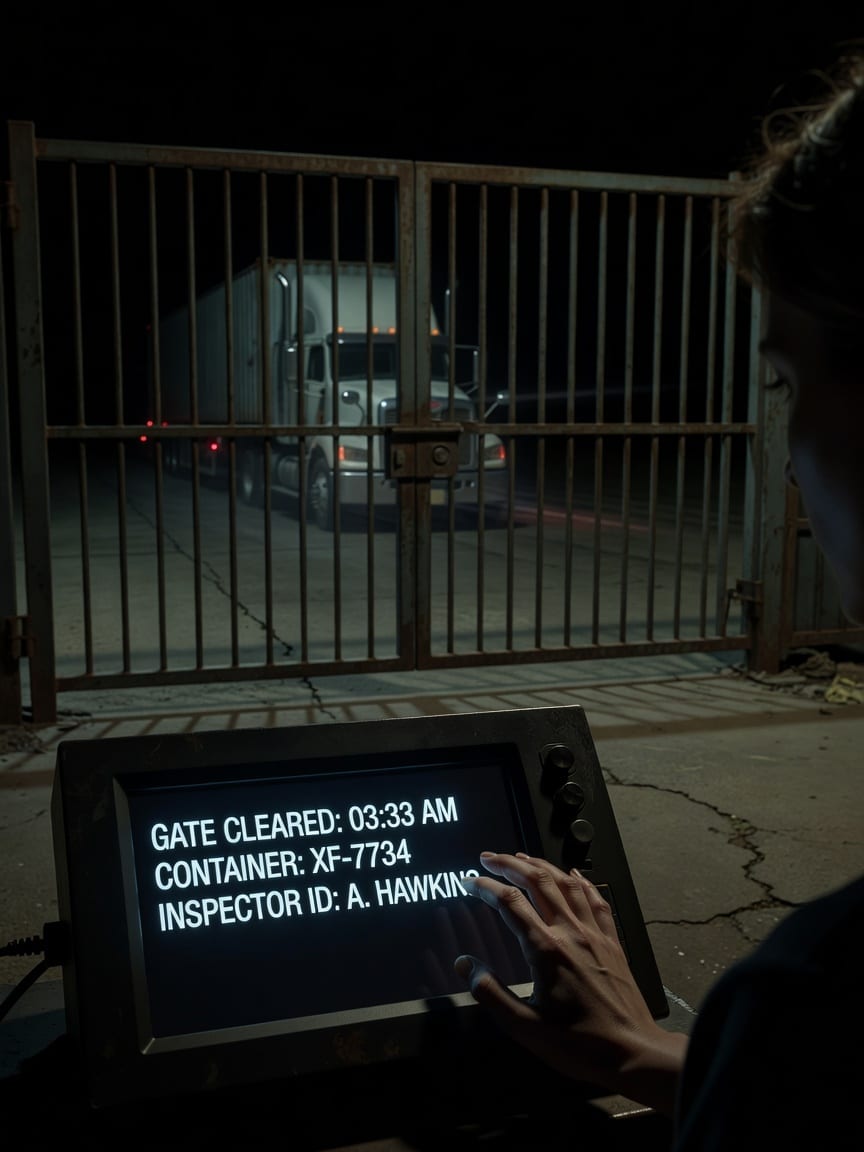
My gate log shows a container left at 3:33 AM, stamped with my ID. The yard was closed, the gate down, and I was asleep.
Audrey Hawkins' inspection log shows a container cleared at 3:33 AM, an impossible time when the gate was locked and no one was working. Her supervisor dismisses it as a glitch, but Audrey can't shake the specific details. Digging into old archives, she finds a handwritten ledger entry from 1974 for the exact same container, signed by a man who died half a century ago.
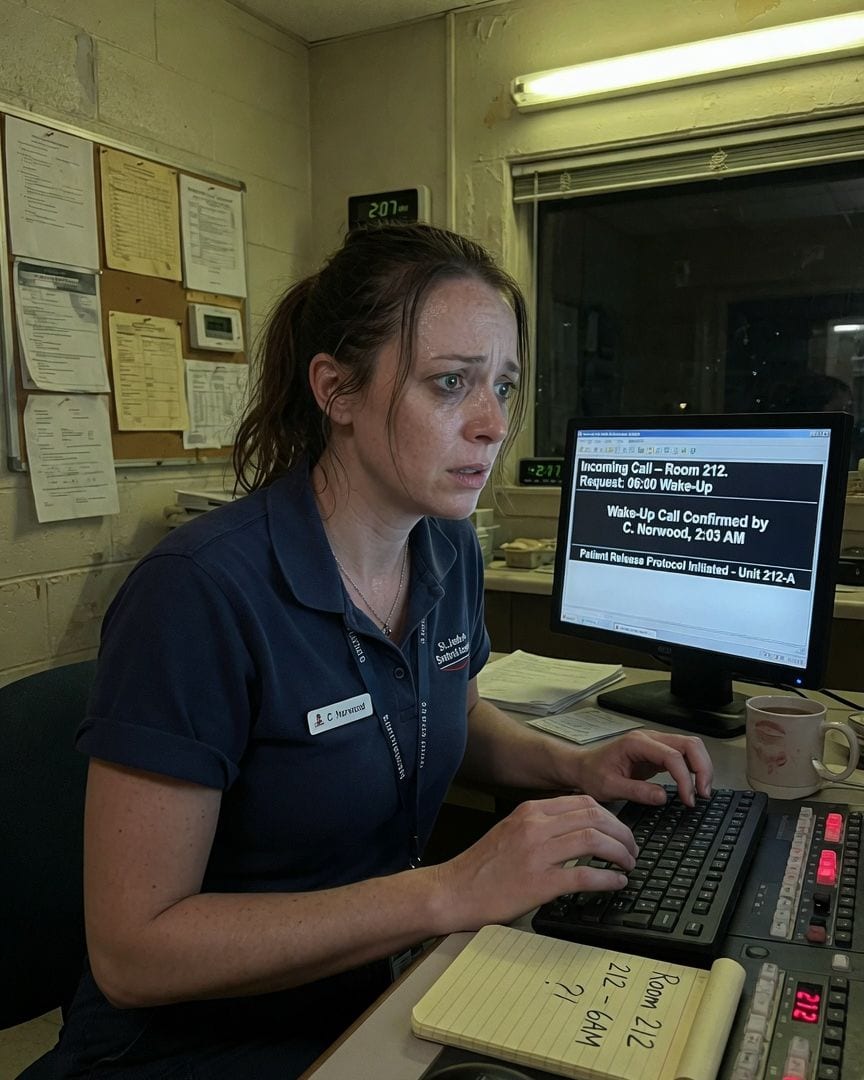
My login started a 'Patient Release Protocol' I'd never heard of for Unit 212-A.
Working the quiet night shift switchboard at St. Jude's, I took a routine wake-up call from Room 212. But the system showed Room 212 had been stripped bare and its phone line disconnected for months. Then, my own login showed I had confirmed the impossible call.
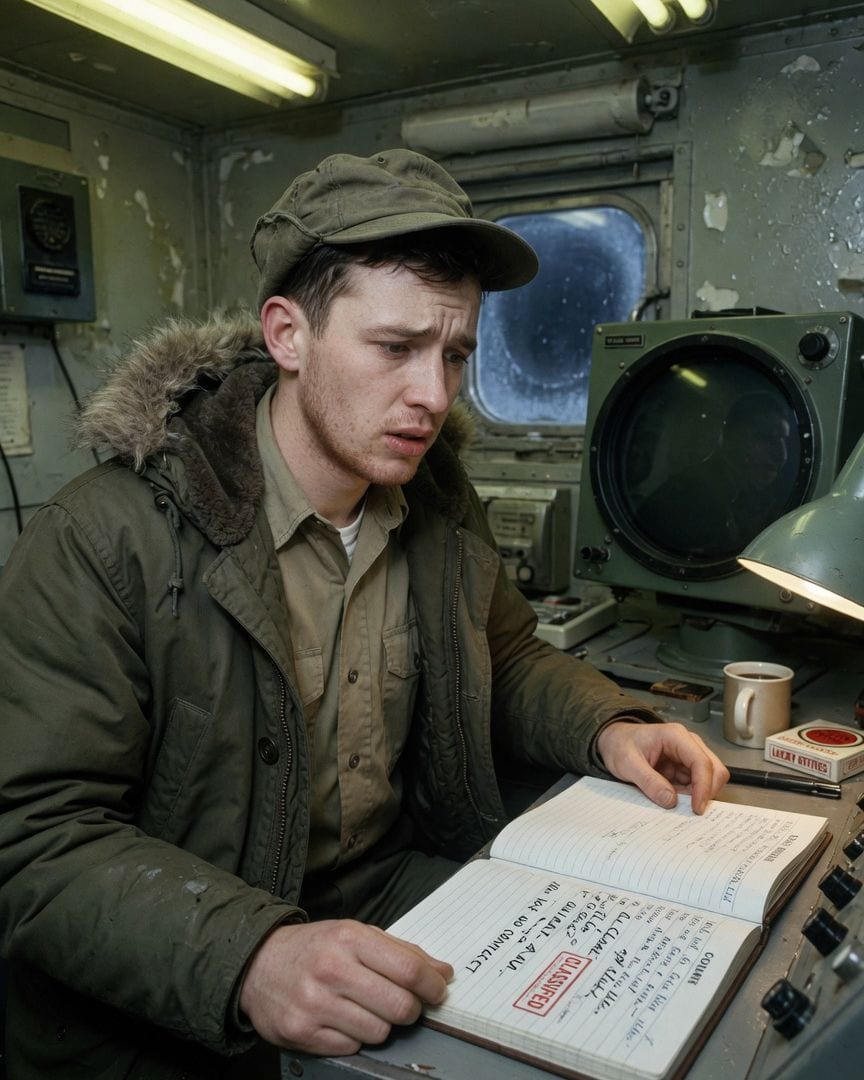
A Cold War airman logs an impossible radar contact on his last sweep. But his official logbook entry is stamped 'CLASSIFIED' and then contradicted by a hastily scrawled 'ALL CLEAR' dated moments before it.
Airman Ordway Vance, 22, manned the radar dome at Site Pellin in the biting North Atlantic dark of January 1962, running the last calibration sweep before its decommissioning. His scope picked up a faint, impossible return, growing closer with each pass, though the ocean remained empty to the eye. When Vance detailed the contact in his official logbook, a 'CLASSIFIED' stamp appeared, followed by a hastily scrawled 'ALL CLEAR' dated moments before his own entry, contradicting his every word. Commander Hartley dismissed it as equipment malfunction, but Vance sensed a chilling, official erasure behind the lie. He soon found a locked cabinet marked 'SITE PELLIN ANOMALIES,' hinting at a deeper truth buried within the base's final days.
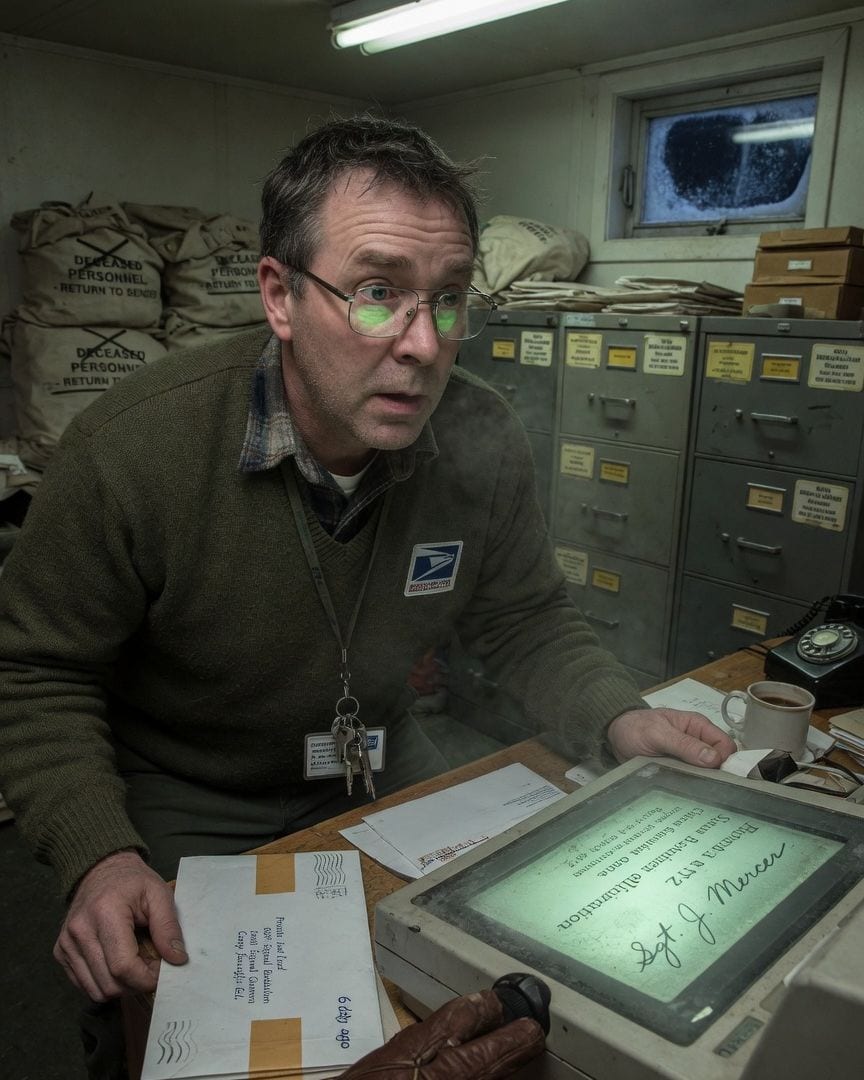
A postmaster at a Cold War Alaskan outpost still received mail for soldiers declared dead in 1969. Then he found their base was active three years later.
Postmaster Rowan Ashcroft had spent two decades watching the weekly mail plane land at Camp Bidwell Annex, a lonely outpost in the bitter Alaskan wind. His methodical mind, accustomed to order, was jolted when the latest mail sack contained forty-three letters for men officially declared dead in 1969. Each envelope, postmarked within days, was addressed to a soldier who wasn't coming back, and Rowan found one already opened and neatly resealed. Driven by duty, he began to sift through declassified Army archives, only to uncover a chilling maintenance log entry for the camp's equipment, dated three years after the base was officially shuttered. What was still happening at Camp Bidwell?