My dashcam filmed a child in the empty bus aisle for eight minutes after the last drop-off. Every student was signed off, and I was alone.
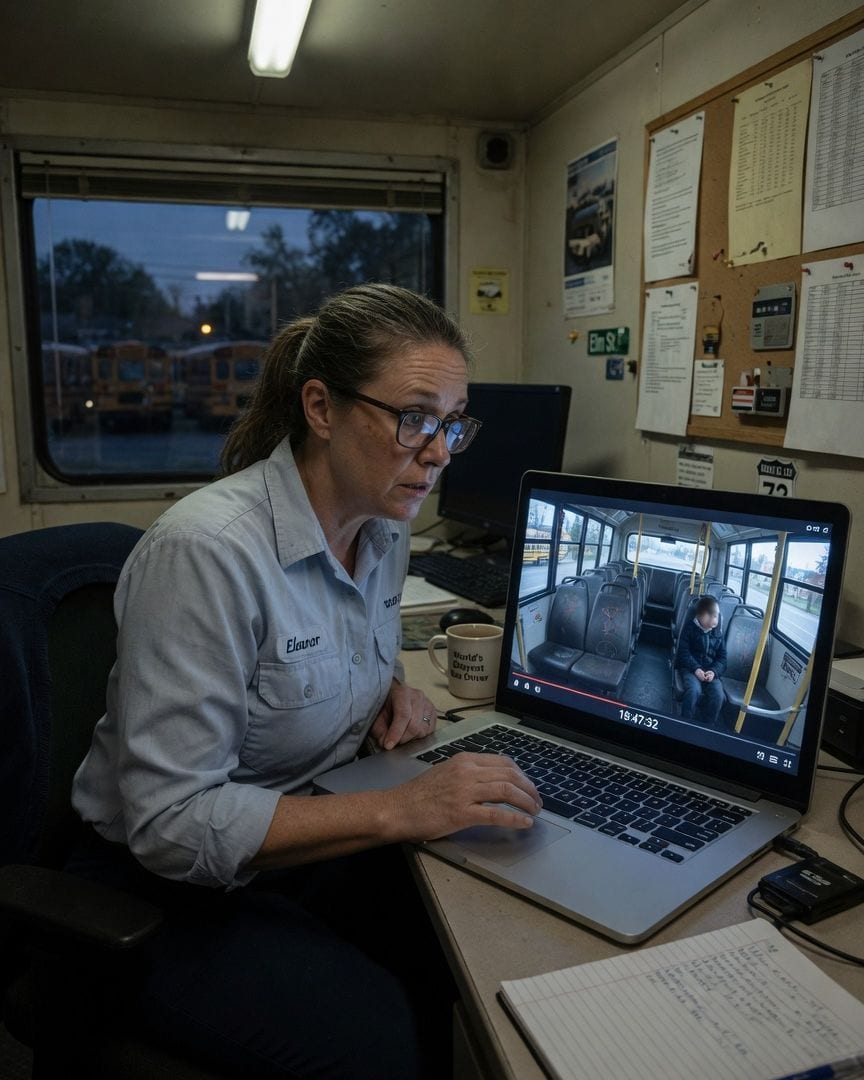
It started like any other Tuesday. I’d just finished my last drop-off for the day – the Miller twins, giggling as they tumbled out of Bus 73. Mrs. Miller waved from her porch, the usual routine.
I watched them disappear inside, checked my mirrors, and pulled away. The bus was empty, the air suddenly quieter, just the low hum of the engine and the faint scent of stale juice boxes and forgotten crayons.
Ten years I’ve been driving this route, and the deadhead back to the depot is always the same: empty seats, empty aisle, just me and the road.
Back in the yard, I parked Bus 73 in its usual spot, grabbed my logbook, and pulled the SD card from the dashcam. Routine.
You check for incidents, near misses, or maybe just a funny moment with a squirrel crossing the road. Most days, it’s nothing. I went to the small office, plugged the card into my laptop, and clicked open the video file.
Skipped past the morning chaos, past the afternoon route, straight to the eight minutes of empty road after the Miller twins got off.
The bus rolled along, the familiar trees passing by. Empty seats. Empty aisle. My reflection in the rearview. It was all so normal. I was about to click it off, but then something… a flicker.
In the second-to-back seat, on the passenger side. I froze, my hand hovering over the trackpad. I leaned closer to the screen. My breath hitched.
There was a child sitting there.
Small, indistinct at first, but absolutely there. Facing forward, hands folded neatly in their lap, as if waiting patiently. Impossible. My stomach dropped. I was alone. Every child was signed off, accounted for.
I remembered checking the aisle, a habit of years, a quick sweep of the bus from front to back, before pulling away from that last stop. It was empty. I knew it. Empty.
But the recording, timestamped and clear, the minutes ticking by on the bottom of the screen, showed otherwise.
I rewound the footage, my fingers fumbling. Played it again. The bus pulled away from the Miller house. The aisle was empty. I watched myself in the mirror, turning my head slightly, confirming the clear view to the back.
And then, at the 3:14 mark, as the bus turned onto Elm Street, there it was. The child. Just... there. Sitting. As if they’d materialized from the fabric of the seat itself. It wasn't a blur, or a smudge.
It was solid. Unmoving.
My rational mind tried to claw its way out of the sudden panic. A trick of the light? A reflection? The sun was low, but it shouldn't have done that. A faulty sensor in the camera?
But the image was too clear, the small form too distinct. I paused the video, leaning in, trying to make out details on the pixelated face. Only shadows and smudges, but I sensed a calm, unwavering gaze.
As if it knew I was watching.
I played the audio, hoping for some mundane explanation – a rustle, a cough, anything. But there was only the low rumble of Bus 73’s engine and the faint, ever-present static of the dashcam mic. No voice. Nothing. Just silence.
Later that week, I showed the clip to Richard Langford, the depot's oldest mechanic. He’s seen it all, fixed everything from cracked axles to haunted horn systems, or so he jokes. I tried to sound casual, dismissive even.
"Hey, Richard, take a look at this glitch on Bus 73's dashcam. Weirdest thing."
He leaned over my shoulder, his breath smelling faintly of oil and coffee. He watched the eight minutes, his face unreadable as the child appeared. He watched it again when I rewound.
Then he straightened up, shrugged, and clapped me lightly on the shoulder. "Electronics act up, Eleanor. Probably just a ghost in the machine. Bus 73’s an old girl. Delete it."
A ghost in the machine. The phrase struck a cold note in my chest. But I couldn't delete it. I tried to, I really did. Hovered over the delete button, but my finger just wouldn't press down.
The image of the child, so still, so out of place, had burrowed into my mind. I found myself re-watching it in the quiet hours, long after I should have been asleep.
Searching for any detail I missed, any explanation that made sense. None did. The silence of that child on the screen was heavier than any scream.
Ignoring Richard’s advice, I started reviewing all my old dashcam footage. Not just Bus 73’s, but everything from the last month, then two.
It was tedious work, hours of empty roads and quiet aisles, the only sound the hum of the laptop fan. I told myself I was looking for patterns, for other ‘glitches,’ for anything that might explain it away.
I was about to give up, my eyes gritty with exhaustion, when late one night, a different date flashed on the screen. Three weeks prior. The same route. The same empty deadhead.
And there, in the second-to-back seat, the unmistakable outline of the child, hands folded, facing forward, just as before. It had been there longer than I knew.
The discovery of that older clip didn’t just send me into a panic; it was a cold, methodical kind of dread. This wasn't a glitch. This was a pattern. The realization settled over me, heavy and suffocating.
I started systematically reviewing every clip from the last two months, isolating only the deadhead return trips. My kitchen table became a command center, littered with printouts of bus schedules and student rosters.
The child appeared in roughly one out of every three recordings, always in the same seat, always after the last drop-off. Never moving. Always silent.
I cross-referenced every student on my bus, every route, every stop. Checked the school’s attendance records, even called a few parents under the guise of confirming next year's routes. No child had ever been reported missing.
No one matched the vague outline. I checked the bus itself, Bus 73. Every crevice, every loose panel, looking for any hidden compartments or forgotten items. Nothing.
I even spent an afternoon crawling under the seats with a flashlight, my knees aching on the grimy floor.
It was during that meticulous search, running my hand along the worn fabric of the second-to-back seat cushion, that I felt something. A small, hard lump, tucked deep into a tear in the material, almost hidden by the foam.
I wiggled my fingers in, working it free. When I pulled it out, it was a tiny, old-fashioned wooden doll. Its paint was chipped, its face worn smooth from what looked like years of handling.
It wasn’t a modern toy; it was too old, too out of place. It felt cool in my palm, even on that hot day. I tucked it into my pocket, a strange, silent piece of evidence.
My quiet investigation didn't go unnoticed. Richard, usually gruff but friendly, became distant. When I’d walk into the depot office, he’d stop talking, his eyes following me from across the bay, his gaze lingering when he thought I wasn't looking.
He knew something was up.
One afternoon, after I’d been asking the dispatcher about old bus routes and incidents from decades past—casual questions, I thought—I found something tucked under my bus's windshield wiper.
It was a newspaper clipping, faded to sepia, partially obscured by age and a jagged tear. The headline was ripped, but the visible words chilled me to the bone: 'TRAGEDY... BUS 73... CHILD UNACCOUNTED FOR...'
The date, clear despite the yellowing, was from 1998.
As I stood there, the brittle paper shaking in my hand, Richard approached. His usual swagger was gone, replaced by a slow, deliberate walk. His eyes, usually crinkled with good humor, were flat and serious.
He stopped a few feet away, his voice low, almost a whisper in the cavernous depot. "Some things are better left alone, Eleanor. You start digging into old stories, you might find more than you bargained for."
His eyes held a deep, unsettling sadness, a knowing that chilled me more than any ghost.
He didn't explain, just walked away, his footsteps echoing, leaving me with the clipping and the certainty that he knew exactly what I’d found, and what I was looking for.
I found Richard later, hunched over an engine block, a wrench in his hand, but he wasn’t turning it. He was just staring.
I walked right up to him, the crumpled newspaper clipping and the wooden doll clutched in my hand. I held them out. “What happened, Richard?” My voice was steady, betraying none of the tremor in my hands.
“What was on Bus 73?”
He flinched, as if slapped. His shoulders slumped, and he slowly set the wrench down. He sighed, a long, weary sound that seemed to carry decades of weight.
He led me to a dusty corner of the depot, pulling up two overturned buckets for us to sit on. He told me then, haltingly, about the accident in 1998.
“It was a severe storm,” he started, his gaze fixed on a distant point. “Flash flood, washed-out road. Bus 73… I was driving her. Skidded on a curve, went right over the embankment. Rolled.” He paused, his voice catching.
“Most of the kids… we got them out. Neighbors helped, emergency services. But one… a little girl. Bonnie Pennington. She was eight.” He swallowed hard. “Never found her. Body presumed lost in the river.”
A cold dread, solid and inescapable, settled in my chest. “Bonnie,” I whispered.
Richard nodded, his eyes unfocused. “She loved that second-to-back seat. Always insisted on it. Said it was ‘her’ spot. Always folded her hands, just like… just like in your footage, Eleanor.”
He looked at the wooden doll, now resting in my lap. “That’s her doll. Her favorite. We found it years later, a search team found it near where the bus wreckage finally settled.
Thought it was a good sign at the time. A closure. God forgive me.”
He shook his head, a single tear tracing a clean path down his grimy cheek. “They said the bus was a write-off. Totaled. But… she was an old model, tough as nails. They patched her up. New paint, new engine.
Re-numbered her later, tried to forget. But it was always Bus 73.”
The child in the footage, the specific seat, the old-fashioned doll, the date on the clipping – it all snapped into place with a sickening clarity. Bus 73, my bus, was Bonnie's bus. And Bonnie had never left it.
I walked back to Bus 73, the weight of Richard's confession heavy on me. The air in the depot felt different now, charged with unseen history.
I sat in the driver's seat, the old wooden doll clutched tight in my hand, its worn surface a direct link to a past I now understood.
I pulled out the dashcam’s SD card and played the most recent footage on my laptop. The child was there, as always, in the second-to-back seat. Unmoving. Silent.
But now, I didn’t just see an image. I saw Bonnie.
I leaned closer to the laptop speakers, my hand trembling, and focused on the audio. I amplified the track, filtering out the bus's ambient noise – the engine hum, the road static, the faint creaks of the old frame.
At first, it was just the expected static, a low, persistent white noise. But then, almost imperceptibly, a faint, distorted sound began to emerge from the empty aisle. A whisper.
I played it again, pushing the volume higher, straining to hear over my own pounding heart. The static broke, and a child's voice, faint but clear now, echoed, a whispered, insistent sound: 'Eleanor. Eleanor. Eleanor.'
The name, my name, spoken in that impossible silence.
The whispers of my name on the dashcam confirmed my deepest fear: Bonnie wasn't just an echo, a memory trapped in the old bus. She was a presence, and now, she was actively reaching out.
I understood the cold dread I felt wasn't just for a ghost, but for a direct, personal contact. The bus itself wasn't merely a vessel; it was a conduit, a channel.
And my daily routine, my driving of Bus 73 across the precise points of the old, forgotten accident route, had somehow 'charged' this channel. My consistent presence, my unwitting retracing of those final moments, had activated something dormant.
Bonnie's echo wasn't seeking revenge, I realized. There was no anger in the whispers, only an insistent, almost pleading tone. She was seeking completion.
Richard’s guilt, the hidden doll, the recurring image of her in the seat – it all made a terrible, coherent sense. It was all part of a pattern, a loop that Bonnie’s spirit was trying to close.
I understood now that Bonnie wanted to be guided home, or perhaps, to complete the trip that was so tragically interrupted. The doll, Bonnie's last physical link to the living world, the object I had unknowingly unearthed, was the key.
The pattern snapped into place: Bonnie wanted me to drive her, to finally finish the journey that ended so long ago, and she had chosen Eleanor to do it. Me.
I knew what I had to do. Or what I felt I had to do. I took Bus 73 out on its route one last time. The old wooden doll rested on the dashboard, a silent, painted witness.
As I drove, I replayed the most recent dashcam footage on a small, portable monitor I’d set up beside me.
The child was there, in the second-to-back seat, but now, its form was subtly clearer, almost translucent, its small head turned slightly, as if watching me through the screen.
I drove the exact route from 1998, guided by old, hand-drawn maps Richard had provided, maps he’d kept hidden for decades. The bus felt heavier, colder, as if the air itself was thick with anticipation.
As I crossed the old, rusted bridge where the original accident had occurred, I felt a profound coldness wash over the entire bus, like the temperature had plummeted twenty degrees in an instant. My breath plumed.
On the dashcam monitor, Bonnie's image flickered, momentarily dissolving into static, then solidified. Her small hand slowly lifted, a translucent outline, pointing first forward, towards the river below the bridge, then unmistakably, at the doll on my dashboard. I understood.
It wasn’t a demand, but a final, clear message.
I pulled Bus 73 over, the emergency brakes hissing. The bus sat silent. I took the doll, its chipped face smooth beneath my thumb, and walked to the back.
I placed it carefully, gently, in the second-to-back seat, right where Bonnie always sat, right where her echo always appeared.
I returned to the driver's seat. On the monitor, Bonnie's head turned fully. Her eyes, dark and ancient, met mine through the dashcam lens. A silent communication passed between us, a profound sense of understanding.
I felt an immense pull, a desire to simply sit there, to merge with the quiet, to become part of the loop that had held her for so long. The stillness was inviting, a final, weary rest. But I resisted.
My hands gripped the steering wheel, knuckles white, my mind fighting the encroaching stillness. I focused on the road, on the living world outside. I made a choice.
I started the bus again. The engine rumbled to life, a roar in the unnatural silence.
I drove, not home, not back to the depot, but away from the river, away from the old route, away from the silent invitation of the bridge. I drove, breaking the pattern.
Eleanor transferred to a new route, far from the old river road. Bus 73 was decommissioned, deemed too old and problematic, riddled with 'electrical issues'. Richard retired quietly, moving away to live with his sister in another state.
The old wooden doll was never seen again. Eleanor never spoke of the child on the dashcam, or the whispers, to anyone else. She lives a quieter life now, the hum of her new bus a constant, almost reassuring sound.
But sometimes, in the corner of her eye, she catches a flicker, a fleeting shadow in her rearview mirror.
Or a whisper of her name, carried on the wind when no one else is near, a sound only she can hear. The pattern was broken, but the channel, once opened, was never truly closed.
Eleanor drives her new route, always checking her rearview mirror, always listening to the silence. She carries the knowledge, a cold, quiet weight that never fully lifts.
She survived, but a piece of the dread lives with her, a faint echo of a child's voice, a persistent whisper on the edge of hearing, a name only she can hear. She knows, now, that Bonnie is always listening.
If this one got to you
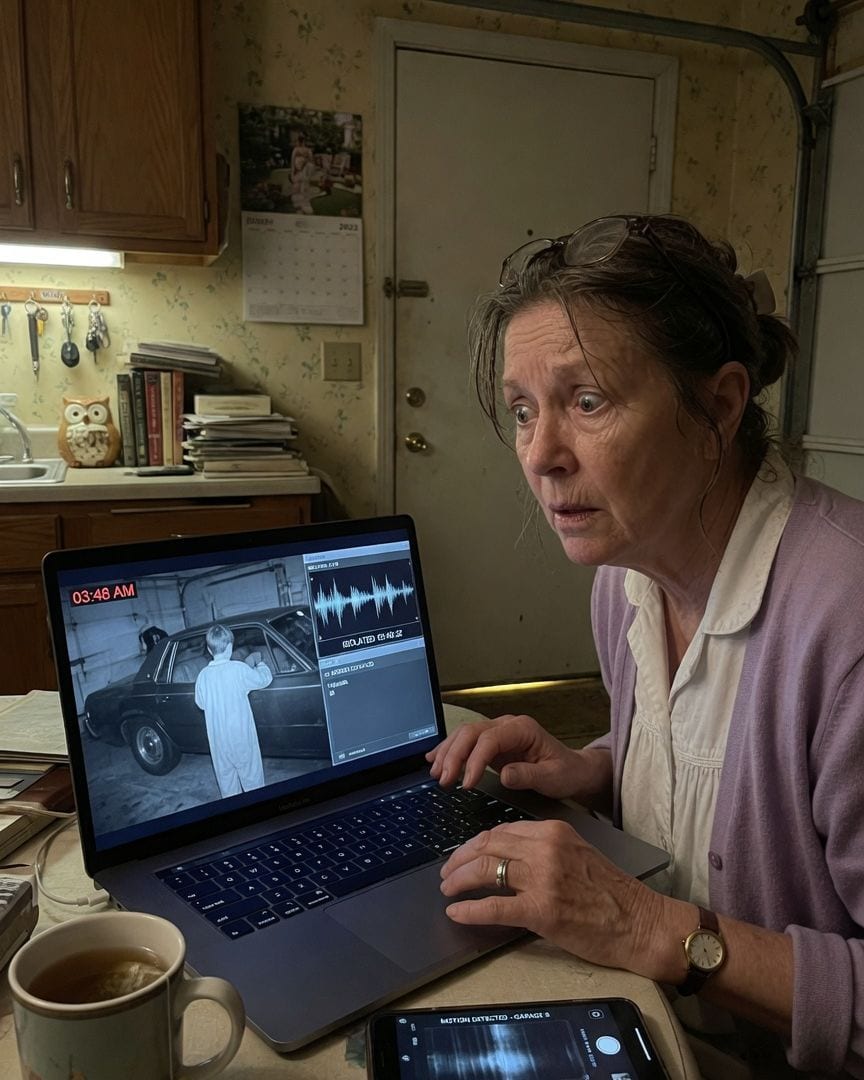
My garage camera filmed a boy of six walk out of a locked door at 3:48am, stare into my empty car, then vanish. My children live abroad.
I live in a quiet, solid house, my children grown and gone. But one night, my garage camera caught an impossible sight: my internal door, locked and bolted, slowly opened. A small, solid boy, no older than six, stepped through, then stood staring into the driver's seat of my empty car.
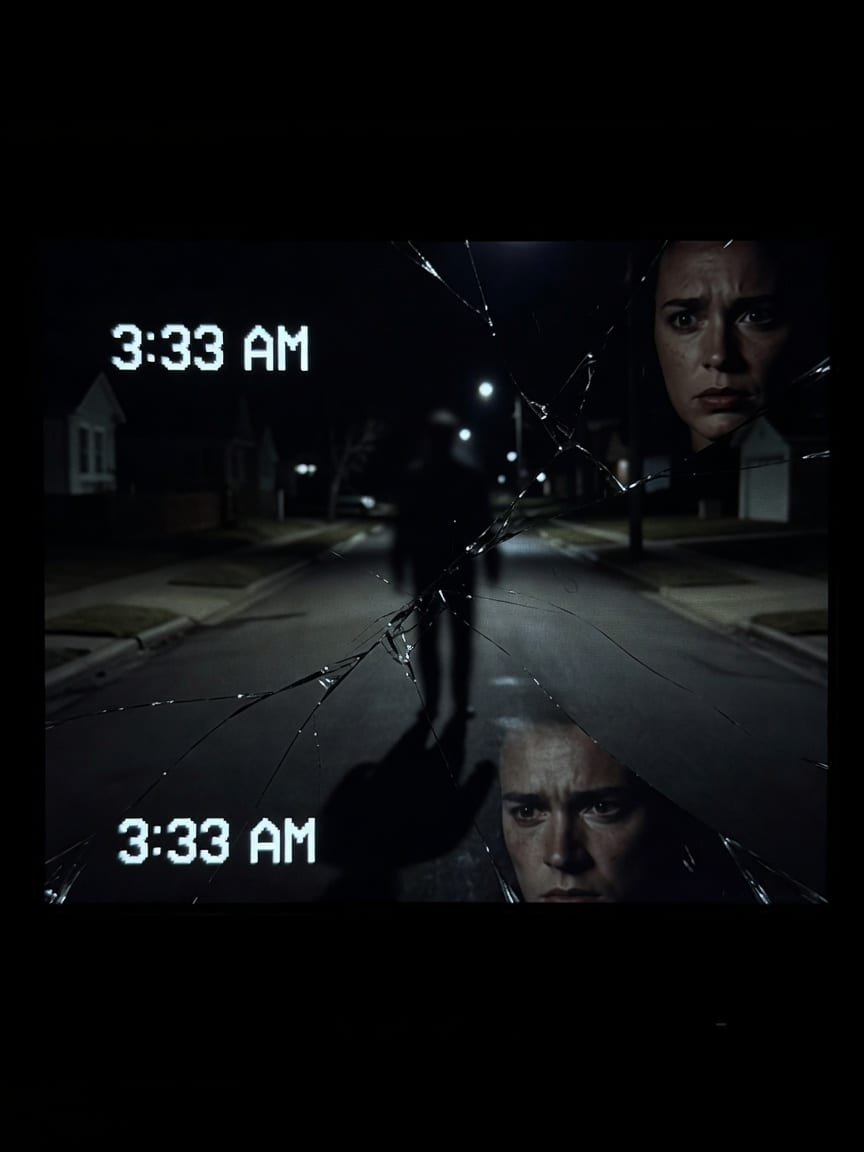
Every night at 3:33 a.m., my dashcam records the same empty street. But in each clip, the figure at the far end is one house closer to mine.
My quiet street should be empty at 3:33 a.m. But for five nights, my dashcam captures a blurred figure at the far end of the block. It isn't moving within the clips, but each day, it stands one house closer to my home.
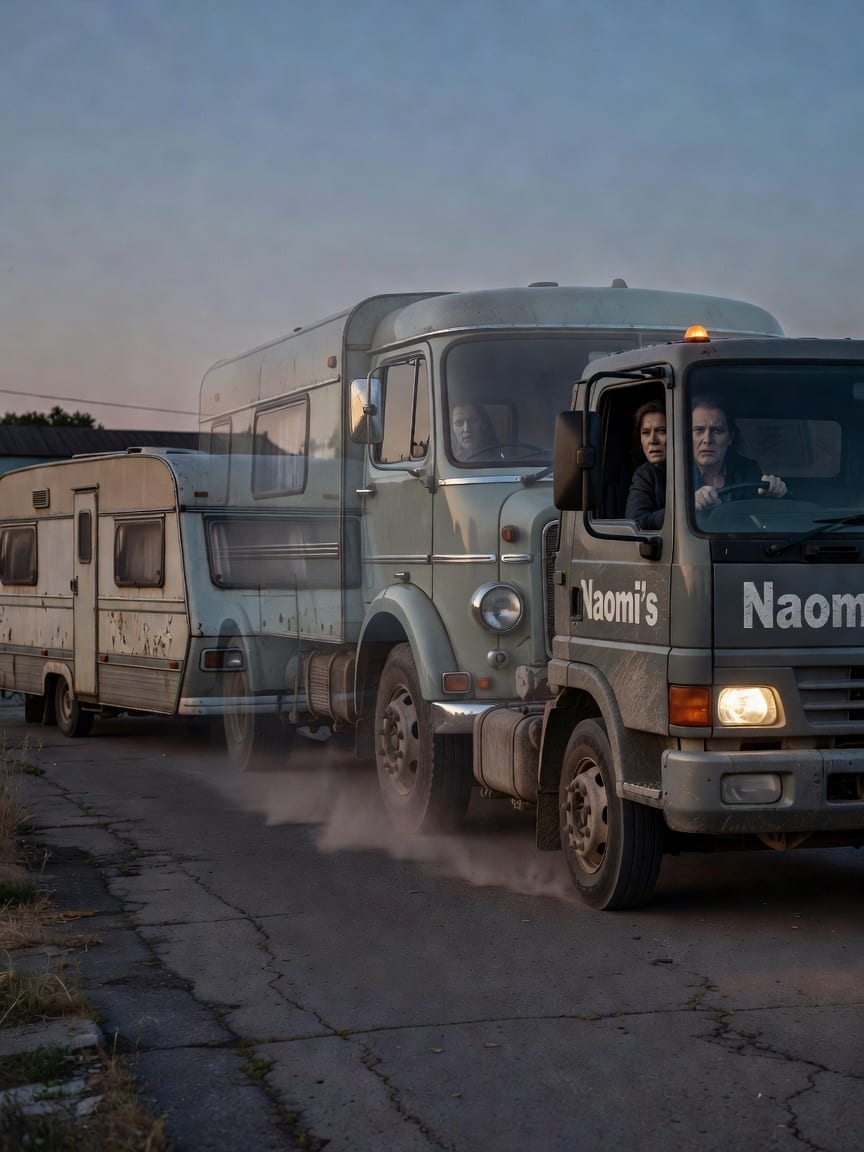
My dashcam shows the same parked caravan scrolling past eleven times in forty minutes. The timestamp advances. The mileage advances. The caravan never moves, and neither, it seems, did I.
I was on my usual lorry route, my dashcam humming, when I passed the old caravan in the lay-by. Five minutes later, I saw it again – the exact same lay-by, the same peeling blue paint. My dashcam timestamp advanced, my odometer clicked over, but the road kept repeating.
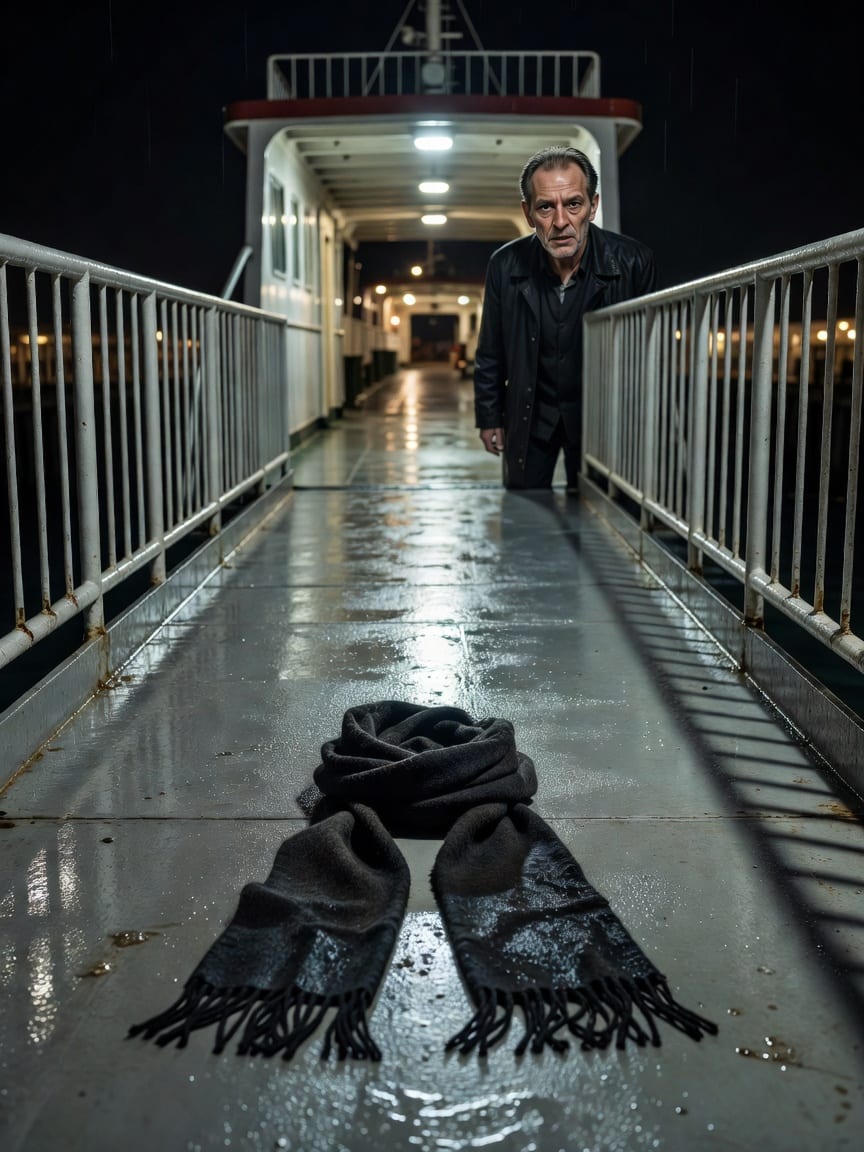
My ferry's night log recorded a foot passenger disembarked at 2:15 AM. We don't sail until six, and I wrote the entry myself.
Working the night shift on the 'Sound Clipper,' I found my own handwriting in the watch log recording an impossible event: a foot passenger disembarking at 2:15 AM. The ferry was tied up, engines cold, and the gangway locked tight. No one could have left, yet the entry was undeniable, signed with my initials.
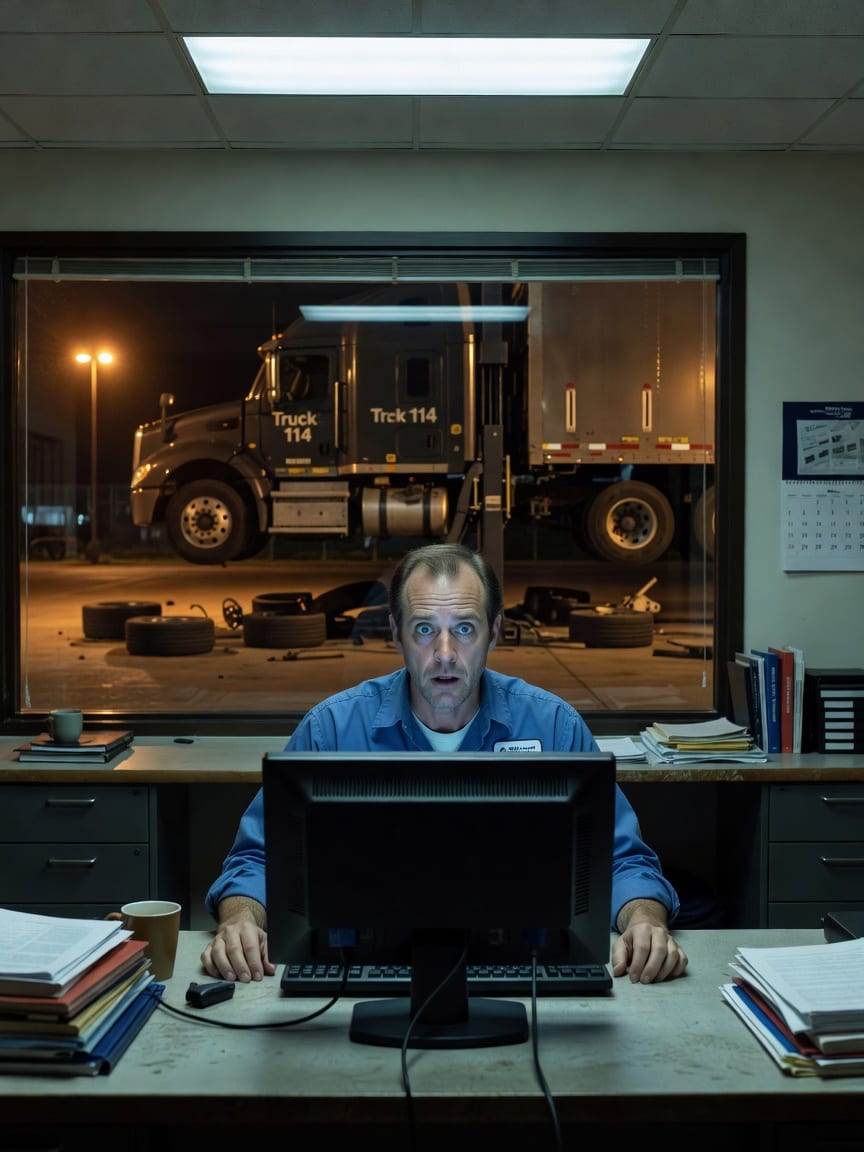
Truck 114 left the yard last night, CAD says. It burned forty miles of fuel. But my truck 114 was up on the lift, no wheels, all shift.
It was another quiet Wednesday overnight in the dispatch office until the CAD system pinged. My screen blared, showing Truck 114 logged outbound for forty miles and back, burning forty gallons of fuel. But I knew that very truck was immobile, suspended on a lift in Bay 4 with its drive wheels removed.
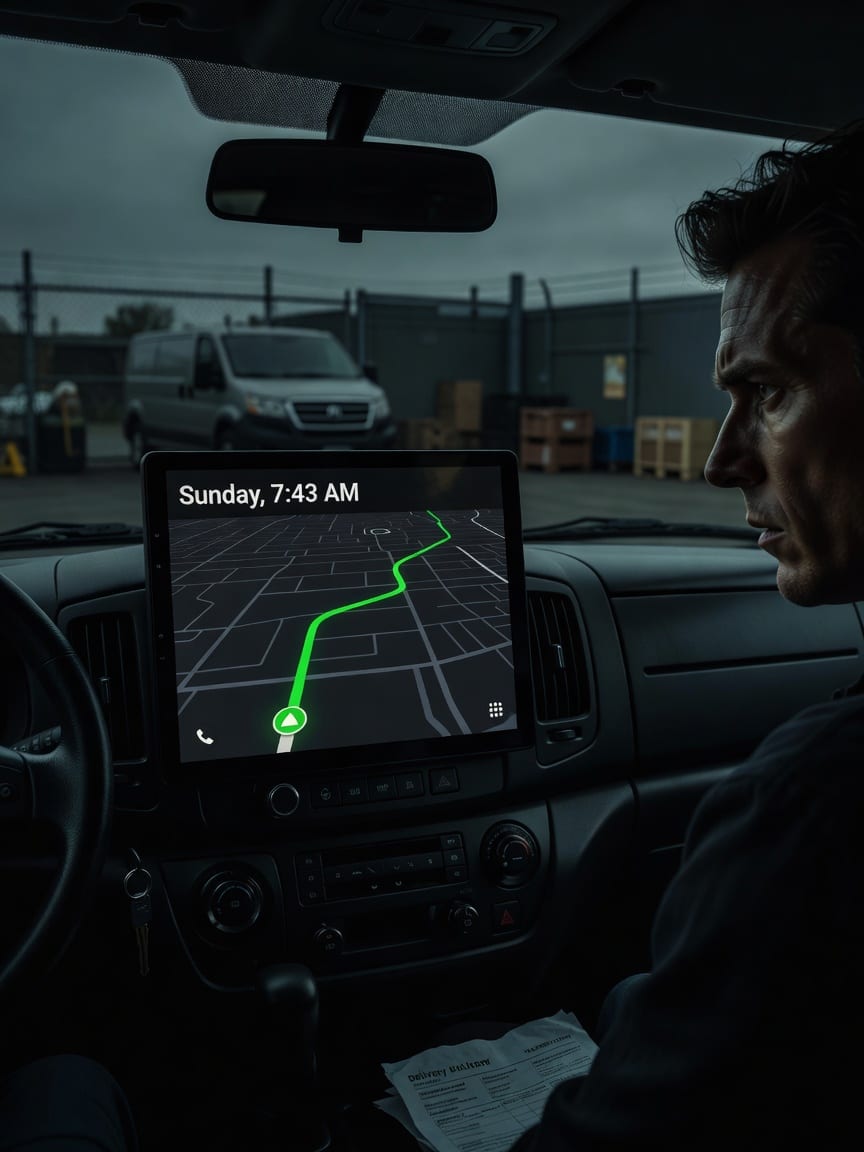
My delivery van drove 130 miles last Sunday, stopping for four hours in another state. It never left our locked yard. The GPS log drew the whole trip, timestamped to the minute.
I was just doing my job, sitting in the dispatch office with my manager Joel, when he pulled up the GPS log for my delivery van, Unit 74. It showed a 130-mile round trip to Delaware, engine on for four hours, with a distinct stop, all while my van was locked in the yard and I was home. The camera footage confirmed it hadn't moved an inch, yet the system insisted it had traveled hundreds of miles.