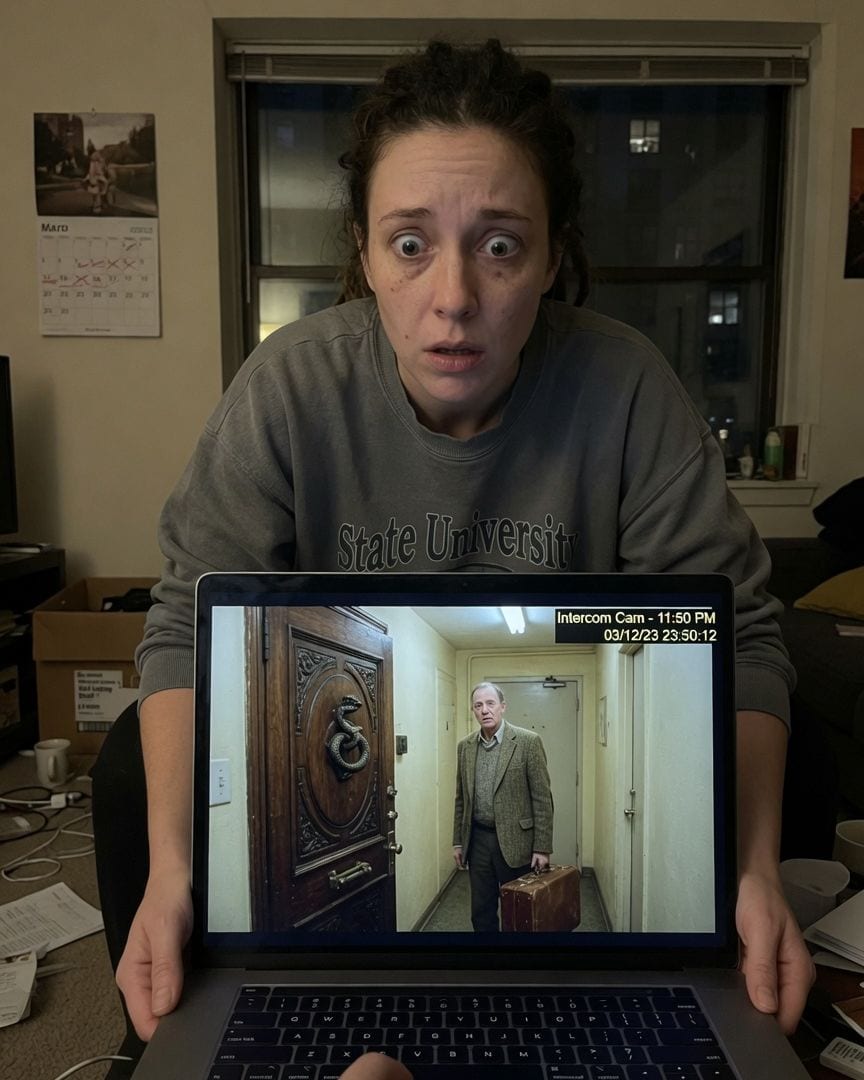
My dead father stood at my apartment door at 11:50pm, two hundred miles from where he died, and the old intercom caught him.
Two months after I moved out of 14 Elmwood Street, I was finally clearing out the digital clutter on my old laptop. It was a chore, mostly old college papers and thousands of mundane photos.
I clicked through a folder I’d labeled "Intercom Snaps" – a collection of quick stills from my old apartment building’s security system. Mostly blurred delivery drivers, an occasional mail carrier, a couple of pizza guys. Nothing exciting.
Just the usual procession of strangers at my door.
Then I stopped. My breath hitched.
There, perfectly clear, timestamped 11:50 PM, exactly three months ago to the day, was my father. Robert Easton. He was standing in my old apartment corridor, directly facing my door, filling the frame.
He wore his familiar tweed jacket, the one with the leather patches on the elbows, and he was holding a small, worn leather suitcase in his left hand.
His eyes, usually warm and crinkled at the corners when he smiled, were fixed on the lens, unblinking, strangely flat. The impossibility of it slammed into me with a physical blow.
My father had died that night, a heart attack, two hundred miles away in his own bed. He had never once been in my city, not even for a visit, let alone at my apartment door.
The image was undeniably him. Undeniably there.
I tried to rationalize. A glitch in the camera? A wrong date somehow embedded in the file? My hands were shaking as I navigated the laptop’s interface, pulling up the file properties: creation date, modification date, metadata. All clean.
All consistent with the 11:50 PM timestamp, three months ago. I scrolled through other snapshots from that night, images from earlier and later in the evening – all empty corridor, nothing unusual, no other faces.
Then I pulled up the news article I’d saved from the local paper about his passing, rereading the time of death. It matched. Precisely. The intercom system didn't just save stills; it also recorded short video clips.
I clicked the play button. The grainy footage showed the empty corridor, a flickering fluorescent light near the ceiling.
Then, suddenly, my father appeared as if from nowhere, stepping into the frame, standing still for a few seconds, his gaze fixed on the lens. Then, just as abruptly, he vanished.
As his image materialized, a faint, almost inaudible whisper seemed to bleed from the tiny speaker of my laptop, too indistinct to make out, lost in the static hum of the recording.
It sounded like a breath, a sigh, or maybe a name. I replayed it, again and again, turning up the volume until the speakers buzzed, straining to hear.
The ordinary explanations failed, one after another, leaving only the impossible image and that faint, ghost-like sound.
I zoomed in, pixel by pixel, on my father’s image, searching for anything, any anomaly, hoping to find a flaw in the picture, a trick of light.
My gaze drifted past his familiar, unblinking face, past the worn tweed of his jacket and the old leather suitcase, to the corridor behind him.
The walls in that hallway were always plain, pale yellow, with standard, flat metal fire doors leading to the other apartments. But there, just over his left shoulder, behind him and clearly part of the background, was something else entirely.
An ornate, deeply carved wooden door, dark and heavy, with a brass knocker shaped like a coiled serpent. It was solid. Real. A part of the structure. I stared, my stomach dropping into my shoes.
That door was not, had never been, in my hallway at 14 Elmwood Street.
The impossible door became an obsession. I couldn't shake the image from my mind. A week later, I found myself driving back to 14 Elmwood, the old building now quiet, undergoing renovations for new tenants.
I walked my old corridor, the air smelling faintly of plaster dust and disinfectant. I ran my hand along the plain, painted wall where the carved door had appeared in the photo. Nothing. Just smooth, unbroken plaster.
I checked old online rental listings for the building, scrolling through dozens of photos of apartments, the lobby, the laundry room, the common areas. No carved door. It simply didn’t exist in any visual record I could find.
I managed to get a copy of a very old floor plan from Charles Whitfield, the building manager. He was a man in his late sixties, with weary eyes and a perpetually worried frown, and initially very reluctant to help.
The faded blueprints showed a small storage closet in that spot, nothing more. I showed the snapshot to my friend, Paige Abbott, over coffee.
Paige, ever rational, suggested it was a trick of light, a strange reflection, or even a subtle digital manipulation by someone playing a cruel joke.
I argued, pointing out the intricate detail of the serpent knocker, the undeniable depth of the carving, the texture of the wood. Paige remained skeptical, but I could see the seed of unease had been planted in her eyes.
I found myself drawn back to Elmwood Street repeatedly, lingering outside the building, sometimes slipping in through a side door when Charles Whitfield was busy or distracted.
I’d walk the corridor, stare at the wall, feeling a growing, icy chill that had nothing to do with the outside temperature. One afternoon, as I was leaving, I caught Charles watching me from his ground-floor office window.
His expression was unreadable, almost knowing, his gaze following me until I was out of sight. A few days later, an anonymous email landed in my inbox. The subject line was blank.
The body contained a single image: a close-up, high-resolution shot of the ornate carved door, the serpent knocker glinting in what looked like natural sunlight, but from a slightly different angle than my intercom photo.
Below it, in plain text, in a simple sans-serif font, was a chilling message: 'Some doors are best left shut.' The email address was a random string of characters, untraceable, clearly a burner account.
I felt a prickle of genuine fear then, crawling up my spine. Someone knew I was digging. Someone knew about the door.
I printed the email and confronted Charles Whitfield in his office. I slapped the printout on his desk, the photo of the door glaring up at him.
He tried to dismiss it as an elaborate prank, his eyes darting nervously around the room, avoiding my gaze. “Look, Miss Easton, I told you, this building… it’s old. People get ideas.”
I pressed him, my voice tight, my patience gone. “Don’t lie to me. That door. It was real, wasn’t it? What is 'The Lindenwood Annex'?”
Charles visibly flinched at the name, a spasm of something akin to fear crossing his face. He sighed, running a trembling hand over his thinning hair. “Look, Miss Easton, please. This building… it has history. Old history.
Before my time, even, before my father’s. They called it 'The Lindenwood Annex' – a wing that was never built, supposedly. A local legend, mostly. Talk of some kind of extension, a parallel building, something… beyond.”
He paused, looking at the scuffed linoleum floor. “The carved door… it was rumored to be the entrance to it. They say it used to just… appear. And disappear. It was bricked up decades ago.
The old tenants, they said things got… confused. People started seeing things, hearing things. One tenant, back in the seventies, a young woman, went missing. Never found. The papers called it 'the phantom door incident.'
The owners just wanted it gone, forgotten. Said it was bad for business.” He reached into a desk drawer and pulled out an old, faded newspaper clipping, the yellowed paper brittle at the edges.
It detailed the disappearance of a young woman, referencing the 'unexplained vanishing' and a 'door that appeared and disappeared.' The ink was blurry in places, but the headline was clear enough: Local Woman Vanishes, Door Blamed.
“They said the building had a way of… collecting things,” Charles continued, his voice barely a whisper. “Moments. Memories. Sometimes, people.”
Charles, agitated now, pointed a trembling finger at the exact spot in the corridor wall where the door was bricked up. “Right there. They sealed it up tight.” He kept repeating, “You should leave it be, Miss Easton.
Some things are better left undisturbed.” But a sudden, irrational urge seized me. I walked to the wall, ignoring Charles’s protests, the frantic shaking of his head. I scraped at the plaster with my house key.
It gave way easily, crumbling to the floor in a fine, white dust. Behind it, not solid brick as Charles had claimed, but a dark, narrow void. It was too small to be a room, more like a deep alcove.
I reached in, my fingers brushing against something cold, smooth metal. Not a brick, but a small, intricately carved brass keyhole plate. I pulled it out, my hand trembling, the metal chilling my skin.
It was solid, undeniably real, the same serpent motif as the knocker in the photos. As I turned it over, the dim light from the hallway caught something etched into its back, tiny but clear: 'Lindenwood Annex, Apt 14B.'
Apt 14B. My apartment. And then, from inside the dark opening in the wall, a faint, rhythmic thump began, like a heavy, slow heartbeat.
The rhythmic thump from the wall opening grew louder, more insistent, vibrating through the floor and up my legs. Charles Whitfield, pale and trembling, leaned against the opposite wall, looking like he might pass out.
“It’s activating,” he whispered, his voice hoarse, his eyes wide and unfocused. “The Annex… it’s not a physical wing. It’s a temporal pocket, a place where echoes gather. Moments of intense emotion, transitions, grief… the building acts as a conduit.
Your father’s image, that was an echo. Your grief, your final goodbye that never happened, it drew him. It drew you.”
He explained that the carved door was never truly a door in the architectural sense, but a momentary bridge, a weak point where the Annex bled into their reality.
The keyhole plate I held was a fragment, a 'latch' from the Annex, and it resonated with those who had strong connections to its echoes. “It collects them,” Charles said, his voice now a raspy whisper of fear.
“It feeds on them. And once it takes an interest… it tries to draw you in. To add you to its collection of echoes, to bind you to its memory.
That thumping… it’s the building’s heartbeat, trying to pull you into its own time, its own space, to make you a permanent resident of the Annex.”
The air in the corridor grew colder, the fluorescent light dimming imperceptibly, as if the building itself was drawing a deep, slow breath.
The thumping morphed into a low, resonant rumble that shook the entire corridor, dust sifting from the ceiling in faint, powdery trails. Charles grabbed my arm, his grip surprisingly strong, his fingernails digging into my skin. “You have to leave!
Now! Never come back. The only way to sever the connection, to break its hold, is to leave that behind.” He gestured with his chin to the keyhole plate burning against my palm.
But I felt an inexplicable pull, a cold, heavy insistence to keep it, to possess it. The metal burned against my skin, a strange, possessive heat, not hot, but cold and intense.
I clutched the plate tighter, shaking my head, my jaw tight. As I turned to flee, the wall where the door had been began to shimmer, not like a reflection on glass, but like water, wavering and indistinct.
A faint, distorted image of my father, holding the suitcase, flickered into view within the shimmering wall. His face was twisted, not in anger, but in a silent, desperate plea, his eyes wide and empty.
The image seemed to reach out, an ethereal hand stretching through the watery distortion. I screamed, a raw, choked sound that felt torn from my chest, and bolted.
I ran down the stairs, three at a time, the building groaning and rumbling behind me, the image of my father seeming to stretch, to reach, to pull.
I burst out onto the street, gasping for air, the cold plate still burning in my hand, an anchor.
Behind me, Charles Whitfield, his face ashen and terrified, slammed the heavy main door shut, the sound echoing like a gunshot through the quiet street, sealing me outside.
I left the city the very next day. I tried to explain everything to Paige, showing her the intercom snapshot, pointing out the impossible carved door, displaying the brass keyhole plate with its chilling inscription.
Paige, seeing the photo as a clever trick of light, a digital artifact, and the plate as merely a weird, old antique I’d picked up, listened with concern but ultimately dismissed it as stress-induced delusion, a grief-fueled breakdown.
No one believed me.
The police, when contacted about Charles Whitfield a week later, found no one by that name associated with the building; the new owners said the manager was a young woman, fresh out of college, who’d been there for only a month.
I carried the keyhole plate with me, a cold, heavy constant reminder of what I had seen, what I had felt, what I now knew.
I never looked at old photos again, especially not those from my time at 14 Elmwood Street.
I live in a new apartment now, in a different state, hundreds of miles from Elmwood Street. The keyhole plate is in a locked, lead-lined box, buried deep in my closet, under a pile of old blankets.
I try to live a normal life.
Sometimes, late at night, when the house is quiet and the city sleeps, I hear it: a faint, rhythmic thump, a sound that seems to come from inside the walls of my new, ordinary home. I know it’s impossible.
I know it’s just my imagination. But she still checks the locks twice, every night.
If this one got to you
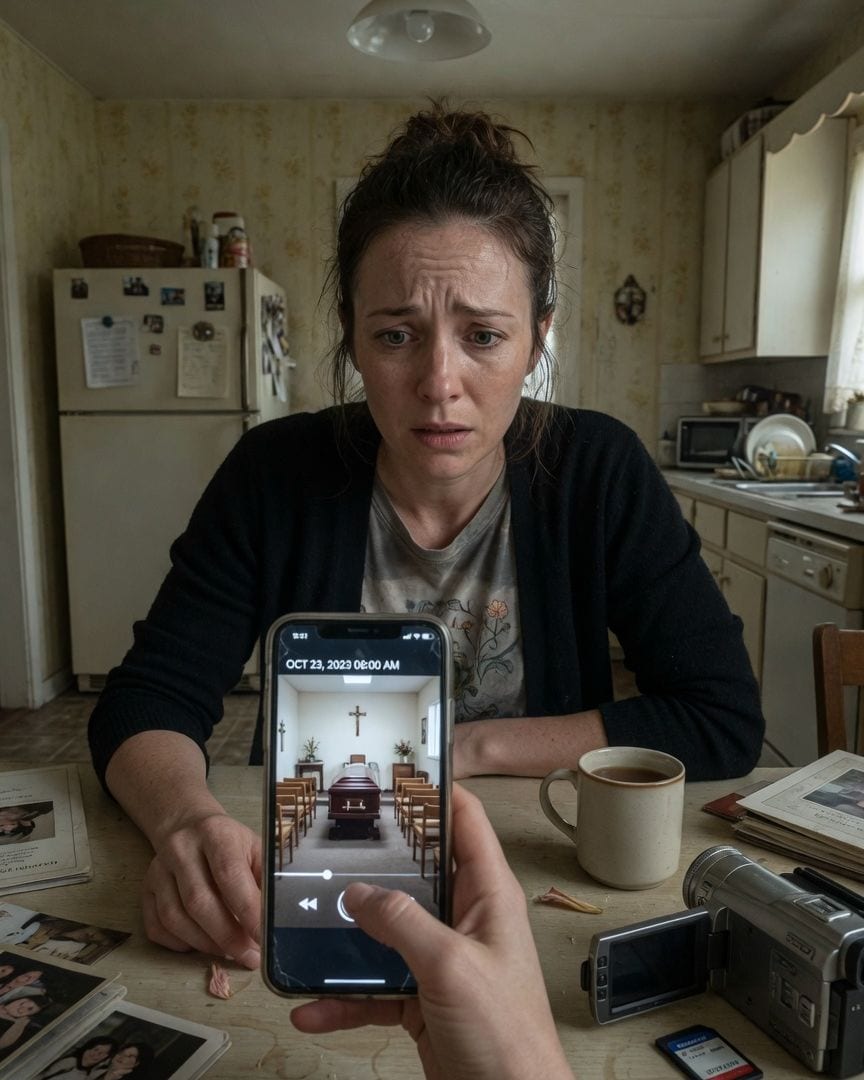
On my dead mother's phone I found a video of her funeral — steady, shot from the back over the mourners' heads, holding on her coffin. The timestamp says it was filmed an hour before any of us had arrived.
Days after my mother's funeral, I sifted through her digital life, hoping for comfort. Instead, her old camcorder revealed a video of my living room, timestamped for tomorrow morning. The abstract landscape I'd just hung was already there, waiting on the wall, a cold dread tightening in my gut.
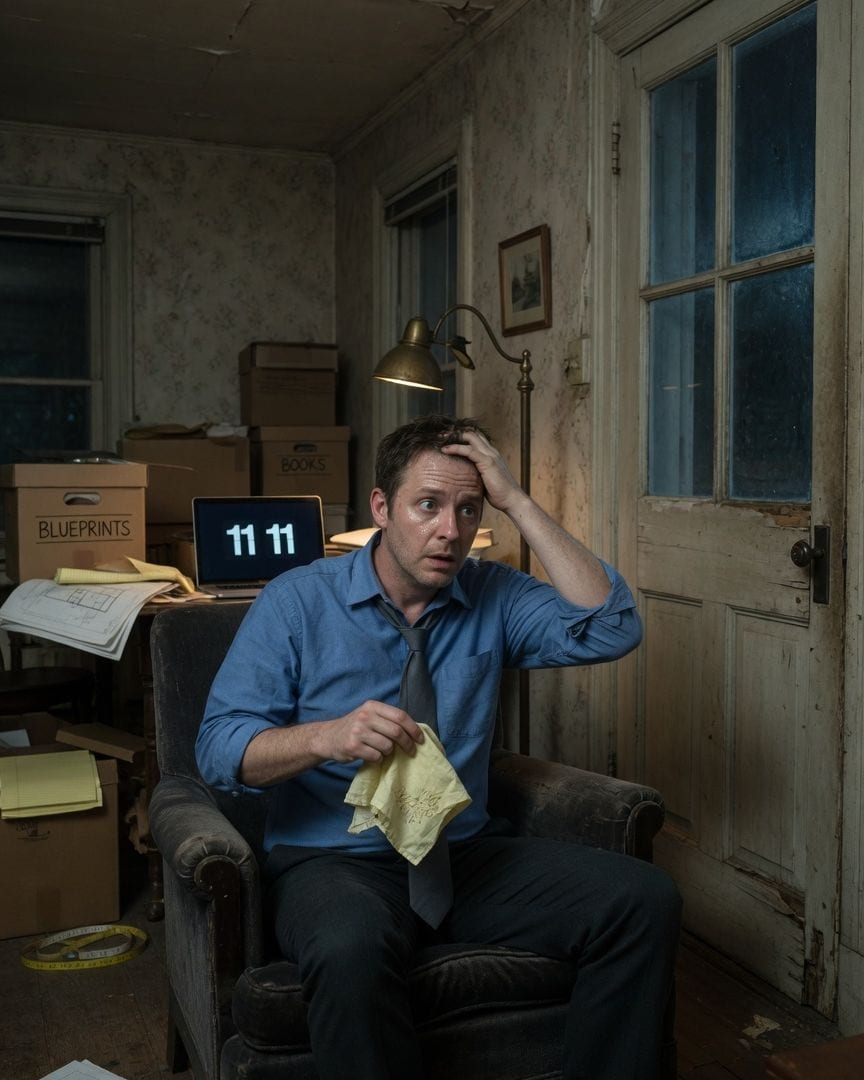
The boarded-up door in my study has twice swung open onto the balcony that was torn off this house years ago — iron railings back, and a woman at the rail with her back to me, watching a street that no longer runs below.
As an architect, I approach my great-aunt's inherited house with a rational eye, seeing its potential, not its ghosts. I knew the charming French door was boarded up because its balcony was removed back in 1953. But for two nights now, at 11:11 PM, those boards simply vanish, revealing the balcony restored and a silent woman watching an impossible street.
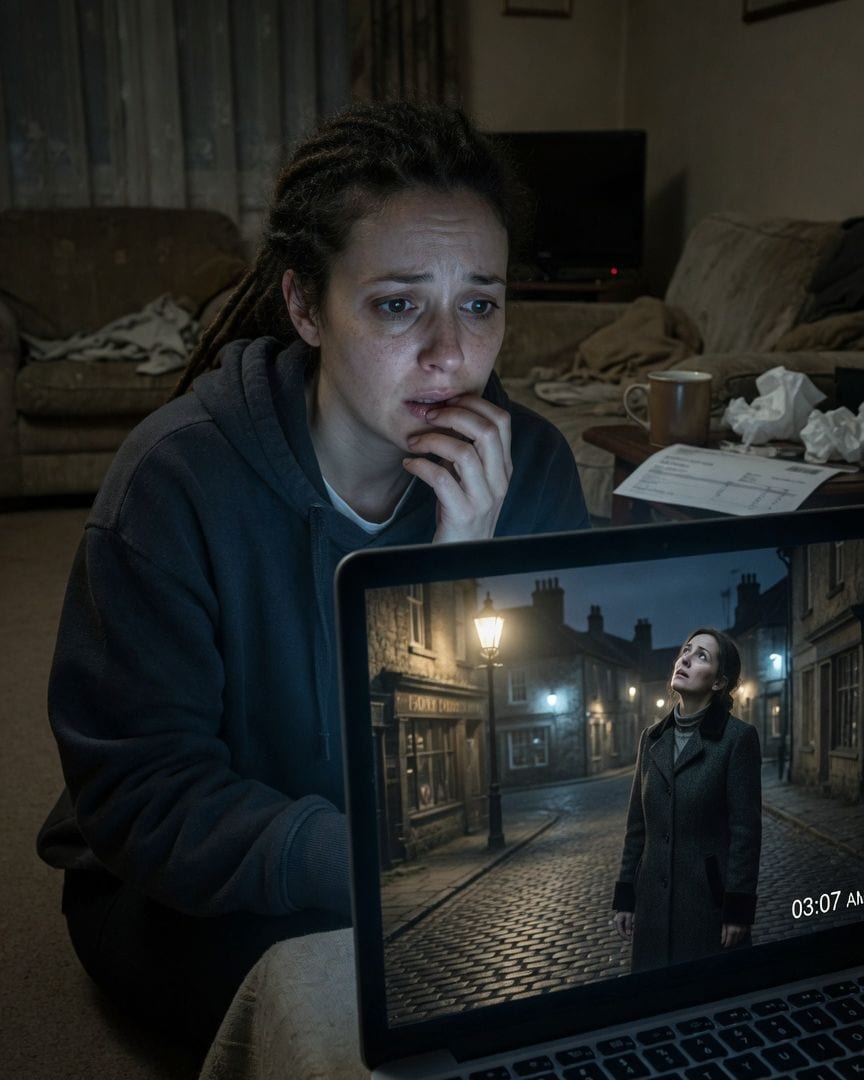
My aunt's coat walked into the village square at 3 AM. The webcam caught her looking straight into the lens, two weeks after we buried her in it.
Staring at my village church webcam at 3 AM, the square was deserted and quiet. Then a figure emerged, wearing the distinctive wool coat my Aunt Constance was buried in just two weeks ago. She paused, then slowly tilted her head up, looking directly into the camera lens, right at me.
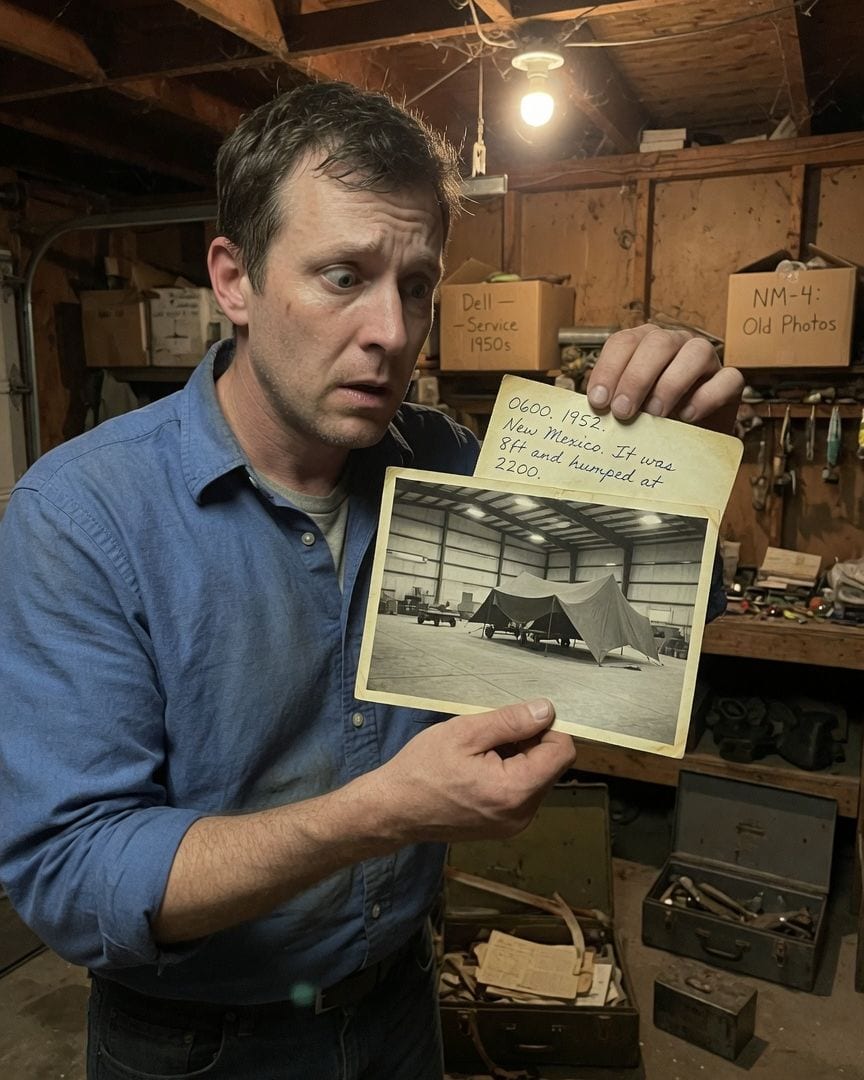
An archivist clears his father's garage, finding a Cold War photo. The object under the tarp has impossible corners, defying his father's own notes.
Franklin Fontaine, an archivist, slowly tackled the mountain of his recently deceased father's life in the dusty garage. Among old photos, he found a grainy image from 1952: a military hangar, and an object under a tarp. The tarp was pulled taut, its lines defining stark, impossible corners that rose far too tall for the cart beneath. His father's own note on the back described the object as '8ft and humped,' a description that stubbornly defied the photograph's impossible height and angles. The image was a physical impossibility, frozen in time, leaving Franklin profoundly disturbed.
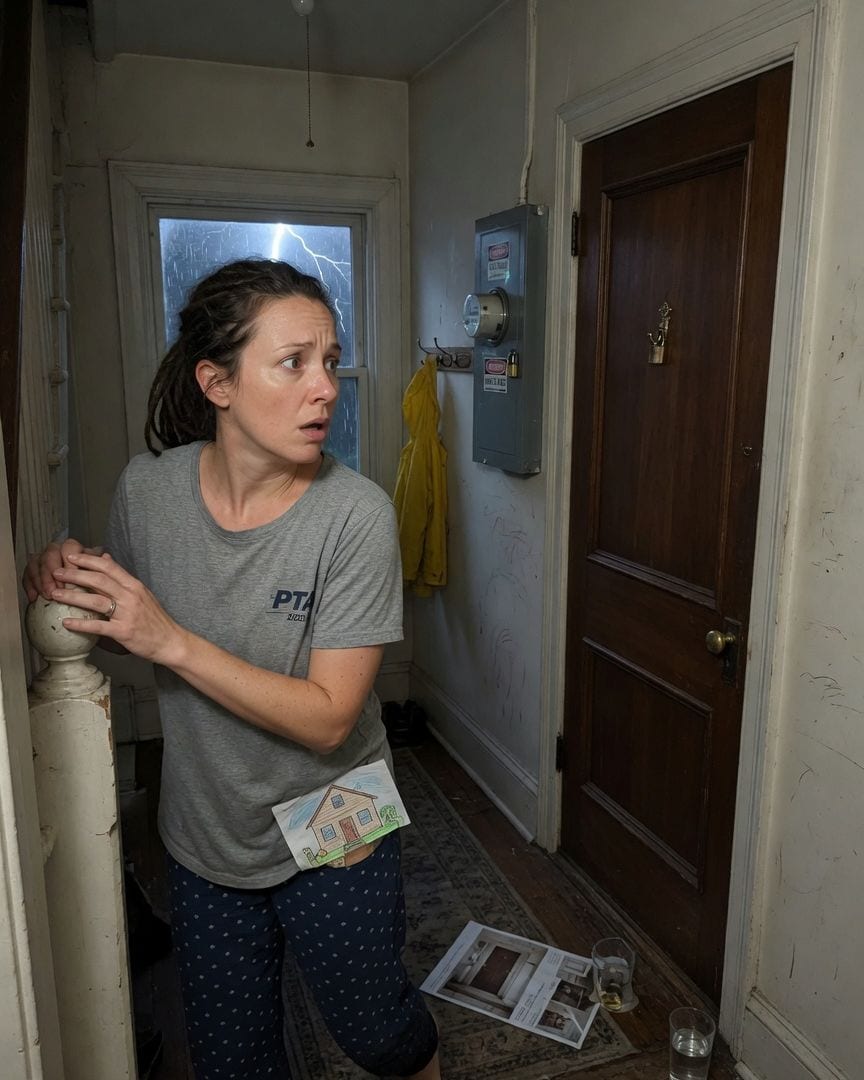
My son drew a door under our stairs. Tonight, I touched its cold brass handle.
My son Oliver drew our house with a small, panelled door under the main staircase, a detail I quickly dismissed because only a solid wall stood there. But an old real estate listing photograph revealed the exact door, perfectly placed, where no door could possibly exist.
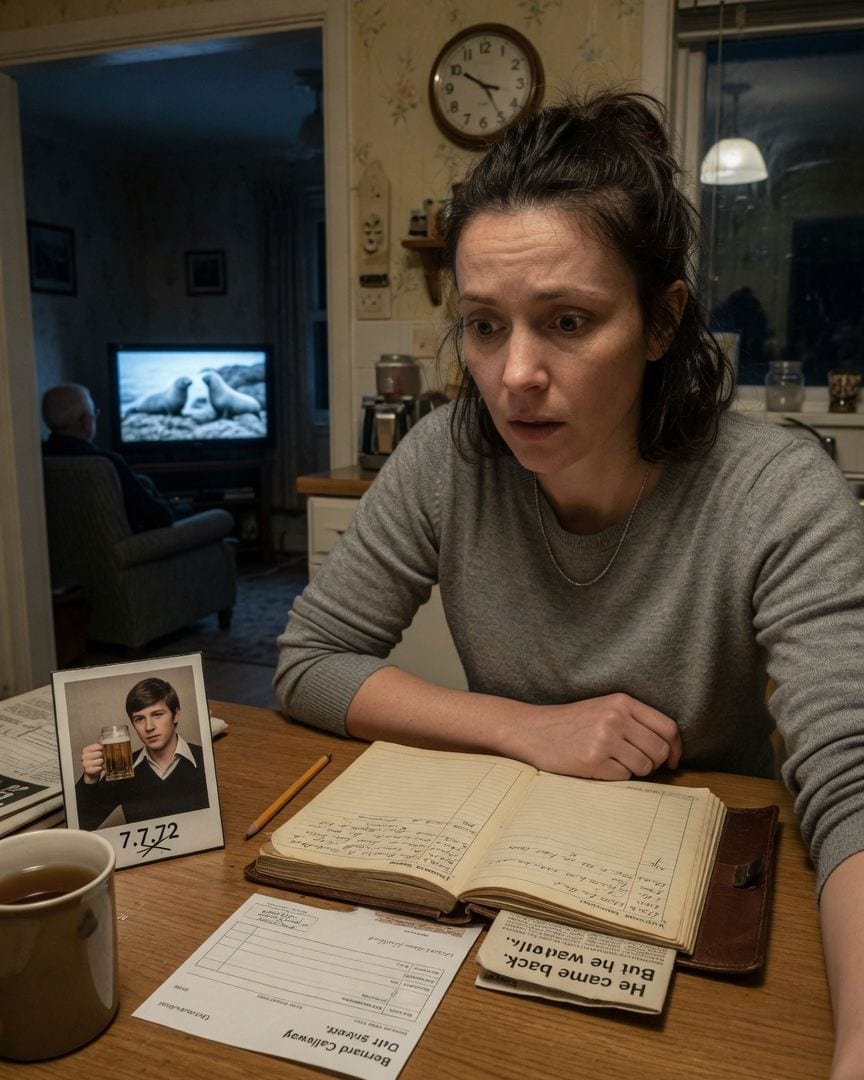
My father's bank slip had uncrossed '7's. He swore he never had that habit.
My father, Bernard, returned three months ago, a miracle after being presumed lost at sea. But a bank statement revealed a disturbing detail: the '7's in his signature were uncrossed. For decades, he'd meticulously crossed every '7', yet now he denied ever having the habit.