A declassification reviewer uncovered a Cold War file from 1954, showing a six-fingered handprint pressed from inside an empty hangar.
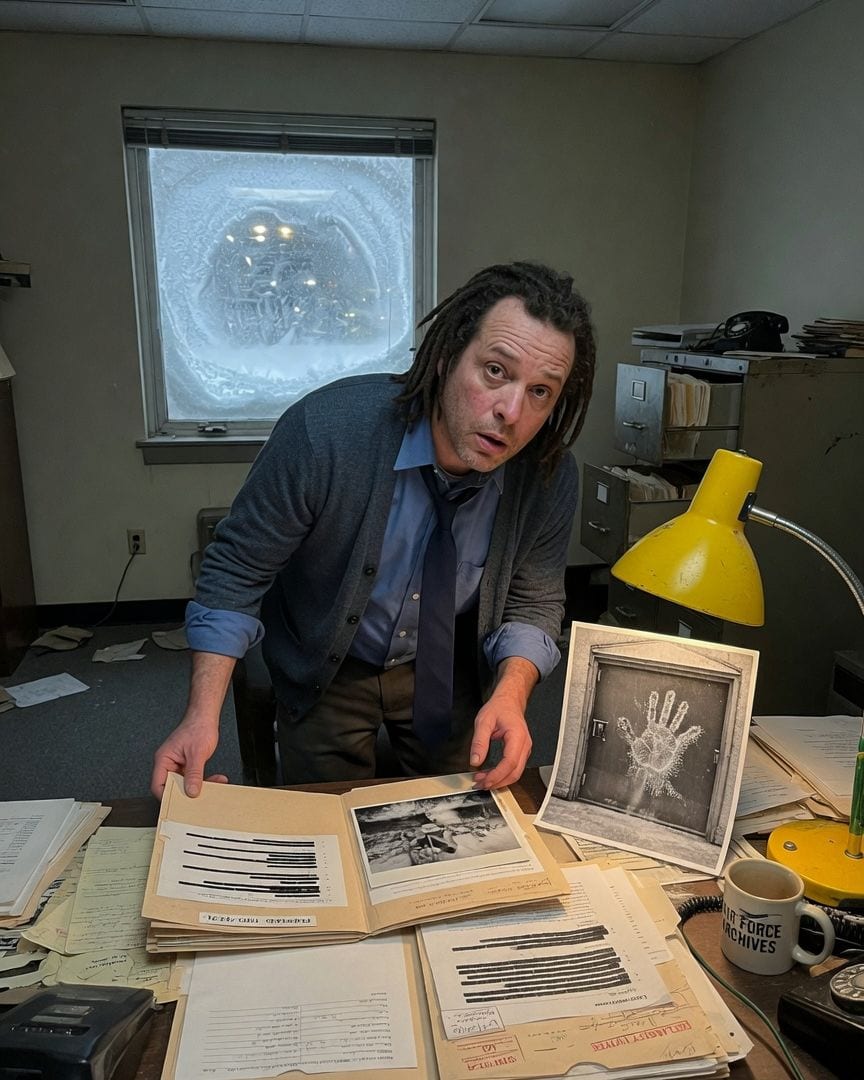
Josiah Kemp, a declassification reviewer, sat in his office, the only window a blur of snow. He was sifting through the Perrin Field file, an old government record declassified from 1954, though its contents felt anything but mundane.
The file logged an incident involving a hangar door, found frozen shut from within. That detail snagged in Kemp’s mind. The facility had been empty and unheated for two years prior to the reported event.
His professional skepticism offered a mundane explanation: a faulty sensor, perhaps, or an extreme cold front seeping through unseen cracks.
His office, usually humming with the quiet thrum of old machines, felt unnaturally still, the blizzard outside pressing a muted silence against the glass.
Then he saw the appended photograph. It was a grainy black-and-white print, curled at the edges with age. It showed a frost pattern mapped across the outside of the observation port set into the hangar door, clear and distinct.
The frost had formed the undeniable shape of a handprint, pressed not from the warmer exterior, but from the empty, unheated darkness inside. And the handprint, to Kemp’s disbelieving eyes, had six fingers.
Kemp leaned closer to the photograph, his rational mind scrambling for an explanation. A trick of the light? A peculiar ice formation? But the print was too distinct, too anatomical, despite its extra digit.
The pads of the fingers, the curve of the palm, even the faint lines of a fingerprint were rendered in crystalline detail, all impossibly formed on the outer surface by something from within.
He put the photo down and returned to the file itself, his desk lamp casting a harsh yellow glow over the brittle pages. He noticed other anomalies now, small details that his initial professional scan had dismissed.
The cover sheet listed 14 pages, but the folder held only 11.
The control number, PF-74-001, traced to no originating office in the Air Force's old records system; it was a number without an administrative parent, a phantom in the vast bureaucratic skeleton.
Most chillingly, the downgrade schedule for the file, typically a date for public release, read simply: 'DECLASSIFY NEVER.'
He tried to dismiss them as bureaucratic quirks, relics of an older, less organized era. Perhaps the cold had affected the original record-keepers.
But the six-fingered handprint kept pulling at his attention, a physical impossibility that defied every mundane explanation he could conjure.
The air in the office felt colder now, as if the image on the desk had begun to leech heat from the room itself.
He stood, the worn carpet creaking beneath his shoes, and walked to the filing cabinet, a hunch guiding him.
He scanned the adjacent folders, looking for any cross-references to Perrin Field, any related incident, even an unrelated file that might share a bizarre numbering scheme.
His fingers brushed against a folder, identical in size and faded beige color to the one on his desk, its label simply 'PF-74-002,' filed directly beside the first, as if placed there deliberately.
He pulled the second folder, its paper brittle with age, and carried it back to his desk. Inside, he found another copy of the Perrin Field report.
He laid both files open on his desk, side-by-side, the light reflecting off the different textures of their paper. The frost photograph was identical in both.
But as he began to compare the text, line by painstaking line, a cold tremor ran through him. The redactions, the heavy blocks of black ink meant to obscure sensitive information, fell in wildly different places.
What was blacked out in the first copy was perfectly visible in the second. What was visible in the first was obscured in the second.
And on a page detailing personnel involved in the incident, where the first file had a solid black rectangle, the second copy clearly listed a name: 'Private David Muller, Airman Basic, Hangar Security.'
His breath hitched, a cold tremor running through him that had nothing to do with the snowstorm outside.
The name 'Private David Muller' became Josiah Kemp's anchor, a sudden, solid point in a swirling sea of anomalies. He cross-referenced Muller's service number, tracing his movements through the fragmented, declassified records of the mid-fifties.
Muller was listed as 'transferred' from Perrin Field shortly after the incident, then his trail simply vanished. No discharge, no retirement, no further assignments, no death certificate. Just a final, unceremonious 'reassigned, special duties' entry, followed by silence.
It was as if the man had walked off the edge of the world, erased by bureaucratic ink.
Kemp began to find other files, tucked away in obscure corners of the archives, that bore the ominous 'DECLASSIFY NEVER' stamp.
He noticed a disturbing pattern: similar control number anomalies that couldn't be traced to any department, inexplicable cold events logged in otherwise routine weather reports, and personnel who, like Muller, simply disappeared from records after contact with these incidents.
He even found a few internal documents within his own office that carried these same unassigned control numbers, tucked away in obscure, rarely accessed archives that predated his employment by decades.
The paper in these folders felt colder to the touch than the surrounding files, a subtle chill that prickled his fingertips.
He started to compile a timeline of these incidents, meticulously noting the dates, locations, and the personnel involved. He saw a horrifying echo of the Perrin Field event in each one, a cold fingerprint reaching across the decades.
He was no longer just reviewing history; he was seeing an ongoing, active system, hiding in plain sight, its presence marked by impossible cold and bureaucratic erasure.
The cold in his office seemed to deepen with each new connection he made, the monitor on his desk humming with a faint, almost musical resonance, like something trapped.
Kemp's focused queries, particularly those regarding specific control numbers and the vanished Private Muller, didn't go unnoticed.
One afternoon, as the snow continued to fall with relentless dedication, Karen Sinclair, a senior archivist with a quiet demeanor and an unsettlingly calm gaze, appeared at his desk.
She was a woman who blended seamlessly into the beige monotony of the archives, yet her presence now felt like a spotlight.
“Mr. Kemp,” she began, her voice soft, barely audible over the distant rumble of the heating system, “I understand you’re delving into some rather… complex material.”
She leaned against the adjacent filing cabinet, her posture relaxed, but her eyes were sharp, scanning the open files on his desk. She offered to “assist” him, her questions precise, too specific for a casual offer of help.
She seemed to know exactly which obscure records he’d been pulling, which cross-references he’d been making, almost as if she had been following his progress.
Her composure, in the face of the bizarre anomalies he had uncovered, was unsettling, a smile that seemed cold enough to freeze the room.
Later that day, after Sinclair had left, her footsteps silent on the worn carpet, Kemp found a small, yellow sticky note affixed to his own personnel folder, which he rarely handled, tucked away in his bottom drawer.
On it, scrawled in an unfamiliar but neat hand, was a new control number. He recognized the pattern immediately: it matched the anomalous, unassigned numbers he’d been tracking in the 'DECLASSIFY NEVER' files.
PF-XX-XXX, a number that shouldn't exist in any official registry. A prickle of dread, sharper and colder than anything the blizzard could offer, ran down his spine.
Someone knew he was digging, and they had just logged his own file into the system he was trying to understand.
The next morning, the sticky note now a permanent fixture of his dread, Kemp confronted Sinclair in her sparsely decorated office, a space as neutral and devoid of personal touches as a holding cell.
He laid out his findings: the duplicate files, the vanished Private Muller, the anomalous control numbers, the pervasive pattern of 'DECLASSIFY NEVER' stamps, and finally, with a trembling hand, the sticky note he'd peeled from his own personnel folder, its new number stark against the yellow.
Sinclair listened patiently, her expression unreadable, her gaze steady. The only sound in the room was the soft whir of an old hard drive from a nearby office.
“You’ve been very thorough, Mr. Kemp,” she finally said, her voice devoid of judgment, as if discussing a particularly well-organized library shelf. “Perrin Field was a containment site, yes. And Private Muller wasn’t lost. He was… processed.”
She explained that the 'conditions' were not conventional entities or aliens, but self-sustaining, pattern-replicating phenomena. They manifested as intense, extreme cold, manipulating physical matter and, crucially, information itself. “The six-fingered handprint? A signature, a pattern replication.
A way for the condition to manifest its informational blueprint into the physical world. The frost on the outside of an unheated hangar? A byproduct of its presence, of its inherent nature to generate profound cold, even in a vacuum.”
She tapped a finger on the Perrin Field file, its brittle cover cracking slightly under her touch. “These files aren’t just records of incidents, Mr. Kemp. They are part of the containment. A way to channel, to bind, the patterns.
The redactions, the missing pages, the anomalous control numbers – they’re not errors. They’re deliberate. A means to control the flow, to prevent the condition from spreading through information itself, through knowledge.
It’s a living containment system, constantly being maintained, evolving with every piece of information it interacts with.”
The pieces clicked into place, horrifyingly, with the precision of a trap springing shut. The impossible frost, the vanished soldier, the contradictory documents, the phantom control numbers – it all made a terrible, coherent sense.
The mundane explanations he’d clung to had dissolved, revealing a deeper, colder truth.
Kemp felt a profound chill, a cold that started not in the room, but deep within his own bones, realizing the implications of what Sinclair was saying.
The bureaucracy, the endless paper trail, the very act of documenting and redacting, was a cage.
He was processing this, the immense weight of the truth pressing down on him, when Sinclair gently slid an ancient, leather-bound logbook across her desk.
It was another Perrin Field document, a 'personnel status update,' thick with yellowed pages and faded ink. She flipped it open to a specific page, its surface scored with hundreds of minute entries.
“And the processing isn’t a one-time event, Mr. Kemp,” she said, her voice dropping to a near whisper, somehow even calmer now. She pointed to a freshly penned entry on the page, stark against the aged paper.
It listed a new 'subject accession,' dated for this very day. The last line of the entry, in a strange, eerily familiar script that looked startlingly like his own, read: 'Reviewer: Josiah Kemp.' The ink still looked wet.
Kemp stared at his name, his own handwriting, in the file. A wave of nausea washed over him, a cold dread that eclipsed any physical chill. Sinclair watched him, her calm gaze unwavering, devoid of triumph or pity.
“The conditions don’t just affect physical matter, Mr. Kemp. They affect information, records. They assimilate. Your investigation, your focus on these patterns, on tracing their spread through the archives, has made you… an entry.”
She explained that the act of reviewing, of connecting the disparate pieces, had created a new pathway for the condition. He hadn't just been reading the file; he had been added to it.
The six-fingered handprint wasn't just a physical trace, a fossil of some impossible event; it was a propagating pattern, finding new hosts, new ways to manifest its informational blueprint.
Muller had been 'processed' into the system, becoming part of the containment, or perhaps an extension of the condition itself, a new conduit for its cold, silent spread. Now, Kemp was next.
The file wasn't just a record of containment; it was a mechanism of assimilation. The 'DECLASSIFY NEVER' stamp wasn't a warning to outsiders; it was a seal on the living, growing containment, a label on the processed.
Every clue, every anomaly, now clicked into place with horrifying precision, revealing a trap meticulously set over decades, waiting for someone just like him to connect the dots, to become part of the pattern.
A profound, unnatural cold began to emanate from Kemp, a chill that had nothing to do with the room's temperature, but which seemed to make the air around him shimmer.
He could feel it spreading through his limbs, a faint tingling in his fingertips, a creeping numbness. He looked at his hand; for a moment, the shadows seemed to twist his fingers, distorting them into an impossible six-digit shape.
He understood. He had to stop it.
He lunged for the logbook, his intention to rip out the page with his name, to sever the connection, to erase the entry. Sinclair, moving with surprising speed for her age, intercepted him, grabbing his arm.
Her grip was cold, firm, like a clamp of ice. “It’s too late, Mr. Kemp. You’re already part of the record. Resistance is… inefficient.” He struggled, the cold intensifying from within him, making his joints ache.
He saw faint, intricate, six-fingered patterns forming in the condensation on Sinclair’s glasses, reflections of the propagating condition.
With a desperate surge of adrenaline, he twisted free, knocking the logbook to the floor with a heavy thud. It skidded open, landing on the page with his name.
He stomped on it, tearing the ancient paper, grinding it under his heel in a frenzied attempt to destroy the inscription. The cold in the room intensified, a sharp, crystalline crackle in the air, a sound like microscopic glass shattering.
Sinclair didn't react with anger, only a slight tilt of her head, a look of mild disappointment. “A temporary disruption,” she murmured, her voice still perfectly calm. Kemp didn’t wait.
He burst from the office, leaving the shattered logbook and the unnervingly composed archivist behind, the gnawing cold his constant companion, a chill that was now undeniably his.
Kemp made it out of the archives, out into the biting snow. He quit his job the next day, citing 'personal health issues' in a hurried, almost panicked email.
He moved to a small apartment, far from the city, far from any archive or any official record. But the cold followed him.
He felt it constantly now, a deep, internal chill that no amount of heating or blankets could dispel, a cold that felt like it came from inside him.
He began to see patterns everywhere: in the frost on his windows, the condensation on his water glass, the intricate cracks in the sidewalk, the swirling foam in his coffee.
Always, the faint, impossible suggestion of a six-fingered hand, just at the periphery of his vision. He knew he hadn't truly escaped, only delayed.
The file, he understood, was still being signed, still being written, and he was just one entry among many.
He was now a witness to a secret that had become part of him, a truth now inscribed in his very being.
One evening, watching the snow fall outside his apartment window, a new, deeper chill settled over him. He saw it. A faint, six-fingered handprint began to form on the inside of his own window, the glass cold to the touch.
He pressed his palm against it, feeling the impossible cold, tracing the extra digit with his thumb. He knew it wasn't condensation.
He watched it, a hollow dread settling deep in his bones, knowing he was now part of the pattern he had tried so desperately to uncover. He was still being filed. He was still being signed.
The cold seeped deeper, into his marrow, into the very core of his being. He didn't bother to wipe it away. He knew it was useless.
He just watched, the world outside blurred by snow, the world inside blurred by a colder, more patient horror. He knew it wasn't condensation.
A few weeks later, a new file was opened at the National Archives, its control number tracing to no known office or department. The cover sheet listed a single reviewer, Josiah Kemp, marked "Transferred." It was already stamped "DECLASSIFY NEVER."
It wasn't condensation.
If this one got to you
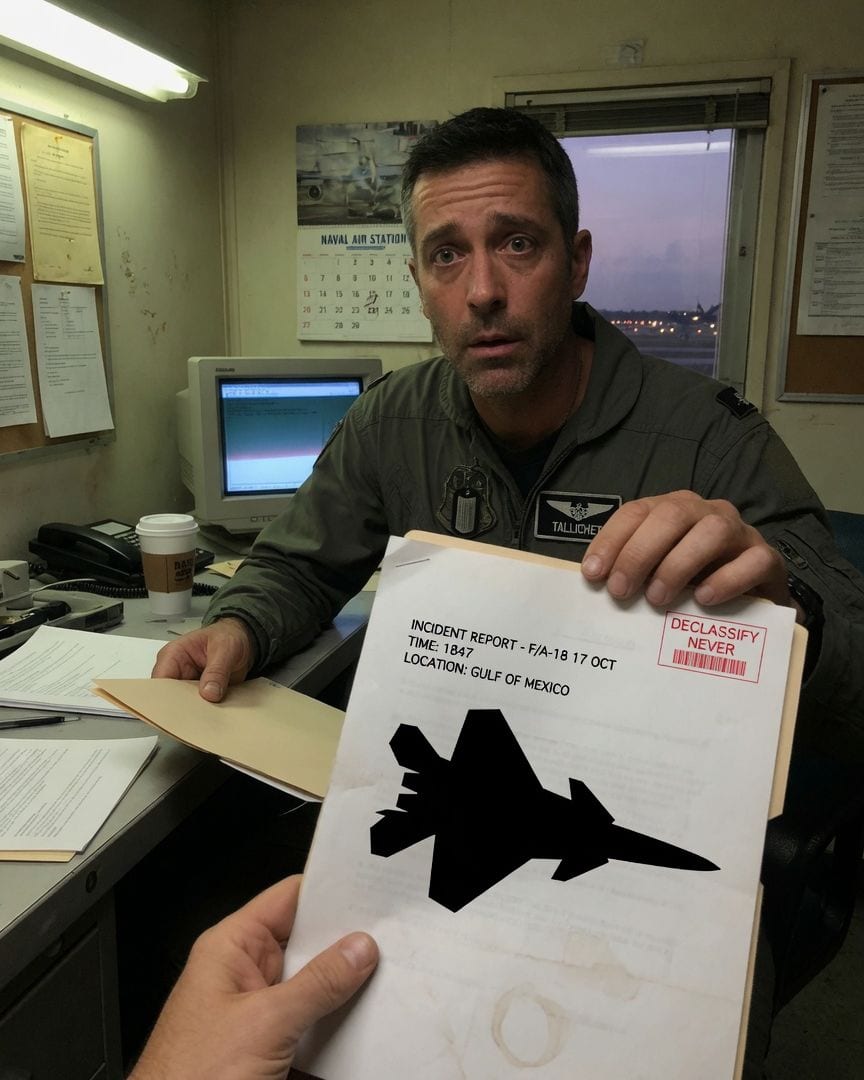
A pilot's classified flight report had a precise, angular blackout. The digital file said 'Page 1 of 12,' but only six pages existed.
Captain Yves Tallichet landed his jet, his hands shaking from an impossible encounter in the sky. He'd seen a dark, seamless shape mirror his F/A-18, defying all known physics. Days later, seeking answers in his official flight report, he found a precise, angular blackout over his observations. A senior records clerk confirmed the redaction was permanent, flagged "DECLASSIFY NEVER." But the true dread came when the digital file showed "Page 1 of 12," yet his physical copy held only six. What happened to the other pages?
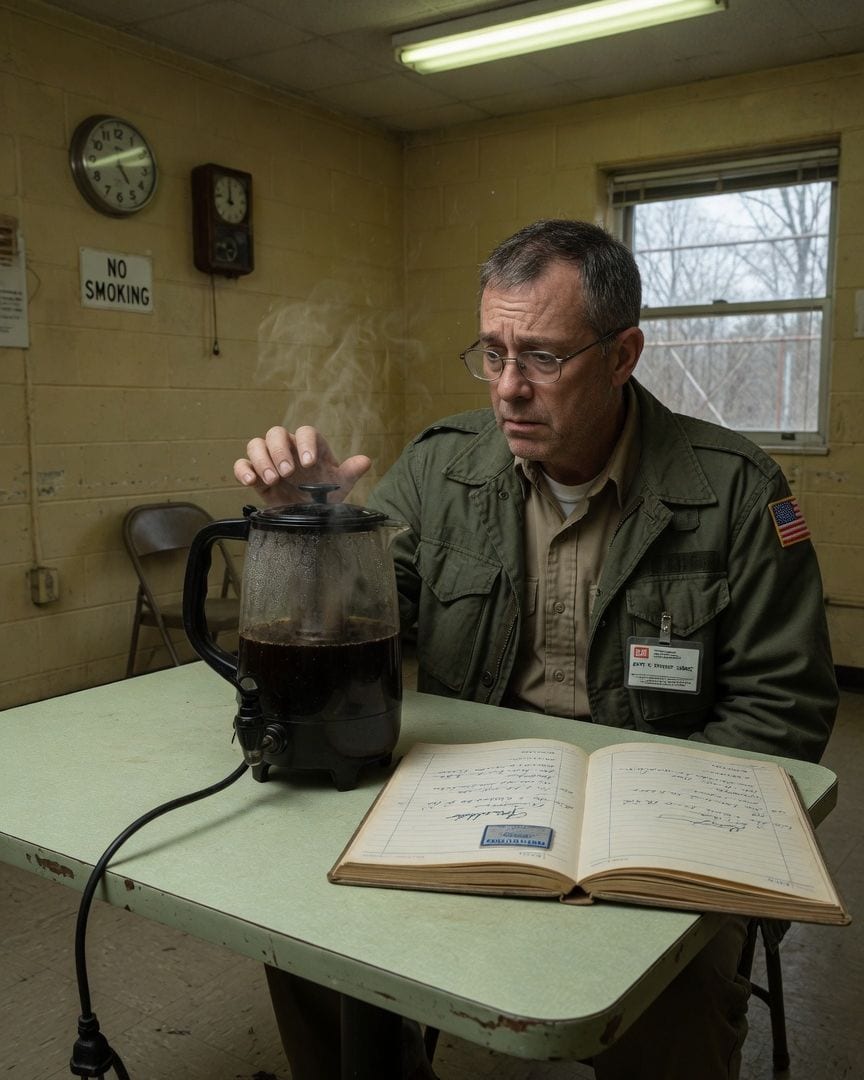
A methodical US Army engineer found a Cold War facility's file stamped 'DECLASSIFY NEVER' — and half its pages were missing.
Captain Nolan Threep, a methodical US Army engineer, expected another routine decommissioning at Alert Facility Twelve in rural Montana. The chains on the doors had rusted solid since 1970, promising a long-dead site. Yet, inside, a faint warmth hung in the air, and a glass coffee urn sat half-full, a wisp of steam rising lazily from its dark surface. The urn, warm to the touch, was clearly unplugged, and the duty log beside it, signed for a shift ending nineteen years prior, looked as though it had been signed yesterday. What secret could a supposedly abandoned Cold War facility hold?
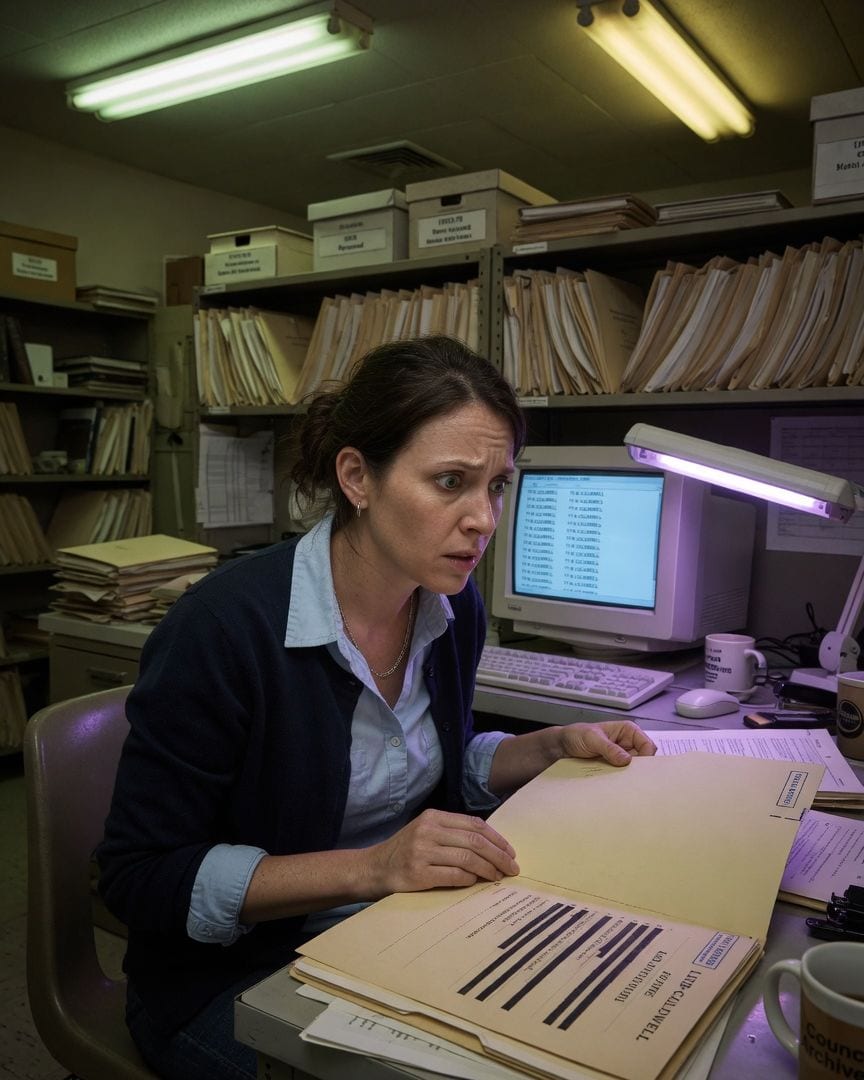
My employer's security file holds a vetting report on me dated nine years before I ever applied. It has my full name and my parents' address — with only one line, the source who referred me, blacked out.
Working a routine data audit, I pull my own security file. The issue date is nine years before I even applied for the job. Then, hidden within an old archive file, I find my current address etched under a blacked-out line.
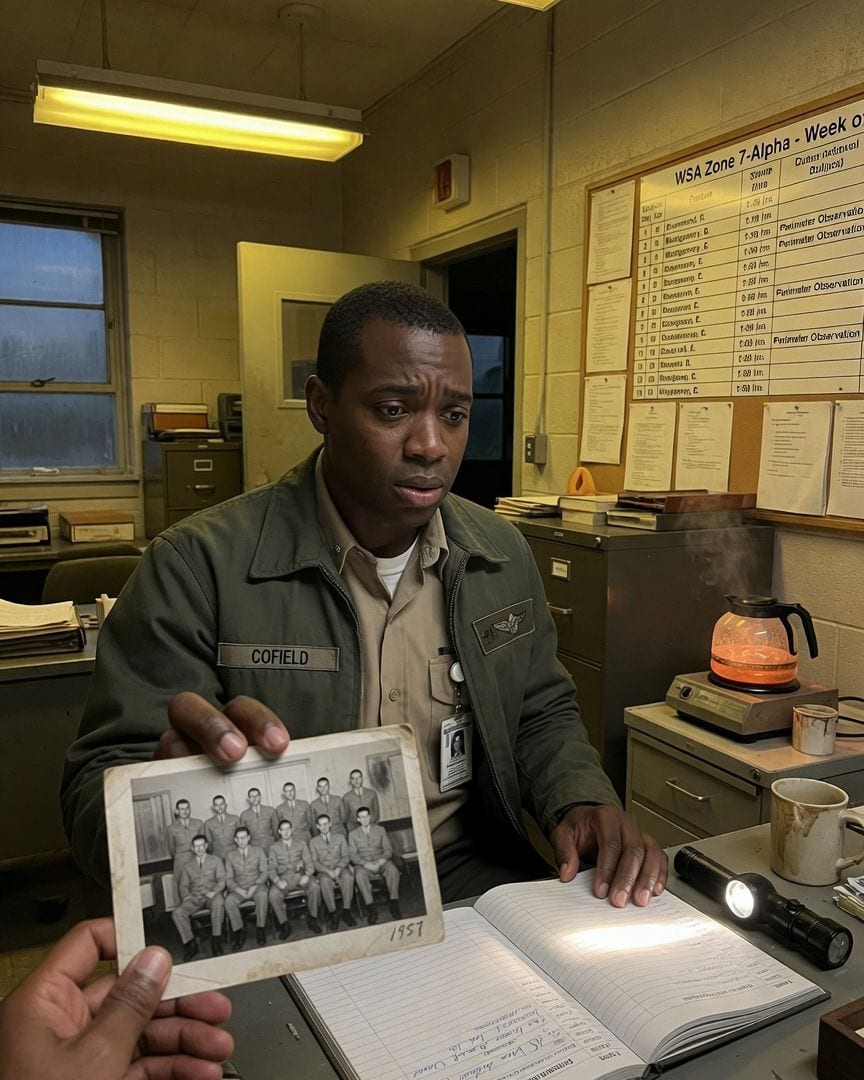
On his last patrol, Senior Airman Cofield found hot coffee steaming inside a base building mothballed since 1992. The fresh roster was signed by a man from a 1957 photo.
Senior Airman Felix Cofield was on his last perimeter patrol of the decommissioned Weapons Storage Area when an impossible light bloomed in the pre-dawn dark. The building had been mothballed for decades, yet a warm, unnatural glow pulsed from within. Ignoring Central Security's all-clear, Cofield found an unlocked door and a brightly lit office, as if someone had just stepped out. A freshly printed roster for the coming week lay on a corkboard, and a coffee pot on the counter was still steaming hot. Then he saw the faded group photo from 1957, showing the very man who had just signed today's logbook.
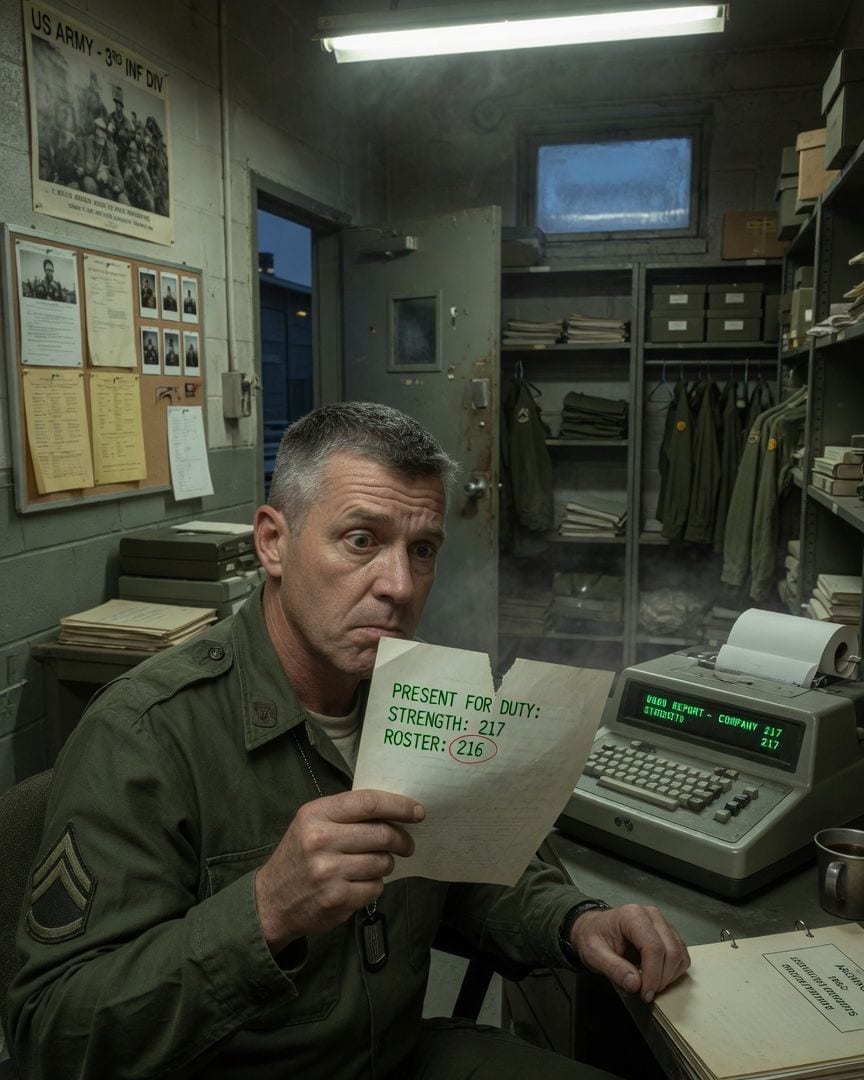
Sergeant Halloran is three months from a promotion, but his Cold War morning report shows 217 men. He counted only 216. A cold, hidden log from 1963 records the same impossible count.
Sergeant First Class Joseph Halloran, three months from a promotion and stateside transfer, faced the chilly 0600 darkness of his West German garrison in 1987, his career built on impeccable order now threatened. For a week, his morning reports had defied him: a meticulous physical count of 216 shivering soldiers always resulted in the Teletype machine blinking 217. His exhaustive double-checks confirmed no error, yet the impossible 'plus one' persisted, leading him to a distinctly colder section of the supply room. Behind ancient manuals, a hidden alcove revealed a worn leather log, where a Sergeant Hayes in 1963 had recorded the identical, chilling discrepancy.
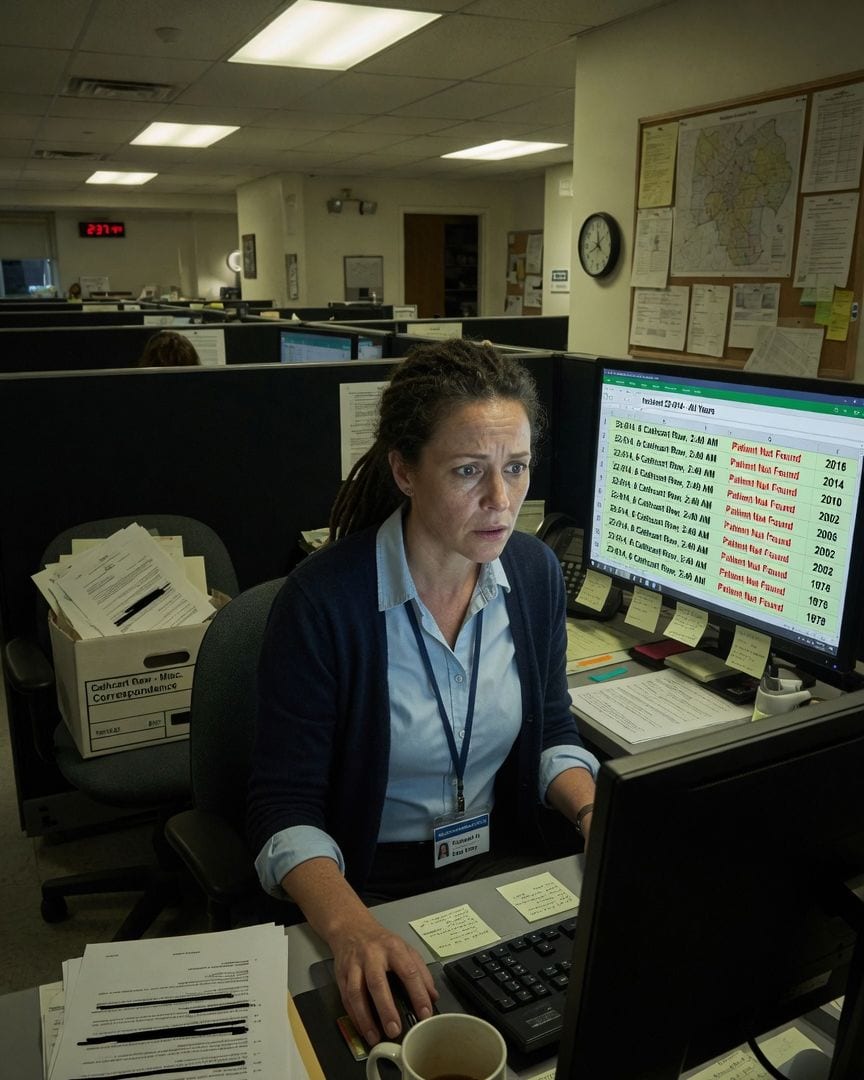
My computer log shows the same 2:40 AM call to Cathcart Row, every four years since 1978, always closed 'patient not found'.
Working data entry for the County Ambulance Trust, I found a routine incident logged as 'Patient Not Found.' But digging deeper, I discovered the exact same phantom call had repeated every four years for over forty years, always at the same address, always at 2:40 AM. Then I found a heavily redacted memo linking it to my own street.