A drone operator spotted a kneeling man in the desert, unseen by her team. Then she found his duplicate, hundreds of yards away, in old footage.
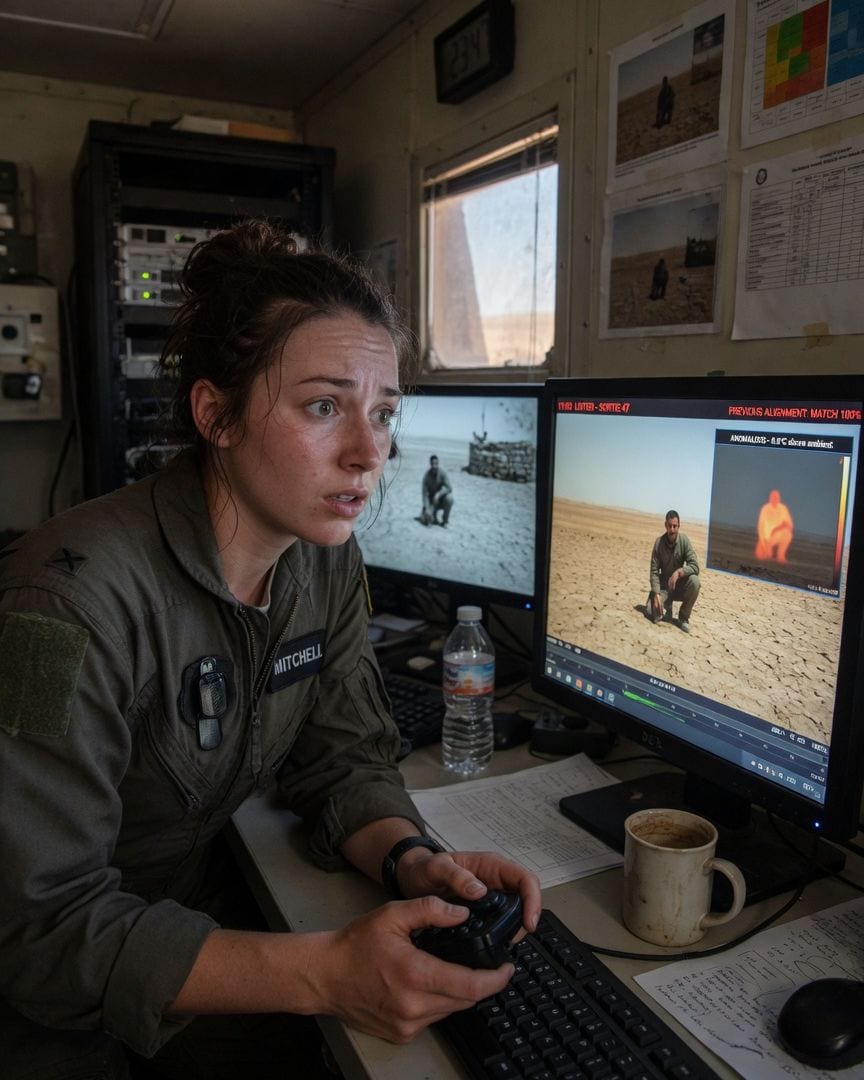
Airman Laura Mitchell, twenty-four, held the sensor ball steady. It was one of her squadron's last sorties before their rotation at Forward Operating Location Sandstone ended, and the sun beat down on the desolate landscape with relentless intensity.
On her display, a lone man knelt at the edge of a dry, sun-baked field, impossibly still. He wore drab, indistinct clothes, his form perfectly outlined against the cracked earth.
Below, a ground team, including her friend Airman Samuel Sullivan, walked the exact grid, their boots kicking up nothing but dust. They searched for forty minutes, their movements slow and deliberate in the searing heat.
The feed from Mitchell's unmanned aerial vehicle, however, showed the kneeling man the entire time. His outline remained unwavering, directly beneath the boots of the searching airmen.
Every crack in the parched earth, every heat signature from a distant rock, registered on her screen with pristine clarity. Yet, no human body, no physical presence, was ever found by the men on the ground.
The desert heat shimmered, blurring the distant horizon, making the rocks dance in the light, but the figure on Mitchell's display remained in sharp, impossible focus, a silent, unmoving anomaly.
Later, long after the sortie had returned, Mitchell scrubbed through the archive footage. Her stomach tightened as she confirmed her initial, disquieting observation.
The same figure knelt in the same corner of the field, across three earlier sorties from the past three months.
Each time, it appeared precisely at the eleventh minute of loiter, a ghost in the machine that only her sensors seemed to perceive.
Mitchell spent the next day in the cramped, air-conditioned sensor room, replaying the footage. She ran through every diagnostic, every calibration log for her equipment. No glitches, no anomalies, no system errors.
The sensor array was operating perfectly, its readouts crisp and unblemished. She called Sullivan, trying to sound casual, asking if anything had felt ‘off’ about that sector, anything unusual beyond the usual desert monotony.
Sullivan just laughed, complaining about the heat and the futile search. 'Nothing but rocks and dust out there, Mitch,' he’d said, his voice crackling slightly over the comms. 'Just another goose chase for an equipment malfunction.'
Mitchell zoomed in on the kneeling figure again. The resolution was uncanny, almost unnerving in its clarity. She could almost make out the texture of his clothes, the faint shadow he cast on the parched ground.
It was detailed enough that her mind screamed for it to be real, for her eyes to finally see the ground team find him. But when she isolated the thermal overlay, a detail made her stomach clench with cold dread.
The figure, though invisible to the naked eye and untouched by the ground team, registered a faint, consistent heat signature. It wasn’t the robust warmth of a living body, radiating metabolism.
Instead, it was an anomalous, residual warmth, like a rock that had absorbed the brutal sun all day, but distinct from the surrounding terrain. It had its own faint thermal identity, a presence without substance.
And over the forty minutes the ground team searched, that faint signature shifted. Not the figure moving, not a change in its posture, but its position relative to a fixed rock formation on the ground.
A minute, almost imperceptible drift of a few inches, a lateral slide across the earth. It was present, but not. It existed, but not in the way anything else did, an entity defined by its very un-being.
Mitchell spent hours meticulously aligning the three previous sorties with the latest one, pixel by pixel, trying to pinpoint the exact coordinates of the kneeling man’s 'drift.' The eleventh minute of loiter.
It was always there, an immutable truth in a sea of variables. Her eyes ached, but she couldn't pull away. As she cross-referenced a particularly grainy feed from two months prior, a flicker caught her eye.
For a fraction of a second, an identical kneeling figure, just as sharp, just as impossible, materialized.
But this one wasn't in the usual corner of the dry field. This one was hundreds of yards away, near an ancient, collapsed wellhead, a location the current sortie hadn't even approached.
It was a duplicate, a ghost of a ghost, appearing then vanishing, an impossible echo across time and space.
Mitchell froze, her hand hovering over the console, the faint hum of the server racks the only sound in the room, a low thrum against the sudden, absolute silence in her own head.
The duplicate figure shattered Mitchell’s rationalizations. This wasn't a glitch in the system, a software bug, or a phantom read from faulty hardware. This was something else entirely, something that mocked the very laws of physics she understood.
Her last few days at FOL Sandstone were meant for packing, for saying goodbyes, for the quiet anticipation of home leave, but instead, she plunged headfirst into the base’s digital archives.
She started with keywords, typing furiously into the search bar: 'unexplained contacts,' 'sensor anomalies,' 'visual distortions,' 'eleventh minute.' The search yielded fragmented, often heavily redacted reports, mostly from decades past.
They spoke of 'atmospheric interference' or 'ground-based mirages' in the same sector, always around the eleventh minute of observation. No explicit mention of kneeling figures, but the consistency of the timing and location was chilling.
It was a pattern emerging from the noise, a whisper across the years.
Mitchell also began noticing odd gaps in the digital personnel manifests. Certain names from older squadron rosters would simply disappear from later records, as if they’d never existed.
No transfer orders, no discharge papers, no retirement notices, just a blank space where a name should have been.
It was like trying to read a book with pages torn out, but the missing sections always seemed to align with the dates of the 'anomalous' reports she was finding. The unease grew, a cold thread winding itself around her.
This wasn't just about a phantom figure; it was about a forgotten history, a pattern buried in the very system designed to record everything, then slowly, deliberately, erased.
Mitchell’s late-night archive dives didn’t go unnoticed. Colonel Daniel Blackwood, the base's stoic commanding officer, summoned her to his office. His face, etched with years of desert sun, was unreadable, a mask of quiet authority.
He commended her 'diligence' in reviewing historical data, then casually remarked on the 'unnecessary strain' such deep dives put on the system, especially with the base’s upcoming decommissioning.
The air in his office was cool, almost too cool, a contrast to the outside heat. 'Focus on your transition, Airman,' he advised, his voice calm, almost paternal, yet carrying an undertone of steel.
'Don't get bogged down in old ghosts.' The warning was subtle, but clear, like a faint tremor just before an earthquake.
After that, Mitchell found her access to certain older archive sections restricted. A 'system maintenance' message popped up whenever she tried to cross-reference specific personnel data, its pixelated text a digital barrier.
Walking the deserted corridors of FOL Sandstone at night, the air conditioning units rattling like dry bones, she felt a prickle on her neck, as if unseen eyes tracked her movements.
A shadow seemed to linger at the edge of her vision, just out of reach, always just a step behind.
One evening, a cryptic, anonymous message, a single line of garbled text that resembled an ancient log entry, flashed on her terminal before deleting itself with a soft, final beep: 'THE WATCHERS ARE ALWAYS HERE. THE PATTERN MUST BE KEPT.'
The words burned into her mind, turning the isolated base into a cage, every wall and window now a potential barrier.
Mitchell cornered Sullivan during a rare break, her voice low, almost a whisper against the distant hum of machinery. 'Sam, have you ever heard anything about this place? Old stories? Not just desert legends, but… real whispers?'
Sullivan looked uncomfortable, glancing around the empty break room. He picked at a loose thread on his uniform. 'Just whispers, Mitch. You know, desert legends. 'The quiet ones,' they called 'em. People who saw things, then got reassigned.
Nobody ever heard from 'em again, their families got some vague letter about classified ops.' He fidgeted, his eyes avoiding hers. 'There’s an old hangar, Hangar Seven. Disused. You know, over by the old runway?
Sometimes, when they decommission a base, they just dump the paper records there. Stuff too old for digital archiving, or too sensitive to be scanned, too much red tape to shred it all.'
A spark ignited in Mitchell. Hangar Seven. It was a dusty, cavernous space, smelling of ozone and forgotten things, filled with decommissioned equipment and forgotten crates draped in canvas.
The air was thick with the smell of rust and old paper, a dry, musty scent that clung to her clothes.
After an hour of methodical searching, her flashlight beam cutting through the gloom, she found it: a series of mildewed filing cabinets, their labels faded to illegibility. With a grunt, she pried open a drawer. 'Personnel Records – Pre-Digital Era.'
Inside, she found physical manifests from decades ago. These manifests contained names that were conspicuously absent from the digital archives she'd searched, names that had simply vanished from the modern records. Sensor operators, specifically, their ranks and specialties meticulously noted.
And next to their names, not a discharge date, not a transfer to a conventional base, but a handwritten note: 'Transferred to Special Detachment Echo-7.'
The same Echo-7 that didn't exist, that had no records, no command structure, no physical location anywhere in the Air Force's vast database.
She cross-referenced the names with the handwritten 'anomalous contact' reports she'd found in the digital archives – the few that hadn't been fully redacted.
The pattern was stark, undeniable: every airman who had logged a significant 'visual distortion' or 'unexplained contact' around the eleventh minute of loiter was subsequently transferred to the phantom detachment.
The paper records confirmed the digital gaps, giving them a horrifying, tangible weight.
These weren't just missing names; they were missing people, erased from existence, absorbed by a system she was only just beginning to comprehend, a system that now seemed to breathe around her.
Mitchell, her hands trembling, continued sifting through the dusty files in Hangar Seven. The air felt heavy, pressing in on her, the silence of the cavernous space amplified by the frantic beat of her own heart.
She found more transfer orders for 'Special Detachment Echo-7,' each one a chilling testament to the pattern, each one a life quietly snuffed out from the official record.
She laid them out on a rusted workbench, a silent parade of forgotten names, each one a sensor operator, each one a cautionary tale. The dates spanned decades, a chilling consistency to the disappearances, an unbroken chain of absorption.
Then, at the bottom of a stack of more recent, though still pre-digital, personnel files, she found it. A single page, a draft. It was a transfer order, incomplete, but unmistakable. The header read: 'FOL SANDSTONE – TRANSFER RECOMMENDATION.'
The 'To' field was blank, but the 'From' field stated 'Airman 1st Class Laura Mitchell, Sensor Operations.' The date for the proposed transfer was next week. Her name. Her rank. Her posting.
Written into the pattern, a prophecy of her own disappearance.
She stared at it, the paper feeling impossibly cold in her hand, the quiet hum of the distant base suddenly a deafening roar in her ears, a sound that threatened to split her skull.
Mitchell marched directly to Colonel Blackwood’s office, the draft transfer order clutched so tightly in her hand that the paper crackled. She laid it on his desk, its faint, smudged ink a contrast to the polished wood.
Blackwood looked at it, then at her, his expression unchanging, a calm that was more unsettling than any anger.
'You've been thorough, Airman Mitchell,' he said, his voice as calm as the desert night, without a hint of surprise or denial. 'More thorough than most.'
He didn't deny it. He explained it. He spoke of the 'sentinel,' not as a ghost or a hallucination, but as an ancient anchor for a presence, dormant for millennia, buried beneath the very ground FOL Sandstone occupied.
His words were precise, unhurried, as if delivering a standard briefing.
He explained that the eleventh minute of loiter was when the anchor's resonance was strongest, a brief, temporal window that allowed its subtle form to be perceived through instruments, a momentary overlap with reality.
'It doesn't kill,' Blackwood said, leaning back, his chair creaking softly, 'not in the way you understand. It observes. It absorbs. It integrates. Those who perceive its pattern too deeply, who persist in their observation, become… part of it.
New sentinels.' He revealed that he, too, had been a sensor operator decades ago, had seen the kneeling figure, had found the records.
But instead of being absorbed, he was 'recruited,' he said, by a clandestine network within the military that monitors such sites.
He became 'the one who knew,' entrusted with maintaining the 'containment protocol' – managing the quiet disappearances, ensuring the entity remained dormant, its existence a secret from a world that couldn't comprehend it.
'It's a duty, Airman,' he concluded, his gaze steady, unwavering, 'to prevent something far greater from awakening.' His calm acceptance, his utter lack of remorse or fear, was a horror beyond anything Mitchell could have imagined, a cold, rational evil.
Blackwood didn't move, didn't threaten Mitchell with physical force. He simply offered her a choice, the words falling like stones into a still pond. 'You’re already marked, Airman. You've seen the pattern, you've understood it.
You're part of the rotation now. You can accept your new role, become a sentinel, or you can fight it. But fighting it will only accelerate the process.'
His words were a cold, rational explanation of her inevitable doom, a clinical diagnosis of her fate.
The horror wasn't in any violence, but in the quiet, absolute certainty in his voice, the implication that resistance was futile, and her fate was already sealed, a predetermined loop.
Mitchell felt a chill deeper than any desert night. Her mind screamed for a different answer, a way out, a denial. But his calm acceptance had poisoned every rational thought.
She stumbled back from his desk, the transfer order falling unheeded to the floor, a forgotten prophecy.
She turned and ran, blindly, out of the office, down the deserted corridors, the polished floor reflecting her distorted image, stretching her into something gaunt and unnatural.
Every step felt heavier, as if the very air was thickening around her, becoming viscous, clinging to her lungs.
She glanced at the faces of the few airmen she passed in the stark fluorescent light, their expressions subtly off, a faint, distant look in their eyes, as if their minds were elsewhere, or not entirely their own.
Was she seeing things? Or had the absorption already begun in others, a silent plague of quiet disappearances? A growing stillness began to spread from within her, a calm that was alien and terrifying, seeping into her very bones.
It was a quiet hum, a resonance that echoed the eleventh minute of loiter, now inside her own head, a deep, pervasive thrum.
She felt a strange, cold sense of clarity, a growing understanding of the desert, the base, the kneeling man. A new perspective, vast and impersonal, began to open within her.
She ran toward the sensor tower, the source of her initial discovery, a magnetic pull she couldn't resist, her movements stiffening, her gaze becoming fixed, unwavering on the distant structure.
Airman Laura Mitchell was last seen heading towards the sensor tower, her stride unnaturally even, her eyes fixed on the distant horizon, a new, unsettling serenity on her face.
Her personal effects, packed neatly in her duffel bag, remained in her bunk, awaiting her scheduled transport home. The base continued its decommissioning, the remaining personnel focused on their tasks, oblivious to the silent shift that had taken place.
Colonel Blackwood oversaw the final packing of his own office, his expression serene, his duty fulfilled. The transfer order for 'Special Detachment Echo-7' remained on his desk, unsigned, its purpose served.
The sensor tower, now empty, stood sentinel over the dry field, a silent monument to a system that continued to operate, unseen, unheard, beneath the very fabric of their reality.
The transport plane left FOL Sandstone on schedule, carrying the last of Mitchell’s squadron. She was not on it.
A few days later, Airman Samuel Sullivan, packing up the last of the squadron's gear in the sensor room, found Mitchell's tablet.
On it, an unfinished log entry, describing the kneeling figure, but the words trailed off into repetitive, meaningless sensor readings: '…thermal anomaly, 0.003, 0.003, 0.003…' The screen went dark, its battery depleted.
Months later, at a new posting in a different, equally desolate region, Sullivan was on a routine night patrol, the air cold and still. He glanced at a dry field, the moonlight painting it in stark shadows.
For a fleeting moment, he saw a lone figure kneeling, impossibly still, at its edge. He blinked. It was gone. He reported nothing.
The desert wind carried a faint, almost imperceptible hum, a resonance that had always been there, just beneath the threshold of hearing, a quiet, ancient watch that would never truly end.
If this one got to you
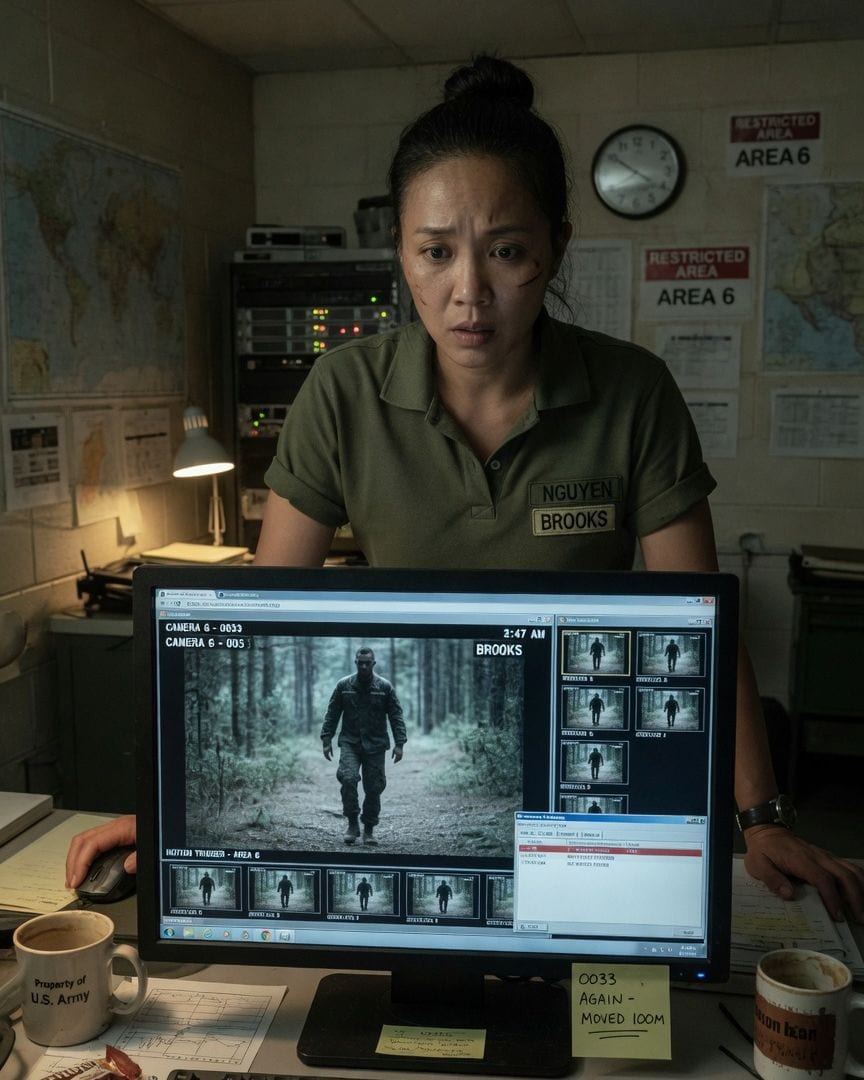
A perimeter guard's camera logs a man at 0033 every night. His uniform says 'Brooks', but no such name exists in 40 years of records.
Specialist Alice Nguyen's meticulous duties in a remote Louisiana training area were usually a monotonous rhythm, but camera six had shattered it. Every night, precisely at 0033, its motion sensor would trigger, capturing a man mid-stride, while adjacent cameras recorded nothing. She moved the camera, recalibrated its sensors, yet the phantom man continued to appear, his uniform subtly shifting across identical images. After painstaking enhancement, the name 'BROOKS' appeared on his uniform, a name completely absent from forty years of base records. What was this impossible presence, this constant error in a world designed for exact counts?
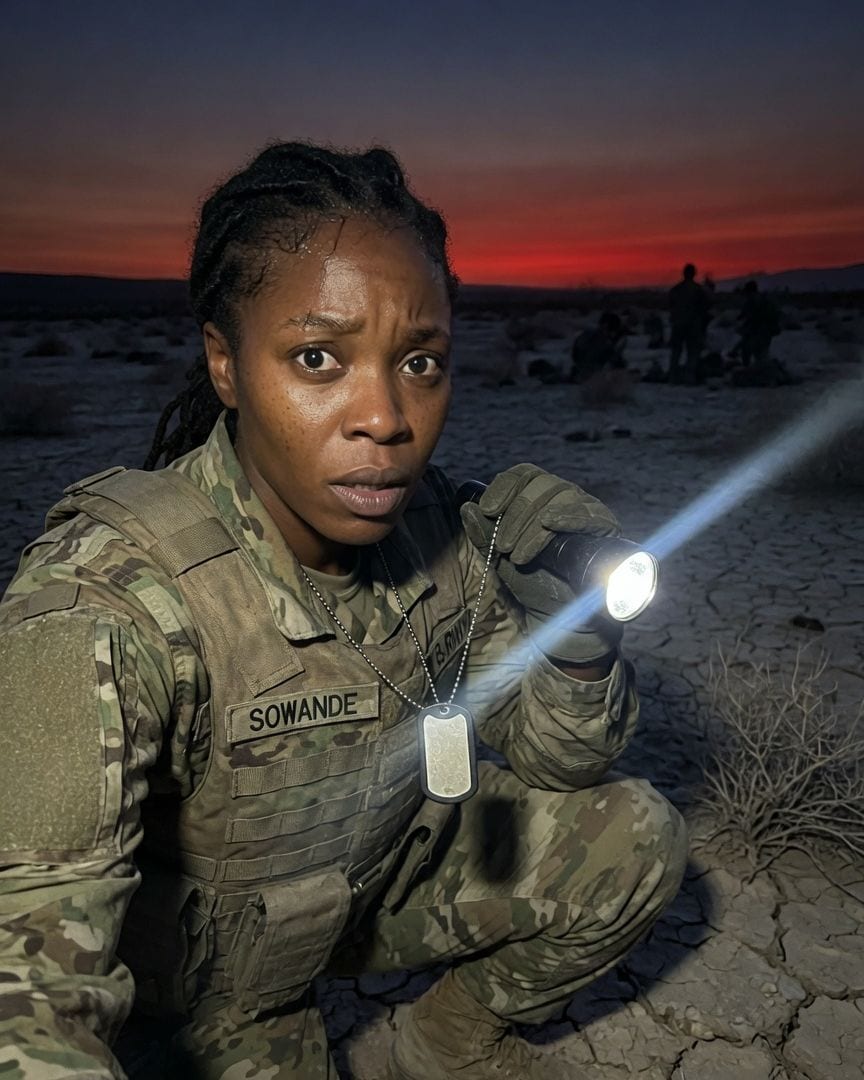
An hour from roll-out, Lieutenant Sowande's thirty-eight soldiers became thirty-nine. Then, where the extra man stood, she found a blank, warm dog tag.
Lieutenant Sowande stood on a cracked Mojave lakebed, her platoon's battle problem done, ready for routine accountability. But the count came back wrong: her thirty-eight soldiers were now thirty-nine. She knew every face and name, yet an extra man stood silent and solid in the ranks, defying all logic. With an hour until roll-out, she led a meticulous search, only for her specialist to unearth a tarnished dog tag where the phantom soldier had stood. It was strangely warm, smooth and blank, bearing no name or number, only an impossible heat.
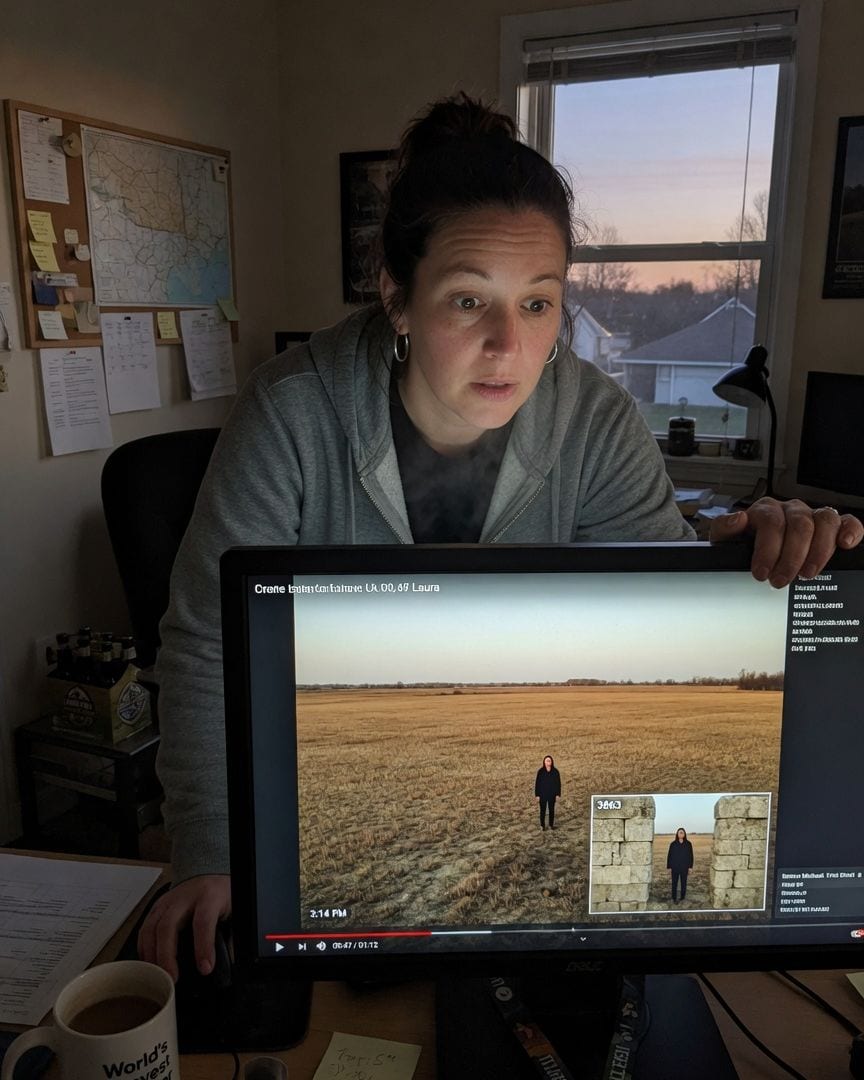
My drone's return footage shows a man standing in the empty field looking up. I was alone out there, the field clear when it launched.
My routine drone survey of a vast, empty field was just another job, miles from any paved road. But the footage revealed a silent man standing alone in the field's center, gazing up at my ascending drone. As my friend and I analyzed the frames, we found a weathered stone structure that briefly appeared around him, then vanished.
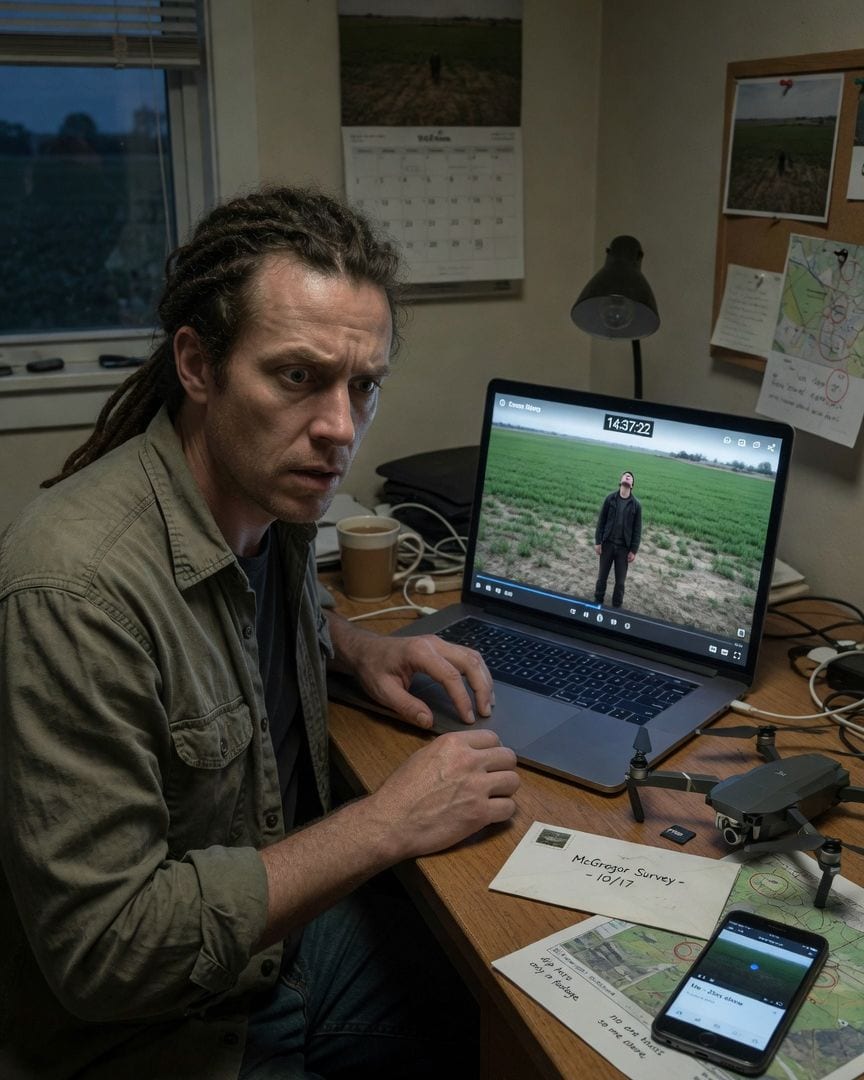
My drone's return footage shows a man standing alone in the field, looking up. The field was empty when I flew out, and I was alone.
I sent my drone for a routine agricultural survey, mapping crop health across a farmer's property. But reviewing the footage, a man materialized, standing perfectly still in the middle of a field I knew was completely empty. He was looking straight up at my drone, a solid figure where no one should have been.
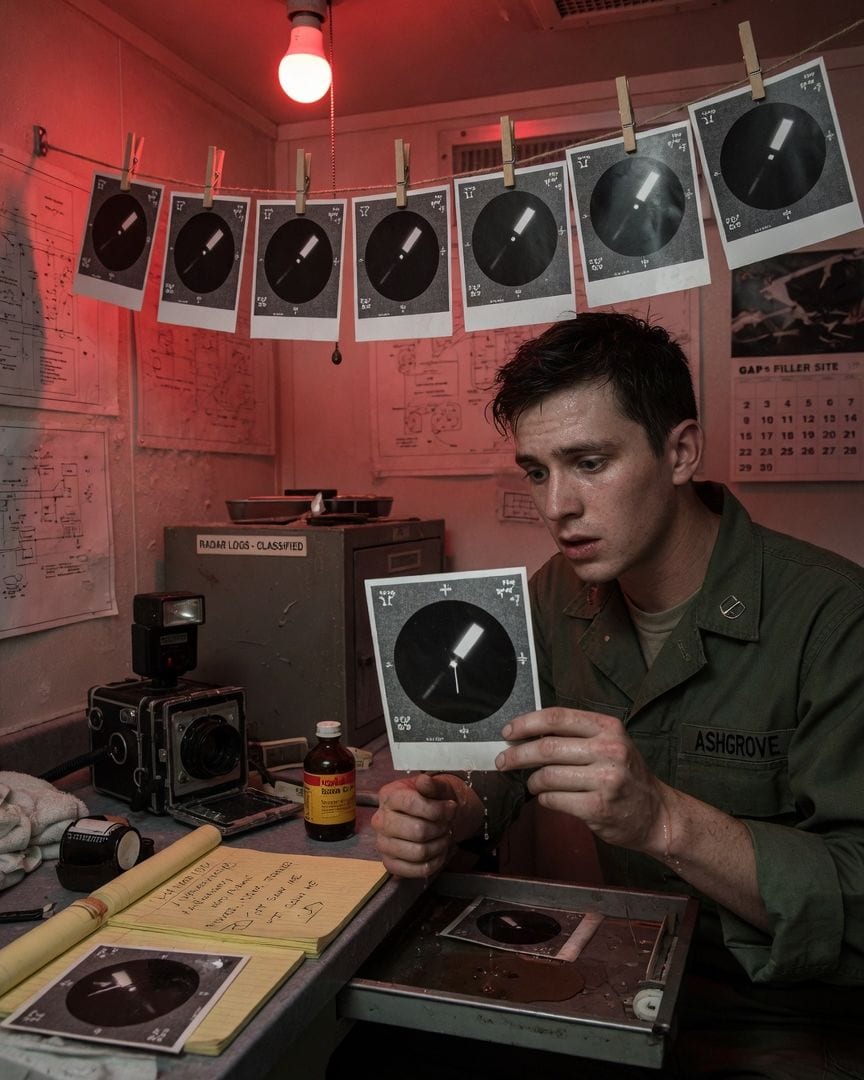
A Cold War Airman watched his radar display: a hangar-sized blip from the empty Montana prairie turned to face him.
Airman First Class Tobin Ashgrove knew his radar scope, the constant drone of the dish, the ground clutter that smeared the screen like ink. For two years at the Montana gap-filler site, he'd memorized its lies and truths. But one day, the familiar clutter vanished, leaving a single, hard-edged return: a stationary, hangar-sized blip at eleven miles on the empty prairie. He photographed it for nine hours, until it moved two miles closer, its hard edges angled precisely toward his camera lens, an undeniable, deliberate turn. What impossible thing had just seen him and responded from the desolate plains?
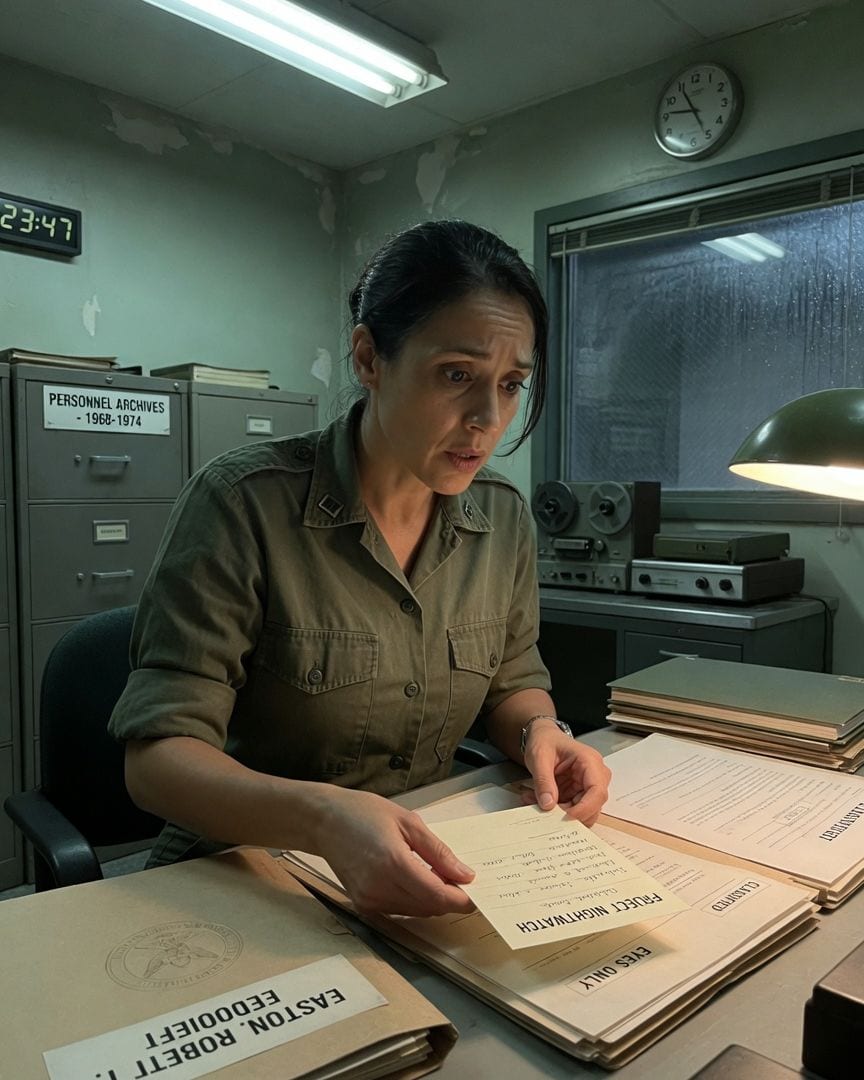
A Cold War tower controller logs an object vanish from radar, then hears the pilot scream it’s filling his windscreen. Her own name, 'Bardolph, Ines', now marked 'Observed' in a secret file.
Captain Ines Bardolph, a tower controller, was counting down the months until her transfer to Langley and the decommissioning of her base, hoping to leave behind the unsettling incidents of her final posting. But one night, her radar scope showed an impossible blip, solid and unwavering, 40 miles north of the Danube, only to vanish in less than a second, leaving a pilot screaming in terror. Despite the clear evidence, the official report blamed "atmospheric inversions," while the terrified pilot received a glowing review and promotion, his file meticulously scrubbed of any anomaly. As Captain Bardolph reviewed the pilot's pristine record, she found a hidden slip of paper, revealing a chilling truth: 'Subject: Bardolph, Ines. Status: Observed.' Was she merely an observer of the impossible, or was she now part of something far more sinister?