A Cold War Airman watched his radar display: a hangar-sized blip from the empty Montana prairie turned to face him.
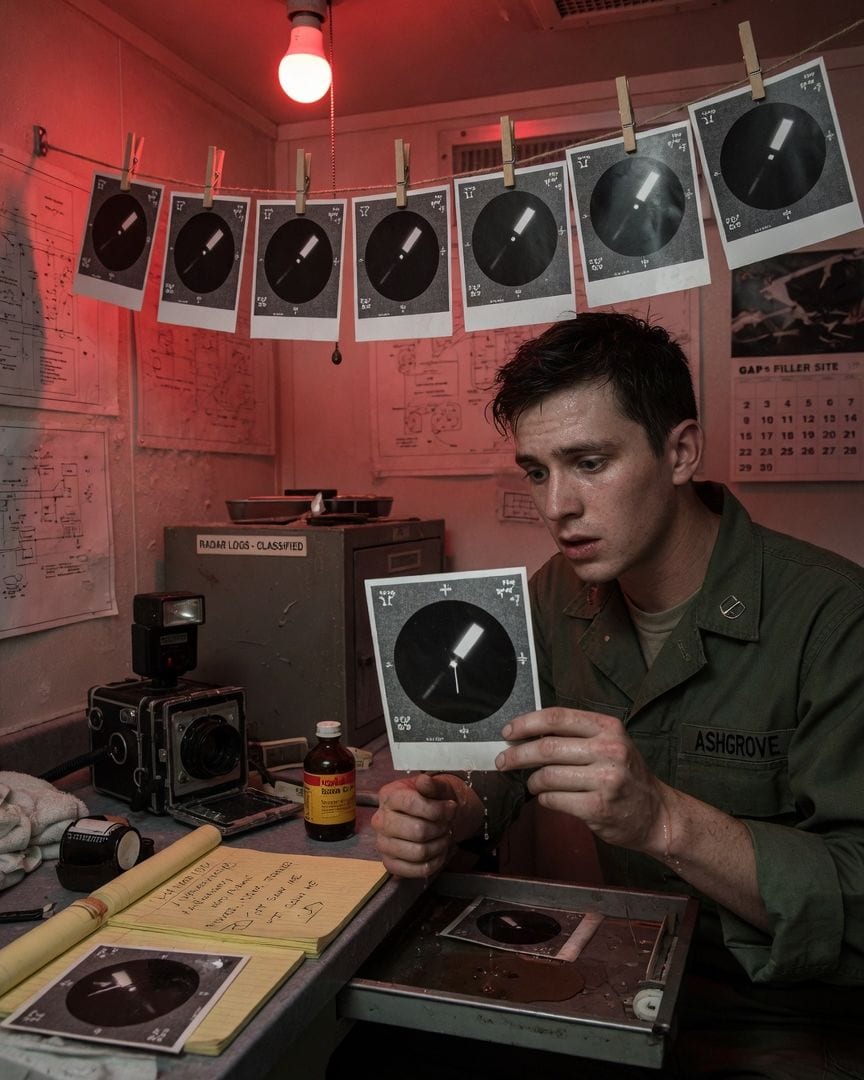
Airman First Class Tobin Ashgrove, 21, shivered in the Montana gap-filler site, the whine of the radar dish outside a constant drone against the March wind.
He knew the scope’s quirks, the way ground clutter smeared across the screen like spilled ink, shifting with the weather. He’d spent two years staring at the green sweep, memorizing its lies and its truths.
But on the fourteenth, the clutter simply went out. Not a power surge, not a tube failure, just… gone. The screen cleared, a perfect, dark circle, save for the single, hard-edged return. It sat at eleven miles. Stationary.
The size of a hangar. On a stretch of prairie he’d driven through in daylight, finding nothing but wire fences and frozen grass.
He tapped the scope, checked the connections, even kicked the cabinet, but the blip remained, solid and unblinking, an impossible eye staring back from the empty plains.
He leaned closer, trying to see if it was a phantom, a ghost in the electronics. But the blip was too crisp, too definitive. It didn't waver, didn't fade. It simply was.
Tobin, methodical by nature, pulled out his camera. It was a standard-issue Speed Graphic, used for documenting equipment failures or unusual weather phenomena. He clicked on the mounted flash and framed the scope, hour after hour, for nine hours straight.
Each click of the shutter was a desperate attempt to record something his rational mind refused to process. He marked the time, the range, the bearing, scribbling notes on a pad next to the radar console.
The blip never wavered, never drifted. It was fixed, utterly still, against the swirling snow outside and the frantic beat of his own pulse.
He tried to think of an explanation: an atmospheric inversion, a flock of birds, a rogue civilian aircraft. But the size, the complete lack of movement, the sheer, solid presence of it, defied every explanation.
It was too big for a bird, too static for an aircraft, too defined for a weather phenomenon. As the ninth hour approached, the range indicator flickered. The blip had moved.
Not by much, just two miles, now sitting at nine. Tobin froze, his finger hovering over the shutter. The air in the small station felt suddenly cold, though the heater hummed steadily.
He took the final shot, the flash momentarily blinding him, then rushed to the darkroom, the smell of chemicals a welcome distraction from the cold dread coiling in his gut.
He worked quickly, his hands shaking slightly as he dipped the film into the developer. Each minute felt like an hour.
Tobin Ashgrove stands in the small, cramped darkroom, the faint red safelight bathing his face.
The last photograph, still dripping from the developing tray, shows the radar blip, now clearly closer, its hard edges angled precisely toward the camera lens, an undeniable, deliberate turn.
He stares at it, the chemical smell thick in the air, his own reflection ghostly over the impossible image. He knew he had to report it. He knew it would be dismissed.
But the certainty that it had seen him, that it had responded, chilled him to the bone. He carefully pinned the nine photographs to the drying line, each one a step closer to the impossible.
The silent hum of the safelight seemed to press in on him, making the air heavy and still.
Then he started writing his report, the words feeling utterly inadequate to describe the silent, vast thing that had turned to face him on the Montana prairie.
Tobin’s formal report, accompanied by the nine photographs, was delivered to his commanding officer, Captain Charles Caldwell, 45, a week later. Caldwell, a man known for his bluster, read through the meticulous log in unnerving silence.
He examined each photograph, his face impassive. The Captain traced the outline of the blip on the last photo with a finger, his brow furrowed, but his eyes betrayed no surprise. “Ashgrove,” he said, his voice flat, “this is… thorough.”
There was no incredulity, no dismissal. Just a quiet, almost resigned acceptance. The heavy silence in Caldwell’s office seemed to swallow the ticking of the wall clock.
The next day, Tobin received new orders: transfer to a records management facility in Cheyenne, Wyoming, effective immediately.
Attached was a single sheet of paper, a 'restricted access' classification code stamped across it – a code Tobin had never seen in any manual, never encountered in his years of service.
His incident, his impossible encounter, had been swallowed by the machine without a ripple. He had expected dismissal, a reprimand, perhaps even a psychiatric evaluation. Not this. Not a smooth, immediate reassignment to a new, sterile existence.
In Cheyenne, the work was mind-numbingly dull, sorting microfiche and indexing old reports. The air in the facility was dry and stale, smelling of paper and disinfectant.
But Tobin, now driven by a desperate need to understand, used his new access. He cross-referenced the mysterious classification code, digging through obscure indices and forgotten databases. He found nothing.
It was as if the code existed only for his transfer, a ghost in the system, a blank entry in a ledger that stretched on forever. The transfer itself, however, was a thread.
He began searching for similar 'restricted access' transfers, for other airmen or personnel moved abruptly after unexplained incidents. He found a handful, scattered across the 1940s and early 50s, all related to 'unidentified aerial phenomena' or 'unusual radar returns.'
The reports were heavily redacted, black bars obscuring names and specific locations, but the pattern was undeniable: observe, report, transfer, silence.
The deeper he dug, the more he felt like he was sifting through the remains of a vast, patient silence, where every word not spoken amplified the wrongness of what was.
The archive itself seemed to listen, its endless rows of files humming with unspoken secrets.
Tobin’s late-night searches in the archive didn't go unnoticed. One evening, as he was cross-referencing a particularly dense microfiche reel, the overhead lights flickered, then died, plunging his aisle into darkness.
A moment later, the emergency lights hummed to life, casting long, stark shadows that made the towering shelves look like grasping hands. He heard a soft click from the adjacent aisle.
"Ashgrove," a voice, calm and even, cut through the quiet. "You're working late."
Desmond Drummond, 62, a senior civilian records manager, stood silhouetted at the end of the aisle. Drummond was a thin, impeccably dressed man with eyes that seemed to miss nothing. His presence felt like a sudden drop in temperature.
Tobin stammered an excuse about catching up on backlog, the words catching in his throat. Drummond nodded slowly. "The archives are a labyrinth, Airman. Easy to get lost in here.
Especially when you start pulling threads that aren't on any manifest." He paused, his gaze unwavering. The emergency lights cast a cold gleam on his rimless glasses. "Some things are filed away for a reason, Ashgrove.
Not to be forgotten, but to be… contained."
He walked past Tobin, his footsteps barely audible on the polished concrete floor, and stopped at the unmarked cabinet Tobin had been eyeing for days – the one with no accession number, that seemed to measure longer on the inside than the building itself.
It stood apart from the others, a darker, colder block of steel. Drummond ran a gloved hand over its cold metal surface. "This one, for example. Not on any list. Best left that way, wouldn't you agree?"
The implied warning was clear. The cabinet seemed to exhale a chill that had nothing to do with the archive’s climate control. Tobin felt a shiver that had nothing to do with the cool archive air.
He wasn't just investigating a mystery; he was being watched by its custodians. The quiet hum of the fluorescent tubes seemed to amplify the unspoken threat.
The next day, Tobin found a note on his desk: 'Room 314. 1700 hours. D.D.' Drummond. Tobin arrived promptly, his heart thudding a frantic rhythm against his ribs.
Room 314 was a small, windowless office, sparsely furnished with a single filing cabinet and a coat rack. Drummond sat behind a plain metal desk, a single, thick, unmarked folder before him. He gestured to the chair opposite.
"Airman Ashgrove," Drummond began, his voice flat, "You've been asking questions. About your incident. About the transfers."
Tobin nodded, bracing himself. "I just want to understand, sir. What I saw… it wasn't a weather balloon."
Drummond gave a faint, humorless smile that didn't reach his eyes. "Of course not. We know what you saw, Ashgrove. The 'thing' on your scope. We've been filing reports like yours for decades." He pushed the folder across the desk.
Its weight felt immense. "This is not a classified document, Airman. This is a collection of observations. A pattern."
Tobin opened the folder. Inside were grainy photographs, faded sketches, and terse handwritten notes, all depicting similar 'returns' – objects, shapes, lights – from different eras, different locations. A blimp-like form over a naval convoy in 1943.
A perfect disc over a remote weather station in 1951. A shimmering column near a desert testing ground in 1949. Each entry was accompanied by a brief summary of the observer's subsequent transfer.
The reports were detached, clinical, a bureaucratic record of the impossible.
"These are the ones who saw it, Ashgrove," Drummond explained, his voice devoid of judgment, as if recounting stock figures. "The ones it… acknowledged." He leaned forward slightly.
"Recognition?" Tobin managed, his voice barely a whisper. "It… it turned to face me."
Drummond nodded. "Indeed. A signature. The moment it added you to its own internal ledger, so to speak. Our files simply reflect that." The air in the small room felt suddenly thin, as if the oxygen had been drawn out.
The truth, when it came, wasn't a monstrous reveal, but a chillingly mundane confirmation of a known, recorded pattern. The horror was in the coherence, the quiet, undeniable agreement of every detail.
Every inexplicable observation Tobin had made now clicked into place, not as an anomaly, but as a recognized step in a process.
Tobin stared at the folder, the decades of impossible sightings blurring into a single, horrifying truth. "So, this institution… you just… file them?" he asked, his voice hoarse, the words scraping against his dry throat.
"We record, Airman. We observe. We track," Drummond replied, his gaze unsettlingly calm, utterly devoid of emotion. "It’s been happening since before this country was founded. Before written history, some believe. We are merely the custodians of the record."
The quiet confidence in his voice was more unnerving than any shouted threat.
Drummond then reached under his desk and pulled out another, smaller folder. This one was plain manila, with a single, handwritten label: 'ASHGROVE, TOBIN C.' He placed it carefully on the desk, not opening it.
The folder seemed to hum with an unseen energy, a silent accusation. "There's one more thing, Airman. Something we don't usually show. But given your… thoroughness."
Tobin felt a prickle of unease that quickly escalated into a cold dread. He knew his own official files, his service record, his medical history. This wasn't one of them. This was something else entirely.
Drummond's eyes met his, a strange, knowing glint in their depths. The room seemed to shrink around Tobin, the walls pressing in. "This file," Drummond said, his voice dropping to a near whisper, "was opened in 1948.
Years before you were even born. It contains your full name, your predicted service number, and a blank entry for 'First Contact Date'." The words hung in the air, heavy and absolute, solidifying into an unbearable weight. Tobin's breath hitched.
He wasn't just another observer; he was a subject. His encounter wasn't an accident. He was already named in the file, waiting to be found.
Tobin stared at the manila folder, then back at Drummond, his mind reeling. "Before I was born? How?" The question felt inadequate, foolish even, against the weight of the revelation.
Drummond sighed, a sound of ancient weariness, as if he had answered this question a thousand times before. "We don't know the 'how,' Airman. Only the 'what.' There are… patterns. Markers. Certain individuals, across generations, exhibit a unique resonance.
A predisposition. They are, for lack of a better term, 'chosen' to observe. Or perhaps, they are simply more likely to be observed." He opened the folder. Inside, indeed, was a carefully typed card with Tobin’s details, dated 1948.
Below it, a series of complex-looking astrological charts and genealogical trees, cross-referenced with similar files. The paper was yellowed, the ink faded, but the details were stark and undeniable.
"My family," Tobin whispered, recognizing a few names, a great-uncle, a cousin he'd met once at a funeral. "Some of them… they were in the military too."
Drummond nodded. "Indeed. Your grandfather, a signalman in the Great War, reported 'an impossible light' over the North Sea.
Your great-aunt, a civilian observer for the coastal watch during the Second World War, logged 'a vast shadow' moving against the current in the Atlantic. All filed. All, in their time, transferred."
The pattern was horrifyingly clear, a generational thread woven through the fabric of the impossible. His family wasn't just military; they were part of a lineage of observers, each 'contacted' in their own way, each dutifully recorded.
The institution wasn’t preventing anything; it was documenting a process it couldn't control, a process that used human eyes and minds as its instruments. The realization hit Tobin with the force of a physical blow, leaving him breathless.
He was not an anomaly; he was merely the latest iteration.
Tobin’s hand trembled as he closed the file, the thin cardstock rustling like dry leaves. "So, what do you do with us? The 'chosen'?"
Drummond leaned back, his expression unreadable, his eyes fixed on Tobin. "We ensure the record is kept. We ensure you are… managed. Placed where you can continue to be observed, discreetly. Your transfer to records management, Ashgrove, was no accident.
It was an assignment. You are now part of the machine that files those like you." The calm in Drummond's voice was chilling, a bureaucratic drone that made the vastness of the conspiracy all the more terrifying.
He spoke not of conspiracy, but of a bureaucratic inevitability.
"There's no escape from the pattern, Airman. Only acceptance. You've seen it. You're part of it. Your life, from this moment, is dedicated to understanding and upholding this silent, ongoing record."
Tobin felt a surge of rage, hot and futile, then a deeper despair that settled like lead in his stomach. "You mean I'm just another entry in your cold little book?"
Drummond looked at him, his eyes ancient, filled with a knowledge that predated Tobin's very existence. "You are a witness, Airman. A very important witness. And now, a custodian. You will be provided with access to the archives.
You will learn to identify the markers, the patterns. You will help us maintain the integrity of the record." The choice was not a choice at all. Tobin could rage, he could fight, but what could he fight?
An institution that had existed for centuries, filing the impossible as mundane fact? A phenomenon that predated him, that had chosen his very lineage?
He felt the weight of the files, the cold metal of the cabinet he had been warned away from, pressing down on him. The 'thing' on the prairie hadn't just turned to face him; it had appointed him.
He was filed. He was sealed. He was part of the record, and the record was still being written.
Tobin Ashgrove never returned to the Montana high line. His transfer to records management became permanent. He worked diligently, his meticulous nature now serving a purpose far darker than he could have imagined.
He learned the labyrinthine paths of the archive, the subtle language of its classifications. He became adept at identifying the ‘markers’ in new reports, the quiet indicators of a ‘first contact.’
He saw the same resignation in the eyes of others who were quietly shunted into similar roles, their initial bewilderment replaced by a hollow understanding. The institution continued its work, silent and patient, collecting its strange harvest of observations.
The files grew, year by year, each new entry a testament to the unchanging, undeniable pattern.
Tobin became an indispensable part of it, his own name a permanent fixture in the 'subject files,' a constant reminder of the day the prairie watched back.
The archive itself seemed to breathe around him, a living entity of paper and silence.
Years later, Desmond Drummond retired, his role seamlessly filled by Tobin Ashgrove. Tobin now sat behind the same desk in Room 314, reviewing a new report from a young Navy ensign who had observed 'unnatural bioluminescence' in the deep Pacific.
He recognized the markers. He opened a new manila folder, carefully typed the ensign's name, and added it to the growing collection. His own file, 'ASHGROVE, TOBIN C.,' remained on his desk, its 'First Contact Date' now filled in.
He had become what he had feared: a cog in the machine that filed the lost, not to find them, but to catalog their disappearance.
The dread had not gone away; it had simply settled, a quiet, familiar companion in the silent, dusty halls. He was no longer a witness, but a signatory.
He picked up his pen, a heavy, official instrument, and prepared to sign the ensign's fate into the record. The file, he knew, was still being signed.
A few weeks after Desmond Drummond’s retirement, a new, younger figure was seen in Room 314. He was diligent, quiet, and unnervingly calm.
When a junior clerk, Rachel Caldwell, 24, asked him about a particularly unusual incoming report, he simply smiled faintly, a distant, knowing look in his eyes, and said, "It's all in the files, Rachel. Just keep signing."
If this one got to you
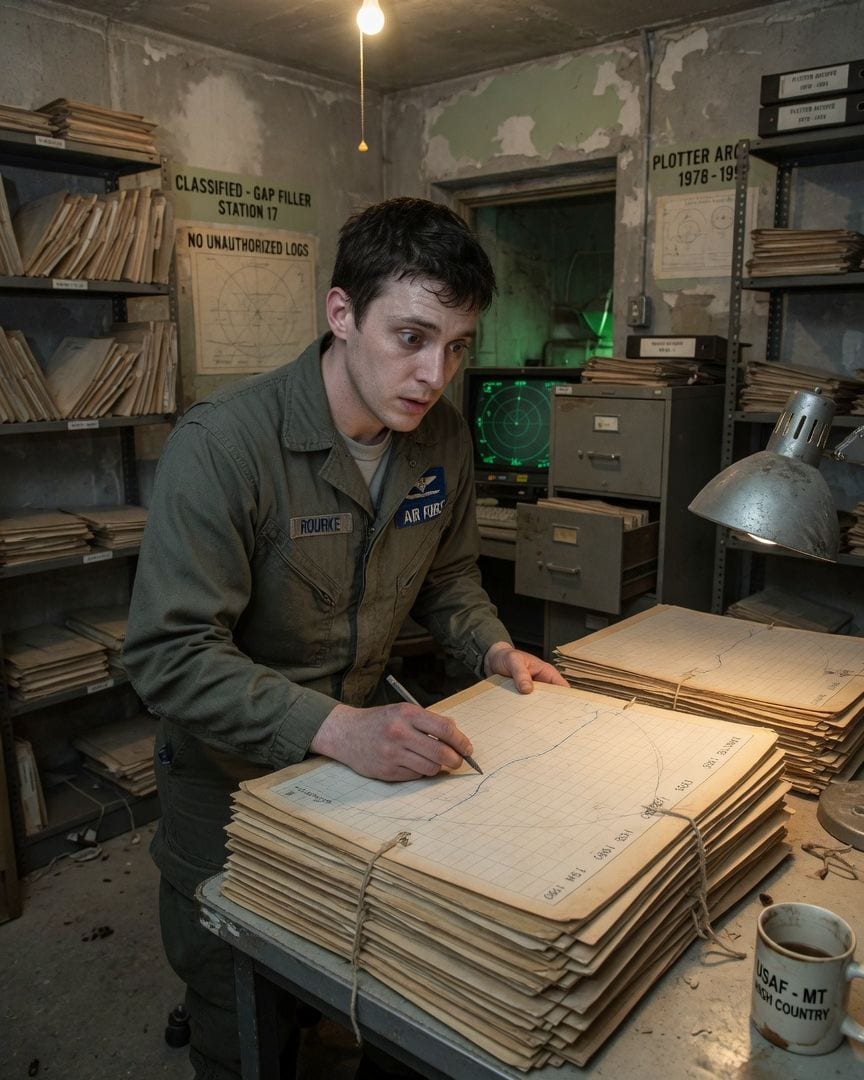
An Airman tracks a nightly radar contact. But in dusty archives, he finds old Cold War plotter boards, each showing that exact same line drawn by other airmen for three winters.
Airman Second Class Felix Rourke endured the cold, quiet nights at his isolated Cold War station, watching the perimeter radar. For three weeks, a single, slow contact appeared at 2300 hours, a precise violation of every protocol that chilled him deeply. He dismissed it as an anomaly, until a hunch led him to a forgotten closet in the dusty archives. There, he unearthed old plotter boards, each revealing the exact same impossible line drawn across the valley floor at the same hour, signed by different airmen from three consecutive winters decades ago. What impossible secret did the mountain station truly hold?
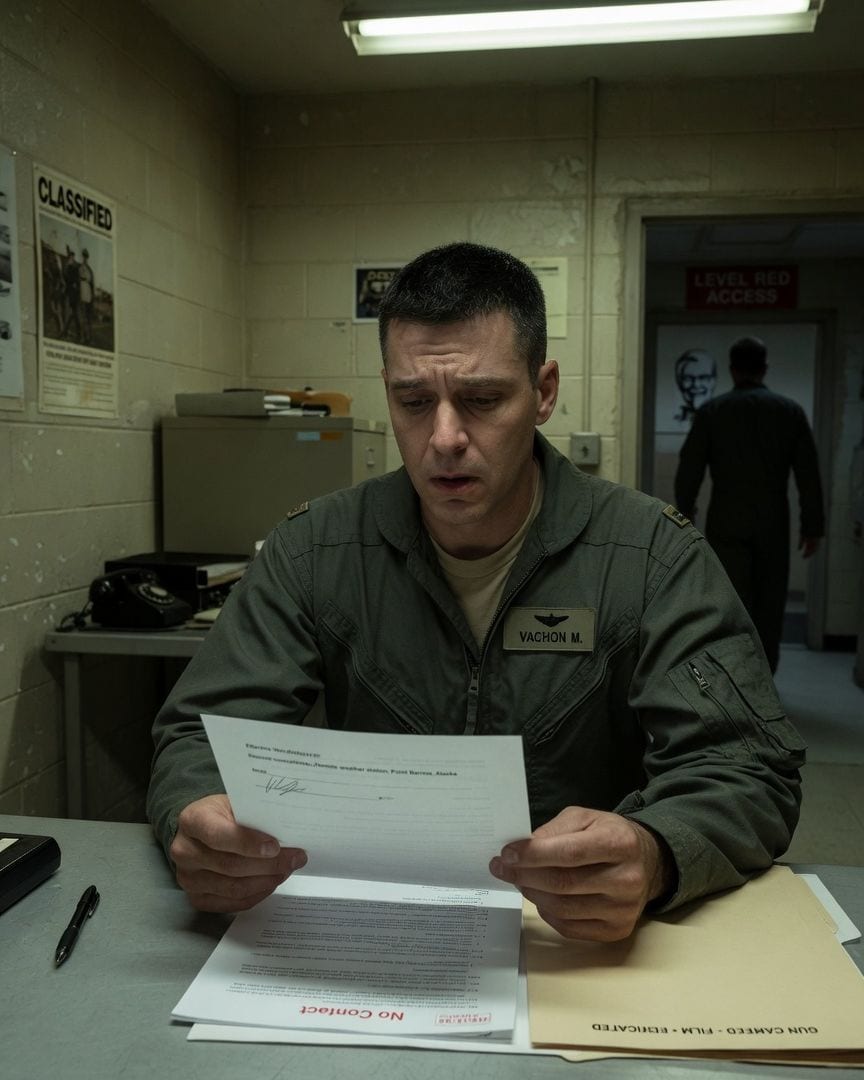
A pilot with a daughter waiting felt his stick tremble: a silent disc slid sideways, impossibly, at forty thousand feet.
Captain Merle Vachon had a newborn daughter waiting at home and just eleven minutes of fuel left when he spotted the impossible. High above the Nevada ranges, at forty thousand feet, a silent, featureless disc hung utterly still, then slid sideways with an impossible, smooth translation. His breath hitched, mundane answers dying in his mind, a cold knot tightening. Later, watching the gun camera film, he saw the disc grow larger, not zooming, but approaching, until it pulsed faintly in the sixty-first frame. His commanding officer confiscated the reel and ordered him to sign a 'No Contact' report, transferring him immediately to a remote weather station in Alaska. What impossible sight had Captain Vachon truly witnessed?
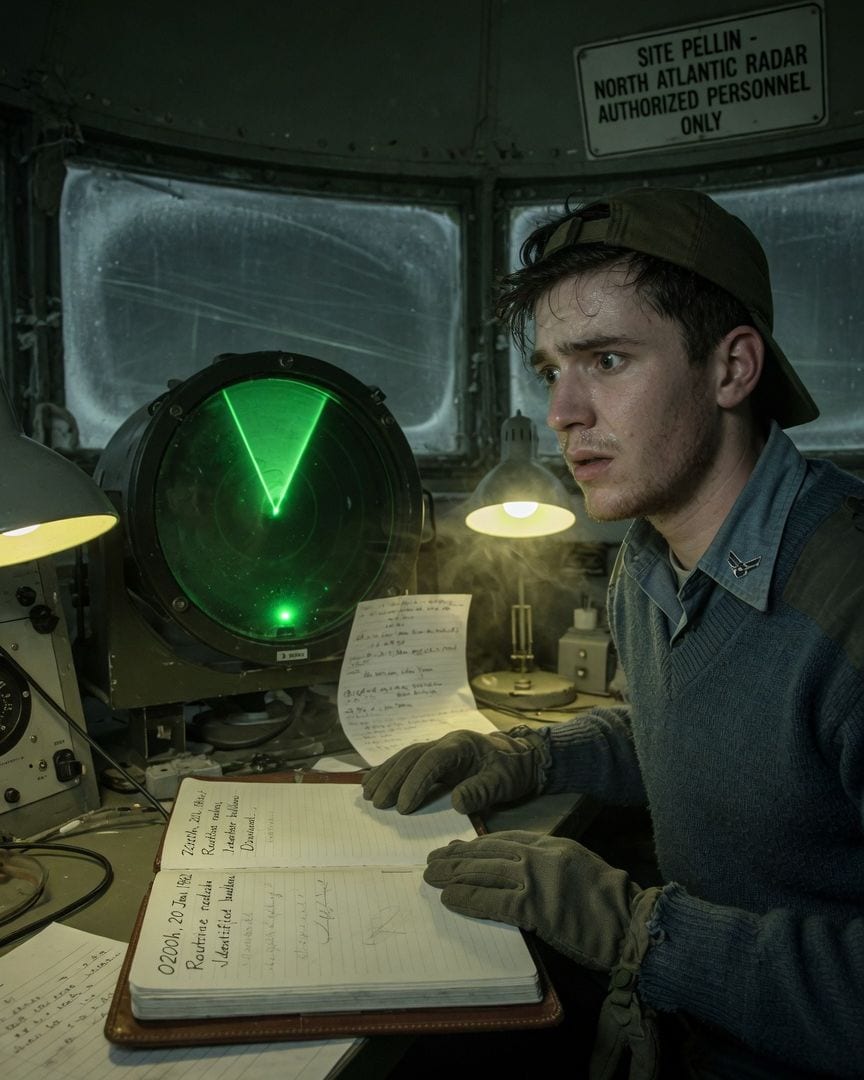
Nine days from closing, Cold War Site Pellin's Airman Vance watched his radar track a solid blip moving closer, dead in open sea where nothing could exist.
In the dimly lit dome of Site Pellin, Airman Ordway Vance, just days from discharge, ran his final radar sweeps before the base closed for good. Outside, the North Atlantic wind howled, but inside, only the hum of his console broke the silence. His last calibration had been clean, yet a single, unwavering green blip appeared on the scope, forty miles out, in open water where no vessel should be. The impossible return moved closer with each sweep, defying all logic and other sensors, until it sat static just beyond the coast fence line. What unseen presence did the radar truly hold in its unwavering green grip, contradicting the official record?
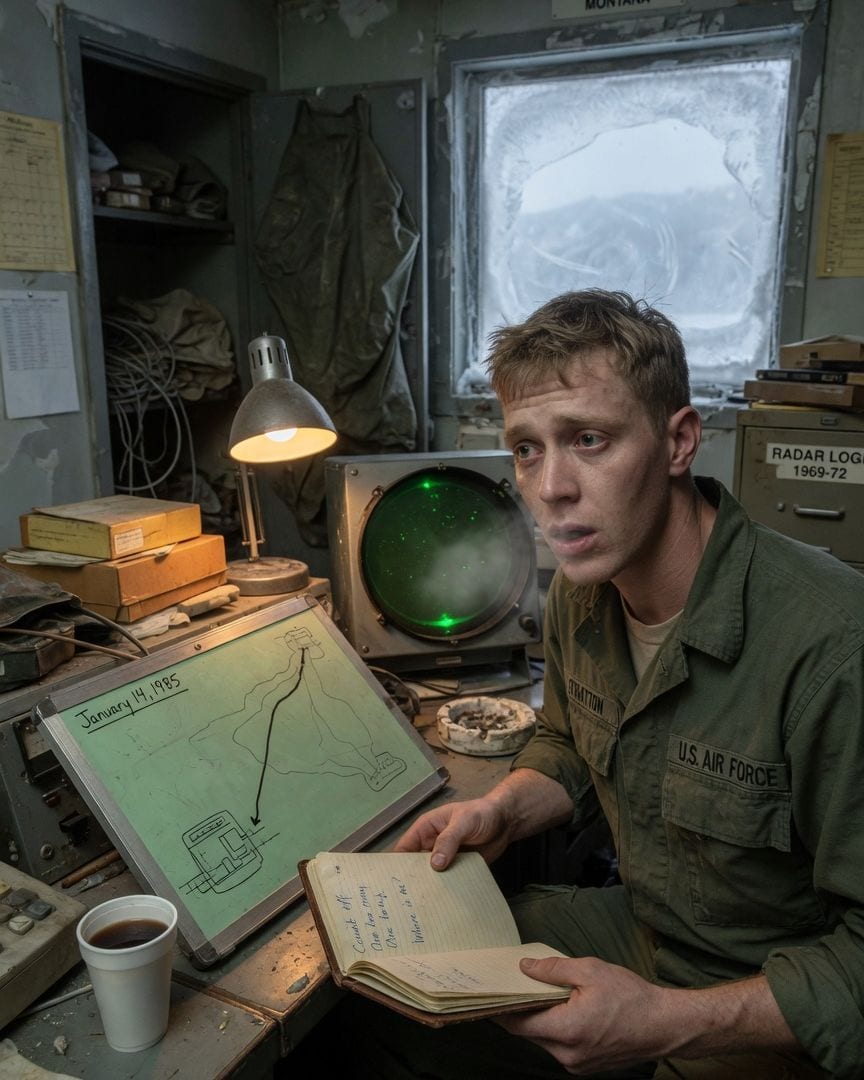
Airman Lars Stratton found an old Cold War manifest listing one name twice: 'Bernard Radcliffe' transferred and 'Bernard Radcliffe' still present.
Airman Second Class Lars Stratton was counting down his final weeks at Echo Station, a desolate Cold War outpost due for mothballing. He longed for home, far from the bitter Montana winds and the constant hum of static. Inside the dim radar shack, he logged the usual nightly ghost blip, a faint contact appearing at 2300, just as it had every winter since 1987. This night, a metallic tang like old blood lingered in the air, raising the hairs on his arms. Seeking distraction, Lars later discovered a leather-bound logbook from 1971, detailing the same 2300 contact, but with chilling notes and a manifest listing one airman's name, Bernard Radcliffe, twice—once transferred, once present. Was he truly alone in the silent, remote station?
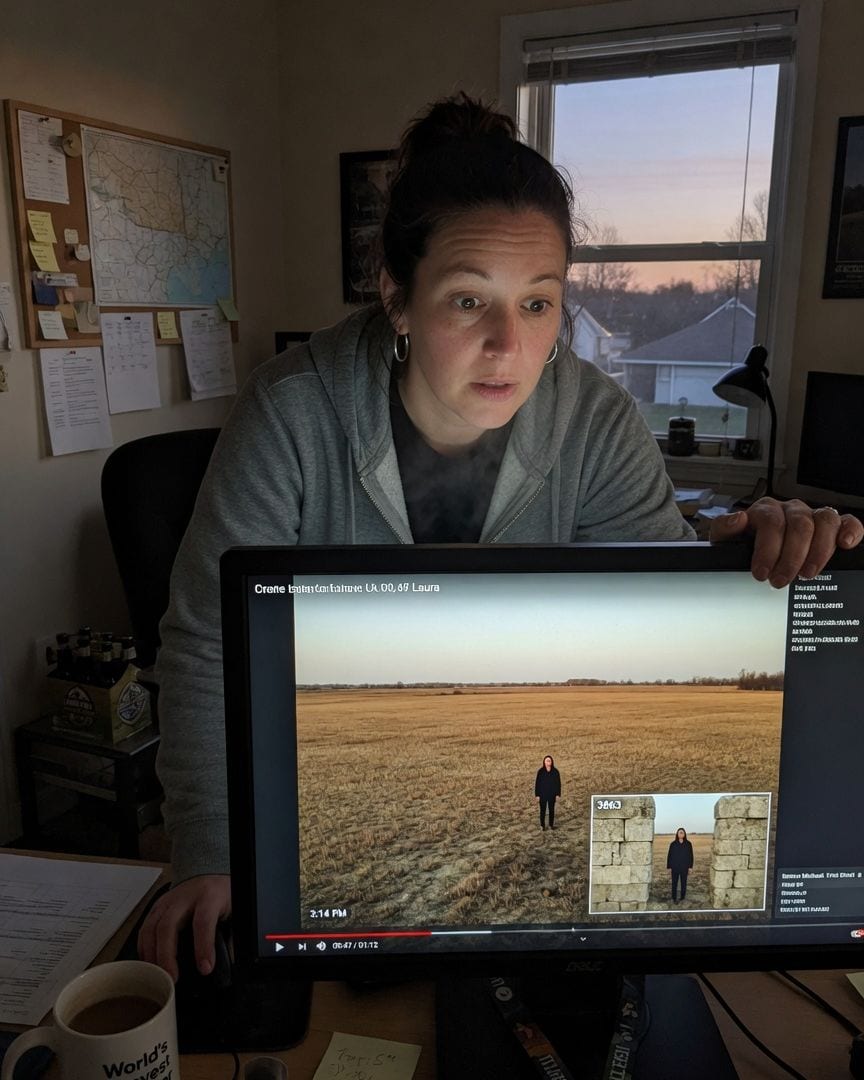
My drone's return footage shows a man standing in the empty field looking up. I was alone out there, the field clear when it launched.
My routine drone survey of a vast, empty field was just another job, miles from any paved road. But the footage revealed a silent man standing alone in the field's center, gazing up at my ascending drone. As my friend and I analyzed the frames, we found a weathered stone structure that briefly appeared around him, then vanished.
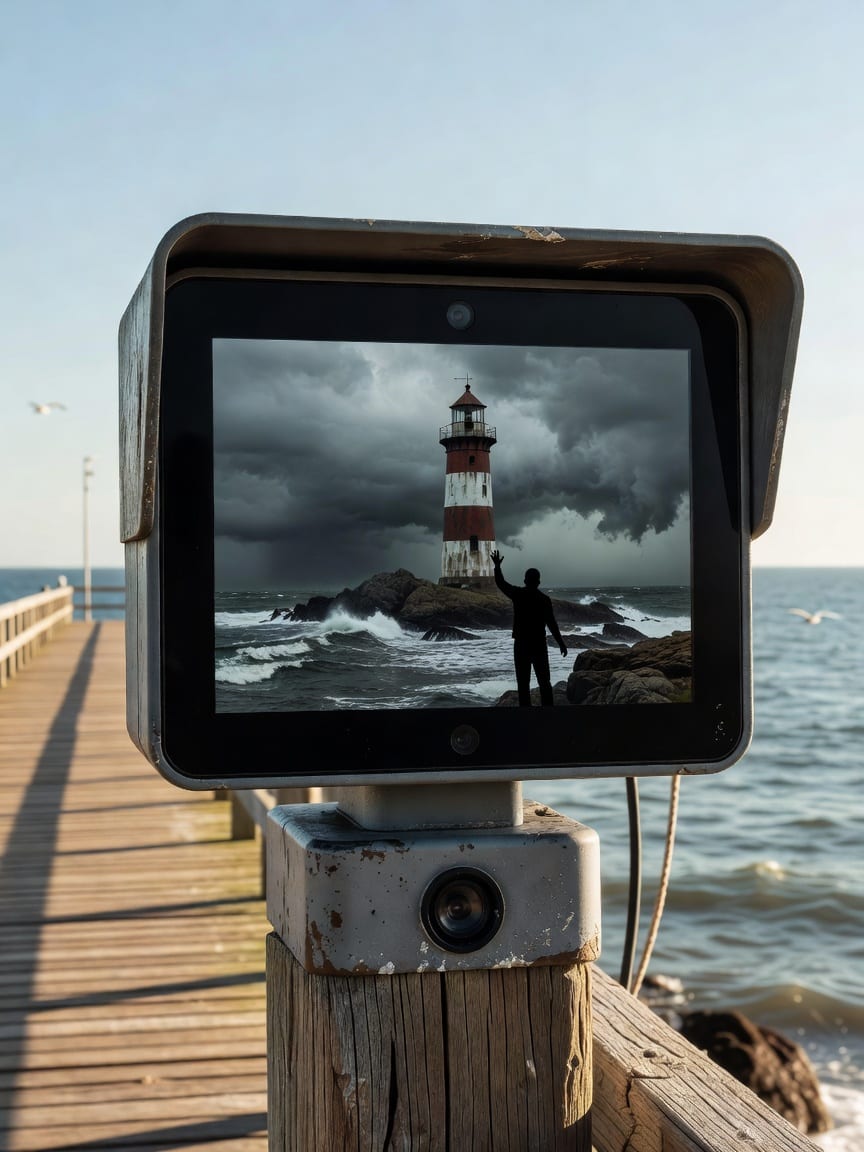
My pier camera snapped a figure walking my empty pier at 3 AM. No frames since.
My morning ritual involves checking the weather camera at the end of our family's pier. But one day, after a mysterious figure appeared in the 3:10 AM photo, the feed died. Yet, the camera's SD card held a video: not of my familiar pier, but a storm-lashed, unknown coastline with a strange lighthouse.