A pilot with a daughter waiting felt his stick tremble: a silent disc slid sideways, impossibly, at forty thousand feet.
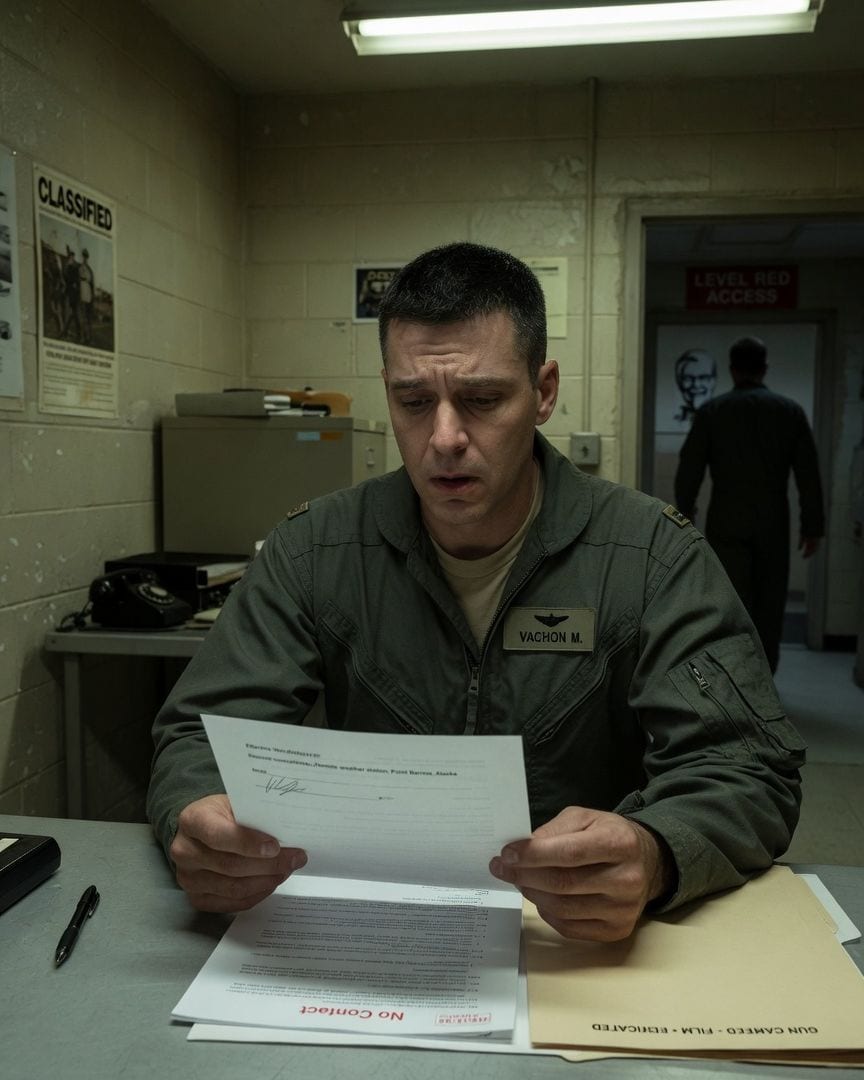
Captain Merle Vachon felt the F-86’s stick tremble in his hand, not from turbulence, but from the sheer wrongness of the sight. Eleven minutes of fuel, one intercept left, and a daughter born previous Tuesday waiting for him at home.
But above the Nevada ranges, at forty thousand feet, hung a disc. Silent. Impossibly still. He’d tried to rationalize it on the climb: a high-altitude balloon, a temperature inversion making a distant reflection shimmer. But then it moved.
Not a drift, not a bank. It slid sideways, a smooth, impossible translation across the vast blue, defying every law of aerodynamics he knew. His breath hitched, a cold knot tightening in his gut.
The mundane answers died one by one in his mind, leaving only the impossible. He landed, the desert air feeling too thin, the tarmac too solid, the memory of that impossible slide etched behind his eyes.
In the sterile debriefing room, Merle’s report met with polite, professional skepticism. Colonel Desmond Foster, Merle’s commanding officer, sat across the polished table, his hands folded. 'Captain, are you certain of these… unique flight characteristics?'
he asked, his voice even, betraying no hint of disbelief, only detached inquiry. Merle slammed a hand on the table, the sound echoing in the quiet room. 'Sir, I flew right up to it. It was a disc. Standing still.
Then it slid.' He recounted the impossible movement, the perfect silence, the way it simply was, defying every expectation. The room, for all its fluorescent light and beige walls, seemed to press in, a silent judge.
He insisted on the gun camera film. A few hours later, in a darkened projection room deep within the base, Merle watched as the 16mm film spooled through the projector. The whirring of the machine was the only sound.
The projectionist, a young airman named Simon Bishop, sat rigid beside him, his gaze fixed on the screen. The first frames showed the distant, silver disc, a tiny, almost imperceptible speck against the deep blue.
Then, frame by frame, it grew larger. Not a zoom, Merle realized with a growing horror. An actual, impossible approach. The airman muttered, a low, frightened sound, 'Sir, this isn't possible.'
The disc filled the screen, its surface featureless, silent, utterly alien. In the sixty-first frame, it was so close Merle felt he could reach out and touch it, a perfect circle of polished dread, utterly consuming the view.
The projector light flickered, and for a second, the disc seemed to pulse faintly.
Colonel Foster entered the projection room without knocking, his expression unreadable, and ordered Simon Bishop to halt the film. 'Confiscate that reel, Airman. Secure it in vault three, Level Red.' Merle protested, the words catching in his throat.
'Sir, that’s evidence! You saw it!' Foster turned to him, his eyes calm, unblinking. The air in the room felt suddenly cold, sterile. 'Captain, your report cites atmospheric distortion and operator fatigue. There was no contact.'
He pushed a fresh report across the table, its 'No Contact' checkbox already marked with a crisp red pen. 'Sign it.' Merle stared at the blank line, then at the Colonel's unwavering gaze. The paper felt heavy, like a stone.
He couldn't. 'I can't,' he said, the words barely a whisper. Foster merely nodded, sliding a transfer order across the table. The paper was clean, stark white against the dark table. 'Effective immediately, Captain. Remote weather station, Point Barrow, Alaska.'
Merle watched the Colonel's retreating back, the transfer order a heavy, chilling weight in his hand, its words blurring.
Point Barrow was a desolate, frozen cage. The endless white landscape outside his window mirrored the blank wall Merle kept hitting.
The silence of the remote station was absolute, broken only by the howl of the wind and the crackle of a faulty radio.
He tried calling old colleagues, but his calls went unanswered or were met with clipped, evasive responses from unfamiliar voices. His wife, Grace, via crackling satellite phone, reported his original unit had been 'restructured,' his old squadron dissolved.
He felt erased, not just from the base, but from the narrative of his own life. Driven by a quiet desperation to prove he wasn't mad, to himself and to the memory of that impossible disc, Merle began to dig.
His new posting, ironically, granted him access to dormant, low-level military archives – a dusty digital repository of forgotten paperwork, accessed through an ancient terminal that hummed incessantly in the corner of his tiny office.
He started cross-referencing keywords: 'unexplained aerial phenomena,' 'unauthorized contact,' 'rapid reassignment.' Slowly, painstakingly, a pattern emerged from the digital dust.
Reports from the 50s and 60s, describing objects with impossible flight characteristics – silent, disc-shaped, moving 'sideways' – followed by the abrupt transfer or disappearance of the reporting personnel. The official explanations were always vague: 'equipment malfunction,' 'misidentification,' 'nervous exhaustion.'
He started a new file on his terminal, his own, linking these disparate entries, names, and dates, a web of forgotten men and unhappened events that stretched across decades like a spider's silent work.
The subtle anomalies began. His weekly mail, routed through a military depot hundreds of miles south, arrived weeks late, often with official seals broken and then carelessly resealed.
His secure communications, already unreliable, sometimes had a faint, almost imperceptible echo, as if someone else were listening in the vast, empty space between him and the outside world.
The station’s solitary generator, usually a reliable thrum, would occasionally cough and stutter, plunging the small building into momentary darkness, only to restart with a shudder. Then came Vivienne Merritt, ostensibly a 'records auditor' from a regional command.
She arrived by ski-plane, a small, bundled figure against the vast white. Her questions were unsettlingly specific, not about weather data or equipment maintenance, but about his 'personal interest in historical flight anomalies.'
Her eyes, behind thin spectacles, seemed to weigh him, assessing, lingering a moment too long.
'Just ensuring compliance, Captain,' she'd say, her voice flat, but her gaze lingered on his terminal screen, on the corner where he kept his unofficial file open. He felt watched, his isolated station now a spotlight.
One night, while working late, the wind rattling the thin windowpanes, he found it: a small, encrypted file on his terminal, buried deep in a rarely accessed system directory. It wasn't recent surveillance.
It was a log of his own activities, his communications, his archival searches, dating back before his transfer. The timestamps were unmistakable. It was a pre-existing file on him, not initiated, but updated.
The sense of being hunted shifted to something far colder: he wasn't being watched because he was digging; he was being tracked because he was already an entry, a known quantity in a ledger he couldn't see.
Merle confronted Vivienne Merritt during her next 'audit,' the hum of the old server rack the only witness to their conversation.
He laid out his findings on his screen, the columns of dates and names, the repeating pattern of impossible sightings and subsequent reassignments, the vague official explanations.
'This isn't just a series of coincidences, Ms. Merritt,' he said, his voice tight. 'These are people, entire careers, erased. I've found dozens.' Vivienne initially maintained her professional facade, citing 'confidentiality protocols' and waving a dismissive hand at his screen.
The air in the small office grew heavy, thick with unspoken tension. But Merle pushed, detailing the eerie similarities: the 'sideways movement,' the 'silent discs,' the immediate reassignments to 'deep observation' or 'medical leave.' Her composure began to crack.
Merle watched her hands tremble slightly as she adjusted her glasses, her fingers tapping a nervous rhythm on the clipboard she held. Finally, she sighed, a sound like dry leaves rustling in a forgotten attic.
'Captain, I was a clerk, decades ago. In a back office. I saw similar reassignments. It's not a cover-up, not in the way you think.' She leaned in, her voice a low murmur, barely audible over the server's hum.
'There's an unofficial department. Unacknowledged. They don't fight these incidents. They… manage them. They incorporate them.' She spoke of 'Project Shepherd' and 'the Fold,' words that felt ancient and hollow. 'The events aren't unhappened, Captain. They're just moved.
To a deeper set of files. Your gun camera film wasn't blank. It was… reclassified. Into a category that doesn't officially exist.'
The light from the single fluorescent tube above seemed to waver, casting long, unsettling shadows across the small room.
Vivienne, her face pale and drawn in the dim light, pulled a small, worn ledger from her satchel. It was old, its leather cover cracked, its pages brittle, filled with names and dates in neat, fading script.
'My own insurance,' she whispered, her voice barely a breath. 'I kept it. From when I worked for them.' She flipped through the brittle pages, her finger tracing entries. 'Pilots, radar operators, divers. All with similar encounters. All… reassigned.
Some just vanished from the records.' Merle leaned closer, his heart thudding against his ribs. The names were unfamiliar, but the pattern was undeniable. She stopped on an entry from 1958: 'Captain Vincent Bishop, F-86, Nevada Ranges.
Disc, silent, sideways movement.' The service number listed beneath it, a string of digits, was chillingly close to Merle's own. His breath hitched. Then, her finger slid to the very bottom of the page.
In a different, more recent hand, scrawled beneath the faded entries, was his own name. 'Vachon, Merle, Capt.' And beside it, his transfer date to Alaska.
Below that, in the same unsettling hand, was a new, chilling detail: 'Subject: Merle Vachon. Status: Filed. Destination: TBD.'
Merle stared at his name, the cold dread turning to ice in his veins, spreading through him like a sickness. The server’s hum felt suddenly louder, more insistent. 'Filed?' he rasped, the word tasting like ash.
Vivienne nodded slowly, her gaze distant, fixed on some unseen point beyond the thin walls of the station. 'The 'saucers,' Captain, they're not invaders. They're… collectors. They identify. Project Shepherd, the 'secrecy machine,' it doesn't fight them. It facilitates.
It identifies the 'witnesses,' the 'targets,' and then it manages their 'filing' into a parallel existence.' She explained that his remote posting wasn't a punishment, but a preparatory step.
A place where the lines blurred, where existence could be quietly, seamlessly altered. The gun camera film hadn't been proof of an encounter; it had been proof of his selection.
The disc getting nearer in each frame wasn't just an approach; it was the process of being drawn in, the 'file' being opened. The pattern wasn't just disappearances or reassignments.
It was a system that took people, quietly, seamlessly, and made them part of the system. He realized the true horror, not as an intellectual concept, but as a chilling, inescapable truth that settled deep in his bones: he hadn't discovered a cover-up.
He had discovered the mechanism of his own absorption. He was already a record, already being processed.
Panic surged, a cold, desperate wave. Merle grabbed the satellite phone, his fingers fumbling with the receiver, desperate to call Grace, his wife, to warn them, to simply hear their voices one last time. The line was dead.
A silent, mocking click was all he got. He tried the station's emergency radio, flicking switches, twisting knobs. Nothing but static, a hissing white noise that seemed to swallow his frantic efforts.
He ran to the heavy steel door that led outside, rattling the handle, pulling, pushing. Locked. From the outside.
He could hear the faint, high-pitched hum again, a familiar sound, growing in intensity, a resonant vibration that started deep in the frozen ground and pressed against his skull.
It was the same sound he recognized from the Nevada ranges, the hum of the impossible. He pressed his face to the small, reinforced window, peering out into the vast, white expanse of the Arctic wilderness.
Standing perfectly still, a lone figure against the shimmering white, was Vivienne Merritt. Her face was calm, unblinking, devoid of the fear she'd shown moments before. Her spectacles caught the light, gleaming.
In her hand, she held a thick, manila file, its tag clearly visible even from this distance. His file. She wasn't a helper; she was a facilitator, part of the system all along.
He pounded on the glass, yelling her name, but she simply watched him, a faint, almost imperceptible smile playing on her lips.
The hum intensified, a vibrating pressure against his skull, as the light outside seemed to brighten unnaturally, turning the endless snow into a vast, featureless glow.
A week later, official memos circulated through the various military commands: the Point Barrow weather station was 'decommissioned' due to 'budgetary restructuring.'
Colonel Desmond Foster signed the final paperwork, his signature neat and precise, noting Captain Merle Vachon's 'successful transfer' to a new, highly classified, and permanent 'deep observation' posting. No further contact authorized.
Merle’s wife was informed he was on a long-term, critical mission, details classified, contact impossible. She was given a generous, untraceable pension, deposited quietly into her account each month, a silent exchange for a presence that was no longer there.
The Vachon family received a commendation for their quiet sacrifice, a framed piece of paper that offered no comfort, no explanation, only silence, which grew heavier with each passing day.
Months passed. Grace Vachon, now a toddler, pointed a tiny, curious finger to a faded photograph on the mantelpiece – a young pilot, smiling, in uniform. 'Daddy?' she asked her mother, her voice a small, questioning chirp.
Her mother, whose face had grown thin and distant, her eyes holding a permanent, unspoken weariness, shrugged faintly, as if the effort to answer was too much. 'He's… working,' she said, her voice flat, devoid of emotion, a blank statement.
The photo seemed to shift slightly in the dim light, the pilot's smile a fraction wider, his eyes a shade too still, as if a new layer had settled over the image, obscuring the man Grace had never truly known.
In a deep vault, far beneath the earth, a manila file marked 'Vachon, Merle, Capt. Status: Active. Classification: Folded,' received a new handwritten entry. The careful script added: 'Observations: Consistent. Integration: Ongoing. New witness identified: Grace Vachon.'
The ink is still damp.
If this one got to you
A Cold War pilot, eleven minutes from his new daughter, saw his own signature on a requisition for a 'Harvester' drone, dated a month in his future.
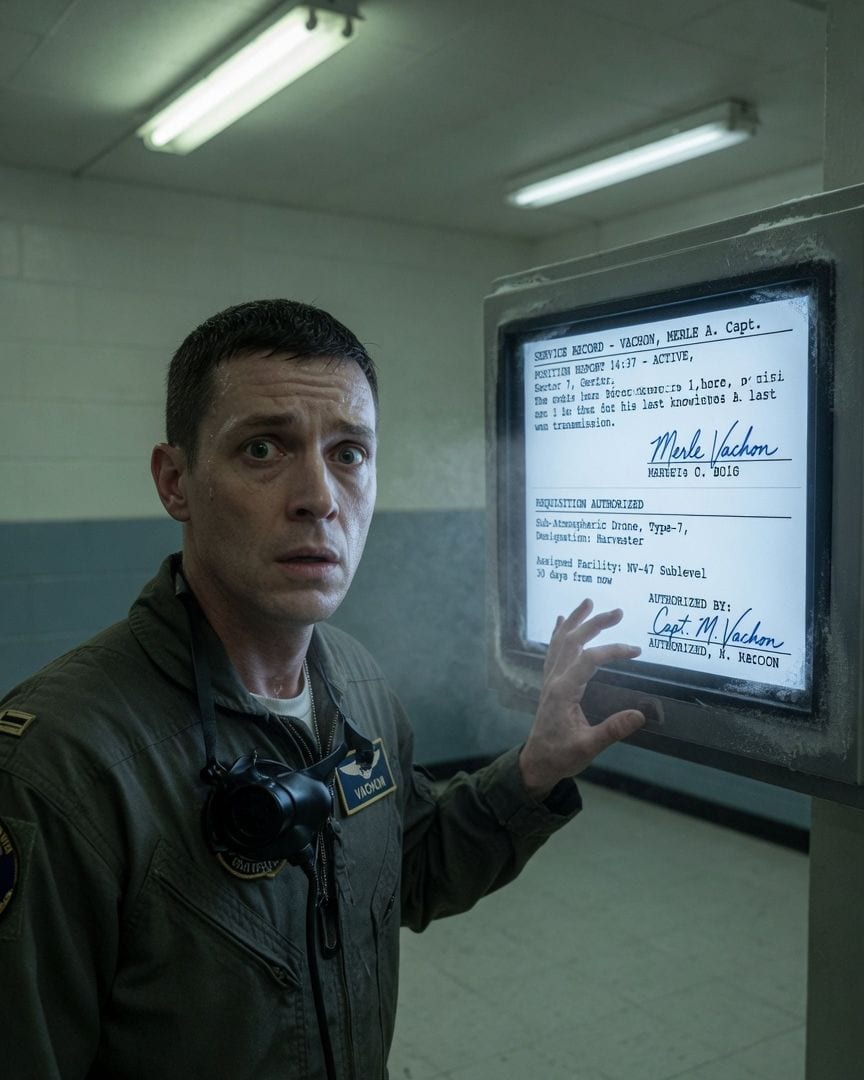
Captain Merle Vachon was just eleven minutes from seeing his newborn daughter when his F-86 Sabre encountered an impossible sight: a silent disc, utterly still, forty thousand feet above him. Radio silence turned to dead air, then the pilot was suddenly no longer in his cockpit, but floating in a vast, cold, sterile space. There, a glowing console displayed his service record, new entries scrolling into existence, listing him active *after* his last transmission. But the true dread landed when he saw his own confident signature on a requisition for an unknown 'Harvester' drone, dated a month in the future, for a facility hundreds of miles from any base he knew.
Returning to his newborn daughter, a Cold War pilot found a perfect diamond shape hidden within his classified report's redactions.
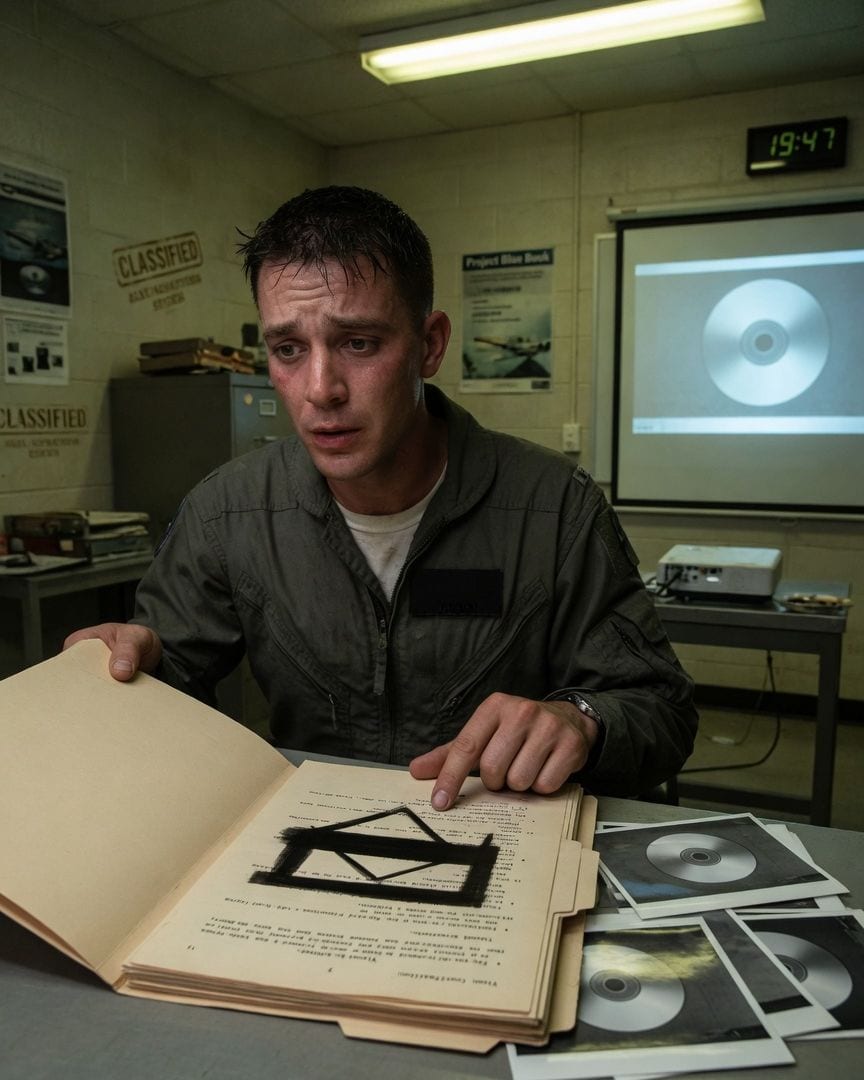
Captain Merle Vachon had one last intercept before he could return home to his newborn daughter Nora. High over the Nevada ranges in his F-86 Sabre, he encountered a disc that moved with impossible, silent displacement, defying all known physics. Days later, the official gun camera film showed the object impossibly close, directly contradicting Vachon’s own telemetry and eyewitness account. But the true chilling detail emerged when he found a perfect diamond shape outlined by redacted black ink within his classified incident report.
Airman Lars Stratton found an old Cold War manifest listing one name twice: 'Bernard Radcliffe' transferred and 'Bernard Radcliffe' still present.
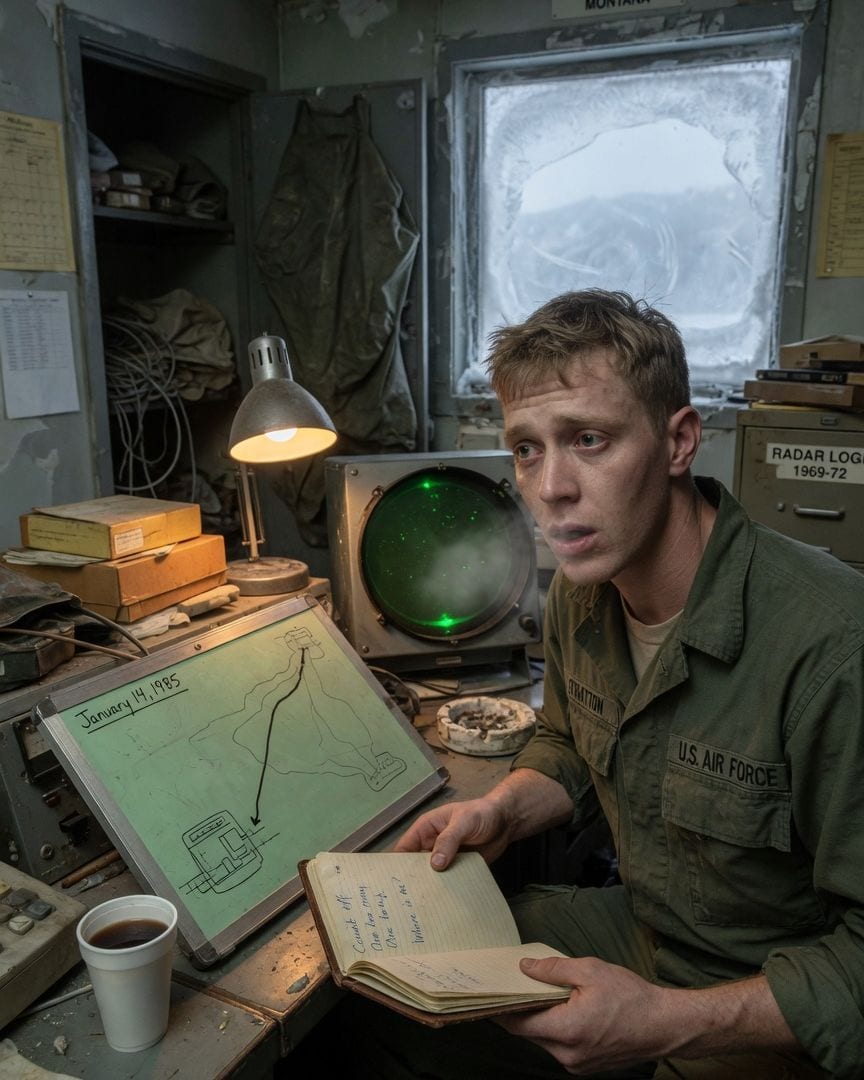
Airman Second Class Lars Stratton was counting down his final weeks at Echo Station, a desolate Cold War outpost due for mothballing. He longed for home, far from the bitter Montana winds and the constant hum of static. Inside the dim radar shack, he logged the usual nightly ghost blip, a faint contact appearing at 2300, just as it had every winter since 1987. This night, a metallic tang like old blood lingered in the air, raising the hairs on his arms. Seeking distraction, Lars later discovered a leather-bound logbook from 1971, detailing the same 2300 contact, but with chilling notes and a manifest listing one airman's name, Bernard Radcliffe, twice—once transferred, once present. Was he truly alone in the silent, remote station?
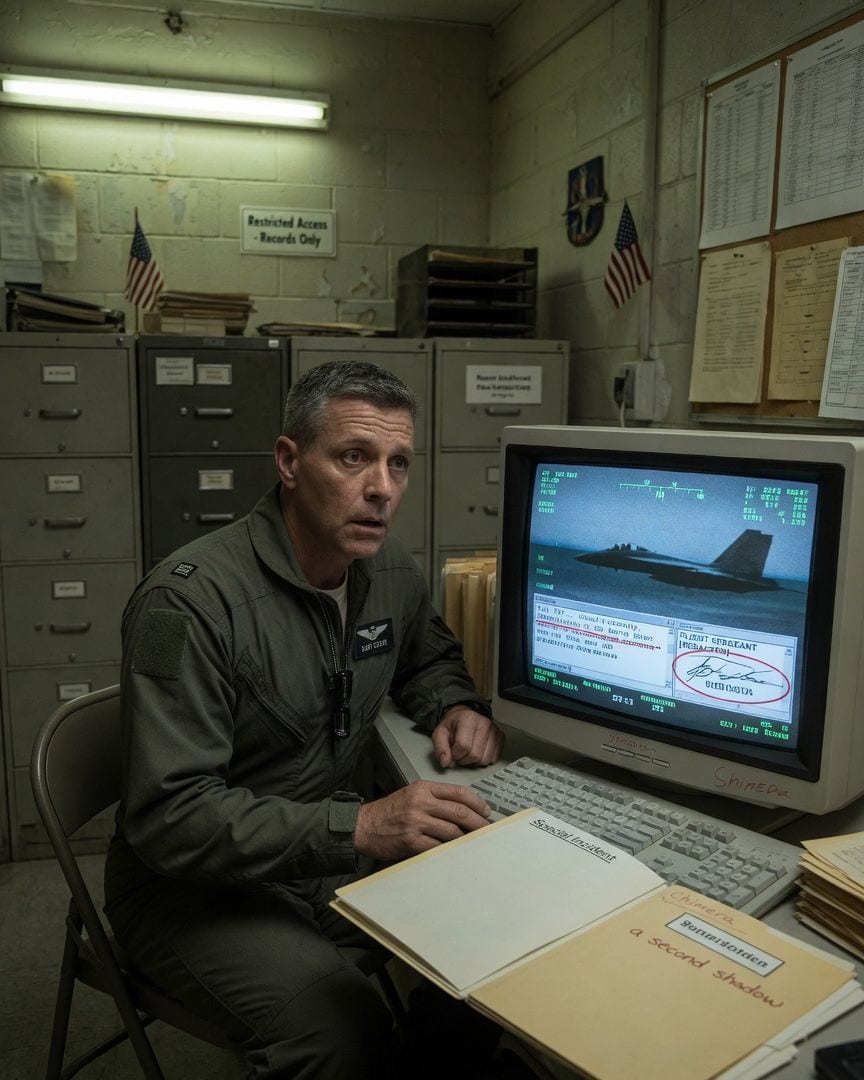
A Chief Warrant Officer's HUD showed a second aircraft watching his plane. He later found a log for *his* tail number reporting the same anomaly weeks ago, but he was grounded for medical leave.
Chief Warrant Officer Gary Estes, a man whose career was built on precision, found his impending Pentagon transfer shadowed by a baffling anomaly. On every flight, at exactly 800 feet, his aircraft's display would briefly show a sleek, dark second plane tucked off his right wing, its canopy subtly angled toward his, watching him. Ground radar never saw it, and his wingmen swore they flew alone. Desperate to maintain his clean record, Estes dug into maintenance logs and uncovered an entry for *his* tail number from weeks prior. It described the exact same 'visual anomaly' during a flight he knew, with chilling certainty, he had never flown.
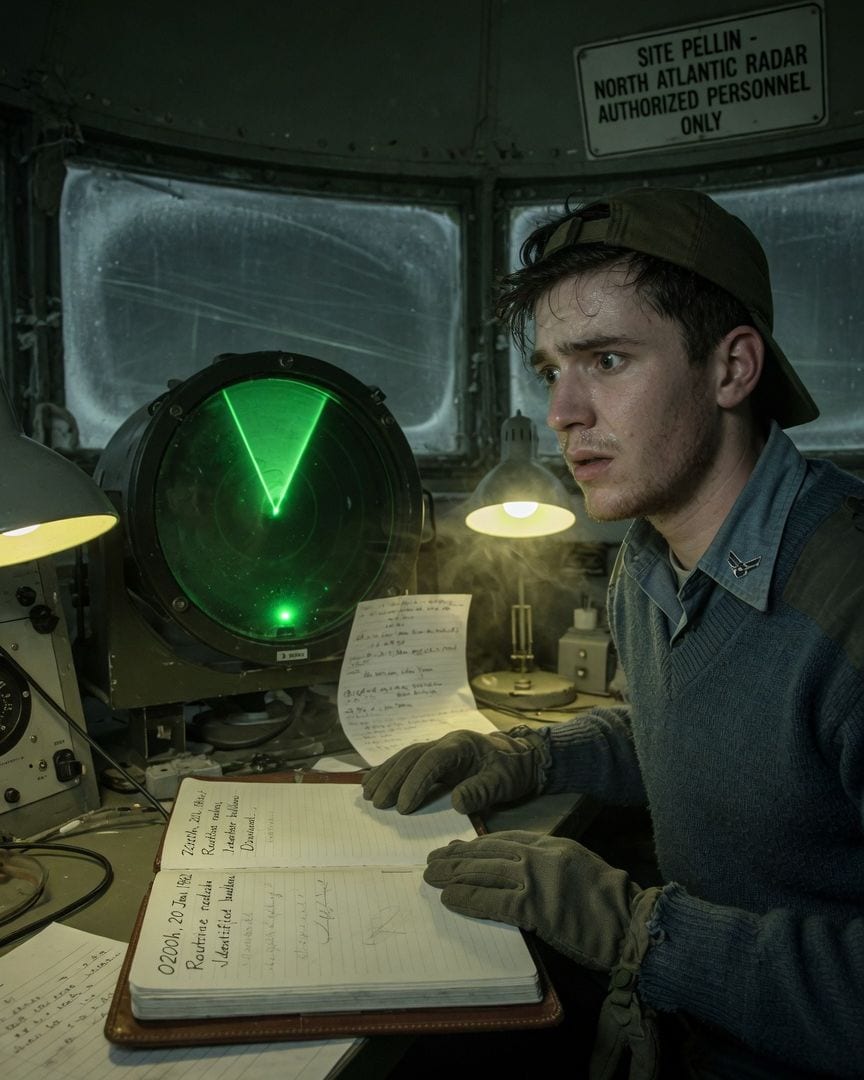
Nine days from closing, Cold War Site Pellin's Airman Vance watched his radar track a solid blip moving closer, dead in open sea where nothing could exist.
In the dimly lit dome of Site Pellin, Airman Ordway Vance, just days from discharge, ran his final radar sweeps before the base closed for good. Outside, the North Atlantic wind howled, but inside, only the hum of his console broke the silence. His last calibration had been clean, yet a single, unwavering green blip appeared on the scope, forty miles out, in open water where no vessel should be. The impossible return moved closer with each sweep, defying all logic and other sensors, until it sat static just beyond the coast fence line. What unseen presence did the radar truly hold in its unwavering green grip, contradicting the official record?
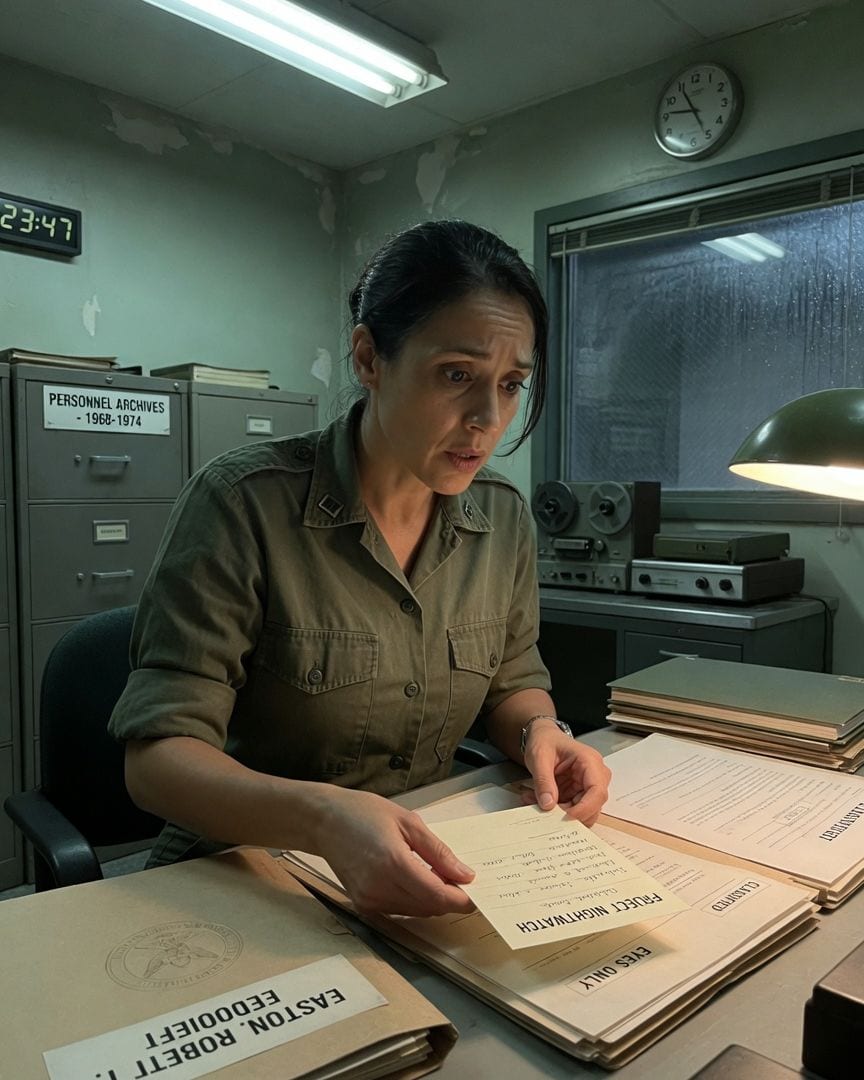
A Cold War tower controller logs an object vanish from radar, then hears the pilot scream it’s filling his windscreen. Her own name, 'Bardolph, Ines', now marked 'Observed' in a secret file.
Captain Ines Bardolph, a tower controller, was counting down the months until her transfer to Langley and the decommissioning of her base, hoping to leave behind the unsettling incidents of her final posting. But one night, her radar scope showed an impossible blip, solid and unwavering, 40 miles north of the Danube, only to vanish in less than a second, leaving a pilot screaming in terror. Despite the clear evidence, the official report blamed "atmospheric inversions," while the terrified pilot received a glowing review and promotion, his file meticulously scrubbed of any anomaly. As Captain Bardolph reviewed the pilot's pristine record, she found a hidden slip of paper, revealing a chilling truth: 'Subject: Bardolph, Ines. Status: Observed.' Was she merely an observer of the impossible, or was she now part of something far more sinister?