Returning to his newborn daughter, a Cold War pilot found a perfect diamond shape hidden within his classified report's redactions.
Captain Merle Vachon, strapped into his F-86 Sabre, watched his fuel gauge needle hover over the red. Eleven minutes. He had one intercept left before he could rotate home to Nora, his daughter, born just two days ago.
The Nevada ranges stretched out below, a vast, indifferent canvas. Then his scope blipped. Forty thousand feet. His F-86 clawed upwards, the air thinning, the engine a strained roar.
He leveled off, and there it was: a disc, utterly motionless, reflecting the high-altitude sun like a polished mirror. It wasn’t a balloon, not a weather inversion, not a trick of light. It was a saucer.
He wrote the word down later, in his own hand, because there was no other word for it. He pushed the stick, trying to close the distance, but the moment he committed, the disc moved.
It didn’t bank, didn’t turn, didn’t accelerate in any conventional sense. It simply slid sideways, a silent, impossible displacement, as if the air itself offered no resistance to its will. Vachon’s gut seized.
Nothing with wings, nothing in this world, could do that. He felt a cold dread settle in his stomach, a chill that had nothing to do with the altitude.
He tried to rationalize it on the way down, running through every mundane explanation, but each one died before he crossed the fence.
The only thing that remained was the impossible memory, and the unspoken question of what the gun camera had captured.
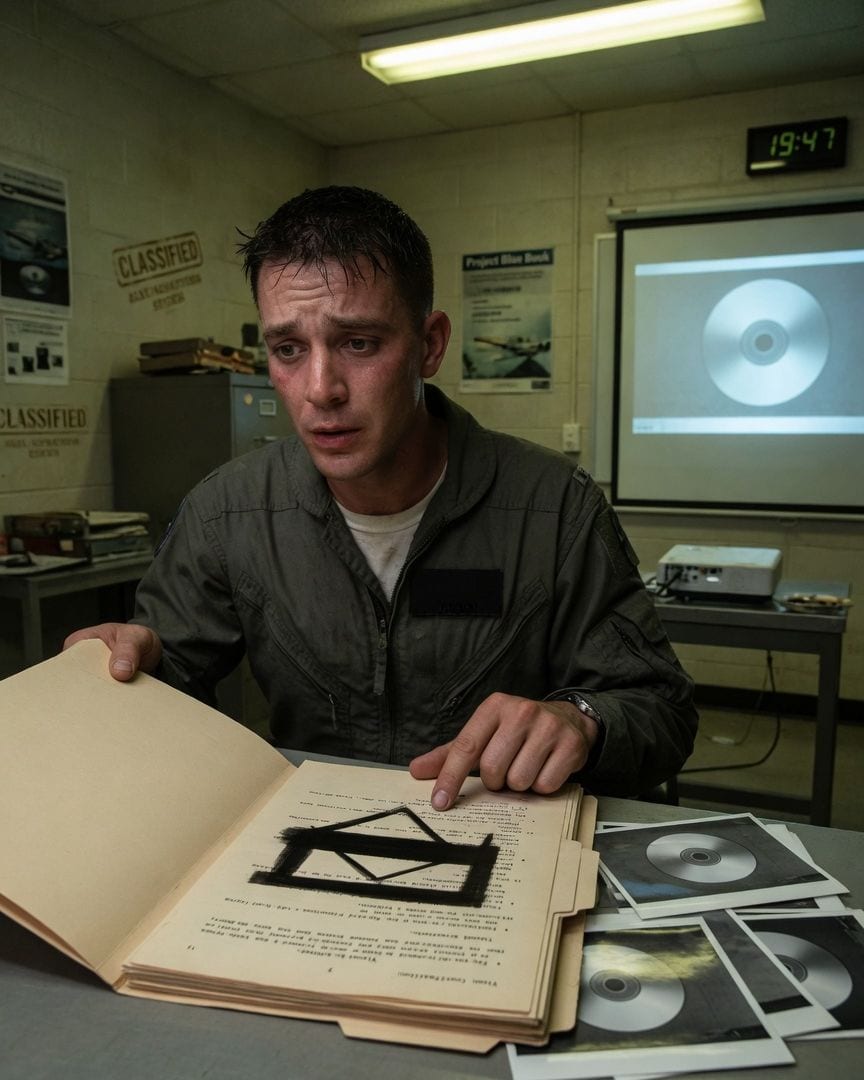
Days later, the debriefing room was stark, sterile. Commander Joseph Sutton, a man whose face was etched with too many classified briefings, sat across from Vachon. The gun camera film was projected onto a small screen. Sixty-one frames.
Each frame showed the disc, a silver coin against the stark blue, and each frame, Vachon noted with a growing unease, showed it slightly closer than the last.
His own cockpit readings, the telemetry, suggested he was maintaining a stable distance, even losing ground. Yet the film told a different story. Sutton cleared his throat. “Captain, the official determination is a weather balloon, caught in unusual atmospheric conditions.
The visual distortion is consistent with lens flare and operator fatigue.” Vachon stared at the screen, at the impossible proximity in the final frames. “Commander, I was not fatigued. And a balloon does not move like that.”
He recounted the sideways slide. Sutton’s gaze was flat. “The film shows no such maneuver, Captain. Only a static object, and your craft approaching.” But Vachon knew what he saw.
He asked to see the full incident report, the official documentation. Sutton hesitated, then produced a thick file. Vachon flipped through it, past the standard forms and flight logs. He found the section marked 'Visual Confirmation and Analysis.'
It was heavily redacted, thick black bars obscuring most of the text. But as he looked closer, a specific detail snagged his attention. The blacked-out sections weren't random.
On page seven, a particularly dense block of redaction seemed to form a distinct, almost deliberate, geometric shape.
Vachon leaned in, tracing the edges of the black rectangle on the report. It wasn't just a rectangle. Within it, the negative space, the faint outlines where the ink had bled slightly, formed a perfect, unsettling diamond.
A cold sweat prickled his scalp. He’d seen that shape.
For a fleeting instant, just before the disc had vanished, a precise, shimmering diamond had appeared on its surface, a detail so brief and impossible he’d dismissed it as an optical illusion, a stress hallucination.
But here it was, in the official record, outlined in black ink, a ghost beneath the censor’s hand.
The redaction wasn’t hiding information; it was revealing something, a deliberate, impossible signature from within the very system meant to deny its existence. He looked up, his eyes meeting Sutton’s, who was watching him with an unnerving stillness.
The air in the room felt suddenly heavy, charged with an unspoken understanding. The diamond stared back at Vachon, a silent, impossible challenge.
The diamond-shaped redaction became an obsession. Vachon couldn’t shake it, couldn’t dismiss it. He started pulling strings, quietly at first, through old Air Force buddies in records and intelligence.
He requested copies of other ‘unexplained aerial phenomena’ reports from the past decade, citing a personal interest in historical aviation anomalies. Most came back as expected: heavily redacted, vague, or outright dismissed as hoaxes or misidentifications.
But he began to notice patterns. Not in the details of the sightings, which varied wildly, but in the method of redaction.
A certain thickness of line, a particular density of ink, and, in a few instances, the faint, almost accidental bleed-through that hinted at the same unsettling geometric shape beneath the black. It was like a watermark, a hidden signature.
He found a sympathetic ear in Frank Brooks, a grizzled lead archivist in a dusty, forgotten annex of the records office. Brooks, nearing retirement, had a weary honesty in his eyes.
“They black out what they don’t want you to see, Captain,” Brooks had rasped, sifting through a stack of yellowed files. “But sometimes, the black itself is the message.” Vachon explained the diamond.
Brooks paused, a flicker of something unreadable in his gaze. “You wouldn’t be the first to see patterns in the ink.” He pulled a box labeled ‘Discrepancies – Pre-1950’ from a high shelf.
“Some of these old ones, they tried to bury them so deep, the paper itself screams.”
Vachon spent hours in that annex, the air thick with the smell of old paper and dust, sifting through reports of unexplained radar contacts, impossible objects, and even missing aircraft.
The rational explanations offered in these files—atmospheric conditions, equipment malfunction, pilot error—felt increasingly flimsy, almost desperate. Each failed explanation only strengthened the implication of the redactions.
He was no longer looking for what was hidden, but for how it was hidden, and the consistent, almost ritualistic nature of the black lines began to suggest not a cover-up of isolated incidents, but the systematic management of an ongoing phenomenon.
Vachon's quiet digging didn't stay quiet for long. One morning, he found a note tucked under his windshield wiper: a single, crisp white index card with a single, typewritten word: 'FILED.' No sender, no other context. His stomach clenched.
Later that week, a phone call. The line was static-laced, the voice distorted, but the message was clear: “Captain Vachon. Your daughter is doing well. A beautiful baby, Nora. Take care of her.” The call disconnected.
Vachon felt a cold dread colder than anything in the cockpit. They knew about Nora. They were watching him. He confronted Commander Sutton, the note crumpled in his hand. Sutton’s face remained impassive. “Captain, I’m not sure what this is.
Perhaps a prank. You’ve been asking a lot of questions.” His tone was even, but his eyes held a warning. “Some questions are best left unasked, Vachon. For your own good. For your family’s good.” Vachon didn't back down.
He went back to Frank Brooks, his hands shaking slightly as he told him about the note and the call. Brooks listened, his face grim. “They don’t like loose ends, Captain. Not when it comes to these files.”
He pushed a small, bound ledger across the table. “This is a cross-reference index. Unofficial. Been keeping it for years. Sometimes, when a file goes missing, or a report gets too heavily 'processed,' I make a note here.
Just a service number, a date, and a cryptic little code.” Vachon opened the ledger. It was filled with neat, cramped handwriting. He scanned the entries, a growing sense of unease.
So many service numbers, so many dates, so many codes he didn’t understand. But then, almost casually, he saw it.
His own service number, written in Brooks’s hand, next to the date of his intercept, and a single, chilling code: 'M-7'.
Vachon’s finger trembled on the 'M-7' entry. “What does this mean, Frank?” Brooks sighed, a long, weary sound. “It means you’re not the first. And you won’t be the last.” He leaned forward, his voice dropping to a near whisper.
“The ‘saucers,’ Captain, they’re not just… visitors. They’re part of something. Something that operates on its own terms. And it interacts with certain people. People like you.”
Vachon felt a chill, not from the cold of the annex, but from the sudden, terrible clarity. “What kind of interaction?” “An identification. A marking.” Brooks pointed to the diamond shape Vachon had described. “That’s one of the marks.
A signature of an encounter. And the official channels… they don’t just cover it up. They… process it. They file it.” “File what?” Vachon pressed, the pieces starting to click into place with horrifying precision. “The incident? The object?”
Brooks shook his head. “No, Captain. They file you. They file everyone who gets marked. Your report, your gun camera film, your service number… it all goes into a different kind of archive.
Not to be forgotten, but to be… tracked.” He explained that the 'secrecy machine' wasn't just a bureaucracy covering up UFOs; it was an institution that had, for decades, been observing and managing a pattern of contact.
The redactions, the dismissals, the warnings—they were all part of a system designed to identify, isolate, and catalogue individuals who had come into contact with 'it'.
The gun camera film, showing the disc drawing closer, wasn’t about Vachon’s pursuit; it was about its deliberate approach. The impossible movement, the diamond shape, the silence—all consistent signatures across hundreds of other entries in Brooks's unofficial ledger.
Vachon thought of the phone call, the mention of Nora. “They know about my daughter because I’m… marked?” Brooks nodded slowly. “Once you’re in the system, Captain, you’re in. Your whole life becomes part of the file.”
He gestured to the dusty shelves around them. “These aren’t just records of lost things. They’re records of things that were found. And then… filed away.” The dread in Vachon’s gut solidified into a cold, hard knot.
He wasn't just a pilot who saw something. He was now a data point, an entry in a ledger that stretched back decades, defining a pattern far larger and more terrifying than any single encounter.
Vachon spent the next few weeks meticulously cross-referencing Brooks’s unofficial ledger with the official declassified files Brooks allowed him access to.
He focused on the ‘M-7’ code, looking for similar cryptic notations, for patterns in the dates, locations, and personnel involved in older incidents. He found dozens. Incidents dismissed as 'meteorological anomalies,' 'experimental aircraft,' 'mass hysteria.'
But beneath the official narrative, the traces of the diamond signature, the impossible movements, and the specific type of 'witness'—often pilots, radar operators, or isolated sentries—were unmistakable. He was building a terrifying tapestry of coherence.
One afternoon, deep in the archives, Brooks handed him a box marked 'PROJECT MARINER - 1949'. “This one,” Brooks said, his voice unusually strained, “was an early one. Multiple radar contacts, unexplained disappearances in the Pacific.
They never really closed it.” Vachon opened the box, pulling out a faded manila folder. The paper inside was brittle, yellowed. He read through the initial report, the frantic radio logs.
Then he found a typed sheet, a summary of 'witnesses and assets identified for further observation.' The list was long, a series of names, ranks, and service numbers. He scanned it, looking for any familiar pattern, any recurring code.
And then he saw it. Not just another name, but his own service number, written in the official, impersonal font of the 1940s, dated 1957. Beside it, a handwritten note in a different, elegant script: 'Cross-reference M-7. Subject identified.'
His own service number, from an incident eight years in the future, was already here, in a file from 1949. He wasn't just a witness who got filed. He was already in the file.
He looked up at Brooks, his mouth dry, the dusty air suddenly thick and suffocating. The archivist’s face was pale, his gaze fixed on Vachon, a silent, terrible understanding passing between them.
The file wasn't just being signed; it had been signed for him decades ago.
Brooks finally broke the silence, his voice barely a whisper. “It’s not just a pattern of incidents, Captain. It’s a pattern of people. It identifies them. Marks them. And then… it waits.”
He explained that the 'secrecy machine' wasn't simply a human organization; it was an interface, a vast, patient bureaucracy built around the dictates of the entity itself.
The entity, whatever it was, operated on a timeline beyond human comprehension, its 'contacts' not random but precise, almost predestined. Each encounter, each 'marking' with the diamond signature, was a step in a long-term process.
The gun camera film, with its impossible closing distance, was the entity observing Vachon, making contact. The redactions, the official dismissals, the quiet surveillance of his family—these were the human institution’s protocols for managing those who had been 'marked.'
“The file,” Brooks said, tapping the 1949 document with Vachon’s service number, “is the registry. Not of those who are lost, but of those who are… collected. Integrated.”
The pattern across decades, the cross-referencing, the precision of the 'M-7' code—it all snapped into place.
Vachon realized his 1957 intercept wasn't a chance event; it was the activation of a pre-existing entry, the moment he transitioned from an unmarked individual to a 'subject identified.'
He wasn't just an observer of the machine; he was a piece of its mechanism, a cog in its slow, relentless turning.
The entity didn't need to conquer or invade; it simply observed, marked, and filed, slowly accumulating its 'assets' across generations, using human institutions to process its own agenda.
The horror was in the coherence, the terrible, meticulous logic of it all. He had been chasing a mystery, only to discover he was the answer, waiting to be found within the very records he sought to understand.
Vachon knew he couldn’t fight it head-on. The machine was too vast, too patient. His only option was to disappear, to try and break the thread. He went home, kissed Nora’s forehead, and packed a single bag.
But as he turned to leave, the phone rang. He hesitated, then answered. It was Commander Sutton. “Captain Vachon. Your transfer orders just came through. Effective immediately. You’re being reassigned to a remote weather station in the Alaskan interior.
Indefinite term.” Sutton’s voice was devoid of emotion. “Consider it a promotion.” Vachon felt a cold wave wash over him. It wasn't an escape; it was another filing. A new chapter in his dossier.
He tried to argue, to refuse, but Sutton cut him off. “Your family will be cared for. Full benefits. But you, Captain, are needed elsewhere.” The implication was clear: refusal was not an option.
This wasn’t a punishment, but a reallocation. He was an 'asset' being moved to a new position within the entity’s long game.
He looked at Nora, sleeping peacefully in her crib, completely oblivious to the silent, invisible chains that had just tightened around her father. He had become a file, a record that was still being signed.
The truth hadn't set him free; it had merely clarified his new purpose. He was no longer a pilot. He was a piece of data, perpetually logged, perpetually observed, forever part of the buried record.
He walked out of his home, leaving behind the life he had known, knowing he would never see Nora grow up, knowing his new assignment was not to observe weather, but to be observed, a sentinel in the entity’s silent, patient watch.
Merle Vachon never returned from Alaska. His service record was quietly updated to 'Voluntarily Discharged - Location Undisclosed.' Nora grew up without her father, told he was a brave pilot who went on a secret mission and never came back.
Frank Brooks retired shortly after Vachon’s disappearance, taking his unofficial ledger with him, a ghost of knowledge in a world that preferred its secrets buried.
The Nevada incident, like countless others, remained officially dismissed, a footnote in declassified documents, its deeper truth scrubbed clean by the methodical hand of the secrecy machine.
The diamond shape, however, continued to appear, faint and unsettling, in the margins of other, newer reports, waiting for the next marked individual to notice.
Decades later, a young archivist, Eleanor Brooks—Frank’s granddaughter—stumbled upon a heavily redacted document from the 1950s. She noticed a faint, unsettling diamond shape outlined in the black ink.
She paused, a strange sense of recognition stirring within her, an echo of a story her grandfather once told her in hushed tones. She pulled the document closer, her finger tracing the impossible shape.
She felt a familiar, quiet dread, a sense that something vast and patient was watching, waiting. The file, she knew, was still being signed.
If this one got to you
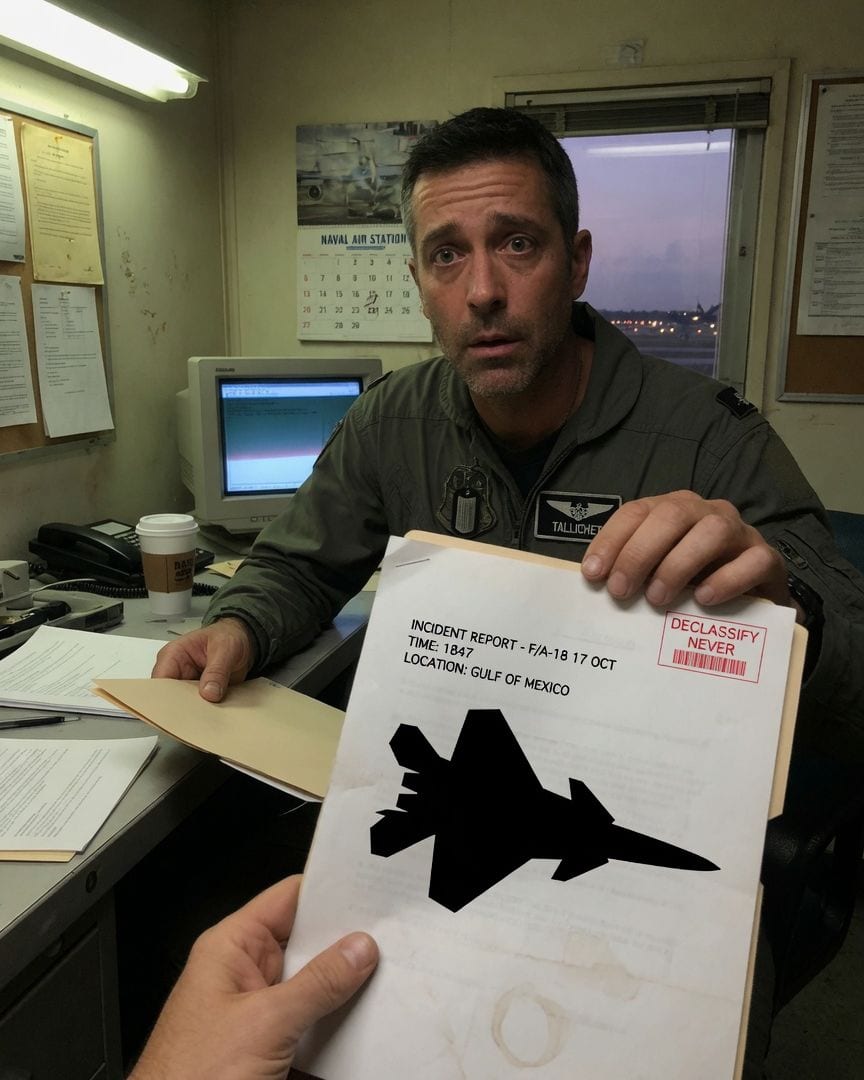
A pilot's classified flight report had a precise, angular blackout. The digital file said 'Page 1 of 12,' but only six pages existed.
Captain Yves Tallichet landed his jet, his hands shaking from an impossible encounter in the sky. He'd seen a dark, seamless shape mirror his F/A-18, defying all known physics. Days later, seeking answers in his official flight report, he found a precise, angular blackout over his observations. A senior records clerk confirmed the redaction was permanent, flagged "DECLASSIFY NEVER." But the true dread came when the digital file showed "Page 1 of 12," yet his physical copy held only six. What happened to the other pages?
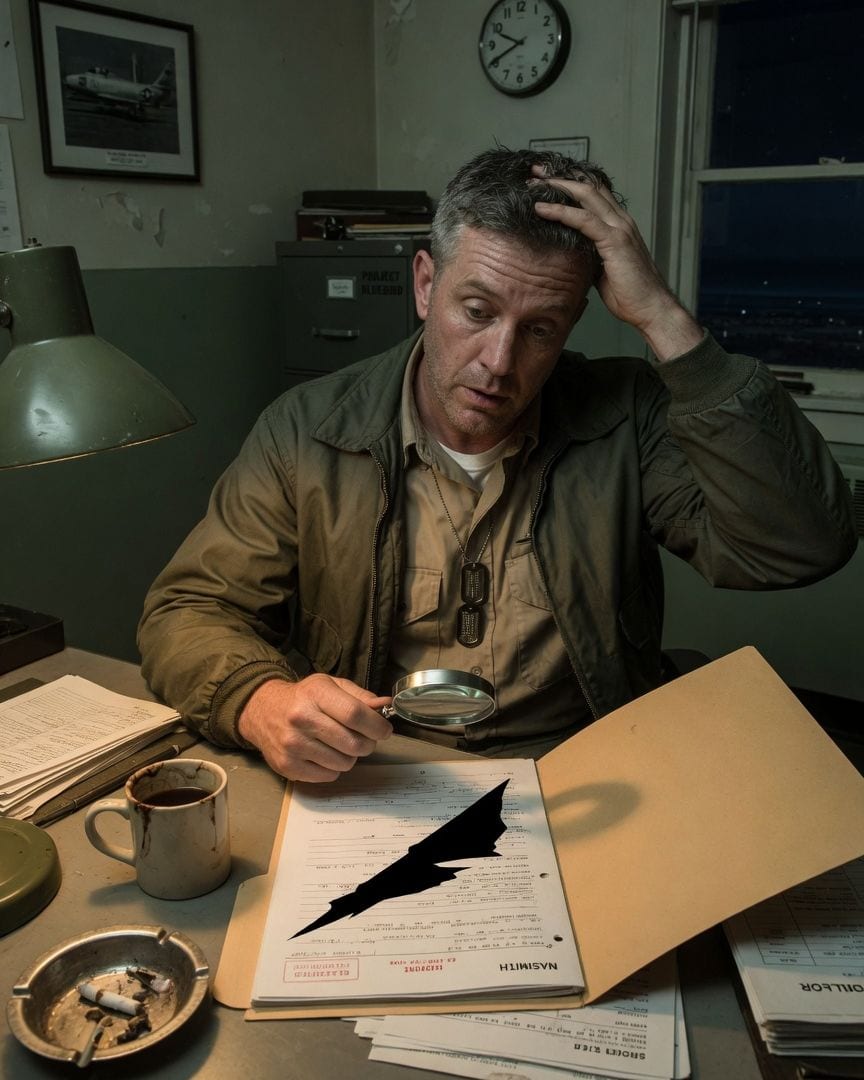
A Cold War pilot's classified file was missing a page, and its final redaction was a jagged, impossible shape with a phantom number beneath.
Colonel Ward Naismith, an F-86 Sabre pilot, found himself haunted by an impossible pursuit over Lake Michigan in 1953. His flight lead's chilling whisper—that the silent, house-sized mass they chased wasn't fleeing but waiting—burrowed deep into his mind. Weeks later, reviewing the incident's classified file, Naismith discovered it was missing a page. But the true dread came from the final page: a block of blacked-out text, not a simple rectangle, but a jagged, geometric shape that felt unnaturally smooth, hiding a faint, ghosted control number beneath its surface.
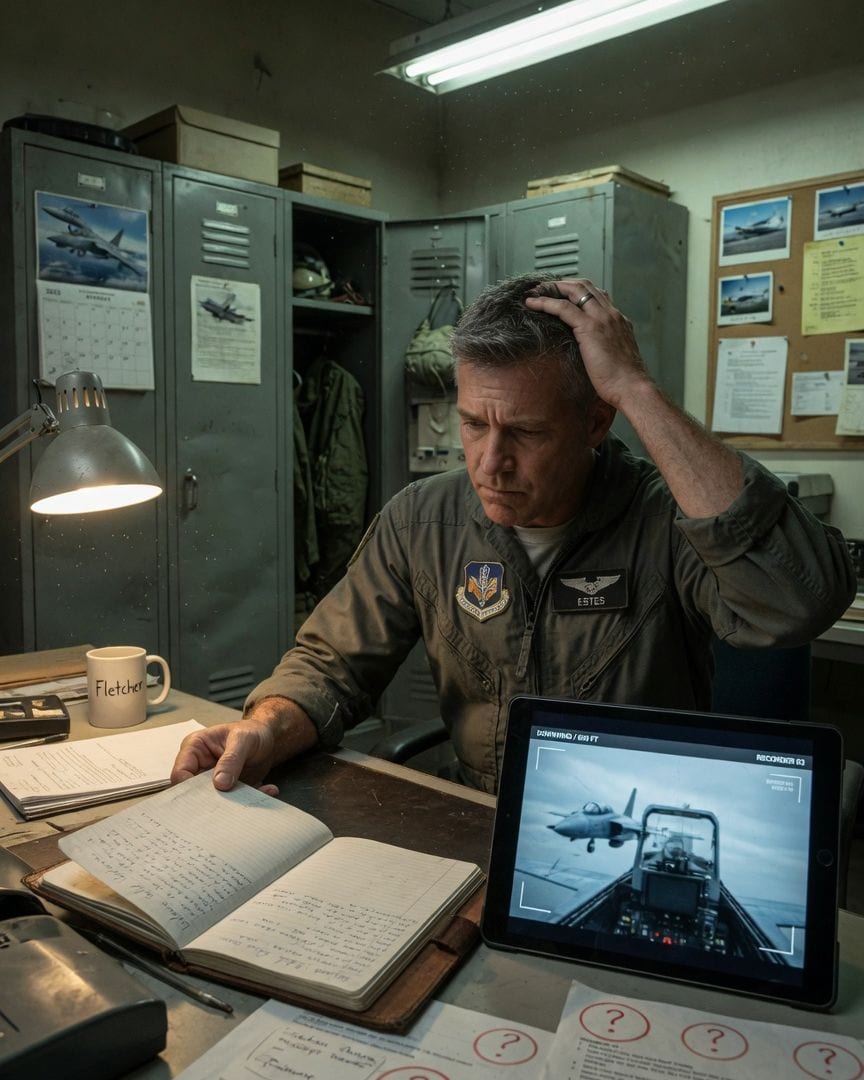
A Chief Warrant Officer's HUD tape shows a phantom jet, impossibly close, off his wing. Forty years ago, another Cold War pilot logged the same impossible sight.
Chief Warrant Officer Nathaniel Estes, a pilot whose career hinged on absolute precision, was under evaluation for a critical promotion. His nightly review of HUD tapes from routine Mojave test flights was a meticulous habit, but for a week, it revealed an impossible detail. At precisely 800 feet, one frame showed a sleek, experimental jet tucked impossibly close off his left wing—a craft ground radar never detected. When his maintenance chief found no equipment fault, Estes unearthed a dusty, decades-old logbook detailing identical phantom sightings from 1978. What unseen presence shadowed the desert skies?
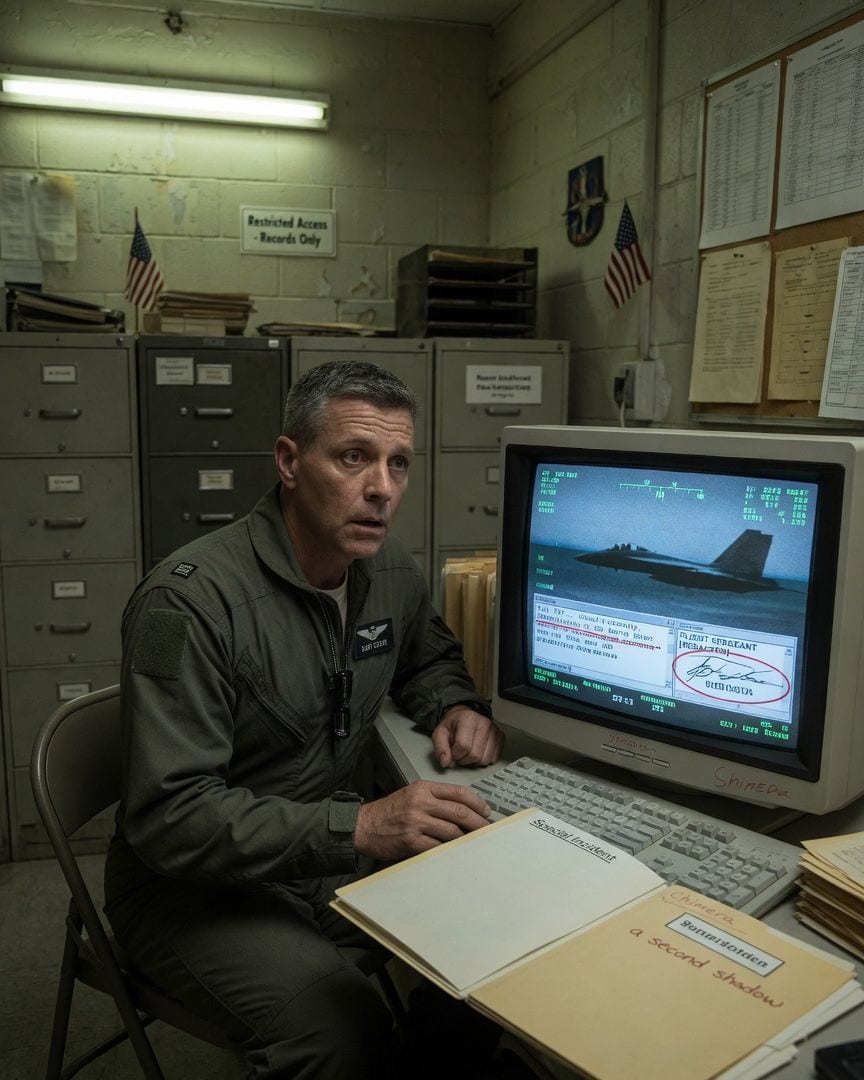
A Chief Warrant Officer's HUD showed a second aircraft watching his plane. He later found a log for *his* tail number reporting the same anomaly weeks ago, but he was grounded for medical leave.
Chief Warrant Officer Gary Estes, a man whose career was built on precision, found his impending Pentagon transfer shadowed by a baffling anomaly. On every flight, at exactly 800 feet, his aircraft's display would briefly show a sleek, dark second plane tucked off his right wing, its canopy subtly angled toward his, watching him. Ground radar never saw it, and his wingmen swore they flew alone. Desperate to maintain his clean record, Estes dug into maintenance logs and uncovered an entry for *his* tail number from weeks prior. It described the exact same 'visual anomaly' during a flight he knew, with chilling certainty, he had never flown.
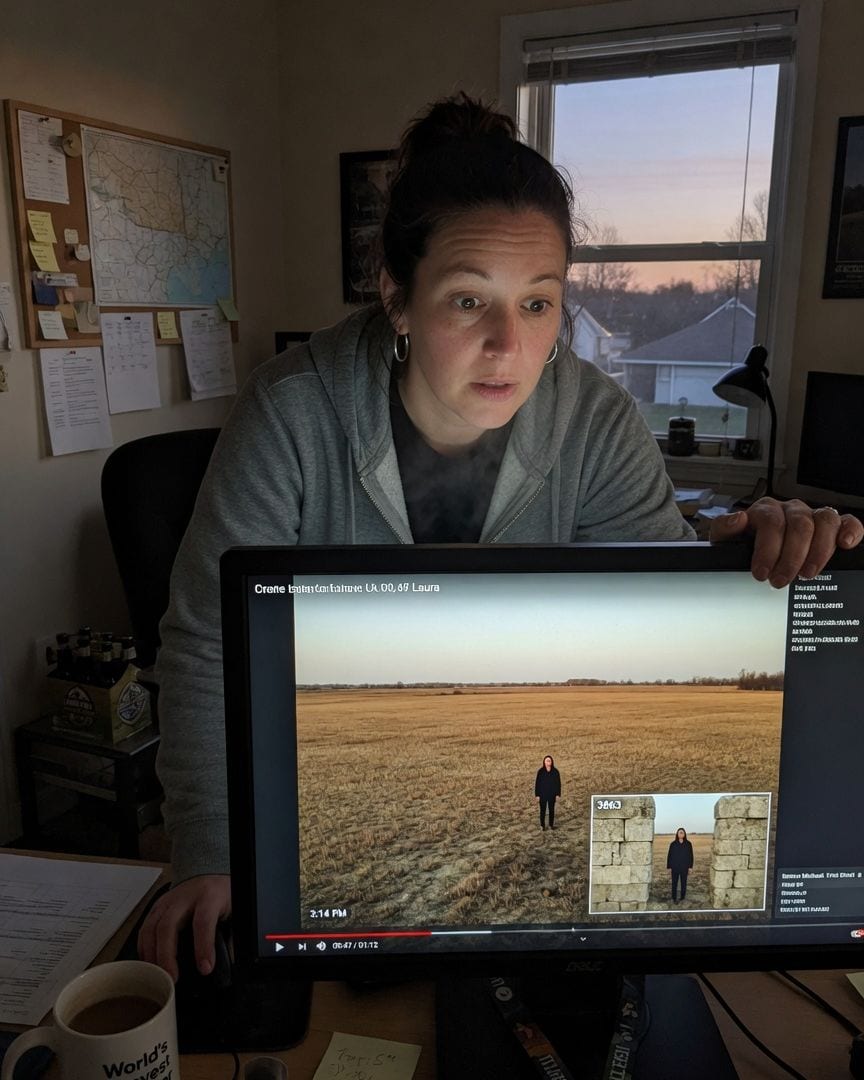
My drone's return footage shows a man standing in the empty field looking up. I was alone out there, the field clear when it launched.
My routine drone survey of a vast, empty field was just another job, miles from any paved road. But the footage revealed a silent man standing alone in the field's center, gazing up at my ascending drone. As my friend and I analyzed the frames, we found a weathered stone structure that briefly appeared around him, then vanished.
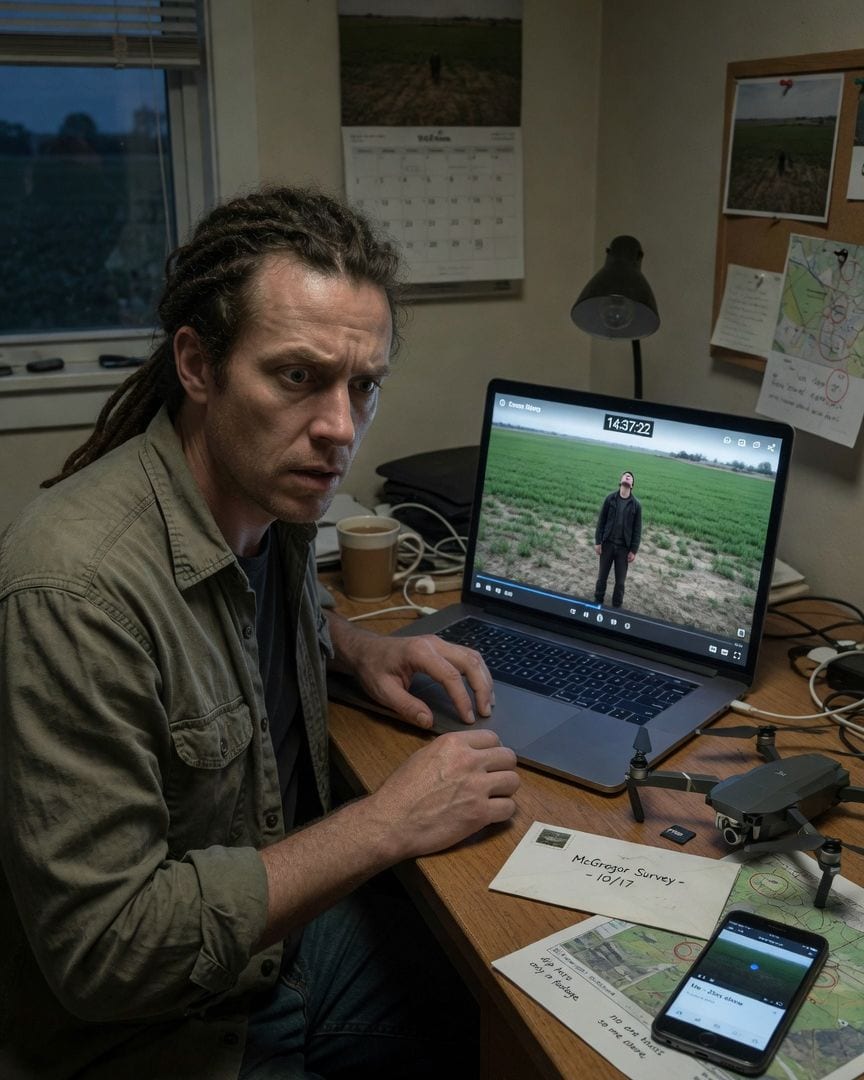
My drone's return footage shows a man standing alone in the field, looking up. The field was empty when I flew out, and I was alone.
I sent my drone for a routine agricultural survey, mapping crop health across a farmer's property. But reviewing the footage, a man materialized, standing perfectly still in the middle of a field I knew was completely empty. He was looking straight up at my drone, a solid figure where no one should have been.