A Cold War pilot's classified file was missing a page, and its final redaction was a jagged, impossible shape with a phantom number beneath.
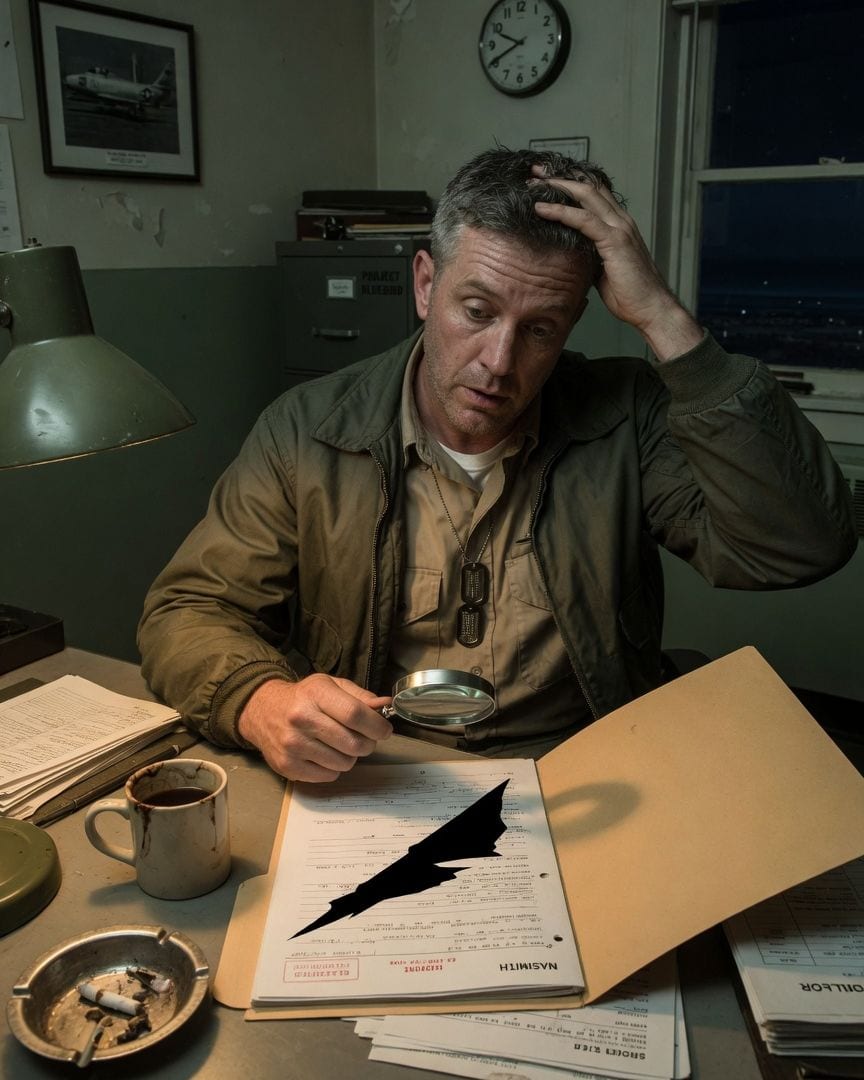
Colonel Ward Naismith sat in the debriefing room, the stale coffee doing little to cut through the knot in his stomach. The flight had been forty minutes of pure, impossible pursuit over Lake Michigan in 1953.
His F-86 Sabre had pushed its limits, chasing something that defied physics. He'd seen it, a dark, silent mass, the size of a small house, pass a mere hundred feet under his wing.
No heat signature, no exhaust, just cold metal against the sky. He’d filed his report, every detail precise, every observation logged. But it wasn't the impossible speed, or the sudden stops that truly unsettled him.
It was what Raymond Walsh, his flight lead, had said quietly after the debrief, his voice barely a whisper. 'When it stopped,' Walsh had murmured, staring at his untouched coffee, 'it was waiting for us.
Like a man stops on a road to let you catch up.' That phrase had burrowed into Naismith's mind, a quiet, chilling certainty that made the lake’s vastness outside the window feel like a hungry mouth.
Weeks blurred into months. Naismith flew other patrols, trained new recruits, but the image of that silent, waiting mass never truly left him. He requested the official file on the incident, standard procedure for any classified encounter.
When it arrived, a slim, unassuming manila folder, Naismith settled into his office, expecting a rehash of his own meticulous report. He flipped through the carbon copies: his flight plan, Walsh's confirmation, the radar logs.
Everything seemed to align, until he reached the final few pages. The cover sheet listed seven pages, but the folder only contained six. A minor clerical error, he told himself, but his pilot's instinct for precision flared.
He checked the control numbers, cross-referencing them against the index. They were sequential, correct. Then he saw it on page six, the final page: a block of text, blacked out with an official-looking stamp. But it wasn't a neat rectangle.
The redaction was a jagged, almost geometric shape, like a shard of obsidian, too precise to be hand-drawn, too complex to be a simple oversight.
It was an impossibility, a deliberate, unnatural void on the page, and it stood out like a wound.
Naismith pulled out his magnifying glass, a tool he used for inspecting instrument panels. He examined the edges of the blacked-out shape. They were crisp, almost too perfect, as if cut by a template.
He ran his finger over the paper, expecting a raised ink-line, but it felt smooth, as if the shape itself was part of the paper, not superimposed.
He looked closer at the control number stamped at the bottom of the page.
It was consistent with the others, but then he noticed a faint, almost imperceptible ghosting beneath the black ink of the redaction itself, a barely visible trace of another control number, different from the one printed at the bottom, one that seemed to lead to nothing.
The file wasn't just missing a page; it felt like a palimpsest, a record written over another, and the impossible shape was a window into something far more deliberate than a simple error.
The ghosted control number became Naismith’s obsession. Using his clearance, he began cross-referencing it with other classified incident reports from the base archives. He found nothing for weeks, the number leading to dead ends.
Then, by sheer persistence, he found a report from a different airbase, a decade earlier, concerning a missing supply plane. The control number was a near match, one digit off, but the file was heavily redacted. He requested more.
His inquiries led him to Rosemary Barlow, a meticulous archivist in her late fifties, whose office was a maze of steel cabinets and the faint, sweet smell of aging paper.
She initially regarded his detailed requests with a professional, almost bored, courtesy. Naismith showed her the odd redaction shape from his own file. 'Clerical anomaly,' she’d said, her voice flat, without even looking closely. 'Different censors, different standards.'
But Naismith pressed, showing her a printout from the supply plane file. There, amidst the black lines, was the same impossible, jagged shape. Rosemary’s composure faltered for a fraction of a second.
She took the printout, her fingers tracing the outline. 'Unusual,' she conceded, her eyes darting to a shelf of unmarked folders. 'But not unprecedented. Files from that era… sometimes they were less… uniform.' Naismith knew she was lying.
The shape was too precise, too identical. It was a signature.
Naismith’s relentless digging started to draw attention. His access to certain sections of the archives was suddenly restricted, citing 'ongoing review.' He found a folder he’d left on his desk subtly askew, a detail only he would notice.
One afternoon, General Bernard Hughes, a man known for his calm, almost placid demeanor, stopped Naismith in the mess hall. 'Colonel Naismith,' Hughes said, his voice low, 'I hear you’ve developed a keen interest in historical anomalies.'
Naismith felt a chill. 'Just following up on a few loose ends, General.' Hughes smiled, a thin, humorless line. 'Some ends are best left tied, Colonel. The past has a way of staying buried for a reason.
Don't go digging for things that don't want to be found.' The warning was clear, delivered with the quiet authority of someone who knew exactly what Naismith was looking for. Back in the archives, Rosemary Barlow was now visibly nervous.
She avoided his gaze, her hands trembling slightly as she filed documents. 'You should stop, Colonel,' she whispered one day, pressing a fresh file into his hands. It was a standard transfer order. 'For your own good.
Some files… they don't just record things. They absorb them.'
Naismith cornered Rosemary Barlow in a quiet corner of the archives, the transfer order still in his hand. 'What did you mean, 'absorb them'?' he demanded. Rosemary wrung her hands. 'They're not just redacted, Colonel.
Some of these files… they're like templates. Pre-formatted. Waiting.' Naismith felt a cold wave wash over him. 'Waiting for what?' Rosemary glanced around, then pulled a slim, unmarked folder from a locked drawer, handing it to him.
'This is a 'Type C' incident template. For… anomalous aerial encounters.' Naismith opened it.
It was mostly blank, but certain fields were pre-printed: 'DATE OF ENCOUNTER:', 'PRIMARY WITNESS ID:', 'OBSERVATION:', and a large, blacked-out shape that was undeniably the same impossible geometric form he’d seen in his own report, and in the missing plane file.
'The redaction… it’s a placeholder?' Naismith asked, his voice barely a whisper. Rosemary nodded, her eyes wide. 'It’s a signature, Colonel. Of the… thing that gets filed. Or that does the filing. These aren't just records of events.
They’re the system itself. They’re designed to create coherence, to make it all fit, even when it shouldn’t. The missing pages, the ghosted numbers… they're not mistakes. They're part of the process.
They make the original event disappear into bureaucracy, make it unprovable, but perfectly recorded. They make it official.'
Naismith stared at the 'Type C' template, the implications chilling him to the bone. This wasn't just a cover-up; it was an active mechanism. He thought of Walsh’s words: 'It was waiting for us.'
He looked at the pre-printed 'PRIMARY WITNESS ID' field. He knew his own service number by heart. He pulled out a small notepad and pencil, his hand trembling slightly.
He wrote his service number onto the blank line of the template. Then, he looked at the 'DATE OF ENCOUNTER' field. He wrote '1953'.
He stared at the two numbers, his service ID and the year of his incident, sitting starkly on the template. His eyes drifted to the control number at the bottom of the template page. He recognized the sequence.
He had seen it before, not in another generic template, but in the ghosted trace beneath the redaction in his own intercept report. His blood ran cold.
The file he had been chasing, the system he had been unraveling, wasn't just a record of others. It was a record for him. He was not just investigating the filed; he was already part of the filing.
The full, horrifying coherence of it slammed into Naismith. The 'saucer' was no alien craft. It was the 'mechanism,' the 'thing' that performed the filing. It identified, it engaged, it waited.
His intercept, his pursuit, his near-overshoot – it had been a deliberate interaction, a test, an invitation. The institution didn't just cover up anomalous events; it engineered them to select and absorb individuals.
The files weren't just documentation; they were the tools, the pre-written narratives into which these lives were slotted.
The impossible geometric redaction was the signature of this mechanism, a symbol of the void it created and then filled with its own 'official' truth.
Naismith realized his relentless investigation had not exposed the system, but rather completed his own entry within it. By trying to prove the wrongness, he had inadvertently provided the details needed to finalize his own 'filing.'
He was not a witness to an anomaly; he was an active participant in his own disappearance, his own transformation into paperwork.
The dread wasn’t about what was out there, but what was already in the files, waiting for him to fill in the blanks.
Naismith gathered every shred of evidence: his own redacted report, the 'Type C' template with his service number, the cross-referenced control numbers linking to other 'filed' incidents, and printouts of the impossible redaction shape from a dozen different decades.
He intended to take it all to a trusted contact in Washington, a senator he knew from his academy days. He packed a small briefcase, his hands steady despite the frantic beat of his heart.
He almost made it out of the base. As he approached the main gate, a staff car pulled up alongside him. General Hughes was in the passenger seat, calm as ever.
'Colonel Naismith,' he said, a faint smile playing on his lips, 'I believe you have something of ours.' Naismith gripped the briefcase tighter. 'I have the truth, General.' Hughes chuckled softly. 'The truth? No, Colonel.
You have merely completed your paperwork. Your file, you see, was always open. Your incident in '53? That was merely the preliminary entry. Your subsequent inquiries, your relentless pursuit of 'coherence' – all of it has been meticulously recorded.
You have, shall we say, provided the necessary addendums. You have proven yourself to be exceptionally thorough. We appreciate thoroughness.' Hughes gestured to the back seat, where two impeccably dressed men sat, utterly silent. 'Your file is now complete, Colonel.
All the loose ends are tied. You will find it is quite a comprehensive record.' The dread was not in a threat, but in the utter, unblinking calm of Hughes, who simply understood and accepted the horror as bureaucratic necessity.
Colonel Ward Naismith's service record was updated a week later. It showed a quiet, honorable discharge, followed by a transfer to an undisclosed, 'highly sensitive' research assignment, then a subsequent, early retirement.
Rosemary Barlow was reassigned to a remote records facility in Nevada, her old office swiftly cleared out and sealed. The files Naismith had been examining were all accounted for, their control numbers perfectly sequential, their redactions flawless.
No questions were asked. The system had simply absorbed the anomaly, and then the investigator himself, leaving behind only the paper trail. The machine continued, unseen, unbothered.
Decades passed. The base where Naismith served was eventually decommissioned. In 2007, a new archivist, reviewing declassified documents from the era, came across a file marked 'NAISMITH, W. – INCIDENT 1953'.
The cover sheet was pristine, the page count exactly matched, and the contents were a perfectly coherent, if bland, account of a pilot's routine flight and subsequent administrative transfer.
But on the last page, where a standard security stamp should have been, was a single, precisely rendered redaction. It was the impossible geometric shape, stark and black against the faded paper.
The archivist tilted the file, and for a moment, in the shifting light, the black shape seemed to subtly deepen, as if it contained a vast, silent space within it. The file felt cold to the touch.
It was still being signed.
If this one got to you
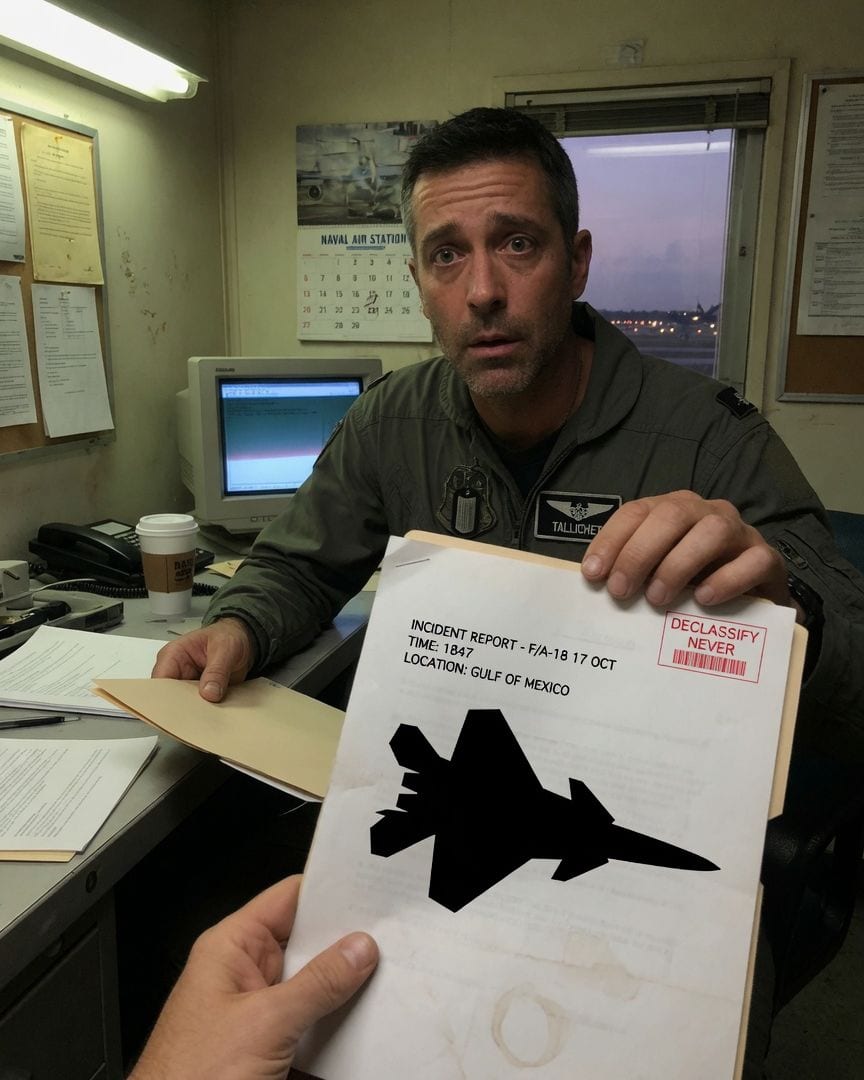
A pilot's classified flight report had a precise, angular blackout. The digital file said 'Page 1 of 12,' but only six pages existed.
Captain Yves Tallichet landed his jet, his hands shaking from an impossible encounter in the sky. He'd seen a dark, seamless shape mirror his F/A-18, defying all known physics. Days later, seeking answers in his official flight report, he found a precise, angular blackout over his observations. A senior records clerk confirmed the redaction was permanent, flagged "DECLASSIFY NEVER." But the true dread came when the digital file showed "Page 1 of 12," yet his physical copy held only six. What happened to the other pages?
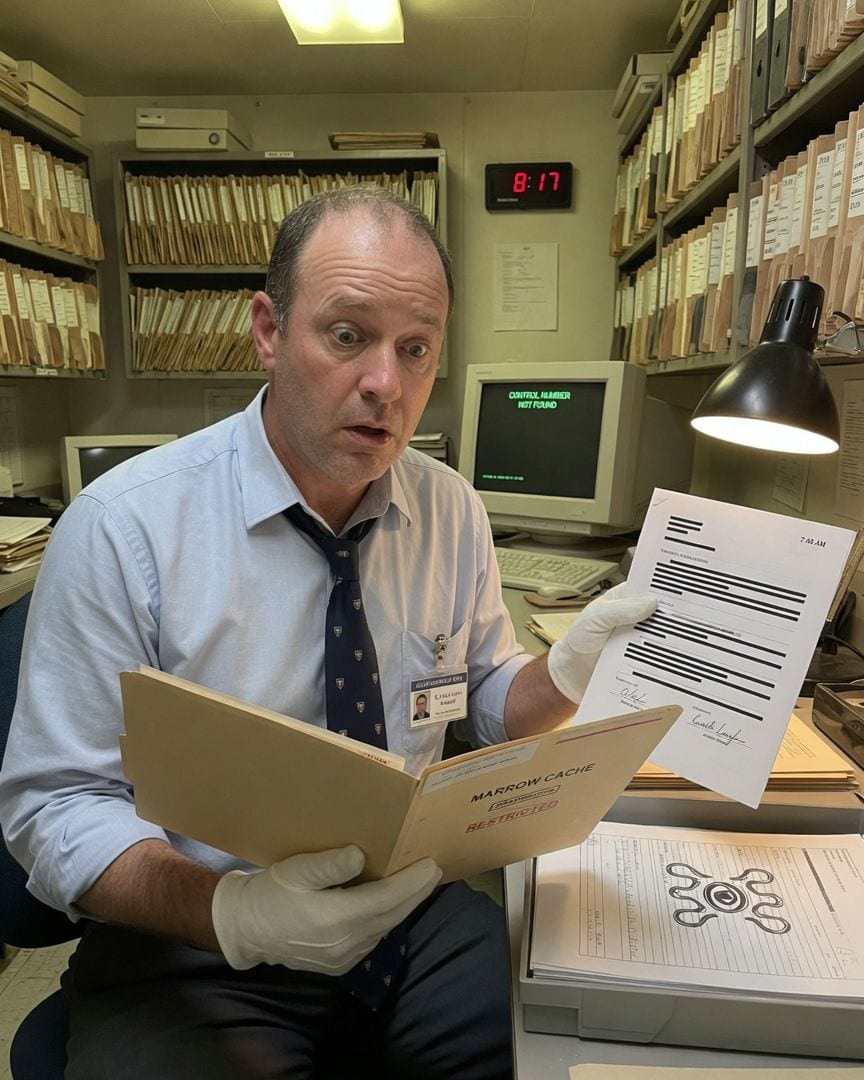
A records manager found a file extension signed at 7:48 AM. He hadn't clocked in yet, and a strange symbol pulsed in its redacted pages.
Corwin Vale, lead records manager for Fort Ruthven, lived by routine, his world precise and ordered. This morning, however, that order shattered when he found the Marrow Cache file's extension signed at 7:48 AM. Corwin had not clocked in until 8:00 AM, and the vault logs showed no other entry. As he reviewed the heavy file, he discovered its control number did not exist in any database. Then, deep within the redacted pages, a strange, geometric symbol pulsed faintly, an alien glyph etched into the classified paper. What impossible secret did the file hold?
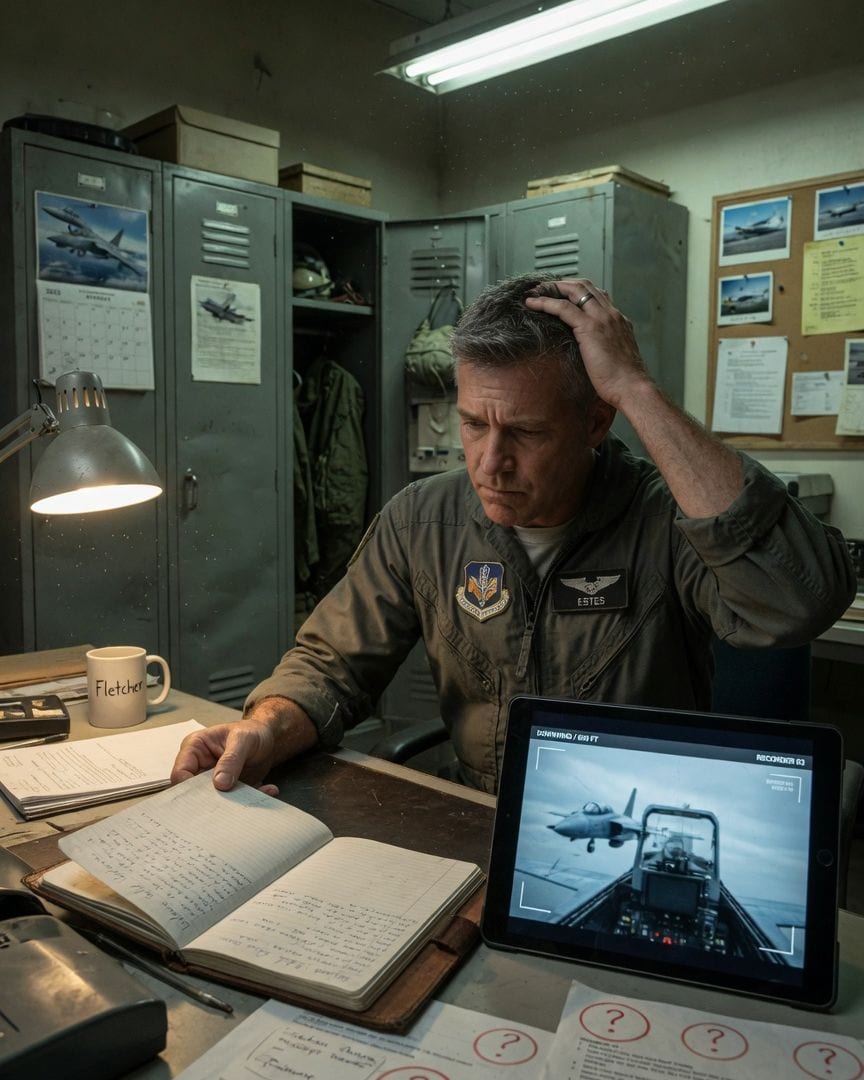
A Chief Warrant Officer's HUD tape shows a phantom jet, impossibly close, off his wing. Forty years ago, another Cold War pilot logged the same impossible sight.
Chief Warrant Officer Nathaniel Estes, a pilot whose career hinged on absolute precision, was under evaluation for a critical promotion. His nightly review of HUD tapes from routine Mojave test flights was a meticulous habit, but for a week, it revealed an impossible detail. At precisely 800 feet, one frame showed a sleek, experimental jet tucked impossibly close off his left wing—a craft ground radar never detected. When his maintenance chief found no equipment fault, Estes unearthed a dusty, decades-old logbook detailing identical phantom sightings from 1978. What unseen presence shadowed the desert skies?
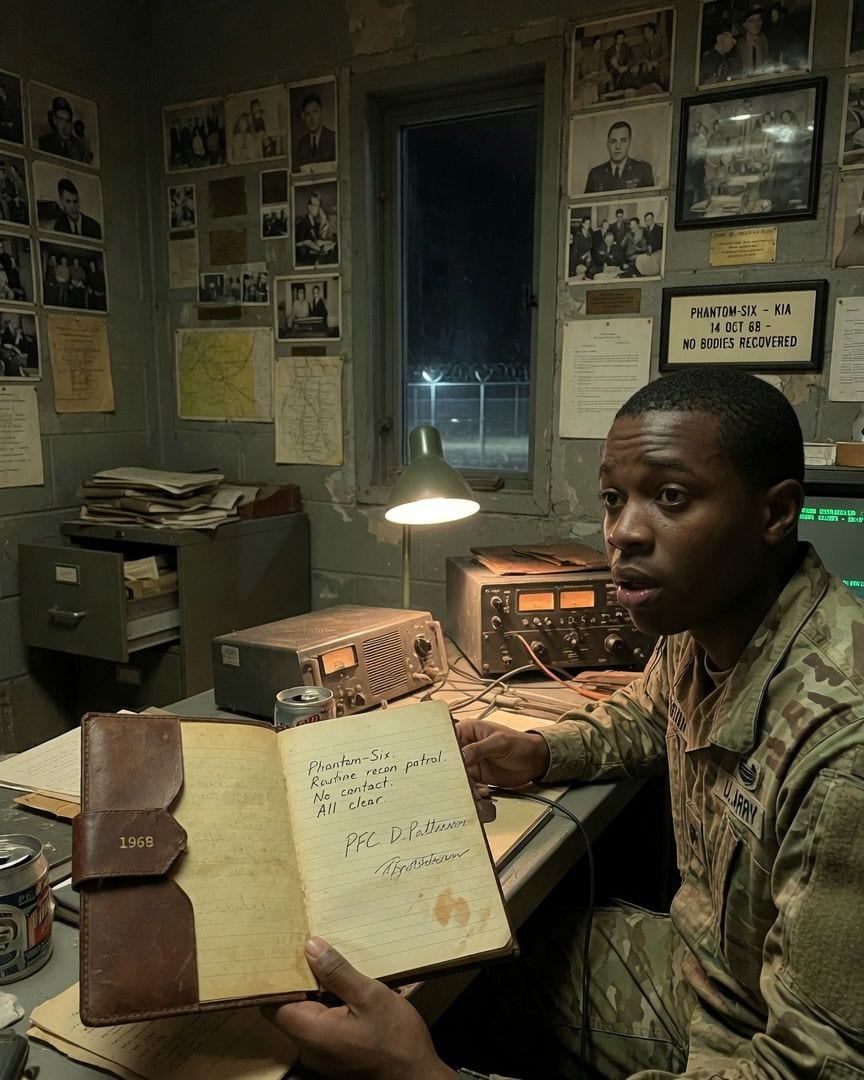
A DMZ specialist finds a 1968 Cold War logbook entry, signed by a lost soldier, its ink shimmering faintly.
Specialist James Farr, on a long night shift at a desolate Korean DMZ outpost, meticulously monitored his console, a squared-away soldier accustomed to the quiet hum of equipment. His focus shattered when a faint, static-laced whisper ghosted from a dead channel, calling out 'Phantom-Six' — a unit lost near this wire in 1968. The urgent voice then specifically mentioned his tower window light, asking him to turn it off before it drew fire. Later, an old logbook from 1968 revealed an entry dated three days *after* Phantom-Six was officially lost, signed by one of the vanished soldiers, its ink subtly shimmering with an unnatural gleam.
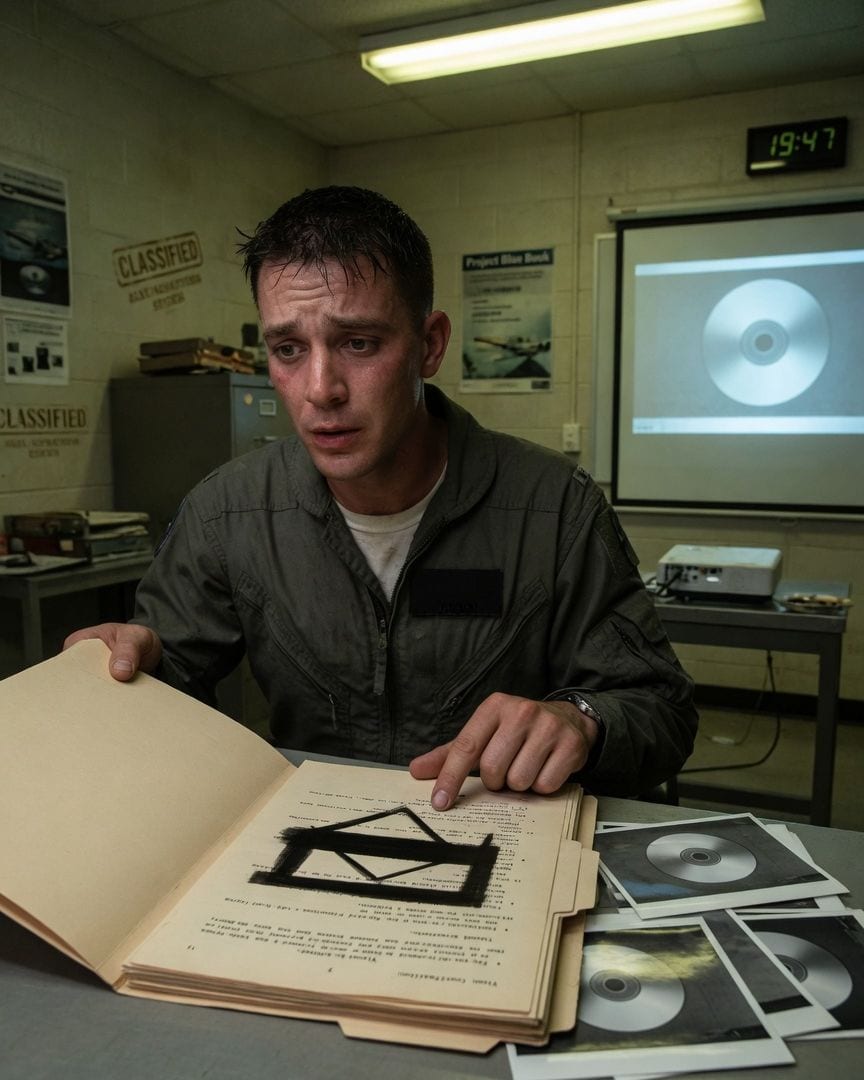
Returning to his newborn daughter, a Cold War pilot found a perfect diamond shape hidden within his classified report's redactions.
Captain Merle Vachon had one last intercept before he could return home to his newborn daughter Nora. High over the Nevada ranges in his F-86 Sabre, he encountered a disc that moved with impossible, silent displacement, defying all known physics. Days later, the official gun camera film showed the object impossibly close, directly contradicting Vachon’s own telemetry and eyewitness account. But the true chilling detail emerged when he found a perfect diamond shape outlined by redacted black ink within his classified incident report.
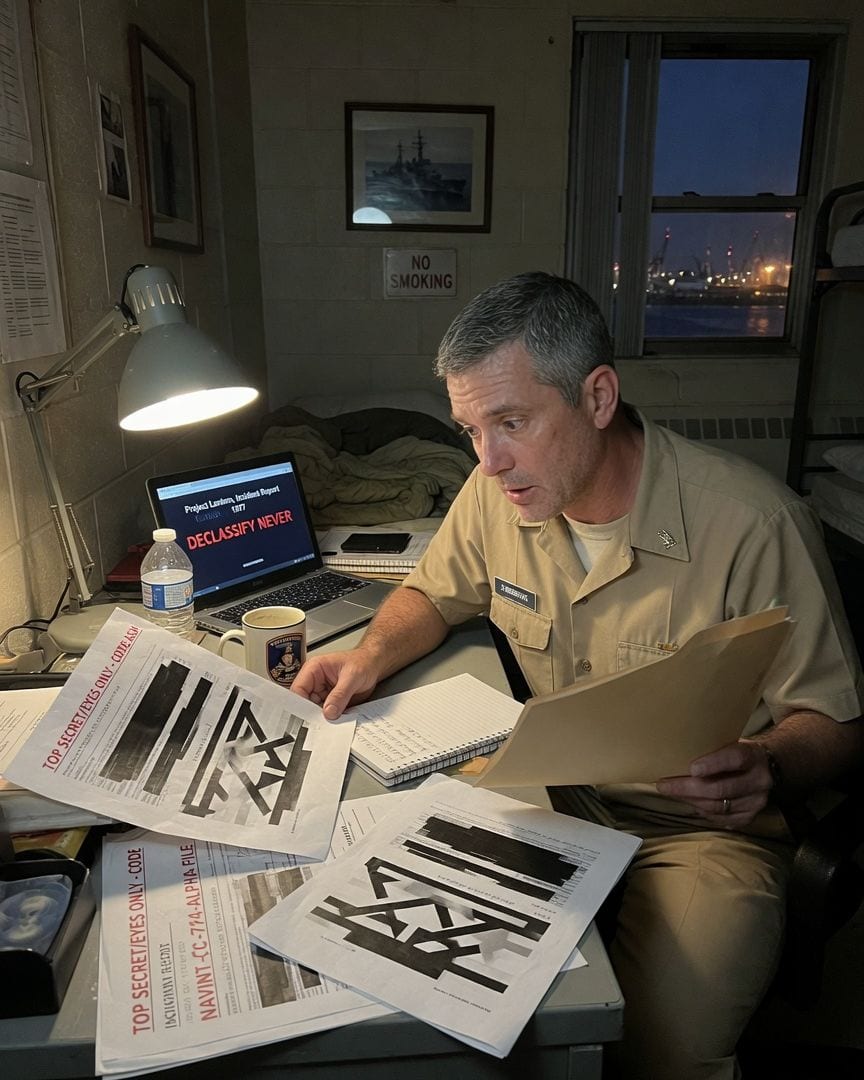
On the USS Farragut, Lieutenant Commander Roy Ashgrove logged a zero-altitude contact. His report was stamped 'TOP SECRET,' and a directive for it read: 'DECLASSIFY NEVER.' He found an old Cold War file with an identical, geometric redaction.
Four days from ending his Gulf deployment, Lieutenant Commander Roy Ashgrove longed for home leave. On the bridge of the USS Farragut, his surface search radar painted a contact a mile off the port beam, but its altitude readout was impossibly zero. He ordered the searchlight on it, watching as the dark mass moved toward the beam, then stopped dead still on the moving water. Roy's incident report was swiftly stamped 'TOP SECRET,' and a follow-up directive carried a chilling downgrade schedule: 'DECLASSIFY NEVER.' His investigation soon unearthed an old Cold War file containing an identical, geometric redaction, hinting at a secret far deeper than a sensor glitch.