On the USS Farragut, Lieutenant Commander Roy Ashgrove logged a zero-altitude contact. His report was stamped 'TOP SECRET,' and a directive for it read: 'DECLASSIFY NEVER.' He found an old Cold War file with an identical, geometric redaction.
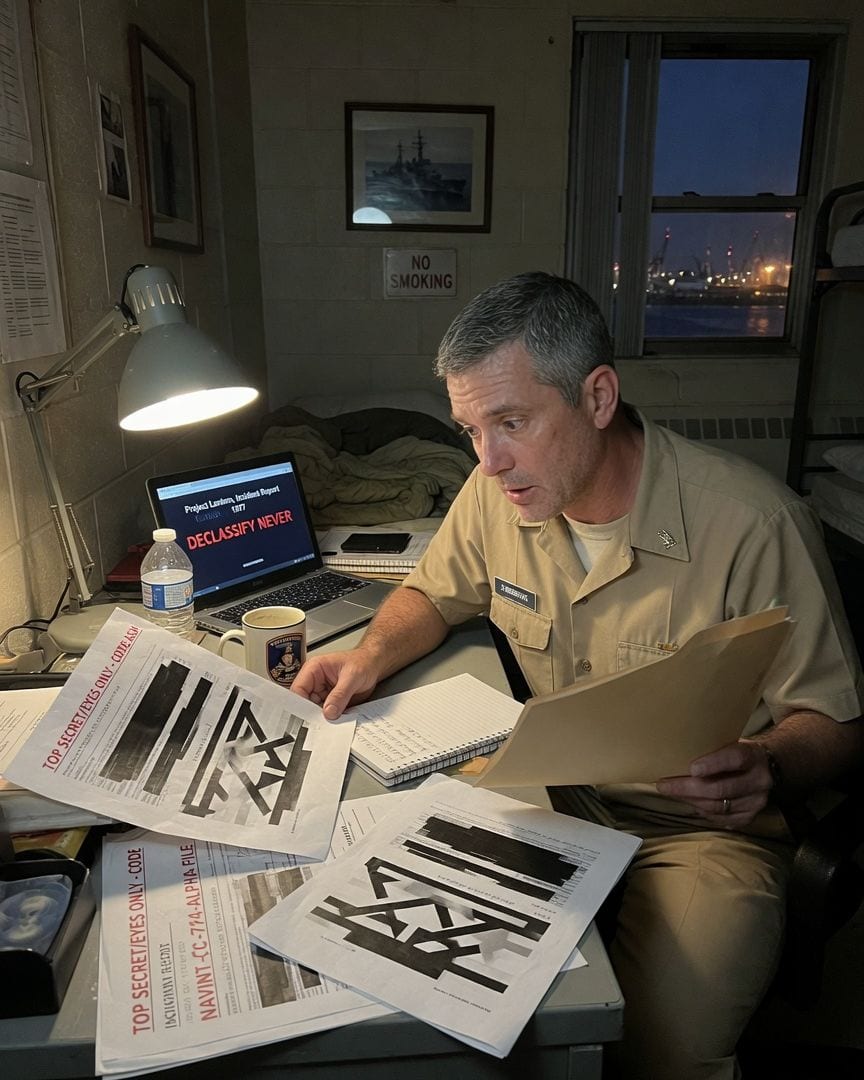
Lieutenant Commander Roy Ashgrove, 40, stood on the bridge of the USS Farragut, four days from the end of a Gulf deployment. He was tired, ready for home leave, when the surface search radar painted a contact.
It was a mile off the port beam, no problem there. But the altitude readout was zero. Not skimming the waves, not a low-flying bird, just... zero. Roy, methodical as always, ordered Ensign Lily Kowalski, 24, to verify the contact.
Her voice, usually steady, hitched. 'Still zero, sir. Solid paint.' The book said to identify contacts. Roy ordered the twelve-inch searchlight on it. The beam cut through the warm night, a bright spear.
The contact, a dark, indistinct mass against the distant horizon, moved. It came toward the light. It closed half the distance, then stopped. Dead still. Over water that was moving at three knots.
The bosun's mate, a burly man named Hughes, quietly crossed himself. Roy felt a cold prickle on his neck. He ordered the light off.
The sudden dark on the bridge was absolute, pierced only by the quiet hum of the ship and the collective, ragged breathing of his crew.
The thing out there did nothing at all, waiting to see if the light would come back on.
Back at his desk, Roy meticulously drafted his incident report. He stuck to the facts, the radar signatures, the visual observation, omitting only the bosun's mate’s superstitious gesture.
He expected it to be filed away, perhaps dismissed as a sensor glitch or an atmospheric anomaly. Instead, within twenty-four hours, the report returned stamped 'TOP SECRET/EYES ONLY - CODE ASH.'
A few days later, a follow-up directive landed in his encrypted inbox.
It wasn't a request for clarification, but a demand for highly specific, almost extraneous data: precise atmospheric pressure readings at the moment of contact, the exact frequency variations of the ship's comms, even the ambient temperature of the bridge.
The directive carried an unusual control number, 'NAVINT-C-774-ALPHA-FILE,' and a downgrade schedule that simply read 'DECLASSIFY NEVER.' Roy, a man who lived by procedure, found this profoundly unsettling.
He traced the control number through the Navy's internal systems, expecting to find an originating office. Instead, the number resolved to a defunct records annex, officially closed since the late 1970s.
Digging deeper, he found a digitized, tangential report from that same annex, detailing an unrelated equipment malfunction. The report itself was largely innocuous, but a single, heavily redacted paragraph caught his eye. The black-out wasn't a simple rectangle over text.
It was a complex, almost geometric shape, like a diagram or a symbol had been obscured, the black ink flowing around what must have been a highly specific image, not just words.
The odd redaction gnawed at Roy. Back ashore and officially on leave, he used his clearance to access the Navy's older, declassified archives, specifically searching for anything linked to 'NAVINT-C-774-ALPHA.'
It was a long shot, but the control number felt like a breadcrumb. After hours of sifting through digital dust, he found it: a faded, digitized folder marked 'Project Lantern, Incident Report 1977.'
The cover sheet listed a dozen pages, but the digital file contained only three. Inside, the pages detailed a 'surface anomaly' in the Persian Gulf, a radar contact at 'zero altitude,' and a 'visual confirmation by searchlight.'
The uncanny parallels to his own incident sent a chill down his spine. Then he saw it: a heavy, geometric redaction, identical in shape to the one he’d glimpsed in the tangential report. It wasn't covering text.
It was covering a precise, repeating, unidentifiable shape, a dark silhouette repeated across the page.
Roy Ashgrove spent his 'leave' hunched over a borrowed terminal in a quiet academic library, his official access codes his only companions. He cross-referenced 'Project Lantern' with every 'NAVINT-C' control number he could find.
The pattern emerged, horrifying in its consistency.
Over the last fifty years, a dozen similar incidents were buried in the archives: radar contacts at impossible altitudes, visual confirmations of 'unidentified objects' that moved with unnatural precision, followed by reports of 'loss of contact' or, more chillingly, 'administrative transfer of personnel.'
Each file, without fail, contained the 'DECLASSIFY NEVER' tag and the distinct, geometric redactions. He traced the control numbers linked to these files to various defunct, disestablished, or simply non-existent offices, mostly under the umbrella of Naval Intelligence.
It was a web of deliberate obfuscation, designed not to hide what was happening, but to hide the fact that the Navy had a systematic way of processing it.
He compiled a timeline, a grim chronology of ships and personnel that had vanished into this bureaucratic maw. The records weren't just covering up events; they were cataloging a process.
The 'Redaction That Has a Shape' appeared again and again, like a sigil for something unspeakable, a constant across decades of impossible encounters.
The more he pulled, the more the thread tightened around a horrifying truth: these were not isolated incidents, but part of an ongoing, institutionalized response to something the world was never meant to know about, something that was still out there, still making contact, still being filed.
Roy's quiet digging didn't stay quiet for long. First, his access to certain deep-archive databases was revoked without explanation, flagged for 'excessive query volume.' He tried to reinstate it, but his requests were met with polite, unhelpful boilerplate.
Then, an anonymous, untraceable email landed in his personal inbox, its subject line blank. The body contained a single, chilling phrase: 'Some files are best left closed, Commander.' No sender, no digital footprint.
A few days later, while getting coffee at his regular diner, a former colleague, Captain Monica Rutherford, a woman known for her discreet connections, sat down beside him. Her voice was low, almost a whisper.
'Heard you've been asking questions, Roy. About some old classified stuff.' She paused, stirring her coffee. 'Good advice, keep your head down. Some things... are better left alone. For your career. For your family.'
Her eyes held a deep, troubled knowing. Roy felt a cold dread settle over him. He wasn't just investigating; he was being watched. His apartment, once a sanctuary, now felt exposed.
He started checking his locks twice, peering through the blinds before turning on lights. The feeling of being observed was constant, a pressure on the back of his neck, a phantom presence in his peripheral vision.
His phone seemed to drain battery faster, his laptop would occasionally 'glitch' and restart. He was no longer the hunter; he was the hunted, and the game had just begun.
Roy knew he needed to talk to someone who genuinely understood the depth of the deception.
He remembered James Holloway, 72, a retired Naval Intelligence officer he'd met years ago at a symposium, a man with an almost legendary memory for obscure classified operations.
Roy found Holloway living a quiet life in a coastal town in Maine. He drove there, unannounced, carrying his timeline and printouts of the redacted files. Holloway, a genial man with kind eyes, invited him in.
Roy laid out his evidence: the impossible radar contacts, the systematic classification, the defunct offices, the 'DECLASSIFY NEVER' tags, and especially, the repeating 'Redaction That Has a Shape.' Holloway listened patiently, his face unreadable.
'You've been thorough, Commander,' he finally said, pouring them both coffee. 'Most people would have given up at the first dead end.' Roy pressed him. 'What is it, Mr. Holloway? What are they filing?' Holloway sighed, a weary sound.
'It's not what, Commander. It's who. And how.' He explained that the 'secrecy machine' wasn't just hiding incidents; it was processing them. The 'things' were real, persistent, and not from Earth. They didn't invade or destroy. They simply... interacted.
And when they did, certain individuals, certain vessels, became 'subjects.' The 'Redaction That Has a Shape' was a placeholder, a symbol for something the human mind couldn't easily categorize, a signature of the entities themselves.
'They weren't lost, Commander,' Holloway said, his voice dropping to a near whisper. 'The vessels, the men... they were filed. Integrated. Re-purposed.
The Navy learned decades ago not to fight it, but to manage the paperwork, to contain the knowledge, to classify the truth out of existence.' Roy felt the blood drain from his face as the pieces snapped into place.
The impossible radar contacts, the systematic cover-ups, the strange data requests—it all coalesced into a terrifying, coherent whole. The dread was not in the unknown, but in the chillingly organized, patient bureaucracy of it all.
Holloway's words echoed in Roy's mind, a terrifying new lens through which to view his entire career. He returned to his research with a desperate urgency, now knowing what he was truly looking for: not just incidents, but names.
He focused on the 'Project Lantern' file, the one from forty-seven years ago, with its distinctive geometric redactions. He knew there had to be more, another layer.
He leveraged every contact, every back channel, every favor he'd ever earned, pushing for access to any 'Lantern'-related meta-documents, any cross-referenced personnel files. After weeks of relentless effort, a secure digital package arrived, encrypted, untraceable.
Inside, he found a second copy of the Project Lantern incident report. This version, retrieved from a different, even more obscure archive, was also heavily redacted, but the black-out patterns were subtly different.
Where the first copy had been a solid block, this one had a faint, almost transparent section. Roy zoomed in, his heart pounding. And there it was, beneath a shifted redaction, faded but unmistakable: a handwritten service number.
He recognized the format immediately. It was his own. Below it, in the same careful script, a single line: 'Ashgrove, R. - Subject.' Not a witness, not an investigator. Subject.
His own name, implicated in an incident almost fifty years before he was born.
He looked up at the darkened window of his office, the glow of the screen reflecting in his eyes, suddenly feeling the weight of the years, and the file, on his own skin.
Roy drove back to Holloway's house, the second file clutched in his hand like a burning coal. He burst in, foregoing pleasantries, and thrust the document at the retired officer. 'My name,' Roy rasped, pointing to the faded script.
'My service number. In a file from 1977. What does this mean, James? Am I part of it?' Holloway took the file, his expression unperturbed. He nodded slowly. 'It means you were always part of it, Roy.
Your 'encounter' in the Gulf wasn't random. It was a re-activation. A recall.' He explained that the entities, whatever they were, operated on a scale of time and consciousness humans couldn't grasp. They didn't just appear; they selected.
And sometimes, those selections recurred across generations, across bloodlines, across echoes in the fabric of existence. 'The file,' Holloway said, tapping the document, 'isn't just a record of what happened.
It's a living ledger of who they've interacted with, who they've... brought into their system. And you, Commander, are one of them. Your incident was the re-signing of an old entry.
The file is still being written, because your story, your 'filing,' is now current.'
Roy staggered back, the room spinning. 'A recall? What do you mean, a recall? What happens now?' Holloway rose, his calm demeanor utterly chilling. 'You're not dead, Roy. Not in the way you understand it. You've simply been... integrated.
Your purpose has shifted. The file is complete for this stage.' He gestured vaguely. 'The thing that answered your searchlight, that waited in the dark? It wasn't curious. It was checking. Confirming. You answered its call.'
Roy felt a surge of desperate defiance. 'No. I won't accept this. There has to be a way out. A way to fight it.' Holloway shook his head, a faint, sad smile touching his lips. 'Fight what, Roy?
A process that's older than nations, older than records? They don't want to hurt you. They want to... utilize you. Like a piece of data. Or a cog in a machine you can't even perceive.'
Roy's mind raced, searching for an escape, a loophole, anything. He was a commander, a man of action, of logic.
But Holloway’s calm certainty, the way he spoke of it all as a matter of fact, was more terrifying than any monster. The horror wasn't in a threat of violence, but in the casual, absolute inevitability. He was already filed.
He looked at Holloway, seeing not a mentor, but an usher, a functionary of the very system that had claimed him. He saw the same calm acceptance in Holloway's eyes, a quiet understanding that transcended fear.
He realized that Holloway wasn't just a keeper of secrets; he was another filed subject, perhaps long ago. Roy was trapped, not by bars or walls, but by a truth so vast and coherent that resistance was meaningless.
He was simply another entry in a cosmic ledger, his life now a line item in an ongoing, unspeakable process.
Lieutenant Commander Roy Ashgrove was honorably discharged from the US Navy a month later, citing 'stress-related leave' and 'early retirement for meritorious service.' His records were pristine, his service history impeccable. No scandal, no whispers of insubordination.
He simply vanished from the active roster. He moved to a small, isolated cabin in the Pacific Northwest, far from the ocean, far from radar screens. The world carried on, oblivious to the quiet bureaucratic shift in his status.
His old shipmates occasionally called, wondering why he'd left so suddenly, but his answers were vague, noncommittal. His life was empty, hollowed out by the truth, but outwardly, it was a perfectly normal, if solitary, existence.
The file was closed, his name moved to another section, another ledger, but the process continued.
Roy tried to build a new life, but the patterns haunted him. He saw the geometric redactions in the shadows of the trees, heard faint, impossible signals in the static of the radio.
He felt a constant, subtle presence, a quiet observation that never lifted. He was always waiting for the next 'recall.' One morning, weeks after moving, he found an unmarked, heavy-stock envelope in his mailbox.
It was addressed to him, in a precise, almost clinical font. No return address. Inside, he found a single, blank sheet of pristine, heavy paper. At the bottom, printed in the same clinical font, was a unique, official-looking control number.
It was a number that matched the pattern of the 'Redaction That Has a Shape' he had meticulously documented, a sequence he now knew intimately.
Roy never received another message after that morning. His life in the cabin continued, quiet and outwardly unremarkable, but the truth remained a constant hum beneath the surface, a quiet awareness of his new, unwritten purpose.
The empty envelope held no message, only the pristine, official control number: his own.
If this one got to you
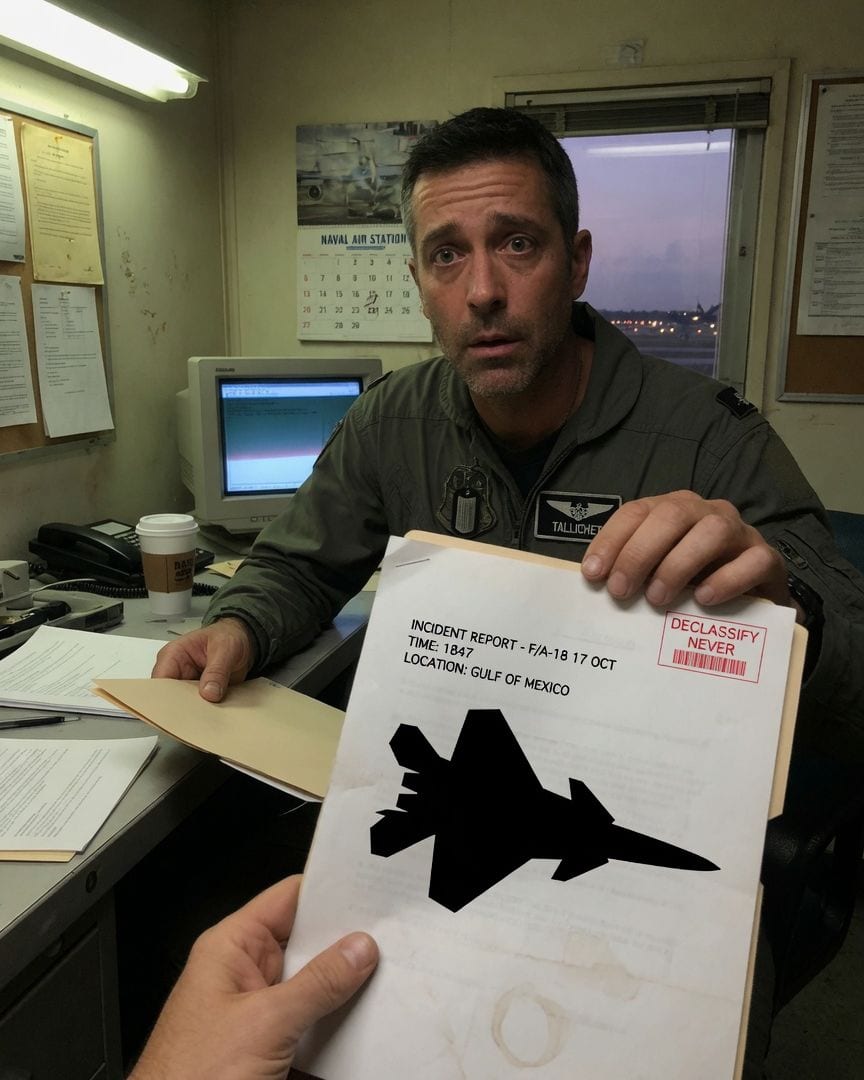
A pilot's classified flight report had a precise, angular blackout. The digital file said 'Page 1 of 12,' but only six pages existed.
Captain Yves Tallichet landed his jet, his hands shaking from an impossible encounter in the sky. He'd seen a dark, seamless shape mirror his F/A-18, defying all known physics. Days later, seeking answers in his official flight report, he found a precise, angular blackout over his observations. A senior records clerk confirmed the redaction was permanent, flagged "DECLASSIFY NEVER." But the true dread came when the digital file showed "Page 1 of 12," yet his physical copy held only six. What happened to the other pages?
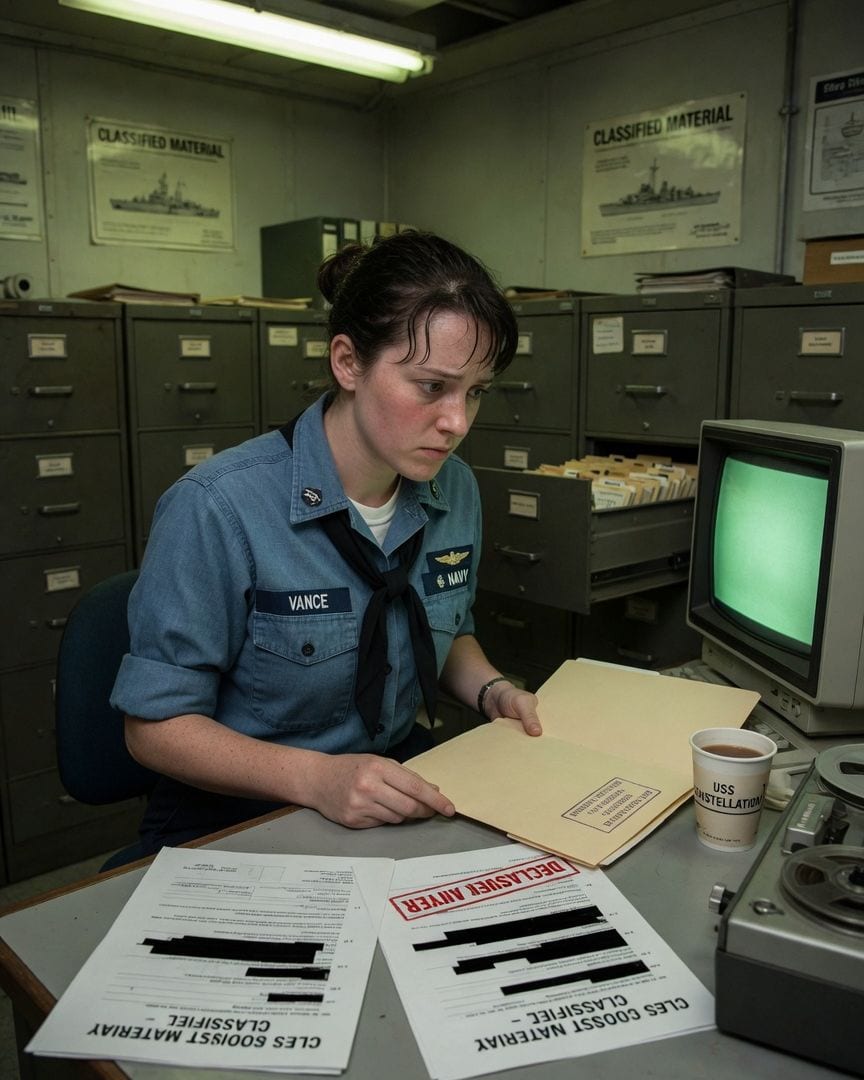
A radarman tracked an object from 60,000 feet to the deck in four seconds. The next night, her tape was gone, replaced by a lie.
Radarman Second Class Peggy Vance, 22, began her first night alone in the carrier's dim green radar room off San Diego, the ship gently rolling. She tracked an impossible contact: a shape without wings, falling from sixty thousand feet to the deck in under four seconds, baffling the pilot. The next night, her incident tape was gone, the slot relabeled, and the official log dismissed the event as a "weather balloon" that couldn't be found. Peggy soon uncovered a deliberate pattern: conflicting, heavily redacted reports, each copy hiding what the other revealed, confirming a layered deception. What secret was so vital it required such an intricate, impossible lie?
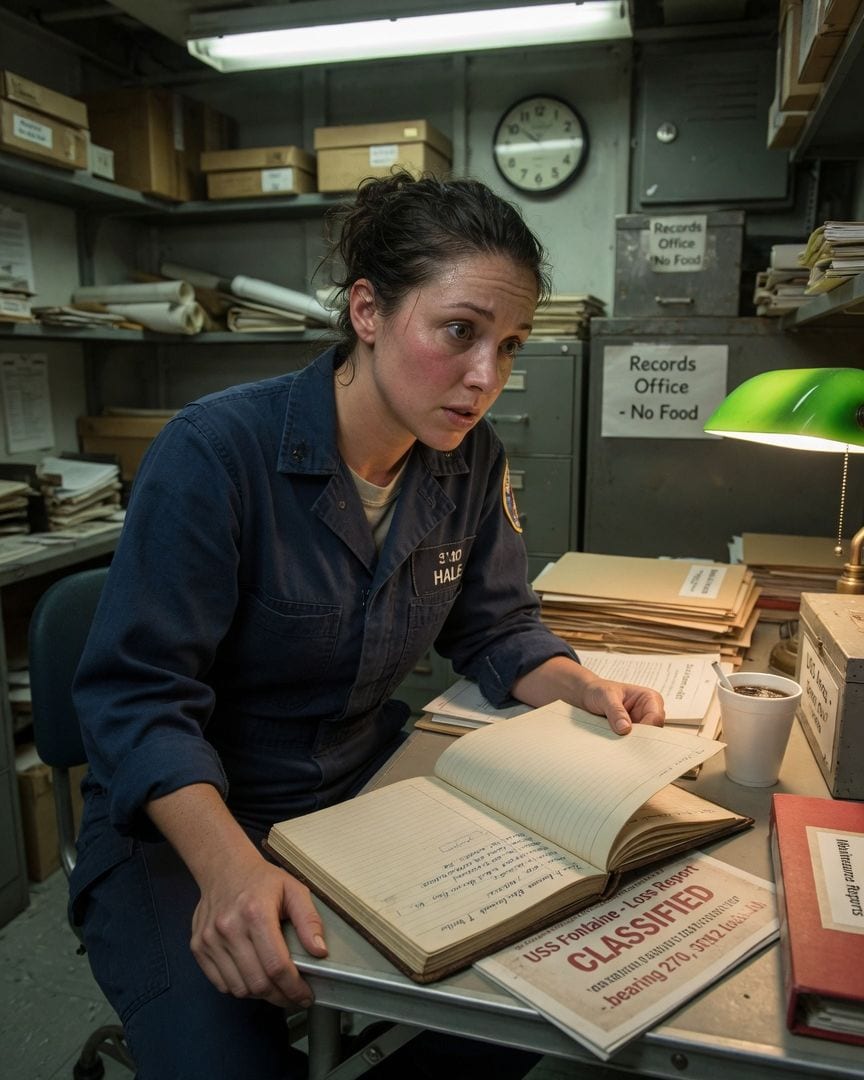
Petty Officer Hale needs a spotless record for her transfer. But the USS Ares sonar logs show an identical, impossible contact, logged to the minute, years apart, and tied to a classified loss report.
Petty Officer Sarah Hale needed a spotless record for her coveted shore duty transfer, a posting she'd worked five years to secure. Alone in the USS Ares sonar shack, three days out from San Diego, her midwatch was broken by an impossible contact: a close, slow echo holding perfect pace, invisible to radar, then vanishing. Her heart hammered, not from fear, but from the data's impossibility. When she found an identical entry in her own log from just one week prior, the cold dread tightened its grip. But the true chill settled when she unearthed decades of similar records, signed by other sonar officers, all showing the same impossible contact at 0212, off the port beam, for nineteen minutes, on the same ship, stretching back years—a persistent echo tied to a classified loss report.
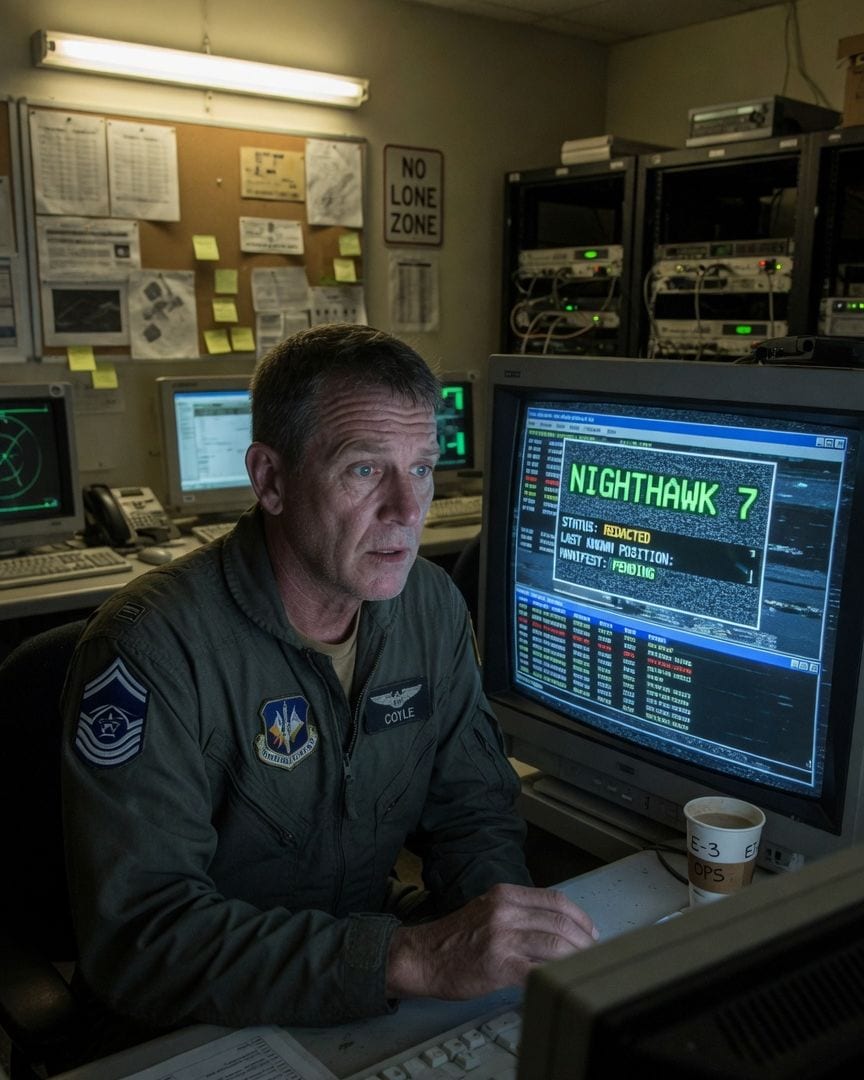
A ghost radar blip returned for Master Sergeant Coyle, three months from retirement. Its call sign: NIGHTHAWK 7, status REDACTED.
Master Sergeant George Coyle, nearly three decades in uniform, counted the last missions before his retirement. High above the black North Atlantic, his E-3 Sentry hummed with the familiar, impossible truth of a ghost radar blip. This single return squawked nothing, eluding every filter and fighter jet sent to investigate, yet the precise systems swore it was there, inbound, week after impossible week. Driven by obsession, Coyle later found a flicker of data: the call sign "NIGHTHAWK 7." Investigating further, an obscure database revealed its status as 'REDACTED,' with its last known position matching the ghost track. What forgotten project was haunting the skies, precisely where it had been scrubbed?
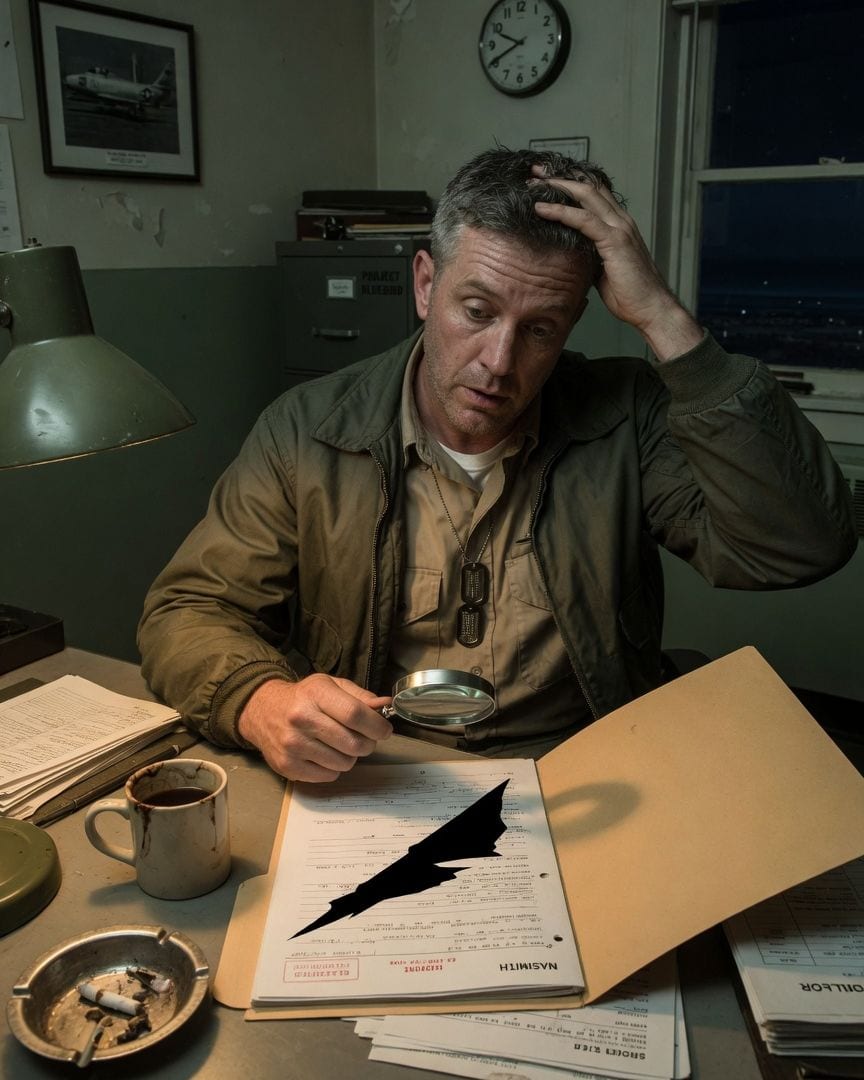
A Cold War pilot's classified file was missing a page, and its final redaction was a jagged, impossible shape with a phantom number beneath.
Colonel Ward Naismith, an F-86 Sabre pilot, found himself haunted by an impossible pursuit over Lake Michigan in 1953. His flight lead's chilling whisper—that the silent, house-sized mass they chased wasn't fleeing but waiting—burrowed deep into his mind. Weeks later, reviewing the incident's classified file, Naismith discovered it was missing a page. But the true dread came from the final page: a block of blacked-out text, not a simple rectangle, but a jagged, geometric shape that felt unnaturally smooth, hiding a faint, ghosted control number beneath its surface.
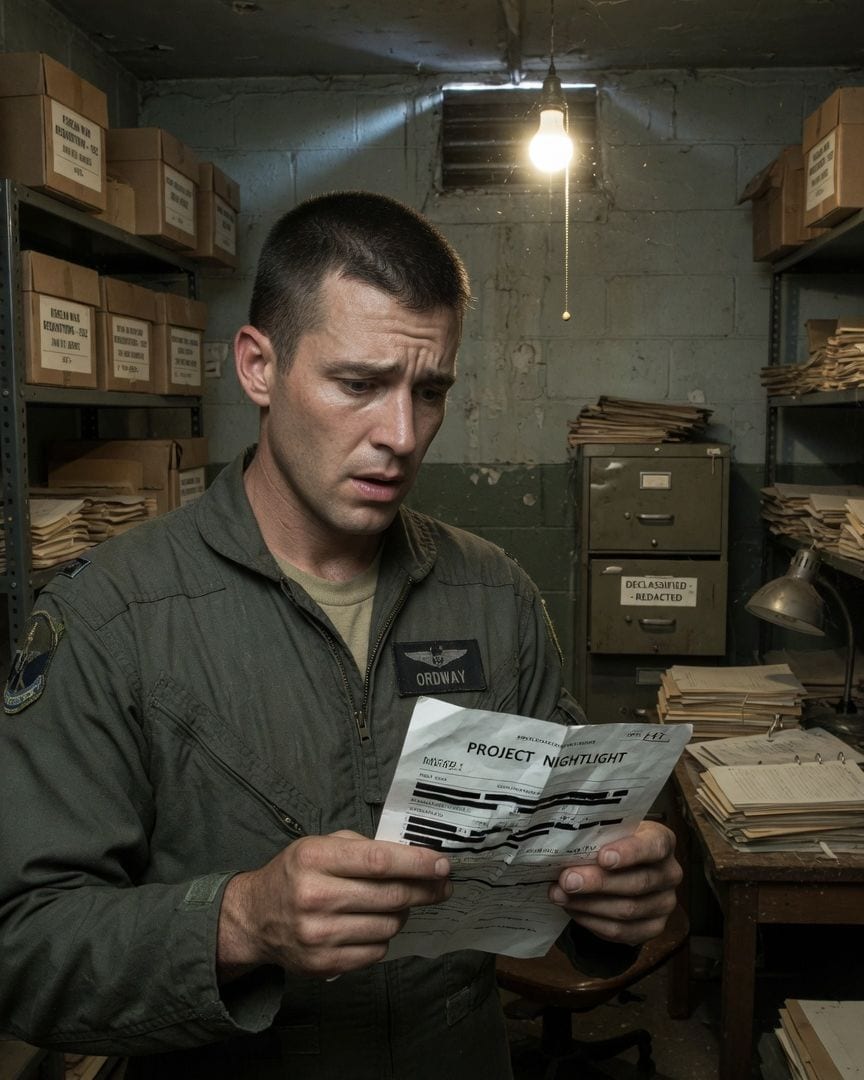
A Cold War pilot's F-104 Starfighter was shadowed by an impossible object. Weeks later, a secret memo referenced his own service number for 'pilot reassignment protocols.'
First Lieutenant Cal Ordway soared over the Mojave in his F-104 Starfighter in 1962, the night sky a familiar canvas. But that night, one 'star' broke formation, pulling alongside his wing and mirroring his every impossible maneuver. His instruments confirmed the silent, unblinking object, defying all known physics. After filing his precise report, Cal found his flight log altered to 'no incidents,' radar tapes corrupted, and a superior advising him to 'let it go.' Driven by his training, he uncovered a heavily redacted memo referencing 'Project NIGHTLIGHT' and, chillingly, his own service number for 'pilot reassignment protocols initiated.' Was he merely a witness, or already a subject in a much deeper secret?