A ghost radar blip returned for Master Sergeant Coyle, three months from retirement. Its call sign: NIGHTHAWK 7, status REDACTED.
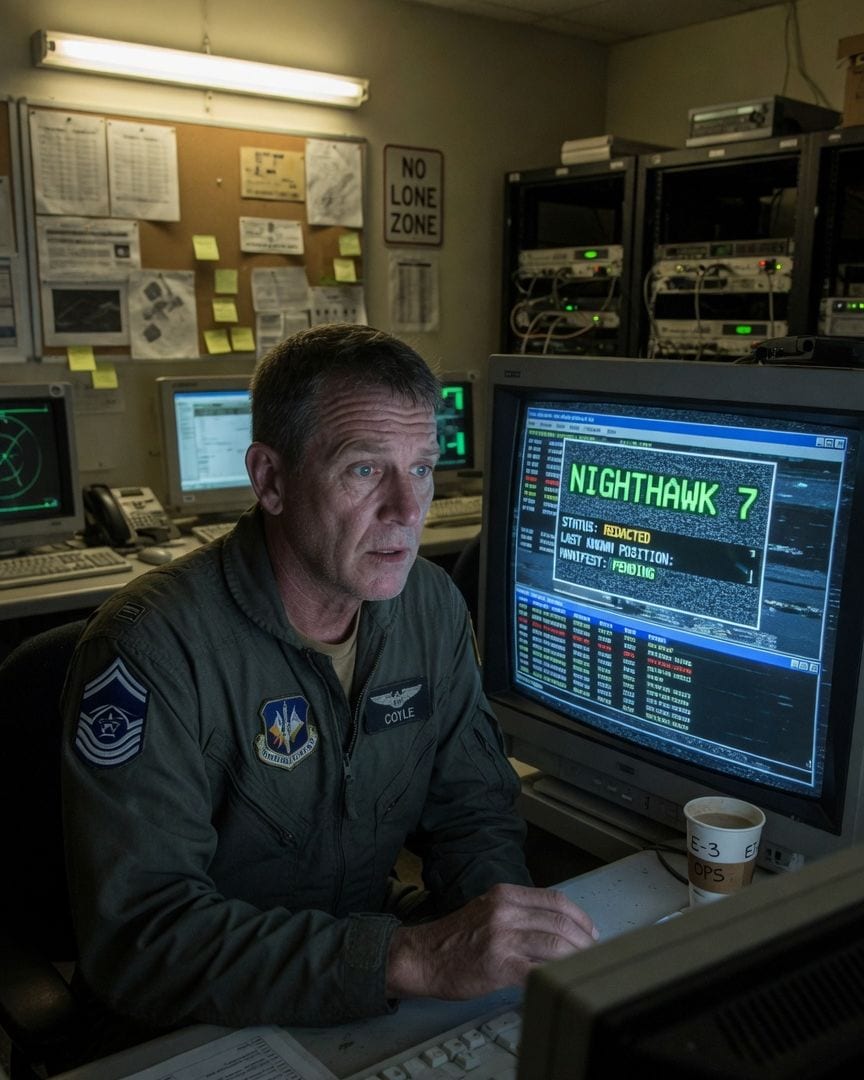
Master Sergeant George Coyle, his face etched with the weariness of nearly three decades in uniform, watched the radar scope on his E-3 Sentry high over the black North Atlantic.
He was three months from retirement, counting down the last few missions. Tonight, the familiar, impossible ghost was back. A low-and-slow return held station off the tanker track, a single blip that should not exist.
It squawked nothing, no IFF, no transponder response, ghosting clean through every filter Private First Class Audrey Doyle, the junior tech beside him, could throw at it.
Her fingers flew across her console, her brow furrowed in concentration, but the filters were useless. Fighters vectored onto the spot found only empty sky and clear infrared signatures – nothing.
Yet, the E-3’s systems, precise to the nanosecond, swore the track was there. It held its bearing, inbound, exactly as it had last week, and the week before that.
The E-3's systems hummed, a low, constant thrum that felt less like machinery and more like a vast, breathing beast, stubbornly insisting on its impossible truth.
Coyle ran the diagnostics again, his own fingers flying across the console, every check returning a clean bill of health. Every sensor functioned perfectly.
The ghost was there, a persistent, unacknowledged blip in a world built on absolute accountability, an infuriating, silent defiance of every protocol Coyle had ever learned.
Back on base, the ghost track became Coyle’s obsession. He spent his off-hours in the E-3’s mission planning office, a sterile room of humming servers and glowing monitors, poring over the digital flight logs from the previous sorties.
He cross-referenced the ghost track’s unique internal ID—a string of numbers and letters that should have corresponded to a specific aircraft or known anomaly—against every existing database. It returned nothing.
“It’s like it’s a phantom entry, Master Sergeant,” Audrey said, leaning over his shoulder one evening, her brow furrowed with a mix of exhaustion and genuine curiosity.
“The system generates an ID for it, assigns it parameters, but it’s not linked to anything real. It’s a perfectly rendered void.” Coyle grunted, his eyes fixed on the screen, scrolling through what should have been an empty index.
The cold blue light of the monitor pulsed, each flicker of data a quick, almost accusatory wink. He came to a corrupted sector of data, a patch of digital static that routinely caused minor errors.
As Coyle scrolled past, Audrey’s finger snagged on a flicker within the static. “Wait, what’s that?” she muttered. A partially rendered data packet, an anomaly within an anomaly, had momentarily displayed an impossible call sign before vanishing into static again.
“NIGHTHAWK 7.” Coyle froze. He felt a prickle on his arms, a sudden, inexplicable chill. “Try to retrieve that,” he ordered, his voice sharper than he intended. Audrey tapped rapidly, rerunning the scan, trying to isolate the flicker.
But it was gone, a digital mirage swallowed by the static. Coyle knew the E-3’s systems didn’t just invent call signs.
Something about ‘NIGHTHAWK 7’ felt like a key, a name that didn't belong in their meticulously documented world, yet had surfaced from the very heart of its data.
Driven by the chilling call sign, Coyle used his senior clearance to access a rarely used, offline database of decommissioned military assets and archived mission data, a digital graveyard for forgotten projects. The interface was clunky, archaic, slow to respond.
He typed in 'NIGHTHAWK 7.' After a tense moment of buffering, the screen filled with buzzing static, then a single, obscure entry appeared. It wasn’t a live asset, nor a decommissioned one in the usual sense. The status read: 'REDACTED.'
Beneath it, two lines of data glowed: 'LAST KNOWN POSITION: [coordinates matching ghost track]. MANIFEST: PENDING.' Coyle stared at the screen, the single, obscure entry for 'NIGHTHAWK 7' glowing back.
The implications of a mission that was scrubbed, yet still had a 'last known position' precisely where the ghost track always appeared, felt like a cold hand on his neck.
The 'REDACTED' status gnawed at Coyle. He knew what that meant: not just decommissioned, but erased. He contacted Fiona Montgomery, a meticulous records officer known for her ability to unearth even the most deeply buried paperwork.
He explained his predicament over a secure line, carefully omitting the 'ghost' part of his story. He framed it as an 'administrative anomaly' on a legacy system, a ghost entry that was causing data integrity issues.
Fiona, initially skeptical, grew intrigued by Coyle’s insistence on the 'NIGHTHAWK 7' call sign and the 'REDACTED' status. The silence on the other end of the line stretched, thick and heavy, like something pressing down on the secure connection itself.
“That’s… unusual,” she admitted, her voice tight, after a long pause. “Most scrubbed projects are simply deleted, not marked for perpetual redaction. It implies a continued… awareness of its existence, even in absence.” She promised to dig.
Days later, Fiona called back, her tone hushed. She’d found a physical file, indexed under 'NIGHTHAWK 7' in a deep-storage archive, but it was empty—a manila folder containing only a single, blank sheet of paper marked 'CLASSIFIED.'
More unsettling, her system’s internal audit logs showed a spike in unauthorized access attempts to her specific archive terminal, all targeting the 'NIGHTHAWK 7' file ID, in the weeks leading up to Coyle’s call.
Someone else, she suspected, had been looking for it, or trying to ensure it stayed empty. The unease began to solidify into something more specific, something with intent.
As Coyle and Fiona continued their covert investigation, the subtle pressures began. Coyle noticed his own secure terminal’s access logs were being mirrored.
Every query he made on older databases, every search for 'NIGHTHAWK 7,' every timestamp, was duplicated, not by him. It was a silent, unnerving surveillance.
Fiona found her office subtly disturbed; a file box she swore she’d left open was now closed, its contents undisturbed but subtly rearranged. Nothing was overtly stolen or damaged, but the message was clear: someone was watching them.
Captain Marcus Jennings, Coyle’s Mission Crew Commander, pulled him aside after a routine debrief. “Master Sergeant, I’ve been hearing whispers,” Jennings said, his tone casual, almost too casual, but his eyes were sharp, scrutinizing. “Your interest in certain… historical data.
It’s raising eyebrows. Is there something you need to report?” Coyle offered a vague explanation about a system bug he was attempting to track down, but Jennings’s gaze lingered, unconvinced, before he finally nodded and dismissed Coyle.
The air in Jennings’s office felt thin, charged with unspoken warnings, each word George spoke seeming to echo back with an unseen listener.
Later that evening, an anonymous, encrypted message appeared on Coyle’s secure terminal, the kind that bypassed standard firewall protocols, appearing directly on his desktop with a silent, insistent chime: “Let sleeping dogs lie. Some records are best left scrubbed.”
The words chilled Coyle to the bone. Someone high up, someone with access and knowledge, was actively trying to warn him off, or worse, make him disappear into the system’s quiet oblivion.
Coyle confronted Captain Jennings directly, cornering him in his office late one night. The building was mostly empty, save for the distant hum of servers.
“Captain, I know about NIGHTHAWK 7,” Coyle stated, his voice low and steady, cutting through the silence. Jennings’s face, usually calm and composed, tightened perceptibly. His gaze flickered to the door, then back to Coyle.
“Master Sergeant, I don’t know what you’re talking about,” he replied, his voice carefully neutral.
“The redacted file, the empty folder, the ghost track that matches its last known position,” Coyle pressed, laying out every piece of evidence, watching Jennings’s carefully constructed composure crack like thin ice. “And the message on my terminal.
You know what it is.” Jennings sighed, running a hand over his close-cropped hair.
The quiet hum of the building’s ventilation system seemed to press in, amplifying the weight of every word Jennings uttered, turning the air itself into a confidant. “Fine, Coyle. Yes. NIGHTHAWK 7 was real.
It was a highly classified, unsanctioned reconnaissance mission, twenty-five years ago.” He paused, looking Coyle directly in the eye. “A political powder keg. It vanished without a trace over the Atlantic. No distress signal, no wreckage, nothing.
The official story was… it never existed.” Jennings leaned forward, his voice dropping to a near whisper. “All records were purged. Every last one. But the E-3 system… it’s designed for perfect accountability.
It has an internal, indelible 'ghost' of its last known parameters, a persistent glitch that occasionally renders the track visible, an echo of what was. It’s a phantom, Coyle. A system memory of something that officially isn’t there.”
He looked Coyle in the eye again, his expression grim. “Now you know. Drop it. For your own good. For everyone’s good.”
The earlier clues snapped into focus: the ghost track wasn’t an error; it was a perfect, unerasable memory of a perfect erasure.
Jennings’s confession left Coyle reeling. The ghost wasn't a glitch, but the system's unwilling witness. He returned to the old archive, the 'MANIFEST: PENDING' entry for NIGHTHAWK 7 now screaming a new, horrifying implication.
It didn't mean the manifest was waiting to be created; it meant it was never finalized because the crew never returned.
He remembered a fleeting, vague rumor from his early years in the service about a last-minute crew swap on some classified flight, a minor administrative 'hiccup' that saved someone’s career.
At the time, he’d dismissed it as typical barracks gossip, but now it echoed with a chilling new resonance.
Driven by a morbid curiosity, a sudden, desperate need to connect the dots to something tangible, Coyle began digging through the physical, decommissioned archives adjacent to Fiona’s office, searching for anything related to NIGHTHAWK 7 that might have escaped the digital purge.
He worked through the night, dust motes dancing in the beam of his flashlight as he rifled through forgotten boxes.
Tucked away in a dusty, mislabeled box of 'Personnel Transfers - Q3,' he found it: a crumpled, carbon-copy draft of the original NIGHTHAWK 7 crew manifest, dated the day before the flight.
His breath hitched as his eyes fell on the name 'Coyle, G. - Radar Tech.' printed clearly on the faded carbon copy.
His own name, a younger version of himself, listed as crew on the doomed 'NIGHTHAWK 7' flight, a mission he had no memory of ever being assigned to, let alone scrubbed from.
The crumpled manifest shook Coyle to his core. He remembered now, the memory returning like a punch to the gut: a hazy recollection from twenty-five years ago.
It was a last-minute administrative 'error' that pulled him from a routine training rotation. A junior tech, whose wife was in labor, had been swapped in at the last minute for him.
He remembered being annoyed at the change in schedule, but ultimately relieved to avoid the long, tedious flight. The training rotation, he realized with dawning horror, must have been the cover for NIGHTHAWK 7.
His 'administrative error' was a last-minute reassignment that saved his life.
The ghost track wasn't just an echo of a lost flight; it was the system's unerasable record of an alternate timeline, a 'what if' that had nearly been his reality.
The E-3’s advanced system, designed for absolute accountability, couldn't simply forget. It retained every permutation, every possibility, every piece of data, even those officially suppressed.
The persistent blip on the scope wasn't a glitch in the hardware, but a perfect, unyielding adherence to all data, including the data of his own near-fate.
The accountability that could not be denied was the system’s insistence on a truth that everyone else had successfully buried, including the fact that he was supposed to be part of it.
The realization hit him like a physical blow, the dusty archive air suddenly feeling impossibly heavy, suffocating, as if the past itself was settling around him.
The horror was in the coherence: every clue, every strange detail, now clicked into place, forming a terrifyingly logical, undeniable pattern.
On his final E-3 mission, the vast, dark expanse of the North Atlantic stretched beneath them, an endless canvas of ink black punctuated by the distant glitter of stars.
Coyle sat at his console, the familiar hum of the machinery a backdrop to the silent dread within him. The ghost track appeared again, a low-and-slow return off the tanker track, squawking nothing, ignoring every filter Audrey diligently applied.
This time, Coyle didn't try to dismiss it, didn't run diagnostics. He simply watched it. He knew its name, its history, and its indelible connection to him.
He understood that he could not stop it, could not make others truly see it for what it was, because its truth was too inconvenient, too terrifying in its implications about the absolute nature of their perfectly accounted world.
The system, designed to prevent anomalies, had become a silent, eternal witness to one, and to the lives it had consumed and nearly consumed.
He saw Audrey, the young tech, glance at the blip, a flicker of confusion in her eyes before she dismissed it, shaking her head slightly, as a 'known anomaly.' Coyle felt a profound, heavy sadness settle in his chest.
He knew that the system would keep tracking it, an eternal phantom, a testament to a forgotten tragedy and his own impossible reprieve. He was left with the knowing, a burden that no retirement could lift.
The E-3’s cabin, usually a hive of controlled activity, seemed to hold its breath, the low hum of its electronics a conspiratorial whisper in the vast, dark sky. The silence felt like a conspiracy of the air itself.
George Coyle retired quietly, his exemplary service record a testament to a career lived within the lines. The ghost track continued to appear on E-3 scopes over the North Atlantic, a low-and-slow return off the tanker track, squawking nothing.
Newer techs like Audrey occasionally reported it, but they were always told it was a known, unresolvable system anomaly, an artifact of old code, nothing to worry about.
The mission tapes still held its inbound path, week after week, year after year.
Years later, George sat in his living room, a veteran now, far from the hum of radar scopes. He watched a news report about a new, advanced E-3 model being commissioned, boasting 'unprecedented data integrity and historical archiving capabilities.'
He sipped his coffee, a faint, knowing smile playing on his lips. He knew the system never truly forgot what it was designed to deny.
His wife, Dorothy, walked in. 'Still watching those old jets, George?' she asked. He just nodded, his smile fixed, his gaze distant.
'They just keep finding new ways to remember,' he murmured, the words barely audible, as a new E-3's digital ghost flickered across the TV screen, perfectly inbound.
If this one got to you
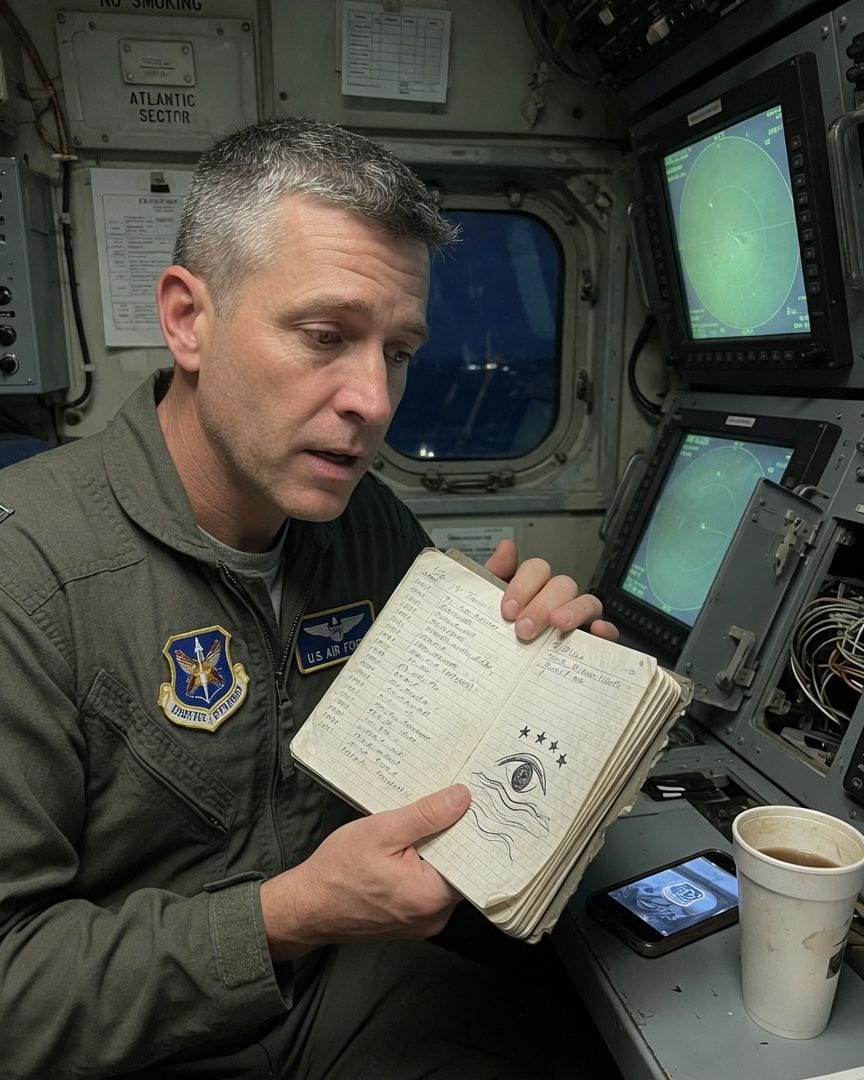
Weeks from his transfer, Master Sergeant Coyle found a Cold War logbook behind his console detailing the exact phantom blip he saw, documented since 1983.
Master Sergeant Everett Coyle yearned for his impending transfer, a clean break from the endless North Atlantic patrols. He had eighteen years of operational experience with the E-3's systems, but one anomaly, a silent blip he called 'The Traveler,' defied every explanation. Fighters found only empty sky, yet the track always returned, perfectly on schedule. During a routine console check, Coyle's fingers brushed against a hidden, spiral-bound notebook. Inside, meticulously handwritten entries detailed his exact phantom blip, recorded by other hands, spanning back to 1983, along with a chilling note: 'They say it's just a ghost. But it keeps trying to answer.'
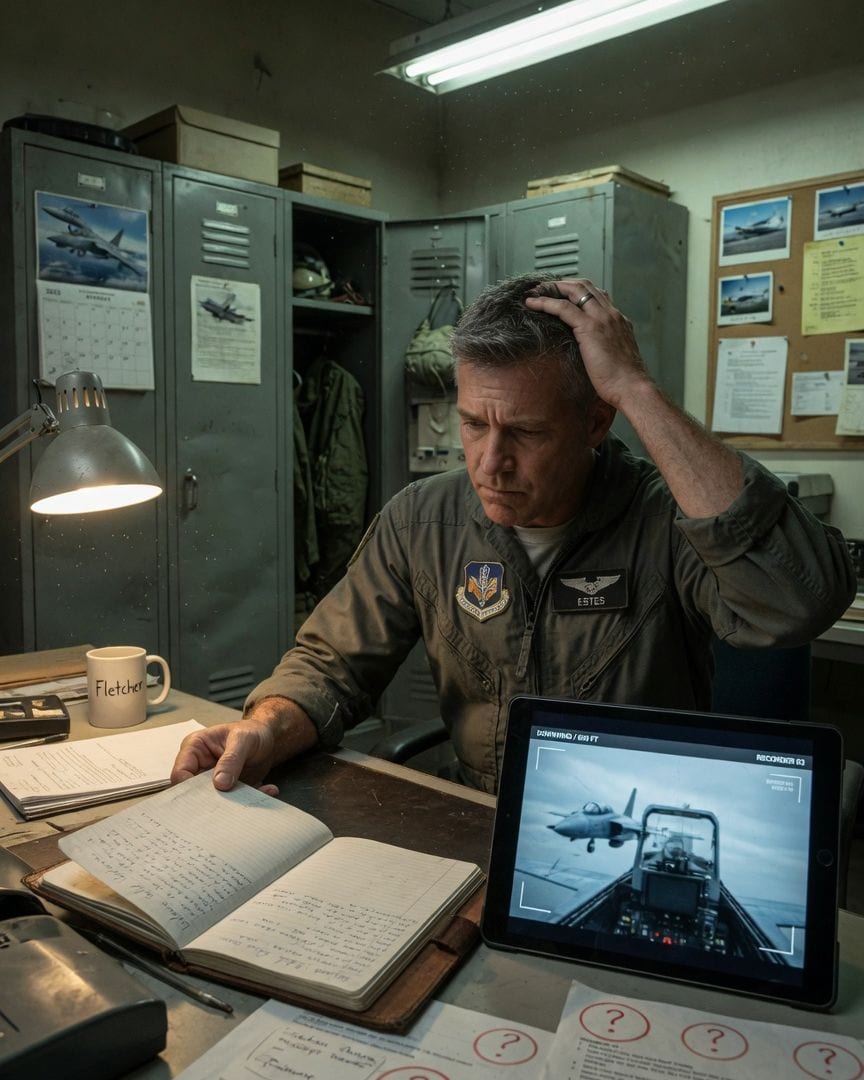
A Chief Warrant Officer's HUD tape shows a phantom jet, impossibly close, off his wing. Forty years ago, another Cold War pilot logged the same impossible sight.
Chief Warrant Officer Nathaniel Estes, a pilot whose career hinged on absolute precision, was under evaluation for a critical promotion. His nightly review of HUD tapes from routine Mojave test flights was a meticulous habit, but for a week, it revealed an impossible detail. At precisely 800 feet, one frame showed a sleek, experimental jet tucked impossibly close off his left wing—a craft ground radar never detected. When his maintenance chief found no equipment fault, Estes unearthed a dusty, decades-old logbook detailing identical phantom sightings from 1978. What unseen presence shadowed the desert skies?
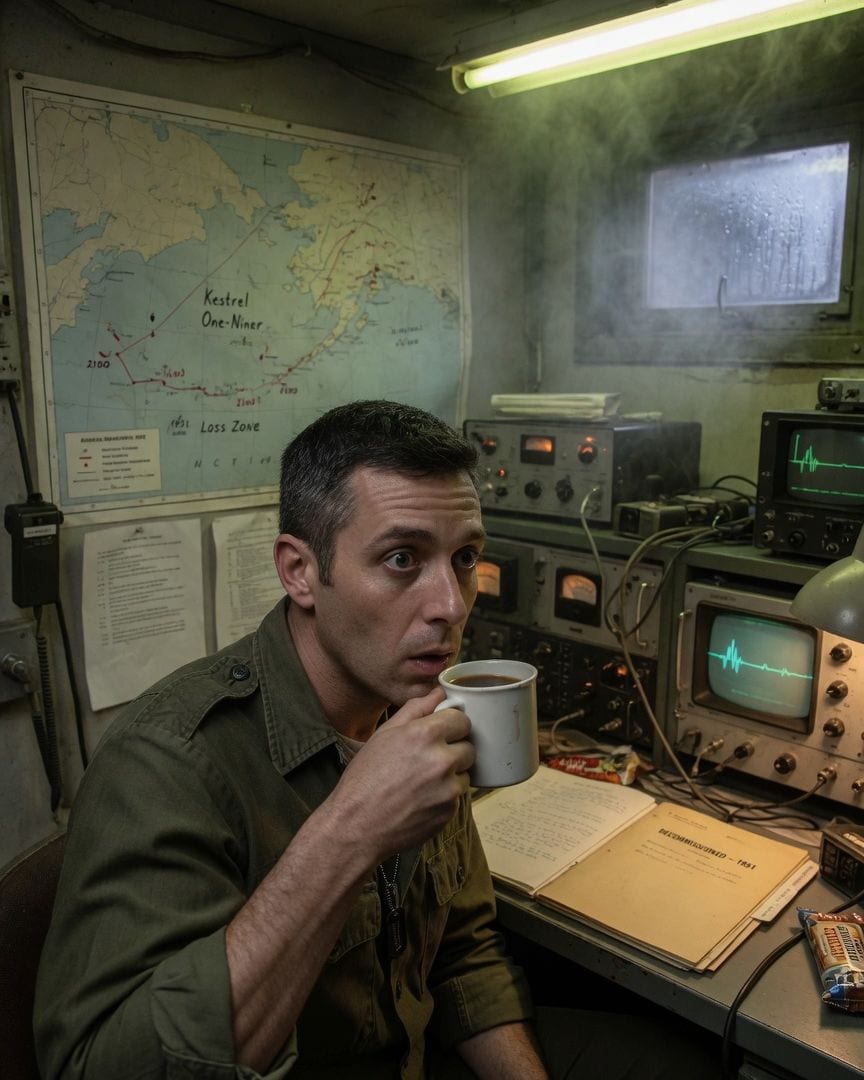
A communications lieutenant hears a Cold War reconnaissance plane, lost in 1951, transmitting clear reports seventy years later.
Lieutenant Aaron Suvak's shift in the isolated Aleutian communications bunker was usually quiet, a lonely vigil against the thick, silent fog that had closed the strip. But precisely at 2000 hours, the low hum of his radio equipment broke with a clear, professional voice. The signal came from "Kestrel One-Niner," a Cold War reconnaissance plane officially lost over the Bering Sea in 1951. Suvak plotted its impossible progress across his old paper chart, realizing the signal wasn't a glitch, but the same plane, still transmitting its route seventy years later.
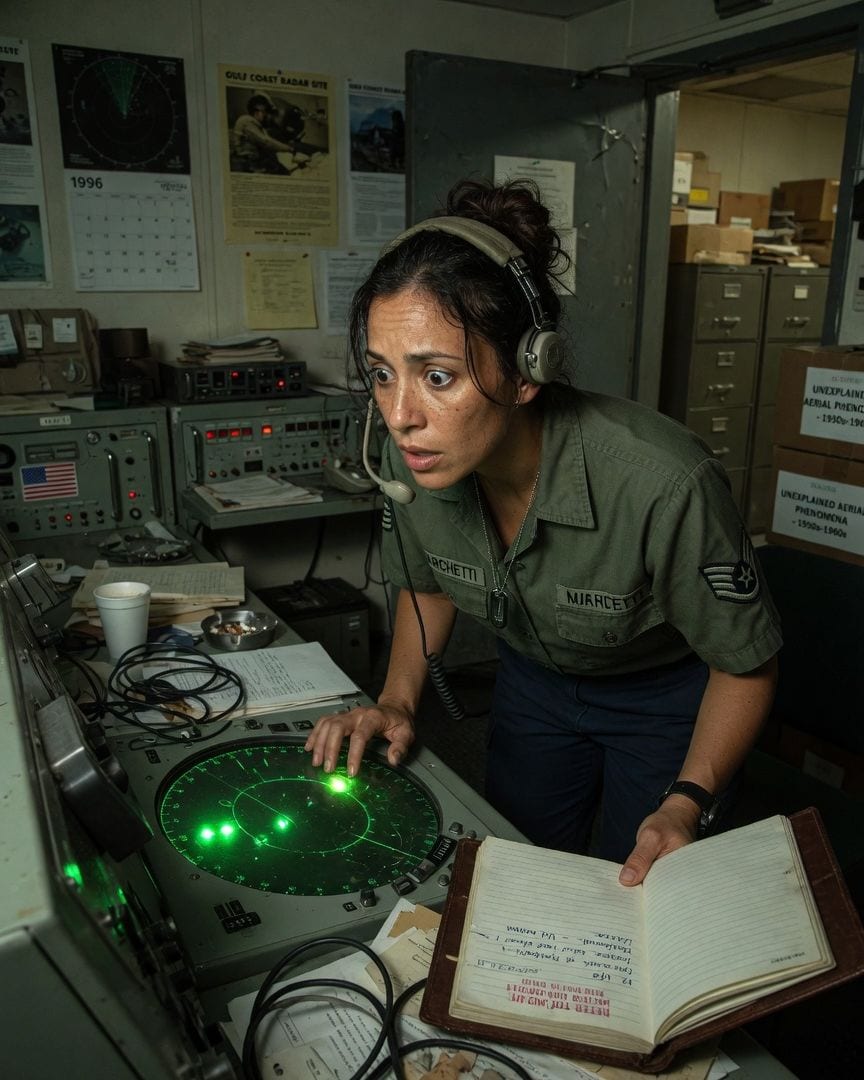
During her last weeks at the Cold War radar site, a technical sergeant logged a UFO. Her entry box was already stamped with a code from a missing 1958 jet.
Technical Sergeant Odile Marchetti was winding down her last few weeks as a radar operator at a remote Gulf Coast site in 1996. Alone in the cavernous room, she watched the green glow of her scope, the only light cutting through the pre-dawn gloom. At 2:30 AM, an airliner reported something flying in formation—a craft Odile couldn't see, until a massive, impossible blip bloomed beside it on her screen. After the pilot reported flying straight through empty air, Odile logged the UFO, only to find a faded, decades-old code already stamped on her logbook entry, identical to one on a missing jet report from 1958. Had this happened before, and was her own entry just a pre-written footnote in a much older, terrifying file?
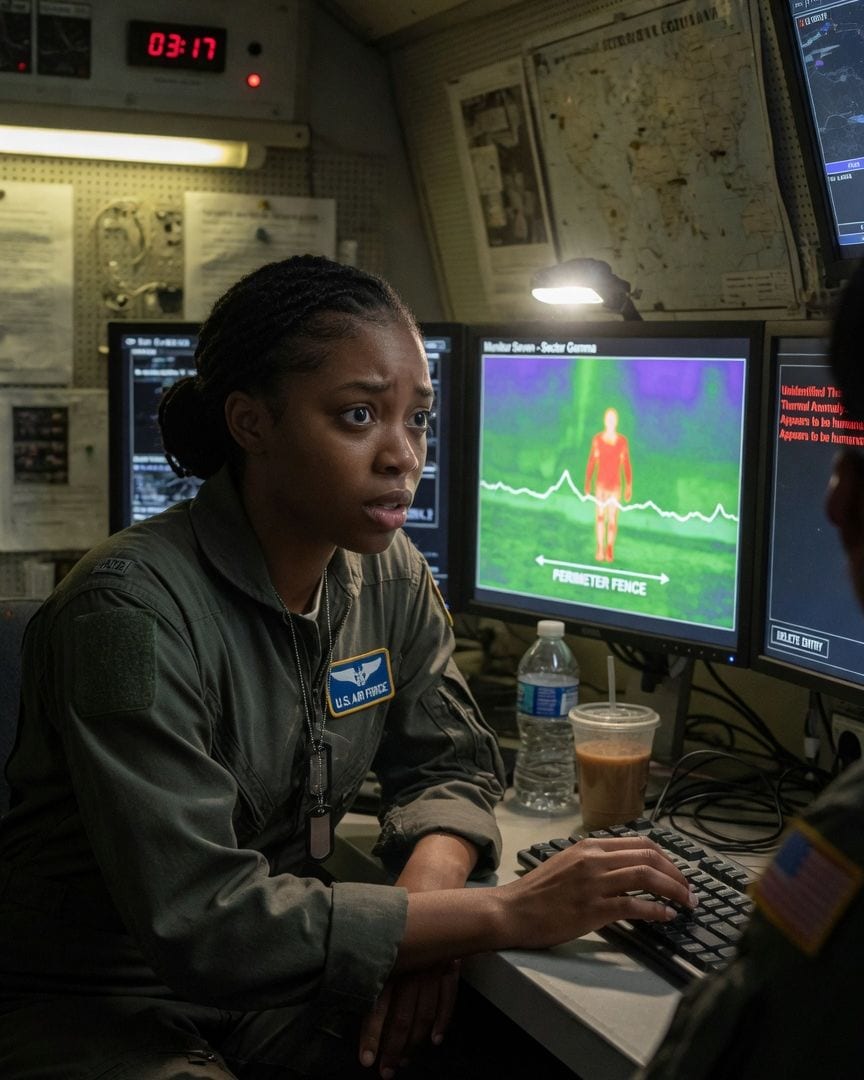
An airman’s thermal feed shows a figure moving in the restricted desert. Her captain orders it scrubbed, but the heat signature appears to tilt its head and look right at her.
Airman First Class Olivia Kade was new to her remote high-altitude outpost, fresh from advanced training, and the isolation pressed in, amplifying every hum. Her duty was to monitor the desert perimeter, but one shift, a faint thermal signature appeared on Monitor Seven: a solitary, upright figure moving with impossible precision beyond the barbed wire. No personnel were authorized in that sector. Her mission commander quickly ordered the anomaly scrubbed, but as it dissolved, the featureless outline seemed to tilt its head, looking directly into the camera. Now, the signature returns night after night, forcing the airman to wonder what impossible thing patrols the dark beyond the wire.
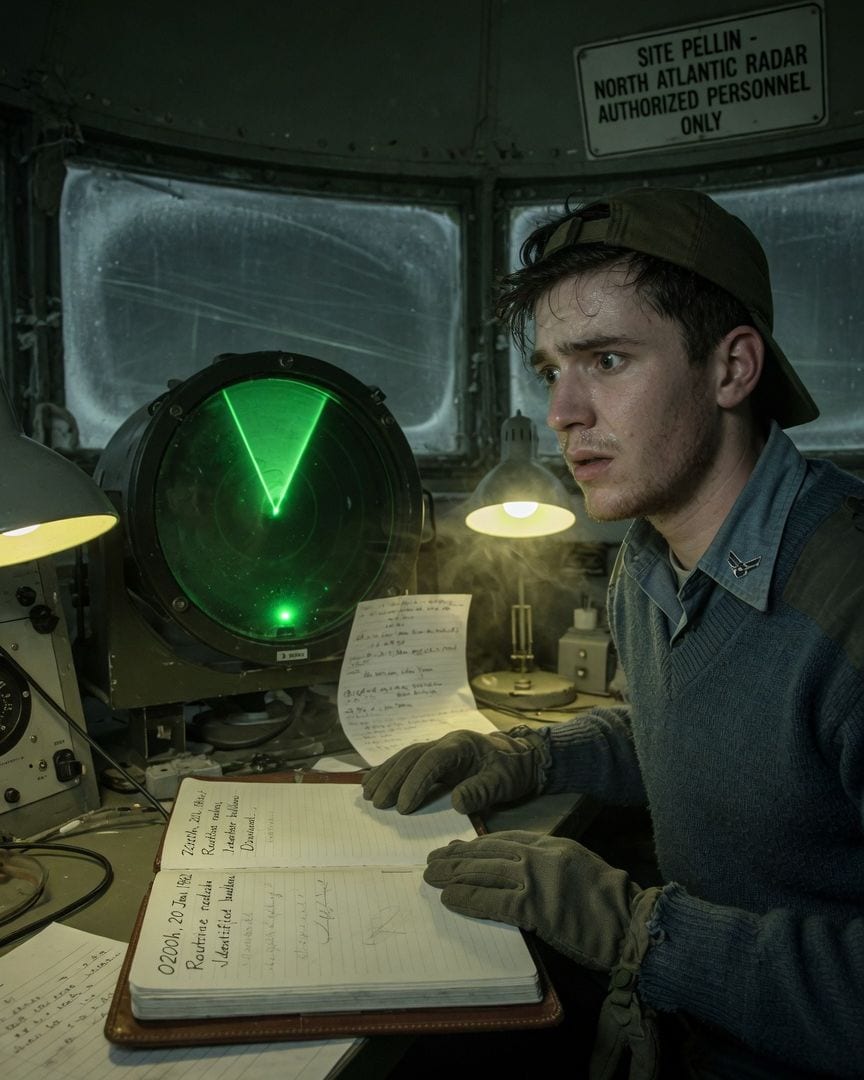
Nine days from closing, Cold War Site Pellin's Airman Vance watched his radar track a solid blip moving closer, dead in open sea where nothing could exist.
In the dimly lit dome of Site Pellin, Airman Ordway Vance, just days from discharge, ran his final radar sweeps before the base closed for good. Outside, the North Atlantic wind howled, but inside, only the hum of his console broke the silence. His last calibration had been clean, yet a single, unwavering green blip appeared on the scope, forty miles out, in open water where no vessel should be. The impossible return moved closer with each sweep, defying all logic and other sensors, until it sat static just beyond the coast fence line. What unseen presence did the radar truly hold in its unwavering green grip, contradicting the official record?