Weeks from his transfer, Master Sergeant Coyle found a Cold War logbook behind his console detailing the exact phantom blip he saw, documented since 1983.
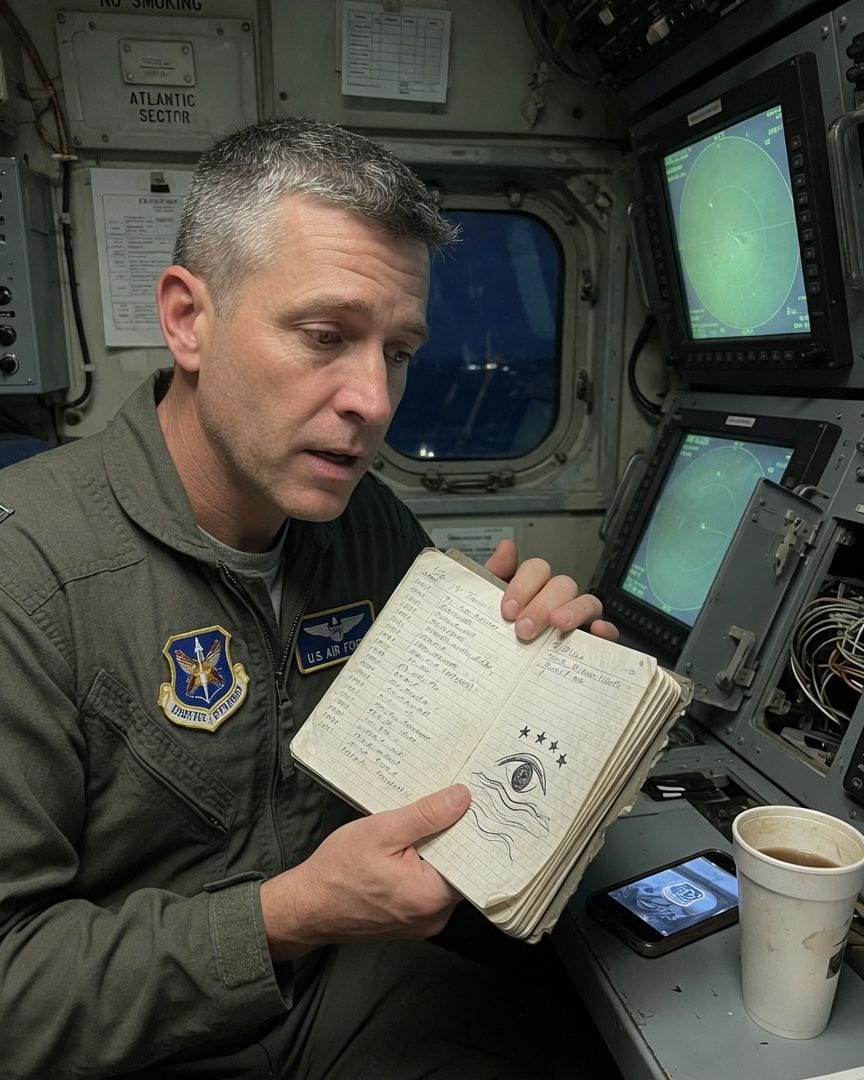
Master Sergeant Everett Coyle watched the low-and-slow return hold station on his scope, a ghost off the tanker track high over the North Atlantic.
It squawked nothing, a clean, silent blip that ghosted through every filter the E-3's systems could throw at it. He ran diagnostics, cross-referenced with the other consoles, and confirmed it wasn't a system glitch.
The other operators saw only the filtered data, a clear sweep of ocean and known traffic.
Coyle, however, had learned the subtle art of coaxing the raw feed to display its anomalies, the things the algorithms deemed too insignificant or too irregular to be real.
This blip, 'The Traveler' as he'd privately named it, was precisely that: an irregularity that insisted on its presence.
When fighters were vectored onto the spot, a standard response for any unidentified track, they found only empty sky and clear infrared.
The pilots reported nothing, not even a wisp of cloud, just the vast, indifferent expanse of the North Atlantic. They'd return, baffled, and Coyle would log another 'system anomaly' in the unofficial margins of his mind.
The track always dropped at the same bearing it always dropped, dissolving into the digital ether. What truly unsettled him was not just its appearance, but its uncanny predictability.
The mission tapes from the prior week's sortie, which he'd reviewed on his own initiative, held it inbound to the very second of its appearance, a perfect, impossible echo of something that wasn’t there.
The persistent anomaly gnawed at Coyle. His impending transfer to a shore-based training command should have brought relief, a clean break from the endless rotations high above the gray-green sea, but the phantom track was an itch he couldn't scratch.
It felt like a deliberate challenge to his eighteen years of operational experience.
During a routine console check, a task he often used to escape the monotony, he reached behind a loose panel, idly checking wiring that had been notoriously finicky since the last overhaul.
His fingers brushed against something unexpected: a beat-up, spiral-bound notebook, its cover faded to an indistinct gray, tucked deep into the cavity of the console's housing. It wasn't official issue; the paper was cheap, the binding loose.
He pulled it out, feeling a strange jolt of curiosity. Inside, meticulously handwritten entries filled the pages.
They detailed peculiar atmospheric conditions, odd sensor readings, and then, a series of notes on 'The Traveler' – a persistent, unidentifiable track, with precise coordinates and timings that perfectly matched Coyle’s own observations.
The entries spanned years, written in multiple hands, some elegant, some crude, but all converging on the same impossible phenomenon. One particular entry, dated 1983, mentioned a specific, archaic-sounding call sign: 'Echo-Four-Zero-Niner.'
Coyle tried to find 'Echo-Four-Zero-Niner' in the E-3's extensive official registries, historical and current. Nothing. The system returned a blank, as if the call sign had never existed, or had been scrubbed clean.
The mundane explanations – a prank by a previous operator, a shared delusion, or simply his own fatigue – crumbled under the weight of the notebook’s consistent, detailed record. Someone else had seen it, documented it, and known its name.
The air in the cockpit felt colder, the hum of the electronics sharper, as Coyle realized he wasn't alone in witnessing this impossible thing.
Coyle's fingers traced the faded ink in the old logbook. An entry from 1984, dated just weeks before the unit's official disbandment, described 'The Traveler' with an almost desperate tone, the handwriting larger, more forceful than previous entries.
'It keeps squawking blank,' the scrawl read, 'but the return is solid. Nothing there. Again.' Beneath it, a crudely drawn insignia, unlike any Coyle had seen in his career.
It was a stylized eye, gazing out over a wave, with four stars above it.
He took a surreptitious photo with his phone, then cross-referenced it with an archived, unsecured database of forgotten unit patches he accessed through a burner laptop back in his bunk.
The screen flickered, searching, then resolved: a highly specialized, short-lived reconnaissance unit, 'Atlantic Watchers,' officially disbanded in the mid-80s. Their records were almost completely scrubbed, thin and contradictory, but the patch was unmistakable, matching the one in the log.
And beneath the drawing in the logbook, someone had scrawled a single, chilling note: 'They say it's just a ghost. But it keeps trying to answer.'
During his precious few hours off-duty, Coyle discreetly immersed himself in the sparse history of the 'Atlantic Watchers.'
Official reports cited their disbandment due to 'operational redundancy' and 'personnel reassignments,' clean and concise explanations that now, armed with the logbook, felt like deliberate obfuscation.
The names of the personnel were listed, but their subsequent assignments seemed to vanish into administrative black holes. The logbook, however, ended with a crisp, clear signature: 'D. Sinclair.'
Using his access to retired personnel records – a privilege of his upcoming transfer and long service – Coyle found a Dorothy Sinclair, a former E-3 radar operator, now retired in a small coastal town in Maine.
She would be seventy years old now.
He drafted a careful email, posing as a researcher for a historical project on early AWACS operations, hoping to draw her out without alarming her. He mentioned the peculiar anomalies found in old records, specifically 'The Traveler.'
Days later, he received a terse reply, just a few lines agreeing to a brief phone call. When he finally reached her, the connection crackled with static, mirroring the tension in his gut.
Coyle cautiously mentioned 'The Traveler' and the call sign 'Echo-Four-Zero-Niner.' A long, heavy silence stretched across the line, punctuated only by the distant squawk of gulls. Finally, a raspy voice, old and weathered, confirmed, 'You found the book.'
She agreed to meet him during his next scheduled shore leave, but warned, her voice dropping to a near whisper, 'You’re digging where you shouldn’t, Master Sergeant. Some things are buried for a reason.'
The dread intensified; this wasn't just a glitch, not just a shared private anomaly, but a secret actively guarded, a trail that led to a living witness, a trail that someone had clearly wanted to keep cold.
The next flight rotation, the hum of the E-3's systems felt more oppressive than usual, the familiar cabin suddenly claustrophobic.
Captain Roland Lockwood, Coyle's flight commander, a man whose easygoing demeanor often masked an inflexible adherence to protocol, approached his console. The air around Coyle seemed to thicken, the light from his scope casting sharp, accusatory shadows across Lockwood's face.
'Master Sergeant Coyle,' Lockwood began, his tone even, almost conversational, but his eyes held an unnerving stillness, 'I've noticed your excessive interest in some of the older, unofficial documentation, and your queries into decommissioned units.
Is there something you'd like to share?'
Coyle tried to explain his observations about the phantom track, the consistency across years, the impossibility of it being a simple glitch. He carefully omitted the logbook, wary of implicating Dorothy or himself further.
Lockwood listened, his gaze unblinking, his fingers drumming a quiet, rhythmic beat on the edge of Coyle's console.
He then dismissed Coyle’s concerns as 'fatigue' and 'sensor ghosting,' terms Coyle had heard a hundred times from pilots who couldn't explain what they saw.
'You're on your final rotation before that training command transfer, Coyle,' Lockwood added, his voice dropping slightly, losing its conversational lilt, hardening into something cold and official. 'Wouldn't want anything to jeopardize that, or your pension, would we?
Maintaining focus on current operational parameters is paramount.' The words were a clear, unspoken warning, a chill that seeped into Coyle's bones, far more effective than any direct threat.
After that, Coyle noticed subtle shifts. His access to certain archived databases became slower, occasionally timed out without explanation. His 'historical research' emails, even those sent through encrypted channels, went unanswered, or bounced back with administrative errors claiming non-existent addresses.
He felt a pervasive sense of being observed, not just by Lockwood, but by the unseen mechanisms of the system itself, a quiet, omnipresent vigilance that had nothing to do with routine operational oversight.
The system was pushing back, reminding him that some truths were not meant to be uncovered, and that his career, his future, depended on his compliance.
The phantom track continued to appear, a silent accusation on his screen, and each time it did, Coyle felt a growing sense of isolation.
Coyle met Dorothy Sinclair in a quiet, unassuming diner on the Maine coast, the scent of stale coffee and fried food clinging to the air.
She was frail, her hands spotted with age, but her eyes held a sharp, wary intelligence that seemed to pierce straight through Coyle's polite façade. She wore a simple, faded cardigan, but her posture held a stubborn, almost defiant straightness.
'The logbook is mine,' she confirmed, her voice raspy, pushing a cup of lukewarm coffee across the table. 'And 'The Traveler' was real. A known, unspoken anomaly among a few of us old-timers back in the eighties.
We saw it, but no one talked about it outside of the unofficial logs. You learn not to.'
She explained that 'Echo-Four-Zero-Niner' was the call sign of a small, experimental reconnaissance craft, part of the 'Atlantic Watchers' unit.
'They went dark in '84,' she recounted, her voice hushed, her gaze fixed on some distant point beyond the diner's window. 'One minute, a blip, precisely where 'The Traveler' would later appear, then nothing. No wreckage, no distress, no bodies.
Just gone. The search and rescue found empty water. Then the orders came down.' The official story of 'disbandment and reassignment' was a fabricated lie.
Dorothy had been a junior tech then, but she remembered the internal memos that were passed, then shredded, in the aftermath. A highly classified directive, 'Protocol Cerberus,' was issued.
Its purpose, she explained, was not merely to cover up a loss, but to erase all active records of the unit's true fate.
'The Record That Swears Otherwise' was real, she insisted. Dorothy recounted how she personally witnessed service records of the 'Atlantic Watchers' personnel being updated with fabricated transfer dates and reassignments to units they never joined.
Awards were issued for missions that never happened, all signed off by high-ranking officers Coyle recognized from historical documents. 'They weren't just lost, Everett,' Dorothy said, her voice trembling now, thin with decades of suppressed fear.
'They were just made to not be. Officially, they were accounted for, transferred, retired, whatever fit the story. But their records were a lie. That’s the accountability that cannot be.'
The phantom track, she concluded, was their persistent, unacknowledged echo, a digital ghost still trying to report its position, a glitch in the system that refused to be silenced, proof of a lie.
The diner's mundane clatter suddenly felt distant, the air thick with the weight of her revelation.
Dorothy, emboldened by Coyle's genuine interest, by the shared burden of the unspoken, leaned across the table, her voice dropping to a whisper, urgent and conspiratorial. The steam from her coffee mug rose like a small, white ghost between them.
'Protocol Cerberus wasn't about covering up a failure,' she confided, her eyes wide with a terror forty years old, a fear that hadn't faded with time. 'It was about containing something. Something that came back.'
Her hand trembled as she slid a yellowed, grainy photograph across the diner table.
It wasn't a pristine official document; it was a picture of an old radar screen, clearly taken with a cheap camera, not a screenshot, the edges curled and faded.
'The Traveler' was a clear blip, precisely where Coyle had always seen it on his own scopes, a silent defiance of reality. But beside it, almost imperceptible, a fainter, secondary return shimmered, labeled 'Echo-Four-Zero-Niner-Two.'
It was small, indistinct, but its position relative to 'The Traveler' was unmistakable, almost touching. 'It wasn’t just one track, Everett,' she whispered, her eyes wide, glistening. 'Sometimes… there were two.
And the second one… it was always on an intercept course. Always.' The implication struck Coyle like a physical blow, a cold, hard fist in his gut.
The phantom wasn't just an echo of the lost, but a recurring pattern, and something else was out there, hunting them, and potentially still is. The truth was far larger and more active than he could have imagined.
Coyle returned to his E-3 rotation, the image of Dorothy’s photograph burned into his mind like a brand.
He now understood the 'pattern across rotations or dates' that Dorothy had hinted at in her logbook, the unnerving consistency that defied explanation.
The phantom track, 'The Traveler,' was no random anomaly; it was the lingering trace of 'Echo-Four-Zero-Niner,' a craft caught in a desperate, final struggle. Captain Lockwood's tense warnings, his insistence on 'maintaining focus,' now made chilling, horrible sense.
Lockwood wasn't merely dismissing Coyle; he was enforcing 'Protocol Cerberus,' the system's mandate to deny and suppress, a functionary of a deep and insidious cover-up.
During his dwindling off-duty hours, Coyle used every remaining access point – every obscure archive, every back door in the system he could exploit before his transfer finalized – to dig into the actual flight paths and recorded anomalies from 1984.
He cross-referenced them with Dorothy's unofficial log and the photograph. He discovered that 'Echo-Four-Zero-Niner-Two' wasn't a separate craft, wasn't a hostile aircraft or vessel.
It was a unique energy signature, a predatory presence that appeared only when 'The Traveler' was present, always in an intercept pattern, always initiating contact, always the aggressor.
It was the 'thing' that made them 'not be,' the catalyst for 'Protocol Cerberus,' the reason for the fabricated records.
Every clue now clicked into place: the ghosting through filters because it wasn't a conventional target, the empty sky for fighters because it defied physical presence, the 'accountability that cannot be' in the fabricated records because its nature could not be acknowledged.
It was all part of the system's desperate attempt to contain the terrifying truth that something else, beyond human comprehension or conventional weaponry, existed in the vastness of the North Atlantic, preying on their most secure assets, leaving only digital echoes that the system then diligently, and futilely, tried to erase.
The air in the E-3's cabin felt charged, no longer just with the hum of electronics, but with the pressure of this immense, concealed truth.
High over the black North Atlantic, during Coyle's penultimate flight, the E-3's console screen glowed with its familiar, complex dance of blips and vectors. 'The Traveler' appeared again on his scope, a silent accusation against the filtered reality.
But this time, it was not alone. A second, fainter blip materialized beside it, small and indistinct, yet unmistakable, matching the precise, predatory pattern from Dorothy's photograph. 'Echo-Four-Zero-Niner-Two' was back.
Coyle felt a cold dread seize him, turning his stomach to ice.
He was the only one who saw it; the system, in its relentless adherence to 'Protocol Cerberus,' was filtering it out for everyone else on the flight deck, presenting only the sanitized, acceptable version of reality.
He tried to alert his crew, his hand flying to the comms button, but his console flickered, a momentary glitch locking him out of transmitting the raw data, just for a crucial second.
Captain Lockwood, sensing Coyle’s sudden, visceral distress, his rigid posture and wide, fixed gaze, approached his station. Lockwood's own scope displayed only the standard, filtered data, showing 'The Traveler' as a minor, dismissible anomaly that would soon be automatically purged.
Coyle jabbed a finger at his screen, trying to explain, his voice tight with suppressed terror, barely a whisper. 'Captain, look! It's here! The second one!'
But as Lockwood leaned in, his face etched with concern for Coyle’s apparent breakdown, the fainter blip vanished, dissolving back into the system's lies, leaving only 'The Traveler,' which then, as always, dropped off the scope, its echo silenced.
Lockwood gave Coyle a long, pitying look, tinged with firm disapproval. 'Master Sergeant, I understand you're nearing the end of your tour. But these… aberrations… are often a product of fatigue.' His voice was quiet, final.
Coyle knew the second blip was real. He knew what it signified.
The truth detonated within him—the full, horrifying understanding that the system was not merely covering up a past event, but actively perpetuating a lie to protect itself from an ongoing, incomprehensible threat.
He was left with the knowing, a terrifying impotence, unable to prove it or act on it, trapped in a truth that could not be undone.
The drone of the aircraft became a dull roar in his ears, a constant reminder of the vast, indifferent reality that was being carefully managed around him.
Master Sergeant Coyle completed his final rotation without further incident. The remaining flights were a blur of routine operations, the phantom track a silent, personal burden he carried beneath the surface.
His transfer to the training command on shore was processed smoothly, his performance reviews exemplary, save for a minor, almost imperceptible note about 'stress-induced focus issues' in his final weeks, a diplomatic nod to Captain Lockwood's concerns.
He never spoke of the phantom tracks or the 'Atlantic Watchers' again, not to his new colleagues, and certainly not to Dorothy Sinclair. He understood his place now, a cog in the system, and the system had spoken.
The E-3 Sentry aircraft continued its patrols over the North Atlantic, its advanced systems diligently filtering out every anomaly, maintaining the illusion of a perfectly accounted-for sky, a seamless world of predictable data.
Coyle settled into his new role on a quiet base in Florida, the heat and humidity a contrast to the cold North Atlantic.
He taught young airmen the intricacies of radar operations, emphasizing the absolute reliability and precision of their systems, his voice steady, his explanations confident.
One evening, while demonstrating an archived mission tape from a North Atlantic patrol, a faint, almost imperceptible blip appeared on the large projection screen, just off the tanker track.
It lasted only a second, a fleeting ghost, before the system's auto-correction filtered it out, erasing it from view.
No one else in the dimly lit training room noticed, their eyes on the next set of instructions, their minds accepting the pristine image projected before them.
Coyle paused, his hand hovering over the controls, a quiet understanding etched into his face, a deep, unsettling certainty. He knew. He would always know.
Years later, a new E-3 Sentry operator, fresh out of training, reviews a routine North Atlantic mission tape. They pause, rewinding the footage. A fleeting, almost imperceptible blip appears on the screen, just off the tanker track, before vanishing.
They shrug, attributing it to a data anomaly. But deep in the system's unflagged logs, a persistent, unidentifiable trace holds station, squawking nothing, and attempting to answer a call sign that doesn't exist.
If this one got to you
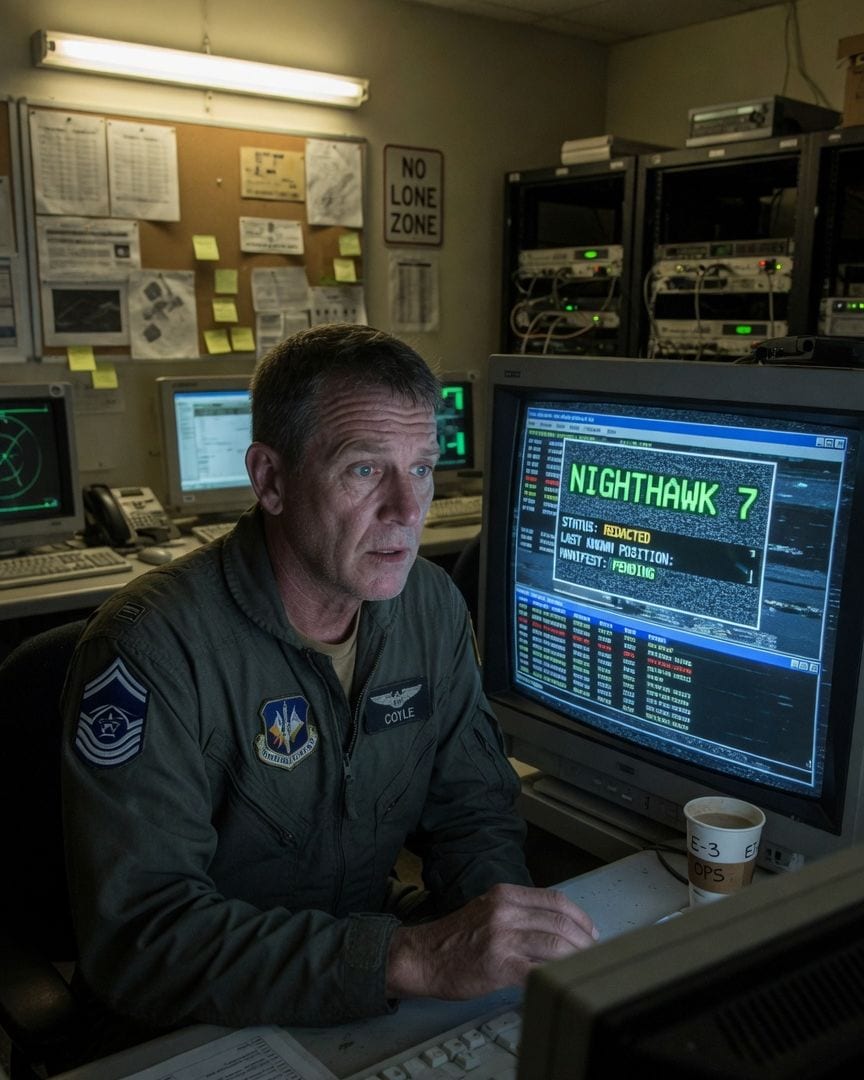
A ghost radar blip returned for Master Sergeant Coyle, three months from retirement. Its call sign: NIGHTHAWK 7, status REDACTED.
Master Sergeant George Coyle, nearly three decades in uniform, counted the last missions before his retirement. High above the black North Atlantic, his E-3 Sentry hummed with the familiar, impossible truth of a ghost radar blip. This single return squawked nothing, eluding every filter and fighter jet sent to investigate, yet the precise systems swore it was there, inbound, week after impossible week. Driven by obsession, Coyle later found a flicker of data: the call sign "NIGHTHAWK 7." Investigating further, an obscure database revealed its status as 'REDACTED,' with its last known position matching the ghost track. What forgotten project was haunting the skies, precisely where it had been scrubbed?
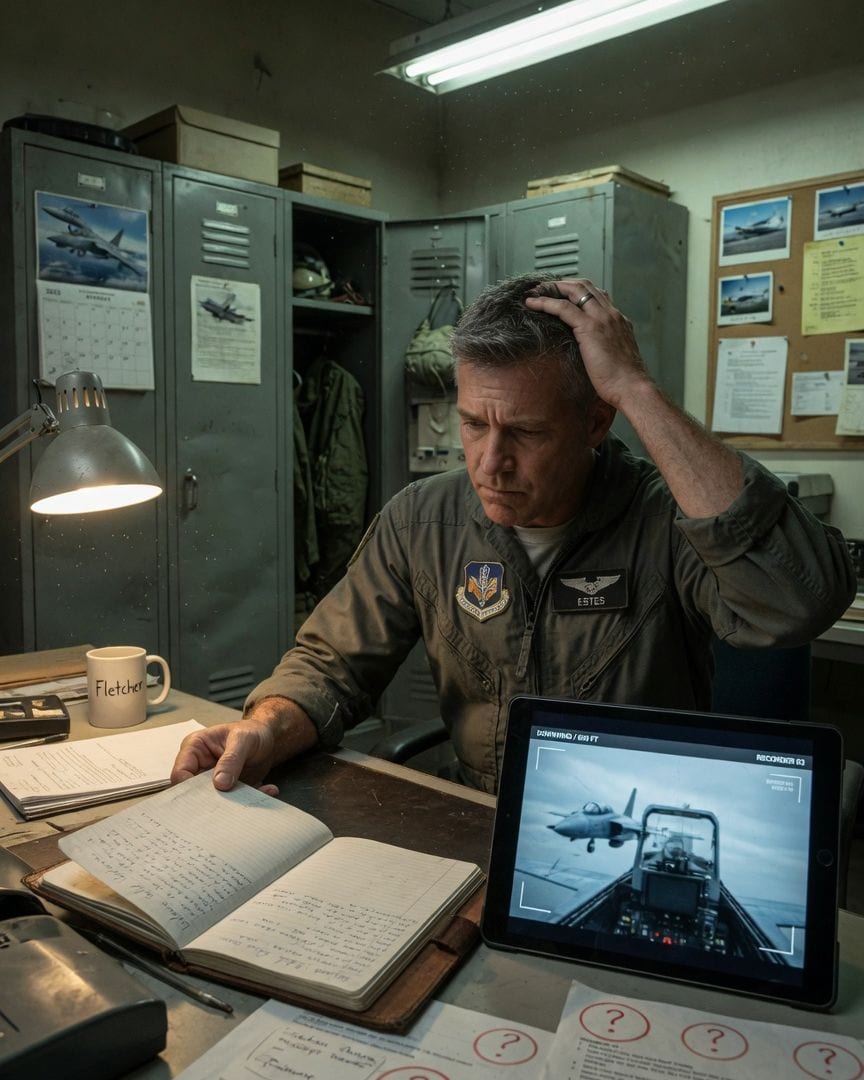
A Chief Warrant Officer's HUD tape shows a phantom jet, impossibly close, off his wing. Forty years ago, another Cold War pilot logged the same impossible sight.
Chief Warrant Officer Nathaniel Estes, a pilot whose career hinged on absolute precision, was under evaluation for a critical promotion. His nightly review of HUD tapes from routine Mojave test flights was a meticulous habit, but for a week, it revealed an impossible detail. At precisely 800 feet, one frame showed a sleek, experimental jet tucked impossibly close off his left wing—a craft ground radar never detected. When his maintenance chief found no equipment fault, Estes unearthed a dusty, decades-old logbook detailing identical phantom sightings from 1978. What unseen presence shadowed the desert skies?
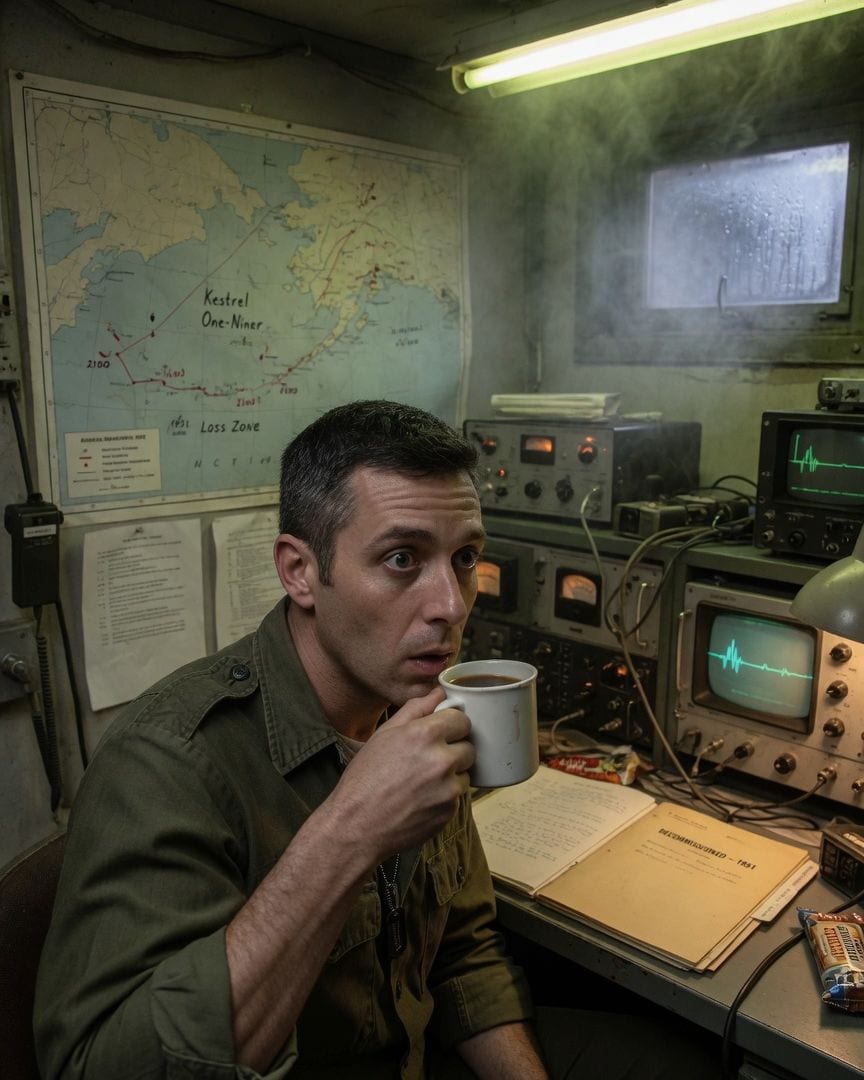
A communications lieutenant hears a Cold War reconnaissance plane, lost in 1951, transmitting clear reports seventy years later.
Lieutenant Aaron Suvak's shift in the isolated Aleutian communications bunker was usually quiet, a lonely vigil against the thick, silent fog that had closed the strip. But precisely at 2000 hours, the low hum of his radio equipment broke with a clear, professional voice. The signal came from "Kestrel One-Niner," a Cold War reconnaissance plane officially lost over the Bering Sea in 1951. Suvak plotted its impossible progress across his old paper chart, realizing the signal wasn't a glitch, but the same plane, still transmitting its route seventy years later.
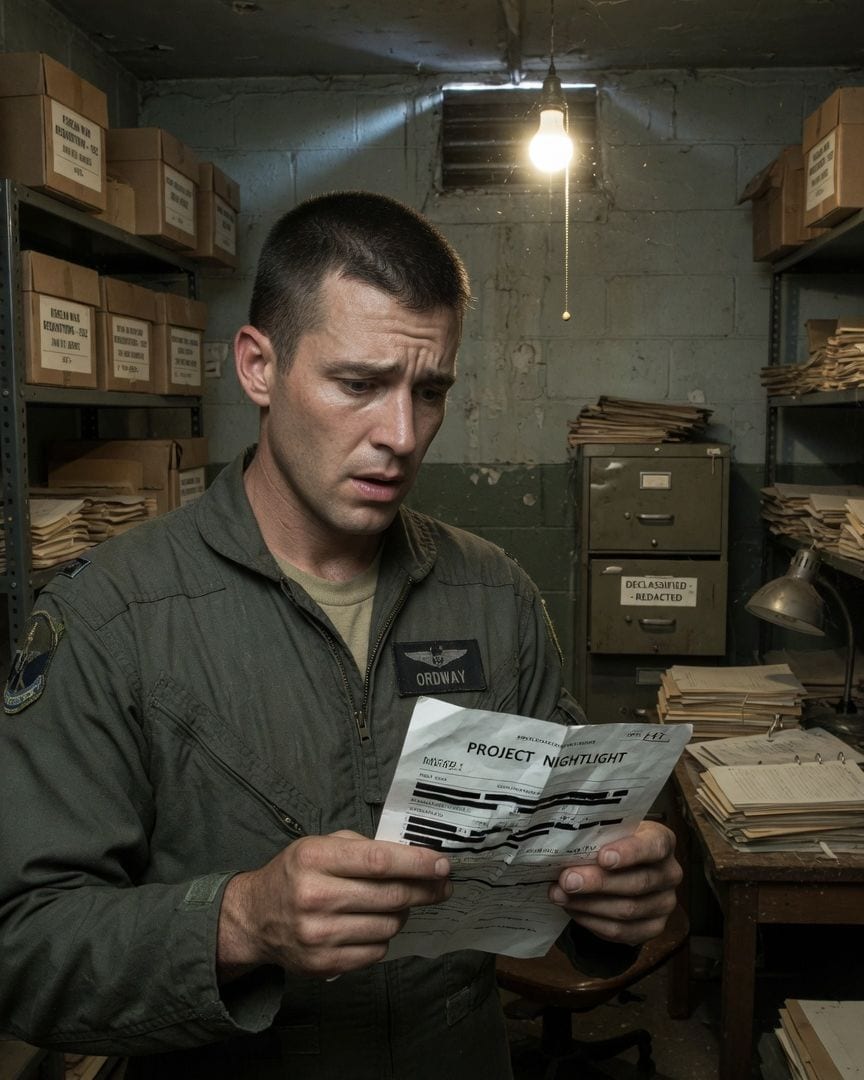
A Cold War pilot's F-104 Starfighter was shadowed by an impossible object. Weeks later, a secret memo referenced his own service number for 'pilot reassignment protocols.'
First Lieutenant Cal Ordway soared over the Mojave in his F-104 Starfighter in 1962, the night sky a familiar canvas. But that night, one 'star' broke formation, pulling alongside his wing and mirroring his every impossible maneuver. His instruments confirmed the silent, unblinking object, defying all known physics. After filing his precise report, Cal found his flight log altered to 'no incidents,' radar tapes corrupted, and a superior advising him to 'let it go.' Driven by his training, he uncovered a heavily redacted memo referencing 'Project NIGHTLIGHT' and, chillingly, his own service number for 'pilot reassignment protocols initiated.' Was he merely a witness, or already a subject in a much deeper secret?
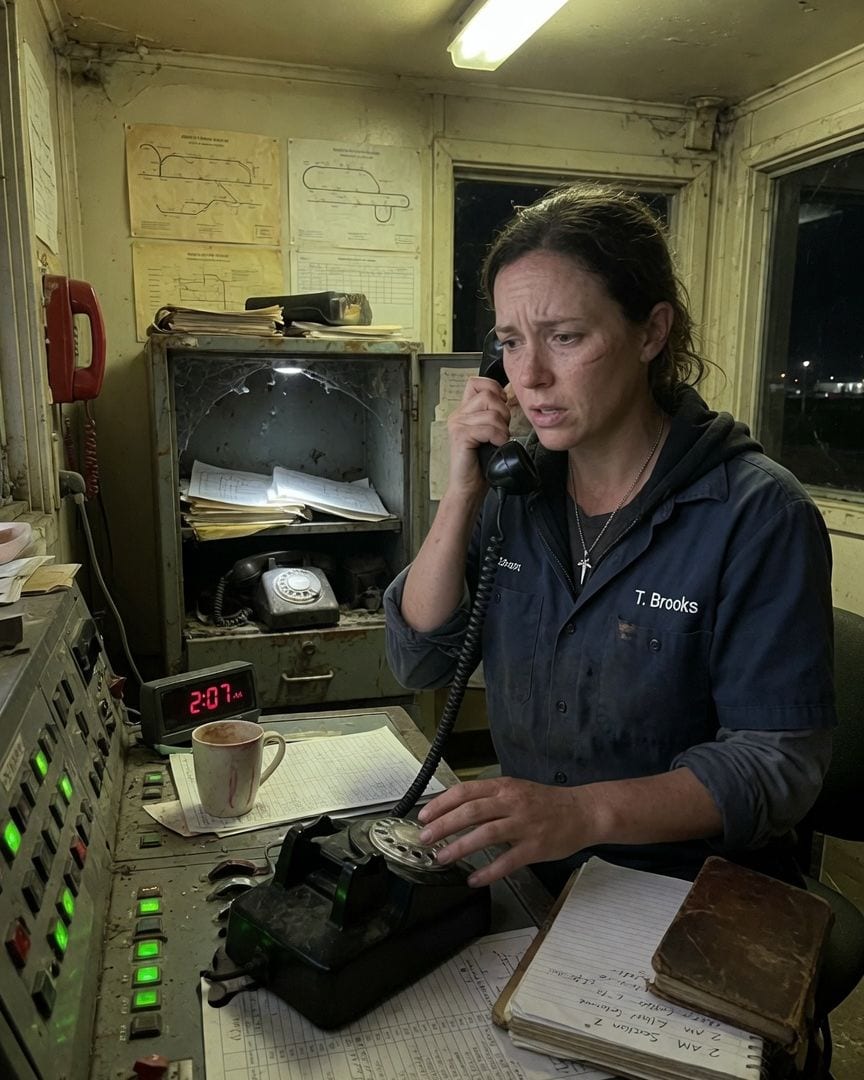
My signal box gets a 2 AM call every night from a man whose section was demolished eleven years ago. Now I found his logbook with today's date.
My night shift at the signal box is quiet and precise, defined by the routine 2 AM call from Ellis confirming Section 7 is clear. But when I asked my duty manager to log it, he said Section 7 hasn't had a track walker in eleven years, not since its cabin and phone were demolished.
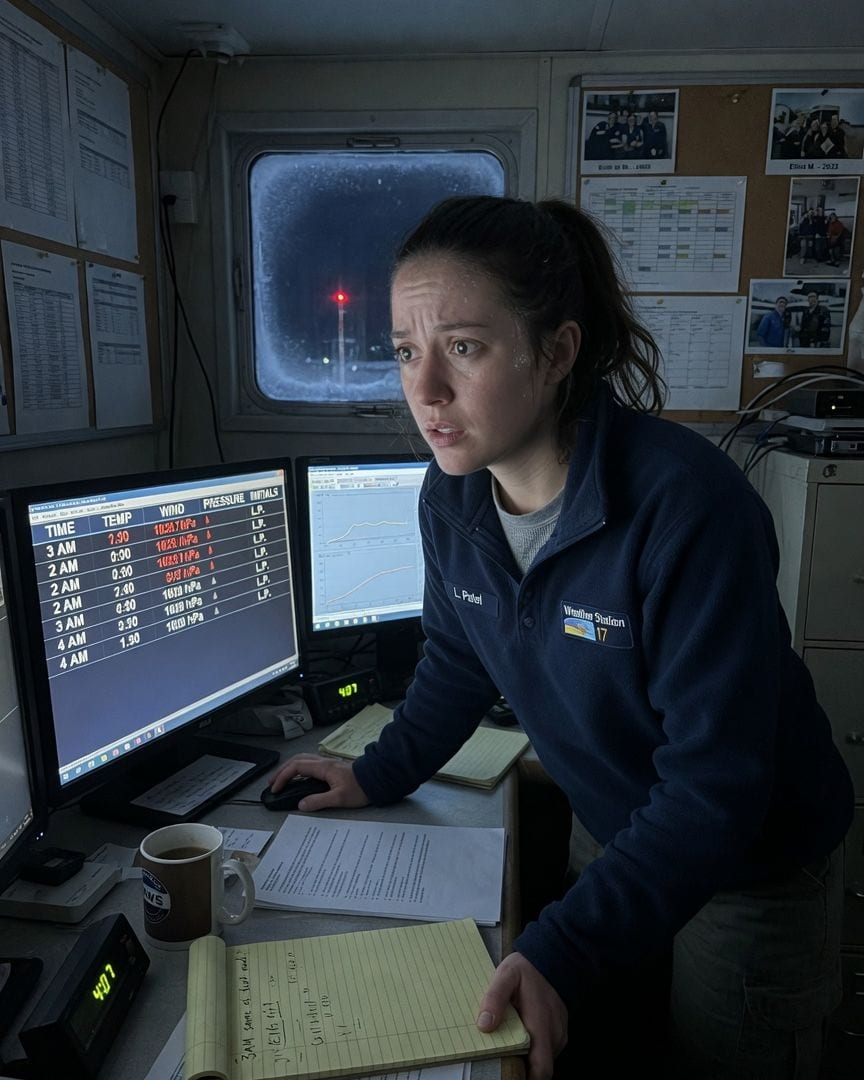
My weather station's 3 AM log shows a pressure reading I never made. My initials are on it, but the dials were dead still.
Working the overnight shift at the remote weather station, I routinely checked the digital logs. The 3 AM entry showed an impossible barometric pressure spike, a hurricane that simply hadn't happened. I distinctly remembered being outside at that time, calibrating a sensor, not making that entry. Yet, my initials, L.P., were clearly logged next to data I never made.